Retaining Wall Calculator
- Last formula update:
Decimal & Rounding Policy
- Keep full numerical precision during intermediate calculations and round only the final displayed results.
- Always round retaining wall rows and columns up to the next whole number when the division is not exact.
- Display wall block and cap block quantities as whole numbers; material counts must never be rounded down.
- Show gravel volume, weight, and cost results with practical decimal precision while removing unnecessary trailing zeros.
- Convert all measurements to compatible units before calculation to prevent mixed-unit rounding errors.
Valid range
- Cap Row: Select either Yes or No; this setting determines whether a separate cap block row is included.
- Wall Height: Enter a finite value greater than 0 in any supported length unit.
- Wall Length: Enter a finite value greater than 0 in any supported length unit.
- Block Height: Enter a finite value greater than 0 and smaller than or equal to the intended wall height.
- Block Length: Enter a finite value greater than 0 and appropriate for the retaining wall length.
- Number of Wall Blocks: Use a positive whole number; calculated requirements are always rounded up to complete blocks.
- Number of Cap Blocks: When a cap row is enabled, use a positive whole number based on the wall columns.
- Backfill Thickness: Use at least 12 in (30 cm) to provide the recommended gravel backfill depth.
- Backfill Length: Enter a finite value greater than 0; it normally corresponds to the retaining wall length.
- Backfill Height: Enter a finite value greater than 0; it normally corresponds to the retaining wall height.
- Backfill Volume: The calculated gravel volume must be greater than 0 and is based on thickness, length, and height.
- Backfill Weight: The calculated gravel weight must be greater than 0 and is derived from backfill volume and gravel density.
- Wall Block Price: Enter a price of 0 or greater per wall block.
- Cap Block Price: When a cap row is enabled, enter a price of 0 or greater per cap block.
- Gravel Price: Enter a price of 0 or greater per supported unit of gravel weight.
- Total Wall Block Cost: The calculated value must be 0 or greater and equals wall block quantity multiplied by unit price.
- Total Cap Block Cost: The calculated value must be 0 or greater when a cap row is included.
- Total Gravel Cost: The calculated value must be 0 or greater and equals gravel weight multiplied by its unit price.
- Total Expenses: The final calculated project cost must be 0 or greater and equals the sum of all applicable material costs.

Reviewers:
Elvarine Jexmont
Fenrick Zorquell
Check our editorial policy
August 16, 2026
1.0.0
Initial calculator and formula release.
Our engineers are here to help you get it right.
How Does the Retaining Wall Calculator Help You Plan Materials and Costs?
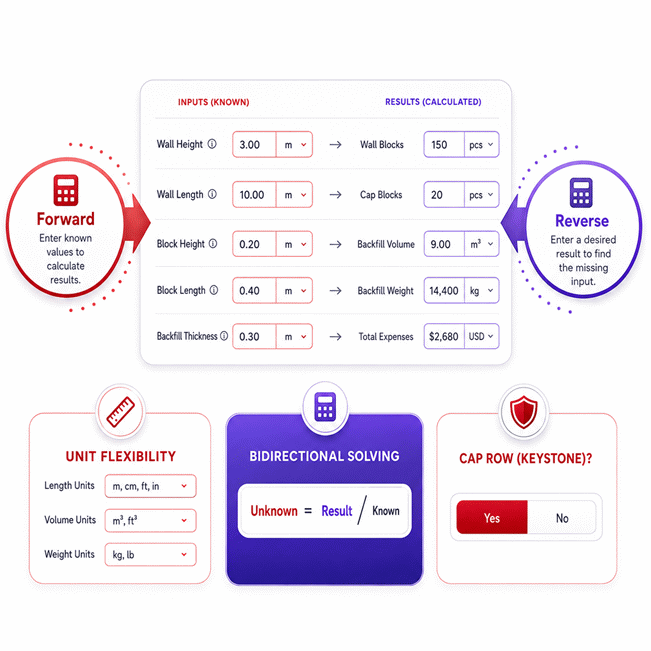
Retaining Wall Calculator helps you estimate wall blocks, cap blocks, backfill gravel, material weight, and project costs from practical wall dimensions. Enter the wall height and length, block dimensions, backfill measurements, and optional material prices to build a clear material estimate. The Retaining Wall Calculator also supports reverse solving, so a known result can help determine one missing value when the remaining required values are known.
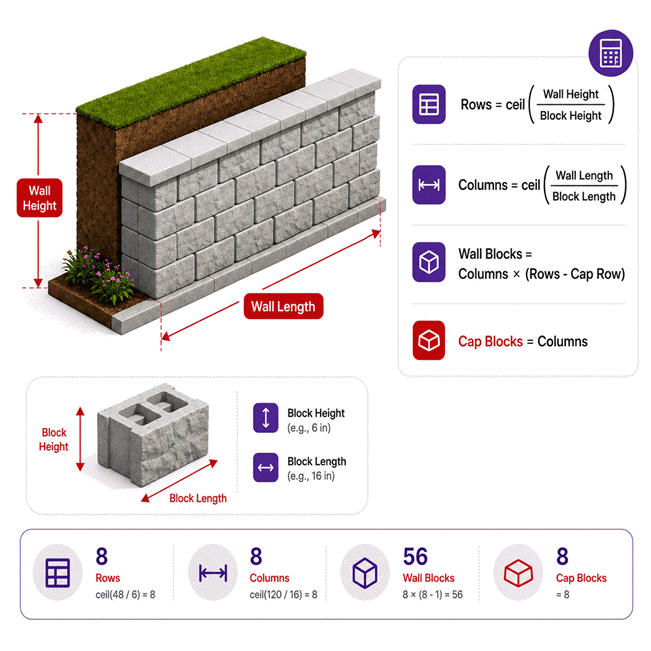
- Wall rows depend on wall height and installed block height.
- Wall columns depend on wall length and installed block length.
- Fractional rows and columns are rounded upward to complete units.
- A selected cap row changes regular wall-block and cap-block quantities.
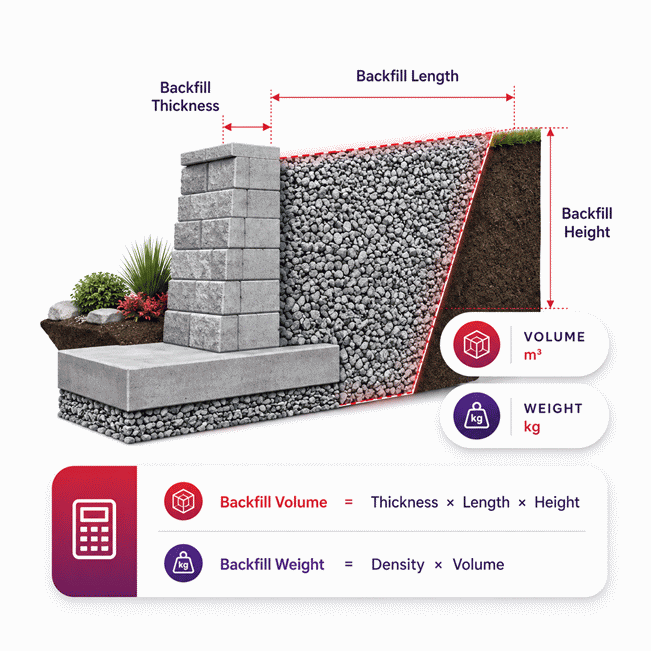
- Backfill volume depends on thickness, length, and height.
- Backfill weight is calculated from gravel volume and gravel density.
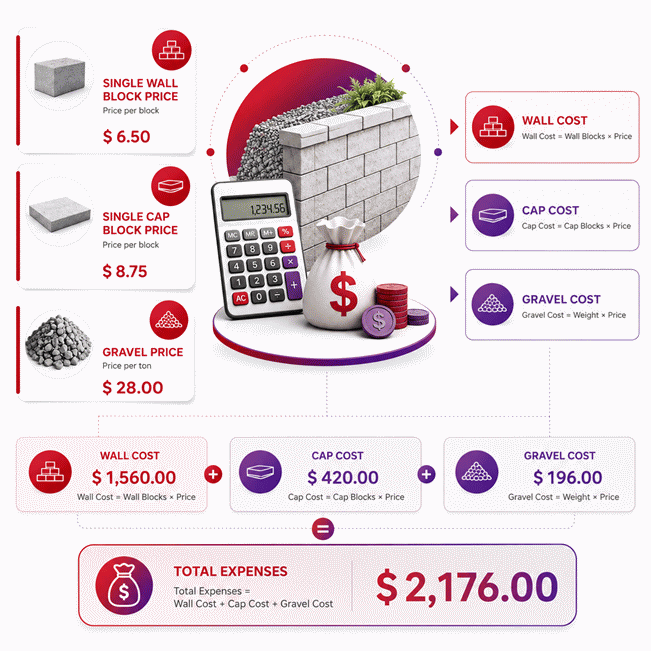
- Material costs combine required quantity with the corresponding unit price.
- Total expenses combine applicable wall-block, cap-block, and gravel costs.
- Compatible metric and imperial units can be used without manual conversion.
- Curves, steps, buried courses, waste, packaging, and supplier rules can affect purchasing quantities.
For the best purchasing plan, verify installed product dimensions, project layout, supplier packaging, gravel properties, delivery terms, and any special block types before ordering materials.
Assumptions used in this calculator
- Wall and block dimensions are assumed to represent usable installed dimensions.
- Wall rows and columns are rounded upward to avoid material shortages.
- Cap blocks are included only when the cap-row option is enabled.
- Backfill is assumed to form a rectangular volume behind the wall.
- Backfill dimensions are assumed uniform across the calculated retaining wall area.
- Gravel density is treated as constant for the selected calculation method.
- Material prices are assumed to exclude taxes, delivery, labor, and equipment.
- Currency selections do not perform live exchange-rate conversions.
- Entered dimensions are assumed accurate and measured using compatible units.
- Site drainage, soil pressure, surcharge loads, and reinforcement require professional verification.
- Local building codes and manufacturer specifications remain controlling project requirements.
- Waste, breakage, cutting losses, and construction tolerances are not automatically included.
- Final quantities should be verified before procurement or construction begins.
Results are rounded for display.
Internal calculations use full precision.
Formulas Used in Retaining Wall Calculator :
1. Unit Normalization
Compatible dimensions are converted to a common base unit before any calculation. Intermediate values remain unrounded.
2. Number of Wall Rows
Any fractional row is rounded upward so the required wall height is fully covered.
3. Number of Wall Columns
Any fractional column is rounded upward so the required wall length is fully covered.
4. Number of Wall Blocks
The cap indicator equals 1 when a cap row is included and 0 when no cap row is included.
5. Number of Cap Blocks
One cap block is required for each wall column when the cap-row option is enabled.
6. Backfill Gravel Volume
7. Backfill Gravel Weight
The gravel density used by the calculation is 1346 kg/m³, equivalent to approximately 84.03 lb/ft³.
8. Material Cost
This relation is applied independently to wall blocks, cap blocks when applicable, and backfill gravel.
9. Gravel Price Unit Normalization
The gravel price and gravel weight must use compatible mass units before their cost is calculated.
10. Total Retaining Wall Cost
When no cap row is used, the cap cost is zero and does not affect total expenses.
11. Reverse Calculation for Multiplicative Relations
This rule is used only when exactly one variable in an invertible multiplication relation is unknown.
12. Reverse Calculation for Backfill Dimensions
Reverse solving is valid when the backfill volume and the other two dimensions are known and positive.
13. Reverse Calculation for a Missing Cost Component
This relation applies only when exactly one applicable cost component is unknown.
- Qb
- Quantity expressed in the calculator base unit.
- Qu
- Quantity entered or displayed in the selected unit.
- ku
- Conversion factor from the selected unit to its base unit.
- hwall
- Retaining wall height.
- hblock
- Height of one wall block.
- lwall
- Retaining wall length.
- lblock
- Length of one wall block.
- nrows
- Required number of wall rows after upward rounding.
- ncolumns
- Required number of wall columns after upward rounding.
- Icap
- Cap-row indicator: 1 for Yes and 0 for No.
- Nwall
- Required number of regular wall blocks.
- Ncap
- Required number of cap blocks.
- tBF
- Backfill area thickness.
- lBF
- Backfill area length.
- hBF
- Backfill area height.
- VBF
- Required backfill gravel volume.
- WBF
- Required backfill gravel weight.
- ρgravel
- Gravel density used for volume-to-weight conversion.
- Ci
- Cost of an individual material category.
- Qi
- Required quantity of an individual material category.
- Pi
- Unit price of an individual material category.
- Pb
- Gravel price normalized to the calculator base mass unit.
- Pu
- Gravel price entered per selected mass unit.
- kmass
- Mass conversion factor from the selected mass unit to kilograms.
- Cwall
- Total cost of regular wall blocks.
- Ccap
- Total cost of cap blocks, or zero when no cap row is used.
- Cgravel
- Total cost of backfill gravel.
- Ctotal
- Total applicable retaining wall material cost.
- dunknown
- The single unknown backfill dimension in reverse solving.
- d1, d2
- The two known backfill dimensions in reverse solving.
- Cunknown
- The single missing cost component in reverse solving.
- Cj
- Each known applicable component cost included in the total.
- m
- Number of known cost components included in the reverse calculation.
Variables & Definitions
View a complete list of all variables used in this calculator, including definitions and units
Retaining Wall Calculator Variables and Symbols
| Variable | Meaning | Quantity Type | Base Unit | Calculation Role |
|---|---|---|---|---|
| Qb | Quantity expressed in the calculator base unit | Generic quantity | Depends on quantity | Normalized value used internally for calculations |
| Qu | Quantity entered or displayed in the selected unit | Generic quantity | Selected unit | User-facing value before or after unit conversion |
| ku | Conversion factor from the selected unit to its base unit | Conversion factor | Dimensionless | Converts supported measurements to common base units |
| hwall | Retaining wall height | Length | m | Used to determine the required number of wall rows |
| hblock | Height of one wall block | Length | m | Used with wall height to calculate wall rows |
| lwall | Retaining wall length | Length | m | Used to determine the required number of wall columns |
| lblock | Length of one wall block | Length | m | Used with wall length to calculate wall columns |
| nrows | Required number of wall rows after upward rounding | Count | rows | Determines the vertical block requirement |
| ncolumns | Required number of wall columns after upward rounding | Count | columns | Determines the horizontal block requirement |
| Icap | Cap-row indicator, equal to 1 for Yes and 0 for No | Binary indicator | Dimensionless | Controls whether a wall row is allocated to cap blocks |
| Nwall | Required number of regular wall blocks | Count | blocks | Calculated material quantity for regular wall blocks |
| Ncap | Required number of cap blocks | Count | blocks | Calculated cap quantity when a cap row is enabled |
| tBF | Backfill area thickness | Length | m | Used to calculate backfill gravel volume |
| lBF | Backfill area length | Length | m | Used to calculate backfill gravel volume |
| hBF | Backfill area height | Length | m | Used to calculate backfill gravel volume |
| VBF | Required backfill gravel volume | Volume | m³ | Calculated from backfill thickness, length, and height |
| WBF | Required backfill gravel weight | Mass | kg | Calculated from gravel volume and gravel density |
| ρgravel | Gravel density used for volume-to-weight conversion | Density | kg/m³ | Converts backfill volume into gravel weight |
| Ci | Cost of an individual material category | Cost | Selected currency | Calculated from material quantity and unit price |
| Qi | Required quantity of an individual material category | Material quantity | Depends on material | Quantity used in the generic material cost equation |
| Pi | Unit price of an individual material category | Unit price | Currency per unit | Multiplied by material quantity to determine material cost |
| Pb | Gravel price normalized to the calculator base mass unit | Price per mass | Currency/kg | Normalized gravel price used for cost calculations |
| Pu | Gravel price entered per selected mass unit | Price per mass | Currency per selected mass unit | User-entered gravel price before normalization |
| kmass | Mass conversion factor from the selected mass unit to kilograms | Conversion factor | kg per selected mass unit | Normalizes gravel prices expressed in different mass units |
| Cwall | Total cost of regular wall blocks | Cost | Selected currency | Wall block quantity multiplied by the single block price |
| Ccap | Total cost of cap blocks | Cost | Selected currency | Cap quantity multiplied by cap unit price when applicable |
| Cgravel | Total cost of backfill gravel | Cost | Selected currency | Gravel weight multiplied by the normalized gravel price |
| Ctotal | Total applicable retaining wall material cost | Cost | Selected currency | Sum of all applicable material cost components |
| dunknown | Single unknown backfill dimension in reverse solving | Length | m | Solved from backfill volume and the other two known dimensions |
| d1, d2 | Two known backfill dimensions in reverse solving | Length | m | Used to solve the remaining unknown backfill dimension |
| Cunknown | Single missing cost component in reverse solving | Cost | Selected currency | Derived from total expenses minus known applicable costs |
| Cj | Each known applicable component cost in reverse solving | Cost | Selected currency | Included in the sum subtracted from total expenses |
| m | Number of known cost components in the reverse calculation | Count | Dimensionless | Defines how many known cost terms are included in the summation |
Unit Conversion Table
Length Unit Conversion Table
| Unit Group | Unit Name | Symbol | Equivalent in Meters | Used For |
|---|---|---|---|---|
| Popular Units | Meter | m | 1 m | Wall and backfill dimensions |
| Popular Units | Centimeter | cm | 0.01 m | Block size and backfill thickness |
| Popular Units | Foot | ft | 0.3048 m | Wall and backfill dimensions |
| Popular Units | Inch | in | 0.0254 m | Block size and backfill thickness |
| Scientific Units | Millimeter | mm | 0.001 m | Precise block and dimensional measurements |
Volume Unit Conversion Table
| Unit Group | Unit Name | Symbol | Equivalent in Cubic Meters | Used For |
|---|---|---|---|---|
| Popular Units | Cubic Meter | m³ | 1 m³ | Backfill gravel volume |
| Popular Units | Cubic Foot | ft³ | 0.028316846592 m³ | Backfill gravel volume |
| Popular Units | Cubic Yard | yd³ | 0.764554857984 m³ | Bulk gravel volume |
| Scientific Units | Liter | L | 0.001 m³ | Small backfill volumes |
| Scientific Units | Cubic Centimeter | cm³ | 0.000001 m³ | Precise small-volume conversion |
Weight Unit Conversion Table
| Unit Group | Unit Name | Symbol | Equivalent in Kilograms | Used For |
|---|---|---|---|---|
| Popular Units | Kilogram | kg | 1 kg | Backfill gravel weight |
| Popular Units | Pound | lb | 0.45359237 kg | Backfill gravel weight |
| Popular Units | Metric Tonne | t | 1000 kg | Large gravel quantities |
| Popular Units | US Short Ton | US ton | 907.18474 kg | Bulk gravel quantities |
| Scientific Units | Gram | g | 0.001 kg | Precise mass conversion |
Gravel Price per Weight Unit Conversion Table
| Unit Group | Unit Name | Symbol | Equivalent in Price per Kilogram | Used For |
|---|---|---|---|---|
| Popular Units | Price per Kilogram | currency/kg | 1 currency/kg | Gravel unit price |
| Popular Units | Price per Pound | currency/lb | 2.20462262 currency/kg | Gravel unit price |
| Popular Units | Price per Metric Tonne | currency/t | 0.001 currency/kg | Bulk gravel pricing |
| Popular Units | Price per US Short Ton | currency/US ton | 0.00110231 currency/kg | Bulk gravel pricing |
| Scientific Units | Price per Gram | currency/g | 1000 currency/kg | Mass-based price conversion |
Example Calculation
The wall dimensions are converted to compatible units before the block layout is calculated.
Because both row and column ratios contain fractions, each quantity is rounded upward before determining the required blocks.
The cap row replaces the upper regular-block row, while one cap block is assigned to each wall column.
Backfill volume remains unrounded during the weight and cost calculations, with rounding applied only to displayed results.
In this reverse-solving case, the backfill thickness is intentionally left unknown while volume, length, and height are known.
The volume relationship is rearranged so the calculator isolates the single missing dimension without changing the physical quantity represented by the known values.
The solved thickness is then used consistently with the known volume, while gravel weight is calculated from the same unrounded volume.
Cost is calculated after the reverse solution, and rounding is applied only to the displayed final values.
Results are rounded for display.
Internal calculations use full precision.
Calculations Disclaimer
How Many Retaining Wall Blocks Do You Need Before Ordering?
A material order can fail before the first block reaches the site. The Retaining Wall Calculator helps prevent that problem. The Retaining Wall Calculator turns wall dimensions into a practical material plan. It keeps the process simple. You enter the wall size and block size. The tool then shows the material quantity needed for the layout.
The first decision is not price. It is geometry. A wall can look simple on paper. Yet a small change in height changes every course. A small change in block length changes every row. That is why good planning starts with the installed block dimensions. Do not rely on a catalog label alone. Use the size that represents the block face in the finished wall.
Wall length controls the horizontal run. Wall height controls the vertical stack. Block length controls how many units fit across the wall. Block height controls how many courses are needed. These four values form the core material takeoff. Once they are correct, the estimate becomes much more stable.
One detail often surprises buyers. A wall may need more blocks than a simple area estimate suggests. Blocks are purchased as complete units. Corners, ends, cuts, and height changes can add demand. Curved walls can also create more offcuts. Stepped walls create another challenge. Each section may have a different height. Treating the whole wall as one average section can hide those changes.
For straight walls, measure each run from end to end. For stepped walls, split the project into sections. Use a separate height for each section. Then combine the section totals. This approach keeps the estimate easier to audit. It also makes supplier discussions much faster.
The fastest mistake is entering nominal dimensions instead of installed dimensions. That error can change the final count. Another common mistake is ignoring the buried first course. If the design places a full course below grade, include it. The calculator should reflect the wall you will build, not only what remains visible.
A good estimate gives you a buying target. It is not the same as a pallet order. Suppliers may sell blocks by pallet, layer, bundle, or piece. Check the pack size after calculating the required quantity. Then round the purchase quantity to the supplier’s packaging rules. This small step can prevent a second delivery charge.
How Wall and Block Dimensions Change the Material Takeoff
A wall can miss its target even when the total square area looks correct. This happens because modular blocks follow rows and columns. The layout matters more than raw area. A taller block can reduce the number of courses. A longer block can reduce the number of units per course. The reverse is also true.
Start with clean measurements. Measure the finished wall length. Measure the planned wall height. Then confirm the block face dimensions. If the wall has several heights, divide it into zones. This keeps each zone tied to its own layout. It also helps when a site has steps, terraces, or sloped ground.
Block height deserves special attention. Many retaining wall systems have lips, setbacks, or interlocking features. Those features can affect the visible rise. The useful measurement is the installed rise per course. The same rule applies to block length. Use the effective face length that builds the wall line.
Wall length also needs a clear reference. Measure the actual wall path. A straight wall uses a straight run. A curved wall uses an arc length. A rough straight-line measurement across a curve will be too short. That difference can become several blocks on a long project.
Mixed wall sections create another risk. A project may use standard blocks in the main field. It may use corner blocks at turns. It may use special units near steps. Those special units should be separated from the main count. Do not treat every unit as interchangeable. A supplier may stock each type in different pack sizes.
Good material planning also protects labor time. A shortage can stop a crew. An oversized order can lock cash into unused material. The best estimate sits between those risks. It uses exact project dimensions first. It then adds procurement checks after the calculation.
Use the calculator as a geometry tool first. Then use your supplier data as the buying layer. This separation keeps the technical estimate clear. It also keeps the purchase decision practical. When the two layers agree, the order becomes easier to defend.
Why Cap Rows, Curves, Steps, and Buried Courses Change the Count
A wall can be measured correctly and still be ordered incorrectly. The missing detail is often the layout condition. Cap rows, curves, steps, and buried courses change how blocks are used. They can also change which block types must be purchased.
A cap row is not just a visual finish. It can replace the top row of standard wall blocks. The exact effect depends on the wall system. When a cap row is enabled, the regular block count and cap count must remain separate. This helps the buyer order the correct products.
Cap blocks may also have a different length. Never assume the cap matches the field block. Check the actual cap size before buying. A shorter cap can raise the cap quantity. A longer cap can lower it. Overhang mainly affects placement. It does not replace the need for the correct cap length.
Curves create another hidden cost. The wall path becomes longer than a straight chord. Some blocks may also need cutting. Tight curves can create more waste. This is why a curved project needs careful arc measurement. It may also need a higher waste allowance than a simple straight wall.
Stepped walls should be treated as linked sections. Each section has its own height. A single average height can hide a tall zone. It can also overstate a short zone. Section-based planning gives a cleaner material takeoff.
The buried first course matters because it still uses material. It may sit below finished grade, but it remains part of the wall. Include it when the design requires it. The same rule applies to blocks hidden by a step or grade change.
Corner units can also change the order. Some systems use dedicated corner blocks. Others allow field blocks to form corners. Check the product system before final purchasing. The calculator can guide quantity. The product layout decides the exact mix of units.
This is where buying guidance must stay separate from technical geometry. First, determine the required wall units. Next, map those units to real products. Then check pallets, colors, cap styles, corners, and availability. Finally, confirm delivery timing. A clear sequence reduces both shortage risk and unnecessary stock.
How to Plan Backfill, Gravel, and Drainage Materials Without Guesswork
A wall can have enough blocks and still fail as a material plan. Backfill is often the missing part. The space behind the wall needs its own measurement. That space is not the same as the wall face. It has thickness, length, and height. Those dimensions define the backfill zone.
Keep the backfill zone simple when measuring. Use the actual thickness behind the wall. Use the wall run that receives gravel. Use the planned backfill height. If the wall has several heights, split the backfill into sections. This approach is easier than forcing one average value across the project.
Gravel weight depends on the material itself. Two equal volumes can have different weights. Aggregate size, moisture, and void space can change bulk density. Use supplier density data when it is available. A generic density can support planning. Supplier data is better for a purchase decision.
Loose and compacted gravel also behave differently. Delivered material may settle after placement. Compaction can reduce the finished volume. This matters when a supplier sells by volume. It also matters when trucking is priced by weight. Know which quantity your supplier uses.
Do not merge every gravel layer into one number. Base gravel and drainage backfill serve different jobs. The leveling base supports the first course. Drainage gravel sits behind the wall. Some projects also use aggregate around a drain pipe. Keep these zones separate when the design treats them separately.
Drainage materials may include more than gravel. A project can use perforated pipe. It can also use filter fabric or geotextile. Those items are not created by a simple block count. Add them as separate buying items when the wall system requires them.
Backfill planning becomes more important on long walls. A small thickness change can move a large material volume. That can affect truckloads and delivery cost. Measure the backfill width before ordering. Confirm the planned wall height. Then compare the result with supplier units.
AxiCalculator is most useful here as a planning bridge. It converts project dimensions into a material quantity. You can then compare that quantity with how gravel is sold. This keeps the estimate tied to the actual project. It also makes supplier quotes easier to compare.
How to Build a Reliable Retaining Wall Cost Estimate Before Buying
A low material estimate can look attractive and still damage the budget. The problem is scope. A calculator can price blocks, caps, and gravel. A supplier quote may include much more. Delivery, pallets, accessories, and special units can change the final order.
Start by separating material categories. Keep regular wall blocks separate from cap blocks. Keep gravel separate from block products. If the wall uses corner units, keep them separate too. This makes each cost easier to check.
Next, compare the calculated quantity with the supplier’s selling unit. A supplier may sell wall blocks by pallet. Gravel may be sold by weight or volume. Cap blocks may have a different pallet count. This is where a clean estimate becomes a purchase plan.
Price also depends on product choice. Color, finish, size, and manufacturer can change unit cost. Delivery distance can change freight cost. A second delivery can be expensive. That is why shortage prevention has real value.
Warranty and support should be checked at the product level. Confirm what the supplier or manufacturer covers. Ask whether color variation is covered. Ask how damaged pallets are handled. Ask about replacement stock. Ask how long the selected product will remain available. These questions matter on phased projects.
Do not assume every quote includes tax or unloading. Some suppliers include local delivery. Others charge by distance or truck type. Some require pallet deposits. Others charge collection fees. A clear purchase check prevents surprises after checkout.
Use the calculator result as the technical baseline. Then build the commercial layer around it. Check the exact product code. Check pack size. Check current stock. Check cap availability. Check corner units. Check freight. Check support. This keeps technical planning separate from buying decisions.
The best purchase decision is not the smallest number. It is the most complete number. A reliable estimate should survive a supplier conversation. It should also survive a site measurement review. Compare like-for-like products before choosing a quote. Check finish, size, pack quantity, and delivery terms. When both checks agree, the order becomes easier to approve.
Reverse Retaining Wall Planning: Solve Missing Inputs From Known Results
A project does not always begin with complete dimensions. Sometimes the known value is the material quantity. Sometimes it is the gravel volume. Sometimes it is the project budget. Reverse planning helps when one important input is missing.
This workflow is useful during redesign. A contractor may already have blocks in stock. The question changes. The team asks what wall size the available blocks can support. A buyer may have a fixed gravel delivery. The next question becomes what backfill zone that delivery can cover.
Reverse planning also helps during value engineering. A design can be tested against a fixed material limit. This makes tradeoffs visible earlier. It can help compare block sizes. It can also help compare cap choices or backfill options.
The key is to keep only one unknown inside a clear relationship. Too many missing values create several possible answers. That is not a stable planning condition. Add another known value before trusting the result. This keeps the reverse workflow practical.
Editable results can also reveal input mistakes. A user may know the final gravel volume from a supplier quote. If that result conflicts with the entered backfill dimensions, the mismatch becomes visible. The same idea applies to costs. A known total can help test whether a unit price is realistic.
Reverse planning should not replace site measurement. It should help test scenarios. Use it to answer constrained questions. Use it to compare options. Use it to recover a missing value when the other data is reliable.
This feature gives AxiCalculator a useful role before and after procurement. Before buying, it can test material demand. After receiving a quote, it can test the quote against project geometry. During design changes, it can show how one known limit affects the remaining plan.
That creates a simple decision loop. Measure what you know. Enter what is certain. Solve the missing item. Check the result against the site. Then compare it with the supplier data. Save the final values with the project notes. This makes later quote checks much easier. The process stays readable, fast, and easy to review.
Frequently Asked Questions
What should I do if my supplier sells retaining wall blocks by coverage instead of individual pieces?
How should I calculate a wall that uses more than one block size or style?
What if the gravel backfill does not extend along the entire wall?
Can I still use the calculator when some project information is not available yet?
What should I do when the supplier’s gravel density differs from the value used in my estimate?
How should I validate a reverse-solved value before using it on a real project?
When should an engineer stop relying on a material calculator and move to structural design checks?
Our engineers are here to help you get it right.