Body Fat Calculator
- Last formula update:
Decimal & Rounding Policy
- Enter decimals with a period in the selected unit.
- Equations and reverse calculations use full stored precision.
- On-screen values show up to two decimal places; intermediate values are not rounded.
- Changing units or sharing a link preserves stored precision.
- PDF values follow the screen; Excel retains numeric precision and formats results to two decimals.
Valid range
- Sex: select female or male for the applicable equation.
- Age: 7–110 years; CUN-BAE requires 18+, and the Navy method is intended for adults.
- Height: 60–260 cm after unit conversion.
- Body weight: 5–500 kg after unit conversion.
- Neck circumference: 10–100 cm for the Navy tape method.
- Waist circumference: 30–250 cm for the Navy tape method.
- Hip circumference: 30–250 cm for female Navy tape estimates.
- Estimated body fat: 0.1–99.9%.
- Body fat mass: 0.01–500 kg.
- BMI: 10–80 kg/m².
- Lean body mass: 0.01–500 kg.
- Tape difference: waist minus neck, or female waist plus hip minus neck, must be positive.

Brinelle Lumquell
Reviewers:
Cavarine Pexmont
Yeldric Vossbourne
Check our editorial policy
September 27, 2026
1.0.0
Initial calculator and formula release.
Our engineers are here to help you get it right.
How does a body fat calculator turn measurements into useful results?
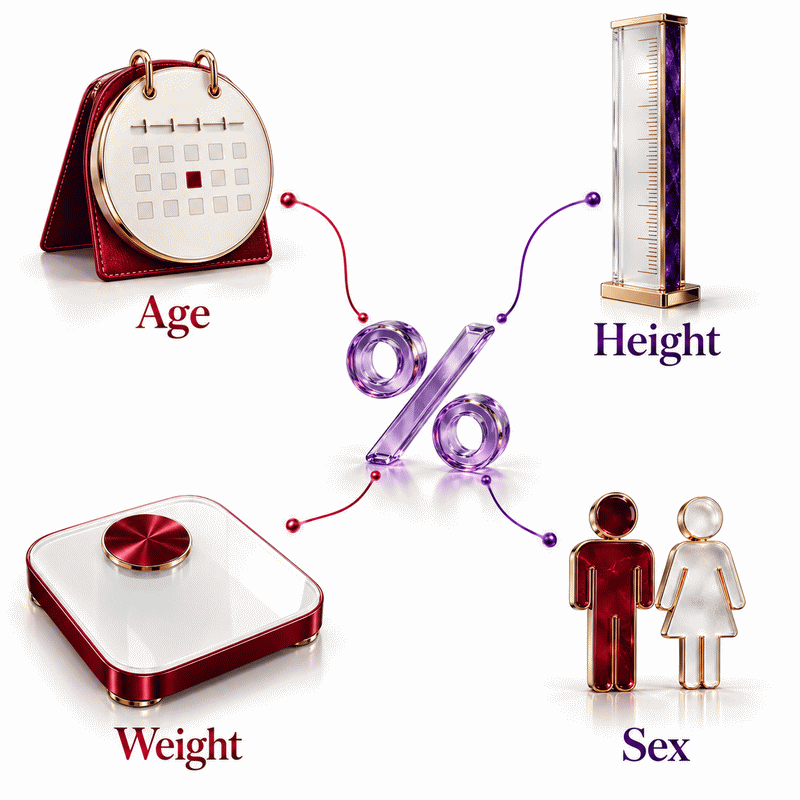
A body fat calculator estimates the percentage of your body weight assigned to fat. AxiCalculator offers three methods. CUN-BAE uses adult age, sex, height, and weight. The Navy tape method uses height, neck, and waist; its female branch also uses hip. The BMI-based method uses age, sex, height, and weight, with an equation change after age 15. Pick the method that matches the measurements you have.
- Read percentage with fat mass, lean mass, and BMI for context.
- Use the same method and tape procedure for repeat comparisons.
- Check centimeters, kilograms, and selected units before interpreting a surprising result.
- Editable result fields can solve compatible missing values backward.
- PDF and Excel exports help retain a record; shared URLs contain entered values.
This body fat calculator offers a practical estimate, not a direct tissue measurement. A low or high number cannot diagnose health status. Muscle, body shape, fluid changes, and tape technique can affect interpretation. Recheck unexpected inputs and discuss important health decisions with a qualified professional. You can use the result to start a consistent record, then compare later readings under the same conditions. Keep the method name beside every date.
Assumptions used in this calculator
- The selected sex determines which equation coefficients apply.
- CUN-BAE applies only to adults aged 18 or older.
- The Navy tape equations are intended for adults.
- The BMI child equation applies from ages 7 through 15.
- The BMI adult equation starts at age 16 in this calculator.
- Height and tape measurements are converted to centimeters before calculation.
- Weight and body masses are converted to kilograms before calculation.
- Neck, waist, and hip measurements should be taken consistently.
- Male Navy estimates require waist circumference greater than neck circumference.
- Female Navy estimates require waist plus hip greater than neck.
- Body fat percentage is an estimate of composition, not a measurement.
- Lean body mass includes water, bone, organs, and muscle.
- Reverse results assume the entered values follow the selected equation.
Results are rounded for display.
Internal calculations use full precision.
Formulas Used in Body Fat Calculator :
Body mass index
CUN-BAE body fat percentage, age 18 and older
U.S. Navy tape body fat percentage, male
U.S. Navy tape body fat percentage, female
BMI-based body fat percentage, ages 7–15
BMI-based body fat percentage, ages 16 and older
Body fat mass
Lean body mass
A = age in years; H = height in centimeters; W = body weight in kilograms; B = BMI in kg/m².
s = sex indicator, 1 for female and 0 for male; N = neck, C = waist, and G = hip circumference in centimeters.
P = body fat percentage; F = body fat mass in kilograms; L = lean body mass in kilograms. Logarithms use base 10 and centimeter input values.
Variables & Definitions
View a complete list of all variables used in this calculator, including definitions and units
Body Fat Calculator Variables and Units
| Symbol | Meaning | Unit or coding | Used for |
|---|---|---|---|
| A | Age | Years | CUN-BAE and BMI estimates |
| H | Height | cm | BMI and Navy tape equations |
| W | Body weight | kg | BMI and body masses |
| B | Body mass index | kg/m² | CUN-BAE and BMI estimates |
| s | Sex indicator | Female = 1; male = 0 | CUN-BAE and BMI equations |
| N | Neck circumference | cm | Navy tape equation |
| C | Waist circumference | cm | Navy tape equation |
| G | Hip circumference | cm | Female Navy tape equation |
| P | Estimated body fat | % | Body fat mass |
| F | Body fat mass | kg | Lean body mass |
| L | Lean body mass | kg | Final result |
Unit Conversion Table
Body Fat Calculator Unit Conversion Table
| Unit Group | Unit Name | Symbol | Equivalent in Base Unit | Used For |
|---|---|---|---|---|
| Age | Year | yr | 1 yr = 1 yr | Age input |
| Age | Month | mo | 1 mo = 1/12 yr | Age input |
| Length | Centimeter | cm | 1 cm = 1 cm | Height; neck, waist, hip |
| Length | Meter | m | 1 m = 100 cm | Height; neck, waist, hip |
| Length | Inch | in | 1 in = 2.54 cm | Height; neck, waist, hip |
| Length | Foot | ft | 1 ft = 30.48 cm | Height; neck, waist, hip |
| Length | Millimeter | mm | 1 mm = 0.1 cm | Height; neck, waist, hip |
| Mass | Kilogram | kg | 1 kg = 1 kg | Weight, fat mass, lean mass |
| Mass | Pound | lb | 1 lb = 0.45359237 kg | Weight, fat mass, lean mass |
| Mass | Stone | st | 1 st = 6.35029318 kg | Weight, fat mass, lean mass |
| Mass | Gram | g | 1 g = 0.001 kg | Weight, fat mass, lean mass |
| Fixed Result | Percent | % | 1% = 1% (fixed) | Estimated body fat |
| Fixed Result | Kilogram per square meter | kg/m² | 1 kg/m² = 1 kg/m² (fixed) | BMI |
Example Calculation
Female, age 40 years, height 165 cm, weight 68 kg; CUN-BAE selected.
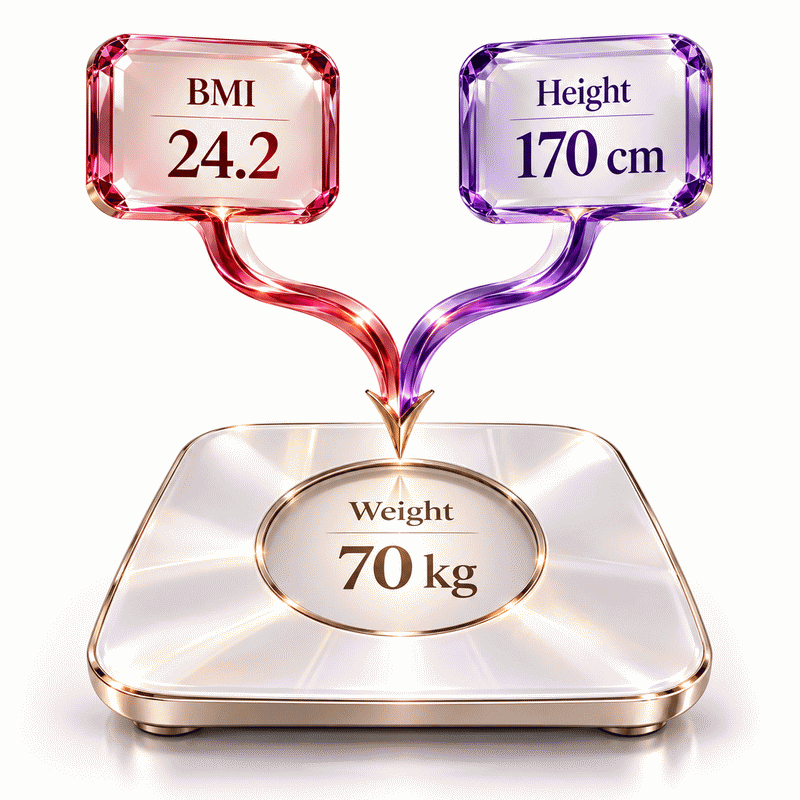
B = W / (H / 100)2 = 68 / 1.652 = 24.977043… kg/m²
P = −44.988 + 0.503A + 10.689s + 3.172B − 0.026B2 + 0.181Bs − 0.020BA − 0.005B2s + 0.00021B2A
With A = 40, s = 1, and B = 24.977043…, P = 35.4883205…%.
F = 68 × 35.4883205… / 100 = 24.1320579… kg; L = 68 − F = 43.8679421… kg.
Height and weight first produce BMI.
The selected adult equation uses BMI, age, and sex to estimate body fat.
Fat and lean mass use the unrounded percentage before display rounding.
Male, age 35 years, height 180 cm; BMI estimate selected and BMI edited to 25 kg/m².
B = W / (H / 100)2; therefore W = B × (H / 100)2 = 25 × 1.82 = 81 kg.
P = 1.20B + 0.23A − 10.8(1 − s) − 5.4 = 30 + 8.05 − 10.8 − 5.4 = 21.85%.
F = 81 × 21.85 / 100 = 17.6985 kg; L = 81 − 17.6985 = 63.3015 kg.
The edited BMI and entered height solve body weight first.
The selected age and sex equation then estimates body fat percentage.
Mass results use full precision and appear with up to two decimals.
Results are rounded for display.
Internal calculations use full precision.
Calculations Disclaimer
Which number should you check first?
Your scale shows a change, but it cannot show its cause. A body fat calculator gives that number more context. Start with the estimated body fat percentage. Then read fat mass and lean mass beside it. The percentage tells you the estimated share of weight assigned to fat. The two masses show how that share divides total weight. This body fat calculator also shows BMI, which relates weight to height. These values answer different questions. None directly measures tissue or explains a health condition. Choose the method before interpreting the result. A number loses meaning when its method and inputs disappear.
Use this body fat calculator for a clear snapshot. Repeat the same procedure when you want a trend. Keep unusual results in context, especially after a measurement change. A small difference between two estimates can come from different equations.
A fast result without a tape
You have your height and weight, but no measuring tape. Select CUN-BAE if you are an adult. Enter age, sex, height, and weight. The tool first calculates BMI. It then combines BMI with age and sex. You can also choose the BMI-based estimate. That option uses a different equation. It has a child branch through age 15. A quick calculation can guide a conversation or a personal record. It does not reveal fat distribution or replace a clinical assessment. Save the method name with any result you record.
For instance, two adults can share one BMI. Their age and selected sex can still yield different CUN-BAE estimates. That is a feature of the equation, not a broken scale.
A tape-based estimate when you can measure
You can measure your waist, but the scale still tells only part of the story. The Navy tape option adds body circumferences to the estimate. Men enter height, neck, and waist. Women also enter hip circumference. Weight remains useful for fat and lean mass. It does not enter the Navy percentage equation. This distinction explains an otherwise puzzling result. Your weight might change while the tape-based percentage stays the same. Fat mass would change because it uses both percentage and weight.
Use a flexible, nonstretch tape. Record the site and procedure alongside your readings. A consistent procedure makes later comparisons more useful than a single isolated number.
Choose a method that fits the inputs you have
The wrong method can make a tidy number misleading. Select one method according to available measurements and age. CUN-BAE needs age, height, weight, and sex. The Navy option needs tape readings and height. The BMI option uses age, height, weight, and sex. Do not average their outputs. Each equation models body composition through a different set of observations. A tape reading cannot be replaced by a guessed BMI. Likewise, a BMI method cannot see where tissue sits on the body.
Keep one method for repeat checks. If you change methods, start a separate series. That simple habit prevents a method change from looking like a body change.
CUN-BAE for adults with age, height, and weight
You know your basic measurements and want an adult estimate. CUN-BAE is available from age 18 in this tool. Let A be age in years. Let B be BMI in kg/m². Let s equal one for female and zero for male. The equation estimates P, the percentage of body weight assigned to fat.
Its squared and interaction terms matter. Dropping one changes the answer. A woman aged 40 weighs 68 kg and stands 165 cm tall. Her BMI is about 24.98. The full equation gives about 35.49%. That is a worked calculation, not an individual diagnosis. The estimate inherits limits from height, weight, and the population equation.
The Navy tape method for circumference inputs
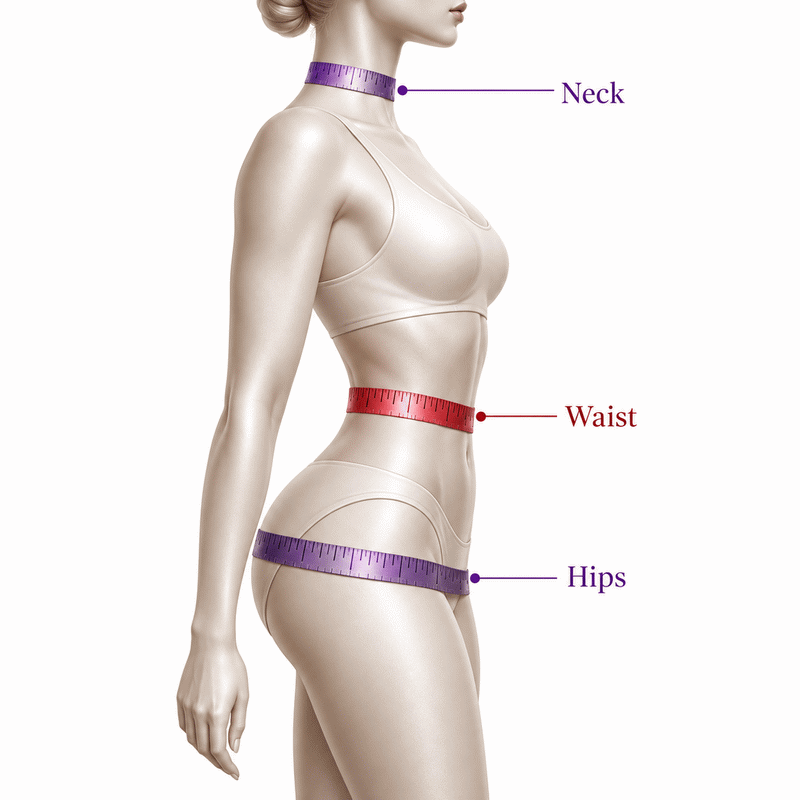
You took a tape reading and want it used directly. Convert height, neck, waist, and hip to centimeters first. The male equation uses the waist-minus-neck difference. The female equation uses waist plus hip minus neck. Both differences must be positive. Log means base ten here. The equations report P as a percentage.
Weight is absent from both percentages. The method was designed for adult use. A tape result depends on placement, tension, and body shape. Repeat readings before treating a surprising change as real.
The BMI-based option across the age boundary
A teenager needs an age-appropriate branch within this calculator. The BMI method uses one equation through age 15. It uses another from age 16. B is BMI, A is age, and s is the same sex indicator. The term 1 − s equals one for male and zero for female.
This age boundary belongs to the implemented equation choice. It does not turn a birthday into a sudden physical change. A BMI-based estimate remains an estimate. It cannot distinguish muscle from fat through height and weight alone.
Measure once, then measure the same way again
A rushed tape reading can move the result more than expected. Decide where to place each measurement before entering numbers. Keep the tape level and snug without pressing into the skin. Read it after a normal breath. Record the unit and the same body site each time. Another person’s measurement can differ from your own. That does not prove either reader is dishonest. It shows why method consistency matters.
If your result looks implausible, check the raw measurements first. A swapped neck and waist value can make a valid number impossible.
Neck placement and tape tension
Your neck number changes when the tape tilts or compresses the skin. Use the same neck site each time. Keep the tape horizontal and avoid pulling it tight. In the Navy equations, neck circumference is subtracted from another circumference total. A small change can alter that difference. The final percentage then moves through a logarithm. Recheck the tape reading when the result changes unexpectedly. Do not adjust the neck value to produce a preferred percentage.
Write down the site if several people collect measurements. That note makes a later comparison easier to understand.
Waist placement and a steady reading
A waist tape can move between the narrowest point and the abdomen. Choose the required site for your procedure and keep it consistent. A full meal, posture, or a held breath can shift the reading. Stand naturally and avoid drawing in your stomach. Take another reading if the tape twists. The waist enters both Navy branches, so an error affects the estimate directly.
One changed circumference is useful information only when measured the same way. A clear record beats a carefully rounded number from an unknown site.
Hip placement in the female tape branch
A female Navy calculation needs a hip circumference. Wrap the tape around the widest relevant part of the hips and buttocks. Keep it level across front and back. Clothing seams or a diagonal tape can increase the reading. The female equation adds hip and waist, then subtracts neck. Check all three before comparing results.
Hip is absent from the male branch in this calculator. That is a property of the selected equation. It does not imply that hip size lacks health relevance outside this tool.
Why two results can disagree
You entered the same person twice and received two percentages. Check the method names before searching for a mistake. CUN-BAE and BMI-based equations infer fat from BMI, age, and sex. The Navy method uses height and tape measurements. They cannot capture the same information. None directly weighs fat tissue. Agreement between two equations is reassuring only in a limited sense. Their errors might still overlap or point in the same direction.
A difference is a reason to review inputs. It is not a reason to blend the answers into a new percentage.
Height and weight versus tape measurements
Your height and weight stayed constant, but your waist reading changed. A BMI-based result can remain unchanged. A Navy result can move. The two methods respond to different inputs. Reverse the situation and change weight alone. BMI and its related estimates can move. The Navy percentage can stay fixed if circumferences stay fixed. Its fat mass still changes with weight.
This input map helps troubleshoot a result. Ask which number changed before asking why the output changed. You can then repeat the relevant measurement.
The same body weight can hide a different mix
Two people weigh 68 kg, yet their bodies are not identical. The scale cannot separate fat from muscle, bone, organs, and water. BMI also uses height, but it still lacks a direct tissue measurement. A tape equation adds shape information without measuring tissue directly. Body composition can change while scale weight holds steady. The estimate may or may not capture that change.
Look for a pattern across consistent readings. A single decimal is too narrow a view. Do not use a calculator output as a label for a person.
Read fat mass and lean mass together
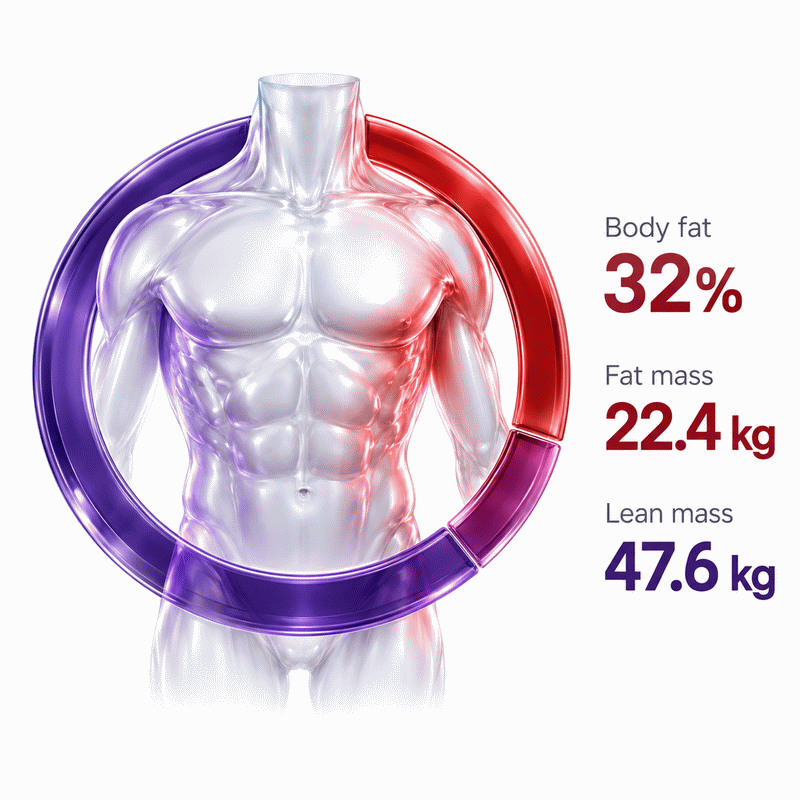
A percentage alone feels abstract when you want kilograms. The tool converts it using entered body weight. Fat mass equals weight times percentage divided by 100. Lean body mass equals weight minus estimated fat mass. These outputs add back to weight before display. They are linked, so one cannot change independently when the other values stay fixed.
Compare the masses with the method beside them. Changing the percentage equation changes both masses, even at the same weight.
Fat mass as a portion of body weight
You see 35.49% and want to know what it means at 68 kg. Multiply 68 by 0.3549 for an approximate fat mass of 24.13 kg. The calculator uses the underlying percentage for its result. It does not need your rounded display value as a new input. The output is an estimate of fat mass, not a separate scan of tissue.
At a fixed percentage, higher weight produces a higher fat mass. At fixed weight, a higher percentage does the same. This basic relationship makes the output easier to check.
What lean body mass includes
You gained lean mass on a calculation and assume every kilogram is muscle. That conclusion is too broad. Lean body mass includes muscle, but also water, bone, organs, and other nonfat material. It is the remaining mass after estimated fat mass is removed. A change in water can therefore matter when interpreting body composition.
Use this value as part of a record, not as a muscle measurement. If a result guides training or care, consider the wider context. Strength, function, measurements, and professional assessment answer other questions.
Use reverse solving without losing context
You know a result and need a missing input. Editable result fields let the calculator solve compatible relationships backward. Enter only the values you actually know. BMI and height can determine weight. Percentage and fat mass can also determine weight. Other combinations solve other missing values within the tool’s limits. The selected estimation method still matters when a percentage is part of the equation.
Reverse solving is algebra, not a forecast of what your body will become. An impossible or conflicting combination is flagged. Clear the conflicting value and check units before trying again.
From BMI and height back to weight
You know BMI but left body weight blank. BMI equals weight divided by height in meters squared. Rearranging gives weight from BMI and height. At BMI 25 and height 1.80 m, weight is 81 kg. That is 25 times 1.80 squared. For a male aged 35, the chosen equation gives 21.85% estimated body fat. That corresponds to about 17.7 kg fat mass and 63.3 kg lean mass.
The numbers form one internally consistent worked case. BMI alone cannot tell you whether that estimated composition matches a person.
From a percentage and fat mass back to weight
You have a percentage and fat mass from an earlier record. Divide fat mass by the percentage as a fraction. If fat mass is 18 kg at 25%, the implied weight is 72 kg. The calculation answers what weight would make those two numbers consistent. It does not establish whether either measurement was accurate.
Check the selected method before adding more fields. A manually entered percentage can conflict with age, BMI, or tape measurements. The calculator highlights such conflicts. Treat the message as a prompt to review inputs.
What one estimate cannot tell you
A percentage can look decisive, yet many personal questions remain open. It cannot show where fat sits internally. It cannot diagnose a condition, explain a symptom, or prescribe a target. It cannot replace an assessment that considers history, examination, and other measurements. Use it as an estimate with a named method. Avoid treating a category boundary as a verdict.
Comparison is most useful when methods stay constant. Large or unexpected changes deserve another careful measurement. Important health decisions need professional context.
Muscle, fluid changes, and individual variation
An athlete may have a high BMI for reasons a BMI equation cannot see. A person with fluid changes may also get a confusing comparison. Circumference methods can be affected by unusual body proportions. The equations summarize patterns in groups. They do not know every body.
That is why two decimals should not create a false sense of certainty. Record the method, date, and measurements. Look for a repeatable direction rather than a tiny change. A professional assessment may be more suitable when precision matters for a decision.
When a professional assessment matters
An unexpected result can cause concern, especially when other health questions exist. Recheck the inputs first. Then seek qualified advice for decisions about diagnosis, treatment, pregnancy, or a child’s growth. The calculator cannot consider medical history or examination findings. It also cannot confirm a laboratory or imaging result.
You can bring your measurement record to an appointment. Show the method and units used. That context helps another person understand how the number arose. It makes a conversation clearer without turning the estimate into medical advice.
Save, share, and revisit a result
You want to compare today’s reading with a later one. Save the method, units, and original inputs with the result. The PDF offers a readable record. The Excel export includes formulas for recalculation. A share link restores entered values for a recipient. Those values appear in the URL, so review the link before sending it. Anyone receiving the link can see its measurements.
Return to the same measurement routine next time. AxiCalculator makes the arithmetic easy to revisit. Your careful input makes the comparison useful. Use the calculator now, or contact AxiCalculator with a tool question through the site.
Frequently Asked Questions
Can I compare this estimate with a smart scale reading?
Why did my waist measurement fall while my weight stayed level?
Does a low estimated percentage always mean better health?
Can I share a result without revealing my measurements?
How should a coach document repeat measurements across a team?
How can a student check an inverse solution for consistency?
When should a practitioner question an apparent trend?
Our engineers are here to help you get it right.