Body Surface Area Calculator
- Last formula update:

Decimal & Rounding Policy
- Convert weight to kilograms and height to centimeters before calculating body surface area.
- Keep the available numerical precision through conversions and formula evaluation.
- Display BSA with up to six decimal places, without unnecessary trailing zeros.
- Use the entered BSA value directly when solving for a missing measurement.
- Display rounding does not change the underlying results or Excel formulas.
Valid range
- Weight: 0.2–500 kg after unit conversion.
- Height: 20–280 cm after unit conversion.
- Entered BSA: 0.01–5 m² after unit conversion.
- For split height, enter both parts; inches must be below 12 and centimeters below 100.
- These are calculator input limits, not normal or recommended clinical ranges.

Brinelle Lumquell
Reviewers:
Cavarine Pexmont
Yeldric Vossbourne
Check our editorial policy
September 27, 2026
1.0.0
Initial calculator and formula release.
Our engineers are here to help you get it right.
How does a BSA Calculator turn height and weight into an area?
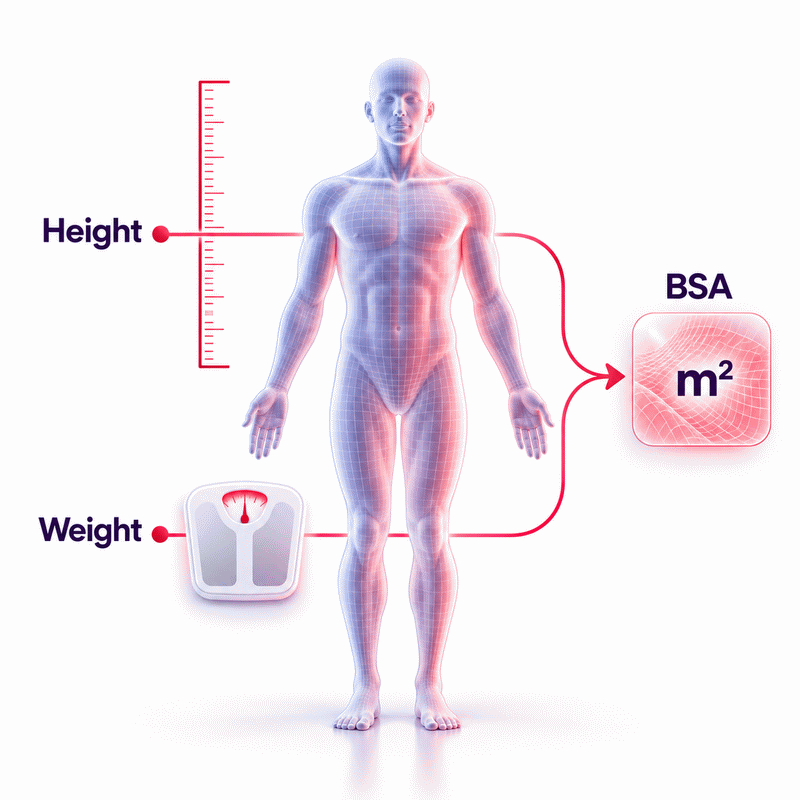
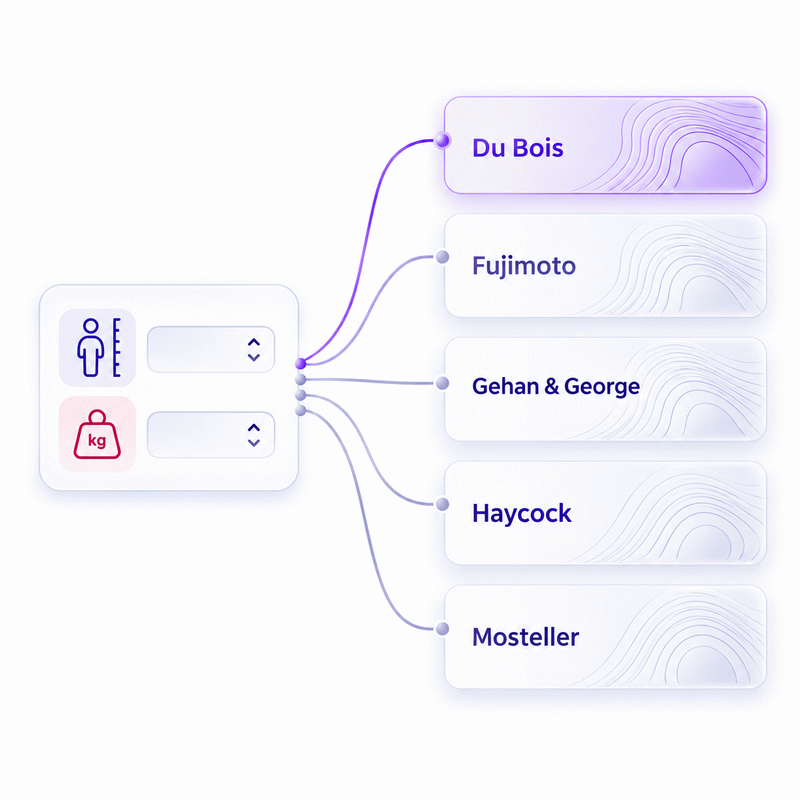
BSA Calculator results estimate external body surface area from height and weight. Enter both measurements and select their units. The main result follows the Du Bois formula and appears in square meters. Four additional results show Fujimoto, Gehan and George, Haycock, and Mosteller. Each equation uses the same measurements but fits them differently, so the outputs can vary. The BSA Calculator also lets you inspect a chosen formula when solving a missing height or weight from a known area and the other measurement.
- For Du Bois, BSA = 0.007184 × weight(kg)0.425 × height(cm)0.725.
- For Mosteller, BSA = √(height(cm) × weight(kg) / 3600).
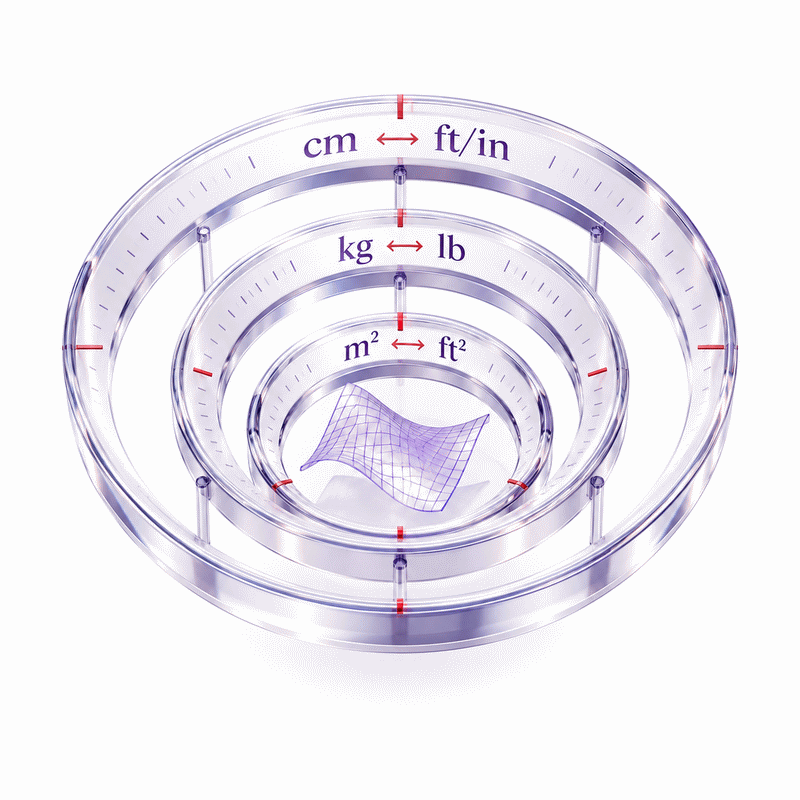
- Check units before you compare values; m² and ft² describe the same area at different scales.
- Keep the equation name with any copied result. A reverse-solved measurement is model-implied, not measured.
- Use the formula and checks named by your clinical protocol. This tool does not set a medication dose.
At 82 kg and 178 cm, the Du Bois estimate is about 2.001206 m². A different formula gives a different estimate for those same inputs. If the number surprises you, recheck height, weight, units, and equation before using it. For patient-specific decisions, have a qualified professional verify the result.
Assumptions used in this calculator
- Weight represents the person’s current measured body mass.
- Height represents standing height or a reliably measured body length.
- Weight and height describe the same person at the same time.
- Input units are converted before an equation is evaluated.
- Each equation estimates total external body surface area.
- Different equations may produce different estimates for identical measurements.
- The selected inverse equation determines the missing measurement.
- An inverse result requires one known measurement and one known BSA.
- Editing BSA while both measurements exist holds height fixed.
- Calculations retain available precision until results are displayed.
- Input limits control the calculator, not clinical eligibility.
- No result establishes an individual medication dose.
- Clinical decisions follow the applicable protocol and professional review.
Results are rounded for display.
Internal calculations use full precision.
Formulas Used in Body Surface Area :
Convert weight to kilograms (W) and height to centimeters (H). Each equation gives estimated BSA (A) in square meters. For inverse calculations, c is the named equation's coefficient, p is its weight exponent, and q is its height exponent.
Du Bois
Fujimoto
Gehan and George
Haycock
Mosteller
Find weight from a known BSA and height
Find height from a known BSA and weight
Variables & Definitions
View a complete list of all variables used in this calculator, including definitions and units
Body Surface Area Formula Variables
| Symbol | Variable | Unit | Role |
|---|---|---|---|
| W | Body weight | kg | Measured input, or a value solved from BSA and height. |
| H | Body height or length | cm | Measured input, or a value solved from BSA and weight. |
| A | Estimated body surface area | m² | Formula result, or a known value entered for inverse solving. |
| c | Equation coefficient | Depends on p and q | Coefficient from the selected named formula. |
| p | Weight exponent | Dimensionless | Exponent applied to W in the selected formula. |
| q | Height exponent | Dimensionless | Exponent applied to H in the selected formula. |
Unit Conversion Table
Weight Units and Kilogram Equivalents
| Unit Group | Unit Name | Symbol | Equivalent in kg | Used For |
|---|---|---|---|---|
| Popular Units | Kilogram | kg | 1 kg | Base weight input |
| Popular Units | Pound | lb | 0.45359237 kg | Imperial weight input |
| Popular Units | Stone | st | 6.35029318 kg | Body weight in stones |
| Scientific Units | Gram | g | 0.001 kg | Small body weights |
Height Units and Centimeter Equivalents
| Unit Group | Unit Name | Symbol | Equivalent in cm | Used For |
|---|---|---|---|---|
| Popular Units | Centimeter | cm | 1 cm | Base height input |
| Popular Units | Meter | m | 100 cm | Metric height input |
| Popular Units | Inch | in | 2.54 cm | Imperial height input |
| Popular Units | Foot | ft | 30.48 cm | Imperial height input |
| Popular Units | Feet and inches | ft / in | 30.48 cm per ft + 2.54 cm per in | Split imperial height |
| Popular Units | Meters and centimeters | m / cm | 100 cm per m + 1 cm per cm | Split metric height |
| Scientific Units | Millimeter | mm | 0.1 cm | Short measured lengths |
Body Surface Area Units and Square Meter Equivalents
| Unit Group | Unit Name | Symbol | Equivalent in m² | Used For |
|---|---|---|---|---|
| Popular Units | Square meter | m² | 1 m² | Base BSA result |
| Popular Units | Square foot | ft² | 0.09290304 m² | Imperial BSA display |
| Scientific Units | Square centimeter | cm² | 0.0001 m² | Small area display |
Example Calculation
For a person weighing 82 kg and measuring 178 cm, calculate BSA from both measured inputs.
The five estimates use the same weight and height with different published equations.
The calculator retains available precision and rounds only the displayed results.
Use the equation specified by the relevant clinical or research protocol.
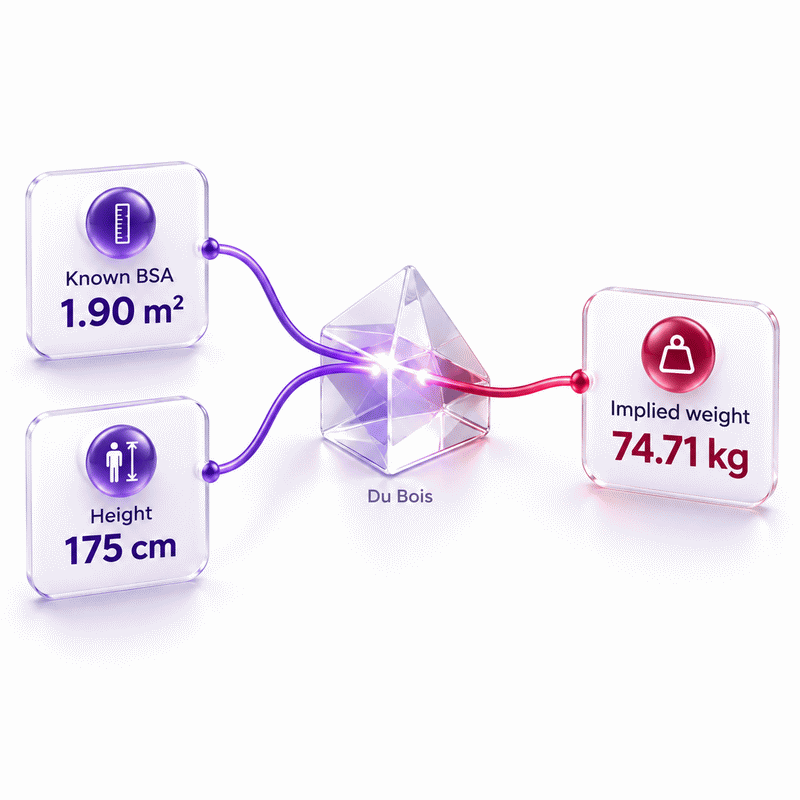
Suppose height is 175 cm and the known Du Bois BSA is 1.9 m². Weight is missing.
The entered BSA and measured height determine weight under the Du Bois equation.
The other BSA figures are recalculated from that solved weight and the known height.
If weight were known instead, the same equation would solve the missing height.
The inferred measurement depends on the selected equation and input accuracy.
Results are rounded for display.
Internal calculations use full precision.
Calculations Disclaimer
What will the BSA calculator show from height and weight?
BSA Calculator results start with two measurements: height and weight. Enter both, then read the estimated body surface area in square meters. The primary result uses the Du Bois equation. Four other results let you compare Fujimoto, Gehan and George, Haycock, and Mosteller. BSA Calculator outputs are estimates from mathematical models, not direct measurements of skin. A different formula may produce a different number for the same person. That difference matters when a worksheet or protocol names a specific method.
Start with the result you need. Then check the equation and units shown beside it. This keeps a convenient number from becoming an unexplained number. For medical decisions, use the method specified by the responsible care team and protocol.
Why does the result appear in square meters?
BSA describes an area, so its usual unit is the square meter, written m². A value near 2 m² does not mean a person is two meters tall. It is a modeled estimate of external body area. The calculator can also display square feet. Convert the area only after the height and weight inputs are understood. If you compare two results, keep both in the same area unit. Otherwise, a unit change can look like a formula disagreement.
Which values should you enter first?
Use a measured height and a current weight suited to your task. Select the units that match the measurements you have. Height can be entered in centimeters, meters, inches, feet, feet and inches, or meters and centimeters. Weight can use kilograms, pounds, or stone. The tool converts those values before applying its equations. Check the height field closely: 1.78 m and 178 cm describe the same height, but 1.78 cm does not. If one measurement is missing, a forward BSA estimate cannot be calculated.
How does the default Du Bois result work?
The primary number follows a height-and-weight equation. In the expression below, W is weight in kilograms, H is height in centimeters, and BSA is in m².
The coefficient belongs to those specific units. Entering pounds directly as W would give a wrong answer. The calculator handles the conversion when you choose pounds. Du Bois is the displayed starting method, not a universal verdict about which equation belongs in every clinical setting.
What do its exponents change?
The powers describe how the estimate changes when height or weight changes. They are part of an empirical model, not a request to multiply the inputs by 0.425 or 0.725. For a fixed height, a higher weight raises the estimated area. For a fixed weight, a taller height also raises it. These changes are not linear. Doubling weight does not simply double the Du Bois result. Keep the original measurements visible when checking an unexpected number.
How do five BSA formulas differ?
Each equation turns the same height and weight into an estimated area. They use different fitted coefficients and powers. The calculator displays all five to make that choice visible. It does not average them into a single clinical answer. Use one named equation consistently when comparing records. A small spread between methods is expected; it is not automatically an input error. A large surprise deserves a review of units, measurements, and formula selection.
Fujimoto: a different fitted curve
The Fujimoto calculation is another height-and-weight model. Its powers and coefficient differ from Du Bois. Use kilograms and centimeters in this expression:
At some input pairs, Fujimoto gives a visibly lower estimate. That is a property of the equation, not proof that either result measured the person’s actual skin. If a record specifies Fujimoto, compare its result with Fujimoto, using the same input units and precision.
Gehan and George: another comparison
Gehan and George uses a different balance of height and weight. The calculator evaluates:
For the same entries, this output can sit above or below another method. Read the formula name with the number. Copying only the area into a spreadsheet hides the modeling choice. That missing label can confuse later comparisons, especially when a different team uses a different equation.
Haycock: a formula validated across ages
Haycock was studied with infants, children, and adults. This broader validation makes its population context useful to know. It does not remove the need to follow a pediatric protocol. With W in kilograms and H in centimeters:
Measurements in small children can change quickly. Confirm that both measurements belong to the same assessment, then check the method required for the decision.
Mosteller: the square-root shortcut
Mosteller is easy to check by hand. Multiply height in centimeters by weight in kilograms. Divide by 3,600, then take the square root:
For 170 cm and 60 kg, the value is √(10,200/3,600), or about 1.6833 m². The simple steps make this equation a useful independent arithmetic check. They do not make it the required method for every patient or protocol.
Which equation should you use for a clinical task?
Start with the instruction that governs the task. A clinical protocol may specify a BSA equation, a measurement date, or a different dosing rule. Use its requirements and ask the responsible professional when they are unclear. The calculator can help you inspect the arithmetic. It cannot choose a medicine, prescribe an amount, assess organ function, or settle a disagreement in care. A plausible result remains an estimate.
For learning, comparing all five outputs is useful. For a regulated or clinical workflow, the named method and independent checks take priority over convenience.
Why might two estimates disagree?
First, confirm the same person, date, height, and weight. Next, compare the formula labels. Then compare units and rounding. Two calculators can differ because they show different methods or decimal places. They can also use different conversion precision. A more serious mismatch may come from treating 1.75 meters as 1.75 centimeters, or entering pounds in a kilogram field. Trace those causes before deciding that the formula failed.
How do you use the calculator in either direction?
The normal route starts with height and weight and returns five BSA estimates. The reverse route begins with a known BSA and one known measurement. Select the equation attached to that BSA, then solve the other measurement. This is algebra on a model. It does not recover a person’s actual weight or height from an area alone. If the chosen BSA came from another method, a reverse result can mislead.
Solve weight from height and a chosen BSA
Suppose you know height and a Du Bois BSA. Rearrange the Du Bois equation, keeping H in centimeters and BSA in m²:
The answer is an implied weight in kilograms. It depends entirely on the selected equation and the two given values. It should never replace a scale measurement when an actual weight is required.
Solve height from weight and a chosen BSA
The same reasoning can solve height when weight and a Du Bois BSA are given:
This produces an implied height in centimeters. It is a consistency check within Du Bois. It cannot identify someone’s measured height from a BSA value without the accompanying weight and equation. Confirm whether the original BSA was rounded before treating the reverse result as precise.
What do unit changes do to the estimate?
Correct unit conversion changes the displayed numbers, not the person’s size. A weight entered as 82 kg represents about 180.8 lb. The equation still receives the kilogram equivalent. Likewise, 178 cm and about 5 ft 10.08 in describe the same height. Changing an output from m² to ft² changes its numerical scale. It does not change the underlying area. Always keep the unit beside a copied result.
Check height in feet and inches
Feet and inches are easy to misread when written as a decimal. Five feet ten inches is not 5.10 feet. Enter 5 in the feet field and 10 in the inches field. The combined height is 70 inches, or 177.8 cm. If a record supplies a decimal number of feet instead, convert it as a decimal length. A few tenths of an inch can affect the last displayed digits, so preserve the original measurement.
Read surface area in square feet
One square meter equals approximately 10.7639 square feet. Thus, a BSA of 2.0000 m² is about 21.5278 ft². This is an area conversion, not a height conversion. A number near 20 ft² may be entirely consistent with one near 2 m². When entering a known BSA for reverse solving, select its actual area unit first. A factor-of-ten difference here can create a very implausible implied measurement.
Where does BSA help, and where does it stop?
BSA can index a quantity to an estimate of body size. That makes it useful in some clinical formulas and research comparisons. Its role depends on the specific measurement and protocol. It does not directly measure body composition, skin condition, disease severity, or treatment suitability. A larger BSA is not a diagnosis. Use the result to answer the defined calculation question, then apply the separate judgment that question requires.
BSA-indexed quantities need their own protocol
A rate stated per m² needs a BSA value, but that is only one part of the calculation. The protocol may specify a formula, caps, adjustments, timing, and checks. Those rules cannot be inferred from a generic BSA output. Keep the original quantity and units in view. Ask a qualified clinician to verify any patient-specific interpretation, especially for medication dosing or a safety-critical decision.
Children and unusual body shapes need care
Equations are models fitted to studied groups. They can disagree more when body proportions differ from those groups. Infants, rapidly growing children, edema, amputations, and substantial changes in weight deserve careful interpretation. A formula comparison shows mathematical spread; it does not identify which result best represents an individual. Record the chosen method and the clinical reason for it. Use a measured height and weight whenever the task calls for measured inputs.
What input errors change the result most?
The biggest avoidable mistakes often begin before the equation. Check for a missing height, a stale weight, a swapped unit, or a decimal in the wrong place. Confirm that kilograms and centimeters are the equation units even if the interface accepts others. Keep the chosen method beside the copied output. If a result looks surprising, calculate Mosteller by hand as an arithmetic cross-check, then inspect the formula selection. Do not interpret a neat-looking number as proof that the inputs were correct.
Check two complete calculations
Consider a training worksheet with 82 kg and 178 cm. Du Bois gives 0.007184 × 820.425 × 1780.725 ≈ 2.001206 m². The other estimates are Fujimoto 1.951288, Gehan and George 2.025594, Haycock 2.024398, and Mosteller 2.013565 m². All five use the same measurements. Their spread follows from their different equations.
Now take a second worksheet: a Du Bois BSA of 1.9 m² and height of 175 cm. Rearranging Du Bois gives W = (1.9/(0.007184 × 1750.725))1/0.425 ≈ 74.709486 kg. Rechecking that implied weight yields 1.900000 m² under Du Bois. The other equations yield Fujimoto 1.851283, Gehan and George 1.917017, Haycock 1.912591, and Mosteller 1.905705 m². These are model checks, not records of actual patients.
How can you keep a useful record?
Save the measured height, weight, units, date, equation name, and displayed BSA together. If you solved a value in reverse, label it as implied rather than measured. Keep enough decimal places to reproduce the computation, but avoid claiming more measurement accuracy than the inputs support. The calculator’s copy, share, and export controls can help preserve a worksheet. Review the saved numbers before sending them onward. For any care decision, the responsible professional should verify the inputs, specified method, and interpretation.
Ready to inspect your own numbers? Enter height and weight in the AxiCalculator BSA Calculator, review the five estimates, and keep the formula name with your result.
Frequently Asked Questions
Can I use my BSA result as a personal health score?
Why does my BSA seem unchanged after a small weight change?
Can I use a BSA result from last year?
What should I send someone who asks for my BSA?
How do I check a spreadsheet BSA formula against the calculator?
Why does solving backwards amplify a rounded BSA?
Can I substitute a different BSA equation in an indexed research dataset?
Our engineers are here to help you get it right.