Oil to Butter Calculator
- Last formula update:
Decimal & Rounding Policy
- Calculations use full internal precision without rounding intermediate values.
- Displayed results are rounded to a maximum of six decimal places.
- Trailing zeros are removed to keep cooking measurements easy to read.
- Values near common cooking fractions may be interpreted using the displayed decimal.
- Minor differences may occur because ingredient density and measuring tools vary.
Valid range
- Enter a finite value greater than zero and no greater than 1,000,000,000.
- Only supported mass and volume units may be used for each ingredient.
- Liquid oil, butter, and coconut oil quantities must represent positive cooking amounts.
- Empty, nonnumeric, negative, zero, infinite, and unsupported values are invalid.

Nolissa Vantford
Reviewers:
Solavyn Marbourne
Orvick Bexquell
Check our editorial policy
September 8, 2026
1.0.0
Initial calculator and formula release.
Our engineers are here to help you get it right.
How Does Oil to Butter Conversion Work in Real Recipes?
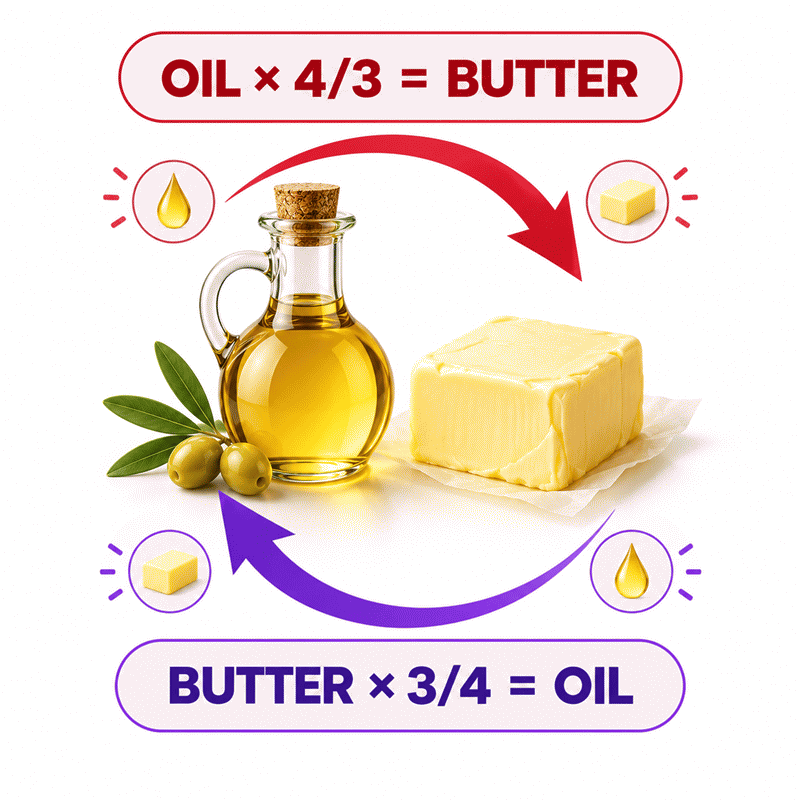
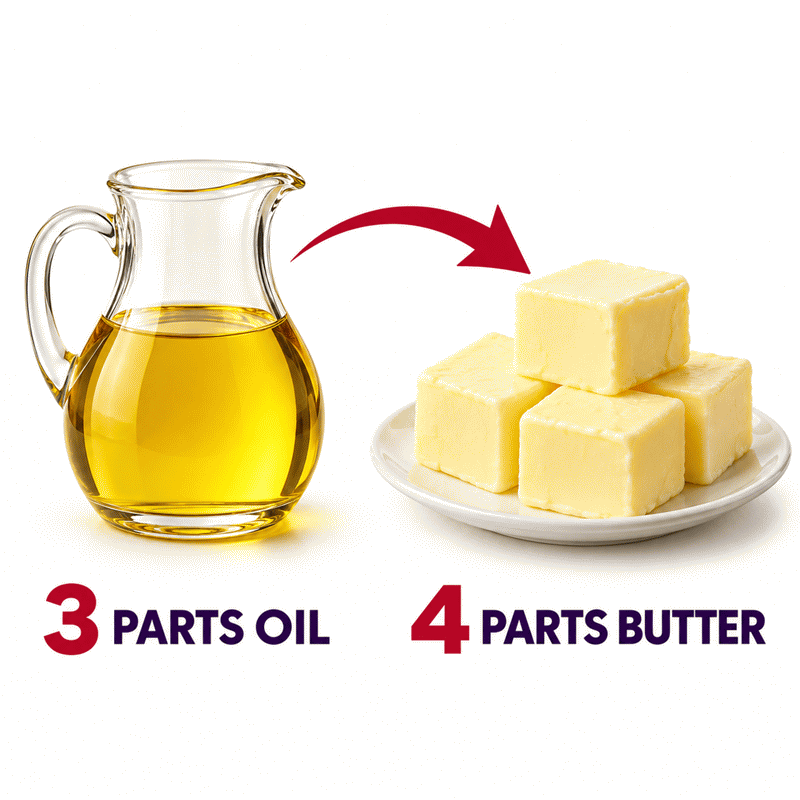
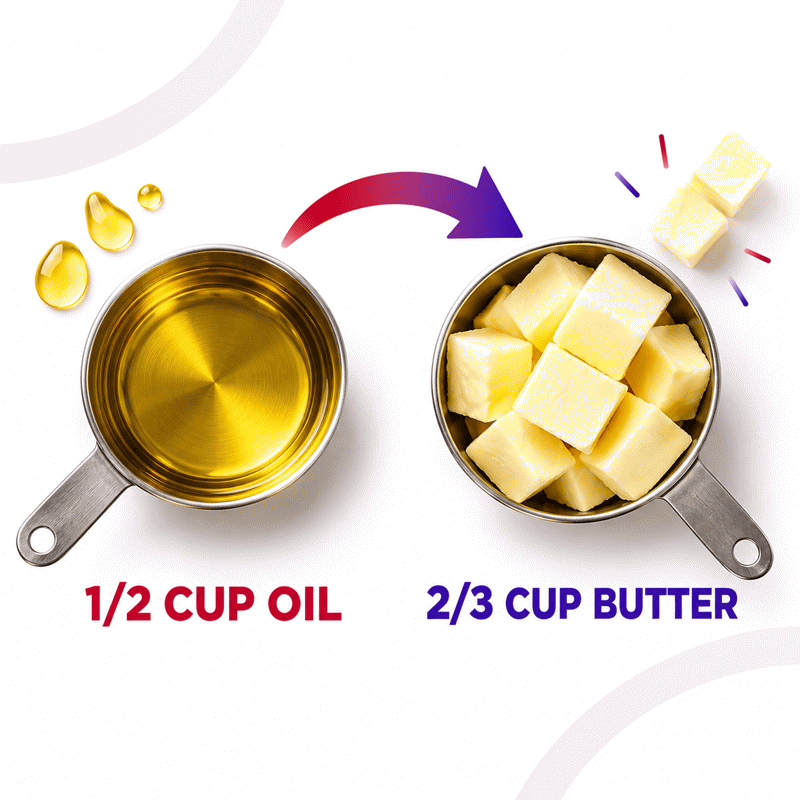
Oil to Butter Conversion helps you replace liquid cooking oil with butter without guessing. The practical relationship is three equal parts oil to four equal parts butter, so the reverse butter-to-oil amount is about seventy-five percent. The calculator supports both directions and keeps selected units independent.
- Enter either liquid oil or butter to solve the other value.
- Use matching mass or volume units whenever possible.
- Choose melted butter when the original recipe uses liquid fat.
- Expect possible changes in flavor, aeration, crumb and cooling texture.
- Treat coconut oil weight and volume as separate conversion paths.
- Avoid casual substitutions in laminated pastry, frosting and shortbread.
- Test a small batch before scaling an important recipe.
The Oil to Butter Conversion calculator supplies a practical starting amount, while recipe method and ingredient temperature still control the finished result. Butter contributes water, milk solids and solid-fat structure, whereas liquid oil remains fluid and can produce a softer refrigerated crumb. Confirm the original unit, select the correct replacement, and preserve the recipe’s intended mixing method.
Assumptions used in this calculator
- Liquid cooking oil and butter use a three-to-four substitution ratio.
- Butter and margarine are treated as equivalent for practical estimation.
- Oil is assumed to be liquid at the measuring temperature.
- Coconut oil weight equals eighty percent of the butter weight.
- Coconut oil volume equals seventy-five percent of the butter volume.
- US customary definitions are used for cups and spoons.
- One butter stick is treated as approximately 113.4 grams.
- Ingredient densities are representative values rather than batch-specific measurements.
- Intermediate calculations retain full numerical precision.
- Displayed decimals may be rounded for practical readability.
- All entered quantities must be finite and greater than zero.
- Recipe texture may change when solid butter replaces liquid oil.
- Results are guidance and do not guarantee identical recipe performance.
Results are rounded for display.
Internal calculations use full precision.
Formulas Used in Oil to Butter Calculator :
Unit normalization
Liquid oil and butter relationship
Coconut oil conversion by weight
Coconut oil conversion by volume
Mass and volume relationship
Result conversion to the selected unit
Variable definitions
- xu is the quantity expressed in the selected unit.
- xb is the normalized quantity in grams or milliliters.
- ku is the selected unit conversion factor.
- O is the liquid cooking oil quantity.
- B is the equivalent butter or margarine quantity.
- Bm is butter mass.
- Bv is butter volume.
- Cm is coconut oil mass.
- Cv is coconut oil volume.
- m is ingredient mass.
- V is ingredient volume.
- ρ is the representative ingredient density.
Variables & Definitions
View a complete list of all variables used in this calculator, including definitions and units
Oil to Butter Calculator Variables and Measurement Definitions
| Variable | Meaning | Base Unit | Role in Calculation |
|---|---|---|---|
| xu | Quantity in the user-selected unit | Selected unit | Entered value or displayed result |
| xb | Normalized base quantity | g or ml | Maintains conversion precision |
| ku | Unit conversion factor | g or ml per unit | Converts selected units to base units |
| O | Liquid cooking oil quantity | Compatible mass or volume unit | Represents three parts of the substitution ratio |
| B | Butter or margarine quantity | Compatible mass or volume unit | Represents four parts of the substitution ratio |
| Bm | Butter mass | g | Basis for coconut oil weight conversion |
| Bv | Butter volume | ml | Basis for coconut oil volume conversion |
| Cm | Equivalent coconut oil mass | g | Calculated from butter mass |
| Cv | Equivalent coconut oil volume | ml | Calculated from butter volume |
| m | Ingredient mass | g | Used for mass-volume conversion |
| V | Ingredient volume | ml | Used for mass-volume conversion |
| ρ | Representative ingredient density | g/ml | Connects mass and volume measurements |
Unit Conversion Table
Volume Unit Conversions for Oil, Butter, and Coconut Oil
| Unit Group | Unit Name | Symbol | Equivalent in Milliliters | Used For |
|---|---|---|---|---|
| Popular Units | Milliliter | ml | 1 ml | Metric recipe volumes |
| Popular Units | US Teaspoon | tsp | 4.92892159375 ml | Small cooking quantities |
| Popular Units | US Tablespoon | tbsp | 14.78676478125 ml | Common cooking quantities |
| Popular Units | US Fluid Ounce | fl oz | 29.5735295625 ml | US liquid measurements |
| Popular Units | US Cup | cup | 236.5882365 ml | Recipe-scale volumes |
| Scientific Units | Liter | L | 1,000 ml | Large metric volumes |
Mass Unit Conversions for Oil, Butter, and Coconut Oil
| Unit Group | Unit Name | Symbol | Equivalent in Grams | Used For |
|---|---|---|---|---|
| Popular Units | Gram | g | 1 g | Metric ingredient weights |
| Popular Units | Ounce | oz | 28.349523125 g | US and imperial recipe weights |
| Popular Units | Pound | lb | 453.59237 g | Large ingredient weights |
| Scientific Units | Kilogram | kg | 1,000 g | Large metric quantities |
Butter Stick Conversion
| Unit Group | Unit Name | Symbol | Equivalent in Grams | Used For |
|---|---|---|---|---|
| Popular Units | US Butter Stick | stick | 113.3980925 g | Packaged butter measurements |
Example Calculation
A cake recipe requires 180 ml of liquid cooking oil, but butter will be used instead.
The calculation applies the practical three-to-four liquid oil and butter ratio. Every three equal volume parts of liquid oil correspond to four equal volume parts of butter. The result is calculated without intermediate rounding. Recipe texture may still change because butter contains water and remains solid at typical room temperature.
A recipe specifies 320 g of butter, and the equivalent liquid cooking oil must be solved automatically.
In reverse-solving mode, the editable butter value becomes the known quantity. The calculator applies the same three-to-four relationship in the opposite direction. Because both values use mass units, no density conversion is required. The calculated oil amount appears immediately after the butter value is entered or changed.
Results are rounded for display.
Internal calculations use full precision.
Calculations Disclaimer
How Much Butter Should Replace Liquid Cooking Oil?
A recipe can fail before mixing begins when the fat amount is guessed. Oil to Butter Conversion removes that uncertainty. Oil to Butter Conversion uses a practical three-to-four relationship. Three equal parts of liquid oil correspond to four parts of butter. This gives cooks a clear starting quantity. It also keeps recipe scaling consistent.
Enter the amount that is already known. The paired quantity appears at once. You can also enter the butter amount. The oil value then updates in reverse. This design helps when either ingredient appears in the original recipe.
The result is clearest when both measurements use the same dimension. Compare cups with cups or grams with grams. A gram measures mass. A milliliter measures volume. Moving between them requires ingredient density. Treating them as identical can create a hidden error.
A practical conversion solves quantity, but it cannot preserve every physical property. Butter contains fat, water and milk solids. Liquid cooking oil is almost entirely fat. Those differences affect mixing, baking and serving. The calculator provides the starting amount. The baker still controls temperature and technique.
Why the Three-to-Four Ratio Works as a Practical Starting Point
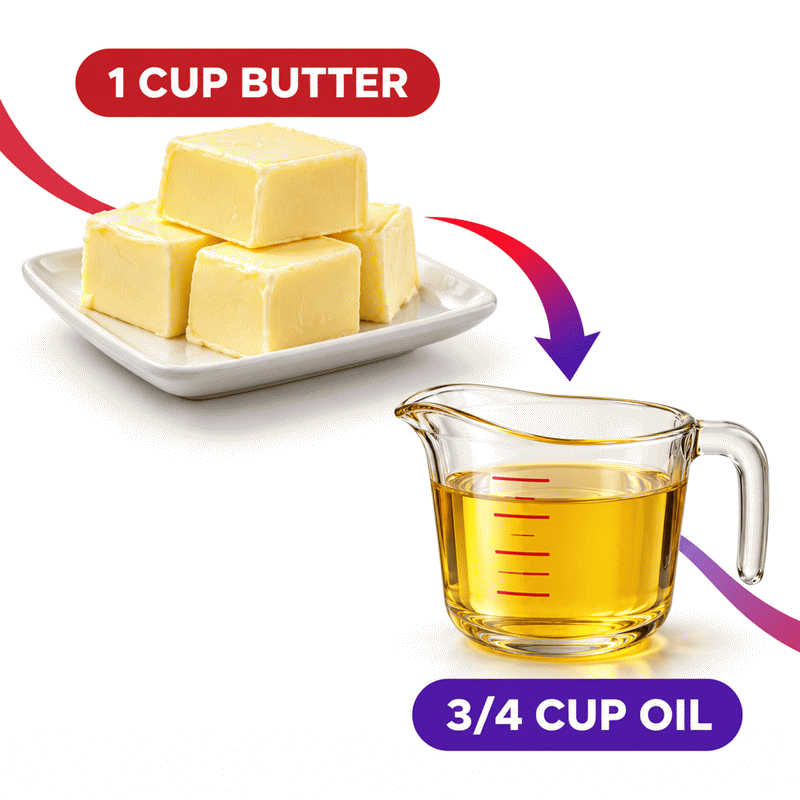
The common problem is simple. Butter is not pure fat, while liquid oil contains little water. Using less oil than butter helps account for that difference. The three-to-four relationship is easy to apply. One cup of butter corresponds to about three-quarters cup of oil. The reverse direction needs more butter than oil.
This relationship scales evenly. It can support a small home recipe or a larger batch. The same ratio applies when both sides use matching units. Cups can be compared with cups. Tablespoons can be compared with tablespoons. Grams can be compared with grams.
The ratio remains a practical model rather than a promise. Different recipes use fat for different reasons. Some need moisture. Others need air, layers or firmness. The correct quantity may still produce a different crumb. That is why recipe type must guide the final choice.
What Changes When a Recipe Gains Water and Solid Fat
A cake can become firmer when oil is replaced with butter. Butter becomes solid as it cools. Oil often remains fluid. This difference is easy to notice after refrigeration. A butter cake may feel dense when cold. It can soften again near room temperature.
Butter also adds water. Some of that water becomes steam in the oven. The steam may support lift in suitable batters. Milk solids add aroma and help the surface brown. These effects can be desirable, but they are not neutral.
Oil distributes through batter without forming the same solid structure. It often produces an even, soft mouthfeel. This quality is useful in cakes served cold. It is also helpful when longer-lasting softness matters.
When Should You Replace Oil With Butter?
A cook may discover an empty oil bottle after other ingredients are ready. Butter can solve the problem when richer flavor is welcome. It works best in recipes that already use a melted fat. Many muffins, brownies, quick breads and simple cakes fit this pattern.
Melt the butter gently. Do not let it become extremely hot. Allow it to cool before combining it with eggs. This reduces the risk of curdling or partial cooking. Continue with the original mixing method unless the recipe requires another step.
The substitution also suits recipes built around vanilla, chocolate, caramel or nuts. Butter can strengthen those flavors. It may improve aroma and browning. Make only one major change during the first trial. That makes the result easier to judge.
Cakes, Muffins and Brownies That Handle the Swap Well
A basic cake mix often accepts cooled melted butter. Muffins and brownies are also flexible. These batters may not depend on creaming solid butter. The substitution can therefore work without rebuilding the whole method.
Observe the batter before baking. Butter may make it slightly thicker. Avoid adding extra liquid immediately. Mix only until the ingredients are combined. Excess mixing can make flour-based products tough.
Keep the same pan, oven temperature and baking position. Check doneness using the original recipe’s method. Record the finished height, crumb and flavor. A simple record turns the next batch into a controlled improvement.
Recipes Where Butter Flavor Creates a Clear Advantage
A mild cake can taste flat when every ingredient is neutral. Butter adds a clear dairy aroma. It pairs well with vanilla, toasted nuts and caramel. It can also enrich cornbread, biscuits and chocolate desserts.
Use unsalted butter when seasoning control matters. Salted butter can work in casual baking. Reduce other salt when required. Read the label before deciding.
Browned butter requires extra care. Heating removes some water and changes the flavor. It no longer behaves exactly like ordinary melted butter. Its toasted character can be useful, but it should be treated as a separate recipe choice.
When Does an Oil-to-Butter Swap Create Problems?
A flaky pastry can lose its layers when the wrong fat state is used. Some recipes need cold pieces of butter. Those pieces remain separate during mixing. They melt in the oven and leave thin spaces. Liquid oil cannot create the same pattern.
Frosting can also fail after a casual substitution. Butter provides structure as it cools. Liquid oil may create a loose or greasy mixture. Candy and delicate emulsions can be equally sensitive.
Look for method clues before converting. Words such as cream, laminate, fold, chill or cut in indicate a structural role. In those cases, quantity is only part of the problem.
Why Creaming and Aeration Cannot Be Ignored
A creamed cake can become dense when its mixing stage disappears. Beating softened butter with sugar creates small air pockets. Those pockets expand as the cake heats. Pouring oil into the recipe does not reproduce that process.
The converted amount may be numerically correct. The missing air can still reduce volume. This explains why a simple ratio works better in melted-fat recipes.
When replacing oil with butter, melted butter usually matches the original process. Softened butter introduces another mixing system. Do not add a creaming stage unless the recipe supports it.
Pastry, Shortbread and Laminated Dough Warning Signs
Shortbread may spread or lose its crisp bite when solid fat becomes oil. Laminated dough can lose clean layers. Pie crust may become tender but less flaky. These products rely on fat crystals and controlled temperature.
A numerical conversion cannot reproduce those physical features. Keep butter when the recipe calls for cold cubes or repeated folding. If a different fat is essential, use a recipe tested for that ingredient.
Solid coconut oil may work in selected products. Its melting behavior still differs from butter. Run a small trial before using it for an important batch.
How Does Butter Change Texture, Moisture and Flavor?
A cake may taste dry even when it contains enough water. Mouthfeel depends on the physical state of its fat. Oil remains fluid at many serving temperatures. Butter becomes firm as it cools. That change affects tenderness.
Butter also carries flavor compounds and milk solids. The finished product may smell richer. The crust may brown more strongly. The center may feel more structured.
Neither outcome is always better. A chilled snack cake may benefit from oil. A warm vanilla cake may benefit from butter. Choose the fat that supports the final eating experience.
Understanding Tenderness, Crumb and Cooling Behavior
A refrigerated butter cake can seem disappointing at first bite. Cold butter becomes firm inside the crumb. Letting the cake warm slightly can improve softness. This is useful for products stored cold but served later.
An oil cake often stays soft straight from refrigeration. That can help layered desserts and snack cakes. However, oil does not create the same aroma or aerated structure.
Plan around storage and serving. The best fat for a warm muffin may differ from the best fat for a chilled cake slice.
How Browning and Spread May Change
Cookies can spread too far when the fat melts early. Butter, margarine and oil have different melting behavior. The substitution can change edge thickness and center texture.
Butter’s milk solids can also increase browning. A converted cookie may darken sooner. Check it before the original baking time ends.
If the dough feels unusually soft, chill it before baking. Keep the pan and oven conditions unchanged. That makes the effect of the fat easier to identify.
Which Cooking Oil Should You Replace?
A delicate vanilla cake can be overwhelmed by strong oil. Flavor should guide the oil choice before calculation. Canola and refined sunflower oils are commonly mild. Refined vegetable oils may also suit neutral recipes.
Olive oil can add fruitiness or bitterness. This may complement citrus, chocolate and savory baking. It may distract from plain vanilla.
Freshness matters as much as variety. Smell the oil before using it. Stale or oxidized oil can spoil a whole batch. Store oil away from heat and bright light.
Neutral Oils for Cakes and Delicate Flavors
A neutral oil protects the intended flavor of a light cake. It works well with vanilla, lemon and subtle spices. Refined oils usually have less aroma than unrefined versions.
Neutral does not mean identical. Oils have different fatty-acid profiles and storage stability. These differences usually matter more in long storage or commercial production.
For home baking, choose a fresh oil with a mild taste. For production, test the exact supplier and product. Keep that specification with the approved recipe.
Using Olive Oil Without Overpowering the Recipe
An olive oil cake can become harsh when a bold oil is selected blindly. Taste the oil before mixing. A fruity oil can support orange, lemon, chocolate and herbs. A mild refined oil suits quieter flavors.
Variety, harvest and storage affect olive oil flavor. Two bottles can produce different results at the same quantity. The calculator solves the amount. Sensory testing solves the flavor choice.
Begin with a small batch when the oil is unfamiliar. Record whether the flavor improves after cooling. Some aromas become more noticeable the next day.
How Should Coconut Oil Be Converted?
Coconut oil creates confusion because it can be solid or liquid. Its physical state can change inside the same kitchen. Conversion should follow the original measurement basis.
Use a weight result when the recipe lists grams or ounces. Use a volume result when it lists cups or spoons. Do not mix both paths without an ingredient-specific density.
Match the state to the method. Melted coconut oil belongs in a melted-fat process. Softened coconut oil may suit selected solid-fat recipes. It still cannot guarantee butter-like aeration.
Why Weight and Volume Need Separate Treatment
A gram answers how much mass is present. A milliliter answers how much space is filled. Density links those measurements. Butter and coconut oil do not share identical density or water content.
This means one percentage cannot solve every cross-unit case. A weight substitution and a volume substitution may produce different numbers. Both can be internally correct for their chosen basis.
Use a scale when precision is important. Volume remains convenient for small household recipes. Keep the selected measurement family consistent from input to output.
Matching Solid or Melted Coconut Oil to the Recipe
A batter can seize when warm coconut oil meets cold ingredients. Bring ingredients toward similar temperatures. Add the oil gradually when the mixture is sensitive.
Measure coconut oil in the state requested by the recipe. Solid oil can trap empty spaces in a cup. Melted oil fills the container more evenly. Weight measurement reduces that packing problem.
Refined coconut oil usually tastes milder. Virgin coconut oil can add a clear aroma. Choose the version that suits the recipe.
How Can You Prevent Common Substitution Failures?
A failed batch often contains several untracked changes. Change only the fat during the first test. Keep flour, sugar, eggs, pan and oven setting constant. This isolates the substitution.
Confirm the unit before accepting the result. A fluid ounce is not a weight ounce. A cup is not a gram. Select the original unit carefully.
Observe the batter before adding more liquid. A thicker appearance does not always require correction. Bake the controlled test first. Then adjust one factor during the next batch.
Match the Original Fat State Before Mixing
A liquid-fat recipe expects easy distribution. Cooled melted butter usually matches that behavior. A creamed recipe expects plastic, softened fat. Oil cannot trap air in the same way.
Read the original instructions before selecting the replacement state. Do not place cold butter into a method designed for oil. Do not pour hot butter into eggs.
Temperature also affects emulsions. Add melted fat slowly when separation is possible. Stop and correct the mixture before adding dry ingredients.
Adjust Salt, Flavor and Mixing Method Carefully
Salted butter can upset a balanced recipe. Check its label and reduce added salt when needed. Margarine may contain more water, flavoring or emulsifiers. Low-fat spread can behave very differently.
Avoid changing sugar or liquid during the first fat trial. Too many changes hide the cause of failure. Record the exact product and temperature.
Use the first batch as evidence. Adjust the next batch only when the observed result supports that change.
How Can the Calculator Support Recipe Scaling?
A bakery batch can magnify a small arithmetic mistake. Enter the original amount exactly. Select the intended unit. Keep the calculation unrounded until the final measurement.
Large batches should rely on weight where possible. Repeated cup measurements add handling error. A scale makes the process faster and easier to repeat.
Keep one approved conversion record with the recipe. Include the ingredient brand, fat state and test date. This supports consistent production and staff training.
Reverse Solving From Butter Back to Oil
An older recipe may list butter while the kitchen only has oil. Enter the butter amount as the known value. The calculator solves the liquid oil amount immediately.
This reverse workflow uses the same locked relationship. It avoids rebuilding equations by hand. It also reduces inconsistent decisions between team members.
Keep measurements dimensionally clear. Use grams with grams or cups with cups when possible. Select another output unit only when its ingredient conversion is supported.
Checking Large-Batch Results Before Production
A production run should never become the first test. Prepare a small controlled batch. Compare it with the original product. Check height, crumb, flavor, spread and cooling texture.
Record the exact oil, butter or margarine. Supplier formulation can affect performance. Confirm the serving temperature and expected shelf conditions.
Approve the substitution only after the product meets its target. Then scale the accepted amount. AxiCalculator supplies a consistent numerical starting point. Real testing provides the final production decision.
Frequently Asked Questions
Can I use the calculated butter amount in every recipe?
Should I measure the converted result by weight or volume?
Does replacing oil with butter make cake taste better?
Can margarine use the same conversion as butter?
Why can a correct conversion still produce dense cake?
How should a bakery validate a large converted batch?
How should coconut oil be handled when room temperature changes?
Our engineers are here to help you get it right.