Garlic Converter
- Last formula update:
Decimal & Rounding Policy
- Calculations use full floating-point precision without intermediate rounding.
- Displayed results use up to ten decimal places when necessary.
- Trailing zeros are removed to keep cooking measurements easy to read.
- Very small valid quantities remain visible instead of being rounded to zero.
- Exported values preserve the calculator’s displayed measurement precision.
- Garlic conversion results are approximate because ingredient size and density vary.
Valid range
- Enter a finite garlic quantity greater than zero and no greater than 1,000,000,000.
- Garlic cloves may contain whole or decimal values for partial-clove calculations.
- Volume fields accept positive quantities in any supported compatible volume unit.
- Zero, negative, empty, nonnumeric, infinite, and unsupported values are rejected.
- A converted clove quantity exceeding the supported maximum is considered invalid.
- Results represent practical recipe estimates rather than exact ingredient weights.

Nolissa Vantford
Reviewers:
Solavyn Marbourne
Orvick Bexquell
Check our editorial policy
September 9, 2026
1.0.0
Initial calculator and formula release.
Our engineers are here to help you get it right.
How Does the Garlic Clove to Powder Converter Give Reliable Recipe Equivalents?
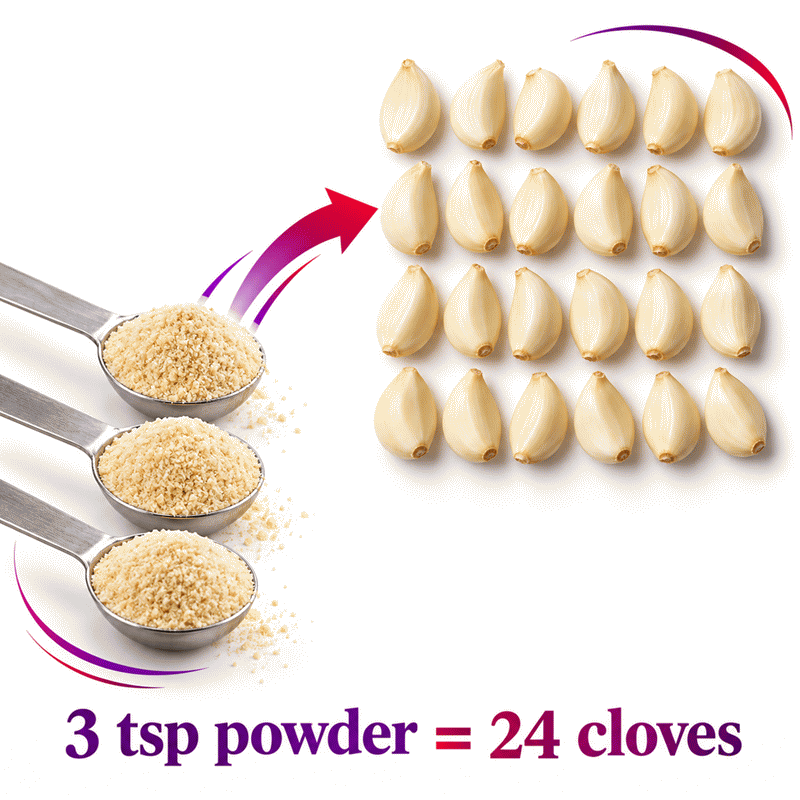
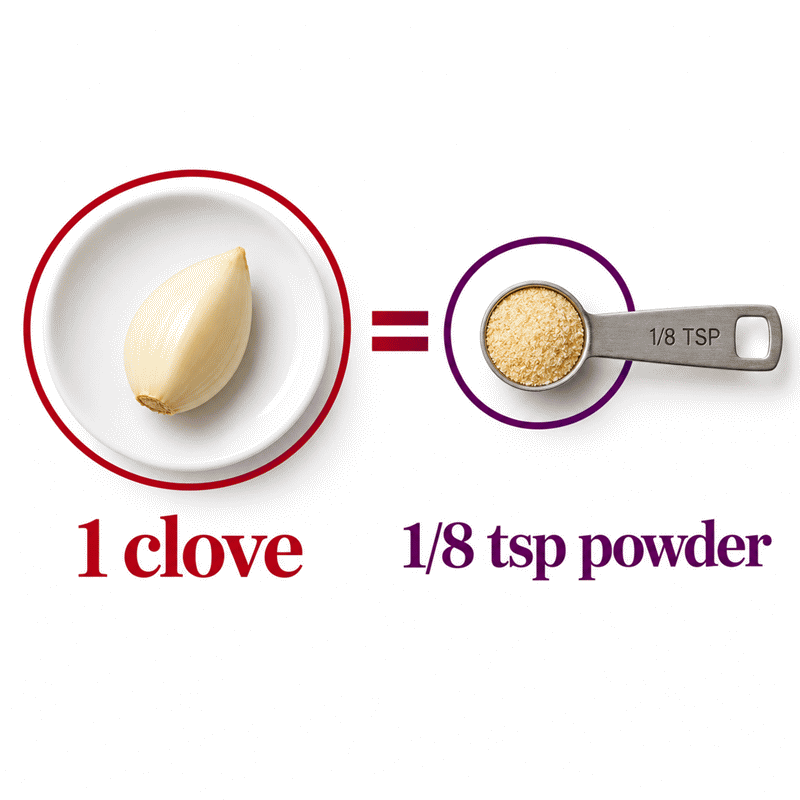
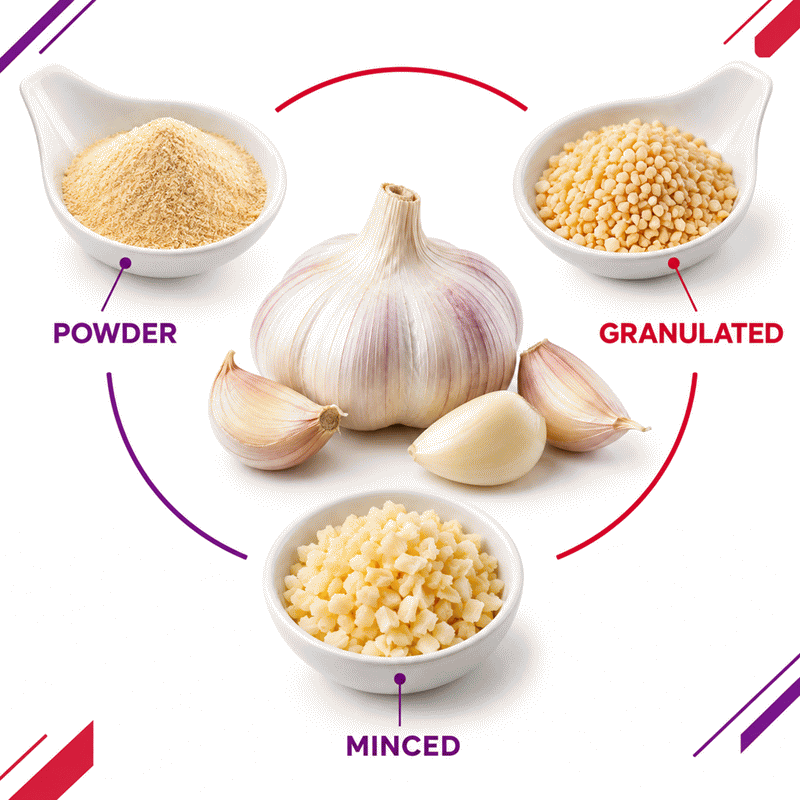
Garlic clove to powder converter results give cooks a fast starting point when fresh garlic is unavailable or a recipe must be scaled. Under the calculator’s declared model, one average clove corresponds to 1/8 teaspoon garlic powder, 1/4 teaspoon granulated garlic, 1/2 teaspoon garlic flakes, 1 teaspoon chopped garlic, 1/2 teaspoon minced garlic, or 1/2 teaspoon garlic salt. Every field works in both directions, so a known powder, flake, minced, chopped, granulated, or salt quantity can also calculate the equivalent number of cloves.
- Enter any known garlic quantity to update all connected equivalents.
- Select compatible volume units without changing the underlying physical quantity.
- Use level measures for more repeatable recipe substitutions.
- Reduce other recipe salt when garlic salt is selected.
- Choose the substitute that matches the dish’s texture and cooking method.
The garlic clove to powder converter provides practical estimates rather than exact flavor measurements. Clove size, product age, grind, moisture, brand, storage, and processing can change the final taste, so evaluate the dish and adjust gradually whenever possible.
Assumptions used in this calculator
- One metric teaspoon equals exactly five milliliters.
- One clove equals one-eighth teaspoon of garlic powder.
- One clove equals one-quarter teaspoon of granulated garlic.
- One clove equals one-half teaspoon of garlic flakes.
- One clove equals one teaspoon of chopped garlic.
- One clove equals one-half teaspoon of minced garlic.
- One clove equals one-half teaspoon of garlic salt.
- Garlic cloves are treated as average-sized recipe cloves.
- Ingredient volumes are measured level rather than heaped.
- Product density differences are not modeled.
- Flavor potency is assumed proportional to the entered quantity.
- Garlic salt composition may differ between manufacturers.
- Results are practical estimates, not laboratory measurements.
Results are rounded for display.
Internal calculations use full precision.
Formulas Used in Garlic Converter :
Use this formula when powder, granulated garlic, flakes, chopped garlic, minced garlic, or garlic salt is the entered value.
Use this formula to calculate any garlic form in any supported volume unit.
| Garlic Form | Symbol | Factor per Clove |
|---|---|---|
| Garlic powder | rpowder | 0.125 tsp/clove |
| Granulated garlic | rgranulated | 0.25 tsp/clove |
| Garlic flakes | rflakes | 0.5 tsp/clove |
| Chopped garlic | rchopped | 1 tsp/clove |
| Minced garlic | rminced | 0.5 tsp/clove |
| Garlic salt | rsalt | 0.5 tsp/clove |
| Variable | Definition | Unit |
|---|---|---|
| C | Equivalent number of garlic cloves | cloves |
| Qi,u | Quantity of garlic form i in selected unit u | selected unit |
| ri | Teaspoon equivalent of garlic form i per clove | tsp/clove |
| fu | Milliliters represented by one selected unit | mL/unit |
One metric teaspoon equals 5 milliliters. Calculations retain full precision until the result is displayed.
Variables & Definitions
View a complete list of all variables used in this calculator, including definitions and units
Garlic Converter Variables and Calculation Factors
| Variable | Meaning | Unit | Allowed Value | Calculation Role |
|---|---|---|---|---|
| C | Equivalent garlic clove quantity | clove(s) | Positive finite number | Canonical value linking every garlic form |
| Vu | Displayed volume of a garlic form | Selected volume unit | Positive finite number | Editable forward or reverse quantity |
| Vtsp | Garlic-form volume normalized to teaspoons | tsp | Calculated positive number | Common volume used by conversion coefficients |
| ri | Volume of garlic form i equivalent to one clove | tsp/clove | 0.125, 0.25, 0.5, or 1 | Ingredient-specific substitution coefficient |
| fu | Milliliters represented by selected unit u | mL/unit | Supported unit factor | Converts selected units to and from milliliters |
| i | Selected garlic form | None | Supported garlic form | Selects the correct ri coefficient |
| u | Selected compatible volume unit | None | Supported volume unit | Selects the correct fu factor |
Unit Conversion Table
Garlic Converter Unit Conversion Table
| Unit Group | Unit Name | Symbol | Equivalent in Milliliters | Equivalent in Metric Teaspoons | Typical Use |
|---|---|---|---|---|---|
| Popular Units | Metric teaspoon | tsp | 5 mL | 1 tsp | Standard garlic recipe measurements |
| Popular Units | US teaspoon | US tsp | 4.92892159375 mL | 0.98578431875 tsp | US customary recipe measurements |
| Popular Units | Metric tablespoon | tbsp | 15 mL | 3 tsp | Larger garlic quantities in recipes |
| Popular Units | US tablespoon | US tbsp | 14.78676478125 mL | 2.95735295625 tsp | US customary large-volume measurements |
| Popular Units | Pinch | pinch | 0.3125 mL | 0.0625 tsp | Very small garlic seasoning quantities |
| Scientific Units | Milliliter | mL | 1 mL | 0.2 tsp | Metric volume measurements |
| Scientific Units | Liter | L | 1,000 mL | 200 tsp | Large-batch and commercial recipes |
| Scientific Units | Cubic centimeter | cm³ | 1 mL | 0.2 tsp | Equivalent scientific volume notation |
Example Calculation
Granulated garlic = 14 × 0.25 tsp = 3.5 tsp
Garlic flakes = 14 × 0.5 tsp = 7 tsp
Chopped garlic = 14 × 1 tsp = 14 tsp
Minced garlic = 14 × 0.5 tsp = 7 tsp
Garlic salt = 14 × 0.5 tsp = 7 tsp
The clove quantity is multiplied by the conversion factor for each garlic form.
No intermediate value is rounded during the calculation.
These quantities provide practical substitutions for an average recipe.
Flavor strength may vary with garlic size, product age, and brand.
Granulated garlic = 22 × 0.25 tsp = 5.5 tsp
Garlic flakes = 22 × 0.5 tsp = 11 tsp
Chopped garlic = 22 × 1 tsp = 22 tsp
Minced garlic = 22 × 0.5 tsp = 11 tsp
Garlic salt = 22 × 0.5 tsp = 11 tsp
The garlic powder quantity is divided by its conversion factor.
The resulting clove quantity becomes the shared reverse value.
All remaining garlic forms are calculated from that clove quantity.
Actual recipe strength may vary because garlic products differ in flavor concentration.
Results are rounded for display.
Internal calculations use full precision.
Calculations Disclaimer
How Much Garlic Powder Replaces One Garlic Clove?
You open the pantry and discover that the fresh garlic is gone. The recipe is already moving, the pan is hot, and stopping is not practical. A garlic clove to powder converter solves that exact problem. Under this calculator’s declared conversion model, one average garlic clove equals about one-eighth teaspoon of garlic powder. The garlic clove to powder converter also works in reverse. Enter powder, granulated garlic, flakes, chopped garlic, minced garlic, or garlic salt. Every connected value updates at once.
The quick number is useful, but the form of garlic still matters. Powder spreads evenly and adds no pieces. Chopped garlic adds visible texture. Minced garlic releases fresh flavor quickly. Flakes need moisture and time to soften. Garlic salt changes both garlic flavor and total salt. The best substitute therefore depends on the dish, not only the number.
Use the calculated result as a controlled starting point. Add it at the stage that suits the selected form. Powder can blend into a dry rub or sauce. Flakes perform better when liquid and cooking time are available. Minced garlic suits dishes that benefit from fresh aroma. Taste near the end whenever the recipe allows. This small check protects the dish from an old, weak powder or an unusually strong new jar.
Choose the Right Garlic Form Before You Convert
A correct number can still produce the wrong eating experience. Imagine replacing chopped garlic in a fresh salsa with powder. The total garlic flavor may seem reasonable, yet the texture and sharp fresh bite disappear. This is why the calculator separates garlic forms. Each field represents a different physical product and a different cooking behavior.
Garlic Powder for Smooth, Even Flavor
Garlic powder is finely ground and easy to spread. It works well in dry rubs, batters, sauces, dressings, seasoned flour, and dishes where visible garlic pieces are unwanted. Mix it evenly before cooking. Avoid dropping a dense pile into one spot, because concentrated powder can create an uneven taste.
Granulated Garlic for Slower Flavor Release
Granulated garlic is coarser than powder. It disperses well but does not vanish as quickly. It suits spice blends, roasted vegetables, meat seasoning, and longer cooking. Do not assume that a spoon of granules equals the same spoon of fine powder. Their calculator coefficients are deliberately different.
Garlic Flakes for Texture and Rehydration
Garlic flakes add small pieces and perform best when moisture is present. Soups, braises, sauces, and stews give flakes time to soften. A very dry or fast-cooked dish may leave them firm. In that case, powder or granulated garlic may be more practical.
Chopped Garlic for Visible Fresh Pieces
Chopped garlic keeps larger pieces. It releases flavor more slowly than a fine mince and provides a noticeable texture. It suits sautés, pasta sauces, roasted dishes, and recipes where garlic should remain visible. Watch the cooking temperature because exposed pieces can brown quickly.
Minced Garlic for Fast Fresh-Garlic Impact
Minced garlic has more exposed surface than chopped garlic. It can release aroma quickly and can also burn quickly. Add it with enough moisture or fat, and avoid leaving it alone over high heat. Jarred minced garlic may taste different from freshly minced cloves because processing and storage alter its character.
Garlic Salt When Seasoning and Salt Must Be Balanced
Garlic salt is not pure garlic. It combines garlic seasoning with salt, and formulations differ. When it replaces a fresh clove, reduce other salt before tasting the dish. This step is more important than chasing a perfect garlic number. Excess salt is difficult to reverse once mixed into the food.
Why Garlic Conversion Ratios Can Differ
You compare two cooking guides and see different numbers. That does not always mean one guide is careless. Garlic is an agricultural ingredient, not a manufactured bolt. Cloves vary in size, water content, age, variety, and intensity. Dried products vary in grind, processing, storage, and brand formulation. A useful calculator must declare one consistent model while explaining that the result is approximate.
Clove Size Changes the Starting Quantity
A small inner clove contains less material than a large outer clove. Treating both as identical makes recipe conversion convenient, but it cannot capture every kitchen situation. If your cloves are unusually large, begin with the calculated substitute and adjust carefully. If they are very small, the standard result may taste stronger than expected.
Processing and Product Age Change Flavor Strength
Freshly opened powder often smells stronger than a jar stored for a long time. Heat, air, moisture, and storage time can reduce aroma. Granules, flakes, and minced products also differ between manufacturers. The calculator converts recipe quantities, not laboratory flavor intensity. Your nose and final tasting remain useful quality checks.
Level Measures Improve Repeatability
A heaped teaspoon has no fixed shape. One cook may create a small mound while another creates a large one. Use level teaspoons and tablespoons for repeatable results. For very small amounts, measuring spoons are more dependable than an informal pinch. Consistent measuring makes it easier to reproduce a successful dish later.
How to Use the Two-Way Garlic Converter
A recipe calls for cloves, but you only know the amount left in a powder jar. This is where reverse calculation saves time. Every quantity in the converter is editable. Enter the value you know. The tool converts that quantity to its equivalent number of cloves, then updates the remaining garlic forms from the same shared value.
Start with Fresh Garlic Cloves
Enter the number of cloves when a recipe lists fresh garlic. The connected fields show powder, granulated garlic, flakes, chopped garlic, minced garlic, and garlic salt. Decimal values allow half cloves or other partial amounts. Choose the unit separately for each volume field when needed.
Start with Powder, Flakes, Minced Garlic, or Salt
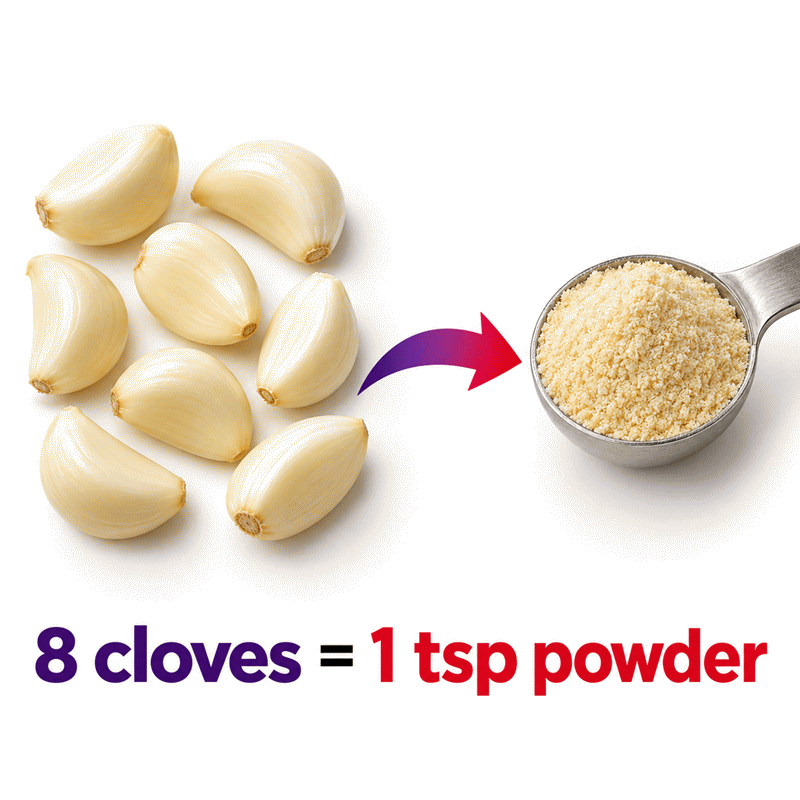
Enter a known processed-garlic quantity to solve backward. For example, one teaspoon of garlic powder maps to eight average cloves in this calculator. Those eight cloves then map to two teaspoons of granulated garlic, four teaspoons of flakes, eight teaspoons of chopped garlic, four teaspoons of minced garlic, or four teaspoons of garlic salt.
Change Units Without Changing the Physical Quantity
Suppose a field displays three teaspoons. Changing that selector to tablespoons should display one tablespoon, not three tablespoons. The physical volume remains constant while its numeric representation changes. This behavior prevents a common unit-selection error and makes the tool useful for metric and US recipe formats.
How to Select a Substitute for the Recipe
You have several garlic products, but only one will fit the dish well. Begin with three questions. Does the recipe need fresh texture? Is there enough liquid for a dried product to hydrate? Does the dish already contain significant salt? These questions narrow the choice faster than comparing numbers alone.
Best Choices for Soups, Sauces, and Marinades
Soups and sauces can accept many garlic forms. Powder blends smoothly. Granules provide a slightly coarser release. Flakes soften during longer cooking. Minced or chopped garlic adds a fresher profile. Marinades often benefit from powder because it distributes across the surface, but fresh minced garlic may deliver a sharper aroma.
Best Choices for Dry Rubs and Seasoning Blends
Powder is usually the easiest form to distribute through a dry mixture. Granulated garlic also works and can reduce clumping. Fresh chopped or minced garlic adds moisture, so it changes the behavior and storage life of a dry blend. Garlic salt can work only when its added salt fits the overall seasoning plan.
Best Choices When Texture Matters
Choose chopped or minced garlic when visible pieces are part of the dish. Choose flakes when dried pieces can rehydrate. Select powder when a smooth finish matters more than fresh texture. This decision is especially important in raw dips, quick sautés, dressings, and finishing sauces.
Common Garlic Substitution Mistakes
The most expensive mistake is not a calculation error. It is treating every garlic product as interchangeable. A correct conversion cannot restore moisture, fresh bite, or visible pieces. It also cannot remove salt added through garlic salt. Check the product label and the cooking method before committing the full amount.
Confusing Powder with Granulated Garlic
Fine powder and coarse granules are both dried garlic, but they are not assigned the same amount here. Selecting the wrong field can double or halve the intended quantity. Read the container label rather than judging only by color. If the particles resemble fine flour, the product is likely powder. If they resemble coarse sand, it is likely granulated.
Forgetting the Salt Inside Garlic Salt
Adding garlic salt as though it were pure garlic can oversalt a dish. Reduce other salt first, then taste after ingredients have mixed. Product formulations vary, so the nutrition or ingredient label is more reliable than a universal salt percentage.
Using Heat Without Considering Garlic Form
Fresh minced garlic can burn before larger ingredients finish cooking. Powder can scorch on a very hot dry surface. Flakes may stay firm without enough liquid. Match the timing to the ingredient. Add delicate fresh garlic later, hydrate flakes when needed, and distribute powder evenly.
Final Pre-Cooking Check for a Reliable Substitution
Confirm the garlic form, selected unit, and recipe scale. Check whether the measure is level. Review the dish for existing salt. Consider whether texture matters. Then use the calculated amount as the starting quantity. This short check takes seconds and prevents the errors that a numeric converter alone cannot detect.
Garlic Conversion for Recipe Scaling and Batch Work
A small recipe succeeds, but the larger batch tastes unbalanced. This often happens when cooks scale by memory or switch between teaspoons and tablespoons during preparation. Start from the original clove quantity. Multiply it by the required batch factor. Then convert the scaled clove value into the garlic form that will actually be used. Keep that selected form unchanged throughout the batch.
For example, a sauce uses four cloves and must be prepared at five times its original size. The scaled recipe requires twenty clove equivalents. Under this calculator’s model, twenty cloves correspond to two and one-half teaspoons of garlic powder. The same clove value corresponds to five teaspoons of granulated garlic, ten teaspoons of flakes, twenty teaspoons of chopped garlic, ten teaspoons of minced garlic, or ten teaspoons of garlic salt.
Do not combine several substitutions unless the flavor effect is intentional. Powder, minced garlic, and garlic salt may each contribute differently. Mixing them can produce a dish that is difficult to reproduce. Record the selected form, brand, quantity, unit, and any final taste adjustment. That record becomes useful when the recipe is prepared again.
Build a Repeatable Garlic Measurement Workflow
A successful dish becomes frustrating when nobody can reproduce it. A short measurement workflow solves that problem. First, identify the garlic form named in the recipe. Second, confirm the garlic product that is actually available. Third, enter the known amount into the matching calculator field. Fourth, select the intended unit. Fifth, check the calculated equivalent before adding it.
Use clean, dry measuring spoons for powdered and granulated products. Moisture can make fine powder cling to the spoon and create uneven measures. Level the spoon without pressing the ingredient down. For chopped or minced garlic, fill the measure naturally and avoid compacting it. These habits cannot remove biological variation, but they improve repeatability.
After cooking, record whether the dish needed more or less garlic. A note such as “use ten percent less with this brand” is more useful than changing the calculator’s general coefficient for every visitor. The calculator supplies a consistent shared baseline. Your recipe record captures the local product, cooking method, and preferred flavor.
Make a Confident Final Choice
You do not need a perfect laboratory equivalence to rescue dinner. You need a clear method, a suitable substitute, and an honest understanding of uncertainty. Use the calculator to remove arithmetic from the decision. Use the dish’s texture, moisture, heat, and salt level to choose the form. Then adjust carefully when tasting is possible.
AxiCalculator keeps all supported garlic quantities connected, so the same tool answers both common and reverse questions. It can start with cloves, powder, granules, flakes, chopped garlic, minced garlic, or garlic salt. This reduces manual mistakes and makes recipe scaling easier to explain, share, and repeat.
The final rule is simple: calculate first, match the substitute to the cooking method, and taste before making a large correction. That sequence protects flavor while keeping the process fast. Open the converter when a recipe and pantry do not match, choose the field you know, and let the remaining equivalents update immediately.
Frequently Asked Questions
Can I use the same garlic conversion for every recipe?
Why does my garlic powder taste weaker than the calculated amount suggests?
Which substitute is closest to a fresh garlic clove?
How should I adjust a recipe when using garlic salt?
How can a catering team scale garlic without creating batch inconsistency?
Why should a product developer avoid treating volume conversion as flavor equivalence?
How should reverse calculations be checked in a recipe application?
Engineering Resources
Our engineers are here to help you get it right.