Percent Ionic Character Calculations
- Last formula update:

Decimal & Rounding Policy
- Calculations use full internal precision to reduce cumulative rounding errors.
- Electronegativity values and ionic character percentages are displayed to two decimal places.
- Dipole moments may be displayed to three decimal places when additional precision is useful.
- Only the final displayed result is rounded; intermediate values remain unrounded.
- Results are estimates and may vary slightly when input values are rounded.
Valid range
- Electronegativity values: Enter values from 0 to 5 on the Pauling scale.
- Electronegativity difference: Use a value from 0 to 5.
- Pauling ionic character: Enter a percentage from 0% up to, but not including, 100%.
- Dipole-based ionic character: Enter a percentage from 0% to 100%.
- Measured dipole moment: Use zero or a positive value in the selected unit.
- Calculated dipole moment: Enter a value greater than zero.
- Bond length: Enter a positive value in pm, Å, nm, or m.
- Charge magnitude: Enter a positive value in elementary-charge units.

Xylena Morforde
Reviewers:
Cirelle Vossford
Zorven Lumquell
Check our editorial policy
September 2, 2026
1.0.0
Initial calculator and formula release.
Our engineers are here to help you get it right.
How Does the Percent Ionic Character Calculator Explain Bond Polarity?
Percent Ionic Character Calculator estimates how closely a chemical bond approaches ideal ionic behavior. It supports the Pauling electronegativity model and the dipole-moment method. The Percent Ionic Character Calculator also supports reverse solving when enough related data is available.
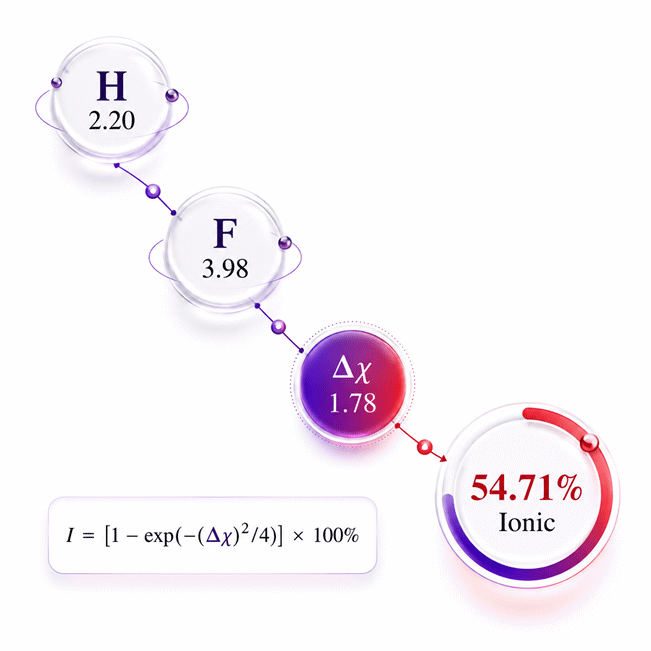
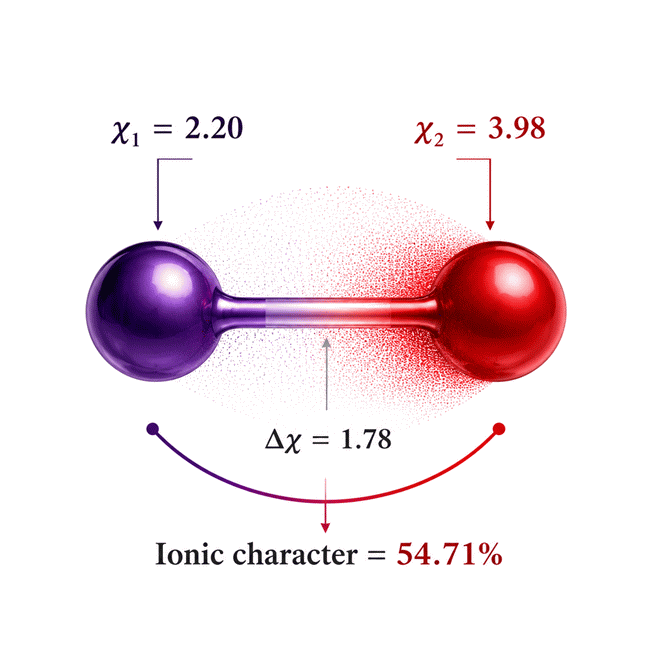
- The Pauling route uses the absolute electronegativity difference between bonded atoms.
- Its relationship is I = 100 × [1 − e−(Δχ/2)²], where Δχ indicates polarity.
- The dipole route compares the measured moment with the fully ionic moment.
- The fully ionic dipole moment depends on charge separation and bond length.
- Reverse solving can recover electronegativity difference, dipole moment, charge, or distance.
- Consistent scientific data is essential when comparing inputs or interpreting calculated results.
Ionic character forms a continuum rather than a fixed bond label. A higher percentage suggests greater charge separation. A lower value suggests more covalent electron sharing. Molecular geometry, polarization, resonance, and chemical surroundings can affect real behavior. Results support education, bond comparison, research screening, and early industrial review. They should not replace laboratory evidence or professional material approval. For reliable interpretation, identify the exact bond and select the matching method. Then review the molecule’s structure, data quality, and intended application before making a decision.
Assumptions used in this calculator
- Values follow the Pauling scale unless manual inputs specify otherwise.
- Electronegativity values are treated as fixed under standard reference conditions.
- Electronegativity-based results use the stated empirical Pauling relationship.
- Dipole-based results assume both moments use compatible units.
- Calculated dipole moment assumes complete charge separation across the bond.
- Bond length represents the effective distance between separated charges.
- Charge magnitude is expressed as a positive multiple of elementary charge.
- Unit conversions use recognized physical constants and exact SI definitions.
- Input values are assumed accurate, finite, and chemically appropriate.
- Intermediate calculations retain full precision before final display rounding.
- Results are estimates and may differ from laboratory measurements.
- Industrial decisions require independent verification by a qualified professional.
- This calculator does not replace testing, certification, or safety assessment.
Results are rounded for display.
Internal calculations use full precision.
Formulas Used in Percent Ionic Character Calculations :
Percent Ionic Character Formulas
1. Electronegativity Difference
2. Ionic Character from Electronegativity
3. Input Unit Normalization
4. Calculated Dipole Moment
5. Ionic Character from Dipole Moments
- χ₁ and χ₂
- Pauling electronegativity values of the bonded atoms.
- Δχ
- Absolute electronegativity difference.
- IP
- Percent ionic character calculated with the electronegativity method.
- ID
- Percent ionic character calculated with the dipole-moment method.
- du and dm
- Bond length in the selected unit and its value in meters.
- kd
- Length factor: 1 for m, 10−9 for nm, 10−10 for Å, and 10−12 for pm.
- μu and μC·m
- Dipole moment in the selected unit and its value in coulomb-meters.
- kμ
- Dipole factor: 1 for C·m, 3.33564 × 10⁻³⁰ for D, and 1.602176634 × 10⁻²⁹ for eÅ.
- μobs,C·m
- Measured dipole moment normalized to coulomb-meters.
- μcalc,C·m
- Calculated dipole moment for complete charge separation.
- q
- Charge magnitude expressed in elementary-charge units.
- e
- Elementary charge, equal to 1.602176634 × 10⁻¹⁹ C.
Reverse calculations isolate the missing variable from the same governing equation. Full precision is retained during calculation, and rounding is applied only to the displayed result.
Variables & Definitions
View a complete list of all variables used in this calculator, including definitions and units
Variables Used in Percent Ionic Character Calculations
| Symbol | Variable | Unit or Range | Purpose |
|---|---|---|---|
| χ1 | First atom electronegativity | 0 to 5 | Represents the Pauling electronegativity of the first bonded atom. |
| χ2 | Second atom electronegativity | 0 to 5 | Represents the Pauling electronegativity of the second bonded atom. |
| Δχ | Electronegativity difference | 0 to 5 | Shows the absolute difference between the two electronegativity values. |
| IP | Pauling ionic character | 0% to less than 100% | Expresses ionic character estimated from the electronegativity difference. |
| ID | Dipole-based ionic character | 0% to 100% | Expresses ionic character obtained from the ratio of dipole moments. |
| du | Bond length in the selected unit | pm, Å, nm, or m; greater than 0 | Provides the entered distance between the bonded atoms. |
| dm | Bond length in meters | m; greater than 0 | Provides the normalized bond length used in the dipole calculation. |
| kd | Length conversion factor | 1, 10−9, 10−10, or 10−12 | Converts the selected bond-length unit to meters. |
| μu | Dipole moment in the selected unit | D, eÅ, or C·m | Represents a dipole-moment value before unit normalization. |
| μC·m | Normalized dipole moment | C·m | Represents a dipole-moment value converted to coulomb-meters. |
| kμ | Dipole conversion factor | Depends on the selected moment unit | Converts D, eÅ, or C·m values to coulomb-meters. |
| μobs,C·m | Observed dipole moment | C·m; zero or greater | Represents the measured molecular dipole moment after normalization. |
| μcalc,C·m | Calculated dipole moment | C·m; greater than 0 | Represents the dipole moment expected for complete charge separation. |
| q | Charge magnitude | e; greater than 0 | Specifies the separated charge in elementary-charge units. |
| e | Elementary charge | 1.602176634 × 10⁻¹⁹ C | Provides the exact physical constant used to calculate dipole moment. |
Unit Conversion Table
Bond Length Unit Conversions
| Unit Group | Unit Name | Symbol | Equivalent in Meters | Used For |
|---|---|---|---|---|
| Bond Length | Meter | m | 1 m | SI bond-length normalization |
| Bond Length | Nanometer | nm | 1 × 10⁻⁹ m | Molecular-scale bond distances |
| Bond Length | Angstrom | Å | 1 × 10⁻¹⁰ m | Common chemical bond lengths |
| Bond Length | Picometer | pm | 1 × 10⁻¹² m | Precise atomic bond distances |
Dipole Moment Unit Conversions
| Unit Group | Unit Name | Symbol | Equivalent in Coulomb-Meters | Used For |
|---|---|---|---|---|
| Dipole Moment | Coulomb-Meter | C·m | 1 C·m | SI dipole-moment normalization |
| Dipole Moment | Debye | D | 3.33564 × 10⁻³⁰ C·m | Measured molecular dipole moments |
| Dipole Moment | Elementary Charge-Angstrom | eÅ | 1.602176634 × 10⁻²⁹ C·m | Charge-separation dipole moments |
Electric Charge Unit Conversions
| Unit Group | Unit Name | Symbol | Equivalent in Coulombs | Used For |
|---|---|---|---|---|
| Electric Charge | Elementary Charge | e | 1.602176634 × 10⁻¹⁹ C | Entered charge magnitude |
| Electric Charge | Coulomb | C | 1 C | Internal SI dipole calculations |
Ionic Character Unit Conversions
| Unit Group | Unit Name | Symbol | Equivalent in Decimal Form | Used For |
|---|---|---|---|---|
| Ionic Character | Percent | % | 1% = 0.01 | Displayed ionic character |
| Ionic Character | Decimal Ratio | I | 1 = 100% | Internal dipole-moment ratio |
Example Calculation
Given values
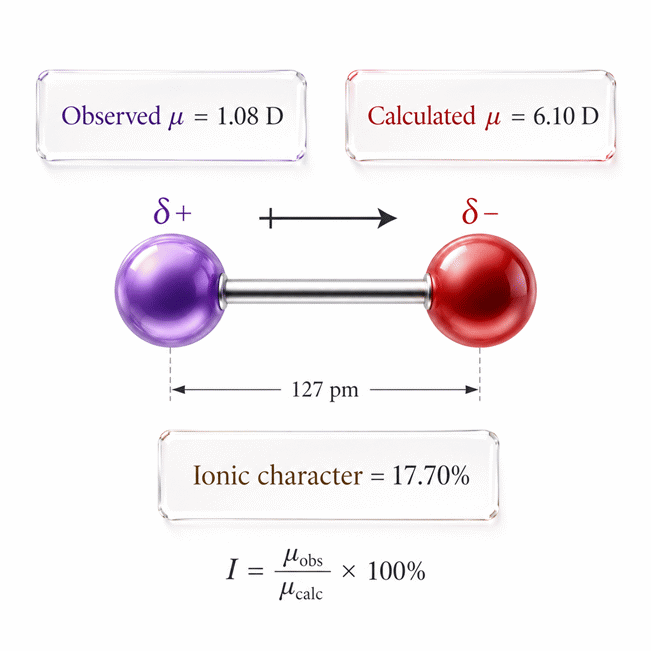
- Observed dipole moment: μobs = 1.08 D
- Bond length: d = 127 pm
- Charge magnitude: q = 1 e
- Elementary charge: e = 1.602176634 × 10⁻¹⁹ C
Formula
Solution
Calculated dipole moment: 6.10007 D
Percent ionic character: 17.70%
This calculation assumes complete separation of one elementary charge across 127 pm.
The bond length is converted to meters before calculating the reference dipole moment.
The calculated moment represents the dipole expected for a fully ionic bond.
The observed-to-calculated ratio gives an estimated ionic character of 17.70%.
Known values
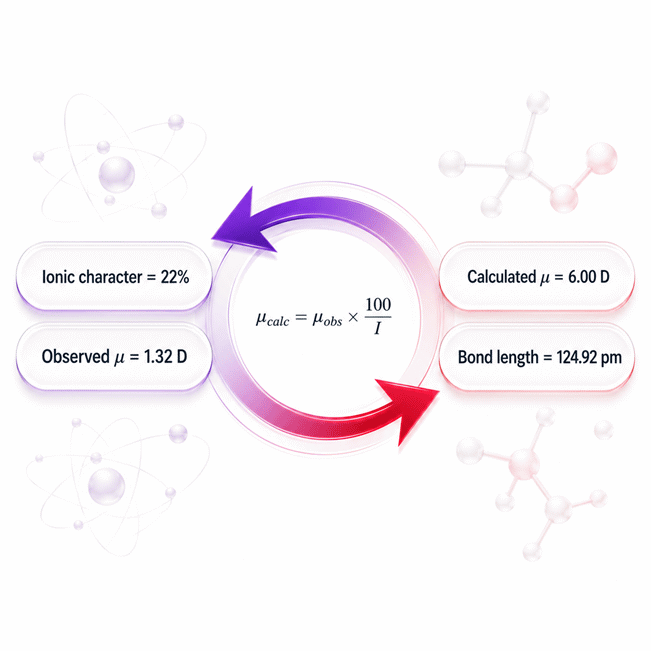
- Percent ionic character: ID = 22%
- Observed dipole moment: μobs = 1.32 D
- Charge magnitude: q = 1 e
- Unknown values: μcalc and d
Reverse formulas
Reverse solution
Calculated dipole moment: 6.00 D
Calculated bond length: 124.92 pm
The ionic percentage and observed moment first determine the fully ionic dipole moment.
The calculated dipole moment is converted from debye to coulomb-meters.
The charge-separation equation is then rearranged to isolate bond length.
Full precision is retained until the final displayed values are rounded.
Results are rounded for display.
Internal calculations use full precision.
Calculations Disclaimer
Why Percent Ionic Character Matters in Real Bond Analysis
Many readers see a bond percentage and assume it gives a final label. That shortcut can hide the bond’s real behavior. The Percent Ionic Character Calculator turns bond polarity into a clear numerical estimate. A Percent Ionic Character Calculator also compares two scientific calculation routes without guesswork. It supports learning, laboratory review, and early material screening. Yet every result needs careful interpretation. It describes ionic contribution within a selected scientific model. It does not make a bond fully ionic or fully covalent.Understanding the Ionic-Covalent Bond Continuum
A common problem begins with rigid bond labels. Textbooks often separate ionic and covalent bonds for easier learning. Real chemical bonds rarely follow such perfect categories. They usually sit somewhere between both extremes. A covalent bond shares electrons between atoms. Equal sharing represents an ideal nonpolar covalent bond. Unequal sharing creates bond polarity and partial charges. Greater charge separation gives the bond more ionic character. An ideal ionic bond assumes complete electron transfer. Real compounds can still show electron sharing and polarization. Even many crystalline salts contain measurable covalent contributions. The percentage therefore describes a continuum, not an absolute identity. This view improves chemical reasoning. It explains why two polar bonds can behave differently. It also prevents false conclusions from a single category. Students gain a clearer model of electron distribution. Engineers gain a useful screening value for material analysis.What the Percentage Really Describes
Another problem appears when users treat the percentage as a material composition. It does not show the percentage of ions inside a sample. It estimates how strongly one bond resembles ideal ionic charge separation. A low result suggests more balanced electron sharing. A higher result suggests stronger charge separation between bonded atoms. The value concerns the selected bond and calculation method. It does not automatically describe the entire molecule. Molecular shape can change the final dipole behavior. Several polar bonds may point in opposing directions. Their effects can partly or fully cancel. A molecule may therefore contain polar bonds without a large molecular dipole. Quick insight: bond polarity and molecular polarity are related, but never interchangeable.Text Infographic: From Electron Attraction to Bond Insight
Electron attraction difference → unequal sharing → partial charges → bond polarity → ionic character estimate → scientific interpretation This sequence shows the real reasoning path. Each stage adds useful context. Skipping a stage can produce a misleading conclusion. The final percentage becomes valuable when the full path remains visible.How Electronegativity Describes Unequal Electron Sharing
A frequent problem occurs when two atoms attract bonding electrons differently. The stronger atom pulls electron density toward itself. This shift creates partial negative and positive regions. Electronegativity offers a practical way to describe that attraction.Why Electronegativity Difference Matters
Electronegativity represents an atom’s attraction for shared electrons. The difference between bonded atoms reveals the expected polarity magnitude. A small contrast suggests more even electron sharing. A larger contrast suggests greater charge separation. The atom order does not change the ionic character estimate. Reversing the atoms changes the polarity direction only. The difference magnitude remains unchanged. This feature prevents duplicate answers for the same bond. Electronegativity values must belong to one consistent scale. Mixing scales can distort the comparison. Values can also depend on chemical environment and bonding state. The result should therefore remain an estimate of bond behavior. The electronegativity route works well during early analysis. It needs only the bonded elements and their accepted values. This makes it useful when experimental dipole data is unavailable. It also helps compare related bonds. A user can study how changing one atom affects expected polarity. This reveals periodic trends without requiring advanced laboratory data.Why the Pauling Model Gives an Estimate
The main challenge is converting attraction difference into a meaningful percentage. The Pauling model provides an empirical relationship for that purpose. Its behavior is smooth across the ionic-covalent continuum. A zero difference gives no ionic contribution within this model. Increasing the difference raises the predicted ionic character. The increase is nonlinear. Equal changes do not always produce equal percentage changes. The result approaches complete ionic character without reaching it at finite differences. This behavior reflects the model’s mathematical design. It also discourages unrealistic claims of perfect charge transfer. The method gives a useful theoretical estimate. It does not measure the bond directly. Local structure, polarization, and electron delocalization can shift real behavior. Solid-state surroundings can also affect charge distribution.When Electronegativity Alone Is Not Enough
A difficult case appears when similar differences produce different experimental behavior. Electronegativity cannot capture every structural effect. Bond length, coordination, oxidation environment, and molecular geometry also matter. Resonance can distribute electron density across several atoms. Metallic bonding can spread electrons through a larger structure. Multicenter bonds can resist simple two-atom descriptions. Highly polarizable ions may show greater covalent behavior than expected. Stop and check: a precise percentage can still come from a simplified model. Use this route for estimation, comparison, and education. Use experimental evidence for critical scientific decisions. That balanced approach protects both accuracy and usability.How Dipole Behavior Adds Experimental Insight
A practical problem appears when electronegativity gives only part of the picture. Measured dipole behavior can add evidence about real charge separation. This route connects observed polarity with an ideal ionic reference.From Charge Separation to Dipole Behavior
A dipole forms when positive and negative charge centers become separated. Greater charge separation generally produces a larger dipole moment. A longer separation can also increase the dipole effect. The fully ionic reference assumes complete elementary charge separation across the bond. The measured dipole reflects the system’s observed behavior. Comparing both values estimates how closely the bond approaches that ideal. This method can use experimental data. It may therefore reflect real bonding more directly. However, its quality depends on the selected data. Poor measurements or unsuitable assumptions can weaken the result. For a diatomic molecule, the molecular dipole represents the bond dipole. Polyatomic molecules require more care. Their total dipole combines several directional contributions. Using that total for one bond may create a false interpretation.Why Molecular Shape Can Change the Result
The hidden problem is direction. Dipole moments are vectors, not simple amounts. Their directions matter as much as their sizes. Two identical polar bonds can point in opposite directions. Their dipoles may cancel in a symmetric molecule. Other geometries can reinforce the same bond contributions. Molecular polarity can therefore change without changing each bond’s local polarity. Lone electron pairs can also affect molecular charge distribution. Bond angles influence the final vector sum. Structural changes may alter the observed dipole behavior. This is why the calculation route must match the chemical system. A simple bond model suits isolated diatomic bonds best. Complex structures need bond-specific data or a justified molecular model.Choosing the Right Scientific Route
Users often hesitate between electronegativity and dipole data. The correct choice depends on available evidence and the intended decision. Use electronegativity for a fast theoretical estimate. Use dipole behavior when reliable experimental information exists. Compare both routes only when their definitions describe the same bond. A difference between both results does not prove calculator failure. Each route measures a different aspect of bond behavior. The difference can reveal polarization, structural effects, or model limits.Text Infographic: A Clear Method Selection Path
Known bonded atoms → use electronegativity insight → estimate expected bond character Reliable bond dipole data → use dipole insight → estimate observed bond character Complex molecular geometry → review bond directions → avoid using total polarity blindly Critical industrial decision → verify with laboratory evidence → document the selected method This path keeps the calculation tied to its scientific purpose. It also reduces overconfidence from convenient data.How to Interpret Ionic Character Without Overclaiming
A major problem begins after the calculator displays a result. Users may search for one fixed boundary between bond types. Chemistry does not provide a universal boundary for every substance.Reading Low, Moderate, and High Ionic Character
Lower ionic character usually suggests stronger covalent behavior. Electrons remain more evenly shared between the bonded atoms. The bond may still be polar when the result is low. Moderate ionic character indicates meaningful unequal sharing. Such bonds often fit the polar covalent region. Their behavior may depend strongly on molecular surroundings and geometry. Higher ionic character suggests stronger charge separation. The bond behaves more like an ideal ionic interaction. It can still retain some electron sharing and polarization. These descriptions are more reliable than rigid labels. Classification thresholds vary across learning systems and scientific contexts. A boundary should guide interpretation, not replace chemical judgment. A single percentage also cannot describe every bulk property. Melting behavior depends on structure and intermolecular forces. Solubility depends on lattice and solvent interactions. Conductivity requires mobile charge carriers.What the Result Cannot Predict Alone
A common surprise appears when a high result fails to predict material behavior. Ionic character is only one part of the chemical picture. It cannot independently predict bond strength. Strong bonds can occur across several bonding types. Bond order, orbital overlap, and atomic size also matter. It cannot guarantee water solubility. Some ionic solids have very strong crystal lattices. Water may not separate their ions efficiently. It cannot confirm electrical conductivity. Solid ions may remain fixed inside a crystal. Conductivity can rise after melting or dissolving. It cannot replace a full safety review. Reactivity depends on the whole compound and its environment. Temperature, pressure, purity, and phase can alter performance.Three Questions That Protect the Interpretation
First, does the selected method match the available data? Second, does the value describe one bond or the whole molecule? Third, does the intended decision require experimental confirmation? These questions add little reading time. Yet they prevent many serious interpretation errors. They also make the result easier to explain and defend.Common Ionic Character Errors and How to Avoid Them
Most inaccurate results begin with a simple misunderstanding. The calculator may work correctly while the selected data describes something else. Finding that mismatch is often faster than repeating the calculation.Confusing Bond Polarity with Molecular Polarity
A polar bond does not guarantee a polar molecule. Molecular geometry controls how individual dipoles combine. Symmetry can cancel them completely. Users should identify the exact bond under review. They should then separate local bond behavior from total molecular behavior. This distinction becomes essential for polyatomic molecules.Treating the Percentage as an Absolute Bond Label
Another error is calling a bond purely ionic or purely covalent. Real electron distributions often resist exact categories. The percentage indicates relative ionic contribution within a model. Avoid turning a continuous result into a rigid verdict. Explain the dominant behavior and keep the remaining contribution visible. This language is more accurate and more useful.Mixing Theoretical and Experimental Meanings
The electronegativity route predicts expected behavior. The dipole route can reflect measured behavior. These values may differ for valid scientific reasons. Do not combine their inputs without understanding their roles. Do not assume one method must reproduce the other. Instead, investigate the chemical reason behind the difference. Possible causes include polarization and structural geometry. Charge delocalization may also influence the observed value. Experimental conditions can create further variation.Using Formal Oxidation State as Physical Charge
Oxidation state is a formal accounting tool. It does not always equal the real charge distribution. Treating both as identical can exaggerate charge separation. Partial charge describes electron density more realistically. Its value can depend on the measurement or computational method. The chosen charge concept must match the calculation purpose.A Fast Error-Checking Sequence
Pause when the result seems surprising. Confirm the selected chemical bond first. Then review the calculation route and data meaning. Check whether molecular geometry affects the interpretation. Finally, compare the conclusion with known chemical behavior. This sequence catches conceptual errors before they spread into reports. It also supports clearer teaching and safer technical communication.Using Ionic Character in Education, Research, and Industry
A final problem concerns action. A useful result must support a real decision. It should not remain an isolated number on a screen.Technical Uses in Chemistry Education and Research
Students can use ionic character to explore periodic trends. Changing one atom reveals how electron attraction affects bond polarity. The result turns an abstract idea into a visible pattern. Teachers can compare related bonds during lessons. The calculator supports discussion about model limits and molecular geometry. It also encourages students to explain results, not merely record them. Researchers can use the estimate during early screening. It may help identify bonds needing deeper computational or experimental study. It can also support quick checks during literature review. The result works best as one layer of evidence. Structural data can provide another layer. Spectroscopic or computational findings can add further confidence.Industrial Uses and Decision Boundaries
Industrial users often need fast screening before deeper testing. Ionic character can support early reviews of salts, ceramics, coatings, and chemical systems. It may also help explain polarity-related behavior. The estimate should never approve a material alone. Real service conditions can change performance. Moisture, temperature, contaminants, and mechanical stress all matter. Industrial checkpoint: use the result to narrow options, not certify final performance. A strong technical record should state the chosen method. It should also identify the bond and decision purpose. This makes later review easier and reduces communication errors.Separating Technical Evaluation from Service Selection
Technical evaluation asks whether the scientific method fits the chemical problem. Service selection asks whether the calculator provides clear operation and dependable support. Keeping both questions separate improves purchasing decisions. A reliable calculator should explain its calculation routes clearly. It should identify the scope of each result. Users should also have a direct path for reporting reproducible issues. Support should cover calculator operation and result interpretation. It cannot replace laboratory testing or professional approval. Digital access also cannot guarantee a material’s real-world performance. AxiCalculator is designed for clear, method-based bond analysis. Its interface supports theoretical and dipole-based reasoning. Users can select the route matching their available evidence. Use the calculator when you need a fast, readable estimate. Review the chemical context before making a critical decision. For technical questions, contact AxiCalculator support with the selected bond and method. This creates a faster path from uncertainty to a defensible result.Frequently Asked Questions
Can the calculator help compare element substitutions before a molecule is synthesized?
Should I use gas-phase, liquid-phase, or solid-state data for my calculation?
Why can a small electronegativity change produce a noticeable percentage change?
How should I share a result with a classmate or laboratory team?
How should engineers compare ionic character across polymorphs or coordination environments?
Can percent ionic character support force-field development or density-functional calculations?
What should a technical report include when ionic character affects a design decision?
Our engineers are here to help you get it right.