Cups to Pounds Conversion
- Last formula update:
Decimal & Rounding Policy
- Calculations use full-precision values without intermediate rounding.
- Displayed results are rounded to a maximum of six decimal places.
- Trailing zeros are removed to keep results clear and readable.
- Very small or large results may use scientific notation.
- Reverse calculations use the unrounded internal result to minimize conversion drift.
- Ingredient-density uncertainty may affect more digits than numerical rounding.
Valid range
- Volume must be a finite number greater than zero and no more than 1,000,000,000 selected volume units.
- Weight must be a finite number greater than zero and no more than 1,000,000,000 selected mass units.
- Custom density must be greater than 0 and no more than 100 g/mL.
- Only supported, dimensionally compatible volume, mass, and density units are accepted.
- At least one valid volume or weight value is required to perform a conversion.

Nolissa Vantford
Reviewers:
Solavyn Marbourne
Orvick Bexquell
Check our editorial policy
September 9, 2026
1.0.0
Initial calculator and formula release.
Our engineers are here to help you get it right.
Assumptions used in this calculator
- The selected ingredient uses a representative reference density.
- Custom density values are entered in grams per milliliter.
- US customary cups contain exactly 236.5882365 milliliters.
- One international avoirdupois pound equals exactly 453.59237 grams.
- The ingredient is evenly distributed throughout the measured volume.
- The ingredient contains no unlisted additions or substitutions.
- Temperature remains suitable for the selected ingredient density.
- Dry ingredients are measured without unintended compression or aeration.
- Liquid ingredients contain no trapped foam or excessive bubbles.
- Containers are level-filled unless the recipe specifies otherwise.
- Intermediate calculations retain full floating-point precision.
- Displayed rounding does not modify the stored calculation value.
- Critical applications require independent measurement with calibrated equipment.
Results are rounded for display.
Internal calculations use full precision.
Formulas Used in the Cups to Pounds Conversion :
Convert the Selected Volume to Milliliters
Calculate Ingredient Mass
Convert Grams to the Selected Weight Unit
Reverse Calculation from Weight to Volume
- Vinput: entered volume in the selected volume unit
- VmL: standardized volume in milliliters
- Voutput: calculated volume in the selected output unit
- minput: entered weight in the selected mass unit
- mg: standardized mass in grams
- moutput: calculated mass in the selected output unit
- ρ: ingredient density in grams per milliliter
- CV: milliliters represented by one selected volume unit
- Cm: grams represented by one selected mass unit
Variables & Definitions
View a complete list of all variables used in this calculator, including definitions and units
Variables Used in the Cups to Pounds Conversion
| Variable | Meaning | Base Unit | Role |
|---|---|---|---|
| Vinput | Volume entered by the user | Selected volume unit | Direct-calculation input |
| VmL | Volume standardized for density calculation | mL | Internal calculation value |
| Voutput | Volume obtained from a reverse calculation | Selected volume unit | Reverse-calculation result |
| minput | Weight entered by the user | Selected mass unit | Reverse-calculation input |
| mg | Mass standardized for unit conversion | g | Internal calculation value |
| moutput | Calculated ingredient weight | Selected mass unit | Direct-calculation result |
| ρ | Reference or custom ingredient density | g/mL | Links volume and mass |
| CV | Volume conversion factor | mL per selected unit | Converts volume to milliliters |
| Cm | Mass conversion factor | g per selected unit | Converts between grams and output mass |
Unit Conversion Table
Volume Unit Conversions
| Unit Group | Unit Name | Symbol | Equivalent in Milliliters | Used For |
|---|---|---|---|---|
| Popular Units | US Cup | cup | 236.5882365 mL | US recipes and household measurements |
| Popular Units | Milliliter | mL | 1 mL | Small metric recipe volumes |
| Popular Units | Liter | L | 1,000 mL | Large liquid quantities |
| Popular Units | US Tablespoon | tbsp | 14.78676478125 mL | Small cooking quantities |
| Popular Units | US Teaspoon | tsp | 4.92892159375 mL | Seasonings and small ingredients |
| Popular Units | US Fluid Ounce | fl oz | 29.5735295625 mL | Beverages and liquid ingredients |
| Popular Units | US Pint | pt | 473.176473 mL | Medium liquid quantities |
| Popular Units | US Quart | qt | 946.352946 mL | Recipe batches and containers |
| Popular Units | US Gallon | gal | 3,785.411784 mL | Large food-production quantities |
| Scientific Units | Cubic Centimeter | cm³ | 1 mL | Scientific and technical measurements |
| Scientific Units | Cubic Meter | m³ | 1,000,000 mL | Industrial bulk quantities |
Mass Unit Conversions
| Unit Group | Unit Name | Symbol | Equivalent in Grams | Used For |
|---|---|---|---|---|
| Popular Units | Pound | lb | 453.59237 g | US ingredient weight |
| Popular Units | Ounce | oz | 28.349523125 g | Small US ingredient weights |
| Popular Units | Gram | g | 1 g | Metric recipes and kitchen scales |
| Popular Units | Kilogram | kg | 1,000 g | Large recipes and food production |
| Scientific Units | Milligram | mg | 0.001 g | Laboratory and trace measurements |
| Scientific Units | Metric Tonne | t | 1,000,000 g | Industrial bulk ingredients |
Density Unit Conversion
| Unit Group | Unit Name | Symbol | Equivalent in g/mL | Used For |
|---|---|---|---|---|
| Popular Units | Gram per Milliliter | g/mL | 1 g/mL | Ingredient volume-to-weight conversion |
| Scientific Units | Kilogram per Liter | kg/L | 1 g/mL | Metric material-density data |
| Scientific Units | Kilogram per Cubic Meter | kg/m³ | 0.001 g/mL | Scientific and industrial density data |
| Scientific Units | Gram per Cubic Centimeter | g/cm³ | 1 g/mL | Laboratory material-density data |
Example Calculation
This calculation first converts the entered US cups to milliliters. The standardized volume is multiplied by the representative density of honey to obtain grams. Grams are then converted to pounds without rounding intermediate values. Actual weight may vary slightly with temperature, composition, and product brand.
The reverse calculation begins by converting pounds to grams. The mass is divided by the flour density to determine its volume in milliliters. That volume is then converted to US cups using the exact cup conversion factor. Flour compaction and measuring technique can cause the practical cup quantity to differ.
Results are rounded for display.
Internal calculations use full precision.
Calculations Disclaimer
Why Can the Same Number of Cups Produce Different Weights?
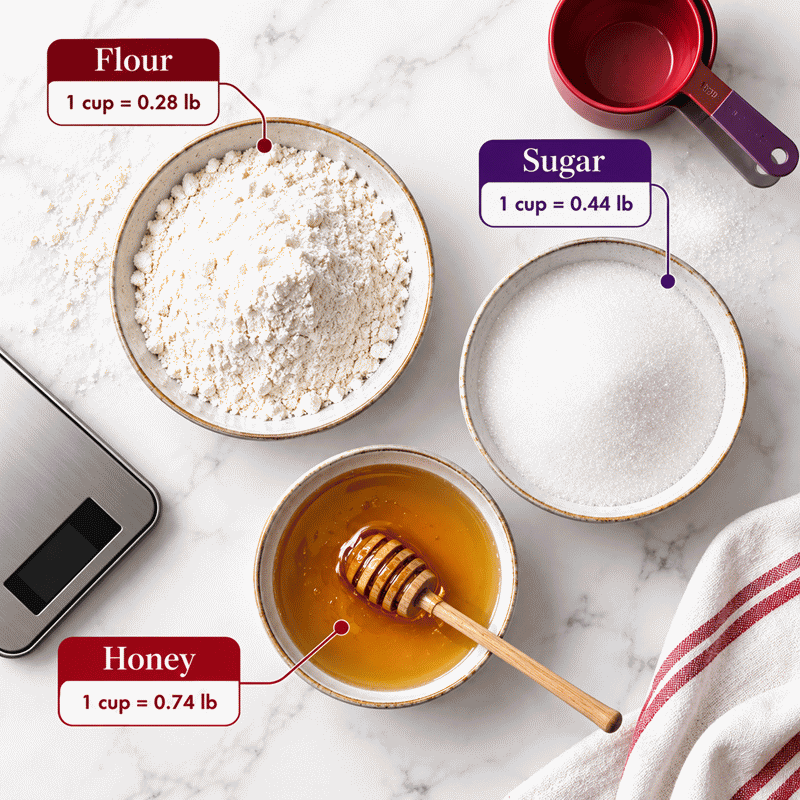
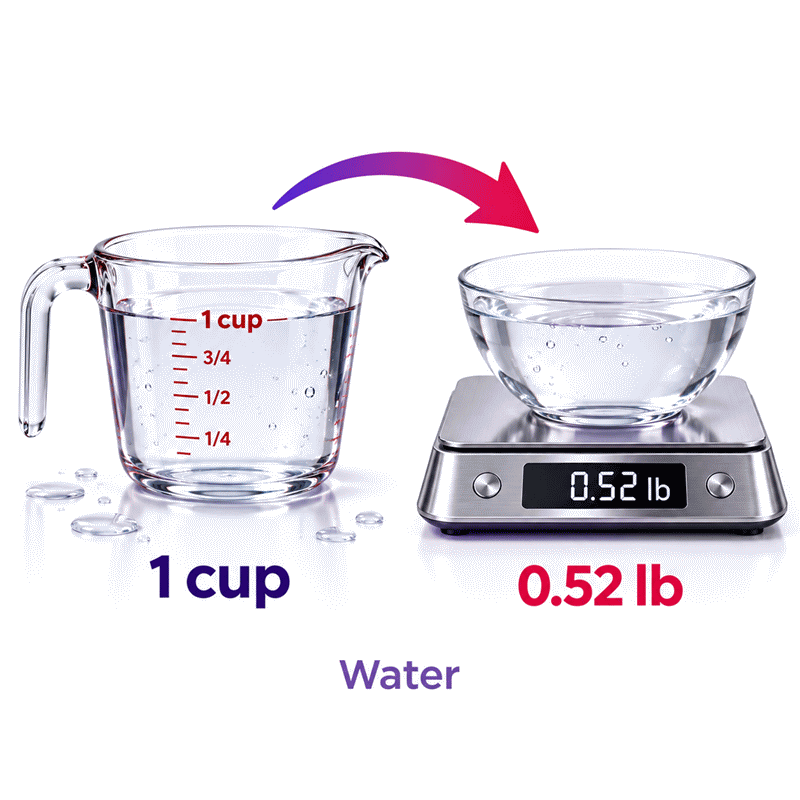
A recipe fails even when every number looks correct. The likely cause is simple: cups measure volume, while pounds measure mass. A Cups to Pounds Converter must know the ingredient before it can give a useful answer. One cup of water does not weigh the same as one cup of flour. Sugar, honey, butter, oats, and cocoa also occupy space in different ways.
Density explains the difference. A dense ingredient places more mass inside the same cup. A light or aerated ingredient places less mass there. That is why a universal statement such as “two cups equal one pound” only works for a limited material, such as butter under a familiar kitchen convention. It cannot be applied to every recipe.
AxiCalculator handles this problem by connecting each ingredient with an appropriate reference density. You choose the material and enter the known amount. The tool then standardizes the units and calculates the other measurement. This approach gives a much safer estimate than applying one fixed factor to every food.
How Does a Cups to Pounds Converter Work?
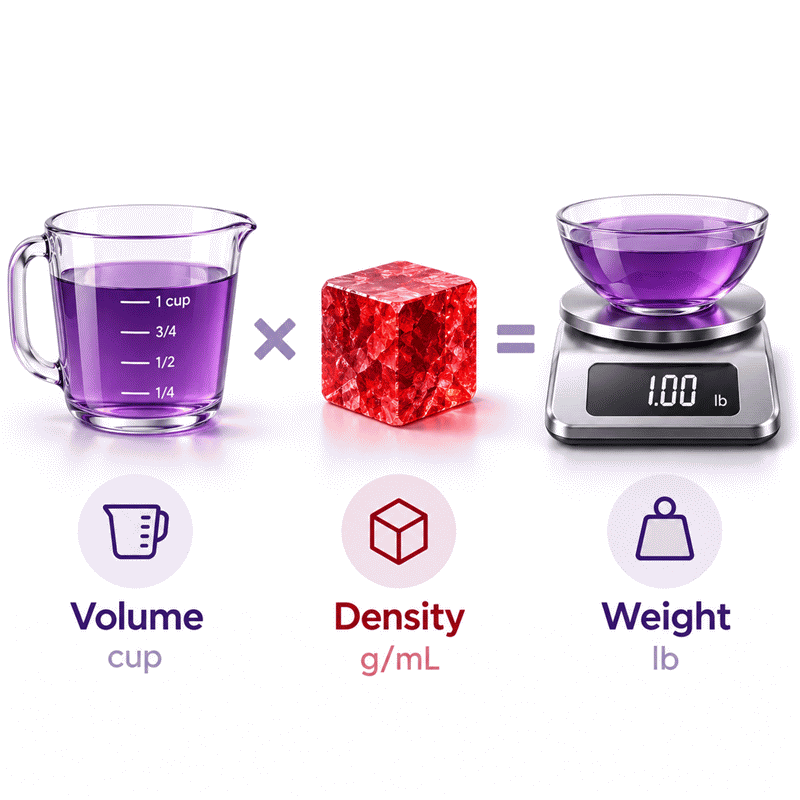
You may have cups in a recipe but only a scale marked in pounds. The converter solves that mismatch in three clear steps. It converts the selected volume into milliliters. It multiplies that volume by ingredient density to obtain grams. It then converts grams into pounds or another selected mass unit.
The same process works in reverse. When weight is known, the calculator converts it to grams. It divides that mass by density to obtain milliliters. The milliliter value is then expressed in cups, tablespoons, liters, or another compatible volume unit.
The Essential Difference Between Volume and Weight
Volume describes occupied space. Weight in everyday recipes describes how heavy the measured ingredient is. These ideas are connected, but they are not interchangeable. A cup can hold equal volumes of flour and honey, yet the honey weighs far more. This is not a calculator error. It is a physical property of the materials.
Why Ingredient Density Controls Every Result
Density is the bridge between volume and mass. For liquids, density often changes with temperature and composition. For dry foods, the calculator uses bulk density because the spaces between particles are part of the measured cup. Grinding, sifting, settling, moisture, and packing can all alter that value.
Which Cup Standard Should Your Recipe Use?
A result can be wrong before the ingredient even enters the calculation. “Cup” is not identical in every measurement system. The default US customary cup contains 236.5882365 milliliters. A metric cup commonly contains 250 milliliters. Using a metric cup where a US cup was intended increases the volume by about 5.67 percent.
US Customary Cups and Metric Cups Are Not Interchangeable
Read the recipe’s origin and unit style. US recipes commonly pair cups with tablespoons, teaspoons, ounces, and Fahrenheit. Metric recipes often use grams, milliliters, and Celsius. A printed cup supplied with a product may also use a manufacturer-specific capacity. Check its marking before relying on it.
How to Identify the Measurement System in a Recipe
Look for supporting units. If the recipe uses fluid ounces and pounds, select US customary volume. If it uses 250 mL as one cup, select a metric cup or enter milliliters directly. This quick check prevents an error that can affect every ingredient in the batch.
How to Convert Cups to Pounds Without Guessing
A bag of flour is running low, and you need to know whether it can finish the recipe. Start with the exact ingredient, not an average for “dry food.” Choose all-purpose flour, bread flour, cake flour, sugar, butter, water, or the closest available material. Different forms of the same food can still require different densities.
Select the Exact Ingredient Before Entering Volume
Granulated sugar and powdered sugar are not interchangeable in a density calculation. Packed brown sugar differs from loosely filled brown sugar. Sifted flour differs from flour pushed into a cup. Match the calculator label to the recipe’s wording. If a verified product density is available, the custom-density option provides a better project-specific estimate.
Enter Volume and Choose the Correct Unit
Enter a positive finite value. Then choose cups, milliliters, liters, tablespoons, teaspoons, or another supported volume unit. When you switch units, the physical quantity should stay constant. Only the displayed number changes. This makes it safe to compare different recipe systems.
Read Pounds, Ounces, Grams, or Kilograms
Select the mass unit that matches your scale or production sheet. Pounds are useful for US bulk quantities. Ounces help with smaller portions. Grams often provide clearer precision for baking. Kilograms suit larger batches. Keep extra digits during planning, then round only as required by your equipment.
How Can You Convert Pounds Back to Cups?
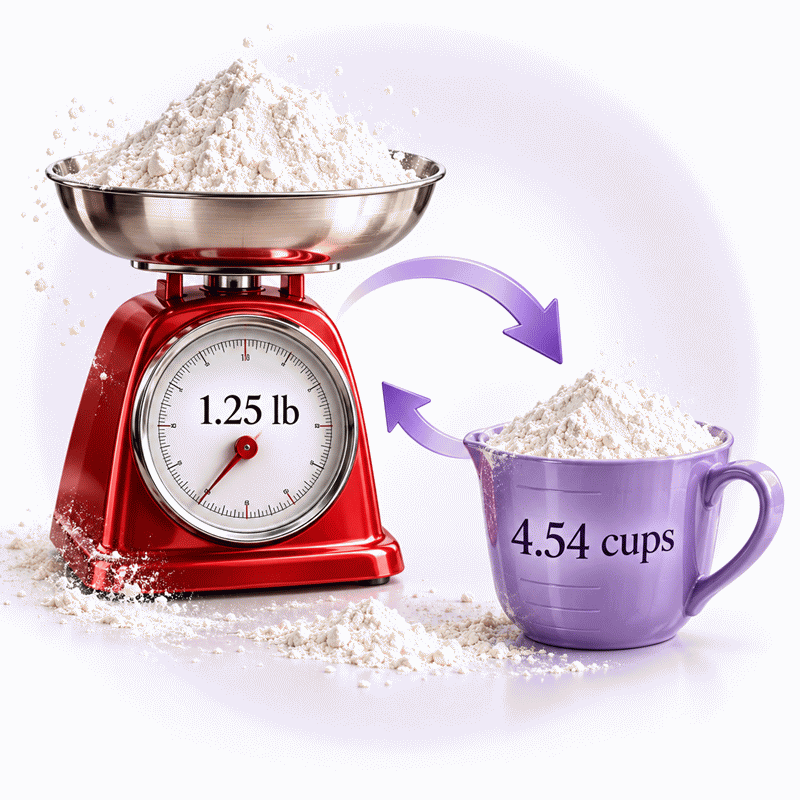
You have a partial package marked by weight, but the recipe asks for cups. Enter the weight instead of volume. A bidirectional calculator recognizes the edited field and solves the unknown measurement. The ingredient selection remains essential because the same pound occupies a different volume for every density.
Use the Same Ingredient Density for Reverse Solving
Changing density between the direct and reverse steps produces an apparent mismatch. Keep the ingredient, form, and packing condition consistent. One pound of packed brown sugar cannot be checked by reversing it with the density of loose powdered sugar.
Check the Reversed Result for Conversion Drift
A sound conversion should return close to the starting value when reversed with the same constants. Small display differences can appear because visible results are rounded. The internal calculation should retain full precision so repeated conversions do not accumulate avoidable error.
What Changes the Weight of a Cup in Real Kitchens?
Two people follow the same recipe and get different dough textures. Their cups may contain different masses. Volume tools are convenient, but the filling method matters. A scooped cup of flour can trap, remove, or compress air. A liquid may contain foam. A sticky ingredient can remain on the utensil.
Packing, Scooping, and Leveling Dry Ingredients
For flour, spooning into the cup and leveling often produces a lighter, more repeatable fill than pushing the cup into a bag. Brown sugar may intentionally require packing. Powdered sugar may be sifted or unsifted. Follow the recipe’s wording because each method changes bulk density.
Temperature, Moisture, and Ingredient Formulation
Honey flows and measures differently when warm. Oils expand slightly as temperature rises. Flour absorbs moisture from the environment. A brand may mill particles more finely or add ingredients that change density. The calculator therefore provides a reasoned estimate, not a laboratory certificate for an unknown batch.
Which Ingredients Need the Most Care?
A quick conversion is most tempting when an ingredient is hardest to measure. Unfortunately, those ingredients often show the greatest variation. Powders, flakes, sticky syrups, and ingredients with large air spaces deserve special attention.
Flour, Cocoa, Oats, and Powdered Sugar
These materials settle, compress, and hold air differently. A cup of rolled oats contains visible spaces. Cocoa can form lumps. Powdered sugar compacts easily. Flour changes with the scooping method. Use the exact ingredient choice and avoid pressing it unless the recipe explicitly requires packing.
Honey, Oil, Milk, and Other Liquids
Liquids are generally easier to fill consistently, but they still have distinct densities. Honey is much denser than oil. Milk varies with fat and solids. Read liquid volume at eye level and allow foam to settle. For a sticky product, account for material left inside the cup when accuracy matters.
How Should You Use Results for Recipe Scaling?
A small rounding choice becomes large when a recipe is multiplied many times. Convert the original quantity first. Scale the unrounded mass, then round once for the available scale. This order limits cumulative error and keeps ingredient ratios stable.
Home Baking and Everyday Cooking Decisions
For home use, a density-based result is usually a practical starting point. It can tell you whether a package is large enough, convert an unfamiliar recipe, or help divide ingredients. For sensitive baking, place the bowl on a scale, tare it, and weigh the calculated mass directly.
Commercial Food Preparation and Batch Verification
Production teams should measure the actual bulk density of the current ingredient lot. Use a defined filling procedure, a known container volume, and a calibrated scale. Record temperature and packing conditions. Compare the observed value with the reference before scaling a large batch. Supplier specifications and internal quality controls should govern final production decisions.
Common Conversion Mistakes That Change the Recipe
The first mistake is treating cups and pounds as units of the same dimension. The second is ignoring the ingredient. The third is mixing US and metric cups. Other common errors include using liquid density for a dry product, confusing fluid ounces with mass ounces, rounding after every step, and selecting packed density for a loose fill.
Another error is copying a value from a chart without reading its measurement method. A flour chart may use spooned-and-leveled flour, while the user scoops directly from a container. Both numbers can be honest yet produce different results. Method labels matter as much as the displayed number.
How Can You Make the Result More Reliable?
Start with the correct ingredient and cup standard. Use a level measure. Avoid compressing powders unless instructed. Enter a verified custom density when available. Keep the same conditions during direct and reverse checks. For important work, compare the estimate with a physical measurement.
A scale provides the strongest final check because it measures mass directly. The converter remains valuable when translating recipes, planning purchases, estimating inventory, or understanding the relationship between units. It becomes most reliable when the input density reflects the material actually being used.
Build a Repeatable Measuring Routine
A repeatable routine is more useful than chasing an unrealistic number of decimal places. Use the same cup, filling method, leveling tool, and ingredient condition each time. Place the cup on a stable surface. For liquids, read the level at eye height. For powders, remove excess material with a straight edge instead of shaking or pressing the cup. If the recipe says “packed,” apply a consistent packing method rather than an undefined amount of force.
Record the result when developing a recipe. A short note such as “flour spooned and leveled” makes the measurement easier to reproduce later. This information is especially helpful when a recipe moves between home and commercial kitchens or between teams in different countries.
How Should Purchasing and Inventory Teams Read the Result?
An estimated recipe requirement is not always the same as the quantity that should be purchased. Containers retain sticky ingredients. Fine powders can spill. Packages may have fixed commercial sizes. Production also needs an allowance for quality checks, start-up losses, and expected waste. Convert the planned recipe volume to mass first, then apply a documented operational allowance separately. Keeping those steps separate makes the estimate easier to audit.
Do not hide the allowance inside ingredient density. Density should describe the material, while the purchasing factor should describe process needs. This distinction helps teams explain why a purchase order exceeds the theoretical recipe mass. It also makes later corrections easier when waste or yield data improves.
Separate Net Ingredient Mass from Package Quantity
A package label states net mass, not necessarily the exact usable mass after handling. Compare the calculated requirement with the package’s net quantity, then round upward to whole packages when partial packages cannot be ordered. Check storage life, available space, and future use before adding a large buffer. A transparent calculation supports better purchasing without pretending that a density estimate predicts every operational loss.
When Should a Kitchen Scale Replace Volume Conversion?
Use a scale when a small mass difference can change texture, structure, yield, nutrition data, cost, or process safety. Bread hydration, pastry ratios, commercial batches, laboratory preparation, and regulated labeling deserve direct measurement. A converter supports the decision, but it cannot observe the exact ingredient in your container.
Frequently Asked Questions
Can two recipes use different pound values for the same number of cups?
Why does my kitchen scale disagree with a cups-to-pounds result?
Should I convert every recipe ingredient from cups to pounds at once?
Can I use this conversion when buying ingredients in packaged pounds?
How should a food technologist establish a custom bulk density?
How can I validate a reverse pounds-to-cups calculation during production planning?
When is a density-based conversion unsuitable for an industrial food process?
Our engineers are here to help you get it right.