Cake Pan Converter
- Last formula update:
Decimal & Rounding Policy
- Calculations use full-precision values without rounding intermediate results.
- Displayed values are rounded only when necessary for clear and practical reading.
- The volume ratio may display up to twelve significant digits.
- Trailing zeros are removed unless they clarify the selected unit.
- Small values remain precise enough to prevent meaningful baking-scale errors.
- Exported results preserve the calculator’s validated numerical values.
Valid range
- Pan diameter, length, width, height, volume, and volume ratio must be finite numbers greater than zero and no greater than 1,000,000,000,000.

Nolissa Vantford
Reviewers:
Solavyn Marbourne
Orvick Bexquell
Check our editorial policy
September 9, 2026
1.0.0
Initial calculator and formula release.
Our engineers are here to help you get it right.
How Does a Cake Pan Converter Scale a Recipe for Another Pan?
A Cake Pan Converter compares the usable geometry of the recipe pan with the pan available in your kitchen, then returns the ratio needed to increase or reduce scalable ingredients. Enter internal dimensions, select the correct shape and units, and use the resulting multiplier consistently across the recipe.
- Measure every pan across its internal usable dimensions.
- Use full volume when the original and target heights differ.
- Use the combined capacity when several pans replace one pan.
- A ratio above 1 increases ingredients; a ratio below 1 reduces them.
- Do not multiply oven temperature or baking time by the volume ratio.
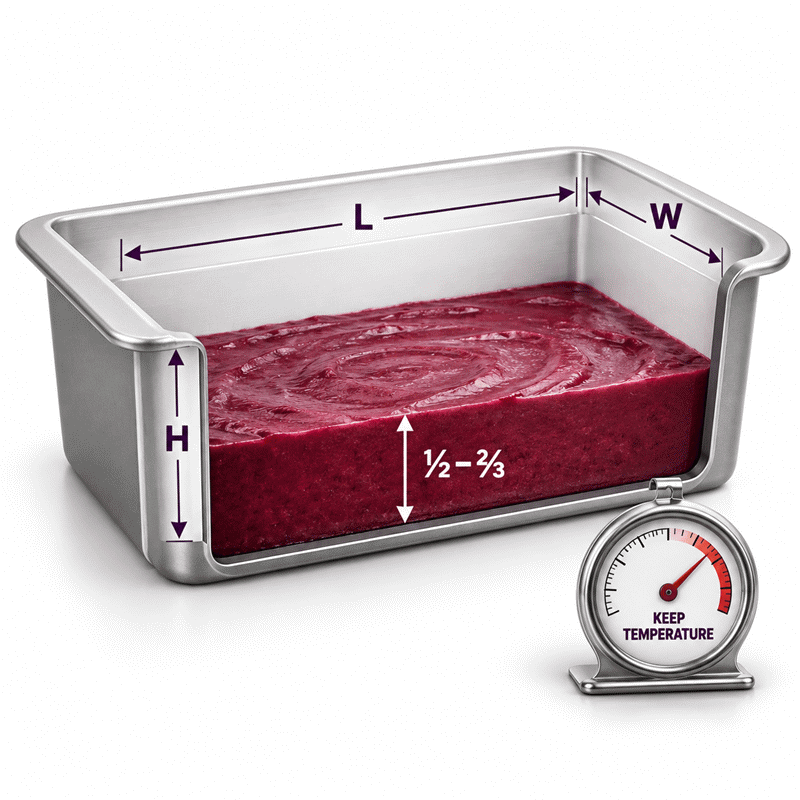
- Leave expansion space instead of filling a pan to full capacity.
- Measure partial eggs by weight after beating them evenly.
- Use measured capacity for Bundt, tapered, and decorative molds.
The Cake Pan Converter provides a dependable mathematical starting point, but pan material, wall shape, batter depth, and oven behavior still affect the bake. Check doneness using recipe-specific visual and physical cues.
Assumptions used in this calculator
- Pan dimensions represent internal usable measurements.
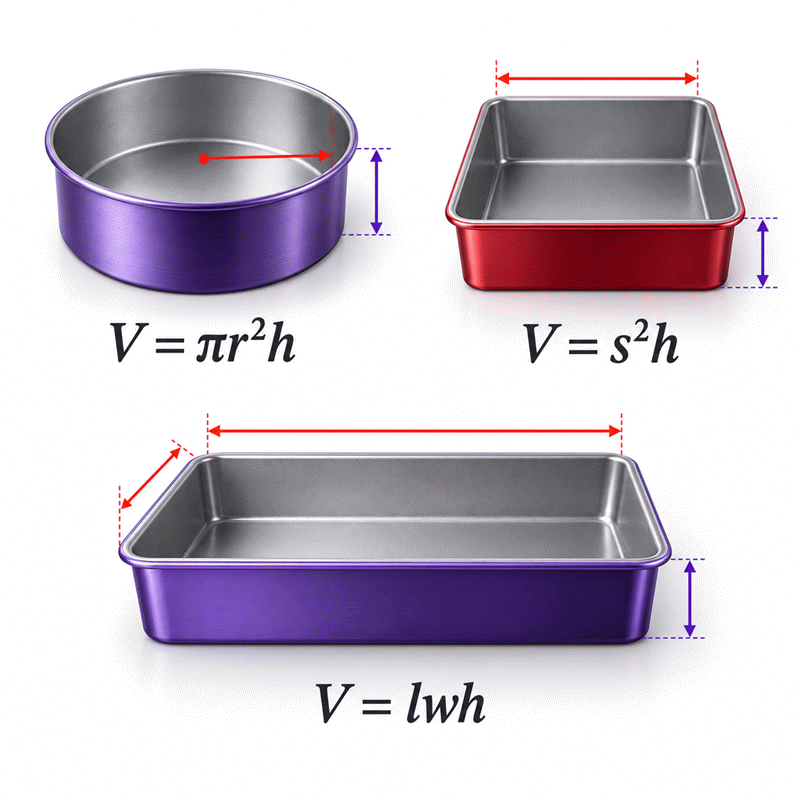
- Round pans are modeled as perfect cylinders.
- Rectangular pans are modeled as rectangular prisms.
- Square pans use equal length and width measurements.
- Pan walls are assumed to be vertical.
- Rounded corners and tapered sides are excluded.
- Both volumes use dimensionally compatible units.
- The ratio compares total theoretical pan volumes.
- Batter density remains unchanged after recipe scaling.
- Ingredient quantities scale linearly with pan volume.
- Usable fill level is selected by the baker.
- Baking time does not scale directly with volume.
- Results are estimates requiring practical baking judgment.
Results are rounded for display.
Internal calculations use full precision.
Formulas Used in Cake Pan Converter :
Round Pan Volume
Rectangular or Square Pan Volume
Pan Volume Ratio
Variable Definitions
- Vr represents the recipe pan volume.
- Vq represents a rectangular or square pan volume.
- Vy represents the available pan volume.
- d represents the internal diameter of a round pan.
- l represents the internal pan length.
- w represents the internal pan width.
- h represents the internal pan height.
- R represents the dimensionless pan volume ratio.
Variables & Definitions
View a complete list of all variables used in this calculator, including definitions and units
Cake Pan Converter Variables and Measurement Reference
| Variable | Meaning | Quantity Type | Accepted Units | Calculation Role |
|---|---|---|---|---|
| Vr | Recipe pan volume | Volume | mL, L, cups, fl oz, in³, cm³, m³ | Reference volume used in the ratio |
| Vq | Rectangular or square pan volume | Volume | mL, L, cups, fl oz, in³, cm³, m³ | Product of internal length, width, and height |
| Vy | Available pan volume | Volume | mL, L, cups, fl oz, in³, cm³, m³ | Target volume used in the ratio |
| d | Internal round pan diameter | Length | mm, cm, in, m | Determines the circular base area |
| l | Internal pan length | Length | mm, cm, in, m | First rectangular base dimension |
| w | Internal pan width | Length | mm, cm, in, m | Second rectangular base dimension |
| h | Internal pan height | Length | mm, cm, in, m | Converts base area into theoretical volume |
| R | Pan volume ratio | Dimensionless ratio | Ratio | Scales the original ingredient quantities |
Unit Conversion Table
Length Unit Conversions for Cake Pan Dimensions
| Unit Group | Unit Name | Symbol | Equivalent in Meters | Used For |
|---|---|---|---|---|
| Popular Units | Millimeter | mm | 0.001 m | Small pan dimensions and precise measurements |
| Popular Units | Centimeter | cm | 0.01 m | Metric pan diameter, length, width, and height |
| Popular Units | Inch | in | 0.0254 m | US pan diameter, length, width, and height |
| Scientific Units | Meter | m | 1 m | Base-unit conversion and unusually large dimensions |
Volume Unit Conversions for Cake Pan Capacity
| Unit Group | Unit Name | Symbol | Equivalent in Liters | Used For |
|---|---|---|---|---|
| Popular Units | Milliliter | mL | 0.001 L | Small pan capacity and precise batter quantities |
| Popular Units | Liter | L | 1 L | Metric pan capacity |
| Popular Units | US Legal Cup | cup | 0.24 L | Recipe-oriented approximate capacity |
| Popular Units | US Fluid Ounce | fl oz | 0.0295735295625 L | US liquid-volume reference |
| Popular Units | Cubic Inch | in³ | 0.016387064 L | Volume derived from inch-based pan dimensions |
| Scientific Units | Cubic Centimeter | cm³ | 0.001 L | Volume derived from centimeter dimensions |
| Scientific Units | Cubic Meter | m³ | 1,000 L | Base-unit calculations and unit normalization |
Example Calculation
The calculation first determines each pan's theoretical internal volume. Both volumes use cubic inches, so no additional unit conversion is required. Dividing the available pan volume by the recipe pan volume produces a dimensionless scaling ratio. Baking time must still be checked independently because it does not increase in direct proportion to batter volume.
The reverse calculation begins with the requested ratio rather than a completed target pan. It calculates the required target volume, converts that volume to units compatible with the height, and then solves the round-pan equation for diameter. A nearby commercially available size may be selected, but its actual volume ratio should be recalculated before scaling ingredients.
Results are rounded for display.
Internal calculations use full precision.
Calculations Disclaimer
How Does a Cake Pan Converter Prevent Thin Cakes and Batter Overflow?
You find a promising recipe, but your pan is a different size. Guessing can waste the batter. A Cake Pan Converter removes that uncertainty. It compares the recipe pan with the pan you own. The Cake Pan Converter then shows how much the ingredient amounts should change.
A larger base spreads the same batter into a thinner layer. That layer often bakes faster and may become dry. A smaller base creates a deeper layer. The center may remain wet while the edges become firm. Too much batter can also rise over the rim.
The useful result is a scale factor. A result above 1 means you need more batter. A result below 1 means you need less. A result of 1 means both pan setups have equal theoretical capacity. This simple result supports a quick choice without forcing you to compare charts manually.
Pan conversion improves consistency, but it does not replace observation. The shape, wall angle, oven, batter, and pan material still affect baking. Use the calculated amount as a reliable starting point. Then watch the cake as it bakes.
Choose the Recipe Pan and the Pan Available in Your Kitchen
A common mistake starts before any calculation. Bakers use the size printed on a package without measuring the pan. Printed sizes can be nominal. Rounded corners, sloping sides, and thick walls may reduce usable space.
Measure Internal Pan Dimensions Before Comparing Capacity
Measure from one inside edge to the opposite inside edge. For a round pan, pass through the center. For a rectangular pan, measure both internal sides. Measure height from the inside base to the usable upper edge. Do not include handles or the outer rim.
If the pan has strongly sloped walls, geometric capacity becomes an approximation. A practical water test can help. Fill the pan with measured water, then record its full capacity. Dry it completely before baking. Never treat full capacity as a safe batter level.
Select Round, Square, or Rectangular Pan Geometry
Choose the shape that matches the pan’s usable interior. A round springform pan usually behaves like a cylinder. A square pan is a rectangular form with equal sides. A standard tray uses separate length and width values.
Decorative molds need more care. A Bundt pan has a center tube. Its curved channels also reduce usable space. Diameter alone cannot describe that shape. A measured capacity is more dependable for these pans.
How Pan Shape Changes the Amount of Batter You Need
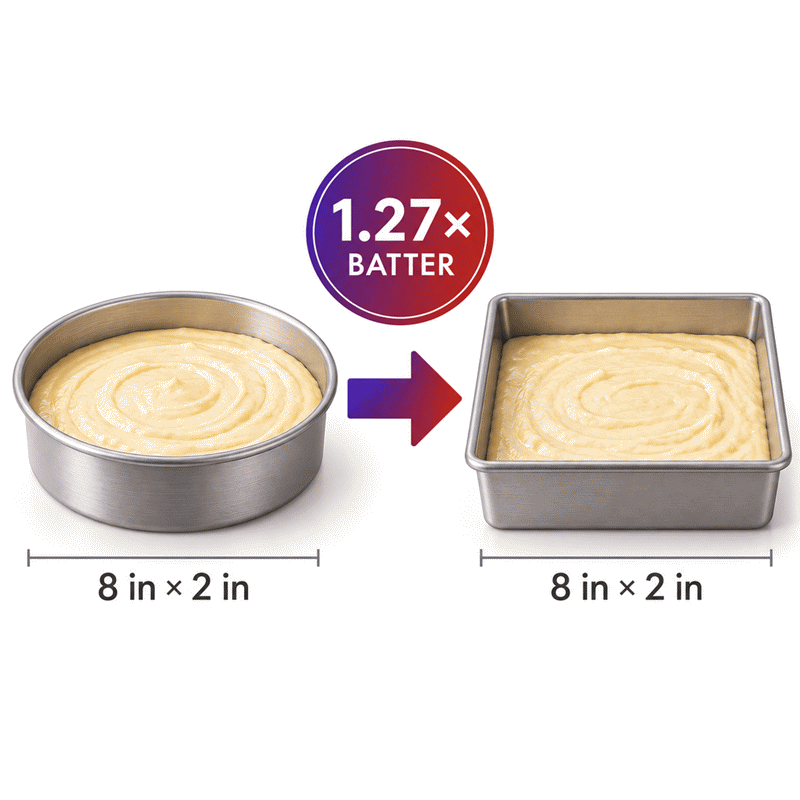
Two pans can share one printed width yet hold different amounts. A 9-inch square has more base area than a 9-inch round. That difference surprises many bakers. Matching one visible dimension is not enough.
Round Cake Pans and the Effect of Diameter
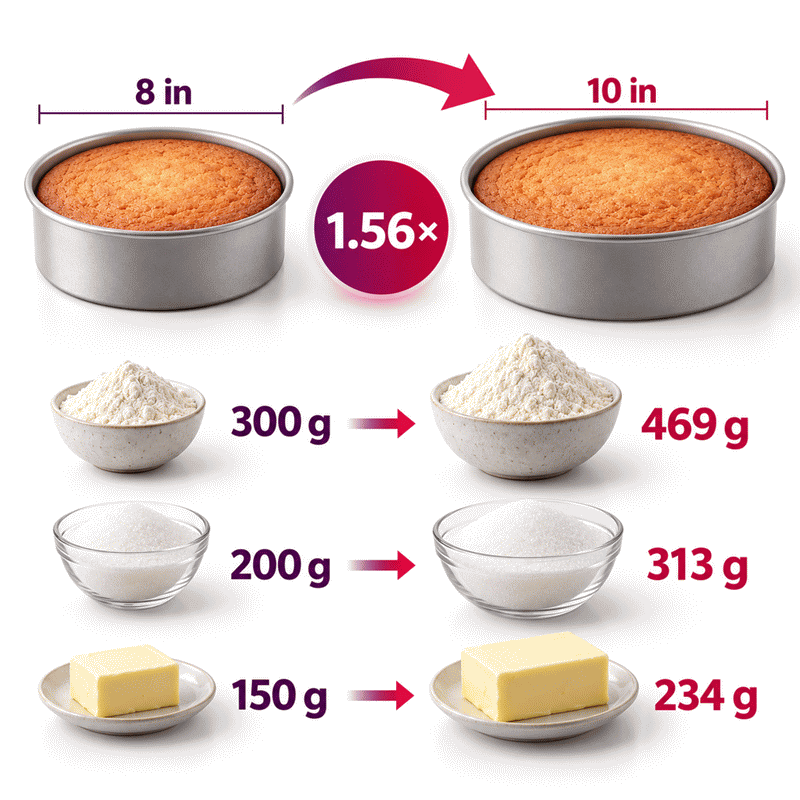
Round capacity rises with the square of the diameter. Moving from 8 inches to 10 inches is not a 25% capacity increase. At equal height, the new base has 56.25% more area. This is why direct diameter scaling fails.
Round pans are well suited to layer cakes. When the old and new heights match, the area ratio usually preserves layer depth. When heights differ, use full volume. This avoids producing a much taller or shallower layer by accident.
Square Pans and Equal-Side Capacity
A square pan uses the same value for length and width. Capacity changes with the side squared when height stays fixed. A small side increase can therefore create a noticeable need for extra batter.
Square pans often work well for brownies, bars, and snack cakes. Yet corner portions receive heat differently from center portions. A correct batter ratio cannot remove that normal baking effect.
Rectangular Pans for Sheet Cakes and Tray Bakes
A rectangular pan uses length, width, and height. It is easy to compare mathematically, but real pans may have rounded corners. Small corner differences rarely matter for ordinary home baking. Large commercial trays deserve direct capacity checks.
When several pans replace one tray, combine their capacities. The calculator should compare the total recipe-pan volume with the total target-pan volume. Ignoring the number of pans creates an incorrect multiplier.
Should You Compare Pan Area or Full Pan Volume?
Many conversion guides use base area. That works under one key condition. The original and target cake layers must have the same intended depth. If the depths differ, an area-only result can mislead you.
Use Area When Both Cake Layers Have the Same Height
Imagine changing from an 8-inch round pan to a 10-inch round pan. Both pans are 2 inches deep. If you want the same batter depth, comparing their circular areas is enough. Height appears in both volumes and cancels from the ratio.
This approach is fast and useful for equal-height layer pans. It is less suitable when moving between a shallow sheet pan and a deep cake tin.
Use Volume When Pan Heights Are Different
A 2-inch pan and a 3-inch pan can share the same diameter but not the same full capacity. Volume accounts for that difference. It also lets the converter solve mixed-shape comparisons with one consistent method.
Volume should still reflect intended use. Filling a deep pan to its rim is unsafe. If the recipe is designed for a shallow layer, using every cubic unit of a deeper pan may produce a cake that cooks poorly in the center.
How to Scale Cake Ingredients with the Pan Ratio
The ratio tells you how the target capacity compares with the original capacity. Multiply scalable ingredient amounts by that result. A ratio of 1.5 suggests using 150% of the original recipe. A ratio of 0.75 suggests using 75%.
Increasing a Recipe for a Larger Pan
Suppose a recipe uses 300 grams of flour. The target pan ratio is 1.4. Multiply 300 by 1.4. The new flour amount is 420 grams. Apply the same multiplier to sugar, butter, liquid, and other scalable components.
Check whether your mixer and bowl can handle the increased batch. A correct numerical conversion can still exceed equipment capacity. Very large increases may also benefit from separate batches.
Reducing a Recipe for a Smaller Pan
A smaller pan needs less batter. If the ratio is 0.64, multiply each scalable quantity by 0.64. Keep ingredient proportions consistent. Do not reduce only the flour or liquid.
Very small batches can behave differently. Mixing losses become more noticeable. A small quantity may also be difficult to measure with cups or spoons. Weight measurements improve control.
Handling Partial Eggs and Small Ingredient Quantities
Whole eggs create a practical challenge. A conversion may require 2.4 eggs. Beat the final egg until uniform. Weigh the beaten egg, then use the needed fraction. This is more consistent than estimating part of a yolk and white by sight.
Leavening and flavoring amounts may become very small. Use an accurate scale when possible. Large recipe changes may require recipe-specific testing because fermentation and leavening behavior are not always perfectly linear.
What Changes After Moving Batter to a Different Pan?
A correct ingredient multiplier does not guarantee the original baking time. Pan geometry changes the distance heat must travel. Batter depth is often more important than total batch size.
How Batter Depth Affects Baking Time
A shallow layer generally heats through faster. A deeper layer usually needs more time. The outside may set before the center. Lowering temperature is sometimes useful for unusually deep cakes, but this depends on the recipe.
Start checking earlier when the batter becomes shallower. Allow extra monitoring for deeper layers. Avoid opening the oven repeatedly during the early rise.
Why Oven Temperature Should Not Follow the Volume Ratio
Never multiply oven temperature by the pan ratio. A recipe baked at 350°F does not move to 525°F because the batter increased by 50%. Temperature controls heat intensity, not ingredient quantity.
Keep the stated temperature as the first test unless the recipe offers specific pan guidance. Adjust time and monitoring before making major temperature changes.
How to Check Doneness After a Pan Change
Use several signals. Look for a set center, expected surface color, and edges that behave as the recipe describes. A clean or lightly crumbed tester may help for many cakes. Some moist cakes require a different cue.
An instant-read temperature check can support consistent testing when the recipe provides a target. Do not rely on time alone after changing pan dimensions.
Common Cake Pan Conversion Problems and Practical Fixes
The most costly errors are usually simple. The wrong measurement, an incorrect pan count, or an unsafe fill level can undermine an otherwise correct calculation.
Prevent Batter Overflow in a Smaller Pan
Never assume full geometric volume equals safe batter capacity. Cake batter expands. Leave the space recommended by the recipe. If extra batter remains, bake it separately in a small mold or cupcake liner.
Place the pan on a suitable tray only when the recipe and pan allow it. A tray can catch small spills, but it cannot make an overloaded pan safe.
Avoid Thin, Dry Layers in a Larger Pan
If you use the original batter in a much larger pan, the cake becomes thin. It may finish sooner than expected. Scale the recipe or choose a smaller pan. Begin checking doneness early if you intentionally make a thinner layer.
Do not extend the original baking time automatically. That can remove too much moisture and harden the edges.
Manage Tapered, Bundt, and Decorative Pans
Complex pans cannot be described accurately by simple diameter and height. Use a measured capacity whenever possible. Compare the measured target capacity with the recipe pan capacity.
Greasing, release methods, and cooling also vary with mold design. Conversion solves quantity. It does not replace pan-specific preparation.
How to Choose the Best Replacement Cake Pan with Confidence
Start with shape, internal dimensions, and intended batter depth. Prefer a pan with a capacity close to the recipe requirement. If the capacity differs, use the calculated ratio to scale every suitable ingredient consistently.
Then assess the practical side. Confirm safe fill space. Consider the number of pans, oven clearance, pan color, wall material, and release method. Watch the first converted bake carefully and record the result.
AxiCalculator makes the numerical decision faster. It lets you compare round and rectangular forms, work across compatible units, and understand the required scale. The final choice still belongs to the baker because every recipe responds differently to depth and heat.
Use the result as a controlled starting point, not a promise of identical baking time. Measure carefully, keep ingredient proportions balanced, and test doneness with the cues suited to your recipe. That process turns a different pan from a problem into a manageable baking decision.
Frequently Asked Questions
Can I use the Cake Pan Converter when both pans have the same shape?
What should I do when the calculator gives a ratio below one?
Can I use the calculated ratio to change the baking time?
Why does my pan hold less batter than its calculated volume?
How should I compare one large pan with several smaller pans?
Should a professional baker use area ratio or volume ratio?
How can I reverse-calculate a missing pan diameter from volume?
Our engineers are here to help you get it right.