Butter Calculator
- Last formula update:
Decimal & Rounding Policy
- All butter conversions are calculated at full internal precision before any display formatting.
- Intermediate calculation values are never rounded, reducing cumulative conversion errors.
- Displayed results are rounded only when necessary to keep measurements practical and readable.
- Trailing zeros are removed when they do not add meaningful measurement precision.
- Very small or very large supported values may use scientific notation for clarity.
- Standard relationships such as 1 stick = 0.5 cup = 8 tbsp remain exact.
- Metric mass and volume results retain sufficient decimal precision for reliable reverse calculations.
Valid range
- Sticks: values must be finite, positive, and between 0.000000000001 and 1000000000 sticks.
- Cups: values must represent between 0.000000000001 and 1000000000 equivalent sticks.
- Tablespoons: values must represent between 0.000000000001 and 1000000000 equivalent sticks.
- Grams: values must represent between 0.000000000001 and 1000000000 equivalent sticks.
- Teaspoons: values must represent between 0.000000000001 and 1000000000 equivalent sticks.
- Ounces: values must represent between 0.000000000001 and 1000000000 equivalent sticks.
- Pounds: values must represent between 0.000000000001 and 1000000000 equivalent sticks.
- Milliliters: values must represent between 0.000000000001 and 1000000000 equivalent sticks.
- Zero, negative, non-numeric, infinite, or dimensionally incompatible values are not accepted.

Nolissa Vantford
Reviewers:
Solavyn Marbourne
Orvick Bexquell
Check our editorial policy
September 8, 2026
1.0.0
Initial calculator and formula release.
Our engineers are here to help you get it right.
How Does the Butter Calculator Make Butter Measurements Easier?
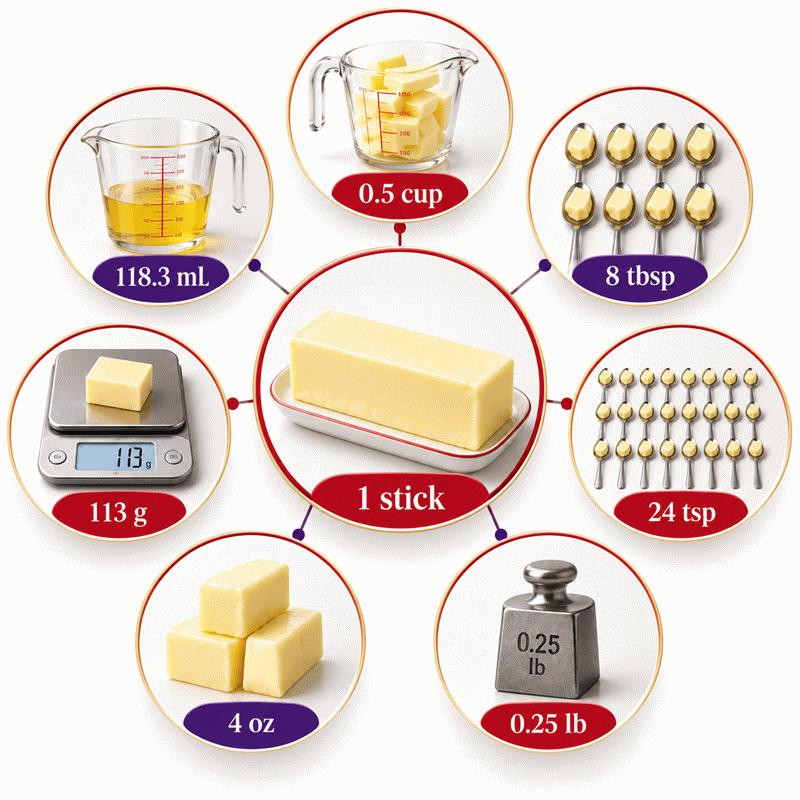
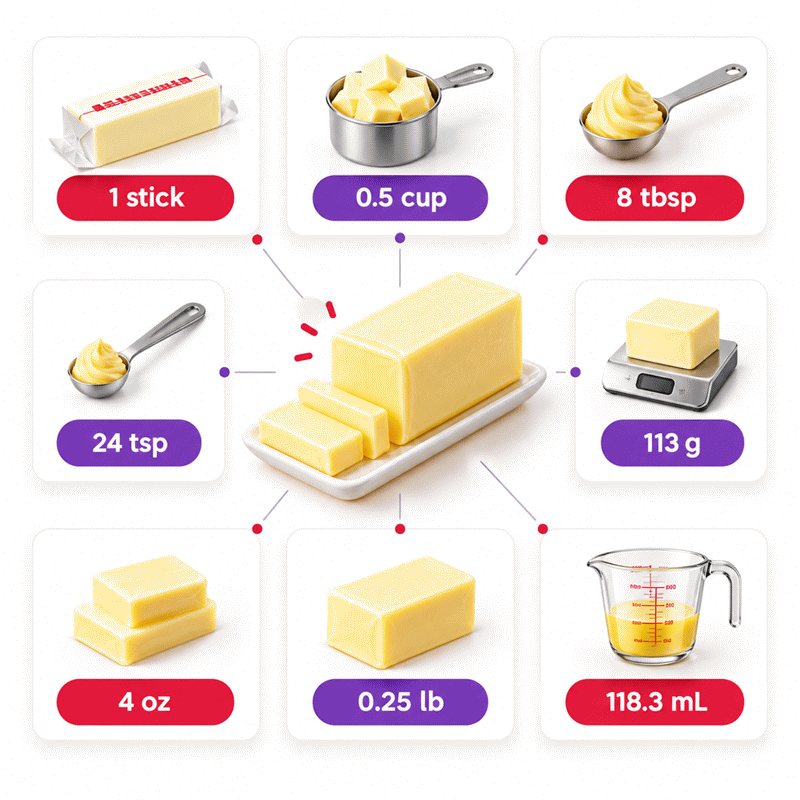
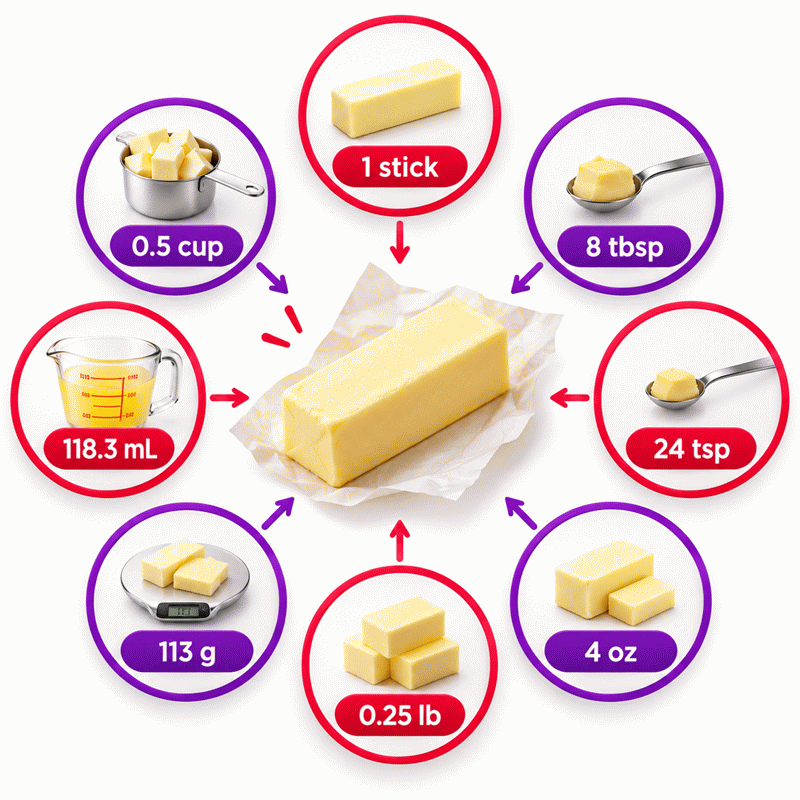
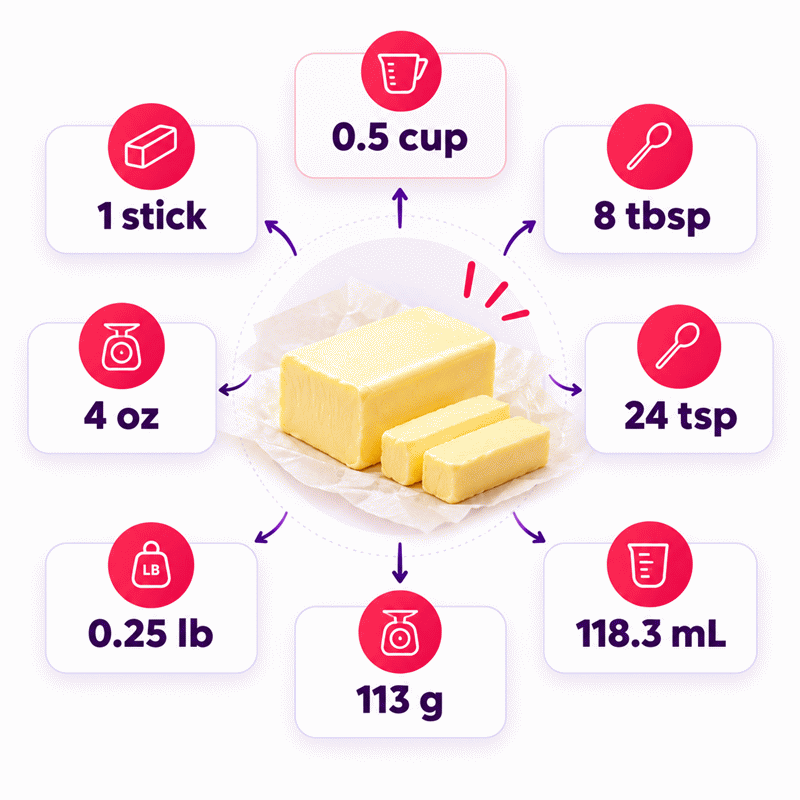
Butter Calculator quickly converts the amount of butter you have into the measurement your recipe actually uses. A standard US stick equals 1/2 cup, 8 tablespoons, 24 teaspoons, 4 ounces, 1/4 pound, and about 113 grams, making it easy to move between American and metric recipes without guessing.
- Enter a value in sticks, cups, tablespoons, teaspoons, grams, ounces, pounds, or milliliters.
- Use any editable measurement as the starting point for reverse conversion.
- Convert American stick measurements into practical metric quantities for international recipes.
- Use wrapper markings for simple portions or a kitchen scale for weight-based recipes.
- Remember that one US cup of butter equals two standard sticks.
- Keep weight ounces and fluid ounces separate because they describe different measurement types.
- Check the printed weight of international butter blocks instead of assuming they equal US sticks.
The Butter Calculator is especially useful when scaling recipes, working with unmarked butter blocks, or switching between recipes written in different measurement systems. Enter the quantity you know and use the equivalent measurement that is easiest to measure accurately in your kitchen.
Assumptions used in this calculator
- A standard U.S. butter stick is the reference measurement.
- One stick equals one-half U.S. customary cup.
- One stick equals eight U.S. tablespoons.
- One tablespoon equals three U.S. teaspoons.
- One stick equals four avoirdupois ounces.
- One stick equals one-quarter avoirdupois pound.
- Metric mass conversions use 113.3980925 grams per stick.
- Metric volume conversions use 118.29411825 milliliters per stick.
- Calculations preserve precision until the displayed result is formatted.
- Inputs must be finite, numeric, positive values.
- Selected units must remain dimensionally compatible with their measurement fields.
- Regional butter package sizes may differ from U.S. stick standards.
- Physical butter volume can vary slightly with temperature and handling.
Results are rounded for display.
Internal calculations use full precision.
Formulas Used in Butter Calculator :
Normalize the Source Measurement to Butter Sticks
Convert the Normalized Butter Amount to the Target Unit
Butter Unit Factors Used by the Calculator
| Unit | Symbol | Amount per Stick |
|---|---|---|
| Butter stick | stick | 1 |
| U.S. cup | cup | 0.5 |
| U.S. tablespoon | tbsp | 8 |
| U.S. teaspoon | tsp | 24 |
| Gram | g | 113.3980925 |
| Avoirdupois ounce | oz | 4 |
| Avoirdupois pound | lb | 0.25 |
| Milliliter | mL | 118.29411825 |
| U.S. fluid ounce | fl oz | 4 |
| Kilogram | kg | 0.1133980925 |
| Liter | L | 0.11829411825 |
- x is the source amount entered or edited by the user.
- fx is the number of source units in one stick.
- S is the normalized amount of butter in sticks.
- fy is the number of target units in one stick.
- y is the calculated amount in the target unit.
Variables & Definitions
View a complete list of all variables used in this calculator, including definitions and units
Butter Calculator Variables and Conversion Factors
| Variable | Meaning | Unit or Type | Role in Calculation |
|---|---|---|---|
| x | Source butter amount entered or edited by the user | Selected source unit | Starting quantity for forward or reverse conversion |
| fx | Source-unit amount equivalent to one butter stick | Source units per stick | Normalizes the source quantity into sticks |
| S | Normalized butter quantity | stick | Canonical internal value shared by every conversion |
| fy | Target-unit amount equivalent to one butter stick | Target units per stick | Converts the normalized quantity into the selected target unit |
| y | Calculated butter amount | Selected target unit | Final converted value displayed to the user |
Unit Conversion Table
Butter Unit Conversion Table
| Unit Group | Unit Name | Symbol | Equivalent in Sticks | Used For |
|---|---|---|---|---|
| Popular Units | Butter Stick | stick | 1 stick | Standard U.S. packaged butter measurement |
| Popular Units | U.S. Cup | cup | 2 sticks | Common recipe and baking volume measurements |
| Popular Units | U.S. Tablespoon | tbsp | 0.125 stick | Butter wrapper markings and smaller recipe portions |
| Popular Units | U.S. Teaspoon | tsp | 0.0416666667 stick | Small butter quantities and recipe adjustments |
| Popular Units | Gram | g | 0.00881849049 stick | Metric butter mass and precise baking measurements |
| Popular Units | Avoirdupois Ounce | oz | 0.25 stick | U.S. butter weight measurements |
| Popular Units | Avoirdupois Pound | lb | 4 sticks | Bulk butter packages and larger recipe quantities |
| Popular Units | Milliliter | mL | 0.00845350568 stick | Metric recipe volume measurements |
| Popular Units | U.S. Fluid Ounce | fl oz | 0.25 stick | U.S. customary volume measurements |
| Scientific Units | Kilogram | kg | 8.8184904874 sticks | Large metric butter mass quantities |
| Scientific Units | Liter | L | 8.45350567546 sticks | Large metric butter volume quantities |
Example Calculation
tablespoons = sticks × 8
teaspoons = sticks × 24
grams = sticks × 113.3980925
ounces = sticks × 4
pounds = sticks × 0.25
milliliters = sticks × 118.29411825
tablespoons = 2.75 × 8 = 22
teaspoons = 2.75 × 24 = 66
grams = 2.75 × 113.3980925 = 311.844754375
ounces = 2.75 × 4 = 11
pounds = 2.75 × 0.25 = 0.6875
milliliters = 2.75 × 118.29411825 = 325.3088251875
The entered stick quantity becomes the calculator's normalized butter amount.
Each result is generated by multiplying that amount by its unit-per-stick factor.
No intermediate value is rounded, which keeps all displayed units mathematically synchronized.
Changing any calculated field can also make that field the new source for reverse solving.
target amount = normalized sticks × target-unit factor
sticks = 2.5
tablespoons = 2.5 × 8 = 20
teaspoons = 2.5 × 24 = 60
ounces = 2.5 × 4 = 10
pounds = 2.5 × 0.25 = 0.625
milliliters = 2.5 × 118.29411825 = 295.735295625
Here, the grams field is edited directly instead of entering a stick quantity.
The calculator divides the gram value by the grams-per-stick factor to recover sticks.
The recovered stick value becomes the shared internal quantity for every remaining measurement.
This method allows any compatible displayed result to operate as a reverse-solving input.
every other result = normalized sticks × required-unit factor
Results are rounded for display.
Internal calculations use full precision.
Calculations Disclaimer
How Much Is a Stick of Butter When Your Recipe Uses Another Unit?
A recipe can become confusing the moment it asks for a stick of butter and your package shows only grams. The reverse also happens. You may have a kitchen scale, while the recipe lists cups or tablespoons. The quickest solution is to translate every measurement into the same butter quantity before you begin.
A standard US butter stick represents half a US cup. It also represents eight tablespoons and four ounces by weight. In metric terms, it is about 113 grams. Those relationships make the stick useful in American recipes, but they can create confusion elsewhere.
AxiCalculator removes that extra step. Enter the butter quantity you already know. You can then read the same amount in the other supported measurements. You do not need to restart the calculation when the known measurement changes.
The Fast Answer for One Standard US Butter Stick
The easiest reference to remember is simple: one standard US stick is half a cup, eight tablespoons, four ounces, or about 113 grams. If a recipe asks for two sticks, the quantity becomes one cup, sixteen tablespoons, eight ounces, or about 227 grams.
This relationship is especially useful when reading recipes from another country. A baker with a metric scale can work in grams. A cook using an American wrapper can work in tablespoon marks. Both are measuring the same intended butter quantity.
Why Butter Sticks Confuse International Recipes
The word “stick” is not a universal unit printed on every butter package. Many countries sell butter as 200 g, 250 g, or other blocks. A reader may therefore know exactly how much butter is in the refrigerator but still not know how much an American recipe expects.
The safest approach is to treat the stick as a US package measurement rather than a universal butter shape. Convert the requested quantity first. Then measure from the package you actually own. This small step prevents a surprisingly large recipe error.
How Do Butter Sticks Compare With Cups, Tablespoons, and Teaspoons?
Volume measurements are convenient when a kitchen scale is unavailable. They also appear often in older cookbooks and home recipes. The key is knowing how the common measures relate to the standard stick.
A single stick occupies half a US cup. That same stick contains eight tablespoons. Each tablespoon contains three teaspoons, giving twenty-four teaspoons per stick. These relationships make smaller portions easy to find without weighing the butter.
Converting Butter Sticks to Cups Without Guesswork
Cups become useful when a recipe uses larger quantities. Two sticks equal one cup. Four sticks equal two cups. This creates an easy mental pattern, but the most dangerous mistake is also obvious: one stick is not one cup.
If you accidentally treat one stick as a full cup, you double the intended butter. That can change spread, texture, richness, and handling in many baked foods. Check the quantity before mixing ingredients that cannot easily be separated again.
Reading Tablespoon Marks on a Butter Wrapper
Many standard US butter wrappers divide each stick into tablespoon portions. That means you can cut a stick directly from the wrapper when a recipe asks for a small amount. Four tablespoons represent half a stick. Two tablespoons represent a quarter stick.
Wrapper markings are especially convenient for cooking. They reduce the need to press solid butter into a spoon or measuring cup. Keep the wrapper aligned with the butter before cutting, because a twisted or displaced wrapper can make the marks misleading.
Working With Teaspoons for Small Butter Quantities
Teaspoons are useful when a recipe needs only a small butter portion. One tablespoon contains three teaspoons, so one full stick represents twenty-four teaspoons.
Small measurements are also where small cutting errors become more noticeable. If a recipe is sensitive to ingredient ratios, weighing the butter may be easier than estimating a tiny slice from a large block.
How Do You Convert Butter Sticks to Grams, Ounces, and Pounds?
Weight measurements remove much of the ambiguity created by package shape. They are particularly useful when working across countries. A standard US stick weighs four ounces, or one-quarter pound. In metric terms, it is roughly 113 grams.
Four sticks therefore make one pound. This is useful when buying or portioning a full American one-pound butter package. For recipes written in grams, the same quantity can be weighed directly without recreating the physical shape of a stick.
Why Grams Are Useful for Precise Baking
Grams make scaling straightforward. Put a bowl on a digital scale, tare it, and add butter until the desired mass appears. There is no need to compress softened butter into a cup or estimate a fraction of a block by eye.
Weight is also convenient when you divide or multiply a recipe. Instead of trying to visualize unusual fractions of a stick, calculate the required mass and weigh it directly.
Understanding Butter Ounces Versus Fluid Ounces
The word “ounce” creates an important trap. An ounce marked “oz” normally refers to mass in this context. A fluid ounce, written “fl oz,” represents volume. They are different quantities and should not be treated as interchangeable simply because both contain the word ounce.
For standard stick butter, four ounces by weight corresponds to one stick. When a source explicitly states fluid ounces, treat it as a volume measurement and keep that distinction visible.
Converting Bulk Butter Between Pounds and Sticks
Bulk quantities are easy to interpret once you remember the quarter-pound stick. One pound contains four standard sticks. Half a pound contains two. A quarter pound is one stick.
This is useful for large batches, food preparation, and recipes that switch between package quantities and individual sticks. Before cutting a bulk block, confirm its net weight rather than assuming the package follows a specific stick format.
How Should You Measure Butter for Reliable Baking Results?
The best measuring method depends on what information the recipe gives you. If it provides grams, a scale is usually the simplest choice. If it provides tablespoons and your stick has wrapper markings, cutting from the wrapper may be faster.
The goal is not to force every recipe into one unit. The goal is to preserve the intended quantity while using the tools available in your kitchen.
Using a Kitchen Scale When a Recipe Gives Weight
A scale is ideal when the recipe already lists butter by mass. Place the container on the scale and use the tare function. Add or remove butter until the required weight appears.
This is also convenient when working with a large unmarked block. You do not need to estimate its volume or recreate an American stick. You only need the required mass.
Cutting a Stick Accurately From Wrapper Markings
A wrapper can work like a simple measuring guide. If it clearly marks eight tablespoon sections, the halfway mark represents four tablespoons. The quarter-stick point represents two tablespoons.
Use a straight cut and keep the wrapper in its original position. If the butter has shifted inside the paper, use another measurement method instead of trusting displaced markings.
Measuring Softened or Melted Butter Without Losing Quantity
Softening butter does not remove mass. Melting it also does not magically reduce its mass. The practical problem is handling. Melted butter can remain on a pan, bowl, spoon, or microwave container, so the amount transferred into the recipe may be slightly lower.
If a recipe asks for a specific state of butter, follow that instruction for recipe performance. Convert the quantity separately from the preparation state.
US Butter Sticks vs Metric and European Butter Blocks
A metric block should not be identified as a certain number of sticks merely by looking at its shape. Check the printed net weight. A 250 g block contains more butter than two standard US sticks, because two sticks total roughly 227 g.
This difference matters most when a recipe uses multiple sticks. Small assumptions can accumulate into a noticeable change in the finished quantity.
Why a 250 Gram Block Is Not the Same as Two US Sticks
Two standard sticks are about 227 g. A 250 g block therefore contains roughly 23 g more butter. That difference may be acceptable in some casual cooking, but it is better to measure the intended quantity when baking depends on ingredient ratios.
You do not need to reshape the block. Weigh the amount you need and keep the remainder refrigerated according to the package instructions.
Converting International Recipes Before You Start Baking
Do the conversion before ingredients are mixed. This gives you time to notice whether the recipe uses US cups, metric quantities, sticks, or weight ounces.
A short check at the beginning is easier than correcting excess butter after flour, sugar, eggs, or other ingredients have already been combined.
How Can You Scale Butter for Half, Double, or Large-Batch Recipes?
Recipe scaling often creates awkward values. A recipe using one and a half sticks becomes three sticks when doubled. A recipe using three-quarters of a stick becomes three-eighths when halved.
Instead of performing several mental conversions, choose one measurement system and scale the butter there. Weight is often convenient for unusual quantities, while wrapper marks work well for simple fractions.
Scaling Odd Butter Amounts Without Mental Math
Odd values are where an interactive calculator becomes useful. You can enter the amount already listed in the recipe and read the equivalent quantity in a unit that is easier to measure.
This is also helpful for batch adjustments. If you need 1.75 times a recipe, calculate the new butter amount before you start measuring. Keeping the adjustment separate from preparation reduces mistakes.
Working With Quarter, Half, and Three-Quarter Sticks
Common stick fractions are easy to recognize. Half a stick equals four tablespoons. A quarter stick equals two tablespoons. Three-quarters of a stick equals six tablespoons.
These portions are useful for sauces, cookies, small cakes, and scaled recipes. If your butter does not come in a marked stick, convert the fraction to weight and use a scale instead.
Common Butter Measurement Mistakes That Can Change a Recipe
The largest errors usually come from mixing measurement systems, not difficult arithmetic. A cook may confuse a stick with a cup, treat fluid ounces as weight ounces, or assume every rectangular butter block is a US stick.
Check the unit before checking the number. “4 oz” and “4 fl oz” do not communicate the same type of measurement. Likewise, a 250 g block and a quarter-pound stick are not equal simply because both are sold as butter.
Confusing One Stick With One Cup
One cup contains two standard sticks. This is one of the easiest mistakes to make when moving quickly through a recipe.
If the recipe asks for one stick and you add one cup, you have doubled the intended amount. A quick conversion before mixing can prevent the entire batch from being affected.
Mixing Weight Ounces With Fluid Ounces
An ounce of mass and a fluid ounce of volume belong to different measurement types. When the recipe describes the weight of a butter stick, use weight ounces. When a volume unit is explicitly written, keep it in the volume system.
The abbreviation is a useful warning. “oz” and “fl oz” should never be treated as identical labels.
When Is Reverse Butter Conversion Most Useful?
Reverse conversion is valuable when your kitchen measurement does not match the recipe. Perhaps the recipe says “two sticks,” but your scale shows grams. Perhaps the recipe lists grams, while your butter wrapper is marked in tablespoons.
A two-way calculator lets the measurement you already know become the starting point. That removes the need to search for a separate converter every time the direction changes.
Converting Grams, Cups, or Tablespoons Back Into Sticks
You may enter grams to discover the equivalent number of sticks, or enter cups to see how much of a stick-based package is required. The same approach works with tablespoons and other supported measurements.
This is particularly useful with leftovers. If an opened butter block weighs a certain number of grams, you can quickly understand how many stick-equivalents remain for an American recipe.
Why Use AxiCalculator for Butter Measurements?
AxiCalculator is designed to remove unnecessary steps between the measurement you have and the measurement your recipe needs. The Butter Calculator supports common mass and volume units and updates connected values immediately.
Its two-way workflow is useful because cooking questions do not always move in one direction. Today you may need sticks to grams. Tomorrow you may need grams back to sticks. The measurement you edit can become the starting point.
The result is a practical workflow for home cooks, bakers, students, recipe developers, and anyone working with recipes from different measurement systems. Use the calculator at the start of preparation, confirm the unit printed in the recipe, and measure the butter using the kitchen tool that gives you the clearest result.
Frequently Asked Questions
Can I use the Butter Calculator when my recipe gives only grams?
What should I do when my butter comes in a 250 g block instead of sticks?
Can I measure part of a butter stick without using a kitchen scale?
Does the same stick conversion work for salted and unsalted butter?
Why should a professional baker prefer grams when scaling a recipe?
How should I handle a recipe that lists ounces without saying whether they are fluid ounces?
Can reverse solving introduce a different answer when I edit a calculated field?
Engineering Resources
Our engineers are here to help you get it right.