Bond Order Calculator
- Last formula update:
Decimal & Rounding Policy
- Bonding and antibonding electron counts are treated as whole numbers and are not rounded during calculation.
- Bond order is calculated using BO = (bonding electrons – antibonding electrons) / 2, so valid results normally occur in 0.5 increments.
- Intermediate values are kept at full precision to prevent rounding errors in forward and reverse calculations.
- Final Bond Order Calculator results are displayed without unnecessary trailing zeros, such as 2 instead of 2.0 and 2.5 when required.
Valid range
- Bonding electrons: Enter a non-negative whole number from 0 upward.
- Antibonding electrons: Enter a non-negative whole number from 0 upward.
- Bond order: Calculated as (bonding electrons – antibonding electrons) / 2 and normally expressed as an integer or half-integer value; zero or negative values indicate no positive net bonding in the simple molecular orbital model.

Xylena Morforde
Reviewers:
Cirelle Vossford
Zorven Lumquell
Check our editorial policy
September 1, 2026
1.0.0
Initial calculator and formula release.
Our engineers are here to help you get it right.
How Does the Bond Order Calculator Work?
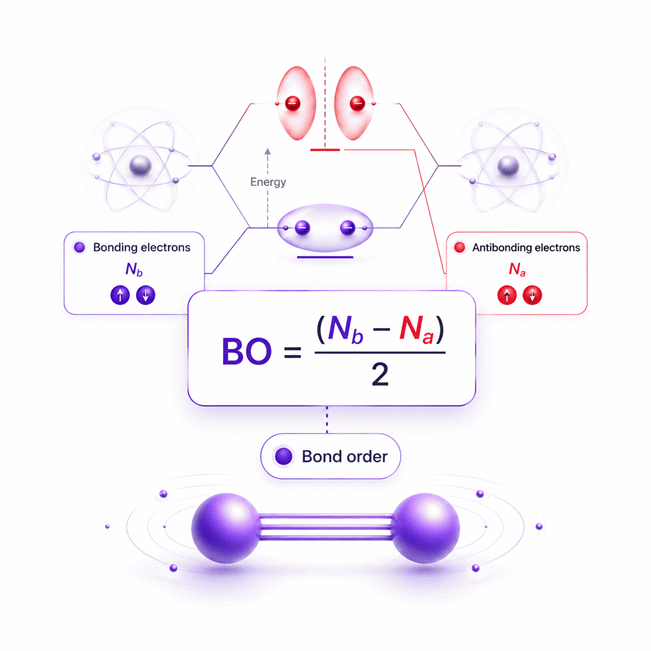
Bond Order Calculator results show the net bonding effect between two atoms using molecular orbital electron occupancy. The method compares electrons in bonding and antibonding molecular orbitals, then converts their difference into a bond-order value. A positive result indicates net bonding within this model, while zero means the bonding and antibonding contributions cancel.
The Bond Order Calculator can also work in reverse. When any two valid variables are known, the missing value can be solved from the same molecular orbital relationship.
- Bonding electrons increase net bonding, while antibonding electrons reduce it.
- Sigma and pi orbitals both contribute when their occupied states are relevant.
- Fractional values such as 0.5, 1.5, and 2.5 can be valid.
- Adding or removing one electron can change bond order by 0.5.
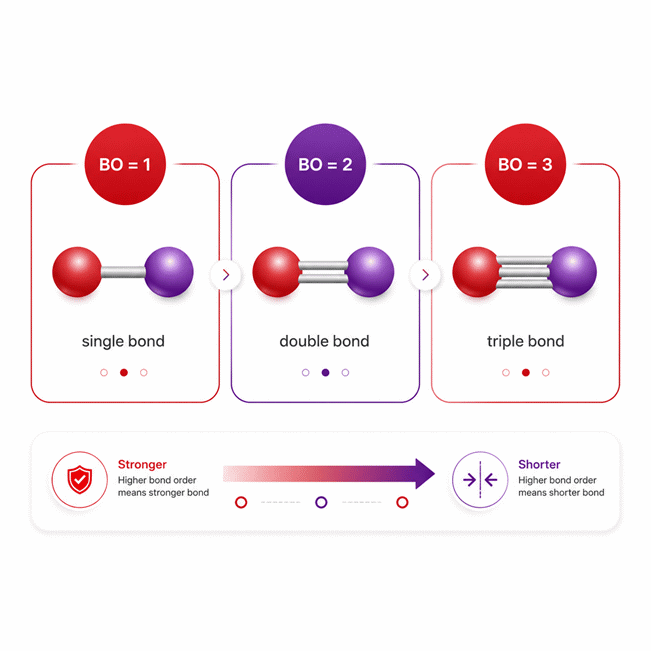
- Higher bond order usually suggests stronger, shorter bonds in comparable species.
- Bond order alone cannot predict exact bond energy, length, or magnetism.
- Correct orbital classification matters more than simply counting total electrons.
- Reverse solving helps verify electron assignments and detect inconsistent inputs.
Use the result as a molecular orbital descriptor, then interpret it within the molecule’s actual electronic structure.
Assumptions used in this calculator
- The calculator applies the molecular orbital bond order equation to supplied electron counts.
- Bonding and antibonding electron counts are assumed to be correctly identified.
- Electron counts are treated as non-negative whole numbers.
- Bond order is treated as a dimensionless molecular orbital quantity.
- Any two valid variables are assumed sufficient to solve the third.
- Intermediate values remain unrounded until the final displayed result.
- Half-integer bond orders are accepted when supported by electron counts.
- Negative bond order values are reported mathematically, not as stable bonds.
- The model does not replace advanced quantum chemical calculations or experiments.
- Results depend on accurate orbital assignments and electron configurations.
- Unusual, excited, or strongly correlated systems may require specialist analysis.
- Industrial decisions should not rely solely on this educational calculation.
- Users should verify critical results against validated scientific or engineering sources.
Results are rounded for display.
Internal calculations use full precision.
Formulas Used in Bond Order Calculator :
Bond Order Formula
- BO
- Bond order, a dimensionless value.
- Nb
- Number of electrons occupying bonding molecular orbitals.
- Nab
- Number of electrons occupying antibonding molecular orbitals.
- The calculator uses this molecular orbital relationship for both forward and reverse calculations.
- Reverse calculations isolate the missing variable algebraically from the same equation, so no additional independent formula is required.
- Bonding and antibonding electron counts are non-negative whole-number counts.
- No unit conversion is required because electron counts and bond order are dimensionless quantities.
- Intermediate calculations are not rounded; valid bond order results occur in integer or half-integer steps.
Variables & Definitions
View a complete list of all variables used in this calculator, including definitions and units
Bond Order Calculator Variables and Molecular Orbital Parameters
| Variable | Symbol | Description | Value Type | Unit | Calculation Role |
|---|---|---|---|---|---|
| Bond order | BO | Measures the net bonding contribution between atoms in the molecular orbital model. | Integer or half-integer | Dimensionless | Calculated from bonding and antibonding electrons or used to reverse-solve a missing electron count. |
| Bonding electrons | Nb | Number of electrons occupying bonding molecular orbitals. | Non-negative whole number | Electron count | Used with antibonding electrons to calculate bond order or solved from the other two variables. |
| Antibonding electrons | Nab | Number of electrons occupying antibonding molecular orbitals. | Non-negative whole number | Electron count | Subtracted from bonding electrons when calculating bond order or solved in reverse calculations. |
Unit Conversion Table
Electron Count Unit Reference
| Unit Group | Unit Name | Symbol | Equivalent in Electrons | Used For |
|---|---|---|---|---|
| Scientific Units | Electron count | e- | 1 e- = 1 electron | Bonding electrons and antibonding electrons |
Dimensionless Bond Order Unit Reference
| Unit Group | Unit Name | Symbol | Equivalent in Dimensionless Value | Used For |
|---|---|---|---|---|
| Scientific Units | Dimensionless bond order | 1 | 1 = 1 bond-order unit | Bond order calculated from bonding and antibonding electron counts |
Example Calculation
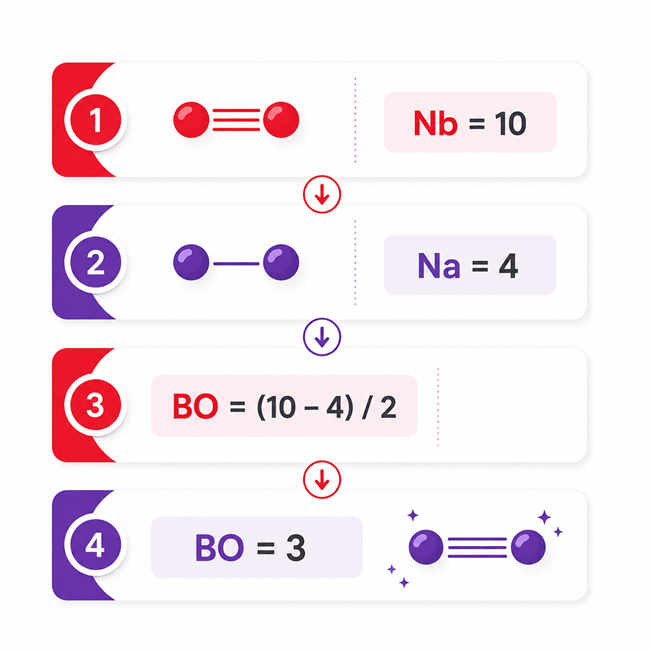
The molecule has 10 electrons in bonding molecular orbitals and 4 electrons in antibonding molecular orbitals.
Subtracting the antibonding electrons gives a net bonding contribution of 6 electrons.
Dividing this difference by 2 gives a bond order of 3.
Within the molecular orbital model, this represents a positive net bonding interaction.
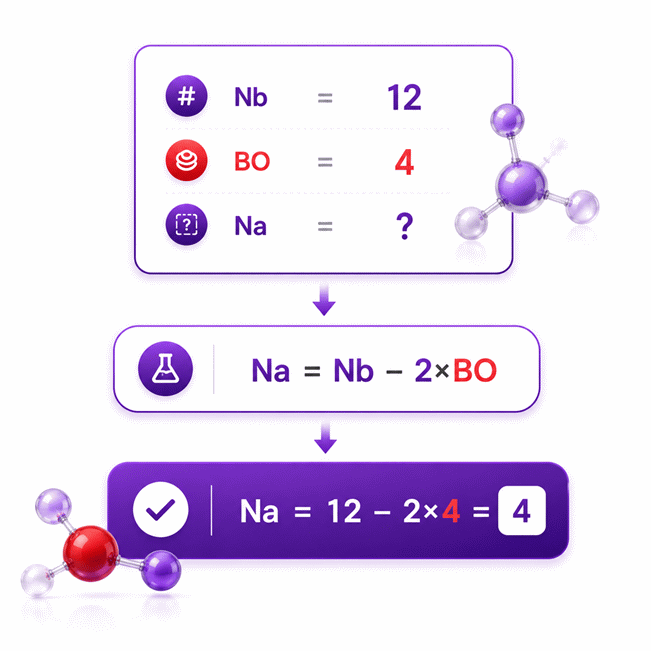
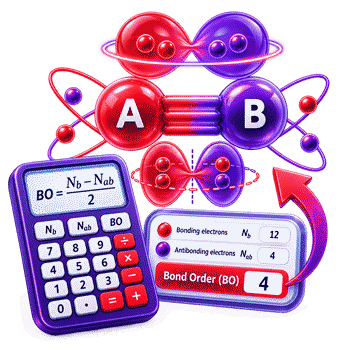
The bond order and bonding electron count are known, while the antibonding electron count is unknown.
The molecular orbital bond order equation is rearranged to isolate Nab.
Substituting 12 bonding electrons and a bond order of 4 gives 4 antibonding electrons.
Substituting all three values back into the original equation confirms a bond order of 4.
Results are rounded for display.
Internal calculations use full precision.
Calculations Disclaimer
What Is Bond Order in Molecular Orbital Theory?
A Bond Order Calculator answers one practical chemistry question very quickly. It shows the net bonding effect between two atoms. The Bond Order Calculator uses molecular orbital electron occupancy for this purpose. A higher positive value usually means stronger net bonding. A lower value shows weaker net bonding within the same model.
This idea becomes useful when an orbital diagram looks complicated. Electrons may occupy both bonding and antibonding molecular orbitals. These two groups do not affect a bond equally. Bonding electrons support the connection between two atomic centers. Antibonding electrons work against that stabilizing effect.
The key idea is therefore a balance. You do not simply count every electron present. You first identify where those electrons are located. Their orbital type determines their role in the calculation.
Bonding occupancy rises → net bonding tends to rise → bond order increases.
Antibonding occupancy rises → net bonding falls → bond order decreases.
Bonding Electrons: Which Electrons Increase Bond Order?
Bonding electrons occupy molecular orbitals that stabilize the bonded atoms. Their electron density supports attraction between the atomic centers. More bonding occupancy usually increases the net bonding effect.
The important word is “bonding,” not simply “occupied.” An occupied molecular orbital can also be antibonding or nonbonding. You must classify each occupied orbital before counting its electrons.
This distinction prevents a common mistake. Students often count all valence electrons as bonding electrons. That shortcut can produce a completely wrong result.
Quick check: identify the orbital first, then count its electrons.
Antibonding Electrons: Which Electrons Reduce Bond Order?
Antibonding electrons occupy orbitals that oppose the bonding interaction. These orbitals are commonly marked with an asterisk. Their occupancy reduces the net bonding contribution.
An antibonding electron does not mean the whole molecule instantly becomes unstable. Its effect depends on the complete electron distribution. Several bonding electrons may still outweigh the antibonding contribution.
This is why two molecules with similar electron totals can behave differently. Their orbital occupancies may not be the same.
Why Is the Electron Difference Divided by Two?
A conventional covalent bond corresponds to two electrons in net bonding occupancy. That is why the electron difference is halved. The process converts net bonding electrons into bond-order units.
This step also explains half-integer values naturally. A one-electron change can alter the result by one-half. That effect becomes important for molecular ions and odd-electron species.
How to Calculate Bond Order Step by Step
A real problem usually begins with an orbital diagram, not a finished answer. The safest method is to reduce that diagram into two electron counts. First identify every occupied bonding orbital. Then identify every occupied antibonding orbital.
Count the electrons in each group separately. Do not mix orbital labels during this step. After that, compare both totals. The difference represents the net electron contribution toward bonding.
The final calculation converts that net contribution into bond order. A positive result indicates net bonding within this model. A larger positive value usually indicates greater net bonding.
The method looks simple after the counting is finished. Most errors happen before the arithmetic begins.
How to Count Bonding and Antibonding Electrons from an MO Diagram
Start at the lowest occupied molecular orbital. Inspect each orbital label before counting electrons. Add electrons from bonding orbitals to the bonding total.
Then find the antibonding orbitals. These usually carry an asterisk in standard diagrams. Add their occupied electrons to the antibonding total.
Do not count empty orbitals. Empty energy levels have no effect on electron occupancy. Do not confuse an unpaired electron with an antibonding electron either.
An unpaired electron can occupy a bonding orbital. It can also occupy an antibonding orbital. Orbital character matters more than electron pairing.
How Sigma and Pi Molecular Orbitals Affect Bond Order
Both sigma and pi molecular orbitals can contribute to net bonding. Their electrons are not placed into separate bond-order calculations. Their bonding occupancies contribute to the same bonding count.
The same rule applies to antibonding orbitals. Electrons in sigma-star and pi-star orbitals reduce net bonding.
This matters when diagrams contain several orbital levels. Ignoring pi orbitals can make the final result too small. Ignoring antibonding pi orbitals can make it too large.
Why Orbital Labels Matter More Than Their Position
Energy ordering can change between different molecular systems. A memorized diagram should not replace correct orbital identification. Read the labels and occupancy shown for the molecule.
The calculation depends on electron placement. It does not depend on how attractive the diagram looks.
Fast check: classify first, count second, calculate third.
How to Reverse Solve Bond Order When One Variable Is Unknown
Some chemistry problems give the bond order instead of asking for it. They may also provide only one electron count. A one-way calculator becomes less useful in that situation.
AxiCalculator treats the relationship as a three-variable system. Any missing variable can be found when the other two are known. This makes reverse solving useful for checking homework and orbital assignments.
The logic remains unchanged during reverse solving. The same molecular orbital relationship is rearranged around the missing value. No second chemistry model is introduced.
This consistency matters. A forward result and a reverse result should describe the same electron balance.
How to Find Bonding Electrons from Bond Order and Antibonding Electrons
Suppose the bond order and antibonding count are already known. The missing information is the bonding electron count.
Start from the known bond order. Convert it back into its net electron difference. Then add the known antibonding contribution. The result gives the required bonding occupancy.
The solved electron count should make chemical sense. Electron counts represent discrete particles. An unexpected result can reveal incorrect input or orbital classification.
Reverse solving is also useful as a verification tool. It lets you test whether a proposed orbital diagram remains internally consistent.
How to Find Antibonding Electrons from Bond Order and Bonding Electrons
The opposite case follows the same logic. Begin with the known bonding count and bond order. Determine how much bonding contribution remains after the required net balance.
The difference identifies the needed antibonding occupancy. This can expose mistakes that are difficult to see visually.
For example, a result may conflict with the available orbital capacity. That tells you to inspect the original MO diagram again.
Two known values → identify the missing variable → reverse the same relationship → verify orbital occupancy.
How to Interpret Bond Order Values from Zero to Three and Beyond
A calculated number becomes useful only after it is interpreted correctly. Bond order is not simply a label for single, double, or triple bonds. Molecular orbital theory can produce values between those familiar integers.
A result near one represents one unit of net bonding. A result near two represents greater net bonding. A value near three indicates an even larger net bonding contribution.
These numbers often align with familiar bond descriptions. However, the molecular orbital picture is broader. It can describe species that simple Lewis structures handle less naturally.
What Do Fractional Bond Orders Such as 0.5, 1.5, and 2.5 Mean?
Fractional bond order is not a calculation error. It can appear when electron occupancy produces an odd net difference.
A value of 0.5 indicates a small positive net bonding contribution. A value of 1.5 lies between the usual single and double descriptions. A value of 2.5 lies between the usual double and triple descriptions.
Molecular ions often show these changes clearly. Adding or removing one electron may alter orbital occupancy by one electron. The bond order can then move by one-half.
The fractional value should be read as a model result. It does not mean half an electron physically disappears.
What Do Zero and Negative Bond Order Results Really Mean?
A zero result means bonding and antibonding contributions cancel in the simple model. There is no positive net bonding contribution from those occupied orbitals.
A negative mathematical result occurs when antibonding occupancy exceeds bonding occupancy. This should not be read as a normal negative-strength chemical bond.
Instead, it signals that the chosen electron configuration provides no favorable net bond. Chemical interpretation still requires context.
This distinction prevents an easy misunderstanding. The calculated number describes an electronic model, not a force-meter reading.
How Bond Order Relates to Bond Strength, Bond Length, and Molecular Stability
Students often want one number to predict every property of a bond. Bond order is useful, but it cannot do that alone.
Within closely related systems, higher bond order often matches stronger bonding. It also often matches shorter internuclear distance. These trends are useful when comparing related molecules or ions.
The key word is “related.” Different atoms have different sizes and electronic structures. Their bonds can respond differently even when bond-order values match.
Why Higher Bond Order Usually Indicates a Stronger and Shorter Bond
More net bonding occupancy increases electron density that supports the bonded atoms. This generally produces a more favorable bonding interaction.
As net bonding grows, the atoms can often remain stable at shorter separation. Breaking the bond may also require more energy.
This gives a useful comparison rule. Higher bond order usually suggests stronger and shorter comparable bonds.
The trend works especially well when comparing closely related molecular species. Molecular ions of the same parent molecule are a common case.
Useful rule: compare similar species before drawing a strength conclusion.
Why Bond Order Cannot Directly Predict Exact Bond Energy or Bond Length
An exact bond length requires more information than bond order alone. Atomic size matters. Electronic structure matters. Molecular geometry and chemical environment also matter.
Bond energy has similar limits. Two bonds can share a bond order yet differ in strength. Different elements can create very different energy landscapes.
For this reason, bond order works best as a chemical descriptor. It is excellent for trends and comparisons. It is not a universal conversion factor.
Why Molecular Stability Needs More Than One Number
A positive bond order suggests net bonding in the chosen model. It does not prove that every molecule is easy to isolate.
Overall stability also depends on geometry and electronic state. Reaction pathways and surrounding conditions can matter too.
This broader view is important when moving beyond classroom diatomic molecules.
How Ionization and Electron Addition Change Molecular Bond Order
A molecule can change dramatically after gaining or losing one electron. The effect depends on the orbital affected by that change.
If an electron leaves an antibonding orbital, antibonding occupancy falls. Net bonding therefore increases. If a bonding electron is removed, the opposite trend appears.
Electron addition follows the same rule. Adding an electron to a bonding orbital increases net bonding. Adding it to an antibonding orbital reduces net bonding.
This is more useful than memorizing isolated molecular ions. It gives a reusable reasoning method.
Why Adding or Removing One Electron Can Change Bond Order by 0.5
The bond-order relationship converts a two-electron net change into one bond-order unit. A one-electron occupancy change therefore creates a half-unit change.
Where the electron moves determines the direction. Bonding occupancy pushes the value upward. Antibonding occupancy pushes the value downward.
This simple rule helps compare neutral molecules with nearby ions. It also explains why ionization can sometimes strengthen a bond.
That result may first seem surprising. Removing an electron sounds destructive. Yet removing an antibonding electron can improve net bonding.
Why Electron Location Matters More Than Electron Loss Alone
Ionization does not have one universal effect on every bond. You must know which occupied orbital loses the electron.
Removing a bonding electron weakens the net bonding contribution. Removing an antibonding electron strengthens that contribution.
The same caution applies when adding electrons. Orbital destination determines the effect.
Bond Order of Common Molecules and Molecular Ions
Common diatomic molecules provide a useful test for molecular orbital reasoning. Their orbital structures are simple enough to inspect carefully. Yet they still reveal important differences.
Hydrogen shows how bonding occupancy creates a positive bond. Helium shows how antibonding occupancy can cancel that gain.
Nitrogen provides a strong net bonding case. Oxygen demonstrates how antibonding occupancy reduces the final value. Molecular ions then show how single-electron changes alter that balance.
These species are useful because the pattern remains visible. You can connect electron placement directly with the calculated result.
Comparing Bond Order in H2, He2, N2, O2, F2, and CO
H2 places its two electrons in a bonding molecular orbital. This produces a positive net bonding contribution.
In the simple MO picture, He2 fills both bonding and antibonding levels equally. Those contributions cancel. The resulting net bonding contribution is zero.
N2 has a much larger bonding advantage. Its molecular orbital population gives a bond order of three. This matches its well-known strong bond.
O2 has antibonding occupancy that reduces its result. Its bond order is two in the standard ground-state MO treatment.
F2 contains still more antibonding occupancy. Its bond order becomes one. The progression shows why total electron count alone is misleading.
CO also has strong net bonding in a molecular orbital description. Its bonding picture is more complex than a simple homonuclear molecule.
Why Molecular Ions Can Reverse an Expected Trend
Consider what happens around oxygen species. Removing an antibonding electron raises net bond order. Adding another antibonding electron lowers it.
This predicts a useful trend among closely related oxygen species. The species with greater bond order tends toward stronger bonding.
The important lesson is reusable. Always identify the changed orbital before predicting the new bond order.
Common Bond Order Calculation Mistakes and How to Avoid Them
Most incorrect answers do not come from difficult arithmetic. They come from incorrect electron classification.
The first mistake is counting total electrons instead of orbital occupancy. Total electron count cannot identify bond order by itself.
The second mistake is treating every occupied orbital as bonding. Antibonding occupancy must be separated before calculation.
The third mistake is forgetting occupied pi orbitals. Sigma orbitals are not the only contributors to molecular bonding.
Confusing Antibonding Electrons with Unpaired Electrons
An unpaired electron is not automatically antibonding. These ideas describe different properties.
“Unpaired” describes whether another electron shares the orbital. “Antibonding” describes the orbital’s effect on bonding.
A molecule can therefore contain unpaired electrons while maintaining positive bond order. Magnetism and bond order should not be treated as identical concepts.
Using the Wrong Molecular Orbital Ordering
Another error comes from memorizing one MO diagram for every molecule. Orbital ordering can differ across molecular systems.
Use the appropriate molecular orbital scheme for the species. Then fill electrons according to the required electronic rules.
A beautifully executed calculation still fails when the starting orbital diagram is wrong.
Assuming Equal Bond Order Means Equal Bond Strength
Equal bond-order values do not guarantee identical bond energies. Atomic identity can change bond strength substantially.
The safer approach compares similar species first. This keeps the trend chemically meaningful.
Forgetting to Recheck the Electron Balance
A fast final check catches many mistakes. Compare the solved result with the original orbital occupancy.
If the answer looks unexpected, inspect the orbital labels again. Check bonding occupancy before checking arithmetic.
Reverse solving can also expose an inconsistent electron count. This is one practical advantage of AxiCalculator’s three-variable approach.
Molecular Orbital Bond Order Limitations, Assumptions, and Scientific Boundaries
Bond order is powerful because it compresses electronic information into one useful descriptor. That simplicity also creates limits.
The electron-count approach works especially well for clear molecular orbital problems. It is widely useful for diatomic molecules and related ions.
Large molecules can be harder to describe with one local bond-order number. Their molecular orbitals may spread across several atomic centers.
A global electron count can then describe wider molecular bonding. It may not describe one selected bond perfectly.
Why Different Bonding Models Can Produce Different Bond Descriptions
Chemical bonding can be described using several theoretical frameworks. These frameworks do not always assign identical numerical bond orders.
That does not automatically make one calculation wrong. The methods may be measuring different aspects of electronic structure.
The AxiCalculator tool stays focused on the molecular orbital electron-count method. This keeps the calculation consistent and easy to audit.
Why Bond Order Should Be Used as a Chemical Descriptor
Bond order helps answer focused questions quickly. It can compare net bonding between related electronic configurations.
It can also explain changes after ionization. It helps connect orbital occupancy with broad bond-strength trends.
It should not be treated as an exact bond-energy measurement. It should not replace a complete electronic structure analysis.
This boundary makes the result more useful, not less useful. You know exactly what the number can support.
When a More Detailed Electronic Analysis Is Needed
Simple electron counting becomes less complete for strongly delocalized systems. It may also be insufficient for unusual electronic states.
Complex metal bonding can require deeper orbital analysis. Large conjugated systems may require more detailed bonding descriptors.
In those cases, bond order remains one piece of the picture. It should be interpreted beside the full electronic structure.
For standard molecular orbital exercises, the simpler method remains fast and effective. It turns orbital occupancy into a clear chemical signal.
Frequently Asked Questions
What should I do if my molecular orbital diagram gives a bond order that seems chemically unreasonable?
Can I use the calculator when I only know the molecule name but not the bonding and antibonding electron counts?
Why can two species with the same total number of electrons still have different bond orders?
How can I tell whether a surprising half-integer result is a real answer or an input mistake?
If an electron is removed during ionization, how do I know whether bond order will rise or fall before recalculating?
Why might a calculated bond order agree numerically while the MO diagram is still wrong?
When should I stop using the simple electron-count bond order model and move to a more advanced method?
Our engineers are here to help you get it right.