Board Foot Calculator
- Last formula update:
Decimal & Rounding Policy
- Decimal values and common fractions are accepted for lumber dimensions and quantity inputs.
- Calculations keep full available precision internally to reduce cumulative rounding errors.
- Board-foot results are rounded only for display; underlying values remain more precise for calculations.
- Currency results are displayed to two decimal places, while volume results may show additional decimals when needed.
- For purchasing whole boards, apply the selected quantity-rounding rule only after the exact board-foot requirement is calculated.
Valid range
- Calculation basis: Board-foot volume is calculated from quantity, thickness, width, and length after all dimensions are normalized to inches.
- Board groups: Up to 200 different lumber size groups can be included in one calculation.
- Quantity: Each board group accepts values greater than 0 and up to 1,000,000 pieces.
- Thickness: The entered value must be greater than 0 and no more than 48 inches equivalent.
- Width: The entered value must be greater than 0 and no more than 240 inches equivalent.
- Length: Main length plus additional length must be greater than 0 and no more than 1,200 feet equivalent.
- Waste allowance: Enter a value from 0% to 100% to estimate additional purchase volume.
- Lumber price: Enter a value from 0 to 1,000,000 per selected volume unit.
- Advanced costs: Milling is limited to 1,000,000 per board foot, while delivery and other fixed costs are limited to 1,000,000,000 each.
- Discount and tax: Percentage values must remain between 0% and 100%.
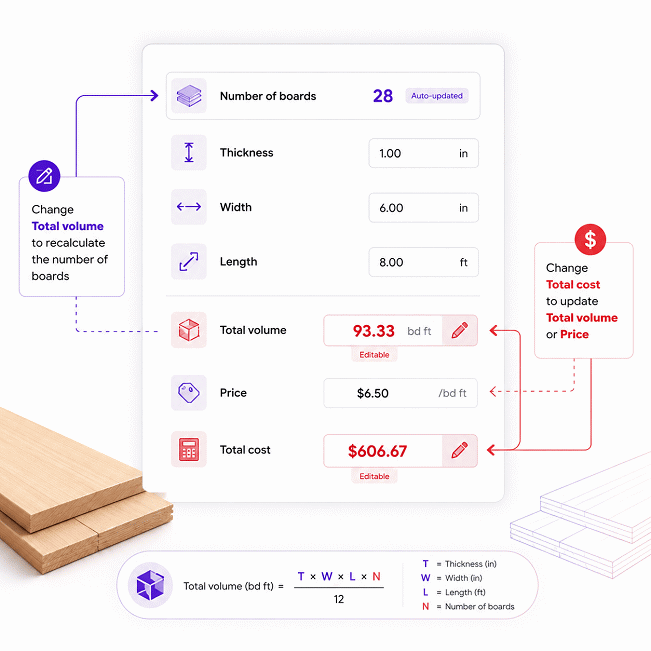
- Reverse solver target: Enter a finite value greater than 0 and provide all other dimensions required to solve the selected variable.

Reviewers:
Davenya Quillford
Elvaron Kesthall
Check our editorial policy
August 13, 2026
1.0.0
Initial calculator and formula release.
Our engineers are here to help you get it right.
How Does a Board Foot Calculator Help You Plan Lumber Volume and Cost?
Board Foot Calculator results turn lumber dimensions into a clear volume estimate for planning, purchasing, and cost review. The calculation uses board quantity, thickness, width, and length, while keeping different lumber sizes in separate groups for a more transparent tally.
- Measure each lumber group using a consistent nominal, actual, rough, or surfaced basis.
- Keep different board sizes separate instead of relying on misleading average dimensions.
- Use net board feet to understand the project requirement before purchasing allowances.
- Add a waste allowance only when extra purchase volume is genuinely needed.
- Use the Board Foot Calculator reverse solver to find quantity, thickness, width, or length from a known target.
- Compare board-foot volume with linear feet and one-face area when shape also matters.
- Review material cost separately from milling, freight, other charges, discounts, and taxes.
- Do not treat calculated board footage as lumber weight, grade, strength, or usable yield.
- Keep supplier measurement methods visible when comparing quotes or checking a lumber tally.
- Confirm available stock sizes after reverse solving because mathematical results may not match commercial lumber sizes.
The best lumber decision starts with a clear measurement basis, an auditable tally, and a purchase plan that keeps volume, waste, and cost separate.
Assumptions used in this calculator
- Board-foot calculations assume rectangular lumber with consistently measured dimensions.
- All dimensions are converted to consistent internal units before calculation.
- Entered dimensions are used without automatic nominal-to-actual size conversion.
- Measurement basis should match the supplier tally or project specification.
- Board quantity represents pieces sharing identical dimensions within each group.
- Waste allowance is included only when explicitly entered by the user.
- Saw kerf, defects, and usable cutting yield are not modeled automatically.
- Material price is normalized to the selected volume pricing basis.
- Currency selection changes labels only and performs no exchange-rate conversion.
- Freight, processing, discounts, and taxes apply only when values are entered.
- Intermediate calculations retain precision before final displayed rounding is applied.
- Board-foot volume does not represent lumber weight, grade, or structural capacity.
- Industrial purchasing results should be verified against supplier documentation before ordering.
Results are rounded for display.
Internal calculations use full precision.
Formulas Used in Board Foot Calculator:
Board Foot Volume Basis
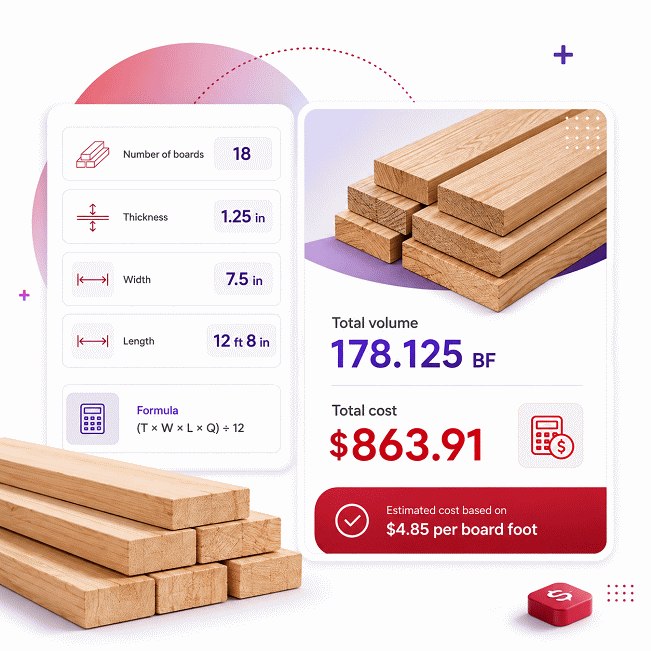
The board-foot calculation uses 144 cubic inches as the fixed volume basis for one board foot.
Dimension Unit Normalization
Each entered thickness, width, or length value is converted to inches before board-foot calculations are performed.
Total Board Length
Main length and optional additional length are converted independently, then combined into one total board length.
Board Foot Volume for Each Board Group
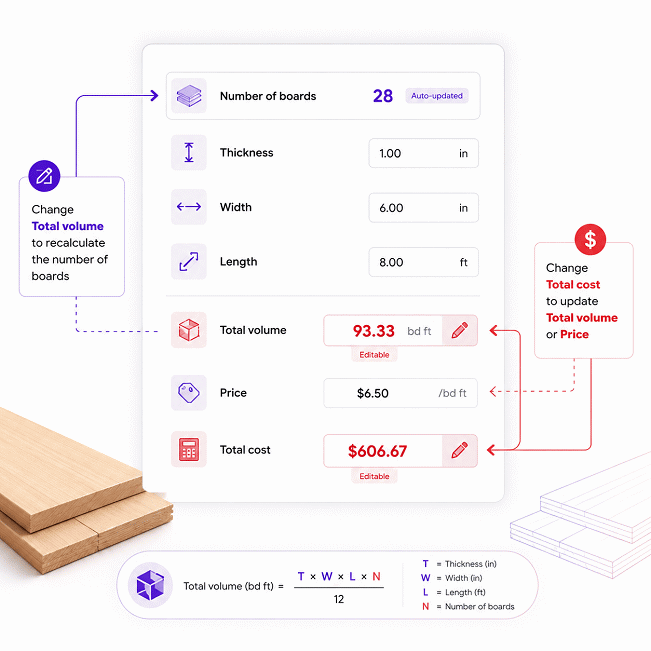
This calculates the board-foot subtotal for one dimensional group. Board feet per piece use the same calculation with a quantity of one. The row reverse solver isolates the selected quantity, thickness, width, or length from this same relationship rather than using a different calculation method.
Net Board Foot Volume for Multiple Groups
The net lumber requirement is the sum of the board-foot subtotals for all valid board groups.
Waste-Adjusted Purchase Volume
The waste allowance increases the net board-foot requirement to estimate the volume that should be purchased.
Selected Volume Unit Conversion
This converts either net or purchase board-foot volume to the selected display unit without changing the physical lumber volume.
Total Linear Feet
Total linear feet represent the combined length of all boards across every valid dimensional group.
Total One-Face Area
One-face area measures the combined area of one broad face of every board and is reported in square feet.
Price Normalization to Board Feet
A price entered per selected volume unit is normalized to an equivalent price per board foot before material cost is calculated.
Material Cost
Material cost uses the waste-adjusted purchase volume. Material-budget reverse solving isolates either volume or unit price from this same relationship.
Estimated Order Cost
Optional processing and fixed costs are added first, the discount is applied next, and the entered tax or surcharge percentage is applied last.
Variable Definitions
- BF = board foot.
- Xu = a dimension entered in its selected unit.
- Xin = the same dimension converted to inches.
- cu = inches contained in one selected dimension unit.
- Lmain,in = main board length converted to inches.
- Ladd,in = optional additional length converted to inches.
- Lin = total board length in inches.
- i = one board group in the multi-row tally.
- m = total number of valid board groups.
- Ni = quantity of boards in group i.
- Ti,in = thickness of group i in inches.
- Wi,in = width of group i in inches.
- Li,in = total length of each board in group i in inches.
- Vi = board-foot subtotal for group i.
- Vnet = total board feet before waste.
- w = waste allowance as a percentage.
- Vpurchase = board feet after the waste allowance.
- VBF = board-foot volume being converted for display.
- Vu = volume expressed in the selected output unit.
- ku = board feet contained in one selected volume unit.
- LF = total linear feet.
- Aface = total one-face area in square feet.
- Pu = lumber price per selected volume unit.
- PBF = normalized lumber price per board foot.
- Cmaterial = waste-adjusted lumber material cost.
- M = optional milling or processing cost per board foot.
- Cdelivery = optional delivery or freight cost.
- Cother = optional additional fixed cost.
- d = discount percentage.
- t = tax or surcharge percentage.
- Corder = estimated final order cost.
Variables & Definitions
View a complete list of all variables used in this calculator, including definitions and units
Board Foot Calculator Variables, Symbols, Units, and Definitions
| Symbol | Variable | Unit or Type | Definition |
|---|---|---|---|
| BF | Board Foot | Volume unit | A lumber volume equal to 144 cubic inches or one-twelfth of a cubic foot. |
| Xu | Entered Dimension | Selected length unit | A thickness, width, or length value entered in its selected unit. |
| Xin | Normalized Dimension | in | The same entered dimension after conversion to inches. |
| cu | Dimension Conversion Factor | in per selected unit | The number of inches represented by one unit of the selected dimension unit. |
| Lmain,in | Main Length | in | The primary board length after conversion to inches. |
| Ladd,in | Additional Length | in | An optional additional board length after conversion to inches. |
| Lin | Total Board Length | in | The combined main length and additional length used in the volume calculation. |
| i | Board Group Index | Integer | Identifies one dimensional group in the multi-row lumber tally. |
| m | Number of Valid Board Groups | Integer | The total number of valid dimensional groups included in the calculation. |
| Ni | Board Quantity | Pieces | The number of boards with identical dimensions in board group i. |
| Ti,in | Board Thickness | in | The normalized thickness of each board in group i. |
| Wi,in | Board Width | in | The normalized width of each board in group i. |
| Li,in | Board Length | in | The normalized total length of each board in group i. |
| Vi | Board Group Volume | BF | The board-foot subtotal calculated for one dimensional board group. |
| Vnet | Net Lumber Volume | BF | The combined board-foot volume of all valid board groups before waste allowance. |
| w | Waste Allowance | % | The optional percentage added to the net lumber requirement for purchasing allowance. |
| Vpurchase | Purchase Volume | BF | The board-foot volume required after applying the selected waste allowance. |
| VBF | Board-Foot Volume for Conversion | BF | The board-foot value being converted to another selected display volume unit. |
| Vu | Displayed Volume | Selected volume unit | The equivalent lumber volume expressed in the selected output unit. |
| ku | Volume Conversion Factor | BF per selected unit | The number of board feet contained in one unit of the selected volume unit. |
| LF | Total Linear Feet | ft | The combined linear length of all boards across the valid board groups. |
| Aface | Total One-Face Area | ft2 | The combined area of one broad face of every board in the tally. |
| Pu | Entered Lumber Price | Currency per selected volume unit | The lumber price entered for the selected pricing volume unit. |
| PBF | Normalized Price per Board Foot | Currency per BF | The entered lumber price converted to an equivalent price per board foot. |
| Cmaterial | Material Cost | Currency | The estimated lumber cost based on purchase volume and normalized board-foot price. |
| M | Milling or Processing Cost | Currency per BF | An optional processing charge applied to each board foot of purchase volume. |
| Cdelivery | Delivery or Freight Cost | Currency | An optional fixed delivery or freight charge added to the order subtotal. |
| Cother | Other Fixed Costs | Currency | Optional additional fixed costs included before discount and tax calculations. |
| d | Discount | % | The optional percentage reduction applied to the calculated order subtotal. |
| t | Tax or Surcharge | % | The optional percentage applied after the discount to estimate the final order cost. |
| Corder | Estimated Order Cost | Currency | The final estimated cost after material, processing, fixed costs, discount, and tax or surcharge are applied. |
Unit Conversion Table
Thickness, Width, and Length Unit Conversion Table
| Unit Group | Unit Name | Symbol | Equivalent in Inches | Used For |
|---|---|---|---|---|
| Thickness, Width, Length | Inch | in | 1 in | Thickness, Width, Main Length, Additional Length |
| Thickness, Width, Length | Millimeter | mm | 0.0393700787401575 in | Thickness, Width, Main Length, Additional Length |
| Thickness, Width, Length | Centimeter | cm | 0.393700787401575 in | Thickness, Width, Main Length, Additional Length |
| Thickness, Width, Length | Foot | ft | 12 in | Thickness, Width, Main Length, Additional Length |
| Thickness | Mil | mil | 0.001 in | Fine Thickness Input |
| Width, Length | Meter | m | 39.3700787401575 in | Board Width, Main Length, Additional Length |
| Width, Length | Yard | yd | 36 in | Board Width and Main Length |
Board Foot Volume Unit Conversion Table
| Unit Group | Unit Name | Symbol | Equivalent in Board Feet | Used For |
|---|---|---|---|---|
| Volume | Board Foot | BF | 1 BF | Volume Display and Price Basis |
| Volume | Thousand Board Feet | MBF | 1,000 BF | Volume Display and Price Basis |
| Volume | Million Board Feet | MMBF | 1,000,000 BF | Volume Display and Price Basis |
| Volume | Cubic Inch | in3 | 0.00694444444444444 BF | Volume Display and Price Basis |
| Volume | Cubic Foot | ft3 | 12 BF | Volume Display and Price Basis |
| Volume | Cubic Yard | yd3 | 324 BF | Volume Display and Price Basis |
| Volume | Cubic Centimeter | cm3 | 0.000423776000657863 BF | Volume Display and Price Basis |
| Volume | Liter | L | 0.423776000657863 BF | Volume Display and Price Basis |
| Volume | Cubic Meter | m3 | 423.776000657863 BF | Volume Display and Price Basis |
Currency Display Label Table
| Unit Group | Unit Name | Symbol | Equivalent in Exchange Value | Used For |
|---|---|---|---|---|
| Currency Label | US Dollar | USD | No exchange conversion | Cost Display Label |
| Currency Label | Euro | EUR | No exchange conversion | Cost Display Label |
| Currency Label | Pound Sterling | GBP | No exchange conversion | Cost Display Label |
| Currency Label | Canadian Dollar | CAD | No exchange conversion | Cost Display Label |
| Currency Label | Australian Dollar | AUD | No exchange conversion | Cost Display Label |
| Currency Label | New Zealand Dollar | NZD | No exchange conversion | Cost Display Label |
| Currency Label | Swiss Franc | CHF | No exchange conversion | Cost Display Label |
| Currency Label | Japanese Yen | JPY | No exchange conversion | Cost Display Label |
| Currency Label | Chinese Yuan | CNY | No exchange conversion | Cost Display Label |
| Currency Label | Indian Rupee | INR | No exchange conversion | Cost Display Label |
| Currency Label | UAE Dirham | AED | No exchange conversion | Cost Display Label |
| Currency Label | Saudi Riyal | SAR | No exchange conversion | Cost Display Label |
Example Calculation
This example combines two different lumber size groups before applying the waste allowance. The material price is calculated from the waste-adjusted purchase volume, while optional milling and fixed costs are added separately. The discount is applied before the entered tax or surcharge. Intermediate values remain unrounded until the final displayed results, helping prevent cumulative rounding differences.
The reverse solver starts with the required row volume and isolates the selected missing variable. In this case, the exact mathematical requirement is about 16.33 boards, but complete boards are needed for purchasing. Selecting Round Up changes the purchase quantity to 17 boards, producing slightly more lumber than the 160 BF target. Row reverse solving uses board-foot volume before any project-level waste allowance is applied.
Results are rounded for display.
Internal calculations use full precision.
Calculations Disclaimer
What Is a Board Foot and Why Does It Matter Before You Buy Lumber?
A lumber order can look correct and still cost more than expected. The problem often starts with volume, not price. A Board Foot Calculator helps turn board dimensions into one clear lumber quantity. The Board Foot Calculator also helps separate physical size from purchasing decisions. That matters when boards have different widths, thicknesses, or lengths.
A board foot measures lumber volume. It does not measure surface area, weight, strength, or usable yield. This distinction is easy to miss. A wide, thin board may contain the same volume as a narrow, thick board. Their shapes look different, but their lumber volume can match.
One number can look simple, yet hide several purchasing decisions. Always know what dimensions that number represents.
This becomes important when buying hardwood, rough lumber, custom stock, or mixed-size boards. A single project may contain several board groups. Each group can have a different thickness, width, length, and quantity. Combining them too early can hide mistakes.
The better approach is simple. Keep each matching size group separate. Measure it using one clear basis. Then combine the groups after each subtotal is known. This creates a tally that is easier to review and easier to explain.
For a buyer, board footage answers a basic question: how much lumber volume is involved? For a woodworker, it creates a common planning basis. For a contractor, it helps compare orders. For a purchasing team, it improves quote review. For a supplier, it helps communicate quantities in a familiar form.
The number becomes more useful when it connects to real decisions. You may need net material for a design. You may need extra purchase volume for waste. You may also need to compare different supplier pricing methods. These are separate questions. Keeping them separate makes the final decision clearer.
Why Shape Alone Can Mislead a Lumber Buyer
Long boards can look expensive because they occupy more space. Thick boards can also appear more valuable. Neither visual impression proves total lumber volume. Volume depends on all three dimensions together.
This is why comparing boards by length alone can fail. Comparing by face area can also fail. A board can cover a large surface while containing modest volume. Another board can have less face area but much greater thickness.
A useful buying process starts with measurement, not appearance. Once dimensions are organized, the rest becomes easier. You can compare stock groups, purchase plans, and pricing without relying on visual guesses.
Board Footage Is a Volume Decision, Not a Visual Guess
The safest mental model is simple: board footage describes how much wood volume exists. It does not tell you whether that wood is useful for your cuts. It does not tell you the grade. It does not predict defects. It also does not tell you how much finished material remains after machining.
This separation protects the buyer from a common mistake. A calculated volume can be accurate while a purchase plan remains poor. Good planning therefore continues beyond the first result.
How Does a Board Foot Calculator Work with Real Lumber Orders?
Real lumber orders rarely contain one perfect board size. A cabinet shop may use several thicknesses. A furniture maker may buy random-width hardwood. A contractor may combine structural and finish stock. A one-row estimate becomes difficult to audit in these cases.
A better workflow groups identical boards together. One group may represent twelve matching boards. Another may represent six boards with different dimensions. Each group remains independent until its volume is established.
This structure has a major practical benefit. You can change one group without rebuilding the entire calculation. If one stock size becomes unavailable, only that row needs attention. The remaining tally stays intact.
Measure → Group matching boards → Review each group → Combine totals → Add purchase allowance → Review cost
This sequence also makes errors easier to find. A total that looks too high can be traced to one row. A wrong length does not disappear inside a large combined estimate. The same is true for quantity mistakes.
For mixed stock, this is more useful than entering an average board size. Averages can create a mathematically neat answer that does not represent the actual lumber. The risk grows when widths vary greatly.
Why Multi-Row Lumber Tallies Are Better for Mixed Sizes
A multi-row tally mirrors how lumber is actually handled. Matching pieces are grouped. Different pieces remain separate. This gives the user a clear chain from board dimensions to order totals.
It also helps during quote review. A buyer can compare the same groups across multiple offers. If one supplier changes a thickness class, that difference becomes visible. If another supplier uses different lengths, the effect can be reviewed without guessing.
Multi-row planning is especially helpful for hardwood purchases. Random widths and mixed lengths are common. Keeping those groups visible prevents one unusual board from distorting an average.
When Should Boards Be Placed in Separate Groups?
Create a separate group when thickness changes. Do the same when width changes. Length changes also deserve a separate group when they affect the tally. Most importantly, separate boards that use different measurement bases.
Quantity alone does not require a new group. If every dimension and measurement basis matches, quantity can represent all identical pieces together. This keeps the calculation compact without reducing clarity.
Should You Use Nominal, Actual, Rough, or Surfaced Lumber Dimensions?
A supplier quote can disagree with your measurement even when nobody made a mistake. The reason may be the measurement basis. Lumber can be described using nominal, rough, surfaced, or directly measured dimensions. These terms should never be treated as interchangeable.
Nominal dimensions describe a trade size. Actual dimensions describe the physical size being measured. Rough lumber may be sold using a thickness class before final surfacing. Surfaced lumber reflects material after machining has reduced some dimensions.
The important rule is consistency. Do not enter one dimension as nominal and another as actual unless the purchasing method requires it. Mixed bases can create a result that looks precise but has no clear commercial meaning.
If your calculated tally disagrees with an invoice, check the measurement basis before questioning the arithmetic.
This issue matters most when comparing different suppliers. One quote may describe rough stock. Another may describe finished dimensions. A direct price comparison can become misleading if the underlying measurement basis is different.
The calculator should therefore preserve what the user enters. It should not silently convert a nominal size into an assumed physical size. It should not guess how much material was removed during surfacing. Those decisions belong to the documented lumber basis.
Nominal vs Actual Lumber Dimensions: Which Basis Is Useful?
Use actual measurements when your goal is physical volume from measured stock. This is useful during receiving, inspection, inventory checks, or custom material planning.
Use a nominal or trade basis when the purchase, specification, or supplier tally is explicitly built around that basis. The goal is not to choose one method for every situation. The goal is to match the calculation to the transaction.
This distinction also improves communication. If two people calculate the same lumber using different bases, both may believe their result is correct. Writing the measurement basis beside the tally prevents that confusion.
Why Silent Dimension Conversion Creates Expensive Confusion
Automatic conversion can feel convenient. It can also hide a major assumption. The user may enter a commercial size while expecting physical volume. A hidden conversion changes the meaning without showing the decision.
Transparent tools work differently. They keep the entered value visible. They keep the measurement basis visible. The user can then compare the result with project documents or supplier records.
Rough-Sawn and Surfaced Lumber Need Different Thinking
Rough stock gives the buyer more material for milling. That extra material is not always usable. Surfacing, jointing, planing, defects, and straightening can reduce finished yield.
Surfaced stock is easier to measure physically. Yet its purchase price may reflect processing already performed. This is why the cheapest price per board foot is not always the cheapest final part.
A better purchase decision considers both volume and processing needs. More raw volume can mean more milling time. Less raw volume can mean higher unit pricing. The best choice depends on the project, equipment, labor, and required finish.
How Does Reverse Board Foot Solving Improve Lumber Planning?
Sometimes the missing number is not board footage. You may already know the volume target. What you need is the board quantity, width, thickness, or length. A normal forward calculation does not answer that question efficiently.
Reverse solving starts with the known target and finds the missing input. This changes the calculator from a measuring tool into a planning tool.
Imagine a shop has a fixed lumber target for one production run. The available stock thickness is known. Width and length are also known. Quantity becomes the unknown. Reverse solving can show the mathematical quantity needed.
The same idea works in other directions. A fixed quantity can be available while the required width remains unknown. A design may specify the target volume while the stock length can still change. These are practical production questions.
Known target + known dimensions → Select missing value → Solve → Check available stock → Make purchasing decision
The final step is important. A mathematical answer is not automatically a purchasable answer. Lumber comes in real sizes. Suppliers have stock limits. A reverse result must still be checked against available material.
Reverse Solving Quantity, Thickness, Width, and Length
Quantity is the most intuitive reverse target. The tool determines how many matching boards would satisfy the chosen volume. The result may include a partial board. That is mathematically useful, but purchasing often needs whole pieces.
Thickness, width, and length require more care. The calculated value may not match a common stock size. This is not an error. It simply means the exact mathematical size is different from available commercial stock.
At that point, the user has a decision. Choose the nearest suitable stock size and calculate again. This makes the tradeoff visible before material is purchased.
Why Exact Reverse Results May Not Match Available Lumber
A calculator solves mathematics. A lumber yard supplies physical stock. Those systems meet only when the solved dimensions match available sizes.
This is why reverse solving should guide a decision, not hide it. A slightly larger stock size may provide enough material. A smaller size may fail the requirement. The result lets the buyer test both choices before ordering.
How Much Lumber Should You Actually Purchase?
The calculated project volume can be correct and still leave a shop short. Finished parts do not emerge from raw boards without loss. Cuts, defects, grain selection, trimming, and milling can consume material.
This creates two useful quantities. Net lumber describes the planned geometric requirement. Purchase volume describes the amount the buyer intends to order after adding an allowance.
Keeping those numbers separate is important. If they are combined too early, nobody can see how much extra material was added. That makes future estimating harder.
The allowance should reflect the work. Straightforward pieces from predictable stock may need less extra material. Complex parts, strict grain matching, defects, or random-width hardwood may need more.
A bigger waste percentage is not automatically safer. It can also hide poor planning.
Good estimators learn from completed work. They compare planned volume with purchased volume. Then they compare both with material actually consumed. Over time, the gap becomes useful planning data.
Net Lumber Volume and Purchase Volume Serve Different Jobs
Net volume is useful for design and quantity planning. Purchase volume is useful for procurement. Confusing them can create problems during cost review.
If a manager sees only purchase volume, the design requirement is hidden. If a buyer sees only net volume, the order may leave no room for real-world losses.
Showing both values gives everyone the same picture. Designers can see the base need. Buyers can see the planned allowance. Managers can understand why the order exceeds the design quantity.
Purchased Board Feet Are Not the Same as Usable Yield
Board footage measures volume. It does not inspect every inch of lumber. A board may contain knots, checks, splits, wane, stain, bow, twist, or unsuitable grain.
Some projects also require matching color or grain. That can reduce usable yield without changing calculated board footage. Wide clear parts may be especially selective.
This is why procurement should consider the material specification alongside the volume. Correct footage cannot compensate for unsuitable grade or poor stock selection.
How Should Lumber Price and Order Cost Be Evaluated?
A lower quoted lumber price can create a higher final job cost. The missing details are often processing, transport, and usable yield. Price comparisons work best when each offer uses the same basis.
Start by understanding how the lumber itself is priced. Some sellers quote by board foot. Larger commercial orders may use a larger board-foot pricing unit. Other suppliers may quote pieces or bundles.
Do not compare those raw numbers directly. First determine what physical quantity each price represents. Only then can the offers be compared fairly.
Material price is also different from total order cost. Milling can add cost. Freight can add cost. Other fixed charges may apply. Discounts and taxes may also change the final amount.
Keeping these components separate makes the decision easier to audit. A high lumber price may include useful processing. A low lumber price may require substantial shop labor later.
Why the Lowest Price per Board Foot May Not Be the Best Purchase
Cheap rough stock can be attractive. It may also require more milling. Narrow boards can increase glue joints. Short boards can create more layout work. Poor consistency can slow production.
Higher-priced material may reduce those problems. That does not make premium stock automatically better. It means unit price should be judged within the full workflow.
A practical buyer asks several questions. Is the thickness suitable? Are widths useful? Are lengths compatible with the cut list? Is the grade appropriate? How much processing remains?
These questions protect the project from false savings. A small price advantage can disappear quickly when labor and material loss increase.
Separate Technical Evaluation from the Buying Decision
The technical review asks whether the calculated quantity and dimensions make sense. The buying review asks whether the offered stock can satisfy that requirement economically.
Do not combine these decisions too early. First verify size, quantity, measurement basis, and material requirement. Then compare supplier terms, processing, transport, and availability.
This order reduces emotional purchasing. A discount feels less important when the underlying stock does not suit the job.
Supplier Support, Returns, and Material Warranty Need Separate Review
A calculator cannot create a lumber warranty. Warranty, grade claims, returns, replacement terms, and delivery support belong to the seller.
Before a large order, confirm these conditions directly. Check what happens when dimensions differ. Ask how shortage claims are handled. Confirm whether grading disputes require photographs, tally records, or inspection.
Keep the calculation with the order records. It creates a useful purchasing trail. The record can show what dimensions and quantities were expected when the order was approved.
How Do Board Feet Relate to Linear Feet, Face Area, and Storage Planning?
A project can have enough board footage and still have the wrong stock. This happens because volume alone does not describe board shape.
Linear footage answers a different question. It describes total board length. This is useful when long continuous pieces matter.
Face area answers another question. It describes the broad surface presented by the boards. That can help with layout and surface-based planning.
Two orders can have equal board footage and very different linear footage. The order with thinner or narrower boards may contain much more total length.
The same is true for face area. Thick stock can carry substantial volume without providing the same broad surface as thinner boards.
Why Board Footage Alone Cannot Plan Every Woodworking Job
Consider trim work. Length matters greatly because joints and interruptions affect installation. A volume total cannot tell you whether enough long pieces exist.
Now consider wide cabinet panels. Width distribution matters because narrow boards require more glue joints. Again, equal board footage does not guarantee equal usefulness.
Furniture work creates another challenge. Grain direction and visual matching can control board selection. The correct volume may still fail the appearance requirement.
Board footage therefore works best as one planning layer. It gives a shared volume basis. Length, face area, grade, width distribution, and cut requirements complete the decision.
Storage and Transport Can Change a Good Purchase Plan
Buying extra stock is not free simply because the lumber price is attractive. Additional boards require space. Heavy bundles require safe handling. Long stock may need special transport.
A large order can also create moisture and storage concerns. Lumber needs suitable support and protection. Poor storage can reduce the value of a carefully calculated purchase.
The buying decision should therefore fit the real site. Ask whether the shop can receive the load. Check available rack space. Confirm that long boards can enter the building safely.
How Are Hardwood Thickness Classes Used in Practical Buying?
Hardwood buyers often encounter thickness descriptions that differ from finished measurements. This can surprise someone moving from standard dimensional lumber.
The thickness class describes the stock basis before the final project decides the finished size. Surfacing and milling reduce material. The finished piece can therefore be thinner than the original class suggests.
This matters when a design has a strict finished thickness. Buying stock too close to that target can leave little room for flattening and surfacing. Buying much thicker stock can increase cost and waste.
The better approach begins with the finished requirement. Then consider how much machining the stock may need. Choose a suitable starting thickness based on that workflow.
Random-Width Hardwood Needs More Than One Average Width
Random-width bundles can create a tempting shortcut. Measure a few boards, find an average width, and apply it to everything. That method may be fast, but it can hide variation.
A more transparent tally keeps meaningful width groups separate. This helps when wide boards carry special value. It also helps when the project needs specific panel widths.
For small mixed bundles, individual measurements may be practical. For large commercial tallies, the supplier’s documented measurement method becomes important. The goal is a repeatable process that both sides can understand.
Live-Edge Stock Requires a Clear Width Method
A live edge creates a basic measurement problem. Width changes along the board. One width value cannot describe every point.
The user should therefore know how the selected width was established. The method may depend on the seller, contract, or project documentation.
This is another reason measurement basis should remain visible. A precise calculator cannot repair an unclear input method. Clear measurement comes first.
What Board Foot Calculation Mistakes Cause the Most Expensive Errors?
The most dangerous errors often look reasonable. A wrong unit can still produce a clean number. An incorrect measurement basis can still produce many decimal places. A mixed tally can still look organized.
The first common mistake is mixing physical and trade dimensions. The second is combining unlike boards too early. The third is treating volume as usable yield.
Another mistake is focusing on the final price before checking the material. Cost calculations are only useful when the underlying lumber quantity is meaningful.
Buyers can also confuse board footage with linear coverage. This is common when planning trim or long rails. The total volume may be enough, while the required lengths are not.
Random-width stock creates another trap. An average can hide the lack of wide boards. This matters when the project needs broad clear pieces.
Why Supplier Tally Differences Should Be Investigated, Not Guessed
A supplier tally and an internal calculation can differ for several reasons. The first check should be the dimensions used by each side. Then review the measurement basis.
Next, compare how boards were grouped. Check whether rough and surfaced stock were treated differently. Review lengths and quantities carefully.
Do not change the calculation simply to match the invoice. First identify the reason for the difference. A clear discrepancy can often be explained by one measurement assumption.
Why Accurate Numbers Can Still Lead to a Poor Order
Mathematical accuracy does not guarantee purchasing success. The calculation may be perfect while the material selection is wrong.
A job can fail because boards are too short. Another can fail because widths are unsuitable. A high volume of low-grade stock may still provide too little usable material.
The best workflow therefore combines calculation with material judgment. The calculator answers the volume question. The buyer still decides whether the stock fits the work.
How Can Professionals Verify a Lumber Order Before Approval?
A purchasing error becomes expensive after the lumber arrives. Before approval, several checks can reduce that risk.
Start with the project requirement. Confirm which components actually need lumber. Review the expected thicknesses, widths, and lengths. Separate groups that differ.
Next, confirm the measurement basis. Make sure the calculation and supplier quote describe lumber in compatible terms.
Then review the buying allowance. Ask why extra material is being added. The reason should connect to the project, not habit alone.
After that, review pricing. Separate raw material from processing and fixed charges. This makes quote comparisons easier.
Project need → Stock basis → Lumber tally → Purchase allowance → Supplier quote → Order review → Receiving check
Finally, save the calculation with the purchasing record. This creates continuity between estimating, ordering, receiving, and production.
A Practical Lumber Tally and Purchasing Review Workflow
The estimator should define the material need first. The buyer should confirm available stock second. The final order should reflect both.
During receiving, compare delivered quantities with the approved purchase record. If the stock differs, the original tally provides context. This is especially useful for mixed hardwood orders.
Production teams can also use the same record. When yield is lower than expected, they can compare actual consumption with the original plan. That creates better estimates for future work.
Turn Each Completed Order into Better Planning Data
The most useful calculator is not only used before purchase. Its results can also support a learning loop.
Record what was planned. Record what was purchased. Then compare those numbers with actual material use. Large differences deserve investigation.
The cause may be defects. It may be poor cutting strategy. It may be design changes. It may be an unrealistic allowance. Each explanation improves the next estimate.
Build a Better Lumber Buying Workflow with AxiCalculator
A good lumber decision should feel clear before money changes hands. You should know what volume the project needs. You should know how the stock was measured. You should also know why the purchase quantity is larger than the net requirement.
AxiCalculator is designed to bring those decisions into one practical workflow. Mixed board groups can remain separate. Measurement basis can remain visible. Purchase planning can stay distinct from the underlying material requirement.
Reverse solving adds another useful layer. Instead of guessing a missing quantity or dimension, you can work backward from a known target. This is helpful during design changes and supplier negotiations.
Cost planning can then follow the technical review. This order matters. First establish what lumber is needed. Then determine what the order may cost.
For woodworking and construction teams, this structure reduces unnecessary rework. For buyers, it creates cleaner comparisons. For managers, it creates a more understandable record.
Use the calculator before requesting or approving a lumber quote. Keep each board group clear. Match the measurement basis to the transaction. Review the purchase allowance separately. Then compare the proposed stock with the actual needs of the project.
The goal is not to produce the largest number of calculated values. The goal is to make the next decision easier. When measurement, purchasing, and cost planning remain connected, a board-foot estimate becomes much more useful than a single volume result.
Frequently Asked Questions
Can I use board-foot results to estimate finished project yield?
Should I calculate from my cut list or from the lumber sizes I plan to buy?
Can this calculator be used for plywood, MDF, or other sheet goods?
Does moisture content or acclimation change the board-foot number I should purchase?
How should a professional team handle a supplier quote that mixes board feet, MBF, and per-piece pricing?
Can a board-foot calculation be used as a structural design value?
What should an engineer check when a mill tally and an internal takeoff disagree only slightly?
Engineering Resources
Our engineers are here to help you get it right.