Atomic Mass Calculator
- Last formula update:
Decimal & Rounding Policy
- Proton count, neutron count, and mass number are treated as whole numbers and are not rounded from decimal inputs.
- Atomic mass in u or Da follows the calculated mass number and is displayed without unnecessary trailing zeros.
- SI mass conversions are calculated with full internal precision and displayed with up to 12 significant digits when needed.
- Very small SI results may use scientific notation to keep Atomic Mass Calculator values clear and readable.
- Intermediate calculations are never rounded; rounding is applied only to the displayed result to reduce cumulative error.
Valid range
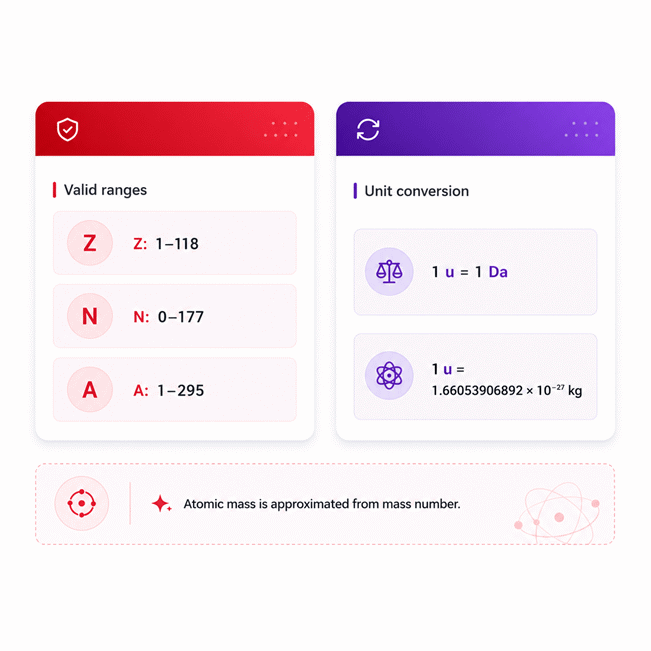
- Number of protons (Z): Enter a whole number from 1 to 118.
- Number of neutrons (N): Enter a whole number from 0 to 177.
- Mass number (A): The supported range is 1 to 295, calculated as A = Z + N.
- Atomic mass: Enter a positive value corresponding to a mass number from 1 to 295 u or Da.
- Atomic mass (SI): Enter a positive mass value that corresponds to the supported mass-number range after unit conversion.

Xylena Morforde
Reviewers:
Cirelle Vossford
Zorven Lumquell
Check our editorial policy
September 1, 2026
1.0.0
Initial calculator and formula release.
Our engineers are here to help you get it right.
How Does the Atomic Mass Calculator Help You Understand Atomic Structure?
The Atomic Mass Calculator connects proton count, neutron count, mass number, and approximate atomic mass in one clear workflow. It is designed for fast atomic-structure calculations while keeping each scientific quantity distinct and easy to interpret.
- Proton count identifies the chemical element and determines its atomic number.
- Neutron count distinguishes isotopes of the same element without changing elemental identity.
- Mass number represents the total number of protons and neutrons inside the nucleus.
- Atomic mass is related to mass number but is not an identical physical quantity.
- Measured isotope masses can differ from whole-number mass values because of nuclear binding effects.
- Periodic-table atomic weights should not automatically be treated as single-isotope mass numbers.
- Reverse solving can determine a missing proton or neutron count from known nuclear information.
- Ion charge changes electron count, not the proton, neutron, or mass-number relationship.
- Simple nuclear calculations work well for education, checking, and rapid scientific reference.
- High-precision isotope work may require evaluated experimental isotope-mass data.
The Atomic Mass Calculator is most useful when you first identify the question type, then enter only the nuclear values relevant to that task. This approach reduces common chemistry errors and makes each result easier to verify and understand.
Assumptions used in this calculator
- Mass number equals the total count of protons and neutrons.
- Proton and neutron counts are treated as whole, non-fractional values.
- Atomic mass is approximated from mass number, not measured isotope mass.
- Nuclear binding energy and mass defect are not included.
- Electron mass contributions are excluded from the simplified mass approximation.
- The atomic mass constant is applied consistently for SI conversions.
- Unit conversions preserve the underlying physical mass before display rounding.
- Intermediate calculations retain full precision without premature rounding.
- Displayed results may be rounded for readability and practical use.
- Reverse calculations assume entered values are physically consistent with each other.
- Unsupported or contradictory values are treated as invalid calculator inputs.
- Results are intended for educational, engineering-reference, and general scientific use.
- High-precision industrial decisions should be verified against authoritative measured data.
Results are rounded for display.
Internal calculations use full precision.
Formulas Used in Atomic Mass Calculator :
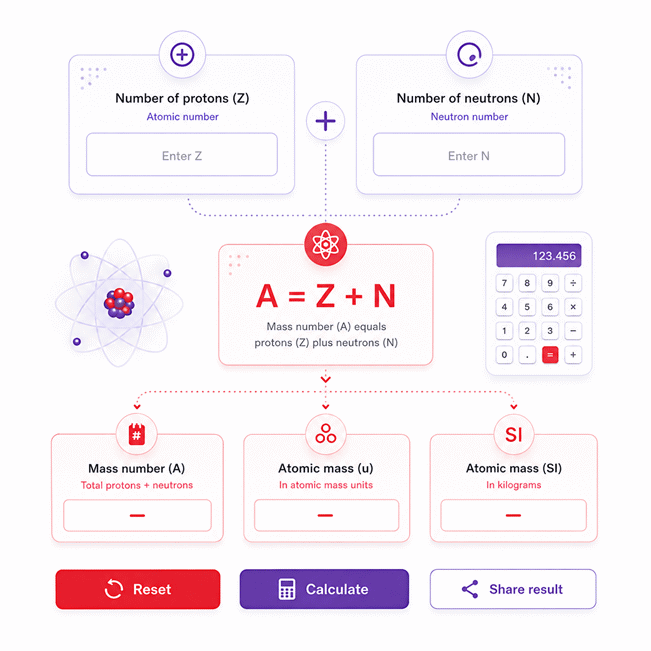
1. Mass Number
2. Approximate Atomic Mass in Kilograms
3. Selected Mass Unit Conversion
A = mass number, the total number of protons and neutrons.
Z = number of protons in the atom.
N = number of neutrons in the atom.
mkg = approximate atomic mass expressed in kilograms.
μu = atomic mass constant, 1.66053906892 × 10⁻²⁷ kg/u.
xU = numerical atomic mass displayed in the selected unit.
FU = kilograms represented by one selected mass unit.
U = selected mass unit.
| Unit | Conversion Factor FU |
|---|---|
| u | 1.66053906892 × 10⁻²⁷ kg/u |
| Da | 1.66053906892 × 10⁻²⁷ kg/Da |
| kg | 1 kg/kg |
| g | 1 × 10⁻³ kg/g |
Reverse calculations use the same mass-number and unit-conversion relationships algebraically to solve the missing value. Intermediate values retain full precision, and rounding is applied only when a result is displayed.
Variables & Definitions
View a complete list of all variables used in this calculator, including definitions and units
Atomic Mass Calculator Variables and Symbols
| Variable | Meaning | Unit or Type | Calculation Role | Valid Range or Value |
|---|---|---|---|---|
| A | Mass number, representing the total number of protons and neutrons. | Whole number | Calculated from A = Z + N and used as the central mass-number value. | 1 to 295 |
| Z | Number of protons in the atomic nucleus. | Count | Used with the neutron count to calculate the mass number. | 1 to 118 |
| N | Number of neutrons in the atomic nucleus. | Count | Used with the proton count to calculate the mass number. | 0 to 177 |
| mkg | Approximate atomic mass expressed in kilograms. | kg | Calculated from the mass number using the atomic mass constant. | Positive mass corresponding to A = 1 to 295 |
| μu | Atomic mass constant used to convert unified atomic mass units to kilograms. | kg/u | Conversion constant in the SI atomic-mass calculation. | 1.66053906892 × 10⁻²⁷ kg/u |
| xU | Numerical atomic mass displayed in the unit selected by the user. | Selected mass unit | Obtained by converting the kilogram mass into the selected unit. | Positive value within the supported mass-number range |
| FU | Conversion factor representing the number of kilograms in one selected unit. | kg per selected unit | Used to convert the canonical kilogram mass into the selected display unit. | Depends on the selected unit |
| U | Mass unit selected for displaying or entering an atomic-mass value. | Unit selector | Determines the conversion factor applied to the displayed mass value. | u, Da, kg, or g |
Unit Conversion Table
Atomic Mass Unit Conversion Table
| Unit Group | Unit Name | Symbol | Equivalent in Kilograms | Used For |
|---|---|---|---|---|
| Popular Units | Unified Atomic Mass Unit | u | 1.66053906892 × 10⁻²⁷ kg | Expressing atomic, isotopic, nuclear, and molecular masses on an atomic scale. |
| Popular Units | Dalton | Da | 1.66053906892 × 10⁻²⁷ kg | Expressing atomic and molecular masses in chemistry, biochemistry, and molecular science. |
| Scientific Units | Kilogram | kg | 1 kg | Expressing atomic mass in the SI base unit of mass. |
| Scientific Units | Gram | g | 1 × 10⁻³ kg | Expressing atomic-scale mass in a metric unit directly related to kilograms. |
Example Calculation
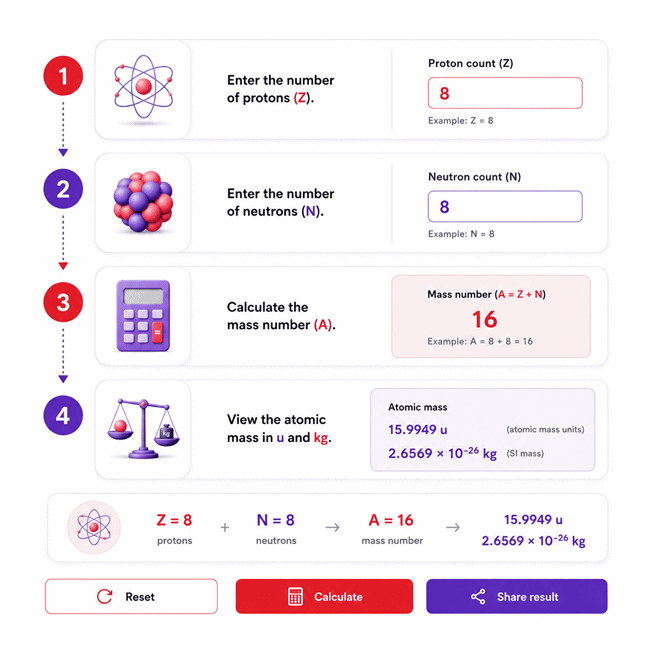
The atom contains 26 protons and 30 neutrons, giving a mass number of 56.
Its atomic mass is therefore approximated as 56 unified atomic mass units.
The SI mass is obtained by multiplying 56 by the atomic mass constant.
This simplified calculation does not include nuclear binding-energy mass loss.
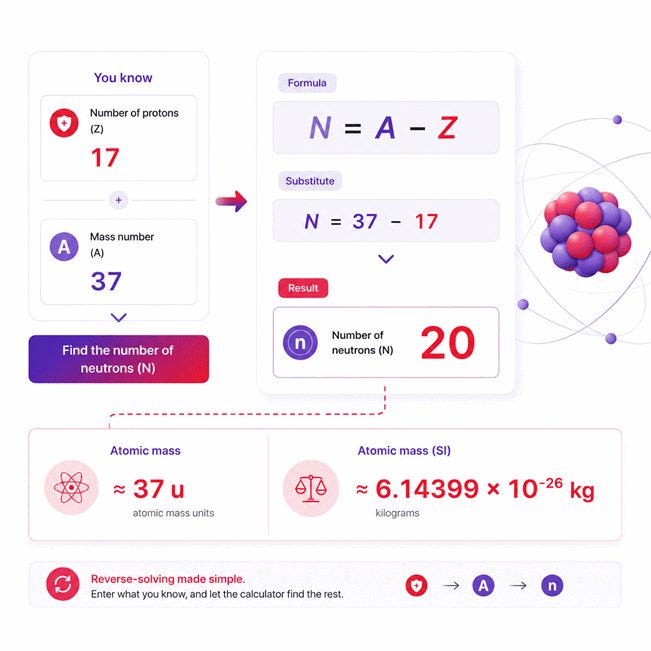
The SI atomic mass is first converted back to its approximate mass number.
The calculated mass number is 37, while the known proton count is 17.
Subtracting the proton count from the mass number gives 20 neutrons.
This reverse solution uses the same mass-number approximation as the forward calculation.
Results are rounded for display.
Internal calculations use full precision.
Calculations Disclaimer
Atomic Mass Calculator: Get the Right Nuclear Value Without Confusion
A chemistry problem can look simple until several atomic values appear together. Proton count, neutron count, atomic number, and mass number can seem interchangeable. They are not. An Atomic Mass Calculator helps separate these values before a wrong assumption spreads through the work.
The Atomic Mass Calculator is most useful when nuclear particle counts are known. It connects proton and neutron information with the atom’s mass-number structure. It can also work backward when one nuclear value is missing. This makes the tool useful for students, teachers, laboratory teams, and technical users.
The key benefit is not only speed. The larger benefit is consistency. Manual calculations often fail because users confuse an isotope value with a periodic-table value. Another common problem appears when a decimal atomic weight is treated as a particle count. These mistakes can look reasonable while producing the wrong interpretation.
A good workflow starts by asking one question: what information is actually known? If proton and neutron counts are available, the nuclear picture is direct. If one count is missing, another known nuclear value can help recover it. This two-way workflow reduces repeated calculations and makes checking easier.
The calculator also keeps two ideas separate. One idea describes how many nuclear particles exist. The other describes physical atomic mass. Those ideas are closely related, but they are not identical. This distinction becomes important when higher scientific accuracy is required.
For fast chemistry work, the calculator gives a clear path through these relationships. For advanced work, the user still needs to understand what each result means. That small difference protects against one of chemistry’s most common interpretation errors.
Why Proton Count Matters More Than It First Appears
A user may change several values and still expect the same element. Proton count does not allow that freedom. The number of protons defines the chemical element itself. Change that number, and the element changes.
This makes proton count the identity anchor of the calculation. A neutron change can produce another isotope of the same element. A proton change produces another element. That difference matters whenever reverse solving is used.
Suppose a calculation returns an unexpected nuclear result. The first check should often be the proton count. A typing error there can change the entire atomic identity. A neutron error usually changes the isotope instead.
This distinction also explains why atomic number has such a central role. Atomic number is tied directly to proton count. It is not simply another mass-related value. It tells you which element you are working with before mass information is considered.
For users solving chemistry exercises, this creates a useful mental shortcut. Think of protons as identity. Think of neutrons as isotope variation. Think of the combined nuclear count as a different type of information.
This simple separation reduces cognitive load. It also makes reverse calculations easier to understand. Instead of memorizing several disconnected rules, the user follows the physical structure of the atom.
PROTONS → Element identity
NEUTRONS → Isotope difference
NUCLEAR PARTICLE TOTAL → Mass-number structure
Why Neutron Count Changes the Isotope, Not the Element
One of the most useful atomic insights is also easy to miss. Two atoms can belong to the same element while having different neutron counts. These atoms are different isotopes of that element.
This matters because isotope questions often look like element questions. A user may see a different nuclear mass and assume the element changed. If proton count stayed constant, that conclusion is usually wrong.
Neutrons affect nuclear composition without changing chemical identity. They also influence nuclear stability. Some neutron combinations produce stable nuclei. Others produce radioactive isotopes. A larger neutron count does not automatically mean greater stability.
This becomes important in technical environments. Nuclear science, isotope tracing, analytical chemistry, and mass spectrometry use isotope-specific information. A simplified calculator can organize the nuclear counts. It should not be confused with a complete nuclear stability model.
The practical lesson is simple. Check proton count first when identifying an element. Then check neutron count when identifying the isotope. This two-stage habit prevents many classification errors.
It also makes the calculator easier to use backward. When element identity is known, proton count is anchored. A second nuclear value can then help determine the missing neutron count. The process becomes logical instead of mechanical.
Atomic Mass and Mass Number Solve Different Problems
A common chemistry mistake starts with a harmless-looking number. The user sees a whole-number nuclear value and calls it atomic mass. That shortcut can be useful in basic work, but it is not a complete scientific definition.
Mass number describes the total number of nucleons in a nucleus. Nucleons are protons and neutrons. Because particles are counted, mass number is a whole number.
Atomic mass describes physical mass on an atomic scale. A measured isotope mass is usually not an exact whole number. The difference exists because real particles do not each contribute exactly one idealized unit. Nuclear binding also affects the final mass.
This is why a calculator must make its method clear. A particle-count method provides a useful nuclear approximation. It does not replace evaluated isotope measurements when high precision matters.
The distinction becomes even more important with periodic-table values. Many periodic tables display decimal values for elements. Those numbers often represent standard atomic weights influenced by natural isotope composition. They should not automatically be treated as the mass number of one isotope.
For general chemistry, separating these concepts creates immediate clarity. Mass number answers a counting question. Atomic mass answers a mass question. Standard atomic weight answers another question again.
This difference may look small on screen. Scientifically, it is one of the most important ideas on the page.
Why Periodic-Table Values Can Mislead a Fast Calculation
A user may open a periodic table, see a decimal value, and round it immediately. Sometimes that shortcut seems to work. It can also hide the wrong reasoning.
The displayed value for an element may reflect more than one naturally occurring isotope. It is not necessarily the measured mass of one chosen isotope. It is also not automatically a nuclear particle count.
This matters when a task asks for a specific isotope. The isotope identity should come from isotope information. A periodic-table average cannot always identify that isotope correctly.
The risk increases when two isotopes have important natural abundances. Their combined contribution can place the periodic-table value between their separate masses. Rounding may point toward one isotope, but that does not prove the isotope was intended.
A safer workflow starts by identifying the question type. Is the task about one isotope? Is it about natural elemental composition? Is it about nuclear particle counts? Those are different tasks.
This question-first approach saves time. It prevents the user from choosing a convenient number before understanding what that number represents.
Quick check: a decimal periodic-table value is not automatically a mass number.
Why Measured Isotope Mass Is Not a Perfect Whole Number
A surprising detail appears when precise isotope data is examined. The measured mass does not simply equal a perfect count of nuclear particles. Real nuclear physics is more subtle.
Protons and neutrons have slightly different masses. Neither behaves as an exact whole atomic mass unit inside every calculation. Electrons add another small contribution to the mass of a neutral atom.
Nuclear binding introduces another effect. When a nucleus forms, its bound state has less mass than the separated particles would have together. This difference is associated with binding energy.
The result is important. A mass-number approximation can be excellent for simple nuclear counting. It should not be presented as an exact isotope measurement.
Most introductory chemistry users do not need nuclear-scale precision. They need the correct conceptual model first. Advanced researchers may need evaluated isotope masses instead.
Knowing this boundary increases trust. It tells the user when a quick calculation is appropriate. It also tells the user when a more specialized data source is required.
Reverse Solving Turns a Static Calculation Into a Diagnostic Tool
Many calculators stop after producing one result. That creates friction when the missing quantity appears on the other side of the problem. A reverse-capable atomic calculator handles the relationship in both directions.
This changes the user experience. The user does not need a different tool for every missing value. Known information can be entered, and the unknown nuclear quantity can be recovered when enough independent information exists.
Reverse solving is especially useful in classroom work. Exercises often give the isotope identity and one particle count. The student must infer the missing value. A two-way calculator supports that exact reasoning process.
It can also help with checking. A user may already have an answer from manual work. Entering the known values backward can reveal whether the result is internally consistent.
This checking role is valuable because many nuclear-count mistakes are simple arithmetic errors. Others come from confusing atomic number with mass number. Reverse solving can expose both types quickly.
The calculator should still preserve physical meaning. A mathematically possible result is not enough if the nuclear values contradict the chosen element. Good validation helps stop impossible or unsupported combinations before they appear trustworthy.
Think backward: known nuclear information can reveal the missing particle count.
How Reverse Solving Helps Detect Inconsistent Atomic Data
A wrong value can sometimes survive a forward calculation. Reverse solving gives the user another way to test the same atomic relationship. This makes the tool useful as a consistency checker.
Imagine that a proton count identifies one element. A second value then implies an impossible neutron result. That conflict should not be hidden behind a calculated number. The user needs to know the inputs do not agree.
The same problem can happen when mass information is copied incorrectly. A value may belong to another isotope. It may also represent an average rather than one isotope. Reverse logic helps reveal this mismatch.
For technical users, this is more than convenience. Data checking is part of reliable scientific work. Small input mistakes can move into reports, spreadsheets, or teaching material if they remain unnoticed.
A good calculator therefore acts like a lightweight diagnostic layer. It calculates, but it also challenges contradictory inputs. This makes the result easier to trust.
The important idea is simple. A calculator should not merely answer. It should help the user notice when the question itself contains conflicting information.
When a Simplified Atomic Mass Method Is Scientifically Appropriate
A user may ask for extreme precision when the task only needs a simple nuclear count. Another user may use a basic result in a context requiring measured isotope data. Both situations waste time.
The simplified method is well suited to educational problems about atomic structure. It is also useful when the goal is to connect protons, neutrons, isotopes, and mass number.
It works well for quick checks. It can help teachers verify exercises. Students can use it to test their reasoning. Technical users can use it for fast reference when approximate nuclear relationships are enough.
The method becomes less suitable when exact isotope mass matters. High-resolution mass spectrometry is one example. Nuclear energy calculations are another. Precision research may also require measured values rather than simplified particle counts.
The difference is not about whether the calculator is useful. It is about matching the method to the question.
This is a powerful scientific habit. Start by deciding what level of precision the task needs. Then choose the method. Do not demand laboratory precision from an educational approximation. Do not use an approximation where measured isotope data is required.
When Exact Isotope Data Becomes the Better Choice
Some tasks become sensitive to tiny mass differences. At that point, a simple nuclear count no longer tells the full story.
Mass spectrometry can separate species based on small mass differences. Nuclear calculations can depend on binding energy. Isotope research may require measured masses with known uncertainty.
In those settings, isotope-specific data should replace simplified estimates. The user should also know which isotope state and measurement definition are being used.
This distinction helps avoid false confidence. More decimal places do not automatically create more scientific accuracy. Precision only matters when the underlying data supports it.
A reliable workflow therefore separates educational approximation from measurement-grade data. The first is fast and intuitive. The second is specialized and evidence-driven.
That separation also keeps the Atomic Mass Calculator useful. It performs a clear task instead of pretending to replace every nuclear or analytical method.
Common Atomic Mass Mistakes Can Look Correct at First
The most dangerous chemistry errors are not always obvious. Some produce neat numbers and still represent the wrong concept. Atomic mass problems are especially vulnerable to this pattern.
One frequent mistake is treating atomic number as atomic mass. Atomic number tracks protons. It does not describe the full nuclear particle total.
Another mistake is treating mass number as a precise measured isotope mass. The two values are related, but their meanings differ.
A third mistake is using a periodic-table decimal as if it identified one isotope. That value may represent natural isotope composition instead.
Users also confuse ion charge with nuclear composition. Gaining or losing electrons changes charge. It does not change the mass number.
Another error appears during reverse work. A user may preserve the wrong variable. If proton count changes accidentally, the element changes too.
The fastest defense is conceptual. Identify the element through proton count. Identify isotope variation through neutron count. Keep mass-number information separate from measured atomic mass.
WRONG PATH → Decimal table value → Assume isotope → Force nuclear counts
BETTER PATH → Identify task → Identify isotope context → Check nuclear values
Why Ion Charge Should Not Be Mixed With Nuclear Particle Counts
An ion can look different in a chemistry equation without changing its nucleus. This is an easy place for beginners to make an unnecessary adjustment.
Ion charge comes from electrons. A positive ion has lost electrons. A negative ion has gained electrons. The proton count remains tied to the element.
The neutron count also remains unchanged during ordinary ion formation. Therefore, the isotope identity remains the same.
This matters when users move between atomic structure and ionic chemistry. Electron information belongs to charge calculations. Nuclear particle information belongs to isotope and mass-number reasoning.
Keeping those layers separate creates a cleaner mental model. It also prevents users from changing nuclear values when only electron count has changed.
For fast checking, ask one question: did the nucleus change? If only electrons changed, nuclear particle counts should remain untouched.
Atomic Mass Calculator for Students, Teachers, and Technical Teams
Different users approach the same calculator with different risks. A student may fear choosing the wrong formula. A teacher may need a quick consistency check. A technical user may care more about interpretation and traceability.
Students benefit from a tool that keeps nuclear values visually distinct. The goal should be understanding, not blind answer collection. Reverse solving is especially useful because it exposes the relationship between known and unknown values.
Teachers can use the same workflow to check exercises quickly. It also helps demonstrate why changing neutrons creates an isotope while changing protons creates another element.
Technical teams may use the calculator as a reference layer. In that setting, clarity matters more than decorative complexity. Users should be able to identify what the output represents immediately.
No single calculator should replace specialized isotope databases or laboratory software. A focused calculator is strongest when its scope remains clear.
AxiCalculator is designed around that idea. The aim is fast interaction without hiding the scientific meaning behind the result.
Fast is useful. Fast and correctly interpreted is far more valuable.
How to Decide Whether This Calculator Fits Your Task
A user can save time by checking the task before entering any value. The decision usually takes only a few seconds.
If the problem concerns proton count, neutron count, isotope identity, or mass-number structure, this calculator fits well. It also fits reverse problems where one nuclear value is missing.
If the task concerns natural isotope abundance, another calculation method may be more appropriate. The same is true when the goal is molecular mass or compound composition.
For high-precision isotope measurements, use evaluated isotope data. For nuclear decay predictions, use isotope-specific nuclear information. For ordinary atomic-structure work, the simpler workflow is often the better choice.
This decision-first approach prevents unnecessary complexity. It also stops users from applying the correct tool to the wrong scientific question.
The best calculator is not the one with the most features. It is the one whose method matches the problem.
Technical Interpretation Should Stay Separate From Tool Selection
A technical user may understand the science and still choose the wrong tool. This happens when several calculators use similar words but solve different problems.
An Atomic Mass Calculator focused on nuclear particle relationships is different from an average atomic mass calculator. It is also different from a molar mass calculator. Each serves a separate scientific intent.
Choose this tool when the problem begins with atomic structure. Choose an isotope-abundance tool when natural mixtures matter. Choose a molar-mass tool when working with chemical amounts and compounds.
This separation matters for professional work. A polished interface cannot correct a mismatched calculation method. The user must first identify the scientific question.
Tool selection should therefore happen before technical interpretation. Once the correct calculation type is chosen, the output becomes easier to understand and verify.
This also reduces unnecessary searching. Instead of forcing one calculator to answer every chemistry question, users can move directly to the tool built for the intended task.
What Reliable Support Should Mean for an Online Scientific Calculator
A user should not need to trust a calculator blindly. Reliable support begins with a clear calculation scope and understandable outputs.
The interface should make mistakes visible. Invalid input should not quietly produce a polished result. Reverse calculations should preserve the meaning of the known values.
Users also benefit from clear access to correction channels. Scientific tools can improve when calculation issues are reported and reviewed.
Support does not mean promising that one tool fits every project. It means helping users understand what the calculator does and when another method is better.
For teams using online calculators in repeated workflows, consistency matters. The same input logic should produce the same interpretation every time.
This approach creates practical trust. The calculator becomes a transparent working tool instead of a black box that simply returns numbers.
Why Clear Scientific Boundaries Make the Result More Useful
Many tools try to appear powerful by hiding their limits. Scientific tools become stronger when those limits are understood.
An atomic calculation can be simple and still be valuable. The key is knowing what the result represents. A nuclear particle relationship can answer many educational and technical questions quickly.
Problems begin when that result is stretched into another scientific meaning. A simplified nuclear value should not silently become an exact experimental isotope mass. A periodic-table average should not become one isotope without evidence.
Clear boundaries prevent those jumps. They also help users decide when more advanced data is required.
This is especially useful for professional readers. Experts rarely need exaggerated promises. They need a method whose scope is easy to inspect.
For general users, the same clarity reduces anxiety. They can understand what the calculator is doing without learning advanced nuclear physics first.
The result is a better balance between speed and scientific responsibility. That balance is what makes an Atomic Mass Calculator genuinely useful.
Frequently Asked Questions
Can I solve a missing proton or neutron count if I know only the approximate atomic mass?
Why does the calculator sometimes leave a nuclear value unsolved instead of guessing it?
Can I use the calculator to check whether isotope notation is internally consistent?
Can two different input routes produce the same correct atomic result?
How should I document an Atomic Mass Calculator result for reproducible technical work?
Can this calculator be used to calibrate a mass spectrometer or validate instrument accuracy?
What should I do if one dataset gives neutral atomic mass while another uses nuclear mass?
Our engineers are here to help you get it right.