BAI Calculator
- Last formula update:
Decimal & Rounding Policy
- Convert height to meters and hip circumference to centimeters before calculating BAI.
- Use full precision in every calculation, including reverse solving and unit changes.
- Display calculated BAI to one decimal place and calculated lengths to at most six decimal places.
- Rounding changes the display only; it never changes the stored calculation values.
Valid range
- Height: 0.5 to 3 meters, regardless of the selected display unit.
- Hip circumference: 30 to 300 centimeters, regardless of the selected display unit.
- BAI: greater than 0% and no more than 100%, whether entered or calculated.
- Enter any two valid values; the calculator derives the third.
- For compound height, use whole feet with inches below 12, or whole meters with centimeters below 100.
- A pair that produces a third value outside its supported range is invalid.
- These supported ranges are calculator input limits, not clinical thresholds.

Brinelle Lumquell
Reviewers:
Cavarine Pexmont
Yeldric Vossbourne
Check our editorial policy
September 28, 2026
1.0.0
Initial calculator and formula release.
Our engineers are here to help you get it right.
Assumptions used in this calculator
- BAI estimates adiposity from measured height and hip circumference.
- The equation uses hip circumference in centimeters.
- The equation uses height in meters.
- Body weight does not enter the equation.
- Age does not alter the calculation.
- Sex does not alter the calculation.
- Measure height while standing upright, without shoes.
- Measure hips around their widest point with a level tape.
- Keep the tape snug without compressing soft tissue.
- Two known values determine the third through the same equation.
- Displayed rounding does not change stored calculation values.
- The estimate is most applicable to adults studied in validation research.
- BAI alone does not establish body fat percentage or health risk.
Results are rounded for display.
Internal calculations use full precision.
Formulas Used in BAI Calculator :
Body Adiposity Index Equation
HC is hip circumference; H is standing height; BAI is the resulting adiposity index on a percentage scale. The exponent 1.5 and offset 18 are fixed coefficients.
Variables & Definitions
View a complete list of all variables used in this calculator, including definitions and units
BAI Calculator Variables and Measurement Units
| Symbol | Meaning | Base unit | Role | Supported range |
|---|---|---|---|---|
| H | Standing height | m | Input or reverse result | 0.5–3 m |
| HC | Hip circumference | cm | Input or reverse result | 30–300 cm |
| BAI | Body adiposity index | % scale | Calculated or editable result | Above 0% through 100% |
Unit Conversion Table
BAI Calculator Unit Conversion Table
| Measurement | Unit Group | Unit Name | Symbol | Conversion to Base Unit | Used For |
|---|---|---|---|---|---|
| Height | Scientific Units | Meters | m | 1 m = 1 m | Height input |
| Height | Popular Units | Centimeters | cm | 1 cm = 0.01 m | Height input |
| Height | Popular Units | Feet | ft | 1 ft = 0.3048 m | Height input |
| Height | Popular Units | Inches | in | 1 in = 0.0254 m | Height input |
| Height | Popular Units | Feet and inches | ft/in | Height (m) = 0.3048 × feet + 0.0254 × inches | Compound height input |
| Height | Popular Units | Meters and centimeters | m/cm | Height (m) = meters + centimeters ÷ 100 | Compound height input |
| Hip circumference | Popular Units | Centimeters | cm | 1 cm = 1 cm | Hip circumference input |
| Hip circumference | Popular Units | Inches | in | 1 in = 2.54 cm | Hip circumference input |
| Hip circumference | Scientific Units | Meters | m | 1 m = 100 cm | Hip circumference input |
| Hip circumference | Scientific Units | Millimeters | mm | 1 mm = 0.1 cm | Hip circumference input |
Example Calculation
Height: 1.72 m. Hip circumference: 96 cm.
BAI = 96 ÷ (1.721.5) − 18
BAI = 24.5577405579...
Displayed BAI: 24.6%
The height and hip circumference use the equation’s base units.
The calculation retains full precision until the result is displayed.
BAI is an estimate and does not diagnose health status.
Known height: 1.68 m. Entered BAI: 28.5%.
Hip circumference = (28.5 + 18) × 1.681.5
Hip circumference = 101.2550926719... cm
Displayed hip circumference: 101.255093 cm
Known hip circumference: 104 cm. Entered BAI: 25%.
Height = [104 ÷ (25 + 18)]2/3
Height = 1.8018138566... m
Displayed height: 1.801814 m
Each reverse calculation uses the same BAI relationship.
Only the unknown measurement is solved from the two entered values.
Displayed decimal places do not change the underlying result.
Results are rounded for display.
Internal calculations use full precision.
Calculations Disclaimer
Can You Estimate Body Adiposity Without a Scale?
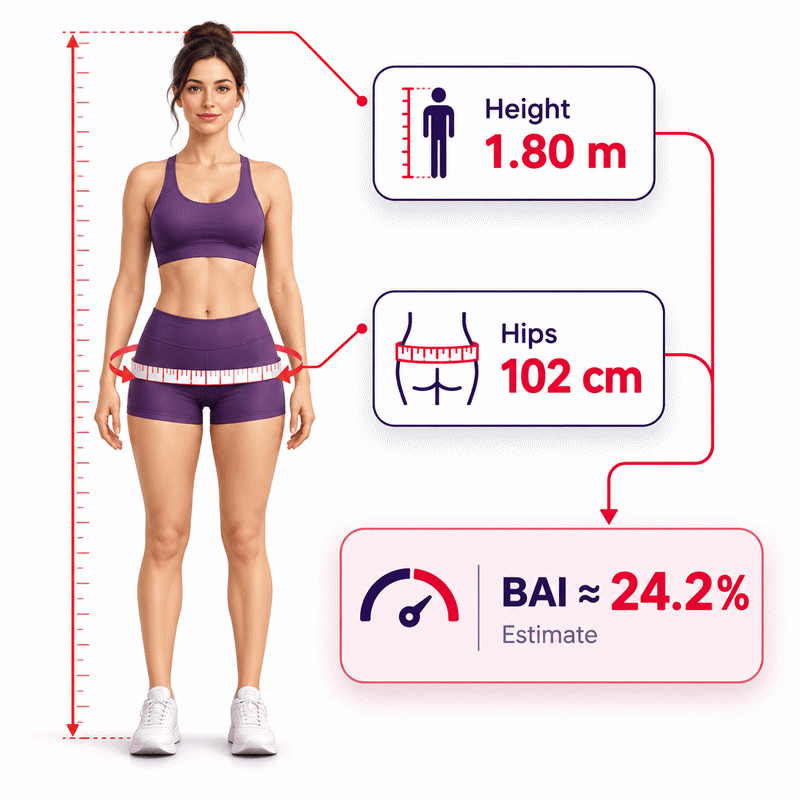
A BAI calculator estimates body adiposity from height and hip circumference. You need a height reading and a flexible measuring tape. The BAI calculator then reports a number meant to approximate body fat percentage. It does not measure fat tissue directly. That limit matters most when a result surprises you.
Start with the question you want to answer. Perhaps you cannot use a scale today. Perhaps you want to check a value from a report. Maybe you need to solve for a missing measurement. The same equation can handle all three tasks when two values are known. Each answer remains a mathematical result, not a health verdict.
When does a weight-free estimate help?
A missing or unreliable scale need not stop a basic body-size calculation. BAI uses hips and height without body weight. You can measure both with simple tools. This makes the method practical for a quick educational check. It can also help explain why two people share a weight yet have different measurements.
The method describes one part of body shape. It cannot show muscle mass, bone density, or where fat sits. A large hip reading may reflect several factors. Height gives that reading some context. Still, the index cannot turn two inputs into a complete picture of health. Use it to frame a question, then seek more context when needed.
Which value can the calculator solve?
Enter any two known values: height, hips, or BAI. Leave the value you want empty. AxiCalculator can calculate the missing third value. With height and hips, it returns the index. With height and BAI, it returns an implied hip circumference. With hips and BAI, it returns an implied height.
Check the label beside the result before using it. A length is not a body fat estimate. A BAI number is not a tape measurement. Clearing the unknown field makes your request clear. If all three values are filled, first choose which value you want to solve.
An implied hip circumference answers an algebra question. It does not describe an ideal body size. A selected BAI number is not a treatment goal. The same caution applies to an implied height. Check any reverse value against a real measurement before relying on it. That simple step can expose a wrong unit or copied number.
Height + widest hip circumference → BAI estimate → careful interpretation
How Can You Measure Height and Hips Reliably?
A poor tape reading can change the answer before any arithmetic starts. Set aside a moment for a repeatable measurement. Use a flexible tape and a level floor. Record the number and its unit together. A bare “102” is difficult to check later.
Where should the hip tape sit?
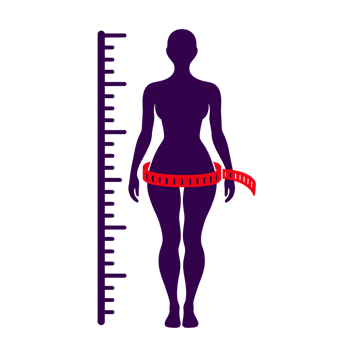
Place it around the widest part of your hips and buttocks. Keep it horizontal around your body. Hold it close without pressing into your skin. Stand naturally and breathe as usual. Do not use your waist size in the hip field. Those sites answer different measurement questions.
Move the tape slightly up and down to find the widest point. Read it without twisting the band. Light clothing can work if you use the same method later. Thick or changing clothing makes comparisons less clear. Ask someone to check tape level if you cannot see the back.
How should standing height be taken?
Measure without shoes against a flat wall. Stand upright and look forward. A level object can mark the top of your head. Avoid estimating from an old document when current height matters. Posture and age can change a recorded value.
If you know feet and inches, use both fields. Five feet ten inches is 70 inches. It is 1.778 meters after conversion. Do not type 5.10 as decimal feet or meters. A decimal entry changes the distance and the calculated index.
What if repeated readings differ?
Take another reading with the tape in the same place. Do not select the smallest value just because you prefer it. Check tape level, clothing, posture, and the marked unit. Note the method you used. A change in technique can resemble a change in body size.
For longer-term comparisons, repeat under similar conditions. Keep the original hip reading with the BAI number. Small index shifts may come from tape placement. If repeated readings remain far apart, postpone interpretation until you can measure more consistently.
A second person can help when tape placement is hard to see. Ask them to read at eye level. Keep the tape flat across the back. Write down the site and method after the check. That note makes the next reading much easier to repeat.
How Does the BAI Calculation Work?
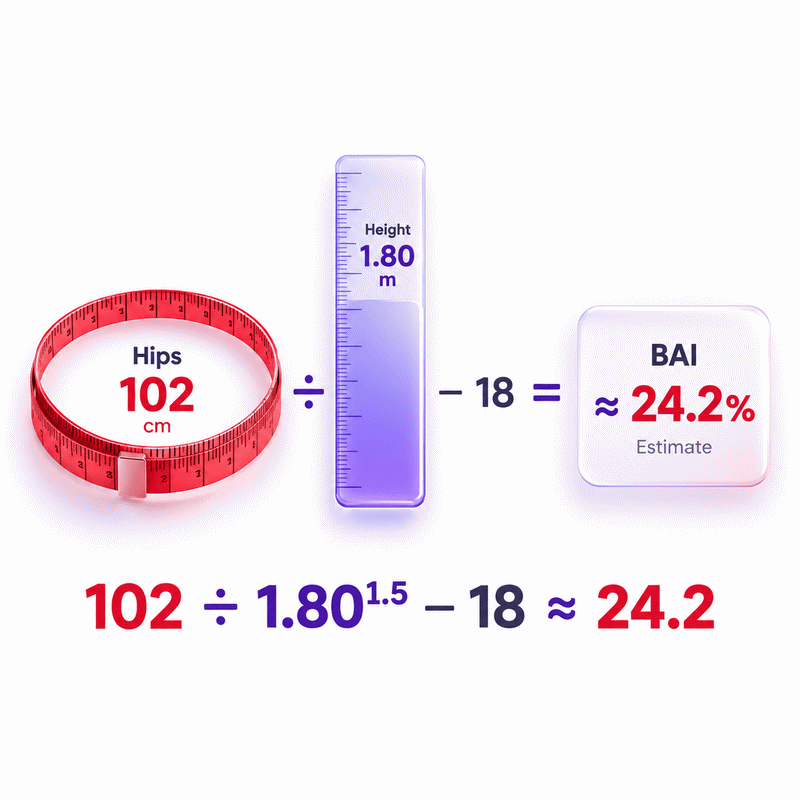
A centimeter-to-meter error can overwhelm a correct formula. The published equation expects hips in centimeters and height in meters. Convert your entered units first. Then raise height to the power of 1.5. Divide hips by that value and subtract 18.
The number is called an index. It was designed to approximate percent body fat. Its percent-like display does not prove an individual’s measured fat percentage. The input method and the model both add uncertainty.
Can you check a result by hand?
Use an illustrative height of 1.80 m and hips of 102 cm. First, 1.80 to the power of 1.5 equals about 2.414953. Next, 102 divided by 2.414953 equals about 42.236840. Subtract 18 to obtain 24.236840. A result display with one decimal shows about 24.2%.
Those numbers are a math illustration, not a real person’s measurements. Keep enough digits until the last step. Rounding the height term too early moves the answer. A neat decimal does not erase tape or model error. It only makes the screen easier to read.
How can you solve for hips?
When height and BAI are known, move the 18 first. Multiply that sum by height to the power of 1.5. The rearranged equation appears below.
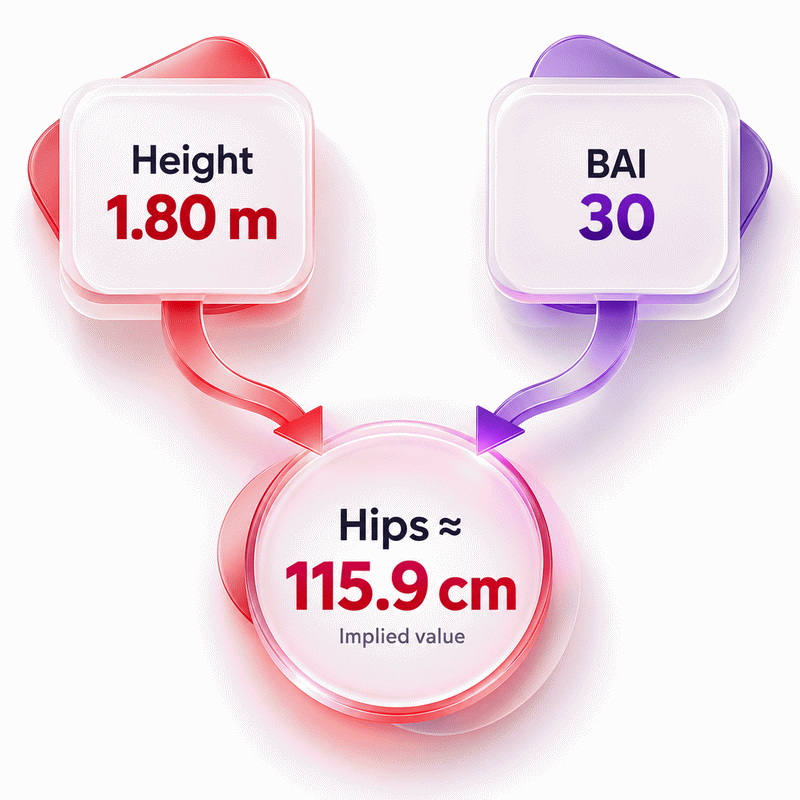
For a chosen BAI of 30 and height of 1.80 m, add 18. Then multiply 48 by 2.414953. The implied hip reading is about 115.918 cm. A display to two decimals shows 115.92 cm. It does not identify a suitable personal goal.
How can you solve for height?
When hips and BAI are known, divide hips by BAI plus 18. Raise that quotient to the power of two thirds. The result is height in meters.
For 102 cm and a chosen BAI of 30, first divide 102 by 48. The quotient is 2.125. Raise it to the power of two thirds. The implied height is about 1.653 m. Compare it with a real height reading before using it elsewhere.
Which step causes most arithmetic mistakes?
Many mistakes come from applying the exponent to the wrong part. It belongs to height alone in the forward equation. Others come from subtracting 18 before division. The unit selector can convert lengths, but it cannot fix a wrong body site. Confirm both inputs when a value looks implausible.
What Can Your BAI Number Actually Tell You?
A percentage-looking answer can feel exact. It is still an estimate. BAI cannot inspect tissue or separate muscle from fat. Two people can share the same index and have different bodies. The method also cannot reveal abdominal or visceral fat.
Is BAI the same as measured body fat?
No. The formula was developed to approximate body adiposity from simple measurements. Research has found meaningful errors for individuals. Accuracy may vary with sex, body fat level, and population. A value near 24.2 does not prove exactly 24.2% body fat.
Do not treat a single decimal as clinical precision. Your tape has a finite scale. Your placement may also shift across attempts. The formula adds its own prediction error. Together, these limits are larger than the last displayed digit. Use the number as a prompt for context, not a diagnosis.
How is BAI different from BMI?
BMI uses weight and height. BAI uses hips and height. BMI is not a body fat percentage. BAI aims to estimate one, but cannot guarantee individual accuracy. Neither measure captures your full health picture.
If they disagree, first check the entries. A waist number in the hip field changes BAI. A wrong weight unit changes BMI. Even with correct inputs, the methods answer different questions. Do not average their numbers. A BAI of 25 and BMI of 25 are different quantities.
No single direction defines health for every person. A lower result can follow a smaller hip reading or a measurement error. It cannot tell whether strength, nutrition, or symptoms improved. Avoid turning an index into a personal verdict. Seek professional context if the result affects a care decision.
- BAI estimates adiposity; it does not directly measure body fat.
- Its output cannot locate fat or describe muscle mass.
- A surprising value deserves an input check and context.
Some sites attach color bands or labels to the result. Those labels can feel more certain than the data support. A green band does not prove good health. A red band does not diagnose a condition. Ask what the label uses as its basis. If that basis is unclear, focus on the measured inputs and seek informed advice.
Why Might a BAI Result Look Wrong?
An unexpected value often points to a measurement or unit problem. Check the two values before interpreting the answer. Read each field label and unit. Then repeat the hip measurement. This sequence is faster than guessing what the result means.
Could the units be mixed?
The equation uses centimeters for hips and meters for height. One inch equals exactly 2.54 centimeters. One meter equals 100 centimeters. Select inches, feet, centimeters, or meters as actually measured. Do not enter 180 as meters when you mean 180 centimeters.
For a 40-inch hip reading, the converted value is 101.6 cm. That is close to 102 cm, but not identical. Keep the real tape reading. Do not adjust it to match an expected answer. If you switch unit menus, reread each visible unit before continuing.
Could the tape be in the wrong place?
A waist reading cannot substitute for hips. A slanted tape can also change circumference. Move the band to the widest hip and buttock point. Keep it level, snug, and free of twists. Recheck a large change using the same posture and clothing method.
Someone else may place the tape differently. If you track values, note who measured them. Record the tape location when possible. This matters more than adding extra decimal places. Consistent inputs make later comparisons easier to understand.
At 1.80 m, one extra hip centimeter changes BAI by about 0.414. That follows directly from the equation. It does not mean body fat changed by that amount. A slight placement difference can produce the same arithmetic movement. Look for a repeatable pattern before interpreting a small shift.
Unexpected answer → Check units → Recheck tape position → Compare repeated readings
A wrong unknown field can also cause confusion. If the output shows centimeters, the tool solved for hips. If it shows meters, it solved for height. To obtain BAI, provide height and hips instead. Clear the old value before changing the task. This avoids a result that is right for the wrong question.
Do not alter an input until the answer looks familiar. That hides a useful clue. Keep the first entry, find the error, and then correct it. A clear record of the change helps you trust the new result.
When Should You Seek More Than This Estimate?
A body-size index cannot answer every health question. It does not measure blood pressure, blood sugar, fitness, or symptoms. It cannot tell whether treatment is needed. Ask what decision you hope the number will support. That question can guide the next step.
Who needs extra care with interpretation?
The equation was studied in adult populations. Children and adolescents need age-appropriate assessment. Pregnancy changes the meaning of body measurements. Unusual body proportions can also affect the estimate. Very lean or highly muscular builds may need more context.
A person with an eating disorder history may find repeated body checks distressing. Supportive care matters more than another calculation. If a number causes worry, speak with a qualified professional. Do not change medication, food intake, or training from BAI alone.
What other information might matter?
A clinician may consider waist size, health history, blood pressure, and laboratory findings. These address questions the BAI equation cannot. Body composition tests can add information, though they also have limits. The right measure depends on your concern and situation.
Bring your original height and hip readings to a conversation. Mention how you measured them and when. If a prior result differs, show both sets of inputs. This helps separate an arithmetic change from a measurement change. It also keeps the focus on your actual concern.
A BAI value alone cannot justify a treatment change. It may help you ask a more precise question. Use clinical advice for decisions about diagnosis, medicines, or nutrition. The calculator’s role is to show transparent arithmetic, not replace personal care.
If you have a new symptom, lead with that concern. If you need a body fat measure, ask which test fits your situation. If you track a health plan, discuss measures tied to its goal. The best answer may not use BAI at all. A useful tool should help you see that limit plainly.
Researchers also need care when they compare groups. A model can fit average data yet miss one person. Report how the sample was chosen and how hips were measured. Do not copy a cutoff into a new group without checking it there.
How Can You Use AxiCalculator Well Over Time?
A single result becomes more useful when its inputs remain available. Keep the date, height, hip size, units, and measuring method. Repeat only when a comparison serves a real purpose. A small shift on one day may be noise.
How should you track a trend?
Use a similar tape, site, posture, and clothing method. Compare like with like. If height is stable, recheck it when needed rather than guessing. Write down each hip reading before calculating BAI. Keep the raw values with the rounded display.
Do not chase every small movement. A trend needs repeated observations and context. If measuring becomes stressful, take a break. A calculator is a tool for clarity, not a test of worth. Your goals should come from your own needs.
What should you share or export?
AxiCalculator can help you save or share a calculation. Review the values and units first. A PDF or spreadsheet records what you entered. It does not certify body composition. Treat health measurements as personal information. Choose where and with whom to share them.
If you send a result to a clinician, include the inputs. The BAI number alone hides possible errors. A short note about the hip tape position also helps. Ask for interpretation when the result affects a decision. Otherwise, use the tool as a clear, free calculation check.
Measure your height without shoes and your widest hip circumference. Enter both with the correct units. Read the result as an estimate. If it looks wrong, repeat the measurement before acting. If it matters for care, bring the readings to a qualified professional.
The page works best as a short path from question to answer. Start with the two fields. Check the result and its label. Open the deeper explanation only when you need it. This keeps the math close to the task without hiding its limits.
You can return to the same method after a later reading. Use the earlier notes to match your tape site. If the values differ, review the raw measurements first. Your record should make a change easier to explain, not merely easier to display.
Frequently Asked Questions
Can I use a BAI result from a fitness app as my medical record?
Why might my measurement change while my clothes fit the same way?
Can I compare my BAI with a friend's number?
Is it useful to calculate BAI if I already know my weight?
How should a student report uncertainty in a BAI project?
Can a reverse-solved hip circumference be used as a treatment target?
How should a researcher compare BAI with a reference body composition method?
Our engineers are here to help you get it right.