Fresh to Dry Herb Conversion
- Last formula update:
Decimal & Rounding Policy
- Calculations use full internal precision without rounding intermediate values.
- Displayed results use up to ten significant digits for practical readability.
- Repeating decimals may be displayed as rounded decimal equivalents.
- Changing a unit recalculates the displayed value without changing the physical quantity.
- Exported values retain more precision whenever the selected file format supports it.
Valid range
- Enter a finite numeric quantity greater than zero and no greater than 1,000,000,000,000.
- The selected herb must provide a documented relationship between the entered and calculated forms.
- Volume units are accepted only for volume-based fields.
- Length units are accepted only for vanilla bean length.
- Fixed item units, such as leaves, cloves, sticks, peppers, onions, and stars, cannot be exchanged with volume units.
- Blank, nonnumeric, zero, negative, infinite, incompatible, and unsupported values are rejected.

Nolissa Vantford
Reviewers:
Solavyn Marbourne
Orvick Bexquell
Check our editorial policy
September 8, 2026
1.0.0
Initial calculator and formula release.
Our engineers are here to help you get it right.
How Does the Fresh to Dry Herb Conversion Calculator Prevent Recipe Mistakes?
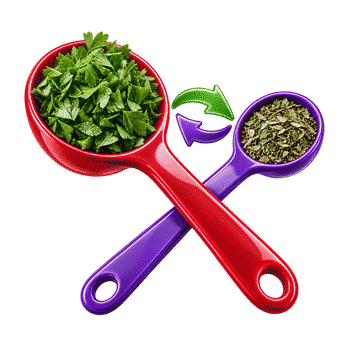
Fresh to Dry Herb Conversion Calculator results use individual reference relationships for supported herbs instead of applying one universal ratio to every ingredient. Select the exact herb, enter one positive quantity in any available fresh, dried, ground, minced, flaked, powdered, or extracted field, and the remaining equivalents update automatically. You can also edit a calculated field to solve the same relationship in reverse.
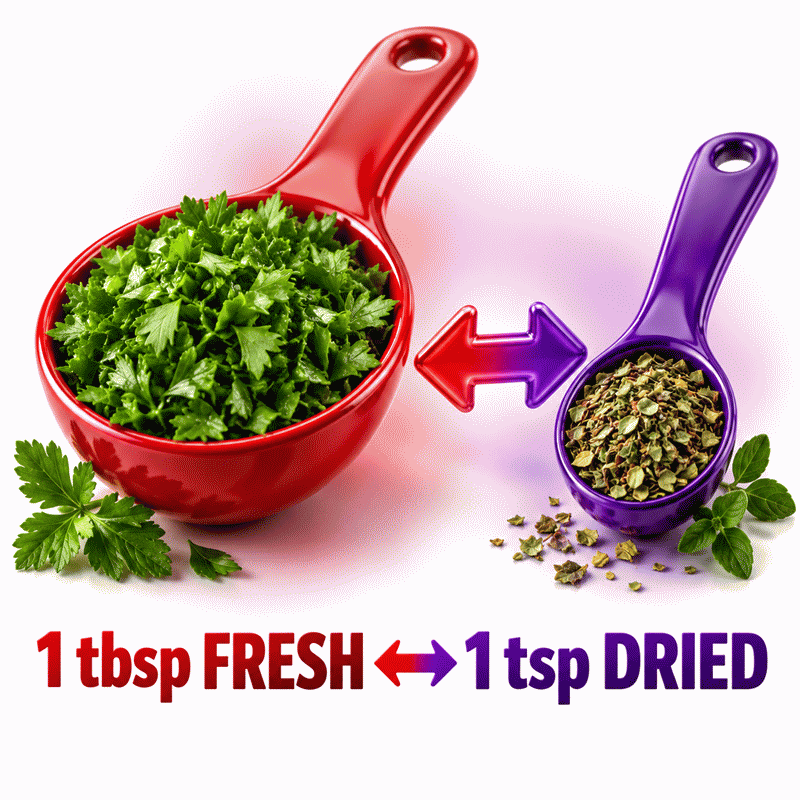
- The common 3:1 guideline applies to many leafy herbs, but exceptions matter.
- Basil, sage, parsley, sorrel, garlic, ginger, onion, chili, and vanilla use dedicated relationships.
- Volume, length, and counted-item fields remain dimensionally separate.
- Changing a unit changes the displayed number, not the physical quantity.
- Fresh herbs usually work best late in cooking; dried herbs often benefit from earlier addition.
- Flavor may vary with age, moisture, storage, variety, packing, and grind size.
Use the Fresh to Dry Herb Conversion Calculator as a precise recipe-planning starting point, then assess the dish before adding more concentrated dried or ground seasoning.
Assumptions used in this calculator
- Each herb uses its own documented substitution ratio.
- Reference ratios estimate comparable recipe flavor intensity.
- Volume measurements assume ordinary level kitchen measures.
- Ingredients are not unusually compressed inside measuring tools.
- Dried herbs are assumed to retain normal usable potency.
- Ground products are assumed to have typical commercial fineness.
- Fresh herbs are assumed to have normal moisture content.
- Fixed item units represent average recipe-sized ingredients.
- Only dimensionally compatible measurement units are interchangeable.
- Unit conversion does not alter the underlying physical quantity.
- Intermediate calculations retain full available floating-point precision.
- Displayed decimals may be rounded for practical readability.
- Final seasoning may require adjustment for freshness and taste.
Results are rounded for display.
Internal calculations use full precision.
Formulas Used in Fresh to Dry Herb Conversion :
Convert the entered value to its base unit
Determine the reference scale
Calculate each corresponding herb quantity
Convert the result to its selected display unit
- Qdisplay is the quantity entered in the currently selected unit.
- Qbase is the entered quantity converted to its base unit.
- Cu is the entered unit conversion factor.
- Ri is the reference amount for the edited herb form.
- k is the dimensionless reference scale.
- Rj is the reference amount for a corresponding herb form.
- Qj,base is the calculated result in its base unit.
- Cv is the selected output unit conversion factor.
- Qj,display is the result shown to the user.
Variables & Definitions
View a complete list of all variables used in this calculator, including definitions and units
Fresh to Dry Herb Conversion Variables and Calculation Factors
| Variable | Meaning | Unit or Type | Role |
|---|---|---|---|
Qdisplay |
Quantity entered in the currently selected unit | Selected compatible unit | User-provided value |
Qbase |
Entered quantity expressed in its base unit | Milliliter, inch, or item | Normalized calculation value |
Cu |
Conversion factor for the entered unit | Base units per display unit | Input unit conversion |
Ri |
Reference amount for the edited herb form | Compatible base unit | Defines the reference ratio |
k |
Scale relative to the edited reference amount | Dimensionless | Links all available herb forms |
Rj |
Reference amount for another available herb form | Compatible base unit | Target ratio component |
Qj,base |
Calculated target quantity in its base unit | Milliliter, inch, or item | Unrounded intermediate result |
Cv |
Conversion factor for the selected result unit | Base units per display unit | Output unit conversion |
Qj,display |
Calculated quantity shown in the selected unit | Selected compatible unit | Displayed result |
Unit Conversion Table
Fresh to Dry Herb Conversion Table
| Ingredient | Fresh or Whole Form | Dried or Alternate Form | Ground or Powdered Form |
|---|---|---|---|
| Basil | 2 tsp fresh basil, finely chopped | 1 tsp dried basil | ⅓ tsp ground basil |
| Bay Leaf | 1 fresh bay leaf | 2 dried bay leaves | — |
| Chervil | 3 tsp fresh chervil | 1 tsp dried chervil | — |
| Chili Pepper | 1 medium fresh chili pepper | ½ tsp chili flakes | ¼ tsp chili powder |
| Chives | 1 tbsp fresh chives | 1 tsp dried chives | — |
| Cilantro | 3 tsp fresh cilantro | 1 tsp dried cilantro | — |
| Cinnamon | 1 cinnamon stick | — | ½ tsp ground cinnamon |
| Cumin | 4½ tbsp whole cumin seeds | — | 3 tbsp ground cumin |
| Dill | 3 tsp fresh dill | 1 tsp dried dill | — |
| Fennel Fronds | 3 tsp fresh fennel fronds | 1 tsp dried fennel fronds | — |
| Garlic, Large | 1 large fresh garlic clove | 1½ tsp minced garlic | ¼ tsp garlic powder |
| Garlic, Small | 1 small fresh garlic clove | ½ tsp minced garlic | ⅛ tsp garlic powder |
| Ginger | 1 tbsp fresh grated or minced ginger | — | ¼ tsp ground ginger |
| Lemongrass | 1 tbsp fresh lemongrass | 1 tsp dried lemongrass | ¼ tsp lemongrass powder |
| Lovage | 1 tbsp fresh lovage | 1 tsp dried lovage | — |
| Marjoram | 3 tsp fresh marjoram | 1 tsp dried marjoram | — |
| Mint | 3 tsp fresh mint | 1 tsp dried mint | — |
| Onion | 1 medium fresh onion | — | 3 tsp onion powder |
| Oregano | 3 tsp fresh oregano | 1 tsp dried oregano | ⅓ tsp ground oregano |
| Parsley | 2 tsp fresh parsley | 1 tsp dried parsley | — |
| Rosemary | 3 tsp fresh rosemary | 1 tsp dried rosemary | ⅓ tsp ground rosemary |
| Sage | 2 tsp fresh sage | 1 tsp dried sage | ⅓ tsp ground sage |
| Sorrel | 2 tsp fresh sorrel | 1 tsp dried sorrel | — |
| Star Anise | 1 whole star anise | ½ tsp anise seeds | ¾ tsp ground star anise |
| Tarragon | 3 tsp fresh tarragon | 1 tsp dried tarragon | — |
| Thyme | 3 tsp fresh thyme | 1 tsp dried thyme | ⅓ tsp ground thyme |
| Vanilla | 1 in vanilla bean length | 1 tsp vanilla extract | ½ tsp ground vanilla |
Example Calculation
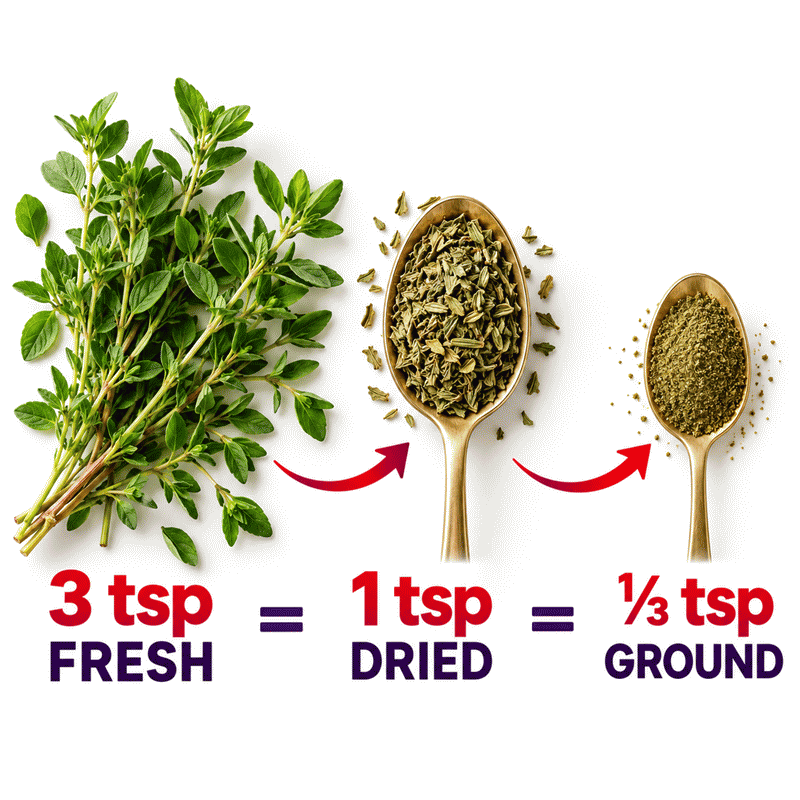
A recipe uses 7.5 teaspoons of fresh oregano. The reference relationship is 3 teaspoons fresh oregano to 1 teaspoon dried oregano and one-third teaspoon ground oregano.
The fresh quantity is first compared with the herb-specific fresh reference amount. That scale is then applied to the dried and ground reference quantities. Intermediate values remain unrounded, while the final ground result may be shortened for display. The result is a practical seasoning substitution rather than an exact measurement of flavor chemistry.
A cook has 2.5 teaspoons of dried oregano and needs to determine the equivalent fresh and ground oregano quantities. The reference relationship is 3 teaspoons fresh oregano to 1 teaspoon dried oregano and one-third teaspoon ground oregano.
The known dried amount is divided by its reference quantity to calculate the scale factor. The same factor is then applied to the fresh and ground reference amounts. This reverse calculation keeps all supported herb forms mathematically consistent while avoiding intermediate rounding.
Results are rounded for display.
Internal calculations use full precision.
Calculations Disclaimer
How Does a Fresh to Dry Herb Conversion Calculator Work?
A missing fresh herb can stop a recipe at the worst moment. The Fresh to Dry Herb Conversion Calculator solves that problem in seconds. Choose the herb, enter one known amount, and read the equivalent forms. You may begin with fresh, dried, or ground herbs. Every available quantity remains editable. This means the tool also works in reverse.
The calculator does not force one ratio onto every ingredient. It uses a separate reference relationship for each supported herb. That detail matters. Three teaspoons of fresh oregano may equal one teaspoon dried. Yet two teaspoons of fresh basil may equal one teaspoon dried. Garlic, cinnamon, ginger, onion, chili, bay leaf, and vanilla need other relationships.
This approach reduces guesswork. It also prevents a common kitchen mistake. Many cooks assume every dried herb is exactly three times stronger. That rule is useful, but it is not universal. Preparation affects the result too. A whole leaf, chopped herb, dried leaf, flake, and fine powder do not fill a spoon in the same way.
To use the tool, select the exact ingredient first. Next, enter a positive quantity in one field. Select the unit used by your recipe. The remaining fields update at once. If you edit a calculated result, that value becomes the new starting point. The other fields are then recalculated.
Why Is the Universal 3:1 Herb Ratio Only a Starting Point?
A recipe asks for fresh rosemary, but only dried rosemary is available. The familiar rule says to use one-third as much dried herb. This is a sensible starting point for many leafy herbs. It is not a promise of identical flavor.
Fresh herbs contain water and tender plant material. Their aroma can feel bright, green, and immediate. Drying removes much of that water. It also changes volatile compounds. Some aromas become less noticeable. Others become easier to release during cooking. The final effect depends on the plant and drying process.
A spoon of dried herb also contains more leaf material than the same spoon of loosely chopped fresh herb. Ground powder may pack more tightly again. This explains why ground quantities are often smaller than dried-leaf quantities.
The role of the herb in the dish also matters. A small amount of oregano in a sauce can often be converted. Two cups of basil in pesto cannot be replaced well by a small amount of dried basil. The fresh herb provides texture, color, moisture, and bulk. A ratio can estimate seasoning strength, but it cannot rebuild those physical properties.
How Drying Changes Herb Concentration and Aroma
Dried herbs may overpower a dish when measured like fresh herbs. Water loss creates a smaller, denser ingredient. The leaves also become brittle. They settle into a spoon differently from fresh leaves.
Robust herbs often perform well after drying. Oregano, thyme, rosemary, sage, marjoram, and bay leaf can release useful flavor during cooking. Delicate herbs are less predictable. Cilantro, parsley, dill, chives, and tarragon may lose some of the qualities that make them valuable when fresh.
Drying is not the only variable. Storage matters. Light, heat, oxygen, and moisture can weaken dried herbs. A newly opened jar may taste much stronger than an old jar. Therefore, a correct conversion can still need adjustment.
Crush dried leafy herbs gently before adding them. This can help release aroma. Avoid grinding every herb far in advance. More exposed surface area can speed aroma loss during storage.
Why Ground Herbs Need Smaller Quantities
A cook replaces dried rosemary leaves with ground rosemary. Equal spoonfuls produce an unexpectedly strong dish. The problem is particle size. Fine powder spreads through food quickly. It also packs with fewer air spaces.
Ground herbs should not be treated as identical to dried leaves. The calculator displays a ground field only where a supported relationship exists. For oregano, rosemary, sage, thyme, and basil, the ground amount is smaller than the dried-leaf amount.
Fine powders are difficult to remove after mixing. Add the calculated amount in stages when possible. This is especially useful in sauces, dressings, rubs, and small-batch recipes. Taste after the flavor has had time to develop.
How to Convert Fresh Herbs to Dried Herbs Without Guessing
You have seven and one-half teaspoons of fresh oregano. A simple 3:1 relationship gives two and one-half teaspoons dried oregano. The calculator performs this step automatically. It can also show the matching ground quantity.
Start by selecting Oregano. Enter 7.5 in the fresh oregano field. Keep teaspoons selected. The dried result becomes 2.5 teaspoons. The ground result becomes about 0.8333 teaspoon.
The same workflow applies to other supported herbs. However, the internal reference values change with the selected ingredient. Selecting Basil changes the relationship. Selecting Garlic changes the available field names and forms. Selecting Bay leaf changes the measurement from spoon volume to leaf count.
Select the Exact Herb and Preparation Form
A recipe says “one tablespoon fresh ginger, grated.” Choosing a generic leafy-herb ratio would be a mistake. Ginger has its own relationship with ground ginger. One tablespoon of fresh grated or minced ginger corresponds to about one-quarter teaspoon ground ginger in this reference method.
Read the full ingredient label. “Fresh,” “dried,” “ground,” “minced,” “flakes,” “powder,” and “extract” describe different forms. Choose the field that matches the recipe and the ingredient in your kitchen.
Garlic also requires size awareness. A large clove and small clove do not share the same powder equivalent. The calculator provides separate large and small garlic choices to prevent that ambiguity.
Enter One Known Quantity in Any Available Field
Users often know the required dried amount but own only fresh herbs. A one-way tool makes this awkward. Here, any numeric field can become the known value.
Enter one amount. The calculator fills the other available forms. Edit another field and it becomes the new source. You do not need to identify an input or output mode. This reduces steps and keeps reverse conversion simple.
Use one source value at a time. Do not try to force several conflicting values into the relationship. The latest edited valid field controls the calculation.
Choose a Compatible Measurement Unit
A recipe uses milliliters, while the herb jar lists teaspoons. Each volume field can use its own compatible unit. Changing a selector updates the displayed number without changing the underlying quantity.
Volume can be expressed in milliliters, teaspoons, tablespoons, or defined pinches. Vanilla bean length can use inches, centimeters, or millimeters. Counted ingredients remain counted items. A leaf cannot be scientifically converted to milliliters without information about its size and preparation.
Use smaller units for small quantities. A fraction of a cup is harder to measure reliably than a teaspoon. For fine powders, a small scale may be more repeatable in professional production, but mass conversion requires ingredient-specific density data.
How to Convert Dried Herbs Back to Fresh Herbs
A recipe needs two teaspoons of dried sage, but fresh sage is available. Select Sage and enter 2 in the dried field. The calculator returns four teaspoons fresh sage. It can also return the associated ground quantity.
Reverse conversion is not a separate scientific method. It uses the same reference relationship in the opposite direction. This keeps the results consistent. If two teaspoons fresh equal one teaspoon dried, then two teaspoons dried equal four teaspoons fresh.
Check the purpose of the herb before accepting the substitution. Fresh herbs may add moisture, color, and texture. Dried herbs may release flavor more slowly. Equal estimated flavor does not guarantee identical appearance or mouthfeel.
Using Reverse Calculation for Recipe Substitution
A cook enters 1.25 teaspoons of ground rosemary. The reference relationship links three teaspoons fresh, one teaspoon dried, and one-third teaspoon ground. Dividing 1.25 by one-third produces a scale of 3.75.
Apply that scale to the other reference amounts. The dried quantity becomes 3.75 teaspoons. The fresh quantity becomes 11.25 teaspoons. Because intermediate arithmetic remains unrounded, the two results remain consistent.
This workflow is useful when pantry stock determines the starting form. It is also helpful during recipe testing. A developer can compare fresh, dried, and ground versions without rebuilding the calculation each time.
Checking Whether Fresh Herbs Suit the Recipe
Fresh herbs are not always the best reverse substitute. A long-cooked stew may benefit from dried herbs added early. Fresh herbs added too soon can lose their brighter aroma.
Fresh herbs work well in salads, salsas, dressings, garnishes, and quick dishes. They are also useful when appearance matters. Add delicate herbs near the end. Robust fresh herbs can tolerate more heat, but timing still affects aroma.
Consider texture. Dried basil cannot provide the leaf volume needed for pesto. Fresh rosemary may add tough pieces unless finely chopped. Fresh bay leaves and dried bay leaves also differ in intensity and handling.
Which Herbs Follow the 3:1 Fresh-to-Dried Guideline?
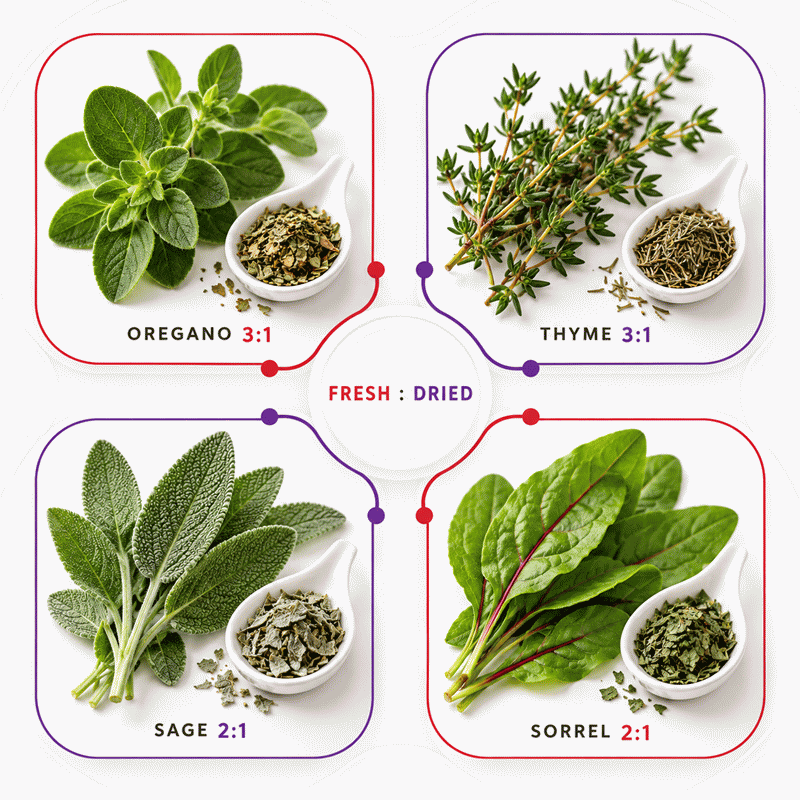
The 3:1 guideline works well as a first estimate for many culinary herbs. Examples include oregano, thyme, rosemary, dill, mint, marjoram, chervil, cilantro, tarragon, and fennel fronds in this calculator’s reference set.
For these herbs, three teaspoons fresh correspond to approximately one teaspoon dried. One tablespoon fresh also corresponds to one teaspoon dried because one tablespoon contains three teaspoons in this measurement system.
Do not extend the guideline blindly. Basil, parsley, sage, and sorrel use a 2:1 fresh-to-dried relationship here. Chives and lovage use one tablespoon fresh to one teaspoon dried, which is numerically 3:1 after matching units. Ground forms may introduce another ratio.
Robust Herbs for Soups, Sauces, and Slow Cooking
A soup tastes flat because dried herbs were added seconds before serving. Robust dried herbs need time and moisture. Add oregano, thyme, rosemary, sage, marjoram, or bay leaf earlier in the cooking process.
Slow cooking lets dried leaves soften and release aroma. Rub dried herbs between clean fingers before adding them. This can wake up the surface aroma. Avoid burning dry herbs in an empty hot pan.
Begin with the calculated amount, but taste later. Reduction can concentrate seasoning. Salt, acidity, fat, and cooking duration also change how the herb is perceived.
Delicate Herbs That Need Extra Care
Dried cilantro cannot recreate the fresh lift expected in salsa. Parsley, dill, chives, and tarragon can also lose distinctive top notes after drying.
The calculator provides a practical equivalent, not a promise of identical sensory performance. When a delicate herb defines the dish, use fresh if possible. When it plays a minor supporting role, a dried replacement may still work.
Add delicate fresh herbs near serving time. This helps retain color and aroma. If dried forms are used, allow some hydration and adjust carefully.
Important Herb-Specific Conversion Exceptions
The fastest way to ruin an herb conversion is to ignore exceptions. A universal rule cannot describe a garlic clove, cinnamon stick, medium onion, chili pepper, vanilla bean, and spoon of chopped basil at once.
The calculator changes its fields after each herb selection. This is intentional. Unsupported forms remain hidden. Users see only relationships defined for the selected ingredient.
Basil, Sage, Parsley, and Sorrel
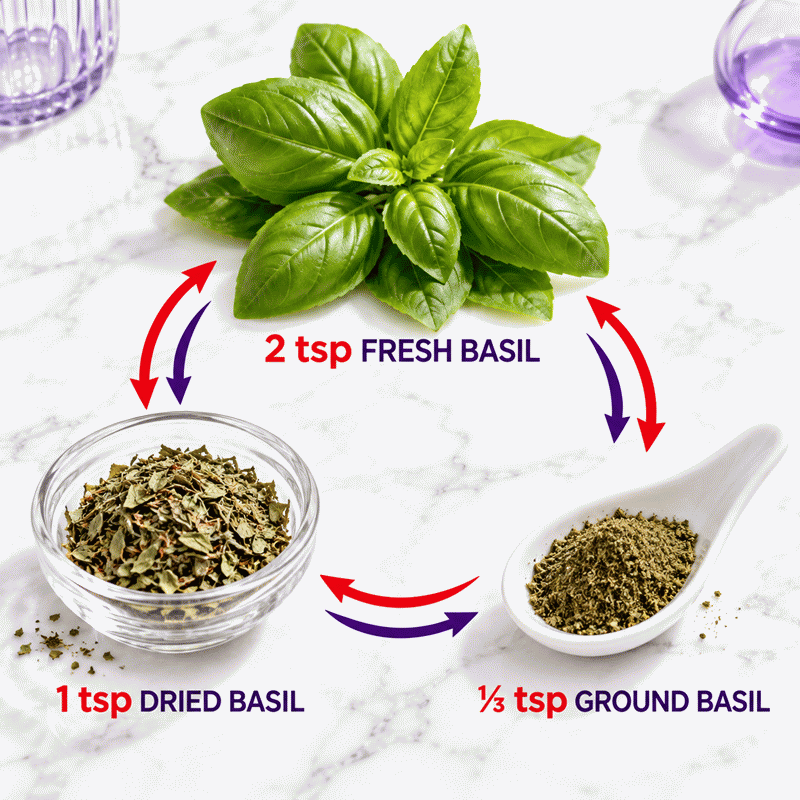
Basil uses two teaspoons finely chopped fresh to one teaspoon dried. One-third teaspoon ground basil corresponds to that same reference quantity.
Sage follows a similar two-to-one fresh and dried relationship. Its ground form is also set at one-third teaspoon for the reference quantity.
Parsley and sorrel use two teaspoons fresh to one teaspoon dried. No ground field appears because this project does not define a separate ground relationship for them.
Garlic, Ginger, Onion, and Chili Pepper
One large garlic clove corresponds to one and one-half teaspoons minced garlic or one-quarter teaspoon garlic powder. One small clove corresponds to one-half teaspoon minced or one-eighth teaspoon powder.
One tablespoon fresh grated or minced ginger corresponds to one-quarter teaspoon ground ginger. One medium onion corresponds to three teaspoons onion powder.
One medium fresh chili pepper corresponds to one-half teaspoon chili flakes or one-quarter teaspoon chili powder. Heat varies widely between cultivars, so taste adjustment remains essential.
Bay Leaf, Cinnamon, Star Anise, and Vanilla
One fresh bay leaf corresponds to two dried bay leaves. These are count-based quantities. Leaf size may still vary.
One cinnamon stick corresponds to one-half teaspoon ground cinnamon. One whole star anise corresponds to one-half teaspoon anise seeds or three-quarters teaspoon ground star anise.
One inch of vanilla bean corresponds to one teaspoon vanilla extract or one-half teaspoon ground vanilla. Vanilla products vary in strength, so check the product label when available.
When Should Fresh and Dried Herbs Enter a Recipe?
A correct quantity can still fail when timing is wrong. Fresh and dried herbs release flavor differently. The cooking method should guide when they enter the dish.
Best Timing for Fresh Herbs
Add delicate fresh herbs near the end of cooking. Basil, cilantro, parsley, dill, chives, mint, and tarragon often taste brighter this way.
Use fresh herbs after cooking when they serve as garnish. Chop them close to serving time. Long exposure to heat can dull color and aroma.
Some robust fresh herbs can cook longer. Rosemary, sage, thyme, and oregano tolerate more heat. Even so, a small fresh finish may restore aroma before serving.
Best Timing for Dried and Ground Herbs
Add dried leafy herbs earlier in soups, sauces, stews, and braises. Moisture and time help soften the leaves and spread their flavor.
Ground herbs distribute quickly. They can also become dominant. Add them carefully and avoid direct scorching. In short recipes, give the powder enough time to blend before making a final adjustment.
Whole bay leaves and star anise should usually be removed before serving. Count them when they enter the pot. This simple habit prevents an unpleasant surprise.
Common Herb Substitution Mistakes That Change Flavor
The most common error is using a 3:1 rule for every ingredient. The second is confusing dried leaves with ground powder. The third is measuring the wrong preparation form.
Do not pack chopped herbs unless the recipe says so. Do not estimate a large clove as a small clove. Do not convert a counted leaf into volume without specific data. Do not assume old and fresh jars have equal potency.
Another mistake is rounding too soon. Repeated rounding can create visible errors in large batches. Keep full precision during calculation. Round only the displayed or practically measurable result.
Finally, avoid replacing fresh herbs when they provide the structure of a dish. Pesto, herb salads, garnishes, and fresh sauces need more than seasoning intensity.
How to Scale Herb Conversions for Large Recipes
A restaurant scales a sauce from ten portions to two hundred. Small spoon errors now matter. Perform the herb-form conversion first. Then multiply the converted quantity by the recipe scale.
For repeated production, record the ingredient brand, batch, form, grind, and final accepted quantity. Volume measures are convenient, but ingredient mass is often more repeatable at scale. A validated mass specification can reduce operator variation.
Run a controlled test before full production. Mix a small representative batch. Allow dried herbs time to hydrate. Evaluate aroma after the same cooking duration used in production. Document any adjustment.
A calculator supports consistency, but sensory approval remains important. Ingredient crops, suppliers, storage, and processing can change flavor strength.
How Storage, Age, Moisture, and Grind Affect Results
A newly opened jar tastes powerful, while an older jar seems dull. Both jars carry the same label. Storage explains the difference.
Keep dried herbs in sealed containers away from heat, moisture, and direct light. Avoid shaking a jar over steaming food. Steam can enter the container and increase clumping or spoilage risk.
Label containers with opening dates. Inspect aroma, color, and condition before use. Discard ingredients that show moisture damage, mold, infestation, or an abnormal odor.
Fresh herbs should also be checked. Wilted herbs may have weaker aroma. Wet herbs can alter chopped volume. Different cultivars and growing conditions can produce different sensory strength.
The Fresh to Dry Herb Conversion Calculator gives a disciplined starting quantity. Accurate selection, careful measurement, correct timing, proper storage, and gradual tasting complete the process.
Frequently Asked Questions
Should I always use one-third as much dried herb as fresh herb?
Can I enter a dried or ground amount instead of starting with fresh herbs?
Why can the calculated quantity still taste too strong or too weak?
Can dried herbs replace fresh herbs in pesto, salsa, or garnish?
How should a restaurant scale these conversions for a large production batch?
Why are leaf, clove, stick, pepper, and onion fields not interchangeable with milliliters?
How can recipe developers verify a converted herb amount during product testing?
Engineering Resources
Our engineers are here to help you get it right.