Grams to Cups Conversion
- Last formula update:
Decimal & Rounding Policy
- Calculations retain full floating-point precision until the final displayed result.
- Intermediate density, mass, volume, and cup-size values are never rounded.
- Results display up to six decimal places when additional precision is useful.
- Insignificant trailing zeros are removed to improve readability.
- Very small valid results remain visible instead of being rounded to zero.
- Displayed values are estimates because ingredient density and packing can vary.
Valid range
- Weight must be a finite number greater than zero.
- Cup quantity must be a finite number greater than zero.
- Ingredient density must be greater than zero and no more than 25 g/mL.
- Custom cup size must be between 1 mL and 5,000 mL.
- Weight and volume values must not exceed 1,000,000,000,000 units.
- Only mass units may be used for weight values.
- Only compatible cup or volume units may be used for volume values.
- Empty, negative, zero, nonnumeric, and non-finite values are rejected.

Nolissa Vantford
Reviewers:
Solavyn Marbourne
Orvick Bexquell
Check our editorial policy
September 8, 2026
1.0.0
Initial calculator and formula release.
Our engineers are here to help you get it right.
Assumptions used in this calculator
- Ingredient density is treated as uniform throughout the measured quantity.
- Preset densities represent typical bulk values for common cooking ingredients.
- The selected cup standard determines the exact volume used.
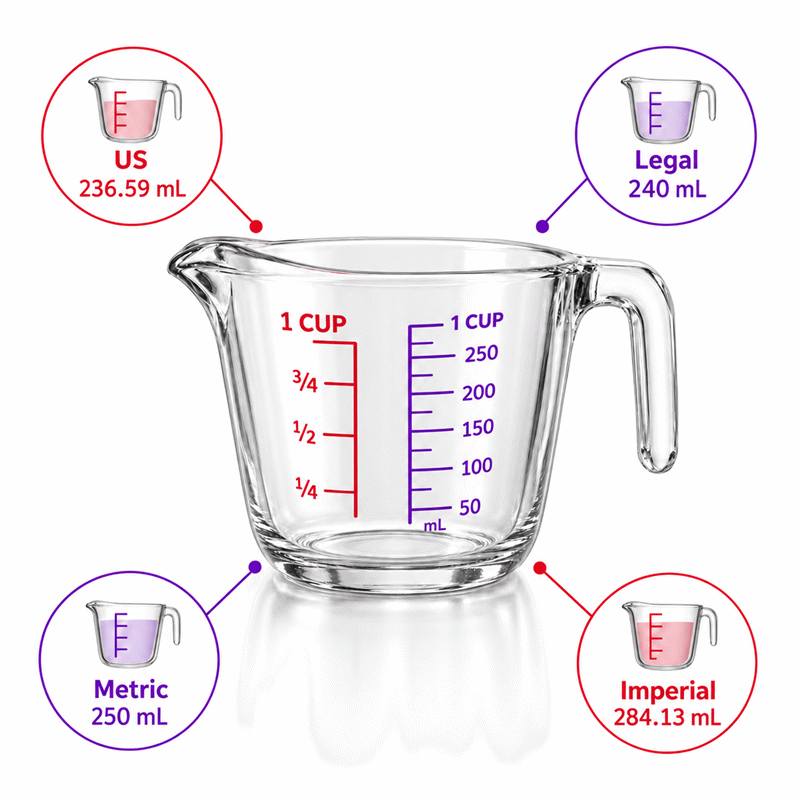
- US customary cups contain 236.59 milliliters.
- US legal cups contain 240 milliliters.
- Metric cups contain 250 milliliters.
- Imperial cups contain 284.13 milliliters.
- Custom cup sizes are entered accurately in milliliters.
- Ingredients are measured without unintended compression or excessive aeration.
- Temperature and pressure remain within ordinary food-preparation conditions.
- Moisture content matches the typical condition of the selected ingredient.
- Intermediate calculations retain full precision until final display.
- Precision-critical work requires verification using a calibrated scale.
Results are rounded for display.
Internal calculations use full precision.
Formulas Used in Grams to Cups Conversion :
Convert the Selected Weight to Grams
Calculate Cups from Weight
Calculate Weight from Cups
Convert Grams to the Selected Weight Unit
Variable Definitions
- mu is the mass displayed in the selected weight unit.
- mg is the normalized ingredient mass in grams.
- Fm is the selected mass unit factor in grams per unit.
- Ncup is the number of selected cups.
- Vcup is the selected cup volume in milliliters.
- ρ is the ingredient bulk density in grams per milliliter.
Variables & Definitions
View a complete list of all variables used in this calculator, including definitions and units
Variables Used in the Grams to Cups Conversion
| Variable | Meaning | Base Unit | Valid Condition |
|---|---|---|---|
| mu | Mass displayed in the user-selected weight unit | Selected mass unit | Finite and greater than zero |
| mg | Ingredient mass normalized for calculation | g | Finite and greater than zero |
| Fm | Grams represented by one selected mass unit | g per selected unit | Compatible mass conversion factor |
| Ncup | Quantity of the selected cup type | cup | Finite and greater than zero |
| Vcup | Volume represented by one selected cup | mL | Greater than zero |
| ρ | Bulk density of the selected ingredient | g/mL | Greater than zero and no more than 25 g/mL |
Unit Conversion Table
Mass Unit Conversion Factors
| Unit Group | Unit Name | Symbol | Equivalent in Grams | Used For |
|---|---|---|---|---|
| Popular Units | Gram | g | 1 g | Standard recipe weights |
| Popular Units | Ounce | oz | 28.349523125 g | US and imperial recipe weights |
| Popular Units | Pound | lb | 453.59237 g | Large ingredient quantities |
| Scientific Units | Kilogram | kg | 1,000 g | Bulk and commercial quantities |
| Scientific Units | Milligram | mg | 0.001 g | Very small measured quantities |
Cup Unit Conversion Factors
| Unit Group | Unit Name | Symbol | Equivalent in Milliliters | Used For |
|---|---|---|---|---|
| Popular Units | US Customary Cup | US cup | 236.5882365 mL | Most US household recipes |
| Popular Units | US Legal Cup | legal cup | 240 mL | US nutrition labeling |
| Popular Units | Metric Cup | metric cup | 250 mL | Metric recipes and kitchen measures |
| Popular Units | Imperial Cup | imp cup | 284.130625 mL | Older imperial recipes |
| Popular Units | Japanese Cup | JP cup | 200 mL | Modern Japanese recipes |
| Popular Units | Traditional Japanese Cup | go | 180.39 mL | Traditional Japanese measurements |
| Scientific Units | Custom Cup | custom cup | User-defined | Recipe-specific measuring vessels |
Example Calculation
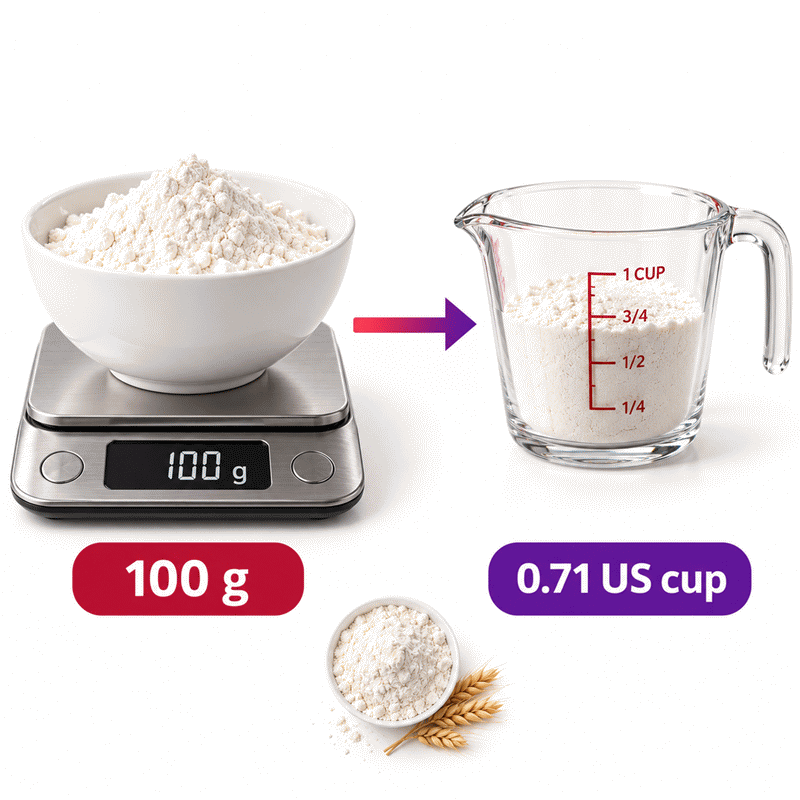
The ingredient weight is first expressed in grams.
Flour density converts the measured mass into a corresponding volume.
The resulting volume is divided by the selected US cup size.
Actual measurements may vary with flour type and packing method.
The selected cup count is multiplied by the metric cup volume.
This produces a total ingredient volume of 437.5 milliliters.
Multiplying that volume by honey density returns the mass in grams.
Temperature and product composition may cause small real-world differences.
Results are rounded for display.
Internal calculations use full precision.
Calculations Disclaimer
Why the Same Grams Can Fill Different Numbers of Cups
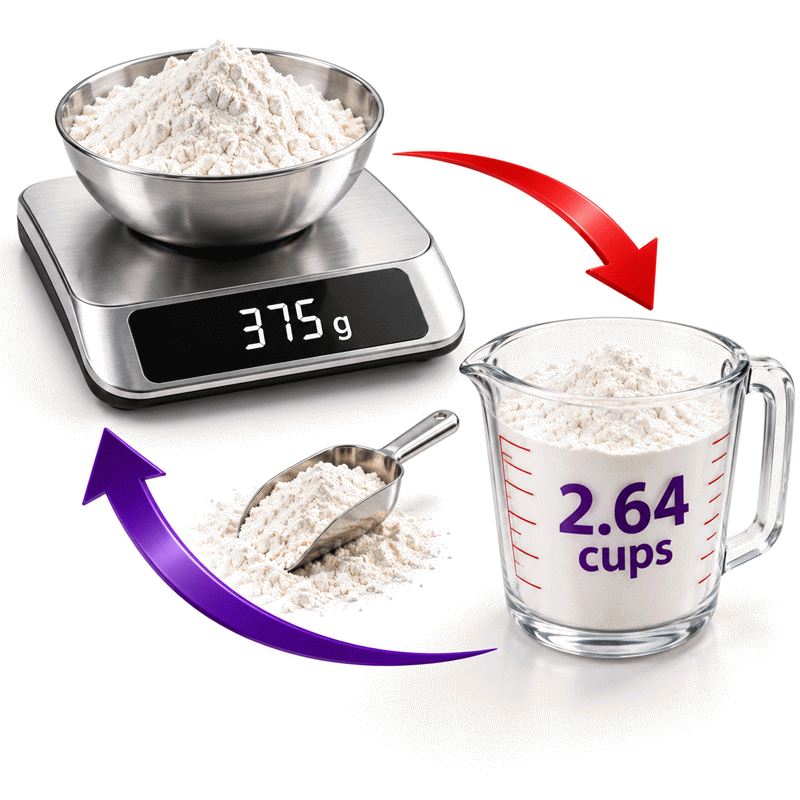
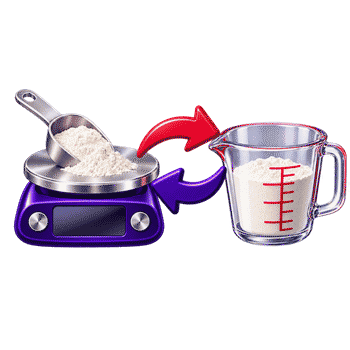
You open a recipe, see a gram value, and reach for a cup. The tempting shortcut is to treat every ingredient like water. That shortcut can change a soft cake into a dry one. Grams describe mass. Cups describe volume. A bridge is needed between them, and that bridge is ingredient density.
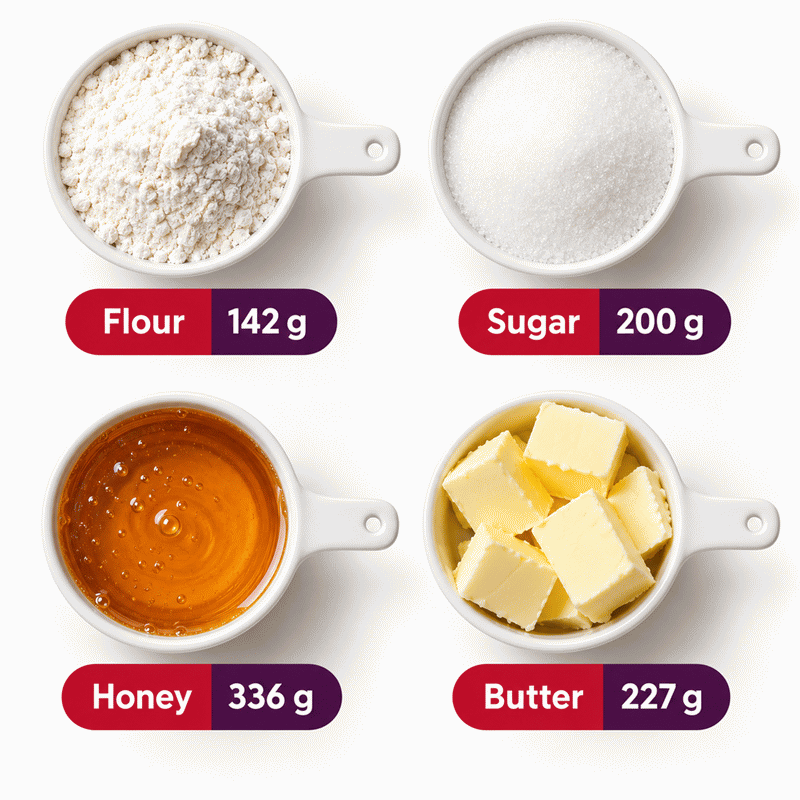
A Grams to Cups Converter should therefore ask what you are measuring. One hundred grams of honey occupies far less space than one hundred grams of oats. Honey packs substantial mass into each milliliter. Oats trap air between flakes. Equal weights create visibly different volumes, even before technique enters the picture.
AxiCalculator solves this by linking each ingredient to an appropriate bulk-density value. It also considers the selected cup standard. Enter a weight and the cup quantity updates. Enter a cup quantity instead and the weight updates. This two-way behavior helps when a recipe and your available tools use different measurement systems.
The Practical Difference Between Mass and Volume
A kitchen scale compares mass. A cup estimates the space occupied by an ingredient. These two methods answer different questions. That is why a cup cannot have one universal gram value. A cup of water, flour, sugar, and honey has the same nominal volume. Each cup has a different mass.
This distinction matters most in baking. Flour controls structure. Sugar affects sweetness, spread, moisture, and browning. Fats change tenderness and texture. A small measuring difference can shift the balance of the whole recipe. Weight-based recipes reduce this uncertainty because a gram remains a gram regardless of container shape.
Why Ingredient Density Changes Every Result
Bulk density describes the mass held within a given volume. Food ingredients are not perfectly uniform laboratory materials. Powder particle size, trapped air, moisture, temperature, and physical state all matter. The value used by a converter is therefore a practical reference, not a promise that every package behaves identically.
Consider flour. Sifting adds air and reduces the mass held in a cup. Scooping directly from a container can compress it. Spooning flour into a cup and leveling the top usually produces a lighter measure. The displayed conversion stays mathematically consistent, but your real cup can differ when your filling method differs.
How to Get a Useful Conversion in Seconds
A rushed cook often enters a number before checking the ingredient. That produces false confidence. Start by selecting the exact ingredient or the closest clearly defined match. Then identify the recipe’s country or stated cup size. Finally, enter the known value. This short sequence removes the largest avoidable errors.
Choose the Exact Ingredient Before Entering a Value
Select wheat flour only when the recipe truly uses wheat flour in a comparable condition. Do not use a generic flour value for almond flour, coconut flour, rye flour, or cornstarch. These ingredients have different particles and densities. The same rule applies to granulated sugar, powdered sugar, and packed brown sugar.
For liquids, match the physical state. Melted butter does not behave exactly like cold butter pieces. Thick syrups can retain product on the measuring vessel. Oils may have similar densities, yet they are not perfectly interchangeable. Accurate selection makes the result more useful before any number is typed.
Select the Cup Standard Used by Your Recipe
A recipe saying “one cup” may still be incomplete. The US customary cup is about 236.59 milliliters. The US legal cup is 240 milliliters. A metric cup is 250 milliliters. An older imperial cup is about 284.13 milliliters. That gap becomes larger when a recipe uses several cups.
Use the recipe’s location, publication notes, and measuring guidance as clues. Modern Australian and many Canadian recipes commonly use metric cups. Most US household recipes use customary cups. Nutrition labels may use the legal cup. Older British material may use an imperial measure. When the source is unclear, record the assumption you choose.
Use Reverse Conversion Without Starting Over
Sometimes the recipe gives cups while your scale shows grams. A two-way converter should not force a second form. Enter the cup quantity, leave weight as the unknown, and let the calculator solve it. If you edit weight again, the cup quantity becomes the calculated value.
This workflow is valuable during recipe scaling. You can test whether a pantry amount is sufficient, convert a family recipe into weights, or estimate a purchasing quantity. Because both fields remain editable, the tool follows the question you actually have.
What Makes Dry Ingredients Difficult to Measure
You carefully fill a cup, yet the finished bake still changes. Dry ingredients contain air gaps. Their volume can shift through pouring, tapping, settling, and compression. The cup itself may be accurate while the filling method is not repeatable.
Loose, Scooped, Packed, and Sifted Ingredients
“Packed” is an instruction, not decoration. Packed brown sugar is pressed firmly enough to remove large air spaces. Flour is usually handled more gently unless the recipe says otherwise. A scooped cup of flour may carry more mass than a spooned and leveled cup. Sifted flour can be lighter still.
Choose one method and repeat it. Do not tap one cup against the counter while leaving another loose. Use a straight edge when leveling is required. For sticky ingredients, scrape the full amount into the mixing bowl. These small habits often improve repeatability more than adding extra decimal places.
Moisture, Temperature, and Particle Size
Brown sugar can dry out. Flour can absorb humidity. Cocoa powders vary in fineness. Salt crystals differ in shape and size. These changes alter how particles settle and how much air remains between them. A density value taken from one condition cannot perfectly describe every kitchen condition.
Temperature matters most for liquids and fats. Warm syrup flows and levels differently. Melted fat occupies volume more evenly than irregular cold pieces. If precision matters, bring ingredients to the recipe’s stated condition and weigh them. Record unusual conditions when repeating a commercial batch.
Why Two Reliable Conversion Charts May Disagree
You compare two tables and see different answers. This does not automatically mean one table is broken. The sources may use different cup standards, ingredient varieties, or filling methods. One may round a cup to 237 milliliters. Another may use 240 or 250 milliliters.
Check the Hidden Measurement Assumptions
Look for the ingredient name, preparation state, density basis, cup size, and rounding rule. “Flour” alone is less useful than “wheat flour, spooned and leveled.” “Sugar” is less clear than “granulated white sugar.” A precise label helps you decide whether the value matches your recipe.
Also check whether a chart reports grams per cup or cups per fixed gram amount. These are inverse views of the same relationship, but heavy rounding can make them appear inconsistent. Use unrounded values during calculation and round only the displayed result.
Resolve an Unknown Cup Standard
When the recipe provides no country or standard, examine the publisher and date. Ingredient wording can also help. Use the most likely standard, then avoid false precision. If the quantity is critical, compare the recipe’s expected dough or batter texture and adjust carefully.
A practical note beside your saved recipe prevents future confusion. Write “US customary cup” or “metric cup,” not merely “cup.” This creates a repeatable process for anyone preparing the recipe later.
Handle an Ingredient Missing from the List
Do not select a random ingredient with a similar appearance. Find a credible bulk-density value for the exact food and condition. Enter that value through the custom-density option. Confirm that the density unit matches the calculator’s required unit before calculating.
A density from a compact solid may not describe loose pieces of that food. Whole nuts, chopped nuts, and nut flour can have very different bulk behavior. Use a value measured for the form you will place in the cup.
When a Kitchen Scale Is the Better Choice
A conversion can guide you, but the recipe may demand repeatability. A scale directly measures the quantity the recipe specifies. It removes variation from cup shape, eye level, packing, and leveling. This makes weighing especially useful for bread, pastry, confectionery, and scaled batches.
Improve Repeatability in Everyday Baking
Place the mixing bowl on the scale and tare it. Add the first ingredient until the required weight appears. Tare again before adding the next ingredient. This reduces extra dishes and limits transfer loss. Keep wet or messy ingredients in separate vessels when the recipe requires controlled mixing.
Check the scale’s capacity and resolution. A large platform scale may not resolve tiny yeast or spice quantities well. A smaller precision scale can support those measurements. Never exceed the rated capacity, and use the scale on a stable, level surface.
Scale Recipes Without Multiplying Small Errors
Volume errors grow with batch size. A slight excess in one cup becomes a large excess across ten cups. Convert the original recipe into weights first. Apply the scaling factor to those weights. This gives each ingredient the same mathematical treatment and supports consistent batches.
Do not assume cooking time scales in the same way. Pan geometry, oven loading, heat transfer, and evaporation can change. Use the converter for ingredient quantities, then evaluate process settings separately.
Professional Use Requires a Controlled Measurement Method
A café repeats a popular bake, but texture changes between shifts. The recipe uses cups, and each worker fills them differently. Converting the recipe into verified weights can reduce this variation. The calculator provides a starting estimate; the production team then confirms the target through controlled trials.
Build a Repeatable Batch Record
Record ingredient brand, lot condition, preparation state, target weight, batch size, and selected cup standard. Note whether flour was sifted or sugar was packed. Keep the approved weight after a successful trial. Future staff can reproduce the process without interpreting an ambiguous cup instruction.
Review the record when suppliers or product forms change. A new flour specification can alter water absorption even when its cup weight appears similar. Conversion supports quantity planning, while production validation confirms performance.
Use AxiCalculator as a Decision Tool
AxiCalculator gives users an immediate two-way answer and keeps the measurement choices visible. It is useful for translating recipes, checking pantry quantities, comparing cup standards, and preparing weight-based instructions. The aim is informed action, not a misleading claim of laboratory certainty.
Save or share a completed result when another person needs the same assumptions. Include the ingredient and cup standard in any production note. If safety, compliance, nutrition labeling, or commercial specifications depend on the value, verify it using approved measurement procedures.
A Quick Decision Checklist Before Measuring
Start with five questions. Is the ingredient exact? Is its physical condition correct? Which cup standard does the recipe use? Does the task need a convenient estimate or repeatable production control? Is a calibrated scale available?
If you need a quick household estimate, select the ingredient and cup type, then convert. If texture is sensitive, weigh the ingredient. If the ingredient is unusual, use a verified custom density. If several people will repeat the recipe, document the chosen assumptions.
The best conversion is not merely the longest decimal. It is the result built from the right ingredient, the right cup, and a realistic understanding of uncertainty. That approach turns a simple calculator into a dependable kitchen decision tool.
How to Judge Whether the Result Makes Sense
A number can be calculated correctly and still reflect the wrong assumption. Before using the result, compare it with the ingredient’s familiar behavior. Dense liquids should usually occupy less volume than light flakes at the same weight. If the answer appears reversed, check the ingredient selection, mass unit, and cup standard before changing the recipe.
Use a Simple Reality Check
Water offers an easy reference because one milliliter has a mass close to one gram under ordinary kitchen conditions. One US customary cup of water therefore weighs about 236.59 grams. Honey should weigh more per cup, while flour and oats should weigh less. This comparison does not replace the calculation, but it can reveal an incorrect unit or ingredient choice quickly.
Watch decimal placement when entering kilograms, milligrams, ounces, or pounds. A value of 0.25 kilograms represents 250 grams, not 25 grams. When a result is unexpectedly large or small, convert the known weight to grams mentally and compare its order of magnitude with the displayed answer.
Match Precision to the Measuring Tool
A result containing many decimals may exceed what a measuring cup can reproduce. Keep full precision inside the calculation, then use a practical display. For a household cup, a familiar fraction or a nearby tablespoon amount may be easier to measure. For a scale, round according to the device resolution.
Do not hide meaningful uncertainty behind extra digits. If the ingredient varies greatly with packing, a six-decimal answer is not six-decimal knowledge. Use the result as a controlled estimate, apply one consistent measuring method, and improve the recipe record after a successful test.
Frequently Asked Questions
Why does the calculator need an ingredient before converting grams to cups?
Which cup setting should I use for an online recipe?
Why can my measured cup weigh differently from the displayed result?
Should I use grams or cups when baking a sensitive recipe?
How should a professional kitchen validate a converted recipe?
What density should be entered for an ingredient missing from the calculator?
How can students verify that a reverse cups-to-grams result is correct?
Our engineers are here to help you get it right.