pKa Calculator
- Last formula update:
Decimal & Rounding Policy
- Keep full numerical precision during all pKa, pH, Ka, and concentration calculations; round only the final displayed result.
- Display pH and pKa results to up to 3 decimal places, removing unnecessary trailing zeros.
- Preserve user-entered precision whenever possible, especially when a displayed result is used for a reverse calculation.
- Use scientific notation for very small or very large Ka and concentration values to keep results clear and readable.
- Never round intermediate logarithms, concentration ratios, or unit conversions, as early rounding can noticeably affect the final pKa value.
- When converting between Ka and pKa, calculate with full floating-point precision before applying the display rounding policy.
Valid range
- pH: Enter any finite value appropriate to the chemical system; values from 0 to 14 are common for standard aqueous solutions, although values outside this range are possible.
- Conjugate base concentration [A-]: Must be greater than 0 because the Henderson-Hasselbalch equation uses it inside a logarithmic concentration ratio.
- Weak acid concentration [HA]: Must be greater than 0; zero or negative concentrations are not valid for the logarithmic calculation.
- pKa: May be any finite real value supported by the acid-base system, including negative values for very strong acids.
- Ka: Must be strictly greater than 0 because pKa is calculated using pKa = -log10(Ka).
- [A-]/[HA] ratio: Must remain greater than 0 so the base-10 logarithm is mathematically defined.

Xylena Morforde
Reviewers:
Cirelle Vossford
Zorven Lumquell
Check our editorial policy
August 31, 2026
1.0.0
Initial calculator and formula release.
Our engineers are here to help you get it right.
How Does the pKa Calculator Help You Understand Acid-Base Behavior?
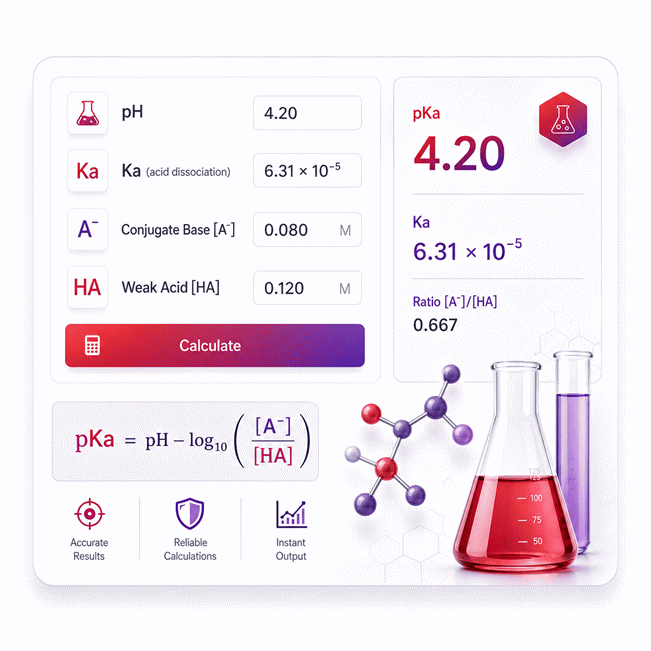
The pKa Calculator helps you evaluate acid strength, solution behavior, and protonation with clear, reversible calculations. It connects pH, pKa, Ka, weak acid concentration, and conjugate base concentration so you can move from known values to the quantity you need. The pKa Calculator is useful for chemistry study, laboratory planning, buffer analysis, formulation work, and process troubleshooting.
- Lower pKa values generally indicate stronger acids under comparable chemical conditions.
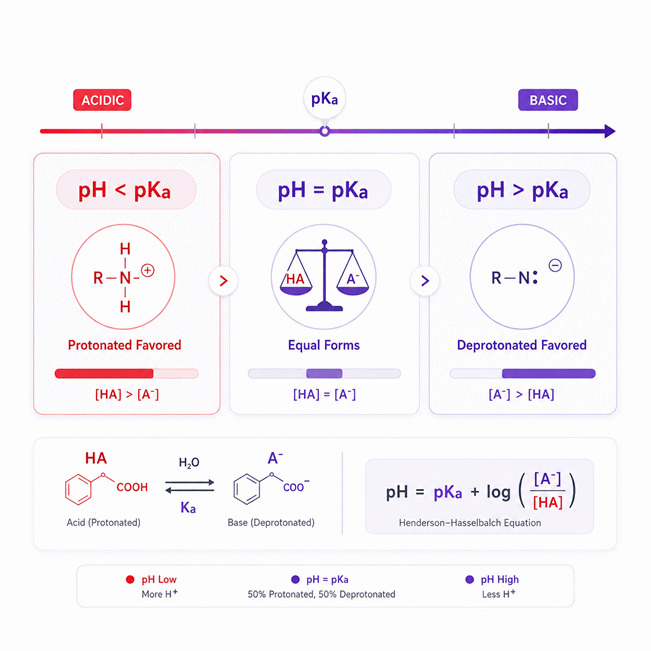
- When pH is below pKa, the protonated acid form is usually favored.
- When pH is above pKa, the deprotonated conjugate-base form is usually favored.
- When pH equals pKa, acid and conjugate-base concentrations are equal.
- Buffer systems are generally most effective when operating near their relevant pKa.
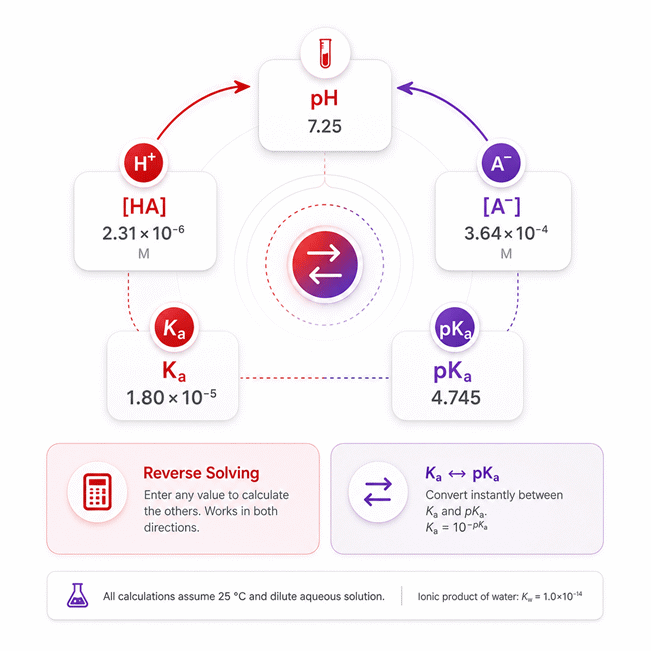
- Reverse solving can determine pH, pKa, weak acid, or conjugate-base concentration.
- Ka and pKa provide two connected ways to describe acid dissociation strength.
- Small pKa differences can represent large changes because the scale is logarithmic.
- Solvent, temperature, ionic environment, and chemical composition can affect real behavior.
For practical decisions, compare pH with pKa first, identify the correct conjugate pair, then interpret the result within the actual chemical environment.
Assumptions used in this calculator
- Calculations assume equilibrium conditions are established before pH or concentration values are used.
- Concentrations represent chemically relevant equilibrium values for the acid and conjugate base.
- Conjugate base and weak acid concentrations are assumed strictly positive.
- Activity effects are neglected unless concentration values already incorporate suitable corrections.
- The Henderson-Hasselbalch approximation is assumed appropriate for the chemical system.
- Temperature is assumed constant for the Ka and pKa values applied.
- Solvent composition is assumed consistent with the source of the equilibrium constants.
- Ionic strength is assumed low enough for concentration-based calculations to remain useful.
- Entered Ka values are assumed dimensionless or thermodynamically normalized.
- No automatic correction is applied for competing equilibria or side reactions.
- Industrial users should verify inputs against validated process or laboratory data.
- Results are estimates and should not replace qualified chemical or process judgment.
- Safety-critical decisions require independent verification under actual operating conditions.
Results are rounded for display.
Internal calculations use full precision.
Formulas Used in pKa Calculator :
1. Concentration Unit Normalization
Each entered acid or conjugate-base concentration is converted to molar concentration before the concentration ratio is evaluated.
M = 1, mM = 10-3, µM = 10-6, nM = 10-9, pM = 10-12
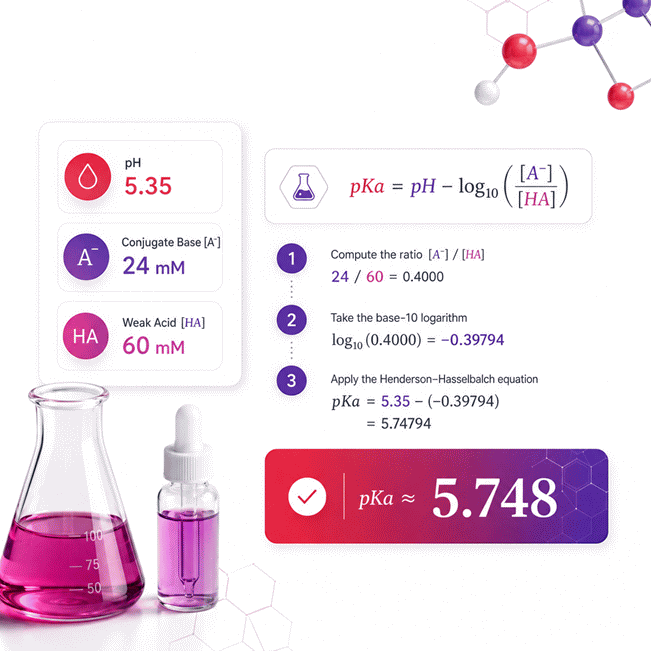
2. pKa from pH and Concentrations
The normalized concentrations must both be greater than zero. The calculator uses this same relationship for reverse solving when pH, pKa, [A−], or [HA] is the unknown.
3. pKa from the Acid Dissociation Constant
Ka must be greater than zero. When Ka is unknown, the calculator reverses this same logarithmic relationship algebraically.
Variable Definitions
- cM — concentration converted to molar units.
- cu — concentration entered in the selected unit.
- fu — conversion factor from the selected concentration unit to M.
- pH — solution acidity value used in the acid-base relationship.
- pKa — logarithmic measure of acid dissociation strength.
- [A−] — conjugate-base concentration after unit normalization.
- [HA] — weak-acid concentration after unit normalization.
- Ka — acid dissociation constant.
- log10 — base-10 logarithm used by both calculation paths.
Variables & Definitions
View a complete list of all variables used in this calculator, including definitions and units
pKa Calculator Variables, Symbols, Units, and Calculation Roles
| Variable | Symbol | Meaning | Unit or Dimension | Valid Requirement | Calculation Role |
|---|---|---|---|---|---|
| Normalized concentration | cM | Concentration converted to the common molar basis before calculation. | M | Must be greater than 0 when used in the logarithmic concentration ratio. | Provides a consistent concentration basis when different units are selected. |
| Entered concentration | cu | Concentration value entered by the user in the selected concentration unit. | M, mM, µM, nM, or pM | Must be finite and greater than 0. | Converted to molar concentration before use in the acid-base equation. |
| Unit conversion factor | fu | Factor used to convert the selected concentration unit to molar concentration. | Dimensionless conversion factor | Must be positive and correspond to the selected compatible unit. | Used in cM = cu × fu. |
| Solution acidity | pH | Acidity value of the solution used in the Henderson-Hasselbalch relationship. | Dimensionless | Must be a finite real value; 0 to 14 is common for standard aqueous solutions. | Can be entered directly or reverse-calculated from pKa and the concentration ratio. |
| Acid dissociation logarithm | pKa | Negative base-10 logarithm of the acid dissociation constant. | Dimensionless | Must be a finite real value. | Can be calculated from pH and concentrations or from Ka, and can also support reverse calculation. |
| Conjugate base concentration | [A−] | Equilibrium concentration of the conjugate base participating in the buffer ratio. | M after normalization | Must be finite and greater than 0. | Forms the numerator of the [A−]/[HA] ratio and may be reverse-calculated. |
| Weak acid concentration | [HA] | Equilibrium concentration of the weak acid participating in the buffer ratio. | M after normalization | Must be finite and greater than 0. | Forms the denominator of the [A−]/[HA] ratio and may be reverse-calculated. |
| Acid dissociation constant | Ka | Acid dissociation constant used to determine the corresponding pKa value. | Dimensionless numerical value in this calculator | Must be finite and strictly greater than 0. | Used in pKa = −log10(Ka) and recovered by reverse calculation when needed. |
| Base-10 logarithm | log10 | Mathematical logarithm used for both concentration-ratio and acid-dissociation calculations. | Dimensionless operator | Its argument must be strictly greater than 0. | Transforms the concentration ratio or Ka value into the logarithmic pH or pKa scale. |
Unit Conversion Table
pKa Calculator Concentration Unit Conversion Table
| Unit Group | Unit Name | Symbol | Equivalent in M | Used For |
|---|---|---|---|---|
| Popular Units | Molar | M | 1 M | Standard weak acid and conjugate base concentration input. |
| Popular Units | Millimolar | mM | 0.001 M | Common laboratory acid and conjugate base concentrations. |
| Popular Units | Micromolar | µM | 0.000001 M | Low-concentration acid-base and biochemical solution calculations. |
| Scientific Units | Nanomolar | nM | 0.000000001 M | Very dilute analytical and biochemical concentration calculations. |
| Scientific Units | Picomolar | pM | 0.000000000001 M | Extremely dilute scientific and high-sensitivity analytical calculations. |
Example Calculation
Because both concentrations use the same unit, their ratio can be calculated directly as 24 / 60 = 0.4. The base-10 logarithm of 0.4 is approximately -0.397940, so subtracting this negative value increases the pKa. The calculator keeps full precision during the intermediate logarithmic calculation and rounds only the displayed result. This result indicates that the solution pH is below the acid pKa, consistent with a higher weak-acid concentration.
In this reverse calculation, pH, pKa, and weak acid concentration are known while the conjugate base concentration is unknown. Rearranging the Henderson-Hasselbalch relationship gives the required [A-] concentration directly. Because pH is higher than pKa, the conjugate base concentration must be greater than the weak acid concentration. Full numerical precision is retained during exponentiation, with rounding applied only to the displayed result.
Results are rounded for display.
Internal calculations use full precision.
Calculations Disclaimer
Why a pKa Calculator Matters When the Chemistry Is Not Obvious
A small acid-base change can alter an entire chemical system. A pKa Calculator helps reveal that change before it becomes confusing. The pKa Calculator also connects measured solution behavior with acid strength. This makes the result easier to interpret, not just easier to calculate. The main challenge is rarely finding one number. The real challenge is knowing what that number means. A pKa value shows how readily an acid can release a proton. Lower values generally indicate stronger acids under comparable conditions. Higher values usually indicate weaker proton donation. This information becomes powerful when pH is considered at the same time. The difference between pH and pKa predicts the dominant chemical form. That relationship matters in laboratories, production systems, formulation work, and chemistry education.What pH and pKa Reveal About Protonation
Suppose the pH moves above the relevant pKa. The deprotonated form then becomes more important. If the pH falls below pKa, the protonated form becomes more important. This simple comparison gives fast chemical insight. You can often predict molecular behavior before performing deeper analysis. The most interesting point occurs near pH equal to pKa. Neither chemical form strongly dominates there. Both forms exist in meaningful proportions. That balance explains why many buffer systems work best near their pKa. It also explains why small pH changes can matter greatly.Why the Same pKa Value Can Mean Different Things in Practice
A pKa value should never be read without chemical context. The surrounding system controls how useful that value becomes. Solvent conditions can change acid-base behavior. Temperature may also affect equilibrium. Ionic environments can influence observed behavior too. This creates an important practical lesson. A precise-looking number is not always equally useful everywhere. A laboratory value measured under controlled conditions may differ elsewhere. A process stream may contain salts, solvents, or other reactive species. Those conditions can change how the system behaves.The Fast Interpretation Rule
Compare pH with pKa before looking at anything else. When pH exceeds pKa, deprotonation becomes more favorable. When pH is below pKa, protonation becomes more favorable. When both values are close, both forms can remain important. That quick comparison turns a calculated number into useful chemical information.How Reverse Solving Changes the Way You Use Acid-Base Data
Real work rarely gives every value in the perfect order. Sometimes pH is measured, but concentration is unknown. Sometimes pKa is known from prior testing. In other cases, the acid-base balance must be estimated first. A useful calculator should adapt to those situations. It should not force one rigid calculation path. Reverse solving allows known values to reveal the missing quantity. This can reduce manual rearrangement and repeated calculations. The benefit becomes clear during troubleshooting. A process engineer may know the target pH and acid behavior. The missing question may concern the required chemical balance. A student may face the opposite problem. Concentration data may be available, while pH remains unknown. The same chemical relationship can support both workflows.Why One-Way Calculation Often Creates Extra Work
Traditional calculators usually separate inputs from outputs. That design feels simple at first. It becomes frustrating when the desired unknown changes. Users may need to rearrange equations by hand. They may copy results between tools. Each transfer creates another chance for error. Reverse solving removes much of that friction. A result field can become a known value. A previous input can then become the unknown. This mirrors real scientific problem solving more closely. It also helps users test different scenarios quickly. Change one value and observe how another responds.Where Reverse Solving Becomes Most Useful
Buffer design is one strong use case. Laboratory preparation is another. Process monitoring may also benefit from reverse reasoning. A measured pH can help explain chemical balance changes. Educational work becomes clearer too. Students can test how the same relationship behaves from different directions. This creates a useful learning loop. Instead of memorizing isolated steps, users see connected chemical behavior.A Better Mental Model for Acid-Base Problems
Do not think only in terms of input and output. Think in terms of known and unknown values. That change sounds small. It changes how the whole calculation feels. The chemistry stays the same. The solving direction changes. This approach makes complex-looking questions much easier to organize.What Acid Strength Really Means When Comparing pKa Values
A common problem appears when two acids have close pKa values. The numbers may look almost identical. Their chemical behavior may still differ greatly. The pKa scale is logarithmic. This makes small numerical differences more important than they appear. A change of one pKa unit represents a tenfold change in acid dissociation tendency. A difference of two units represents about one hundredfold. That is why pKa comparisons deserve careful attention. Users often see values such as 4.5 and 5.5. Those numbers look close on paper. Chemically, the difference is significant.Why Lower pKa Usually Means a Stronger Acid
A stronger acid more readily gives up a proton. Its dissociation tendency is therefore greater. That behavior corresponds to a lower pKa value. The reverse is also useful. A higher pKa normally indicates weaker acid behavior. This rule works well when comparing related systems under similar conditions. It should not replace chemical context. A solvent change can shift acid strength. Molecular structure can also change proton stability. Still, the pKa ranking provides a fast first comparison.How Molecular Structure Can Shift pKa
Molecular structure controls where charge appears after proton loss. Stable charge usually makes deprotonation easier. Electron-withdrawing groups can stabilize negative charge in many molecules. This often lowers pKa. Resonance can also stabilize the conjugate base. That effect may increase acidity. Nearby functional groups matter too. Their electronic effects can change proton behavior. This makes pKa useful beyond simple calculation. It becomes a clue about molecular structure. A surprising pKa result can therefore reveal more than arithmetic. It may expose a structural effect worth investigating.Use pKa as a Comparison Tool, Not an Isolated Label
A single pKa value gives limited insight. Comparison creates more meaning. Compare related acids under similar conditions. Then connect the difference to structure and environment. This approach helps explain why one compound behaves differently from another. It also prevents oversimplified conclusions based on one number alone.Why Buffer Behavior Can Change Faster Than Expected
A buffer may appear stable until the chemical balance shifts. Then pH can change faster than expected. This often surprises new users. A buffer does not resist every amount of added acid or base. Its performance depends on the available acid-base pair. The balance between both forms also matters. A pKa Calculator can help reveal where that balance sits. The most useful region is generally close to the relevant pKa. When pH moves far away, one form increasingly dominates. The system then loses much of its balanced buffering behavior.What Happens Near the Best Buffering Region
Near pH equal to pKa, both chemical forms remain important. This creates an effective response to added acid or base. One component can react with added acid. The other can react with added base. That balance is the reason this region matters. Move roughly one pH unit away from pKa. One species becomes much more dominant. The solution may still be called a buffer. Its resistance becomes less balanced. This is important during formulation and laboratory planning.Why Dilution Can Be Misleading
A diluted buffer may keep a similar pH at first. That does not mean its performance is unchanged. The acid-base proportion may remain similar. Total available material becomes lower. The solution can therefore resist less added acid or base. This distinction matters in real preparation work. Matching pH alone does not guarantee matching buffer capacity. Two solutions may show the same pH. Their practical resistance can still differ greatly. That is one reason pKa analysis should support chemical judgment, not replace it.A Quick Buffer Decision Check
First compare the desired pH with the relevant pKa. Then ask whether both acid-base forms remain present in useful amounts. Finally, consider how much chemical disturbance the solution must resist. This three-step view catches many weak buffer choices early.Common pKa Calculation Mistakes That Can Change the Chemical Conclusion
Many pKa problems fail before any difficult chemistry begins. The mistake often comes from interpretation. Users may choose the wrong acid-base pair. They may confuse acid strength with solution acidity. They may also compare values measured under different conditions. These errors can create convincing but misleading results. The safest approach starts by identifying the actual chemical pair involved.Confusing pH with pKa
pH describes the current solution state. pKa describes acid dissociation behavior. They are related, but they are not interchangeable. A solution can have a pH of five. That does not mean its acid has a pKa of five. The pH depends on the complete solution environment. Concentrations and other equilibria may influence it. This distinction becomes critical in mixed systems. Before interpreting any result, ask one simple question. Is this value describing the solution or the acid? That question prevents many basic errors.Using the Wrong Conjugate Pair
The acid and conjugate base must belong to the same equilibrium step. This becomes especially important with polyprotic acids. Such acids can release more than one proton. Each dissociation step has its own relevant pKa. Choosing the wrong pair may produce a neat-looking result. The chemistry behind it will still be wrong. Always identify the active proton-transfer step first. Then connect the correct acid form with its direct conjugate base.Ignoring the Chemical Environment
Published pKa values can differ between conditions. A value measured in water may not transfer directly into another solvent. Temperature changes can also affect behavior. High ionic environments may create additional differences. This matters most when small pKa shifts affect decisions. A difference of a few tenths may seem minor. It can still change predicted species distribution.Three Warning Signs Worth Checking
A result deserves another look when it contradicts known chemical behavior. Check again when concentration changes cause impossible trends. Also investigate when two trusted measurements disagree strongly. Unexpected results are not always calculation failures. Sometimes they reveal a hidden chemical effect. That possibility makes careful review valuable.How to Use pKa Results for Better Laboratory and Process Decisions
A calculated value becomes useful only when it improves a decision. That decision may involve buffer choice, formulation, sample preparation, or process control. The fastest workflow starts with the real objective. Do you need a target pH? Do you need the dominant chemical form? Are you comparing acid strength? Are you diagnosing a process shift? Each goal requires a different interpretation. AxiCalculator is most useful when the calculation stays connected to that goal.Laboratory Use: Think Beyond the Final Number
Laboratory users often know the target pH before preparation begins. The next question concerns the right acid-base system. A suitable pKa near the target pH can simplify that choice. After preparation, measured pH remains important. Real solutions may not behave perfectly. Reagents can contain impurities. Temperature can change. Instruments can drift. That is why the calculated result should guide preparation and review. It should not remove the need for good laboratory practice.Process Use: Watch Trends, Not Just Single Measurements
Industrial systems often change over time. Feed composition may move. Temperature may drift. Reaction progress may alter acid-base balance. A single pKa-related calculation gives one snapshot. A sequence of results can reveal much more. If pH changes while other values remain stable, investigate the process conditions. If the chemical balance shifts unexpectedly, look for composition changes. Trend awareness can reveal problems before they become larger. This is especially useful where product quality depends on controlled chemistry.Educational Use: Test the Relationship from Both Directions
Students often learn acid-base chemistry as several separate equations. That approach can make the topic feel harder than necessary. Reverse solving exposes the shared relationship. Change pH and watch the chemical balance respond. Change pKa and observe how the dominant form changes. This creates a more intuitive understanding. The user sees cause and effect instead of memorizing isolated steps.Turn the Result Into a Decision
After every pKa calculation, ask what changes next. Does the selected buffer still fit the target pH? Which molecular form should dominate? Does the result match expected acid strength? Does the process trend make chemical sense? A useful calculator should answer the numerical question quickly. Good interpretation turns that answer into action. AxiCalculator supports that next step through direct, reversible problem solving. The goal is simple: fewer manual steps and clearer chemical decisions.Frequently Asked Questions
When is a pKa calculator useful, and when should I be cautious?
Can I use the calculator for polyprotic acids?
Can I compare two acids using only their pKa values?
Why might my measured pKa differ from a published value?
What should I check if process pH changes but pKa appears stable?
Why can two buffers with the same pH perform differently in operation?
What should I do if a reverse-solved concentration looks chemically unrealistic?
Our engineers are here to help you get it right.