Acres to Square Miles Calculator
- Last formula update:
Decimal & Rounding Policy
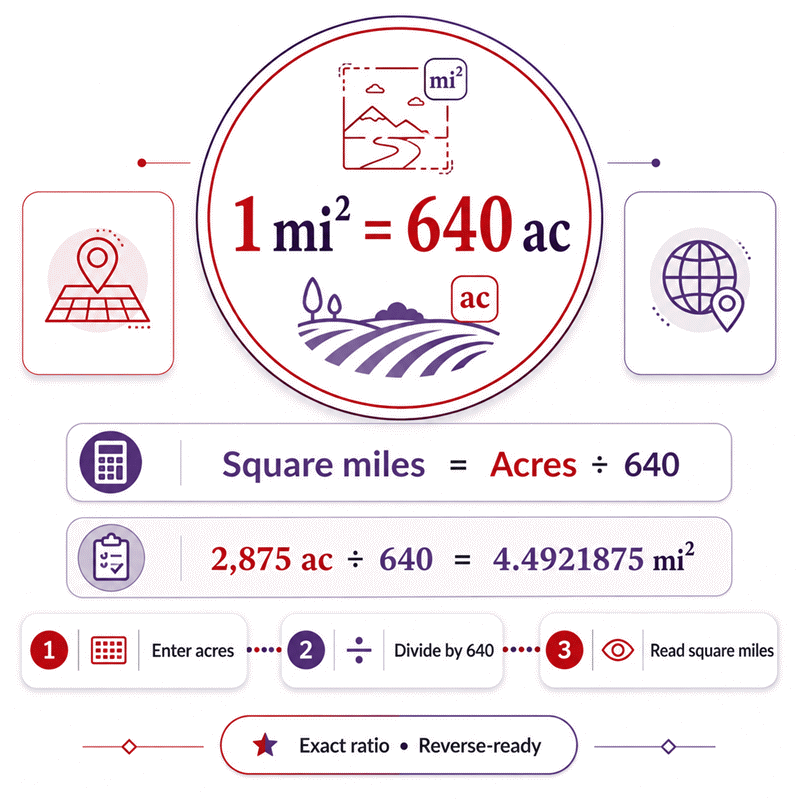
- Acres to square miles calculations use the exact conversion factor: 1 square mile = 640 acres.
- Calculations keep full numerical precision internally and are not rounded during intermediate steps.
- Displayed results may be rounded to a practical number of decimal places for easier reading, especially for small area values.
- Reverse conversions from square miles to acres are calculated from the exact value before display rounding is applied.
- For higher accuracy, use the unrounded calculated value whenever the result is used in further calculations.
Valid range
- Acres: Enter any finite area value greater than or equal to 0 ac; negative values are not valid for physical area.
- Square miles: Enter any finite area value greater than or equal to 0 mi²; negative values are not accepted.
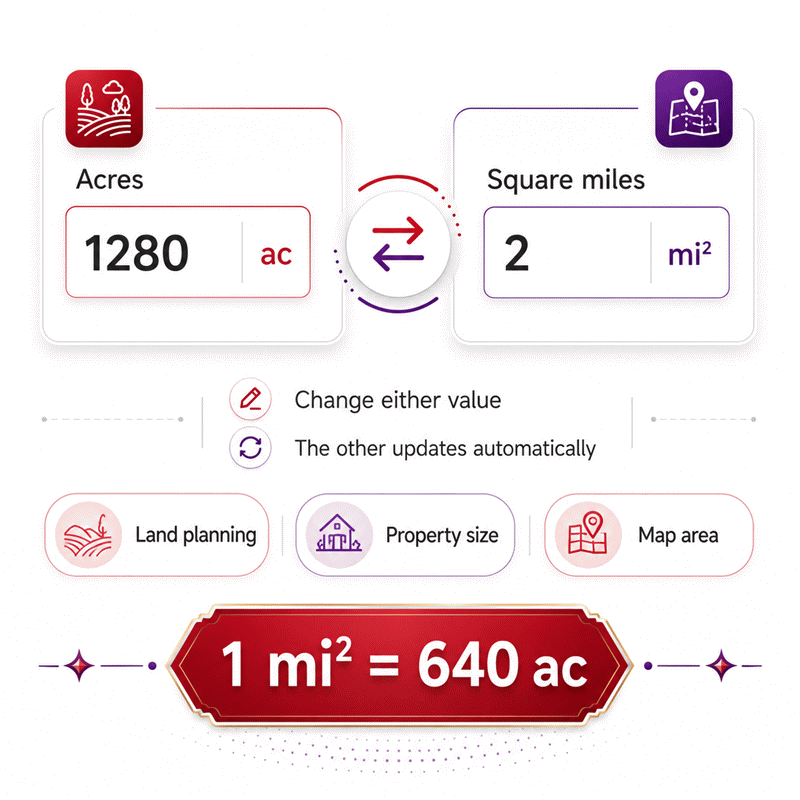
- Either parameter can be entered directly, with the other calculated automatically using 1 mi² = 640 ac.
- Inputs must be valid finite numbers; empty, non-numeric, infinite, or unsupported extremely large values are rejected.

Felovyn Quarnwick
Reviewers:
Meravie Quellmont
Herixon Vosswick
Check our editorial policy
September 6, 2026
1.0.0
Initial calculator and formula release.
Our engineers are here to help you get it right.
How Does the Acres to Square Miles Calculator Help You Convert Land Area?
Acres to Square Miles Calculator converts land area quickly while keeping the same physical area in a different unit. The fixed relationship is simple: 1 square mile equals 640 acres, so acres are converted to square miles by dividing by 640. The calculation also works in reverse, allowing square miles to be converted back to acres.
- Use acres for property, farmland, parcels, and moderate land areas.
- Use square miles when large regions are easier to compare at a broader scale.
- Land shape does not affect the conversion once the total area is known.
- Miles and square miles are different units; only square miles measure area.
- Bidirectional solving lets either acres or square miles become the known value.
- Large acreage values can be easier to understand when expressed in square miles.
- Clear unit labels help prevent mistakes in reports, maps, and spreadsheets.
- Area conversion does not determine property boundaries, ownership, or parcel dimensions.
The Acres to Square Miles Calculator is especially useful for land planning, agriculture, property comparison, mapping, GIS work, and regional reporting. It gives users a clear way to translate area between two common land units without changing the meaning of the original measurement.
Assumptions used in this calculator
- Conversion assumes 1 square mile equals exactly 640 acres.
- Area values represent the same physical surface in different units.
- Inputs are assumed to be finite, numeric, and non-negative.
- Zero is treated as a valid area measurement.
- Negative area values are considered physically invalid for this calculator.
- Intermediate calculations retain full precision before any display rounding.
- Display rounding does not change the underlying calculated area.
- Unit conversions assume standard international definitions of area units.
- User-selected units are assumed dimensionally compatible with area measurements.
- Reverse calculations use the same conversion relationship as forward calculations.
- Land boundaries, shape, slope, and terrain are not evaluated.
- Legal surveys and cadastral records should override calculator estimates when required.
- Industrial, engineering, or contractual use requires independent verification of results.
Results are rounded for display.
Internal calculations use full precision.
Formulas Used in Acres to Square Miles Calculator :
Acres to Square Miles Conversion Formula
- Aac = area in acres.
- Ami² = area in square miles.
- 640 = the fixed number of acres in one square mile.
- The same relationship is used for reverse calculation by solving the equation for the unknown area value.
- Calculations retain full precision internally, and rounding is applied only to displayed results when needed.
Variables & Definitions
View a complete list of all variables used in this calculator, including definitions and units
Variables Used in the Acres to Square Miles Calculator
| Variable | Meaning | Unit | Role in Calculation | Valid Value |
|---|---|---|---|---|
| Aac | Area measured in acres | ac | Input for forward conversion or calculated value in reverse conversion | Finite value greater than or equal to 0 |
| Ami² | Area measured in square miles | mi² | Calculated value in forward conversion or input for reverse conversion | Finite value greater than or equal to 0 |
| 640 | Fixed number of acres in one square mile | ac/mi² | Fixed conversion factor relating acres and square miles | Constant |
Unit Conversion Table
Acres to Square Miles Complete Unit Conversion Table
| Unit Group | Unit Name | Symbol | Equivalent in Square Miles | Used For |
|---|---|---|---|---|
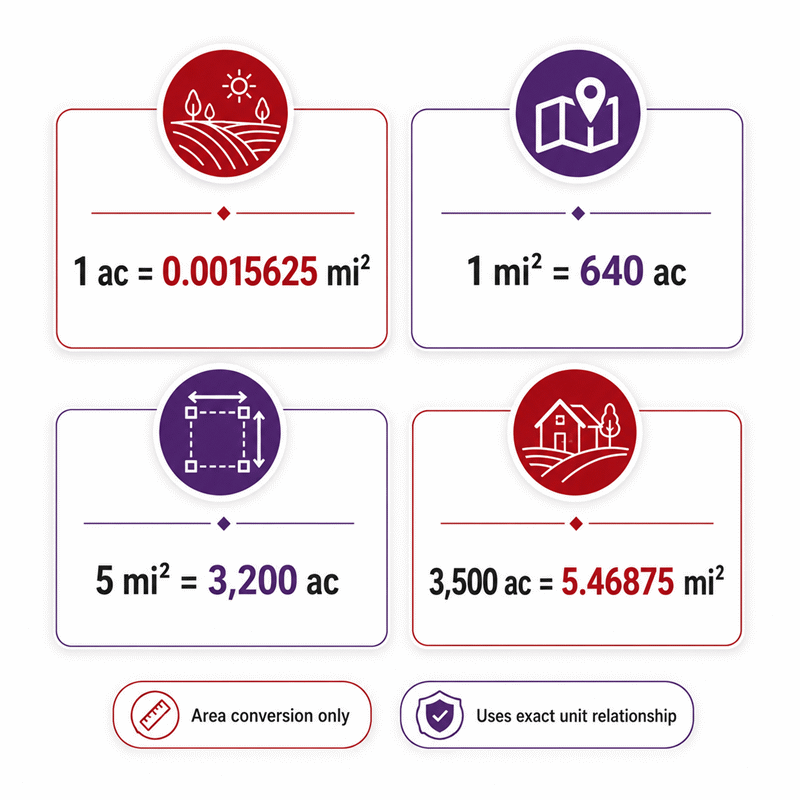
| Popular Units | Acre | ac | 1 ac = 0.0015625 mi² | Land, agriculture, property, and site area measurement |
| Popular Units | Square Mile | mi² | 1 mi² = 1 mi² | Large land areas, regions, cities, and geographic reporting |
| Popular Units | Hectare | ha | 1 ha = 0.00386102158542 mi² | Agriculture, forestry, land management, and property measurement |
| Popular Units | Square Foot | ft² | 1 ft² = 0.0000000358700642792 mi² | Buildings, rooms, residential property, and small land areas |
| Popular Units | Square Yard | yd² | 1 yd² = 0.000000322830578512 mi² | Landscaping, paving, construction, and property measurement |
| Scientific Units | Square Kilometer | km² | 1 km² = 0.386102158542 mi² | Geography, mapping, regional planning, and large-area measurement |
| Scientific Units | Square Meter | m² | 1 m² = 0.000000386102158542 mi² | Engineering, construction, property, and metric area measurement |
| Scientific Units | Square Centimeter | cm² | 1 cm² = 0.0000000000386102158542 mi² | Laboratory work, technical drawings, and small surface measurements |
| Scientific Units | Square Millimeter | mm² | 1 mm² = 0.000000000000386102158542 mi² | Precision engineering, manufacturing, and very small surface measurements |
Example Calculation
Given
Convert 2,875 acres to square miles.
Formula
Substitution and Solution
2,875 ac = 4.4921875 mi²
The conversion uses the fixed relationship of 640 acres per square mile.
The acre value is divided by 640 to obtain the equivalent area in square miles.
The calculation keeps the full value of 4.4921875 mi² before display rounding.
The same relationship can be rearranged when converting square miles back to acres.
Complete Conversion Relationships
Given
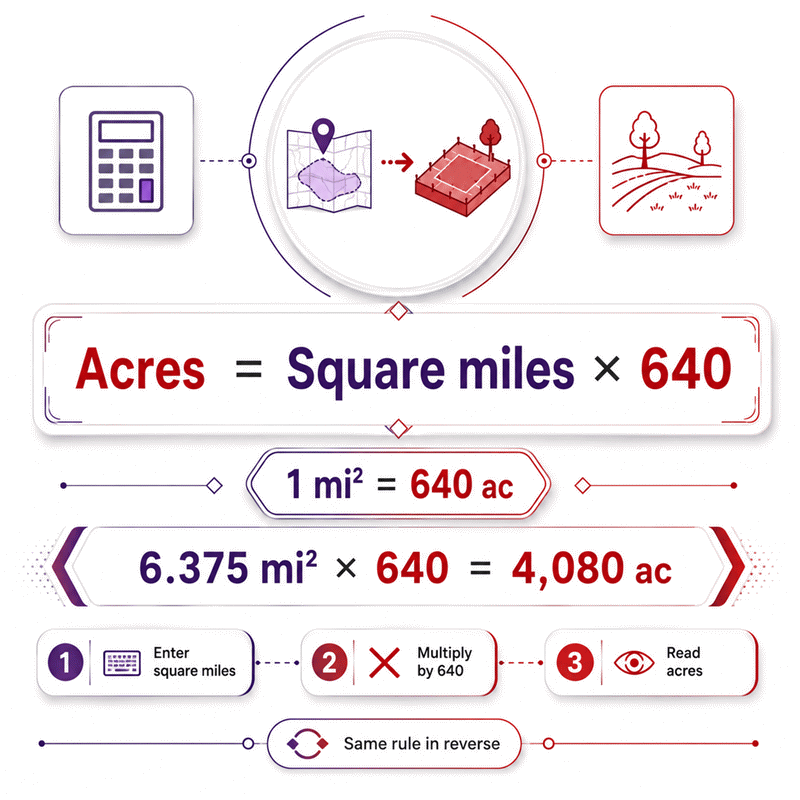
A land area measures 6.375 square miles. Find the equivalent area in acres.
Reverse Formula
Substitution
Solution
6.375 mi² = 4,080 ac
The reverse calculation starts with the known area in square miles.
Each square mile contains exactly 640 acres, so the value is multiplied by 640.
Multiplying 6.375 by 640 gives an exact equivalent area of 4,080 acres.
The same fixed conversion relationship supports automatic solving in either direction.
Complete Conversion Relationships
Results are rounded for display.
Internal calculations use full precision.
Calculations Disclaimer
How the Acres to Square Miles Calculator Solves a Real Land-Size Problem
A large land value can become hard to picture. A figure such as several thousand acres feels abstract. The Acres to Square Miles Calculator turns that figure into a clearer regional area. The Acres to Square Miles Calculator also works in the opposite direction. This makes it useful when maps, reports, and property records use different area units.
The tool is designed for quick decisions. You can start with the area value you already know. You do not need parcel length or width. You also do not need the land shape. The conversion only depends on total area.
Why Converting Large Acreage Can Make Land Easier to Understand
Acres work well for farms, parcels, parks, and development sites. Yet very large acre values can become difficult to compare. Square miles can make those areas easier to understand.
The key relationship is simple. One square mile contains 640 acres. That relationship stays the same for every valid land area. It does not depend on location, terrain, ownership, or parcel shape.
This becomes useful when comparing several large sites. A buyer may receive acreage figures from different property listings. A planner may receive square-mile data from a regional map. A researcher may receive acreage from agricultural records. Converting them into one preferred unit makes comparison faster.
The conversion also helps reduce mental effort. A smaller number can be easier to scan. This matters when reviewing several areas at once. It also helps when sharing results with non-technical readers.
Quick visual check: 640 acres represents one complete square mile of area.
Why the Calculator Can Work in Both Directions
A common problem starts after the first conversion. The user receives square miles but then needs acres again. A one-way tool creates extra work. A bidirectional converter removes that step.
Either side can act as the known value. Enter acreage to receive square miles. Enter square miles to receive acreage. The underlying physical area stays unchanged.
This behavior is useful during planning discussions. Different teams often prefer different area units. Property teams may speak in acres. Mapping teams may use square miles. The calculator lets both groups work from the same area.
Reverse solving also helps with checking results. A converted value can be entered from the opposite side. The returned area should represent the same land size. This gives users a practical way to catch typing mistakes.
What the Conversion Changes and What It Never Changes
The conversion changes only the unit used to describe area. It does not resize the property. It does not alter boundaries. It does not estimate dimensions. It also does not infer parcel shape.
A long narrow parcel can equal a compact square parcel. Both can contain the same acreage. Their shapes differ, but their total areas match.
This distinction matters in real land work. Area conversion is not boundary surveying. It is not coordinate calculation. It is not legal parcel verification. The calculator solves one focused problem: expressing the same area in another unit.
Understanding Acres and Square Miles Without Unnecessary Technical Language
Many conversion mistakes begin with unclear unit meaning. Acres and square miles both measure area. They do not measure straight-line distance. Knowing this difference prevents several common errors.
An acre is practical for individual land parcels. A square mile is practical for larger regions. Neither unit is more accurate by itself. The better choice depends on scale and communication needs.
When Acres Are the More Useful Land Measurement
A property buyer may see several listings measured in acres. That is usually helpful. Acres keep moderate land areas readable without producing tiny decimal values.
Farmers also use acreage because fields are often discussed at parcel scale. Land managers may use acres for woodland, pasture, conservation areas, or development sites. The unit gives a familiar sense of usable land size.
Acres are also helpful when the area is below one square mile. The value remains easy to discuss. People can compare parcels without working with small square-mile figures.
This makes acreage useful in many daily decisions. It can support property comparison, land planning, agricultural discussion, and site reporting.
However, acreage can become less convenient as the area grows. Several thousand acres may be accurate but visually overwhelming. At that scale, square miles can offer clearer communication.
When Square Miles Make Large Areas Easier to Compare
A regional planner may need to compare large land zones. Acre values can quickly become long numbers. Square miles reduce that visual load.
The unit is useful for large parks, municipal regions, watersheds, and broad land holdings. It can also help when discussing map coverage or regional planning areas.
Square miles often work better when readers need a geographic perspective. The unit connects more naturally with large map-based areas. It can make side-by-side comparisons easier.
Think small parcel, think acres. Think broad region, consider square miles.
Why Miles Cannot Be Converted Directly Into Acres
A frequent error happens when users confuse miles with square miles. A mile measures length. An acre measures area. These are different physical quantities.
A road can be five miles long. That number alone gives no land area. Width is still missing. Area requires two-dimensional information.
Square miles already describe area. Therefore, they can be converted into acres. Ordinary miles cannot be converted into acres without additional dimensions.
This simple distinction prevents serious reporting errors. Always confirm that the source value represents area before converting it.
Using Acre and Square Mile Conversion in Real Property and Land Work
A conversion becomes valuable when it helps someone make a decision. Land data often passes between owners, agents, engineers, planners, and mapping teams. Each group may use a different unit.
A practical calculator removes that communication barrier. It lets the user translate area without changing the meaning of the original measurement.
Property, Agriculture, and Land Development Decisions
A buyer may compare two large properties from different reports. One document may use acres. Another may use square miles. Direct comparison becomes difficult until both values use the same unit.
Developers face the same issue. A planning document may describe a regional zone differently from property records. Converting the areas can make early comparison much faster.
Agricultural users may also benefit. Farm holdings are commonly discussed in acres. Yet large combined holdings may be easier to summarize in square miles.
This does not replace detailed site analysis. It gives a consistent area reference. That reference can support later planning work.
The tool is also useful during early screening. Users can quickly judge the scale of a property. They can then decide whether deeper analysis is worthwhile.
Mapping, GIS, and Regional Reporting
A mapping project often combines data from several systems. One layer may describe land in acres. Another dataset may use square miles.
Unit differences can make a map difficult to interpret. Converting values into one preferred unit improves comparison. It also helps readers understand the scale of mapped regions.
GIS users should keep one key idea in mind. Unit conversion does not fix poor source data. An inaccurate area remains inaccurate after conversion.
The best workflow starts with a trusted area measurement. The converter then changes only its unit representation.
Land data flow: measured area → selected unit → converted area → clearer comparison → better reporting.
Why Parcel Shape Does Not Affect This Conversion
An irregular boundary can look complex on a map. That complexity does not change area conversion. Once total acreage is known, shape becomes irrelevant here.
A triangular site and a rectangular site can have equal areas. A curved property can also hold the same area. The conversion relationship remains unchanged.
This is useful when working with mapped parcels. You do not need to simplify the boundary first. You only need the total area value.
However, parcel shape matters for many other tasks. It affects frontage, fencing, access, layout, and development design. Those tasks require different calculations.
Common Acres to Square Miles Mistakes That Can Distort a Land Report
A small conversion mistake can create a large misunderstanding. This is especially true for large properties. Most errors come from direction, unit type, or data entry.
These mistakes are easy to prevent. The first step is knowing what to check before trusting a result.
Using the Conversion Relationship in the Wrong Direction
The most common mistake is reversing the conversion process. The user starts with acres but applies the square-mile direction backward. The result can become hundreds of times too large.
A simple scale check can catch this error. A square mile represents much more land than one acre. Therefore, converting acres into square miles usually produces a smaller number.
The opposite direction usually produces a larger number. Converting square miles into acres expands the numerical value.
This quick logic check works before any detailed review. It gives the user an immediate sense of whether the answer is reasonable.
Confusing Square Miles With Ordinary Miles
Another mistake appears in reports and spreadsheets. The unit label may show miles instead of square miles. That single missing square symbol changes the meaning completely.
Miles measure distance. Square miles measure area. Acres can only be compared directly with other area units.
Always inspect unit labels before using a value. This matters when copying data from maps or spreadsheets. It also matters when receiving measurements from another team.
Fast error check: acres are area, so the matching mile unit must be mi².
Why Copying Numbers Without Their Units Creates Hidden Risk
A number alone is incomplete measurement data. A value of 25 could mean acres or square miles. Those two areas are dramatically different.
This issue becomes serious in shared spreadsheets. Users sometimes copy only the numerical column. The unit may remain hidden in another heading.
Keep the unit beside every important area value. This makes review easier. It also reduces mistakes during handoff.
The same rule applies to exported reports. Clear unit labels protect the meaning of every number.
Why Boundary Data and Area Data Should Not Be Treated as the Same Thing
A property can have an accurate area but uncertain boundaries. The reverse can also happen. These are separate data problems.
Converting acres does not verify legal ownership. It does not confirm survey monuments. It also does not resolve overlapping parcel records.
For legal land decisions, official survey information remains important. The converter helps interpret area. It does not replace boundary evidence.
How to Choose the Right Area Unit Before Sharing a Result
A technically correct result can still confuse the reader. The best unit depends on who will use the information. Good communication matters as much as conversion.
The goal is simple. Choose the unit that makes the scale easiest to understand.
Use Acres When the Reader Needs Parcel-Level Detail
Acre values often work better for property discussions. Buyers, farmers, and land managers commonly think at this scale.
A parcel description may feel more natural in acres. The number can also make differences between neighboring properties easier to compare.
Use acreage when the reader needs detail. It works well for farm fields, building sites, estates, and conservation parcels.
This choice can reduce unnecessary mental conversion. Readers can focus on the actual land decision.
Use Square Miles When the Reader Needs Regional Scale
Large land areas can become awkward when written only in acres. Square miles can simplify the same information.
The unit works well for regional projects. It can support planning zones, large protected areas, and broad map coverage.
Square miles can also help during presentations. A smaller numerical value may be easier to remember. This can improve communication between technical and non-technical teams.
Communication scale: parcel → acres | large estate → acres or mi² | region → mi².
Use Both Units When Different Teams Need Different Perspectives
A mixed team may not share the same preferred unit. Showing both values can solve that problem.
Property staff can read the acreage. Mapping staff can read the square-mile value. Everyone still refers to the same physical area.
This approach is useful in project reports. It can also help during client presentations. Readers do not need to convert values themselves.
Using both units can also reduce follow-up questions. The information becomes useful to more people immediately.
When an Acres to Square Miles Converter Is the Right Tool
Not every land problem needs complex software. Sometimes the user already has a trusted area value. The only problem is unit translation.
That is where this calculator provides the most value. It solves a narrow task quickly. It keeps the workflow focused.
For Fast Land-Size Checks Before Deeper Analysis
A user may receive a property figure during a call. They may need a quick sense of scale. Opening full mapping software would be unnecessary.
A direct conversion gives an immediate reference. The user can then continue with more detailed analysis if needed.
This approach saves time during early project screening. It also helps when reviewing several land opportunities.
The converter can support quick checks during meetings. It can also help when reading property listings or regional reports.
For Clear Communication Between Technical and Non-Technical Users
Area units can create confusion during project discussions. One person may understand acreage immediately. Another may think more clearly in square miles.
A converter provides a common reference. It helps both users understand the same land area.
The interface also removes manual arithmetic. This lowers the chance of simple input mistakes. It keeps attention on the project instead.
A good calculator should feel almost invisible. The user enters the known value. The equivalent area appears without unnecessary steps.
When You Need More Than a Unit Conversion
Some land questions require much more information. Boundary verification needs survey data. Development planning needs dimensions and site conditions. GIS analysis may require coordinates and map projections.
Those problems should use dedicated tools. The acres-to-square-miles converter should remain focused on area conversion.
This clear scope is useful. Users know exactly what the result means. They also know when another tool is required.
A focused calculator can therefore support a larger workflow. It answers the conversion question first. The user can then move to surveying, mapping, or planning tasks.
Making Land Area Data Easier to Review, Share, and Reuse
A correct result becomes more useful when it can move between workflows. Land projects often involve several people and several files. Clear area data reduces friction during that handoff.
The best result is not only readable. It should also remain understandable after sharing.
Why Clear Unit Labels Matter in Reports and Spreadsheets
A spreadsheet can contain hundreds of measurements. Missing unit labels can turn useful data into a guessing exercise.
Every area value should keep its unit visible. This makes review faster. It also protects the value when rows are copied elsewhere.
Clear labels help during quality checks. A reviewer can quickly spot a suspicious value. They can also confirm whether the correct area unit was used.
This simple practice improves communication without adding technical complexity.
Why Shareable Results Help Reduce Repeated Work
Teams often repeat the same conversion several times. One person calculates it. Another person later performs the same task.
A shareable result can reduce that repetition. It gives other users the same starting point. This is useful during project reviews.
Exported records can also support documentation. They help preserve the values used during a discussion. The unit labels remain visible with the result.
This creates a cleaner workflow. The calculator handles conversion. The team can focus on interpretation and decisions.
Building a Reliable Workflow Around the Calculator
Start with a trusted area measurement. Confirm that it represents area, not distance. Then choose the unit your audience understands best.
Use the converter to translate the value. Review the scale before sharing it. Keep the unit visible beside every result.
For important land decisions, compare the converted value with original project records. This protects the workflow from transcription errors.
The result can then move into maps, reports, planning documents, or presentations.
This simple sequence keeps the process clear. It also limits unnecessary complexity. Most importantly, it helps users understand land size without losing context.
Frequently Asked Questions
Can I combine several land parcels before converting the total to square miles?
What should I do when an old deed shows acreage with limited precision?
Should I show both acres and square miles in a property report?
How can I independently check a converted land-area result?
How should I structure an acres-to-square-miles calculation in an engineering spreadsheet?
What should I verify before converting an area exported from GIS software?
How should converted acreage be documented for engineering or survey traceability?
Engineering Resources
Our engineers are here to help you get it right.