Feet to Inches Calculator
- Last formula update:
Decimal & Rounding Policy
- Calculations use the exact relationship 1 foot = 12 inches, with full precision preserved during each conversion.
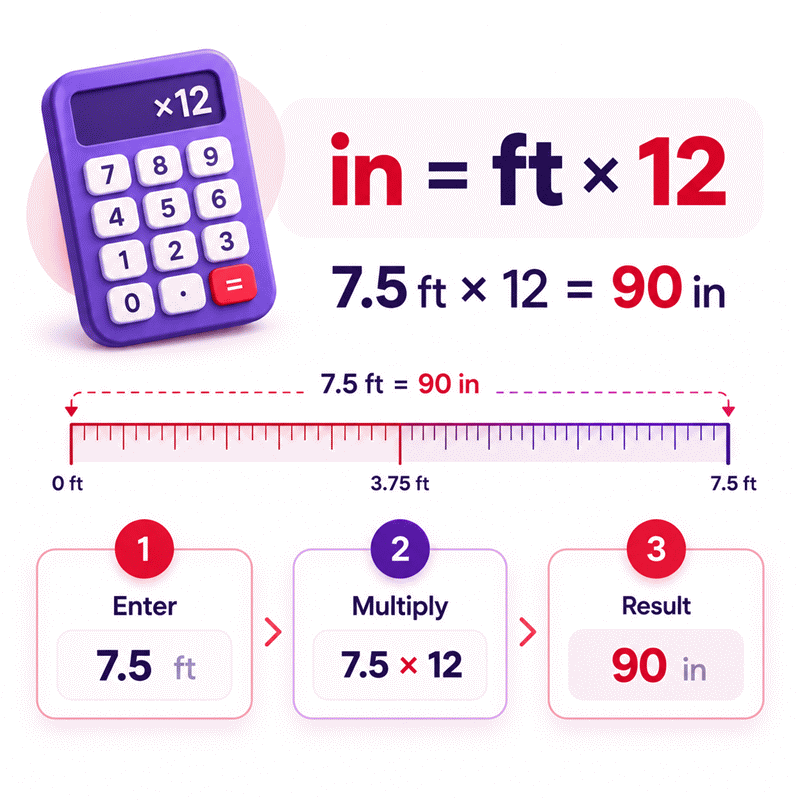
- Feet to inches is calculated as inches = feet × 12, while inches to feet is calculated as feet = inches ÷ 12.
- Intermediate values are not rounded, helping maintain accurate results when converting decimal measurements.
- Displayed results may be shortened to a practical number of significant digits for easier reading without changing the underlying calculation.
- Decimal inputs are supported, so values such as 0.5 ft convert accurately to 6 in and 1.5 ft converts to 18 in.
Valid range
- Feet: Accepts any finite real number, including whole numbers, decimals, zero, and negative values, provided the value remains within the calculator’s supported numerical range.
- Inches: Accepts any finite real number and is converted using the exact relationship 1 foot = 12 inches.
- Valid calculations require finite numeric values; empty, non-numeric, infinite, or computationally unsupported values are not accepted.

Felovyn Quarnwick
Reviewers:
Meravie Quellmont
Herixon Vosswick
Check our editorial policy
September 6, 2026
1.0.0
Initial calculator and formula release.
Our engineers are here to help you get it right.
How Does the Feet to Inches Calculator Work and When Should You Use It?
Feet to Inches Calculator gives an instant, accurate way to convert linear measurements between feet and inches. The calculation uses the exact relationship that 1 foot equals 12 inches, so converting feet to inches requires multiplying the feet value by 12. Reverse solving works by dividing the known inch value by 12.
- Use inches = feet × 12 for direct feet-to-inches conversion.
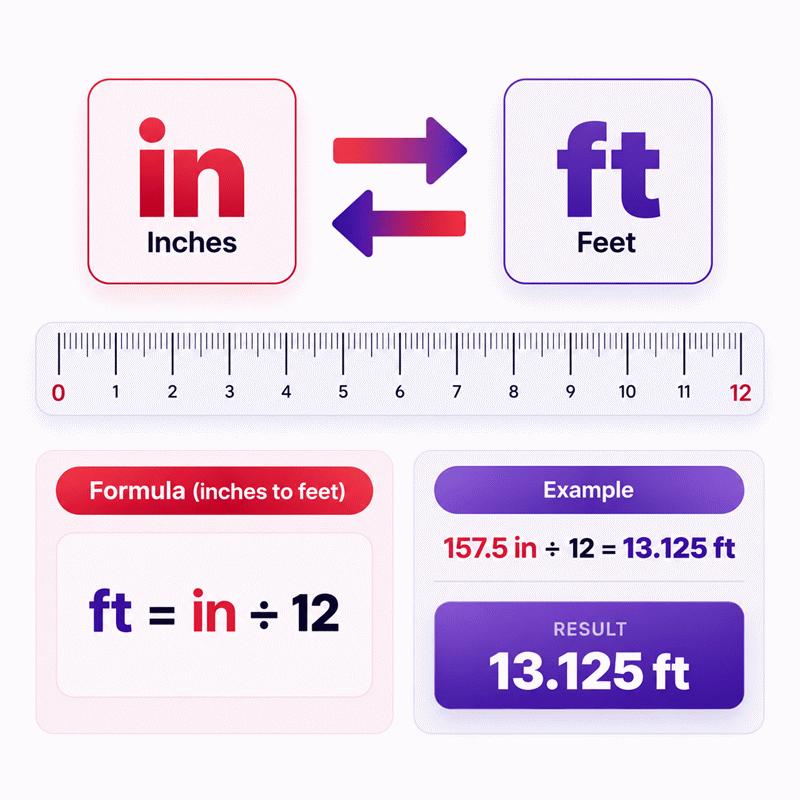
- Use feet = inches ÷ 12 for reverse inches-to-feet conversion.
- Whole-number and decimal measurements can be converted directly.
- Decimal feet must not be confused with feet-and-inches notation.
- Changing between compatible length units keeps the same physical measurement.
- Linear feet cannot be directly converted into square feet or cubic feet.
- Reverse solving helps verify measurements and check converted values quickly.
- The international foot is the standard basis for modern general measurements.
The Feet to Inches Calculator is useful for construction, woodworking, room planning, fabrication, equipment dimensions, height measurements, and everyday length checks. Its bidirectional workflow lets either feet or inches become the known value, making repeated conversions faster and easier to verify. Always confirm the original measurement notation before converting, especially when working with decimal feet, mixed feet-and-inches values, or legacy technical records.
Assumptions used in this calculator
- Calculations assume the exact relationship that one foot equals twelve inches.
- Entered values are assumed to represent linear length measurements only.
- All selected units are assumed to be dimensionally compatible length units.
- Unit conversions assume internationally standardized definitions for feet, inches, and metric units.
- Intermediate calculations retain full precision before any displayed rounding is applied.
- Displayed decimals may be rounded without changing the underlying physical length.
- Reverse calculations assume the entered target value is valid and finite.
- Zero represents a valid zero-length measurement when context allows it.
- Negative values represent mathematical direction or offset, not physical material length.
- Industrial users should confirm required tolerances before relying on rounded results.
- Instrument resolution and measurement uncertainty are not included in conversion results.
- Input accuracy directly determines converted result accuracy because conversion itself is exact.
- Critical engineering or safety decisions require independent verification of final measurements.
Results are rounded for display.
Internal calculations use full precision.
Formulas Used in Feet to Inches Calculator :
Feet to Inches Conversion
- F = length in feet
- I = equivalent length in inches
- 12 = exact number of inches in one foot
Compatible Length Unit Conversion
- X = entered length value in the selected source unit
- Y = converted length value in the selected target unit
- ks = source unit conversion factor to meters
- kt = target unit conversion factor to meters
Variables & Definitions
View a complete list of all variables used in this calculator, including definitions and units
Feet to Inches Calculator Variables and Conversion Parameters
| Variable / Constant | Meaning | Unit | Role in Calculation |
|---|---|---|---|
| F | Length entered or expressed in feet | ft | Source value used for the direct feet-to-inches conversion |
| I | Equivalent length expressed in inches | in | Converted value produced from the corresponding length in feet |
| X | Length entered in the selected source unit | Selected length unit | Starting value for conversion between compatible length units |
| Y | Equivalent length in the selected target unit | Selected length unit | Final converted value after applying the source and target unit factors |
| ks | Conversion factor from the selected source unit to meters | m per source unit | Converts the entered source value to the common base length |
| kt | Conversion factor from the selected target unit to meters | m per target unit | Converts the common base length into the selected target unit |
| 12 | Exact number of inches in one foot | in/ft | Fixed conversion constant used in the feet-to-inches relationship |
Unit Conversion Table
Feet to Inches Unit Conversion Table
| Unit Group | Unit Name | Symbol | Equivalent in Inches | Used For |
|---|---|---|---|---|
| Popular Units | Foot | ft | 1 ft = 12 in | Height, room dimensions, construction, and everyday length measurements |
| Popular Units | Inch | in | 1 in = 1 in | Small dimensions, manufacturing, hardware, displays, and product measurements |
| Popular Units | Yard | yd | 1 yd = 36 in | Fabric, landscaping, sports fields, property dimensions, and medium distances |
| Popular Units | Mile | mi | 1 mi = 63,360 in | Road distances, transportation, mapping, and large-scale distance measurements |
| Scientific Units | Millimeter | mm | 1 mm = 0.0393700787401575 in | Engineering drawings, machining, manufacturing, components, and precision measurements |
| Scientific Units | Centimeter | cm | 1 cm = 0.393700787401575 in | Body measurements, product dimensions, education, and general metric measurements |
| Scientific Units | Meter | m | 1 m = 39.3700787401575 in | Engineering, architecture, science, construction, and standard metric length measurements |
| Scientific Units | Kilometer | km | 1 km = 39,370.0787401575 in | Transportation, geography, surveying, mapping, and large metric distances |
| Scientific Units | Micrometer | µm | 1 µm = 0.0000393700787401575 in | Precision manufacturing, surface measurements, microscopy, coatings, and semiconductor work |
| Scientific Units | Nanometer | nm | 1 nm = 0.0000000393700787401575 in | Nanotechnology, optics, semiconductor fabrication, wavelengths, and nanoscale measurements |
Example Calculation
Each foot contains exactly 12 inches, so the feet value is multiplied by 12. The conversion factor is exact and does not introduce measurement error. Decimal feet are converted using the same relationship without intermediate rounding. The calculated result shows that 7.625 feet corresponds exactly to 91.5 inches.
A measured length is 157.5 inches, while the equivalent value in feet is unknown.
Reverse solving begins with the known inch value instead of the feet value. Because one foot contains exactly 12 inches, the inch measurement is divided by 12. No intermediate rounding is required, so the original physical length remains unchanged. The calculator can therefore solve either direction whenever one valid length value is provided.
Use when feet are known and inches are unknown.
Use when inches are known and feet are unknown.
Use to convert a known source length into another compatible length unit.
Use when the converted value is known and the original source value must be recovered.
Results are rounded for display.
Internal calculations use full precision.
Calculations Disclaimer
How to Convert Feet to Inches Accurately
A wrong length conversion can spoil an otherwise simple measurement task. The Feet to Inches Calculator removes that risk with instant conversion. The Feet to Inches Calculator also works in both directions. You can enter feet or inches and get the matching value immediately.
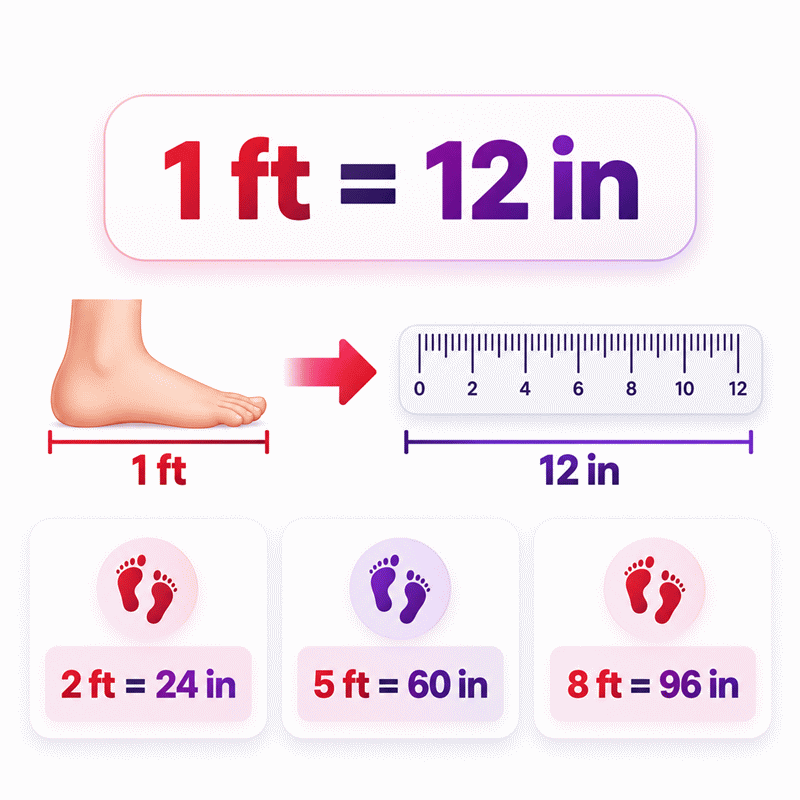
The key relationship is simple and exact. One foot contains twelve inches. That fixed relationship makes the calculation fast and reliable.
Here, F represents the known length in feet. I represents the matching length in inches. The calculator applies this relationship as soon as a valid value appears.
Why One Foot Equals Exactly 12 Inches
Many users wonder whether twelve is only a rounded conversion factor. It is not. A modern foot contains exactly twelve inches by definition. This means the basic conversion does not create mathematical uncertainty.
This point matters when measurements pass through several calculation steps. A rounded factor could slowly change the final result. Using twelve avoids that problem entirely. It also keeps hand calculations easy to check.
The same relationship works for small and large measurements. It works for whole numbers and decimal values. The calculation rule never changes with the size of the measurement.
How the Conversion Works Step by Step
A common mistake is adding twelve instead of multiplying by twelve. Each foot contains twelve separate inches. Therefore, every foot must contribute twelve inches to the result.
The calculator first reads the entered measurement. It then identifies the selected length unit. When feet are the source, it applies the twelve-to-one relationship. The converted inch value appears without requiring a calculation button.
This instant response is useful during fast measurement work. You can adjust the source number and watch results change immediately. That reduces repeated typing and lowers the chance of transcription mistakes.
How to Use the Feet to Inches Calculator
Manual conversion becomes frustrating when measurements change several times. A live calculator removes that repeated work. Enter a known length into any active measurement field. The remaining compatible values update from the same physical length.
You do not need to follow one fixed direction. The calculator is not limited to feet as an input. You can edit another displayed length instead. The tool then treats that value as the new known measurement.
This workflow is useful when checking drawings, room sizes, materials, or height measurements. It also helps when two documents use different length units.
Entering Whole and Decimal Feet
Real measurements are rarely limited to perfect whole feet. A board may measure 7.25 feet. A room may measure 14.6 feet. These values can be entered directly.
Decimal feet should be read as decimal parts of one foot. They should not be read as separate inch digits. This distinction prevents one of the most common measurement errors.
For instance, the decimal part represents a fraction of twelve inches. The calculator handles that relationship automatically. Users therefore avoid manual decimal interpretation during routine work.
Changing the Known Measurement During a Calculation
Many tools force users to clear the form before reversing direction. That creates extra work and breaks the measurement flow. This calculator allows a displayed value to become the new source.
When you edit another measurement, the system recalculates related values immediately. The physical length remains the same across compatible units. Only its numerical expression changes.
This behavior is especially useful during design reviews. One person may work in feet. Another may need inches. Both can work from the same measurement without rebuilding the calculation.
Using Real-Time Reverse Solving
Sometimes the only known value is measured in inches. You should not need another calculator. Enter the inch measurement directly and let the tool solve backward.
This reverse relationship follows directly from the same exact measurement definition. It does not use a separate approximation. That keeps both conversion directions mathematically consistent.
Inches to Feet Reverse Conversion
A contractor may receive a drawing with dimensions given only in inches. A customer may provide height using total inches. Reverse conversion turns those values into feet quickly.
The reverse process divides the inch value by twelve. Each complete group of twelve inches represents one foot. Any remaining amount represents part of another foot.
The calculator handles this process continuously. You can change the inch value and see the feet value respond instantly. This is helpful during repeated checks and field adjustments.
Reverse Relationship for Converting Inches Back to Feet
The reverse calculation is not a second measurement system. It is the inverse of the direct relationship. That makes the logic easy to audit.
If a converted feet value is multiplied by twelve, it returns inches. This simple check gives users a fast way to inspect results.
Reverse solving becomes especially useful with imported values. Spreadsheets, drawings, and product sheets often use only one unit. A bidirectional calculator reduces the need for separate conversion tools.
How to Check a Reverse Conversion Result
Small input errors can look believable unless the result gets checked. A quick inverse check catches many mistakes. Multiply the calculated feet value by twelve.
The result should match the original inch measurement. If it does not, inspect the entered number first. A misplaced decimal point can produce a large difference.
This verification method works well during manual reviews. It also helps when another person needs to confirm your measurement quickly.
Decimal Feet and Feet-and-Inches Notation
One notation problem causes more confusion than the conversion itself. Decimal feet and mixed feet-and-inches notation look similar. They do not mean the same thing.
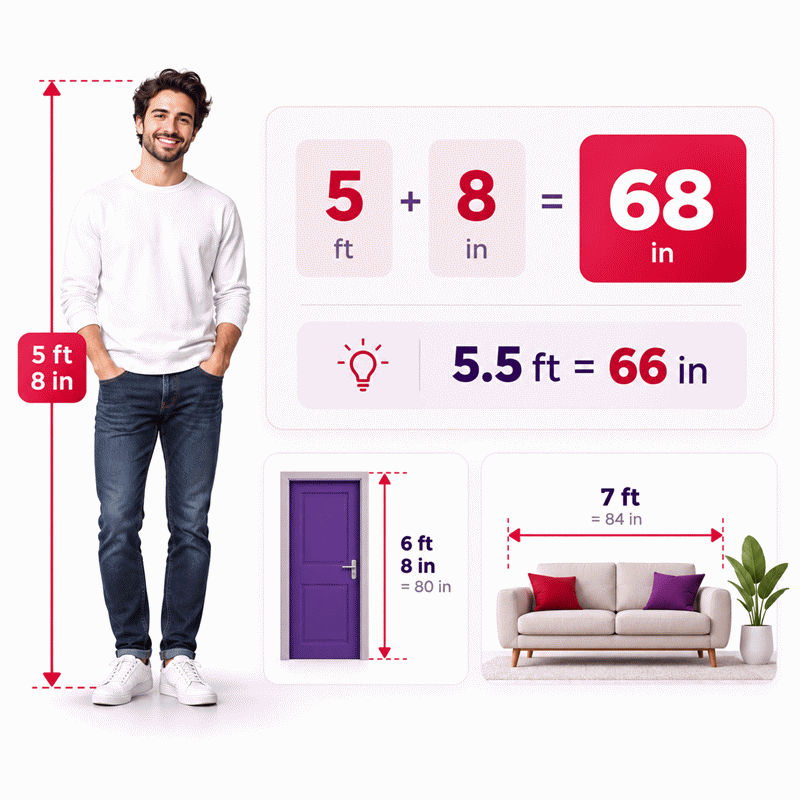
A value such as 5.8 feet uses a decimal fraction. It does not mean five feet and eight inches. The decimal portion represents eight-tenths of one foot.
Mixed notation uses two separate unit amounts. A measurement may contain whole feet and additional inches. Reading one format as the other can create a serious dimensional error.
Why Decimal Feet Are Different From Feet and Inches
Suppose a drawing shows 6.5 feet. The decimal portion equals half of one foot. Half of twelve inches equals six inches.
Therefore, 6.5 feet describes six feet and six inches. It does not describe six feet and five inches. That difference seems small but matters in physical work.
Cabinetry, framing, fabrication, and layout tasks can magnify such mistakes. Several wrong measurements may accumulate across one assembly.
How to Interpret Decimal Feet Correctly
The safest approach is to treat the decimal part mathematically. Separate the whole-foot portion from its decimal remainder. Then relate the decimal remainder to twelve inches.
Here, D represents only the decimal part of the foot value. This relationship explains why decimal notation cannot be read like mixed notation.
The calculator removes that mental step during normal use. Still, understanding the difference helps users detect bad data before conversion.
Why This Distinction Matters in Field Work
A measurement can pass through many people before installation. One person may record decimal feet. Another may expect traditional feet and inches.
Clear notation prevents costly misunderstandings. Always confirm how a source document expresses length before using its values.
Common Feet to Inches Conversion Mistakes and How to Avoid Them
The basic calculation is easy, yet real mistakes remain common. Most errors come from notation, unit type, or data entry. Knowing these traps can save more time than memorizing formulas.
The first danger is treating decimal digits as inch values. Another danger is converting the wrong physical quantity. Length, area, and volume require different dimensional treatment.
A third mistake involves copying values between systems without checking units. A number alone has little meaning. The attached unit tells you what that number represents.
Confusing Decimal Feet With Mixed Feet and Inches
A value such as 7.4 feet can look like seven feet four inches. That reading is incorrect. The decimal part represents four-tenths of a foot.
This error often appears in quick notes or spreadsheets. It becomes more dangerous when the measurement controls a cut length.
The safest habit is simple. Treat decimal notation as one single foot-based number. Treat mixed notation as two separate unit values.
Confusing Linear Feet With Square Feet
A flooring plan may list square feet beside linear dimensions. Those quantities cannot be converted directly into each other. One describes area while the other describes length.
Feet and inches in this calculator refer to linear distance. They describe one-dimensional measurement only.
If a project starts with square feet, another dimension is required. You need enough information to derive a length before using this converter.
Confusing Linear Feet With Cubic Feet
Shipping and storage documents often use cubic feet. That unit measures volume. It does not represent a simple line length.
A cubic-foot value cannot become inches through a direct length conversion. Its dimensions must remain consistent with volume.
Checking the dimensional type before conversion prevents misleading results. This check is especially important in technical documents.
Practical Uses of Feet to Inches Conversion
Simple unit conversion becomes valuable when real work depends on exact dimensions. Many everyday systems mix feet and inches. A fast converter helps keep those measurements aligned.
Construction plans may state room lengths in feet. Product details may show component widths in inches. Bringing both into one unit makes comparison easier.
The same need appears in furniture work, home layouts, equipment spacing, and personal height records. The calculation stays simple while the context changes.
Construction and Interior Layout
A room plan may give wall lengths in feet. Fixtures often arrive with dimensions listed in inches. Comparing them directly can slow the planning process.
Converting the wall length into inches creates one common measurement scale. That makes clearances and spacing easier to review.
This workflow is useful for shelving, cabinets, doors, windows, and wall-mounted equipment. It also helps during fast site checks.
Woodworking and Fabrication
A material list may use feet while a cutting station uses inches. Constant mental conversion creates avoidable risk. One wrong cut can waste material immediately.
Converting the full length into inches makes marking easier. It also supports repeated cuts from one reference dimension.
A shared conversion link can help teams compare the same measurement. This reduces confusion during handoffs between planning and fabrication.
Height and Everyday Measurement
Height is often written using feet and inches. Some systems require a single inch value instead. Converting the measurement supports simpler data entry.
The same approach applies to furniture height and equipment clearance. It also helps when comparing product specifications from different sources.
When a measurement matters, calculate first and copy second. This small habit prevents many transcription errors.
Measurement Standards and Correct Interpretation
Professional work becomes risky when identical unit names hide different definitions. Modern feet and inches use a stable international relationship. That makes ordinary conversion straightforward.
The international foot is tied to the metric system through an exact definition. One foot equals 0.3048 meter. One inch equals 0.0254 meter.
These relationships allow a calculator to use a common internal length reference. The same physical distance can then appear in several compatible units.
The International Foot in Modern Measurements
The international foot is the correct default for modern general calculations. It is used across ordinary engineering, construction, manufacturing, and personal measurement tasks.
Its fixed metric definition keeps cross-system conversion consistent. This matters when a project mixes imperial and metric dimensions.
A common reference also helps prevent small conversion differences. That becomes useful when measurements move between software systems.
Legacy Survey Data Needs Extra Attention
Older survey records may use a historical survey-foot definition. That difference is tiny for short distances. It can matter across very long mapped distances.
Modern everyday conversion should not assume legacy survey values. Historical geospatial records deserve separate review before reuse.
This issue rarely affects household or workshop measurements. Still, recognizing it protects technical users from hidden assumptions.
A Faster Workflow With AxiCalculator
Repeated manual conversion interrupts work and adds another chance for error. AxiCalculator keeps the conversion process in one visible workflow. Users can enter, edit, reverse, and compare measurements without rebuilding the calculation.
The live behavior is useful when values change several times. It is also helpful when different people prefer different units.
A user can keep the physical measurement constant while viewing compatible representations. That supports clearer communication across teams and documents.
When Real-Time Conversion Saves Time
Fast projects often involve many small measurement changes. Repeating the same arithmetic wastes attention. Real-time conversion lets the calculator handle that repetitive step.
You can focus on the actual decision instead. That may involve fit, spacing, clearance, or material use.
The result updates as the known measurement changes. This gives immediate feedback without another button press.
Using Reverse Solving During Reviews
A reviewer may receive inches while expecting feet. Another person may have the opposite problem. Reverse solving lets either value become the starting point.
This makes the calculator more useful during cross-checks. It also reduces unnecessary switching between separate conversion pages.
When both directions follow one relationship, verification becomes easier. The same physical length remains traceable throughout the workflow.
Sharing and Exporting Measurement Results
Measurement errors often happen after the calculation is already correct. Someone may copy the wrong value into another message or file.
AxiCalculator can keep a calculated state available for sharing. This helps another person review the same values and units.
Export options can also support record keeping. A saved result is easier to review than a handwritten conversion.
Use the calculator whenever a length changes between feet and inches. It keeps the task quick, clear, and easy to verify.
Frequently Asked Questions
Can I use a feet to inches calculator when a drawing mixes several length formats?
What should I do if a supplier gives dimensions in feet but my equipment specification uses inches?
Can I use the calculator to check measurements copied from a spreadsheet or PDF?
How can I tell whether a surprising conversion result is actually correct?
How should an engineer handle feet-to-inches data when values move between CAD, BIM, and spreadsheets?
What is the safest way to use feet-to-inches conversion in tolerance-sensitive fabrication?
How can a student or engineer validate a batch of feet-to-inches conversions efficiently?
Engineering Resources
Our engineers are here to help you get it right.