Molar Mass Calculator
- Last formula update:
Decimal & Rounding Policy
- Use full atomic-mass precision throughout the calculation and never round intermediate values.
- Calculate molar mass by multiplying each atomic mass by its atom quantity, then summing all contributions.
- Display molar mass and molecular mass with up to 4 decimal places, removing unnecessary trailing zeros.
- Round elemental mass percentages to a maximum of 2 decimal places while keeping full precision internally.
- For reverse calculations, atom quantities must resolve to positive whole numbers and must never be rounded into a valid result.
Valid range
- Element: Select a valid chemical element from the 118 recognized elements in the periodic table.
- Quantity: Enter a positive whole number from 1 to 9,999 atoms for each selected element.
- Molar Mass: Valid calculated or reverse-input values must be greater than 0 and no more than 1,000,000,000 g/mol or its unit equivalent.
- Molecular Mass: Valid values must be greater than 0 and no more than 1,000,000,000 Da or its unit equivalent.
- Total Atoms: The molecular composition must contain at least 1 atom and may contain up to 1,179,882 atoms within the supported calculation range.

Xylena Morforde
Reviewers:
Cirelle Vossford
Zorven Lumquell
Check our editorial policy
August 31, 2026
1.0.0
Initial calculator and formula release.
Our engineers are here to help you get it right.
How Does a Molar Mass Calculator Give an Accurate Result?
Molar Mass Calculator results depend on the elements in a chemical composition and the number of atoms assigned to each element. The calculator evaluates every selected element, combines its mass contribution, and returns the total molar mass while keeping the composition visible for quick verification.
- Each element contributes according to its atomic mass and atom quantity.
- Molar mass describes the mass of one mole of the selected composition.
- Molecular mass describes the mass of one molecular entity in daltons.
- Elemental composition shows which elements contribute most to the total mass.
- Mass percentage reveals each element’s share of the compound’s total mass.
- Reverse solving can determine one missing atom quantity from a known target result.
- A reverse result must represent a chemically meaningful whole-number atom quantity.
- Isotopic composition and radioactive elements may require special interpretation.
- Hydrates and repeated chemical groups must include every atom in the composition.
- Molar mass alone cannot uniquely identify every unknown chemical substance.
The Molar Mass Calculator also helps verify a proposed composition by comparing known element contributions with the final result. Checking element selection, atom counts, repeated groups, and chemical meaning before using the result can prevent many common calculation errors.
Assumptions used in this calculator
- Atomic masses use standard reference values for naturally occurring elemental compositions.
- Entered atom quantities represent exact whole-number counts within one chemical formula.
- The calculator assumes each selected element is chemically valid within the compound.
- Isotopic enrichment is not included unless a specific isotope is explicitly supported.
- Molar mass is calculated from elemental contributions without intermediate numerical rounding.
- Molecular mass and molar mass represent the same entered chemical composition.
- Elemental mass percentages are based solely on calculated molar-mass contributions.
- Reverse calculations assume exactly one atom quantity is unknown.
- Reverse-solved atom quantities must resolve to positive whole numbers.
- Unit conversions preserve the underlying physical quantity without altering composition.
- Radioactive elements may use representative isotope mass numbers where required.
- Results assume correct user inputs, element selection, quantities, and unit choices.
- Industrial and regulated applications require independent verification against approved technical references.
Results are rounded for display.
Internal calculations use full precision.
Formulas Used in Molar Mass Calculator :
1. Element Mass Contribution
- ci = molar-mass contribution of element i, in g/mol
- ni = whole-number quantity of atoms of element i
- Mi = atomic molar mass of element i, in g/mol
2. Compound Molar Mass
- M = total molar mass of the compound, in g/mol
- r = number of different elements in the compound
The calculator keeps full internal precision while summing all element contributions.
3. Molecular Mass
- mmolecule = molecular mass of one molecule, expressed in daltons
Molecular mass in Da and molar mass in g/mol have the same numerical value for the same chemical formula.
4. Total Number of Atoms
- N = total number of atoms represented by the chemical formula
5. Element Mass Percentage
- Pi = mass percentage of element i in the compound
6. Reverse Calculation from Target Molar Mass
- nk = unknown atom quantity being solved
- Mtarget = user-entered target molar mass in the calculator base unit
- Mk = atomic molar mass of the element with the unknown quantity
A reverse result is valid only when the solved atom quantity is a positive whole number within the supported range.
7. Reverse Calculation from Target Total Atoms
- Ntarget = user-entered target total number of atoms
8. Unit Conversion
- xbase = value stored internally in the calculator base unit
- xdisplay = value shown in the unit selected by the user
- fu = conversion factor that converts the selected unit to the corresponding base unit
Changing a unit changes only the displayed numerical value; the underlying physical quantity remains unchanged.
Variables & Definitions
View a complete list of all variables used in this calculator, including definitions and units
Molar Mass Calculator Variables and Symbols
| Variable | Name | Unit | Definition |
|---|---|---|---|
| ci | Element Mass Contribution | g/mol | Molar-mass contribution produced by element i after multiplying its atomic molar mass by its atom quantity. |
| ni | Atom Quantity | atoms | Positive whole-number quantity of atoms of element i in the chemical formula. |
| Mi | Atomic Molar Mass | g/mol | Atomic molar mass assigned to element i and used to calculate its mass contribution. |
| M | Compound Molar Mass | g/mol | Total molar mass obtained by summing the mass contributions of all selected elements. |
| r | Number of Element Types | dimensionless | Number of different chemical elements included in the compound composition. |
| mmolecule | Molecular Mass | Da | Mass of one molecule expressed in daltons for the entered chemical composition. |
| N | Total Number of Atoms | atoms | Sum of all atom quantities represented by the chemical formula. |
| Pi | Element Mass Percentage | % | Percentage of the compound's total molar mass contributed by element i. |
| nk | Unknown Atom Quantity | atoms | Positive whole-number atom quantity solved during a reverse calculation when exactly one selected quantity is unknown. |
| Mtarget | Target Molar Mass | g/mol | User-entered molar mass converted to the calculator base unit before reverse solving. |
| Mk | Unknown Element Atomic Molar Mass | g/mol | Atomic molar mass of the element whose atom quantity is being determined by reverse calculation. |
| Ntarget | Target Total Atoms | atoms | User-entered total atom count used to solve one unknown atom quantity. |
| xbase | Base-Unit Value | base unit | Physical value stored internally in the calculator's corresponding base unit. |
| xdisplay | Displayed Value | selected unit | Numerical value shown to the user after conversion from the internally stored base-unit value. |
| fu | Unit Conversion Factor | conversion factor | Factor relating the selected compatible unit to the corresponding calculator base unit. |
Unit Conversion Table
Molar Mass Unit Conversion Table
| Unit Group | Unit Name | Symbol | Equivalent in g/mol | Used For |
|---|---|---|---|---|
| Popular Units | Gram per Mole | g/mol | 1 g/mol | Standard chemistry, laboratory, and compound molar-mass calculations |
| Popular Units | Kilogram per Kilomole | kg/kmol | 1 g/mol | Industrial chemistry, process engineering, and large-scale material calculations |
| Popular Units | Pound per Pound-Mole | lb/lbmol | 1 g/mol | US customary chemical engineering and industrial process calculations |
| Scientific Units | Kilogram per Mole | kg/mol | 1000 g/mol | SI-based scientific, thermodynamic, and engineering calculations |
| Scientific Units | Milligram per Mole | mg/mol | 0.001 g/mol | Scaled scientific reporting and low-mass molar calculations |
| Scientific Units | Gram per Kilomole | g/kmol | 0.001 g/mol | Scaled engineering and scientific unit conversions |
| Scientific Units | Milligram per Millimole | mg/mmol | 1 g/mol | Laboratory calculations performed on the millimole scale |
Molecular Mass Unit Conversion Table
| Unit Group | Unit Name | Symbol | Equivalent in Da | Used For |
|---|---|---|---|---|
| Popular Units | Dalton | Da | 1 Da | Molecular mass and the mass of individual atoms or molecules |
| Popular Units | Unified Atomic Mass Unit | u | 1 Da | Atomic and molecular mass calculations in chemistry and physics |
| Scientific Units | Kilogram | kg | 6.022140753667 × 1026 Da | SI representation of the mass of a single particle or molecule |
| Scientific Units | Gram | g | 6.022140753667 × 10²³ Da | Single-particle mass expressed in laboratory-scale mass units |
Example Calculation
| Element | Quantity | Atomic Mass | Contribution | Mass Percentage |
|---|---|---|---|---|
| Carbon | 7 | 12.01 g/mol | 84.07 g/mol | 46.66% |
| Hydrogen | 8 | 1.0079 g/mol | 8.0632 g/mol | 4.48% |
| Nitrogen | 4 | 14.01 g/mol | 56.04 g/mol | 31.10% |
| Oxygen | 2 | 16 g/mol | 32 g/mol | 17.76% |
Each element contributes its atomic molar mass multiplied by the number of atoms in the chemical formula.
The four contributions are added without rounding the intermediate values, giving a total molar mass of 180.1732 g/mol.
The same composition has a molecular mass of 180.1732 Da, while the formula contains 21 atoms in total.
Elemental mass percentages are calculated from each contribution divided by the total molar mass.
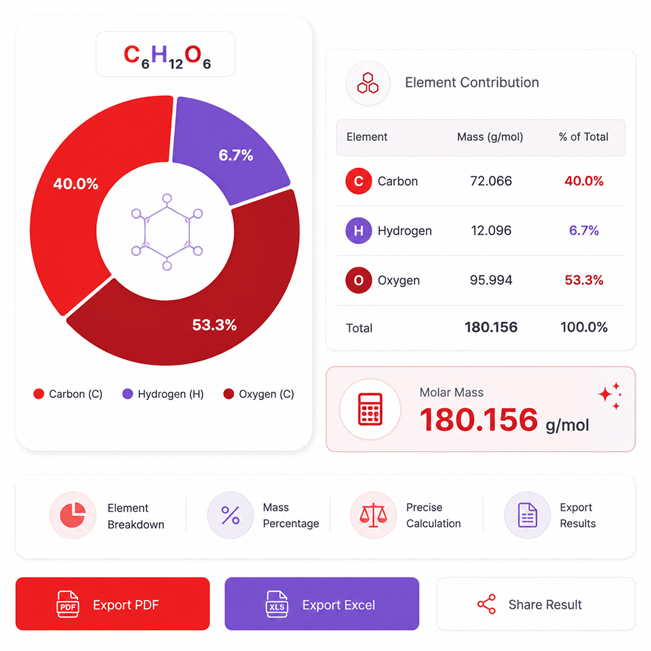
- Known contribution = 72.066 + 12.096 = 84.162 Da.
- Remaining molecular mass = 180.156 - 84.162 = 95.994 Da.
- Oxygen atomic mass = 15.999 Da.
- Unknown quantity = 95.994 / 15.999 = 6.
| Element | Quantity | Atomic Mass | Contribution | Mass Percentage |
|---|---|---|---|---|
| Carbon | 6 | 12.011 Da | 72.066 Da | 40.00% |
| Hydrogen | 12 | 1.0080 Da | 12.096 Da | 6.71% |
| Oxygen | 6 | 15.999 Da | 95.994 Da | 53.28% |
The reverse calculation starts with one unknown atom quantity and a valid target molecular mass.
The known elemental contributions are subtracted from the target before dividing by the atomic mass of the unknown element.
The result must be a positive whole number because chemical formula atom quantities cannot be fractional in this calculation model.
After solving the missing quantity, the complete composition is recalculated to verify molecular mass, molar mass, total atoms, and elemental percentages.
Results are rounded for display.
Internal calculations use full precision.
Calculations Disclaimer
How Does a Molar Mass Calculator Turn a Chemical Composition Into a Reliable Result?
A chemical formula can look simple, yet one small subscript changes everything. A molar mass calculator removes that risk by reading each element separately. It then connects every element with its atom quantity. The calculator evaluates the full chemical composition before showing the final result.
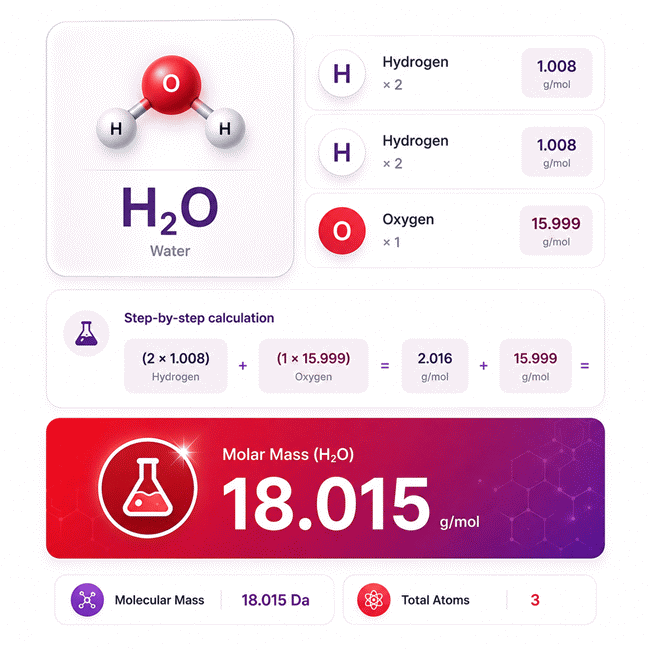
This process matters because molar mass depends on composition, not appearance. Water and hydrogen peroxide both contain hydrogen and oxygen. Their atom ratios are different, so their molar masses are different. The same rule applies to every compound.
Start With the Correct Elements and Atom Quantities
The first task is identifying every element in the composition. Each chemical symbol represents one specific element. Capitalization matters because chemical symbols follow strict notation. Co means cobalt, while CO describes carbon and oxygen together.
The next task is counting atoms correctly. A subscript applies only to the element before it. Grouped structures require even more care. Every repeated group changes several atom quantities at once.
A reliable calculator reduces this mental workload. You select each element and enter its quantity directly. This makes the composition visible before calculation begins. It also makes mistakes easier to spot.
Why Element Contributions Matter More Than the Final Number Alone
A single final number can hide an input mistake. Element contributions make the calculation easier to inspect. A heavy element may dominate the total mass with few atoms. A light element may contribute less, despite a larger atom count.
This breakdown creates a useful verification layer. You can see which element controls most of the result. You can also detect an unexpected contribution immediately.
A good result should be explainable, not merely displayed.
This is especially useful in chemistry education and laboratory planning. It also helps during technical reviews. A user can inspect the composition before relying on the value.
AxiCalculator keeps this workflow visible and interactive. The result updates as the chemical composition changes. This creates a faster path from input to understanding.
Molar Mass, Molecular Mass, and Formula Mass: Similar Numbers With Different Meanings
A common problem starts when three familiar terms appear together. They may look interchangeable, but their meanings are not identical. Understanding the difference prevents confusing units and chemical entities.
Molar mass describes the mass of one mole of a substance. It is normally expressed as mass per amount of substance. Molecular mass describes the mass of one molecule. It is commonly expressed in daltons or unified atomic mass units.
For routine chemistry, their numerical values are almost identical in familiar units. Their physical meanings remain different. One refers to a mole. The other refers to one molecular entity.
When Molecular Mass Is the Better Description
Molecular mass is useful when the substance exists as distinct molecules. Water, carbon dioxide, and glucose are clear examples. Each has a defined molecular composition.
The molecular mass reflects all atoms within one molecule. It therefore follows directly from the molecular formula. Changing the atom count changes the molecular mass immediately.
This idea becomes important when comparing molecules with similar elements. Two molecules can contain identical element types. Their different atom ratios can still produce very different masses.
When Formula Mass Is More Appropriate
Not every substance exists as separate molecules. Ionic solids are often represented by formula units. Sodium chloride is a familiar case. Its written formula describes the simplest electrical balance between ions.
For such substances, formula mass can be the clearer term. The arithmetic process remains similar. The scientific description becomes more accurate.
This wording matters more in technical writing than casual calculations. Clear terminology prevents a correct number from carrying an incorrect meaning.
Why the Same Composition Can Support Several Useful Results
A chemical composition contains more information than one total mass. It also reveals the total atom count. It can show each element’s contribution to the whole. It can also support elemental composition analysis.
That is why an effective molar mass calculator should not hide the structure. The user should see how the compound is built. This improves both learning and verification.
The goal is simple. One composition should produce a connected set of understandable results. That makes the calculation useful beyond homework.
How Reverse Solving Can Find a Missing Atom Quantity
Sometimes the total mass is known, but one atom quantity is missing. A normal calculator stops at that point. A reverse-solving calculator can work in the opposite direction.
This feature is useful when part of a composition is already known. The known elements create a known mass contribution. The remaining mass can then be assigned to one unknown element.
Reverse solving is not guessing. It uses the same chemical relationships in the opposite direction. However, the conditions must support a unique answer.
Why One Unknown Quantity Creates the Cleanest Reverse Problem
A single unknown quantity gives the calculation one clear target. The known contributions are evaluated first. Their combined mass is compared with the target result.
The remaining mass belongs to the unknown element. Its atomic mass determines the missing atom quantity. The result can then be checked against the full composition.
Problems become less certain when several atom quantities are unknown. Many different compositions can produce similar total masses. A single total mass may not identify one unique formula.
This is an important scientific limit. Reverse calculation becomes stronger when the element identities are already known.
Why a Decimal Atom Count Is a Warning Signal
A chemical formula uses whole atom ratios. A result such as 2.43 atoms cannot directly represent one formula unit. That result signals a mismatch somewhere in the problem.
The target mass may be inconsistent with the selected elements. An atom quantity may already be wrong. The assumed composition may also be incomplete.
This distinction prevents a dangerous shortcut. Automatically rounding an impossible atom count can create a believable but false formula.
Reverse Solving From Total Atom Count
The same concept works with total atoms. Suppose several element quantities are already known. Their atom counts can be added first. The missing quantity is the difference from the required total.
This method is simpler than mass-based reverse solving. It still depends on one clear unknown quantity. It also requires a chemically meaningful final composition.
Reverse solving turns the calculator into more than a one-way tool. It becomes a composition checker and problem-solving assistant.
Elemental Composition Reveals What the Total Molar Mass Can Hide
A final molar mass may look correct while the composition remains misunderstood. Elemental composition exposes what sits behind that total. It answers a more useful question: which elements contribute most to the compound?
This is important because atom count and mass contribution are not identical concepts. Ten hydrogen atoms can contribute less mass than one heavy atom. The periodic table creates large differences between elemental masses.
Why Mass Contribution Can Be More Useful Than Atom Count
Atom count tells you how many atoms are present in the written formula. Mass contribution shows how much each element influences the total mass.
These two views answer different questions. A compound may contain many light atoms. A smaller number of heavy atoms may still dominate its mass.
This insight matters in analytical chemistry and material calculations. It also helps users understand percent composition. The relationship becomes visible instead of abstract.
The largest atom count does not always create the largest mass contribution.
How Elemental Mass Percentage Helps Check a Composition
Elemental mass percentage describes each element’s share of the total mass. All element percentages should represent the complete composition together.
This creates another useful check. An unexpected percentage can reveal an incorrect atom count. It can also expose a wrongly selected element.
Mass percentage has practical value beyond classroom chemistry. It helps compare formulas with different atom ratios. It also supports composition-based laboratory calculations.
Why Chemical Identity Cannot Be Proven by Molar Mass Alone
Different substances can share the same molar mass. Some may have almost identical values. Structural isomers can even share the same molecular formula.
This means molar mass is powerful but not unique identification. It can support a chemical conclusion. It cannot always prove that conclusion alone.
This point becomes important in real laboratory work. Unknown compounds often require other analytical methods. Structure and composition may need independent confirmation.
A molar mass calculator should therefore support chemical reasoning. It should not replace chemical reasoning.
This is also why transparent element breakdown is valuable. The user can inspect the assumed composition directly. That is more informative than receiving one isolated number.
Special Chemical Cases That Can Change How a Molar Mass Result Should Be Interpreted
A routine compound may be easy to calculate. Special chemical cases require more attention. Isotopes, radioactive elements, hydrates, and mixtures can change the interpretation.
The arithmetic may still look simple. The chemistry behind the selected values may not be simple.
Natural Isotopic Composition Can Affect Atomic Mass
Many elements occur naturally as mixtures of isotopes. Their listed atomic weight reflects natural isotopic composition. This makes the value suitable for ordinary chemical calculations.
An enriched sample can behave differently. Its isotope distribution may differ from natural material. In that case, an isotope-specific calculation may be more appropriate.
This difference can be tiny for routine work. It can matter in high-accuracy scientific applications.
Radioactive Elements Need Special Interpretation
Some radioactive elements do not have a standard atomic weight. They may instead use a representative isotope mass number.
That number should not be confused with a normal average atomic weight. It identifies a useful isotope reference rather than natural isotopic abundance.
This distinction matters when interpreting calculated results. A displayed value can be mathematically correct for the chosen reference. The physical sample may still require more specific isotope information.
Hydrates and Repeated Groups Can Hide Extra Atoms
A hydrate contains water as part of the written chemical composition. Those water molecules contribute to the total mass. Ignoring them produces a result that is too small.
Repeated chemical groups create a similar risk. A multiplier can affect several atoms at once. Missing that relationship changes both atom count and total mass.
This is one reason direct element entry can be useful. The final composition becomes explicit. Every selected element and quantity can be inspected before use.
Mixtures Should Not Be Treated Like Single Compounds
A mixture may contain several substances with different molar masses. It does not automatically have one molecular formula. A simple average can therefore be misleading.
Any meaningful mixture average must consider composition. The correct method depends on the intended calculation.
This separates a chemical compound from a bulk mixture. The distinction is essential in industrial and laboratory work.
Common Molar Mass Calculation Errors That Can Quietly Ruin a Correct-Looking Result
The most dangerous mistakes often produce believable numbers. A calculator can process the entered values correctly. It cannot know every time that the intended formula was different.
That makes input review just as important as calculation speed.
Misreading Subscripts Is the Most Common Starting Error
A subscript changes the number of atoms of one element. Missing one subscript changes the compound’s composition immediately.
The problem becomes larger with repeated groups. One overlooked multiplier can change several atom quantities at once.
A quick atom-count review catches many mistakes before they spread.
Selecting the Wrong Chemical Element Can Still Produce a Plausible Number
Element symbols can look similar. A single capitalization error may represent another element entirely. Some symbols also differ from their English element names.
This is why controlled element selection improves reliability. It reduces spelling mistakes and invalid symbols.
It also helps users confirm the intended element before the result updates.
Duplicate Element Entries Can Hide a Composition Error
The same element may accidentally appear twice. The total could then include both entries. A user might miss the duplication when scanning a long composition.
A better workflow treats each element as one composition component. Its full atom quantity should be represented clearly.
Confusing Sample Mass With Molar Mass Creates a Different Problem
Sample mass describes the material physically placed on a balance. Molar mass describes mass per mole of a substance.
Changing sample size does not change the compound’s molar mass. It changes the amount of material present.
This distinction is fundamental in stoichiometry. It prevents grams and grams-per-mole from being treated as interchangeable.
How to Verify a Molar Mass Result Before Using It in Real Work
A fast result feels useful, but a checked result is more valuable. Verification does not need to be slow. A few simple checks can catch most serious mistakes.
Recount the Atoms Before Questioning the Arithmetic
Start with the composition itself. Confirm every selected element. Then confirm each atom quantity.
This check often finds the problem immediately. Most large errors begin before the final addition.
Next, inspect the element contributions. A very large contribution deserves attention. A surprisingly small one does too.
Compare the Result With Chemical Expectations
A rough sense of scale can reveal impossible results. A compound containing several heavy atoms should not have tiny molar mass.
Likewise, a simple light molecule should not suddenly reach extreme values.
This is not a replacement for calculation. It is a useful sanity check.
Use Reverse Solving as a Verification Tool
Reverse solving can test whether a target result matches a proposed composition. Keep the known quantities fixed. Leave one quantity unknown.
If the missing quantity returns cleanly, the composition is internally consistent. If it does not, the inputs deserve another review.
This creates a powerful second path through the same chemistry. Forward calculation predicts the result. Reverse calculation tests the structure behind that result.
AxiCalculator combines these workflows in one interactive tool. You can inspect the composition, edit results, and test missing quantities. You can also preserve the calculation for later review.
For students, this improves understanding. For laboratory users, it improves traceability. For technical teams, it makes calculation review faster.
The best next step is simple. Enter the known composition first. Inspect every element contribution. Then test the result from the opposite direction when needed.
Frequently Asked Questions
Does the charge of an ion change its molar mass?
How can I use molar mass to convert a measured sample mass into moles?
Which molar mass should I use when a chemical exists as a salt, solvate, or hydrate?
How should I use molar mass with a balanced chemical equation?
Should reagent purity or assay percentage change the molar mass used in a calculation?
What if my target concentration is based on the parent analyte but my reagent is a salt or hydrate?
How should a laboratory or engineering team validate molar mass calculations for controlled work?
Our engineers are here to help you get it right.