Mass Concentration to Molar Concentration
- Last formula update:
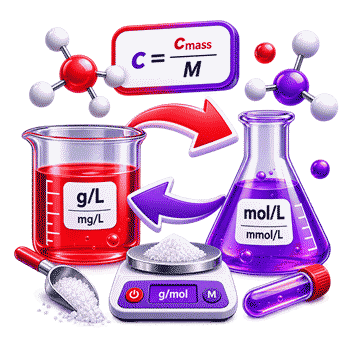
Decimal & Rounding Policy
- Calculations use full available precision and are not rounded during intermediate steps.
- Final mass concentration, molar concentration, and molar mass values are rounded only for clear display.
- Unnecessary trailing zeros are removed while meaningful decimal precision is preserved.
- Very small or very large results may be displayed in scientific notation for better readability.
- Unit conversions are performed before display rounding, so changing units does not reduce calculation accuracy.
- For reliable chemistry calculations, enter molar mass and concentration values with as much measured precision as available.
Valid range
- Molar mass: Must be a finite value greater than 0; a zero or negative molar mass is not valid for this conversion.
- Mass concentration: Must be a finite value of 0 or greater, representing the solute mass per unit volume of solution.
- Molar concentration: Must be a finite value of 0 or greater, representing the amount of substance per unit volume of solution.
- Calculation range: Any two valid parameters can determine the third using consistent, dimensionally compatible units.
- Numeric limits: Extremely large, extremely small, non-finite, or unsupported values should be rejected to prevent unreliable results.

Xylena Morforde
Reviewers:
Cirelle Vossford
Zorven Lumquell
Check our editorial policy
August 31, 2026
1.0.0
Initial calculator and formula release.
Our engineers are here to help you get it right.
How Does Mass Concentration to Molar Concentration Conversion Work?
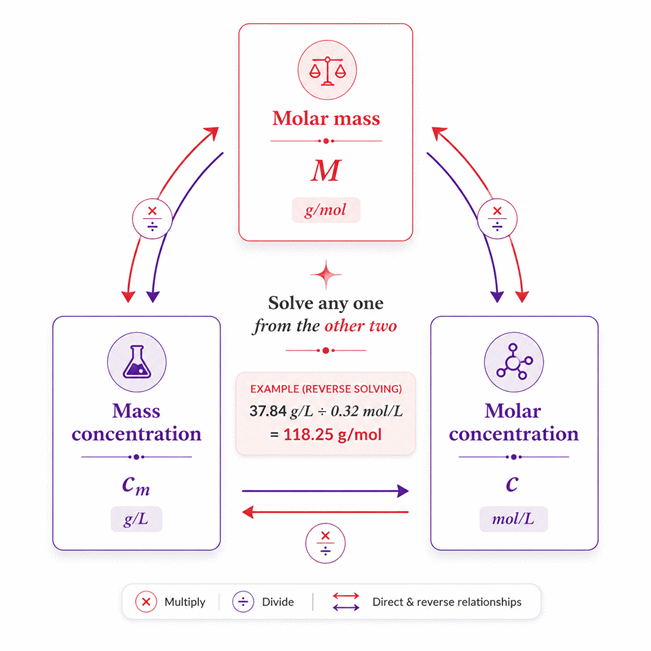
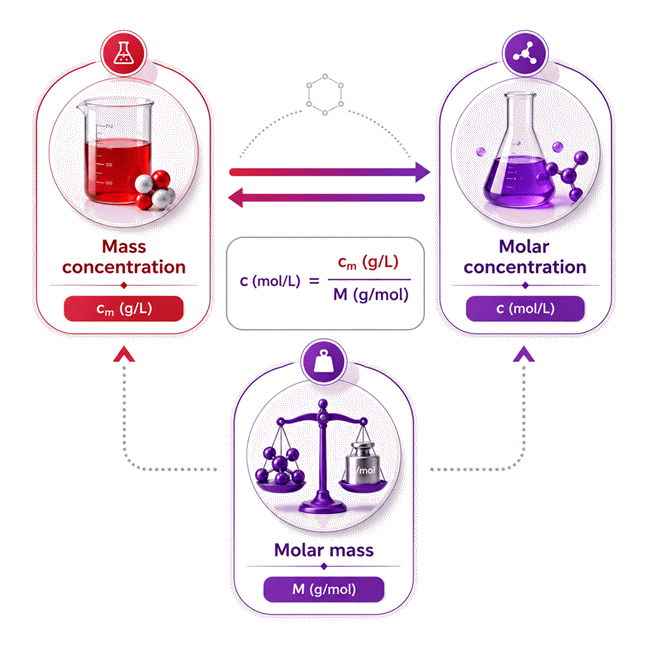
Mass Concentration to Molar Concentration Conversion shows how much substance is present in a solution on a mole-per-volume basis instead of a mass-per-volume basis. The conversion depends on three linked quantities: mass concentration, molar concentration, and the molar mass of the exact chemical species.
- Mass concentration describes the mass of solute contained in a given solution volume.
- Molar concentration describes the amount of substance contained in that same solution volume.
- Molar mass connects mass-based concentration with mole-based concentration.
- Any two known quantities can be used to determine the third.
- Reverse solving can determine mass concentration or molar mass when needed.
- The exact chemical form matters, especially for salts, hydrates, solvates, and complexes.
- Purity and assay information may affect practical laboratory or industrial interpretation.
- Mixtures may not have one meaningful molar concentration without defined composition.
- Unexpected results should trigger a check of chemical identity and sample information.
Mass Concentration to Molar Concentration Conversion is especially useful in laboratory preparation, analytical chemistry, biotechnology, formulation work, and industrial process review. The most reliable workflow starts by confirming the chemical species, then using the known concentration data to solve the required quantity and reviewing whether the result makes chemical sense.
Assumptions used in this calculator
- Inputs represent homogeneous solutions with correctly identified solutes and units.
- Molar mass is assumed accurate for the substance being evaluated.
- Mass concentration and molar concentration refer to the same solution volume.
- Entered values are assumed finite, positive, and physically meaningful.
- Unit selections are assumed dimensionally compatible with the chosen variable.
- Temperature effects on solution volume are not independently corrected.
- Pressure effects on solution volume are not independently corrected.
- Solution density is not required unless externally needed for other conversions.
- Chemical reactions during mixing are assumed not to change solute identity.
- Impurities, hydrates, and formulation differences must be reflected in molar mass.
- Measurement uncertainty remains the responsibility of the laboratory or process user.
- Results assume standard stoichiometric relationships without activity or non-ideal corrections.
- Industrial decisions should be verified against validated procedures and applicable standards.
Results are rounded for display.
Internal calculations use full precision.
Formulas Used in Mass Concentration to Molar Concentration :
1. Unit Normalization
Each entered value is converted to its calculator base unit before the concentration relationship is evaluated. The same physical quantity is preserved when the selected display unit changes.
- xbase = value expressed in the calculator base unit
- xunit = value expressed in the selected unit
- funit = conversion factor from the selected unit to the base unit
2. Mass Concentration and Molar Concentration Relationship
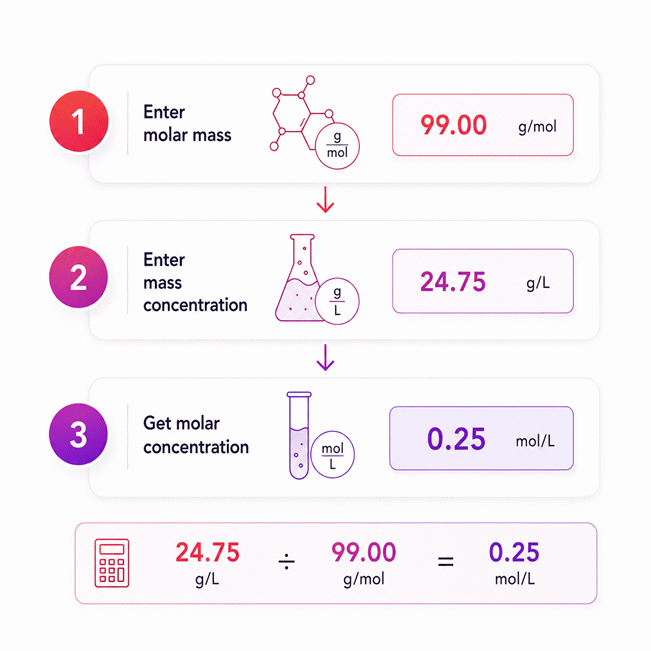
This is the governing equation used by the calculator. Any two valid quantities determine the third, so the same relationship supports forward and reverse calculations without introducing duplicate formulas.
- cmass = mass concentration, with base unit g/L
- c = molar concentration, with base unit mol/L
- M = molar mass, with base unit g/mol
Variables & Definitions
View a complete list of all variables used in this calculator, including definitions and units
Mass Concentration to Molar Concentration Variables and Units
| Variable | Symbol | Meaning | Base Unit | Role in Calculation |
|---|---|---|---|---|
| Mass concentration | cmass | Mass of solute contained in a unit volume of solution | g/L | Used with molar mass to determine molar concentration, or calculated from the other two variables |
| Molar concentration | c | Amount of substance contained in a unit volume of solution | mol/L | Used with molar mass to determine mass concentration, or calculated from the other two variables |
| Molar mass | M | Mass corresponding to one mole of the substance | g/mol | Links mass concentration and molar concentration in the governing relationship |
| Base-unit value | xbase | Physical value after conversion to the calculator base unit | Depends on variable | Provides a consistent internal value for calculations and reverse calculations |
| Selected-unit value | xunit | Numeric value displayed or entered in the selected unit | Selected unit | Represents the user-facing value before conversion to the corresponding base unit |
| Unit conversion factor | funit | Multiplier used to convert a selected-unit value to its base-unit value | Unit-dependent | Maintains the same physical quantity when different compatible units are selected |
Unit Conversion Table
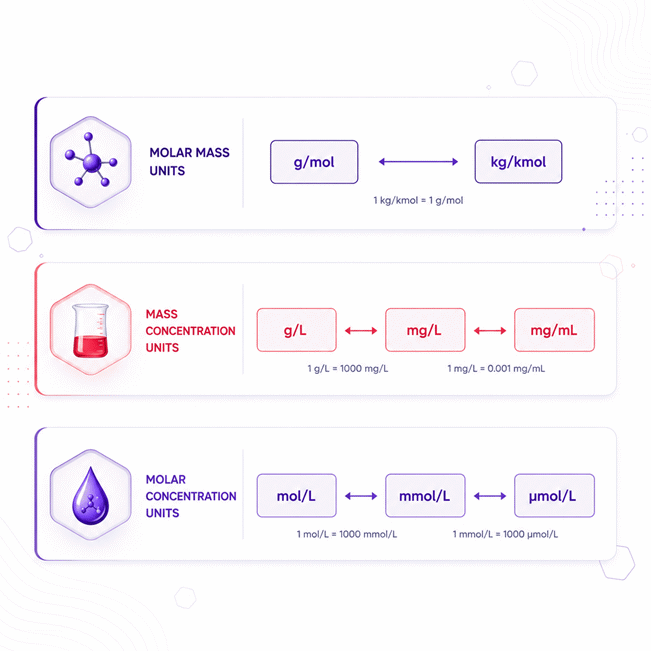
Molar Mass Unit Conversion Table
| Unit Group | Unit Name | Symbol | Equivalent in g/mol | Used For |
|---|---|---|---|---|
| Popular Units | Gram per mole | g/mol | 1 g/mol | Standard molar mass values in chemistry calculations |
| Popular Units | Kilogram per kilomole | kg/kmol | 1 g/mol | Engineering and industrial molecular weight data |
| Popular Units | Milligram per millimole | mg/mmol | 1 g/mol | Laboratory calculations using milligram and millimole scales |
| Scientific Units | Kilogram per mole | kg/mol | 1000 g/mol | Large molar mass values expressed in SI mass units |
| Scientific Units | Gram per millimole | g/mmol | 1000 g/mol | High molecular mass substances and macromolecular calculations |
| Scientific Units | Milligram per mole | mg/mol | 0.001 g/mol | Very small mass-per-mole representations |
Mass Concentration Unit Conversion Table
| Unit Group | Unit Name | Symbol | Equivalent in g/L | Used For |
|---|---|---|---|---|
| Popular Units | Gram per liter | g/L | 1 g/L | General solution mass concentration calculations |
| Popular Units | Milligram per liter | mg/L | 0.001 g/L | Dilute laboratory, environmental, and water samples |
| Popular Units | Milligram per milliliter | mg/mL | 1 g/L | Laboratory solutions, reagents, and pharmaceutical preparations |
| Popular Units | Microgram per milliliter | µg/mL | 0.001 g/L | Low-concentration analytical and biochemical samples |
| Popular Units | Kilogram per cubic meter | kg/m³ | 1 g/L | Industrial and SI-based concentration calculations |
| Scientific Units | Kilogram per liter | kg/L | 1000 g/L | Highly concentrated mixtures and process calculations |
| Scientific Units | Gram per milliliter | g/mL | 1000 g/L | Concentrated laboratory and formulation calculations |
| Scientific Units | Microgram per liter | µg/L | 0.000001 g/L | Trace-level environmental and analytical measurements |
| Scientific Units | Nanogram per milliliter | ng/mL | 0.000001 g/L | Trace analytical and bioanalytical concentrations |
| Scientific Units | Gram per cubic meter | g/m³ | 0.001 g/L | Gas, environmental, and process concentration reporting |
| Scientific Units | Milligram per cubic meter | mg/m³ | 0.000001 g/L | Air quality and low-level industrial measurements |
| Scientific Units | Microgram per cubic meter | µg/m³ | 0.000000001 g/L | Very low airborne and environmental concentrations |
Molar Concentration Unit Conversion Table
| Unit Group | Unit Name | Symbol | Equivalent in mol/L | Used For |
|---|---|---|---|---|
| Popular Units | Mole per liter | mol/L | 1 mol/L | Standard molar concentration and solution chemistry calculations |
| Popular Units | Millimole per liter | mmol/L | 0.001 mol/L | Laboratory, clinical, and moderately dilute solutions |
| Popular Units | Micromole per liter | µmol/L | 0.000001 mol/L | Biochemical and low-concentration analytical solutions |
| Popular Units | Nanomole per liter | nmol/L | 0.000000001 mol/L | Trace biochemical and analytical measurements |
| Popular Units | Picomole per liter | pmol/L | 0.000000000001 mol/L | Ultra-trace molecular and bioanalytical measurements |
| Scientific Units | Kilomole per cubic meter | kmol/m³ | 1 mol/L | Industrial process and SI-based concentration calculations |
| Scientific Units | Mole per cubic meter | mol/m³ | 0.001 mol/L | SI scientific and engineering concentration reporting |
| Scientific Units | Millimole per cubic meter | mmol/m³ | 0.000001 mol/L | Dilute scientific and process measurements |
| Scientific Units | Micromole per cubic meter | µmol/m³ | 0.000000001 mol/L | Very low SI-based amount concentration measurements |
Calculations Disclaimer
Choosing the Right Concentration View for Real Laboratory Work
A common laboratory problem starts with a concentration reported by mass. The next task may require a mole-based value instead. That change sounds simple, but chemical identity matters immediately. A concentration value alone cannot describe the number of molecules present. The substance itself changes that answer.
Mass concentration is useful when material handling is the main concern. It fits weighing, formulation, storage, and many production records. Molar concentration becomes more useful when chemical amount controls the process. Reaction planning, stoichiometry, assays, and molecular interactions often need that view.
When Mass-Based Concentration Is the Practical Choice
Imagine a technician preparing a production solution from a weighed powder. The batch sheet lists the material by mass. The balance also measures mass directly. In this workflow, a mass-based concentration feels natural and practical.
This approach is common during formulation and material preparation. It is also convenient for stock solutions and bulk chemical handling. Operators can compare weighed material with final liquid volume quickly.
However, the same mass concentration can represent different molecular populations. A light compound contains more moles per gram. A heavier compound contains fewer moles per gram. This difference becomes important when molecules drive the process.
When Molar Concentration Gives Better Chemical Insight
A researcher may know exactly how much material enters a solution. Yet reaction behavior depends on molecular amount, not only mass. This is where molar concentration becomes more useful.
Mole-based reporting helps compare different chemicals on a molecular basis. It also supports reaction planning and biochemical work. The same idea applies to many analytical workflows.
For example, two solutions can contain equal mass per volume. Their chemical behavior can still differ greatly. Their molar masses may be very different.
Why Chemical Identity Changes the Answer
The hidden variable is the exact chemical species. Users often overlook this detail. A free compound, salt, hydrate, or complex may have different mass properties.
This is why concentration conversion must follow the actual material used. The name on the bottle matters. The chemical form matters. The supplier specification may also matter.
Same mass does not always mean the same number of molecules.
AxiCalculator helps users move between these concentration views without changing the scientific relationship. The tool is most useful when the chemical identity is already known.
Why the Exact Chemical Form Matters More Than Most Users Expect
A result can look correct while using the wrong chemical form. This is one of the most dangerous errors. The numbers may appear reasonable. The scientific meaning can still be wrong.
The safest workflow begins with exact substance identification. Read the reagent label carefully. Check whether the material is an anhydrous compound, hydrate, salt, or another form.
Salts, Hydrates, and Solvates Can Change the Result
Consider a laboratory using a hydrated salt. Water molecules are part of that weighed material. They contribute to its total mass. Ignoring them changes the relationship between mass and chemical amount.
The same issue appears with solvates. A solvent molecule may belong to the stated chemical form. Its mass becomes part of the material being weighed.
This detail is easy to miss during fast laboratory work. It can create a large concentration error. The error may remain hidden during later calculations.
Purity and Assay Values Need Practical Attention
Another problem appears when a reagent is not fully pure. The bottle may contain less active compound than expected. A simple mass measurement then includes inactive material.
High-purity analytical standards often have clear assay information. Industrial materials may show broader specifications. Research reagents can also vary between batches.
When accuracy matters, use the actual active material information available. Do not treat every weighed gram as active compound automatically.
Mixtures Need a Different Way of Thinking
A mixture creates an even harder problem. Total mass may represent several chemical species. One single molecular value may not describe the entire mixture correctly.
This is common with protein blends, extracts, formulations, and complex process streams. A single converted molar value can become misleading.
Text Infographic: Chemical Identity Check
Step 1: Confirm the exact chemical name.
Step 2: Check salt, hydrate, or solvate form.
Step 3: Review purity or assay information.
Step 4: Confirm whether the sample is a mixture.
Step 5: Use the matching chemical form throughout the workflow.
This short check prevents many hidden errors. It also improves repeatability between users, laboratories, and production teams.
Reverse Solving Turns the Calculator Into a Practical Diagnostic Tool
Users do not always start with the same known values. Sometimes the final concentration is already known. Another variable may be missing instead. A fixed one-way converter cannot handle every workflow well.
Reverse solving changes that experience. The user can work from the information already available. The missing quantity becomes the result.
When the Desired Concentration Is Already Known
A formulation team may have a required molar concentration. The chemical identity is already fixed. The practical question becomes how much mass-based concentration is needed.
This approach is useful during planning. It is also helpful before preparing stock solutions. The user starts with the target, not the material already prepared.
The calculator can support that direction without creating a separate workflow. This keeps the process easier to understand.
When Molar Mass Becomes the Unknown Value
Another situation starts with two concentration values. The user wants to inspect the implied molar mass. This can serve as a useful diagnostic check.
A surprising result may signal a wrong chemical form. It may also reveal an incorrect sample label. A mixture can create the same warning sign.
Reverse solving is therefore more than convenience. It can help users detect inconsistencies before they spread.
Use Reverse Results as a Check, Not Automatic Identification
A calculated value should not identify an unknown chemical by itself. Many substances can have similar molar masses. Mixtures create even more uncertainty.
Use the reverse result to test existing information. Compare it with a known specification. Investigate large differences before continuing.
An unexpected reverse result is often a clue, not a failure.
This approach is valuable in laboratory review. It also helps during process troubleshooting. A strange result can expose an earlier data problem quickly.
Laboratory Workflow: From Sample Record to a Usable Concentration
A busy laboratory often receives concentration data from several sources. One value may come from a certificate. Another may come from an instrument. A third may appear in a preparation record.
The challenge is keeping these values chemically meaningful. A good workflow begins before any calculation. Start by confirming what each recorded number actually describes.
Start With the Sample Record, Not the Calculator
First, confirm the sample identity. Then check the chemical form. Review the concentration basis shown in the record.
Next, confirm whether the value refers to pure solute. Some reports describe total material. Others describe only the active component.
This distinction matters in pharmaceutical and biochemical work. It also matters in industrial formulations.
Use the Calculator After the Chemistry Is Clear
Once the substance information is clear, the conversion becomes much safer. Enter the known values carefully. Choose the intended concentration view.
AxiCalculator performs the relationship in real time. This reduces unnecessary clicking. It also makes reverse checks faster.
The tool is especially useful during repeated laboratory work. Users can move between different reporting needs without rebuilding the calculation.
Check Whether the Result Makes Chemical Sense
Never judge a result only by its clean appearance. Ask whether the magnitude makes sense. Compare it with the original sample information.
A very large change may be correct. It may also indicate the wrong chemical form. Unexpected results deserve a quick review.
Text Infographic: Fast Laboratory Decision Path
Sample identity → Chemical form → Concentration record → Calculator → Result review → Final use
This workflow is simple enough for routine work. It is also structured enough for technical environments.
Keep a Clear Record When Results Are Shared
Problems often appear after a calculation leaves the original user. Another person may receive only the final number. Important context can disappear.
Keep the chemical name with the concentration result. Keep the material form with it too. Add the relevant sample or batch reference when available.
AxiCalculator includes sharing and export options in its workflow. These features can help preserve calculation context during collaboration.
Industrial and Research Applications Need Different Levels of Context
An industrial user may face a different problem from a student. The equation remains scientific. The consequences of a bad input can be much larger.
Industrial work often connects concentration data with dosing, quality control, production, or analytical verification. Research work may connect it with assays, reactions, or molecular studies.
Chemical Processing and Production Workflows
Production teams often receive specifications in different concentration formats. A raw material document may use mass-based reporting. A process model may need a mole-based value.
Moving between these views supports better communication. It can also help engineering and laboratory teams speak the same language.
The chemical species must remain clearly identified throughout this process. A naming error can affect every later step.
Pharmaceutical and Biotechnology Work
Biotechnology creates a special challenge. Proteins and other biomolecules can have large molar masses. Small mass changes may represent very different molecular amounts.
Some biomolecules also exist in several structural states. Monomers and oligomers may not share the same relevant molecular mass.
Glycosylation can add more variation. Product-specific information becomes important. Generic molecular values may not be sufficient.
Batch Information Can Matter in Advanced Work
A supplier may report a batch-specific molecular value. That figure can be more useful than a generic database value.
This matters when small differences affect assay design. It also matters when preparing highly specific research solutions.
Expert Insight: The best concentration result begins with the best substance description.
Environmental and Analytical Chemistry
Environmental laboratories often work with very dilute samples. Small reporting mistakes can create large interpretation problems.
Analytical work may also separate an ion from its parent compound. The reported chemical species must match the value used later.
For example, a result for an ion should stay tied to that ion. Switching silently to a salt can change the meaning.
Scale-Up Makes Documentation More Important
A small laboratory mistake may affect one sample. The same mistake at plant scale can affect a full batch.
Industrial teams should preserve substance identity through every handoff. Preparation records, analytical reports, and process documents should agree.
Common Failures Often Produce Results That Still Look Reasonable
The hardest errors are not obvious. A calculator may return a clean number. That number can still represent the wrong chemistry.
Users should therefore focus on input meaning, not only input format. Most serious problems begin before the calculator runs.
Using the Wrong Chemical Species
This error is very common in practical work. A user selects a molecular value for one form. The actual bottle contains another form.
Salts and hydrates are common examples. Different oxidation states can matter too. Complexes can create the same problem.
The result may differ significantly. Yet nothing on the screen may look unusual.
Confusing Active Ingredient With Total Material
A formulation may contain fillers, stabilizers, or other components. Total product mass is not always active compound mass.
This distinction is important for commercial formulations. It also matters for partially purified materials.
Check whether the reported concentration describes total material or active substance. Do this before any chemical interpretation.
Ignoring Purity Can Shift the Effective Concentration
A reagent with reduced purity contains less active compound per gram. High-accuracy work should account for this difference.
The impact grows when tight tolerances are required. It also matters during reference standard preparation.
Assuming Every Complex Sample Has One Meaningful Molar Value
Biological mixtures often contain many molecular species. Extracts may contain hundreds. Process streams can be equally complex.
A single molar value can oversimplify such samples. The user must define the target species first.
Overlooking Changes in the Actual Chemical Form
A material can change during storage or preparation. Water uptake can alter some compounds. Degradation can alter others.
These changes may affect the effective material composition. A historical specification may no longer describe the current sample perfectly.
A precise number cannot repair an incorrect chemical identity.
How to Use AxiCalculator for Faster and Clearer Concentration Decisions
A user often needs an answer while working, not after reading a textbook. The calculator should therefore remove steps, not create them.
AxiCalculator keeps the main concentration variables inside one workflow. Users can start with the information they already have.
Enter the Two Values You Actually Know
You do not need to force every task into one direction. Start with the two known quantities. Let the missing quantity become the result.
This makes the tool useful during preparation, verification, and reverse checks. It also reduces unnecessary manual rearrangement.
Change the Result When You Need to Work Backward
Sometimes the desired result becomes the new target. A user may need to work backward immediately.
The calculator supports this workflow directly. This helps during formulation planning and laboratory troubleshooting.
It also makes comparison easier. Users can test how changing one known value affects another quantity.
Use the Tool as a Decision Aid, Not Just a Converter
A conversion can answer more than one question. It can reveal whether a specification seems reasonable. It can also expose mismatched substance data.
This is especially useful when reviewing supplier documents. It can help during internal quality checks too.
Keep Technical Work and Practical Decisions Separate
The technical task is understanding the concentration relationship. The practical task is deciding what to do next.
Laboratory users may need to prepare a solution. Engineers may need to review process data. Researchers may need assay-ready concentration information.
A clear calculator should support these tasks without mixing them together.
Use Exports and Sharing for Team Review
A calculation often needs review by another person. Sharing only a final number can remove useful context.
Exported records can help keep values together. A shared calculator state can also support faster review.
This is useful for laboratory teams, students, engineers, and technical reviewers.
Expert Insight: A useful calculator should make verification easier than repetition.
Building Better Concentration Decisions From Better Input Context
The final problem is often not mathematics. It is incomplete information. Users may know a concentration but not its exact chemical basis.
Better decisions start with better context. Confirm the substance. Confirm the material form. Understand what the reported value describes.
Ask What the Concentration Actually Represents
A label may say concentration without enough detail. Does it describe the active compound? Does it describe a salt? Does it describe total solids?
These questions can change the final interpretation. They should be answered before technical decisions are made.
Look for Chemical Form Before Searching for More Digits
Users often focus on decimal precision first. Chemical identity is usually more important.
A highly precise value for the wrong compound remains wrong. A suitable value for the correct compound is much more useful.
Use Supplier and Batch Information When the Work Demands It
Research and industrial materials can vary between products. Batch-specific documents may contain useful chemical details.
Use that information when it affects the substance being evaluated. Keep it linked with the calculation record.
Turn Unexpected Results Into a Quality-Control Question
A strange result should trigger curiosity. Do not immediately assume the calculator failed.
Check the chemical name first. Then review the material form and sample description. Investigate purity or mixture issues when relevant.
This process can uncover errors that simple recalculation would miss.
Use AxiCalculator When Speed and Clarity Both Matter
A useful scientific tool should shorten the path to a sound decision. It should also make that decision easier to review.
AxiCalculator brings forward and reverse concentration work into one interface. This supports fast checks without hiding the chemical context.
Use it when your task begins with known concentration data. Use it again when the missing variable changes. Keep the exact substance identity beside every result.
That simple habit improves clarity across laboratory and industrial workflows. It also makes technical communication easier between teams.
Frequently Asked Questions
What information should I verify before trusting a concentration conversion result?
Can I reuse a previous molar mass or converted concentration for a new sample?
Why does my calculated molar concentration sometimes look extremely small?
Which concentration value should I keep in my laboratory or project records?
What should an engineer check when two concentration records for the same material disagree?
How should I handle molar concentration when an industrial stream contains several changing components?
What should I do when a reverse-solved molar mass conflicts with the expected material specification?
Engineering Resources
Our engineers are here to help you get it right.