Electron Configuration Calculator
- Last formula update:
Decimal & Rounding Policy
- Atomic numbers and electron counts are displayed as whole numbers because these values cannot be fractional.
- Atomic mass values retain their meaningful published precision, with unnecessary trailing zeros removed for clearer results.
- Unit conversions use full internal precision and are rounded only when the final value is displayed.
- Very small mass values, such as kilograms per atom, may be shown in scientific notation to preserve accuracy and readability.
- Electron configurations are never numerically rounded; subshell occupancies remain exact integers according to the selected element’s ground-state configuration.
Valid range
- Element: Select any neutral chemical element from Hydrogen (H) through Oganesson (Og), covering atomic numbers 1 to 118.
- Atomic Number: Enter a whole number from 1 to 118; zero, negative, decimal, and out-of-range values are not valid.
- Atomic Mass: Use a finite positive mass that corresponds to a supported element; the accepted value is converted consistently with the selected mass unit.
- Full Electron Configuration: The total electron count must be between 1 and 118 and follow a valid neutral ground-state configuration.
- Subshell Occupancy: The maximum allowed occupancies are 2 electrons for s, 6 for p, 10 for d, and 14 for f subshells.
- Noble-Gas Shorthand: Use a valid preceding noble-gas core followed by the remaining occupied subshells for the selected neutral element.
- Valence Electron Configuration: Enter only a valid valence configuration associated with a supported neutral element; ambiguous configurations require additional element information.

Xylena Morforde
Reviewers:
Cirelle Vossford
Zorven Lumquell
Check our editorial policy
August 31, 2026
1.0.0
Initial calculator and formula release.
Our engineers are here to help you get it right.
How Does an Electron Configuration Calculator Help You Find the Correct Electron Arrangement?
Electron Configuration Calculator results give you a fast way to identify the ground-state electron arrangement of a neutral element. Enter an element or atomic number to obtain its full electron configuration, noble-gas shorthand, and valence electron configuration. The calculator also supports reverse solving, so a valid electron configuration can be used to identify the matching element and atomic number.
- Supports neutral elements from hydrogen through oganesson, covering atomic numbers 1 to 118.
- Uses accepted ground-state configurations rather than relying only on a simple filling sequence.
- Accounts for important configuration exceptions found in transition metals and heavier elements.
- Checks subshell occupancy limits for s, p, d, and f electron configurations.
- Shows both complete electron configurations and shorter noble-gas notation.
- Helps distinguish orbital filling order from the conventional written configuration order.
- Provides valence configuration information for understanding outer and chemically relevant electrons.
- Supports reverse configuration checks when the element itself is unknown.
- Connects electron structure with atomic number, periodic-table position, and chemical behavior.
The Electron Configuration Calculator is especially useful for checking chemistry work, studying periodic trends, validating configurations, and exploring unusual ground-state arrangements. It reduces repetitive manual work while keeping the underlying atomic structure visible and understandable.
Assumptions used in this calculator
- Calculations assume a neutral atom unless another charge state is explicitly specified.
- Electron configurations represent the ground state, not excited electronic states.
- Electrons fill subshells using standard energy-order rules and accepted ground-state exceptions.
- Subshell capacities are limited to 2, 6, 10, and 14 electrons.
- The calculator supports elements with atomic numbers from 1 through 118.
- Atomic number equals electron count only for electrically neutral atoms.
- Atomic mass values are treated as reference data, not experimentally measured inputs.
- Radioactive elements may use representative isotope masses rather than natural averages.
- Valence configurations follow the calculator’s defined ground-state electron convention.
- Chemical bonding, oxidation state, and molecular environment are not modeled.
- Temperature, pressure, and external fields are assumed not to alter configuration.
- Unit conversions preserve full internal precision before final display rounding.
- Critical industrial or research decisions should be verified against authoritative data.
Results are rounded for display.
Internal calculations use full precision.
Formulas Used in Electron Configuration Calculator :
1. Atomic Number and Total Electron Count
For a neutral atom, the atomic number equals the total number of electrons. In reverse calculation, summing all subshell occupancies identifies the corresponding atomic number.
2. Subshell Electron Capacity
Each occupied subshell must remain within its allowed electron capacity when a full or shorthand configuration is evaluated.
3. Ground-State Filling Order
Electrons are assigned in increasing ground-state orbital energy order, while established ground-state exceptions are applied where the simple filling sequence does not give the accepted configuration.
4. Atomic Mass Lookup
Atomic mass is obtained from the element associated with the resolved atomic number rather than calculated from electron occupancy.
5. Noble-Gas Shorthand Configuration
The preceding noble-gas configuration is replaced by its element symbol in brackets, and only the remaining occupied subshells are written after it.
6. Valence Electron Configuration
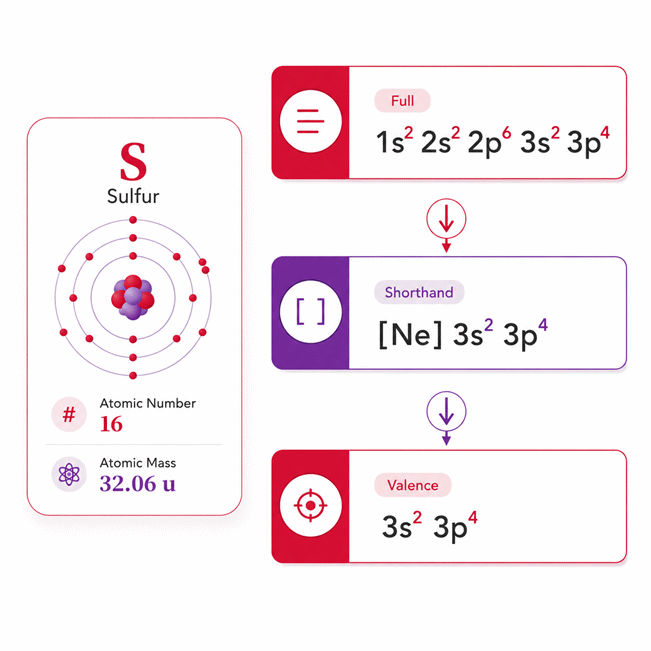
The valence result contains the occupied subshell terms treated as valence subshells for the resolved ground-state element.
7. Atomic Mass Unit Conversion
Full internal precision is preserved during unit conversion, and formatting or rounding is applied only to the displayed result.
- Z
- Atomic number of the neutral element.
- Ne
- Total number of electrons in the neutral atom.
- qi
- Number of electrons occupying subshell term i.
- r
- Total number of occupied subshell terms in the configuration.
- n
- Principal energy level of a subshell.
- l
- Subshell designation represented by s, p, d, or f.
- M(Z)
- Stored atomic mass associated with atomic number Z.
- G
- Nearest preceding noble-gas core used for shorthand notation.
- Crem
- Occupied configuration remaining after the noble-gas core.
- Cshort
- Noble-gas shorthand electron configuration.
- V
- Set of occupied subshells classified as valence subshells for the resolved element.
- Cval
- Valence electron configuration.
- mu
- Numerical atomic mass expressed in unified atomic mass units.
- mDa
- Numerical atomic mass expressed in daltons.
- mkg
- Atomic mass expressed in kilograms per atom.
- ⊕
- Ordered concatenation of electron-configuration terms.
Variables & Definitions
View a complete list of all variables used in this calculator, including definitions and units
Electron Configuration Calculator Variables and Symbols
| Variable | Name | Meaning | Unit or Format | Valid Range or Rule | Calculation Role |
|---|---|---|---|---|---|
| Z | Atomic Number | Number of protons and, for a neutral atom, the total number of electrons. | Dimensionless integer | 1 to 118 | Identifies the element and determines its supported ground-state electron configuration. |
| Ne | Total Electron Count | Total number of electrons represented by the occupied subshells of a neutral atom. | Electrons | 1 to 118 for supported neutral elements | Equals the atomic number and supports reverse identification from a complete configuration. |
| qi | Subshell Occupancy | Number of electrons occupying a specific subshell term. | Electrons | s: 0-2; p: 0-6; d: 0-10; f: 0-14 | Defines the electron population assigned to each occupied subshell. |
| r | Occupied Subshell Count | Number of occupied subshell terms included in the complete configuration. | Dimensionless integer | Positive integer determined by the resolved element | Sets the number of terms included when all subshell occupancies are summed. |
| n | Principal Energy Level | Principal quantum level associated with a subshell. | Dimensionless integer | 1 to 7 for the supported ground-state configurations | Identifies the electron shell used in each configuration term. |
| l | Subshell Designation | Subshell type associated with an electron-configuration term. | s, p, d, or f | Only a subshell allowed for the corresponding principal level | Determines the subshell type and its maximum permitted occupancy. |
| M(Z) | Atomic Mass Lookup | Reference atomic mass associated with the element identified by atomic number Z. | u | Positive stored value for the selected element | Provides the calculator's atomic mass value after the element is resolved. |
| G | Noble-Gas Core | Nearest preceding noble gas used to abbreviate the complete electron configuration. | Element symbol in brackets | He, Ne, Ar, Kr, Xe, or Rn when applicable | Replaces the filled inner-shell configuration in noble-gas shorthand notation. |
| Crem | Remaining Configuration | Occupied subshell terms that remain after removing the preceding noble-gas core. | Electron-configuration notation | Must reproduce the resolved ground-state configuration with the selected core | Forms the portion written after the noble-gas symbol in shorthand notation. |
| Cshort | Noble-Gas Shorthand Configuration | Compact electron configuration consisting of the noble-gas core and remaining occupied subshells. | Electron-configuration notation | Must correspond to one supported neutral ground-state element | Provides the abbreviated electron configuration and supports reverse element identification. |
| V | Valence Subshell Set | Set of occupied subshells treated as valence subshells for the resolved element. | Set of subshell terms | Depends on the resolved element and its ground-state configuration | Determines which occupied terms are included in the valence configuration result. |
| Cval | Valence Electron Configuration | Ordered configuration of the occupied subshell terms included in the valence set. | Electron-configuration notation | Must match the supported valence representation of the resolved element | Displays the calculator's valence electron configuration and may assist reverse identification when unique. |
| mu | Atomic Mass in Unified Atomic Mass Units | Atomic mass expressed in unified atomic mass units. | u | Finite positive value | Acts as the base mass value for supported atomic mass unit conversions. |
| mDa | Atomic Mass in Daltons | Numerical atomic mass expressed in daltons. | Da | Finite positive value | Provides an equivalent mass representation where 1 Da equals 1 u. |
| mkg | Atomic Mass in Kilograms | Mass of one atom expressed in kilograms after conversion from unified atomic mass units. | kg | Finite positive value | Provides the SI mass representation of the resolved atomic mass. |
| ⊕ | Ordered Concatenation Operator | Joins electron-configuration terms while preserving their required notation order. | Operator | Applied only to compatible configuration terms | Combines the noble-gas core with remaining terms or combines ordered valence subshell terms. |
Unit Conversion Table
Unified Atomic Mass Unit Conversion Table
| Unit Group | Unit Name | Symbol | Equivalent in u | Used For |
|---|---|---|---|---|
| Popular Units | Unified Atomic Mass Unit | u | 1 u | Standard atomic-scale mass values for elements and individual atoms. |
Dalton Conversion Table
| Unit Group | Unit Name | Symbol | Equivalent in u | Used For |
|---|---|---|---|---|
| Scientific Units | Dalton | Da | 1 u | Atomic, molecular, biochemical, and mass-spectrometry mass measurements. |
Kilogram Conversion Table
| Unit Group | Unit Name | Symbol | Equivalent in u | Used For |
|---|---|---|---|---|
| Scientific Units | Kilogram | kg | 6.02214075367 × 1026 u | SI representation of the mass of an individual atom. |
Example Calculation
Chromium contains 24 electrons because a neutral atom has the same electron count as its atomic number. Its ground-state configuration is an established exception to the simplest orbital-filling prediction. The preceding noble-gas core is argon, leaving 3d5 4s1 in shorthand notation. Atomic-mass conversion changes only the mass unit and does not change the element or electron configuration.
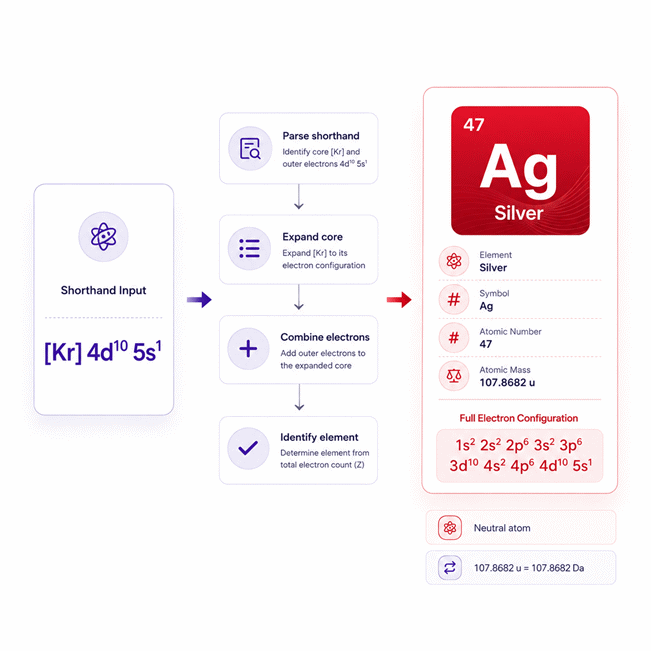
Reverse solving begins with the 36 electrons represented by the krypton core. The remaining 4d10 and 5s1 terms contribute 11 additional electrons, giving a total of 47. Atomic number 47 uniquely identifies silver, allowing its full configuration and reference atomic mass to be restored. The mass can then be converted to another supported unit without changing the identified element.
Results are rounded for display.
Internal calculations use full precision.
Calculations Disclaimer
How the Electron Configuration Calculator Works
A wrong electron configuration can derail an entire chemistry exercise. The Electron Configuration Calculator removes that first point of failure. It connects an element, atomic number, and electron arrangement in one workflow. Enter a supported element and the remaining results appear instantly. You can also begin with another known value. That makes the tool useful when the element itself is unknown.
The calculator focuses on neutral atoms in their ground state. It uses the accepted electron arrangement for each supported element. This matters because simple filling rules do not solve every element correctly. Several transition metals need special treatment. Heavy elements may also need carefully assigned reference configurations.
The result is more than a long string of letters and numbers. It shows how electrons occupy shells and subshells. It also gives a shorter noble-gas form. A valence configuration helps reveal chemically important outer electrons.
The key advantage is speed without hiding the underlying chemistry. You can inspect the result, trace its structure, and test another value immediately.
From Element or Atomic Number to Ground-State Electron Configuration
A common problem begins with only an element name. Another starts with an atomic number. Both routes lead to the same neutral atom. The atomic number fixes the number of protons. A neutral atom has the same number of electrons.
Once that electron count is known, electrons are placed into allowed subshells. Lower-energy positions are filled before higher-energy positions. Each subshell also has a fixed capacity. The final arrangement must match the accepted ground state.
This process is simple for many main-group elements. It becomes more interesting for several transition metals. Their final configurations can differ from a basic predicted sequence. The calculator handles those recognized cases directly.
This makes atomic number one of the safest starting points. It uniquely identifies the element. It also avoids confusion caused by isotope mass differences.
Reverse Solving: From Electron Configuration Back to the Element
Sometimes the configuration is known, but the element is missing. That is where reverse solving becomes useful. The calculator can read a supported ground-state configuration and recover the neutral atom.
The process begins by reading each occupied subshell. The electron occupancies are checked for physical limits. The total electron count is then determined. For a neutral atom, that count gives the atomic number.
A valid result must satisfy more than total electron count. The arrangement must also match an accepted ground state. A configuration with the right total can still be wrong. Electrons may occupy the wrong subshells or exceed allowed capacities.
Reverse solving is especially useful during homework checks and data review. It also helps when configuration data appears without an element label.
How Electron Configuration Represents the Structure of an Atom
An electron configuration is a compact map of atomic electron structure. Each term identifies an energy level and a subshell. Its superscript shows how many electrons occupy that subshell.
This map helps explain many patterns across the periodic table. Elements in the same group often share related outer-electron structures. Those patterns help explain bonding and common chemical behavior.
Electron configuration does not describe every detail of an atom. It does not replace a full quantum model. It does provide a practical ground-state description for chemistry work.
The notation also compresses a large amount of information. A trained reader can quickly see filled shells and partly filled subshells. This makes the notation valuable for both learning and technical review.
Electron Shells, Subshells, Orbitals, and Occupancy Explained
Confusion often starts when shells and subshells are treated as identical. They are different levels of structure. A shell is linked to a principal energy level. Each shell can contain one or more subshell types.
The common subshell labels are s, p, d, and f. Each subshell contains a fixed number of orbitals. Each orbital can hold up to two electrons.
An s subshell contains one orbital. A p subshell contains three orbitals. A d subshell contains five orbitals. An f subshell contains seven orbitals.
These limits create the familiar electron capacities. They also explain why configurations follow structured patterns. If one subshell reaches capacity, later electrons must occupy another allowed position.
Why Atomic Number Determines Electron Count in a Neutral Atom
A frequent mistake is using atomic mass to count electrons. That approach can produce the wrong answer. Electron count starts with atomic number for a neutral atom.
Atomic number identifies how many protons exist in the nucleus. Neutrality means positive and negative charges balance. The electron count therefore matches the proton count.
Atomic mass serves a different purpose. It reflects nuclear mass and isotope information. Two isotopes can have different masses but identical neutral electron configurations.
This distinction keeps the calculation stable. Atomic number controls identity and neutral electron count. Mass information remains related data rather than the configuration engine.
Electron Filling Order: How Electrons Occupy Atomic Orbitals
The hardest part for many learners is knowing which subshell fills next. Shell numbers alone do not give the full answer. Orbital energy also matters.
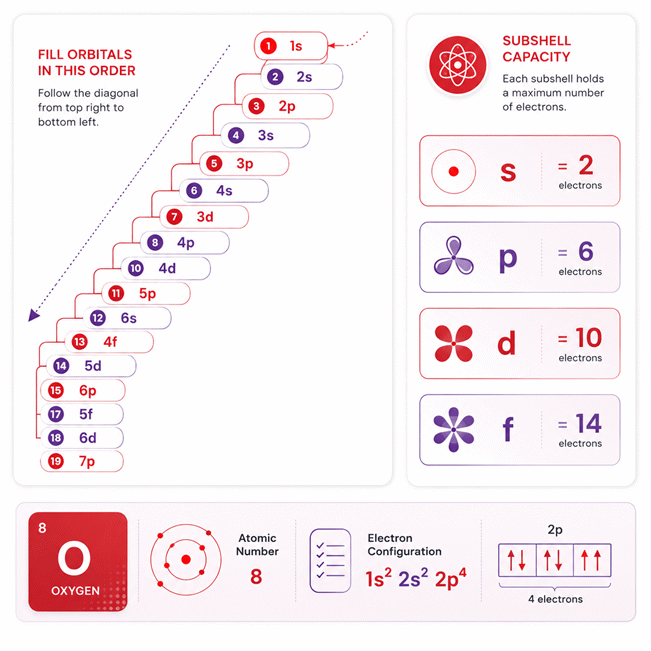
The common filling sequence begins with the lowest available energy state. Electrons then move through higher-energy subshells. This creates the familiar pattern through s, p, d, and f regions.
However, filling order and final written order can look different. This surprises many users. A subshell may fill earlier but appear later in standard notation.
The safest approach is separating two ideas. First determine how electrons fill. Then present the accepted ground-state configuration in a clear order.
Aufbau Principle and the Correct Orbital Filling Sequence
The Aufbau principle gives a useful starting rule. Electrons generally enter lower-energy orbitals before higher-energy orbitals. This builds the atom from lower energy upward.
The rule explains most basic configurations very well. It also gives students a repeatable path through the periodic table.
Yet Aufbau should not be treated as an exception-free law. Real atomic energies can be very close. Small energy differences can favor another arrangement.
That is why a reliable calculator must include accepted ground-state exceptions. It should not generate every element with one mechanical pattern.
Why Filling Order and Written Order Can Look Different
A student may see 4s filled before 3d. Later, the final configuration may display 3d before 4s. Both views can be useful.
Filling order describes how orbital energies guide electron placement. Written configuration order often groups terms by shell or convention.
This difference does not change electron count. It only changes how the same occupied subshells are presented.
Recognizing this distinction prevents a common false error. The notation can look reordered while still describing the same atom.
Hund’s Rule and the Distribution of Electrons Within Orbitals
A subshell can contain several orbitals with equal energy. Electrons do not pair immediately within those orbitals.
Hund’s rule says electrons occupy equal-energy orbitals singly first. They use parallel spin before pairing begins. This lowers the energy of many atomic arrangements.
The rule is easiest to see in orbital box diagrams. A partly filled p or d subshell may contain several unpaired electrons.
This information matters beyond notation. Unpaired electrons can influence atomic magnetic behavior. They also help explain patterns in chemical bonding.
Pauli Exclusion Principle and the Two-Electron Orbital Limit
An orbital cannot accept unlimited electrons. Its maximum population is two electrons.
The Pauli exclusion principle requires those electrons to differ in spin. This gives each electron a distinct quantum state within the atom.
The principle sets the foundation for subshell capacity. More orbitals mean a larger allowed electron population.
It also creates a powerful validation rule. Any configuration that overfills an orbital structure is physically invalid.
Subshell Capacities: How Many Electrons Can s, p, d, and f Hold?
One small occupancy error can corrupt everything after it. Subshell capacity provides a fast way to catch that problem.
The s subshell can contain two electrons. The p subshell can contain six. The d subshell can contain ten. The f subshell can contain fourteen.
These values come from the number of orbitals inside each subshell. Every orbital accepts no more than two electrons.
Capacity does not mean every listed subshell must be full. Many ground-state configurations end with a partly occupied subshell. Those partly filled regions often matter most in chemistry.
When checking a configuration, inspect every superscript. Any occupancy beyond its allowed limit invalidates the configuration immediately.
Full Electron Configuration vs Noble-Gas Shorthand Configuration
Long electron configurations become difficult to scan for heavy elements. Noble-gas shorthand solves that readability problem.
A full configuration lists every occupied subshell. It provides the complete electron arrangement from the first shell onward.
Shorthand replaces filled inner electrons with a noble-gas core. The remaining occupied subshells are written after that core.
Both forms describe the same ground-state atom. One favors completeness. The other favors speed and readability.
The calculator can present both forms together. This makes checking much easier. Users can compare the compact result against the full structure.
How to Choose the Correct Noble-Gas Core
The wrong noble-gas core creates an incorrect shorthand result. The core should come from the preceding noble gas.
That noble gas represents a complete inner-electron structure. Its symbol is placed inside brackets. Remaining electrons are written afterward.
The chosen core must represent fewer electrons than the target atom. A later noble gas cannot be used.
This approach makes long configurations much easier to read. It also highlights electrons outside the stable inner core.
Why the Noble-Gas Core Must Come Before the Target Element
Shorthand notation is a compression method, not a prediction trick. It replaces electrons already contained inside the target atom.
A later noble gas would contain too many electrons. Its core could not exist inside the smaller target atom.
This simple rule prevents many shorthand errors. Move backward through the periodic table to the nearest noble gas.
How to Expand Shorthand Notation Back to a Full Configuration
Shorthand may look incomplete when the core is unfamiliar. Expansion restores every hidden inner electron.
Begin with the noble gas inside brackets. Replace that symbol with its complete configuration. Then keep the remaining subshell terms.
The expanded electron total must match the target atomic number. The resulting structure must also remain a valid ground state.
This makes shorthand useful for reverse solving. A bracketed core already contributes a known number of electrons. Only the remaining occupancies need to be added.
Valence Electron Configuration: Which Electrons Actually Matter?
Valence electrons are often taught as a simple outer-shell count. That works well for many elements. It needs more care for others.
Valence structure is important because outer electrons drive much chemical behavior. They influence bonding, ion formation, and periodic trends.
Main-group elements usually offer the clearest pattern. Transition metals can involve nearby d and s electrons. Lanthanides and actinides add further complexity.
For that reason, a valence configuration can be more useful than one isolated count. It shows which subshells are being treated as chemically relevant.
Valence Electrons in Main-Group Elements
Main-group elements usually give the easiest valence patterns. Their chemically active electrons are commonly found in the outer s and p subshells.
This creates repeated structures within periodic groups. Elements in one group often share similar outer configurations.
Those repeated patterns help explain common charges and bonding behavior. They also make periodic trends easier to recognize.
The configuration therefore connects atomic structure with the periodic table. It is not just a notation exercise.
Why Transition Metals Need Special Care When Counting Valence Electrons
Transition metals create one of the biggest traps in simple valence counting. Their outer s and nearby d electrons can both matter chemically.
A single outer-shell count may therefore hide useful information. The complete relevant valence configuration provides more context.
This is especially important when comparing oxidation states. Transition metals can lose different numbers of electrons in different reactions.
The electron configuration should therefore be read as structure first. A simplified valence count comes second.
Electron Configuration Exceptions: Why the Simple Filling Rule Is Not Always Enough
A perfectly followed classroom filling pattern can still produce the wrong atom. This usually happens when nearby orbital energies are very close.
Some atoms gain extra stability from alternative electron arrangements. Half-filled or filled subshell patterns can contribute to those outcomes.
These cases are not mistakes in chemistry. They show where a simple model reaches its limit.
A reliable electron configuration calculator must therefore use accepted ground-state data. It should not depend only on automatic sequential filling.
Chromium, Copper, and Other Important Ground-State Exceptions
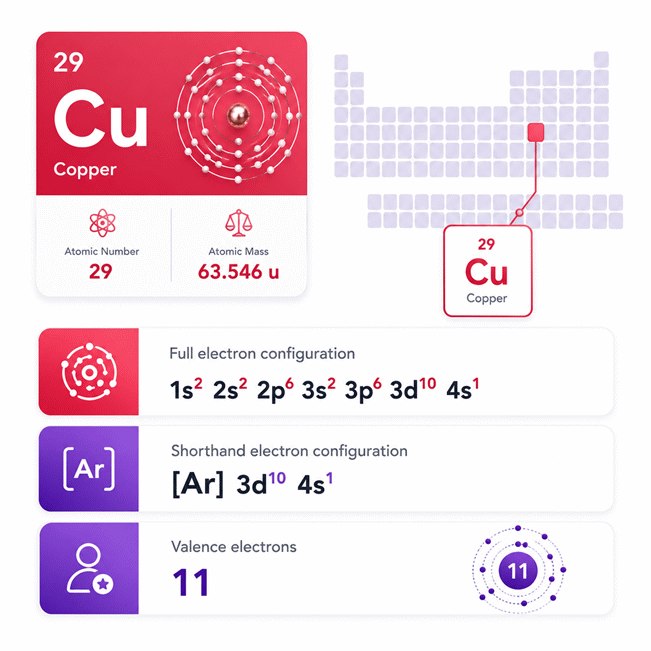
Chromium and copper are famous because their configurations surprise beginners. A basic sequence suggests one arrangement. Their accepted ground states use another.
Chromium favors a configuration with a half-filled d subshell. Copper favors a filled d subshell with one electron in the outer s subshell.
Similar effects appear in several heavier elements. The exact reason involves competing orbital energies and electron interactions.
The practical lesson is simple. Use filling rules to understand the pattern. Use accepted ground states for the final answer.
Measured and Predicted Electron Configurations for Heavy Elements
Confidence becomes more complex near the bottom of the periodic table. Very heavy atoms are difficult to study experimentally.
Relativistic effects also become stronger as nuclear charge increases. These effects can shift orbital energies.
As a result, some heavy-element configurations rely partly on advanced theoretical work. Their treatment may change as better data becomes available.
This does not reduce the value of the calculator. It means heavy-element results deserve more scientific context than simple classroom elements.
Reading and Checking Electron Configuration Results
A result can look convincing while still being misread. The best check starts with atomic identity.
Confirm the element and atomic number first. Then inspect the total electron count. Next check every subshell occupancy.
After that, compare full and shorthand forms. They should represent the same electron population.
Finally, inspect the valence configuration. Ask whether it matches the element’s region of the periodic table.
This layered check catches mistakes faster than rereading one long configuration string.
How to Read a Configuration Without Getting Lost
Long configurations become easier when read in small pieces. Treat each subshell term as one information unit.
The leading number identifies the principal level. The letter identifies the subshell. The superscript gives its electron population.
Move through the terms in order. Keep a running electron total when verification is needed.
Do not judge the result only by its visual length. Heavy atoms naturally contain many occupied subshells.
Use the Last Occupied Terms as a Fast Chemistry Clue
The final occupied terms often reveal the most useful pattern. They can show the element’s block and outer electronic structure.
An ending dominated by p occupancy suggests a p-block element. Partly filled d terms point toward transition-metal behavior.
This is a quick reading method, not a replacement for the complete configuration. It simply helps users orient themselves faster.
Common Electron Configuration Errors and How to Avoid Them
Most wrong answers come from a small set of repeatable mistakes. Recognizing them saves more time than memorizing every element.
One common error is treating atomic mass as electron count. Another is exceeding a subshell’s capacity.
Users also confuse filling order with final written order. Some forget recognized ground-state exceptions. Others choose the wrong noble-gas core.
Reverse solving creates another trap. A correct total electron count does not guarantee a correct ground state.
The fastest defense is a layered check. Verify identity, electron total, subshell limits, configuration pattern, and final notation.
Why the Correct Electron Count Can Still Produce a Wrong Configuration
Imagine arranging the correct number of people in the wrong seats. The headcount is right, but the arrangement is wrong.
Electron configurations behave similarly. Two written arrangements may contain the same electron total. Only one may represent the accepted ground state.
This is why reverse validation checks occupancy and arrangement together. Counting alone is not enough.
The distinction matters most around partly filled d and f subshells. Those regions contain many closely spaced energy states.
Using Electron Configuration in Real Chemistry
Electron configuration becomes valuable when it connects to a real chemical question. It helps explain why elements occupy specific periodic-table regions.
It also supports discussions about bonding and oxidation behavior. Unpaired electrons can provide clues about magnetic behavior.
Outer-electron structure helps explain why some elements react similarly. It also explains why neighboring elements can behave very differently.
Still, isolated-atom configuration is only the starting point. Molecules and solids introduce bonding and environmental effects.
Use the configuration as an atomic map. Then connect that map to the chemistry being studied.
From Periodic Table Position to Chemical Behavior
The periodic table becomes easier to understand after reading electron configurations. Periods connect with principal energy levels. Blocks connect with subshell filling.
Group patterns often reflect similar outer configurations. That is why chemical behavior repeats across the table.
This connection also makes configuration easier to remember. Instead of memorizing isolated strings, follow periodic structure.
The result is a more useful mental model. Atomic number, configuration, periodic position, and chemistry begin to support each other.
Make Electron Configuration Checks Faster With AxiCalculator
Manual configuration work is useful for learning. Repeating the same checks by hand is less useful during review.
AxiCalculator gives one place to test element identity and electron structure. You can begin with an element or atomic number. Supported configurations can also be checked in reverse.
Full notation and shorthand remain visible together. This reduces context switching and makes errors easier to spot.
The best workflow is simple. Predict the configuration yourself first. Then use the calculator to check the result. If they differ, investigate the reason.
That process keeps the learning value while removing repetitive verification work.
Frequently Asked Questions
What information does an electron configuration not tell me about an atom?
Why are empty subshells usually omitted from an electron configuration?
Can two differently ordered electron-configuration strings describe the same atom?
How can I spot a copied electron-configuration typo quickly?
How should electron configurations from different scientific databases be compared programmatically?
What metadata should a technical project store with an electron-configuration result?
When should a project use spectroscopic or advanced electronic-structure data instead of a basic calculator?
Engineering Resources
Our engineers are here to help you get it right.