Pipe Weight Calculator
- Last formula update:
Decimal & Rounding Policy
- Calculations use full numerical precision without rounding intermediate values.
- Decimal inputs are accepted for diameters, wall thickness, length, density, volume, and weight.
- Displayed results are rounded only at the final step, with unnecessary trailing zeros removed.
- Reverse calculations use the original unrounded values to minimize cumulative rounding errors.
- For engineering work, keep consistent units and use additional decimal places when tight tolerances matter.
Valid range
- Outer diameter (Do): Must be greater than 0 and larger than the inner diameter.
- Inner diameter (Di): Must be 0 or greater and smaller than the outer diameter.
- Pipe wall thickness (t): Must be greater than 0 and cannot exceed half the outer diameter.
- Pipe geometry: Any two of Do, Di, and t can be entered; the remaining value follows Di = Do – 2t.
- Length (L): Must be greater than 0 for pipe volume and weight calculations.
- Material density: Must be greater than 0 and use a dimensionally compatible density unit.
- Pipe quantity: Must be a positive whole number when calculating total pipe weight.
- Calculated volume, linear density, weight, and total weight must remain finite and non-negative.

Reviewers:
Elvarine Jexmont
Fenrick Zorquell
Check our editorial policy
August 14, 2026
1.0.0
Initial calculator and formula release.
Our engineers are here to help you get it right.
How Does the Pipe Weight Calculator Calculate Pipe Weight Accurately?
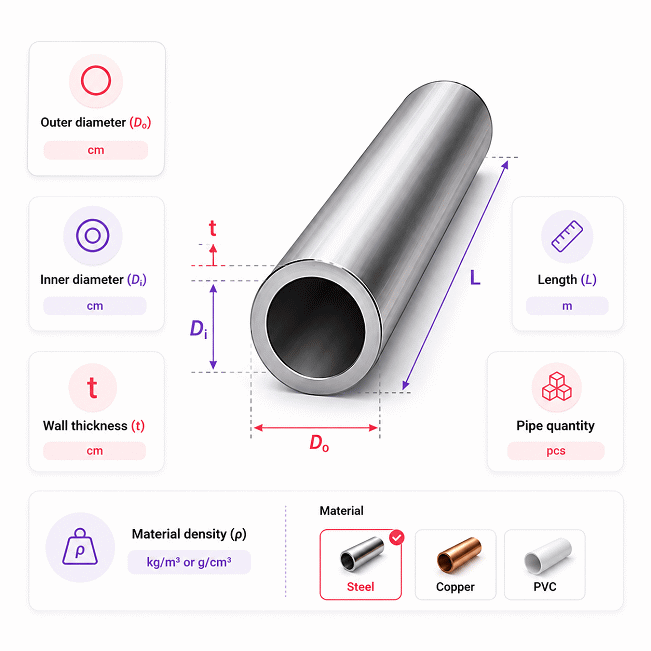
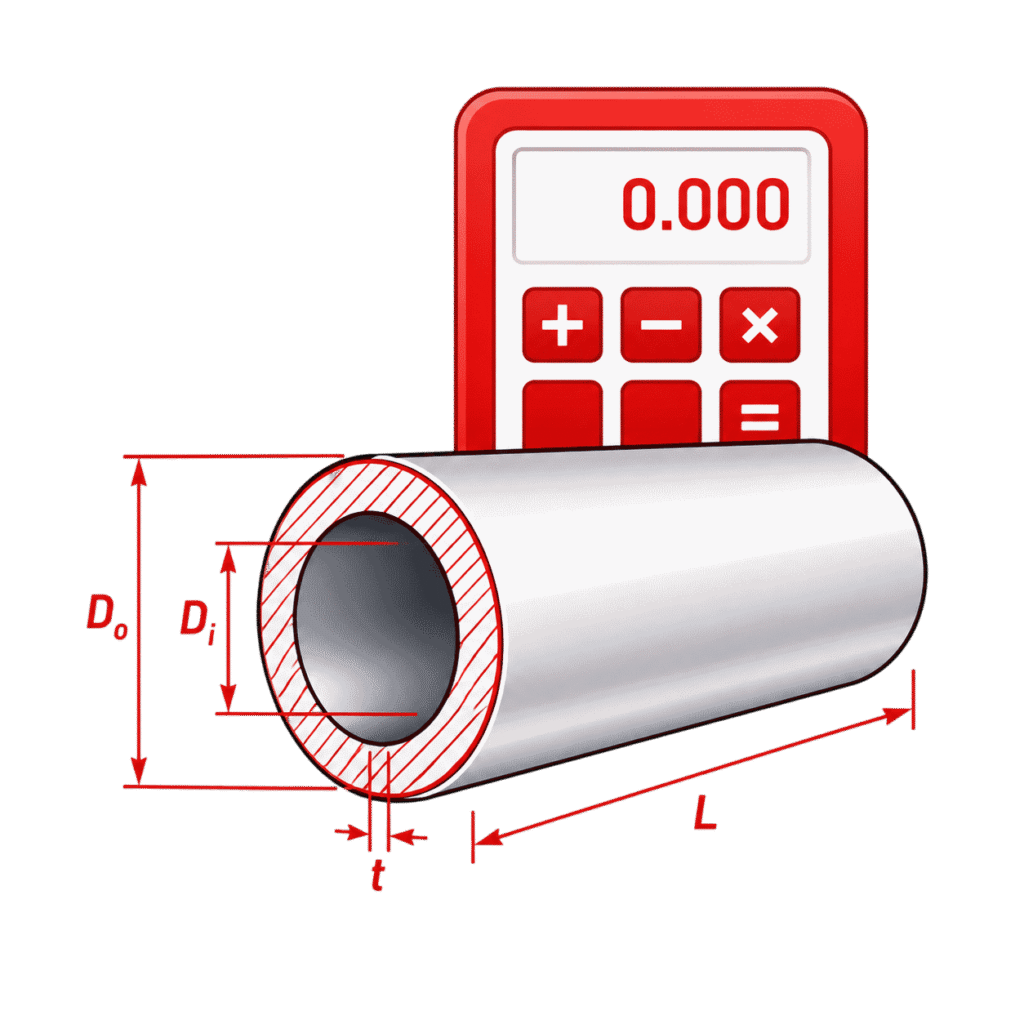
Pipe Weight Calculator gives a fast theoretical estimate of pipe mass from geometry, material density, length, and quantity. It treats the pipe as a hollow cylindrical section, so only the material between the outer and inner diameters contributes to the calculated mass.
- Outer diameter, inner diameter, and wall thickness define the pipe cross-section.
- Any two geometry values can determine the remaining pipe dimension.
- Material density controls how much mass a given pipe volume contains.
- Pipe length changes total mass directly when geometry and density stay constant.
- Linear density shows the pipe mass for each unit of length.
- Pipe quantity converts single-pipe mass into the combined project weight.
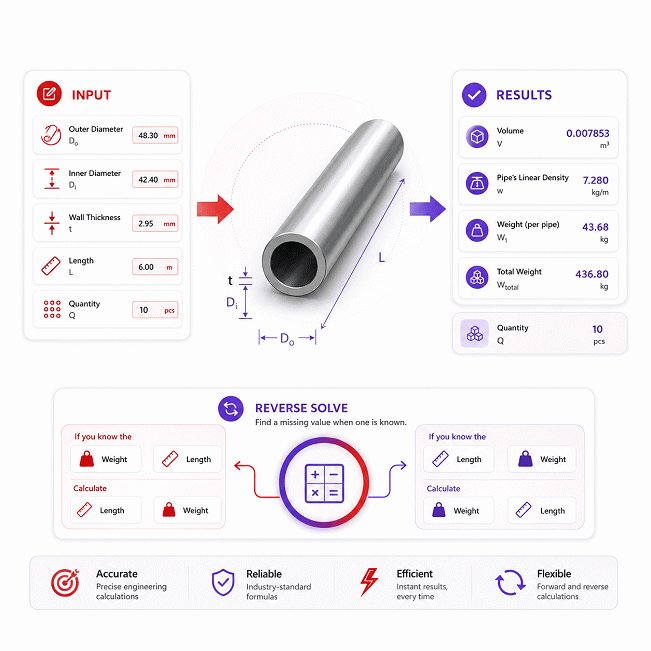
- Reverse solving can determine missing length, geometry, density, weight, or quantity.
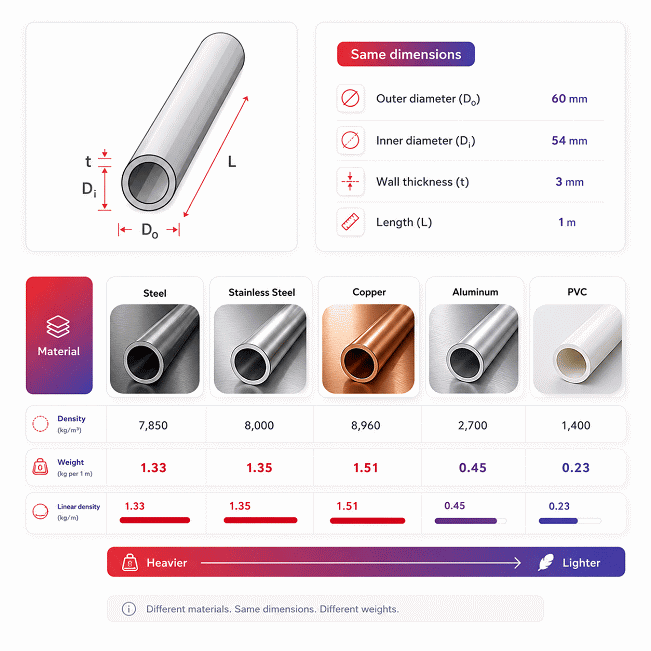
- Different materials can produce very different weights with identical dimensions.
- Theoretical weight can differ from measured weight because real pipes have manufacturing variation.
- Coatings, linings, corrosion, deposits, fittings, and contained fluids can affect actual loads.
The Pipe Weight Calculator is useful for material planning, fabrication checks, inventory estimates, transportation planning, and quick engineering comparisons. For the best result, use reliable pipe dimensions and the density of the actual material grade.
Assumptions used in this calculator
- The pipe is modeled as a straight hollow cylinder with uniform dimensions.
- Outer diameter, inner diameter, and wall thickness are treated as nominal values.
- Material density is assumed uniform throughout the entire pipe wall.
- Selected material densities represent average values and may vary by grade.
- Pipe length is measured along the straight longitudinal axis.
- The inner bore is assumed concentric with the outer pipe surface.
- Wall thickness is assumed constant along the full pipe length.
- Calculated weight excludes coatings, linings, fittings, weld reinforcement, and attached components.
- Pipe quantity assumes all counted pipes have identical dimensions and material.
- Weight calculations use material volume multiplied by the selected material density.
- Linear density assumes constant cross-section and material density along the pipe.
- Compatible units are converted consistently before calculations are performed.
- Results are theoretical estimates and should be verified for critical industrial use.
Results are rounded for display.
Internal calculations use full precision.
Formulas Used in Pipe Weight Calculator :
1. Pipe Geometry Relationship
Any missing pipe diameter or wall thickness can be solved algebraically from this same geometry relationship.
2. Pipe Wall Cross-Sectional Area
3. Pipe Material Volume
4. Pipe Linear Density
5. Single Pipe Weight
The calculator reports pipe weight as mass in compatible units such as kilograms or pounds.
6. Total Weight for Multiple Pipes
Reverse calculations use these same equations without introducing separate or duplicate formulas. Unit conversions are applied before calculation, and rounding is applied only to displayed results.
Variable Definitions
- Do
- = outer pipe diameter.
- Di
- = inner pipe diameter.
- t
- = pipe wall thickness.
- A
- = cross-sectional area of the pipe material.
- L
- = pipe length.
- V
- = volume of the pipe material.
- ρ
- = material density.
- λ
- = pipe mass per unit length.
- m
- = mass of one pipe.
- n
- = number of identical pipes.
- mtotal
- = combined mass of all pipes.
Variables & Definitions
View a complete list of all variables used in this calculator, including definitions and units
Pipe Weight Calculator Variables and Units
| Symbol | Variable | Calculation Role | Base Unit | Definition |
|---|---|---|---|---|
| Do | Outer diameter | Input / Solvable | m | Outside diameter of the pipe. |
| Di | Inner diameter | Input / Solvable | m | Inside diameter of the pipe. |
| t | Pipe wall thickness | Input / Solvable | m | Radial thickness of the pipe wall. |
| A | Wall cross-sectional area | Calculated | m2 | Cross-sectional area occupied by the pipe material. |
| L | Pipe length | Input / Solvable | m | Axial length of one pipe section. |
| V | Pipe material volume | Calculated / Reversible | m3 | Volume of material forming the pipe wall. |
| ρ | Material density | Input / Material value | kg/m3 | Mass per unit volume of the selected pipe material. |
| λ | Linear density | Calculated / Reversible | kg/m | Pipe mass per unit length. |
| m | Single pipe weight | Calculated / Reversible | kg | Calculated mass of one pipe for the specified dimensions and material. |
| n | Pipe quantity | Input / Solvable | Dimensionless | Number of identical pipe sections included in the total. |
| mtotal | Total pipe weight | Calculated / Reversible | kg | Combined mass of all identical pipe sections. |
Unit Conversion Table
Pipe Dimension and Length Unit Conversion Table
| Unit Group | Unit Name | Symbol | Equivalent in m | Used For |
|---|---|---|---|---|
| Popular Units | Millimeter | mm | 0.001 m | Do, Di, t, L |
| Popular Units | Centimeter | cm | 0.01 m | Do, Di, t, L |
| Popular Units | Meter | m | 1 m | Do, Di, t, L |
| Popular Units | Inch | in | 0.0254 m | Do, Di, t, L |
| Popular Units | Foot | ft | 0.3048 m | Do, Di, t, L |
| SI Units | Decimeter | dm | 0.1 m | Do, Di, t, L |
| SI Units | Kilometer | km | 1000 m | L |
| Imperial / US Units | Yard | yd | 0.9144 m | Do, Di, t, L |
| Scientific Units | Micrometer | µm | 0.000001 m | Do, Di, t |
| Oil & Industrial Units | Mil | mil | 0.0000254 m | Do, Di, t |
Material Density Unit Conversion Table
| Unit Group | Unit Name | Symbol | Equivalent in kg/m³ | Used For |
|---|---|---|---|---|
| Popular Units | Gram per cubic centimeter | g/cm³ | 1000 kg/m³ | Material density, ρ |
| Popular Units | Kilogram per cubic meter | kg/m³ | 1 kg/m³ | Material density, ρ |
| Popular Units | Pound per cubic foot | lb/ft³ | 16.01846337396 kg/m³ | Material density, ρ |
| SI Units | Gram per cubic meter | g/m³ | 0.001 kg/m³ | Material density, ρ |
| SI Units | Tonne per cubic meter | t/m³ | 1000 kg/m³ | Material density, ρ |
| Imperial / US Units | Pound per cubic inch | lb/in³ | 27679.9047102 kg/m³ | Material density, ρ |
| Scientific Units | Milligram per cubic centimeter | mg/cm³ | 1 kg/m³ | Material density, ρ |
| Oil & Industrial Units | Pound per US gallon | lb/US gal | 119.826427317 kg/m³ | Material density, ρ |
| Oil & Industrial Units | Kilogram per liter | kg/L | 1000 kg/m³ | Material density, ρ |
Pipe Material Volume Unit Conversion Table
| Unit Group | Unit Name | Symbol | Equivalent in m³ | Used For |
|---|---|---|---|---|
| Popular Units | Cubic centimeter | cm³ | 0.000001 m³ | Pipe material volume, V |
| Popular Units | Cubic meter | m³ | 1 m³ | Pipe material volume, V |
| Popular Units | Liter | L | 0.001 m³ | Pipe material volume, V |
| Popular Units | Cubic inch | in³ | 0.000016387064 m³ | Pipe material volume, V |
| Popular Units | Cubic foot | ft³ | 0.028316846592 m³ | Pipe material volume, V |
| SI Units | Cubic millimeter | mm³ | 0.000000001 m³ | Pipe material volume, V |
| SI Units | Milliliter | mL | 0.000001 m³ | Pipe material volume, V |
| Imperial / US Units | US gallon | US gal | 0.003785411784 m³ | Pipe material volume, V |
| Imperial / US Units | Imperial gallon | Imp gal | 0.00454609 m³ | Pipe material volume, V |
| Imperial / US Units | Cubic yard | yd³ | 0.764554857984 m³ | Pipe material volume, V |
| Scientific Units | Microliter | µL | 0.000000001 m³ | Pipe material volume, V |
| Oil & Industrial Units | US oil barrel | bbl | 0.158987294928 m³ | Pipe material volume, V |
Pipe Weight Unit Conversion Table
| Unit Group | Unit Name | Symbol | Equivalent in kg | Used For |
|---|---|---|---|---|
| Popular Units | Kilogram | kg | 1 kg | m, mtotal |
| Popular Units | Gram | g | 0.001 kg | m, mtotal |
| Popular Units | Pound | lb | 0.45359237 kg | m, mtotal |
| Popular Units | Ounce | oz | 0.028349523125 kg | m, mtotal |
| Popular Units | Metric tonne | t | 1000 kg | m, mtotal |
| SI Units | Milligram | mg | 0.000001 kg | m, mtotal |
| Imperial / US Units | US short ton | short ton | 907.18474 kg | m, mtotal |
| Imperial / US Units | Imperial long ton | long ton | 1016.0469088 kg | m, mtotal |
| Scientific Units | Microgram | µg | 0.000000001 kg | m, mtotal |
| Oil & Industrial Units | Kip | kip | 453.59237 kg | m, mtotal |
Example Calculation
The pipe wall is treated as a uniform hollow cylindrical section.
All dimensions are converted to compatible base units before calculation.
Full numerical precision is retained until the final displayed results.
Actual pipe weight may vary with material grade and manufacturing tolerances.
Reverse solving uses the same physical relationships as the forward calculation.
The entered weight remains fixed while the missing pipe length is calculated.
All dimensions are converted to compatible base units before solving.
Full precision is retained internally and rounding is applied only for display.
Results are rounded for display.
Internal calculations use full precision.
Calculations Disclaimer
How Does a Pipe Weight Calculator Work?
A wrong pipe weight can affect purchasing, transport, lifting, and fabrication planning. The Pipe Weight Calculator removes that uncertainty quickly. It converts pipe geometry and material density into a usable mass estimate. AxiCalculator also supports reverse solving when one value is unknown.
The calculation starts with the physical material inside the pipe wall. A hollow pipe is treated as two concentric circular sections. The smaller circle represents the empty bore. The larger circle represents the outside boundary. Their area difference gives the actual material cross-section.
From Pipe Geometry to Final Weight
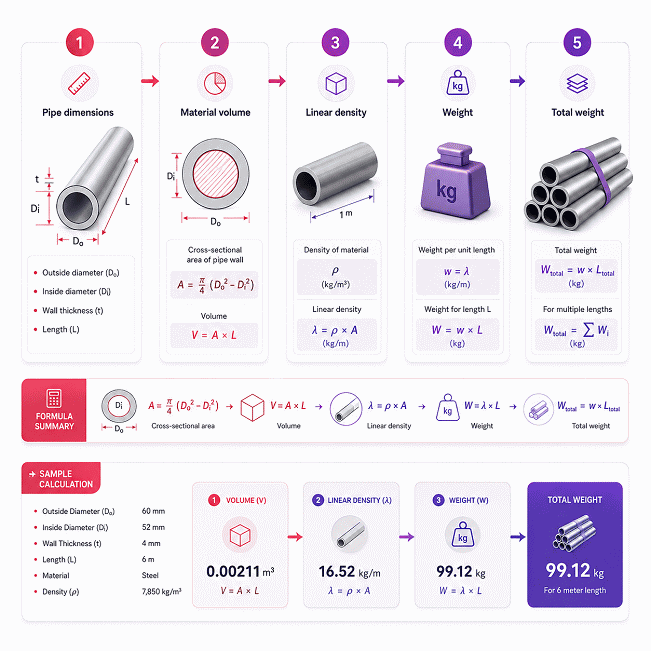
The calculation follows a simple physical path. First, the material cross-sectional area is found. That area is then extended along the pipe length. This gives the pipe material volume. Material density then converts that volume into mass.
Pipe dimensions → Material area → Material volume → Pipe mass → Total quantity mass
The core cross-sectional relationship is:
A = (π / 4) × (Do2 − Di2)
The material volume then becomes:
V = A × L
The pipe mass becomes:
m = ρ × V
This method works for many common pipe materials. These include steel, stainless steel, aluminum, copper, brass, and PVC. Custom density also supports less common materials.
Why the Hollow Section Matters
A pipe is not a solid round bar. Using the complete outer cylinder would overstate material volume. That mistake becomes serious on large diameters. It becomes even larger across long pipe runs.
The empty internal bore must therefore be removed from the calculation. This difference is the key to reliable theoretical pipe weight.
Quick Scan: Bigger diameter adds material. Thicker walls add material faster. Longer pipes increase mass directly.
The result can support estimating, inventory planning, procurement, and transport preparation. It can also help compare different materials before ordering. That makes the calculator useful beyond a simple mathematics exercise.
Which Pipe Dimensions Do You Need for an Accurate Calculation?
Many incorrect pipe estimates begin before any calculation happens. The wrong dimension enters the form. The mathematics then works perfectly on incorrect data.
The three critical cross-section dimensions are outer diameter, inner diameter, and wall thickness. These values are physically connected. Knowing any two can determine the third.
Outer Diameter vs Inner Diameter: Which One Matters Most?
Outer diameter describes the pipe’s outside width. Inner diameter describes the clear opening inside the pipe. Their difference contains the wall material.
Neither value should be considered alone. Pipe mass depends on the material between both circular boundaries.
The geometry relationship is:
Do = Di + 2t
This relationship also allows reverse solving. A missing inner diameter can be recovered from known geometry. The same applies to outer diameter or wall thickness.
How Does Pipe Wall Thickness Change Weight?
Wall thickness can change weight more than many buyers expect. A small thickness increase adds material around the full circumference. The effect continues across the entire pipe length.
This matters when comparing similar-looking pipes. Two pipes may share the same outside diameter. Their weights can still differ greatly.
Watch this: Similar outside dimensions do not guarantee similar pipe weight.
Wall thickness also affects internal space. A thicker wall reduces the inner diameter when outer diameter stays fixed. This increases the material cross-sectional area.
Why Does Pipe Length Directly Affect Total Weight?
Length has a direct relationship with material volume. Double the length, and material volume doubles. Pipe mass therefore doubles when all other values remain unchanged.
This relationship makes linear density useful. It describes mass for each unit of pipe length.
λ = ρ × A
Once linear density is known, longer pipe sections become easy to estimate.
m = λ × L
This is valuable during purchasing. A buyer can compare six-meter and twelve-meter lengths quickly. Fabricators can also estimate rack loading before material arrives.
How Does Material Density Affect Pipe Weight?
Two pipes can have identical dimensions but very different masses. Material density explains the difference. Geometry tells you how much material exists. Density tells you how much that material weighs.
A dense alloy produces more mass from the same material volume. A lower-density material produces less mass. This difference becomes important across large pipe inventories.
Steel, Stainless Steel, Copper, Aluminum, Brass, and PVC Density Differences
Material selection changes the result without changing pipe geometry. Aluminum is much lighter than common steels. Copper and brass are usually heavier for equal volume.
Stainless steel can also differ from carbon steel. The exact grade can influence density. That difference may appear small on one short pipe. It can become significant across hundreds of pieces.
PVC behaves very differently from metallic pipe. Its much lower density produces substantially lower material mass. This can change transport and handling requirements.
Same geometry → Different material → Different density → Different pipe weight
When Should You Use a Custom Material Density?
A material name is sometimes too general. Industrial alloys can vary by grade and composition. Special plastics and composite materials can also vary.
Custom density is useful when verified material data is available. It lets the calculation reflect the specified material more closely.
This is especially helpful during engineering procurement. The selected alloy may differ from a generic material preset.
Why Material Identification Matters Before Ordering
Weight can influence several purchasing decisions. Freight costs may depend on shipment mass. Storage racks may have load limits. Handling equipment may also have capacity limits.
Material identity therefore affects more than the calculator result. It can influence the entire material-handling plan.
Decision Point: Confirm the material grade before using mass for critical planning.
AxiCalculator keeps geometry and material logic separate. This makes comparisons easier. You can study how material choice changes mass without changing dimensions.
How Can You Reverse Solve Pipe Weight Calculations?
Sometimes the missing value is not the pipe weight. You may know the weight already. The challenge is finding a missing length, dimension, density, or quantity.
This is where reverse solving becomes useful. AxiCalculator can work backward through the same physical relationships. It does not need a separate calculation model.
How to Find Pipe Length From Known Weight
Suppose pipe mass is known from a document or scale. Cross-sectional geometry is also known. Material density is available. The missing pipe length can then be recovered.
First, calculate the material cross-sectional area. Then calculate linear density.
λ = ρ × A
The unknown length follows from:
L = m / λ
This can help identify cut lengths from stored material. It can also help check incomplete inventory records.
How to Find Wall Thickness From Outer and Inner Diameter
A common field problem involves known outer and inner diameters. Wall thickness may be missing from paperwork.
The geometry relationship can recover it directly:
t = (Do − Di) / 2
This method reflects ideal concentric geometry. Actual manufactured pipe may show local dimensional variation.
How to Find Pipe Quantity From Total Weight
Warehouse teams sometimes know pallet mass and individual pipe mass. The missing quantity can then be estimated.
The relationship is simple:
n = mtotal / m
A practical pipe count must represent whole pieces. A fractional result signals inconsistent input data. It may also indicate packaging or mixed pipe sizes.
Reverse Solving as a Practical Verification Tool
Reverse solving is useful for more than finding missing values. It can reveal data conflicts.
If calculated length looks unreasonable, one input may be wrong. The density may not match the material. The recorded diameter may also be incorrect.
This creates a useful verification loop. Forward calculations estimate mass. Reverse calculations test whether known values agree.
Fast Check: A surprising reverse result often exposes a hidden input mistake.
Pipe Weight per Meter vs Pipe Weight per Foot: What Changes?
Engineers often receive drawings from different measurement systems. One supplier may quote kilograms per meter. Another may use pounds per foot.
The physical pipe does not change. Only the displayed unit changes.
Why Linear Density Simplifies Pipe Comparisons
Linear density separates pipe cross-section from total length. This makes different stock lengths easier to compare.
A pipe with fixed geometry has constant theoretical mass per length. Multiply that value by length for total mass.
m = λ × L
This approach is useful during procurement. Buyers can compare different available stock lengths. They can also estimate total order mass quickly.
Metric and Imperial Pipe Data Can Still Describe One Physical Pipe
Metric and imperial values may look very different. That can create unnecessary doubt during specification review.
A diameter shown in millimeters can represent the same size in inches. A linear mass shown in kilograms per meter can match pounds per foot.
The key is physical equivalence. Unit labels must never be confused with physical size changes.
This matters when importing pipe specifications. International suppliers may provide mixed drawing standards. Fabrication teams may also work from converted documents.
Why Procurement Teams Should Compare Mass, Not Just Length
Longer stock does not always mean a more expensive shipment. Material, diameter, and thickness can dominate total mass.
A shorter heavy-wall steel pipe can outweigh a longer thin-wall pipe. Material density can widen that difference further.
For buying decisions, compare total required mass and usable length together. This helps reveal waste from unnecessary offcuts.
It also gives purchasing teams better freight estimates. Warehouse teams gain better unloading expectations. Project planners gain clearer material movement data.
Length tells you how much pipe arrives. Mass tells you how difficult handling becomes.
Theoretical Pipe Weight vs Actual Pipe Weight: Why Do Results Differ?
A calculated value can disagree with a warehouse scale. That does not automatically mean the calculator failed.
Theoretical pipe weight describes an ideal geometric model. Manufactured pipe is a physical product. Real production introduces variation.
Manufacturing Tolerances Can Shift Actual Mass
Nominal dimensions are target dimensions. Real products can vary within manufacturing requirements.
Small wall changes affect the entire pipe circumference. They also extend through the full length. A small dimensional difference can therefore change measured mass.
Diameter variation can produce another difference. Combined variations may become visible across large pipe quantities.
Coatings and Linings Add Material
Galvanizing adds zinc to the pipe surface. Paint adds another material layer. Internal lining can add even more mass.
These layers are not part of bare-pipe geometry. Installed or shipped mass may therefore exceed the calculated bare material mass.
Fittings create another difference. Flanges, couplings, valves, and supports should not be treated as pipe wall material.
Corrosion Can Reduce Existing Pipe Mass
Old pipe can lose material through corrosion. The current wall may no longer match original dimensions.
This matters during maintenance and replacement planning. Original nominal weight may not represent the remaining installed mass.
Deposits can create the opposite effect. Scale, sediment, or process residue may add weight inside service piping.
Nominal dimensions → Manufacturing variation → Coatings → Service condition → Actual measured mass
Dry Pipe Weight Is Not Always Operating Load
A pipe can carry water, oil, chemicals, gas, or process mixtures. Contained material adds another load.
Insulation can add more mass. Valves and inline equipment can add concentrated loads. Support design may therefore need more than bare pipe weight.
This distinction is critical during industrial planning. Pipe material mass answers one question. Installed operating load answers a larger question.
What Are the Most Common Pipe Weight Calculation Mistakes?
Most poor results come from simple input problems. They rarely require advanced mathematics to fix.
Using Nominal Pipe Size as an Actual Diameter
Nominal size is a naming system. It should not always be treated as measured diameter.
This error can distort cross-sectional area. The final mass may then look believable but remain wrong.
Confusing Diameter With Radius
This mistake changes circular calculations dramatically. Radius is half the diameter. The square term magnifies the error.
Always check what the supplied drawing actually states.
Ignoring Wall Thickness
Outer diameter alone cannot describe a hollow pipe’s material amount. The internal bore must also be known indirectly or directly.
A solid-cylinder assumption can greatly overstate pipe mass.
Using the Wrong Material
A correct shape with the wrong density still gives a wrong answer.
This mistake often happens with stainless grades or specialty alloys. Similar-looking metals may have different density values.
Mixing Different Pipes Into One Quantity
Quantity multiplication assumes identical pipe pieces. Different diameters require separate calculations. Different materials also require separate calculations.
Mixed bundles should be divided into matching groups first. Their group totals can then be combined.
Forgetting Coatings, Fittings, or Contents
Bare pipe mass should not represent complete installed system mass. Additional components create additional load.
Before trusting a surprising result, check dimensions, material, length, and pipe condition.
This short review solves many calculation disputes. It also prevents unnecessary recalculation.
How Accurate Is a Pipe Weight Calculator for Engineering and Industrial Use?
Accuracy depends on the quality of the entered physical data. Good inputs can produce a strong theoretical estimate.
The calculation itself follows basic geometry and material mass relationships. The largest uncertainty often comes from the real pipe.
Where Pipe Weight Estimates Provide the Most Value
Procurement teams can estimate order mass before requesting freight rates. Fabricators can estimate material handling requirements. Warehouses can plan storage more clearly.
Estimators can compare alternative materials during early project planning. Engineers can perform quick independent checks on supplier data.
Site teams can also assess approximate lifting loads before detailed planning begins. Reverse solving can help investigate incomplete material records.
Use the Result as a Decision Tool
A useful calculator should do more than display one number. It should help users understand what changed that number.
Increase wall thickness and mass rises. Change material and density shifts the result. Increase length and total mass grows directly.
This feedback improves decisions. Users can test alternatives before committing to a material order.
Technical Analysis and Purchasing Decisions Should Stay Separate
The technical calculation answers how much pipe material mass exists. Purchasing adds different questions.
Buyers must consider required grade, dimensions, quantity, documentation, delivery, and supplier terms. Price alone cannot verify technical suitability.
Likewise, calculated mass cannot confirm product quality. It cannot confirm material certification or manufacturing history.
The best workflow uses calculation for quantity and logistics planning. Product verification remains a separate procurement task.
Why AxiCalculator Fits Fast Engineering Checks
AxiCalculator brings forward and reverse calculations into one workflow. Users can explore dimensions without rebuilding equations manually.
The calculator also keeps material choice connected to pipe geometry. This helps users see why similar pipes can have different weights.
The goal is simple. Enter reliable physical information. Get a useful result quickly. Then use that result for the next decision.
For estimating, fabrication planning, inventory checks, or procurement preparation, speed matters. Clarity matters more.
AxiCalculator combines both. Use the Pipe Weight Calculator when dimensions need a fast mass estimate. Use reverse solving when the missing value is elsewhere.
The most valuable result is not always the final kilogram value. Sometimes it is the mistake you catch before ordering material.
Frequently Asked Questions
Can I use the Pipe Weight Calculator to compare materials before ordering?
Does cutting one pipe into shorter sections change its weight per meter?
What should I do if a real pipe is slightly oval instead of perfectly round?
Can I use the calculator to estimate the weight of a mixed stockyard inventory?
How should an engineer estimate weight when pipe wall thickness is eccentric or uneven?
How can measured pipe mass be used as a quality-control check on site?
When should pipe mass per meter be converted into a distributed structural load?
Engineering Resources
Our engineers are here to help you get it right.