
How Much Sand Do I Need for My Project?
A small measuring error can turn into a costly material shortage. The Sand Calculator helps turn site measurements into a clear quantity estimate. A Sand Calculator is most useful before ordering, transport planning, or supplier discussions. It connects the space you must fill with the material you must buy. This makes early planning faster and easier. It also reduces guesswork before work begins.
The first task is identifying what you actually know. Some projects have clear rectangular dimensions. Others only have a measured surface area. A trench may have known depth and volume. A delivered stockpile may only have a known weight. The calculator can work with these different starting points.
What Measurements Do You Need Before Estimating Sand Quantity?
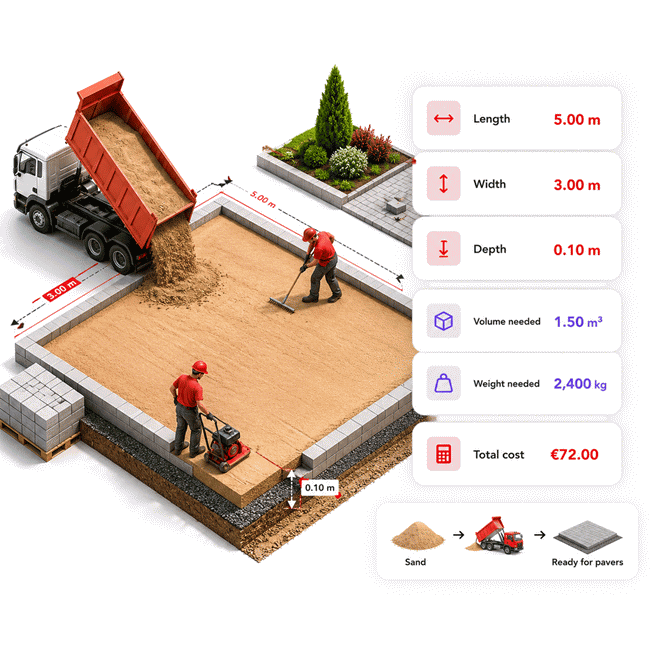
Start with measurements taken from the real work area. Use length and width for simple rectangular spaces. Use a measured area when the shape is already mapped. Then determine the intended sand depth. That depth should represent the finished design requirement.
Do not measure from a rough visual estimate. Small errors become larger across wide surfaces. A depth mistake is especially important. Doubling the layer depth roughly doubles the required material volume.
For outdoor work, measure several points when the ground is uneven. The smallest and largest depths can reveal hidden variation. If the surface changes sharply, divide the project into smaller zones. Estimate each zone separately. This usually gives a more useful planning quantity.
Can You Estimate Sand Without Knowing Length and Width?
Yes. Length and width are not always necessary. A known project area can become the starting value. This is useful for mapped landscaping areas, prepared slabs, and measured excavation zones.
A known volume can also become the starting point. This often happens with excavation records or design documents. A known sand weight can also be useful. The calculator can work backward when enough related information exists.
This flexibility matters on real projects. Field data rarely arrives in one perfect format. A useful estimating tool should adapt to the information already available.
How Does the Sand Calculator Turn Site Data Into a Material Estimate?
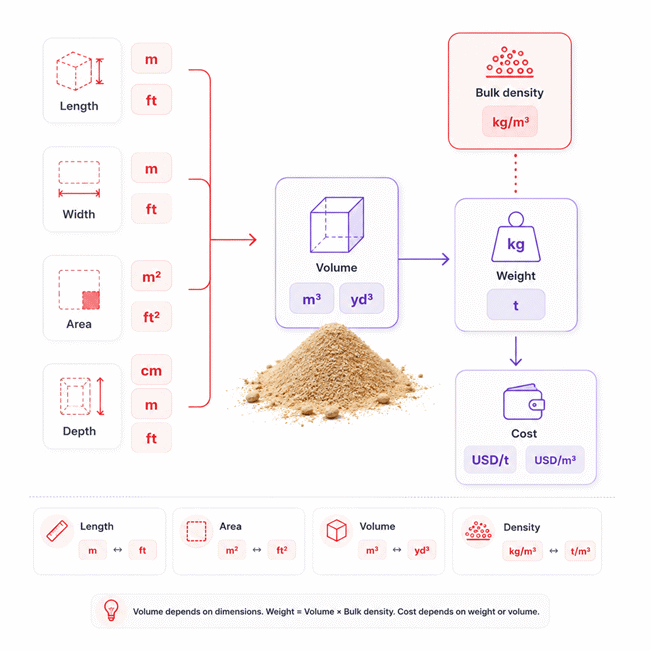
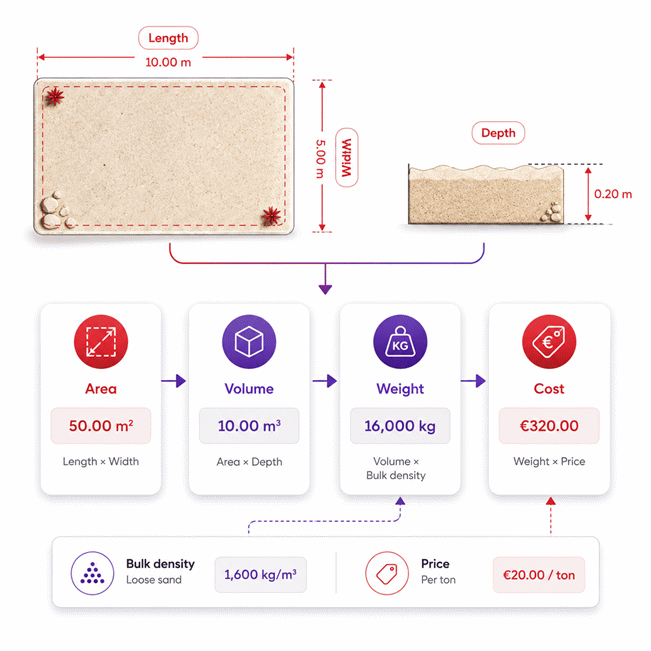
The real problem is not entering numbers. The problem is connecting several physical quantities correctly. Project dimensions describe space. Sand density connects that space with material weight. Pricing then connects the required material with purchasing cost.
The calculation follows this physical chain without forcing every value to become a separate task. This keeps the workflow simple for homeowners. It also remains useful for contractors and technical users.
Why Are Area and Depth Both Important?
Area describes how much surface must be covered. Depth describes how thick the sand layer must become. Both values affect the final amount of material.
A large area with a shallow layer may need less sand. A smaller area with a deep fill may require much more. Looking at area alone can therefore mislead the buyer.
This becomes important for bedding layers, leveling work, drainage zones, and excavation filling. Each application can use a different target depth. The design requirement should always control that choice.
Why Does Sand Weight Differ From Sand Volume?
Volume describes occupied space. Weight describes the amount of material inside that space. They are related through bulk density.
Two equal volumes can have different weights. Their moisture, grading, packing, and material type may differ. This is why a cubic yard cannot always represent one fixed weight.
This distinction matters during transport planning. Trucks often have weight limits. Storage areas may instead be planned by volume. The correct quantity depends on which decision you must make.
How Can Cost Inputs Improve Purchasing Decisions?
A low unit price does not always mean a lower total cost. Suppliers may quote by tonne, ton, cubic yard, or cubic meter. The buying basis therefore matters.
Entering the supplier price beside the estimated quantity gives better context. You can compare expected material cost before requesting final delivery.
Delivery fees, taxes, labor, and placement charges remain separate commercial items. Ask suppliers how their quotation is structured. This prevents a low headline price from hiding a higher delivered cost.
Can a Sand Calculator Work Backwards?
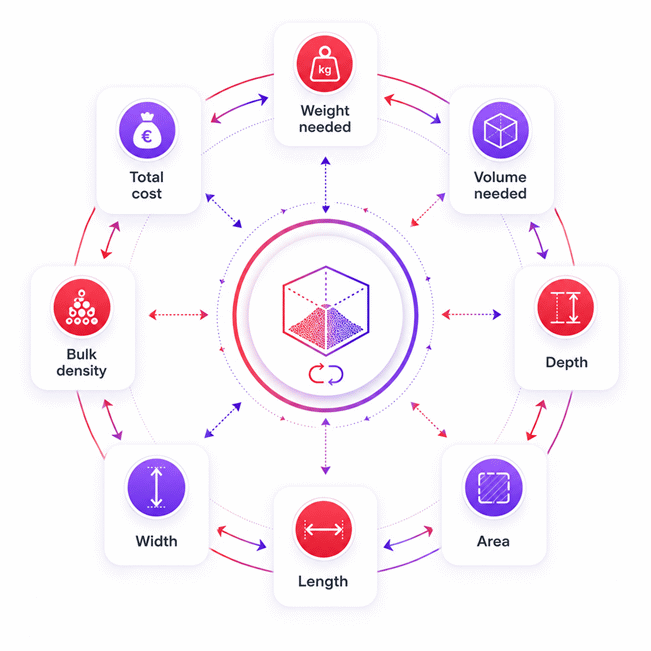
Many estimating tools stop when they produce one final answer. Real projects often need the opposite process. You may know the delivered weight but not the volume. You may know the volume but not the required depth. Reverse solving helps answer those questions.
This is especially useful during design checks and field verification. It lets an editable known value become the new starting point. Related unknown values can then be solved from the remaining project information.
Can You Start From a Known Sand Weight?
Yes. A known weight can be useful after delivery or quotation. Combine that weight with a suitable bulk density. The calculator can then determine the corresponding material volume.
This helps when a supplier quotes only by weight. It can also help compare a weighbridge ticket with the planned excavation space.
When Is Weight-Based Reverse Solving Useful?
Imagine that a supplier confirms the available truck payload. Your design instead specifies a filled space. Reverse solving shows how much project volume that payload can represent.
The same approach helps during reconciliation. A site team can compare delivered mass with estimated occupied volume. A major difference may reveal moisture changes, density differences, or measurement issues.
Can You Start From Known Volume or Area?
Yes. A measured volume can help determine another missing project value. A known area can also support a depth decision.
This is useful when plans provide one quantity but field crews need another. It avoids creating fake measurements merely to satisfy a rigid calculator.
Which Known Value Should You Trust Most?
Use the value supported by the best measurement. A surveyed area may be stronger than estimated side lengths. A verified supplier weight may be stronger than a visual stockpile estimate.
Do not keep conflicting values simply because they are available. Identify which value reflects the real project condition. Then use that value as the reliable starting point.
Why Does Bulk Density Change the Final Sand Weight?
A common planning problem appears when two suppliers give different weight estimates. The dimensions may be identical. The difference often comes from bulk density.
Bulk density describes how much sand mass occupies a given bulk volume. That bulk volume includes spaces between particles. It therefore reflects the material as handled, stored, and delivered.
Why Can Dry, Damp, Wet, Loose, and Compacted Sand Behave Differently?
Sand is not always delivered in one fixed condition. Water changes its mass. Particle arrangement changes the space between grains. Handling can change packing condition.
Loose sand may occupy more space for the same mass. Compacted material may occupy less. Wet material can also weigh more because water adds mass.
This is why one generic density should not replace project knowledge. A planning value is useful during early estimating. A verified material value is better before final ordering.
When Should Supplier Density Replace a General Planning Value?
Use supplier data when the purchasing decision becomes important. This is especially valuable for large quantities. Small density differences can create meaningful weight differences across large volumes.
Ask what condition the stated density represents. Confirm whether it describes loose, compacted, dry, or typical delivered material. The number becomes more useful when its material condition is clear.
Industrial users should also record the material description. Sand type, grading, moisture condition, and intended application can all matter.
Why Is Bulk Density More Useful Than Particle Density Here?
Particle density describes the material particles themselves. It does not represent the full bulk space between grains.
Bulk purchasing concerns occupied material volume. Bulk density therefore better connects that volume with delivered mass. Mixing these two density concepts can create a serious estimate error.
How Much Sand Should You Actually Order?
The calculator may produce a clean mathematical quantity. The jobsite is rarely that clean. Excavation edges can change. Ground levels can vary. Material can settle during placement.
The ordering decision should therefore remain separate from the technical estimate. First determine the required material quantity. Then review project conditions before choosing the purchase quantity.
Should You Add Waste, Settlement, or Compaction Allowance?
Not every project needs the same allowance. A controlled indoor fill differs from an irregular landscape excavation. A compacted base differs from loose decorative placement.
Do not hide every uncertainty inside one large percentage. Identify the reason for each allowance. This makes the estimate easier to review later.
Check excavation tolerance, surface variation, compaction needs, expected settlement, and handling loss. Add only the allowance justified by the project.
Should You Buy Sand by Weight or by Volume?
Buy using the basis that matches reliable supplier data. Some suppliers sell bulk sand by weight. Others quote by cubic volume.
Weight-based purchasing can work well when truck scales are available. Volume-based purchasing can be easier for small landscaping deliveries. Neither method is automatically better.
The key question is traceability. You should know how the supplier measured the quantity. You should also know which sand condition the quotation represents.
How Should You Compare Sand Supplier Quotes?
A cheaper number can become expensive after delivery conditions are included. Compare the same material specification and the same quantity basis.
Check the quoted sand type first. Then check whether pricing uses weight or volume. Review delivery charges, minimum order quantities, unloading limits, and access conditions.
Ask whether the quoted quantity represents loose material. Also confirm whether moisture conditions can affect delivered weight.
What Should You Confirm Before Placing the Order?
Confirm the material description, quantity basis, and expected delivery condition. Check truck access before dispatch. Verify unloading space and site restrictions.
For larger projects, keep the estimate and supplier quotation together. AxiCalculator can help create a clearer calculation record. Exported results can also support internal review and purchasing discussions.
What Are the Most Common Sand Estimating Mistakes?
A sand estimate can look convincing while still being wrong. Most serious mistakes start before the final quantity appears. They usually come from measurements, material assumptions, or purchasing interpretation.
Finding these issues early is cheaper than correcting them after delivery.
Why Is Using One Generic Sand Density Risky?
A general density value is useful for planning. It should not automatically represent every delivered product.
Different sands can have different grading and packing behavior. Moisture conditions can also change actual delivered mass. Large projects magnify these differences.
Use a general value for early estimates. Replace it when better project data becomes available.
Why Is Confusing Bulk Density and Particle Density a Serious Error?
The two terms sound similar but answer different questions. Particle density concerns solid material particles. Bulk density concerns the occupied bulk material volume.
A purchasing estimate needs the relationship between occupied volume and mass. Using the wrong density concept can distort the final weight.
What Happens When Site Depth Is Not Uniform?
A single depth can hide high and low areas. This often happens in excavation and landscape work.
Measure several locations when practical. Separate noticeably different zones. Estimate each zone using its representative depth.
This approach takes slightly longer. It can prevent a much larger shortage later.
How Should Irregular Areas Be Handled?
Do not force every project into one rectangle. Break irregular spaces into simpler measured zones. Estimate those zones separately.
If a survey or design already provides reliable total area, use that value. This is often better than inventing approximate side dimensions.
Why Can Delivered Sand Differ From the Initial Estimate?
A calculation represents the information entered at one moment. Delivered material reflects real conditions.
Moisture may change. Material may settle. The actual excavation may differ from drawings. Supplier density may also differ from the planning value.
A difference does not automatically mean the calculation failed. Compare the assumptions with the delivered condition first.
How Can You Verify a Sand Estimate Before Ordering?
The most expensive mistake often happens just before purchase. The quantity looks reasonable, so nobody checks the inputs again.
A short verification process can catch most avoidable errors. It should review the site, material, and supplier separately.
What Should Be Checked on the Project Site?
Confirm the actual dimensions. Check whether excavation boundaries match the plan. Review the required finished depth.
Look for slopes, steps, service trenches, and hidden low areas. These features can change the real filled volume.
For larger work, have another team member review critical measurements. Independent checking is simple and valuable.
What Should Be Checked With the Sand Supplier?
Confirm the exact material being quoted. Ask how the supplier sells it. Determine whether the quotation uses mass or volume.
Ask for representative bulk density when quantity accuracy matters. Confirm whether the value reflects typical delivered material.
Check minimum loads, truck capacity, delivery fees, and unloading limits. These commercial details can affect the final purchasing decision.
How Can AxiCalculator Support the Final Review?
Use the calculator as a decision tool, not just a number generator. Enter the best available measurements first. Then review the resulting volume, weight, and estimated cost together.
If one result seems unreasonable, work backward from the value you trust. This can reveal a measurement or material assumption that needs review.
The editable outputs are especially useful during supplier discussions. A quoted weight can become a new starting point. A known volume can help investigate an unknown depth or area.
PDF and spreadsheet exports can preserve the calculation for project records. Sharing the calculation link can also improve team review. Everyone can work from the same input set.
What Is the Best Final Check Before Buying Sand?
Ask one simple question: does every important number describe the real project?
The site dimensions should match current conditions. The required depth should match the design. The density should match the chosen material as closely as possible. The supplier quotation should use a clearly understood quantity basis.
When those items agree, the estimate becomes far more useful. You can move from rough guessing to an explainable purchasing decision.
Use AxiCalculator before requesting the final order. Review the calculated volume and weight with your supplier. Then compare the supplier quote against the same project assumptions.
This process takes only a few minutes. It can prevent shortages, excess material, transport surprises, and avoidable project delays.