Roulette Payout Calculator
- Last formula update:

Decimal & Rounding Policy
- All calculations use full internal precision, with no rounding during intermediate steps.
- Decimal winning probability is displayed to 4 decimal places.
- Winning probability in percent is displayed to 2 decimal places.
- Monetary results are normally displayed to 2 decimal places for readability.
- Reverse calculations always use unrounded values before final display rounding.
- Trailing display precision must never change the underlying mathematical result.
Valid range
- Roulette type: European roulette with 37 pockets or American roulette with 38 pockets.
- Covered spaces: S must be one of 1, 2, 3, 4, 6, 12, or 18.
- Bet amount: A must be finite, greater than 0, and within the calculator’s supported numeric range.
- European winning probability: p ranges from 1/37 to 18/37, approximately 0.0270 to 0.4865.
- American winning probability: p ranges from 1/38 to 18/38, approximately 0.0263 to 0.4737.
- European winning percentage: approximately 2.70% to 48.65% for supported bets.
- American winning percentage: approximately 2.63% to 47.37% for supported bets.
- Net payout ratio: R must be one of 35, 17, 11, 8, 5, 2, or 1.
- Payout: W must be positive and finite when entered as a reverse-solving value.
- Expected return: E must be negative for the standard roulette model used here.
- User-entered probability must correspond to a supported covered-space count for the selected wheel.
- Currency values must use one supported denomination consistently; live FX conversion is not performed.

Wylena Brantford
Reviewers:
Valdren Clyforde
Zenara Dentwick
Check our editorial policy
September 20, 2026
1.0.0
Initial calculator and formula release.
Our engineers are here to help you get it right.
What Does the Roulette Payout Calculator Show You?
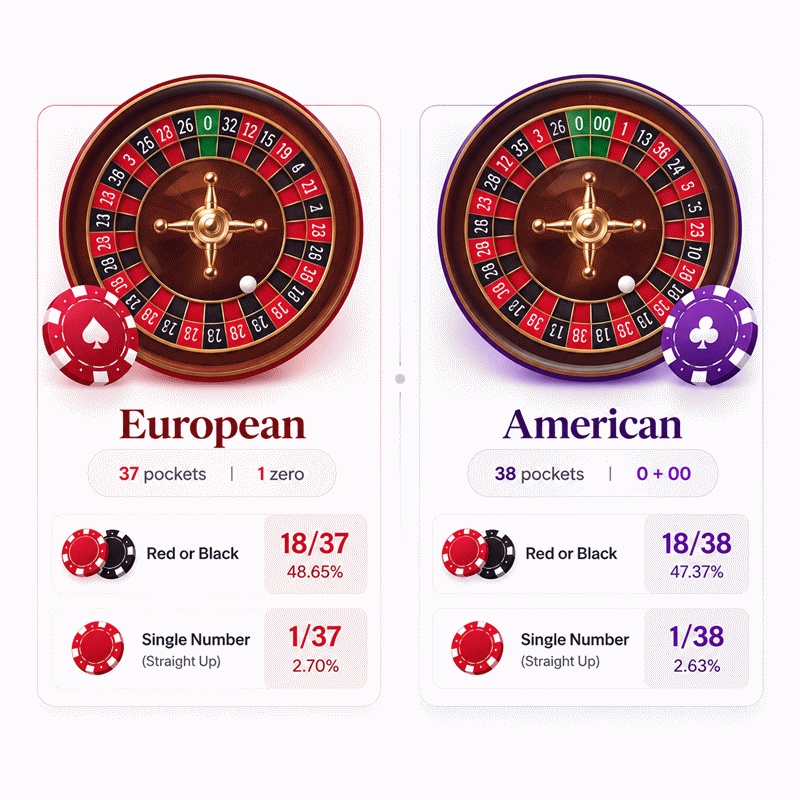
Roulette Payout Calculator results show how your wheel type, bet type, and stake connect to potential winnings and winning probability. The tool separates these values so a large payout is never mistaken for a high chance of winning. It also distinguishes European roulette from American roulette, where the additional double-zero pocket changes probability while standard payout ratios remain unchanged.
- Compare European and American roulette in one calculation.
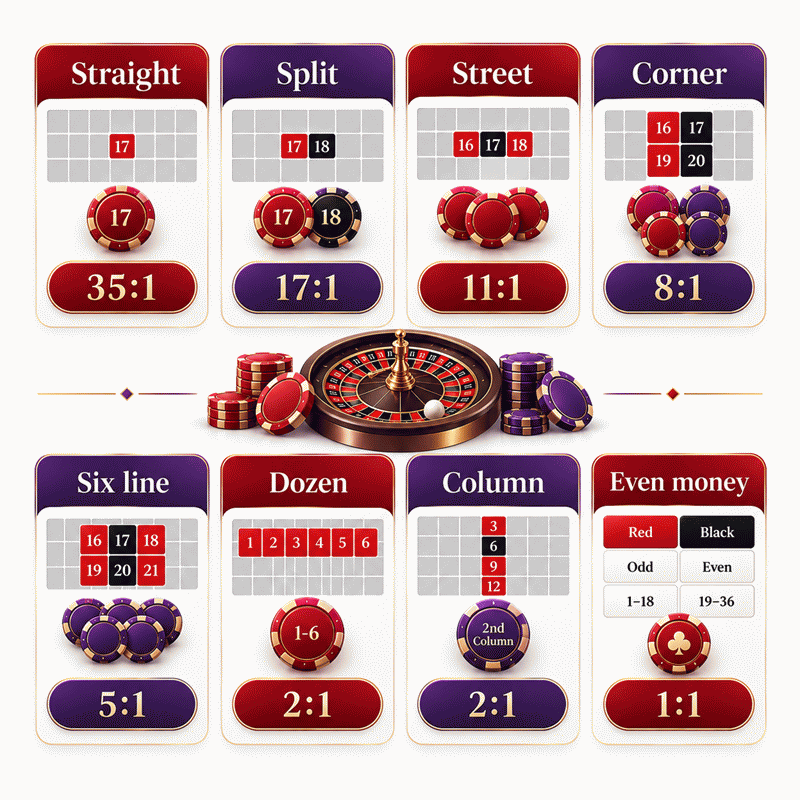
- Check straight, split, street, corner, double-street, dozen, column, and even-money bets.
- See the mathematical winning probability for the selected bet.
- Distinguish net winnings from money returned with the original stake.
- Understand how bet coverage changes payout size and hit frequency.
- Use reverse solving when a payout or connected result is already known.
- Review expected return without treating it as a prediction.
The Roulette Payout Calculator is designed for transparent comparison, verification, and probability education. It does not predict future spins or make a random wager favorable. Use the results to understand the mathematics behind a selected roulette scenario and verify important values independently.
Assumptions used in this calculator
- European roulette uses 37 equally likely pockets, including one zero.
- American roulette uses 38 equally likely pockets, including zero and double zero.
- Every spin is treated as independent of previous roulette outcomes.
- Only standard listed inside and outside bet types are supported.
- Standard payout ratios apply without promotional multipliers or special side bets.
- Payout represents net winnings and excludes return of the original stake.
- Expected return represents long-run average net gain or loss per bet.
- European special rules such as La Partage and En Prison are excluded.
- American five-number basket bets are excluded from the supported bet set.
- Currency selection is a denomination label, not a live exchange-rate conversion.
- All calculations use full precision before final display rounding is applied.
- User-entered reverse values must correspond to a supported roulette bet structure.
- Real casino table limits, rules, and payouts may differ by venue.
Results are rounded for display.
Internal calculations use full precision.
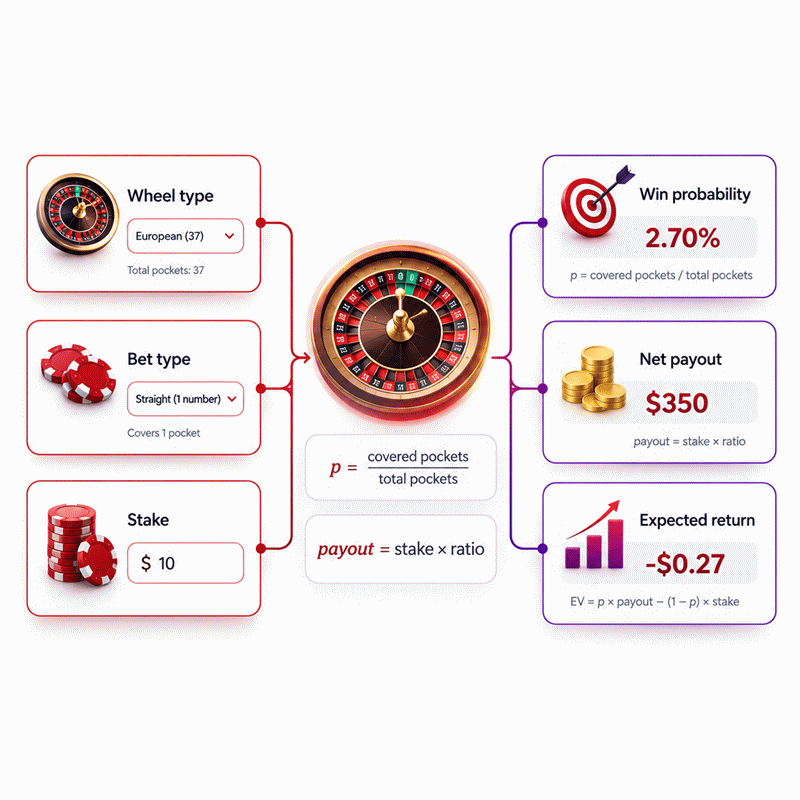
Formulas Used in Roulette Payout Calculator :
1. Total Wheel Outcomes
2. Winning Probability
3. Winning Probability Percentage
4. Net Payout Ratio
5. Net Payout
6. Expected Return
- N
- Total number of wheel pockets.
- S
- Number of wheel spaces covered by the selected bet.
- p
- Decimal probability of winning the selected bet.
- p%
- Winning probability expressed as a percentage.
- R
- Net winnings paid per one unit of stake.
- A
- Amount staked in the selected monetary denomination.
- W
- Net payout received as winnings, excluding the returned stake.
- E
- Expected net gain or loss per bet over repeated identical wagers.
Variables & Definitions
View a complete list of all variables used in this calculator, including definitions and units
Roulette Payout Calculator Variables and Definitions
| Symbol | Variable | Unit | Valid Values | Calculation Role |
|---|---|---|---|---|
| N | Total wheel outcomes | Pockets | 37 or 38 | Defines the total number of equally possible roulette outcomes. |
| S | Covered spaces | Pockets | 1, 2, 3, 4, 6, 12, or 18 | Defines how many wheel outcomes make the selected bet win. |
| p | Winning probability | Decimal | Greater than 0 and less than 1 | Represents the probability of a winning outcome. |
| p% | Winning probability percentage | % | Greater than 0% and less than 100% | Provides the user-facing percentage form of the winning probability. |
| R | Net payout ratio | Stake units per stake unit | 1, 2, 5, 8, 11, 17, or 35 | Defines net winnings for each unit wagered. |
| A | Bet amount | Selected currency or stake unit | Finite value greater than 0 | Provides the monetary stake used to calculate payout and expected return. |
| W | Net payout | Same monetary unit as A | Finite positive value | Represents winnings excluding return of the original stake. |
| E | Expected return | Same monetary unit as A | Finite negative value under this standard model | Represents the long-run average net result of one identical wager. |
Unit Conversion Table
Probability Unit Conversion Table
| Unit Group | Unit Name | Symbol | Equivalent in Decimal Probability | Used For |
|---|---|---|---|---|
| Probability | Decimal probability | p | 1 decimal unit = 1.00 | Probability calculations and reverse solving |
| Probability | Percent probability | % | 1% = 0.01 | User-facing winning probability |
Currency Denomination Handling Table
| Unit Group | Unit Name | Symbol | Equivalent in Calculation Unit | Used For |
|---|---|---|---|---|
| Currency denomination | US Dollar | USD | 1 USD remains 1 USD; no FX conversion | Amount, payout, expected return |
| Currency denomination | Euro | EUR | 1 EUR remains 1 EUR; no FX conversion | Amount, payout, expected return |
| Currency denomination | Pound Sterling | GBP | 1 GBP remains 1 GBP; no FX conversion | Amount, payout, expected return |
| Currency denomination | Canadian Dollar | CAD | 1 CAD remains 1 CAD; no FX conversion | Amount, payout, expected return |
| Currency denomination | Australian Dollar | AUD | 1 AUD remains 1 AUD; no FX conversion | Amount, payout, expected return |
| Currency denomination | Swiss Franc | CHF | 1 CHF remains 1 CHF; no FX conversion | Amount, payout, expected return |
| Currency denomination | Japanese Yen | JPY | 1 JPY remains 1 JPY; no FX conversion | Amount, payout, expected return |
| Currency denomination | Chinese Yuan | CNY | 1 CNY remains 1 CNY; no FX conversion | Amount, payout, expected return |
Example Calculation
A corner bet covers four of the 37 possible European roulette outcomes. The standard net payout ratio is therefore 8 to 1. A 27.50-unit stake produces 220.00 units of net winnings if the bet wins. Over repeated identical wagers, the expected net result is approximately −0.74 units per bet.
In this reverse calculation, the expected return is known while the original stake is unknown. The calculator algebraically inverts the expected-value equation to recover the stake. An expected return of −1.25 units corresponds to a 23.75-unit American roulette wager. For a street bet, that solved stake produces 261.25 units of net payout on a win.
Results are rounded for display.
Internal calculations use full precision.
Calculations Disclaimer
What Does a Roulette Payout Calculator Tell You Before a Bet?
A roulette payout can look simple until several numbers appear at once. A payout ratio, winning chance, stake, and expected result describe different things. Mixing them can make a reasonable-looking comparison misleading. AxiCalculator keeps these values connected in one clear workspace. You select the roulette wheel and bet type. You can then enter the monetary value you already know. The calculator updates the related values immediately.
The Roulette Payout Calculator is most useful when you want clarity before interpreting a wager. A large possible payout does not automatically mean a better mathematical position. It usually means fewer winning pockets are covered. A smaller payout often comes with a higher chance of winning. The calculator lets you see that trade-off without mental arithmetic.
European and American roulette also need separate treatment. Both use the same standard payout schedule for ordinary bets. Their wheel sizes differ. European roulette contains one zero. American roulette contains both zero and double zero. The added American pocket changes the probability attached to every ordinary bet. The advertised payout does not increase to compensate for that extra outcome.
This distinction matters when comparing apparently identical wagers. A red bet still pays even money on either standard wheel. Yet its chance of winning changes with the wheel. The same principle applies to straight, split, street, corner, dozen, and column bets. AxiCalculator keeps the wheel structure visible so the result is easier to interpret.
The tool also separates potential winnings from the broader meaning of risk. A single spin can produce any valid outcome. A favorable short session does not change the underlying probability. An unfavorable session does not prove the calculator was wrong. The calculator describes the mathematical structure of the selected wager. It does not predict where the ball will land next.
Why Can the Same Roulette Payout Hide Very Different Winning Odds?
Players often compare two bets by looking only at the payout. That comparison misses the most important second number: coverage. A straight wager covers one pocket. A split covers two. A street covers three. A corner covers four. Wider outside bets cover many more numbered outcomes. As coverage grows, the chance of a hit grows too. The standard payout falls at the same time.
This creates an easy trap. A 35-to-1 payout looks much more attractive than a 1-to-1 payout. It is larger, but the straight bet must hit one specific pocket. An even-money wager covers 18 numbered pockets. The two bets therefore create very different patterns of wins and losses. One produces rare large wins. The other produces smaller wins more often.
Net Winnings and Total Return Are Not the Same Number
Another common problem is reading payout terminology incorrectly. Net winnings describe the profit earned above the original stake. Total return includes the returned stake as well. These numbers should never be silently mixed. If a one-unit bet wins at 35 to 1, its net winnings are 35 units. The player also receives the original winning unit back. The total amount returned is therefore 36 units.
This difference becomes more important with larger stakes. A displayed result can look inflated when total return is labelled simply as “payout.” It can also look too small when a user expects the stake to be included. Clear labels solve the problem. AxiCalculator uses a consistent calculation model so users can understand what the displayed monetary result represents.
Why Wheel Type Changes Probability Without Changing Standard Payouts
The standard payout schedule is tied to the bet category. The number of total wheel outcomes determines the actual hit probability. This is why changing from a European wheel to an American wheel alters the probability without changing a normal straight or even-money payout.
That difference is easy to overlook in a physical casino. Both layouts show familiar numbers and familiar betting areas. The added double zero can look like a small visual change. Mathematically, it adds another possible losing outcome for many wagers. A calculator makes that difference visible before it is buried inside a percentage.
European vs American Roulette: Which Wheel Changes Your Numbers Most?
Choosing a wheel affects every probability calculation before the stake even matters. European roulette uses 37 pockets. American roulette uses 38. That single-pocket difference changes the chance attached to each standard bet. The payout schedule for ordinary bets stays familiar, so users sometimes miss the effect.
What the Single Zero Changes on a European Wheel
A European wheel contains the numbers 1 through 36 and one zero. The zero creates an outcome outside many common bets. Red does not include zero. Black does not include zero. Odd and even also exclude zero. High and low groups cover numbered ranges rather than the green pocket.
This prevents even-money bets from becoming exact coin flips. They cover 18 numbers, but the wheel has 37 possible pockets. The result is close to one half without reaching it. The same zero also affects inside wagers. A straight bet still covers one outcome, but that one outcome is measured against the full wheel.
Why the Double Zero Matters on an American Wheel
American roulette adds a second green pocket. The wheel contains both 0 and 00 alongside numbers 1 through 36. Standard payouts remain unchanged. The extra outcome therefore reduces the share of the wheel covered by each ordinary wager.
The effect is structural rather than emotional. It does not matter whether a player feels more confident about red, a dozen, or one number. The denominator has changed. That influences every normal hit probability. This is why the wheel selector should be treated as a meaningful mathematical input rather than a cosmetic option.
AxiCalculator makes this comparison useful for learning as well. Users can switch between wheel types and observe how a result changes. That is often easier to understand than reading a static paragraph about probability. The change becomes visible immediately.
Inside vs Outside Bets: Higher Payout or Higher Hit Rate?
Roulette bets are often divided into inside and outside groups. The categories are useful because they describe different risk patterns. Inside bets focus on smaller groups of specific numbers. Outside bets cover broader sets. Neither category makes the next spin predictable. They simply distribute winning probability and payout size differently.
Why Straight, Split, Street and Corner Bets Feel More Volatile
A straight bet targets one number. A split covers two adjacent numbers. A street covers three. A corner covers four. A double-street covers six. As the covered area grows, the payout decreases. The chance of a hit increases at the same time.
This is why inside bets can produce large swings. A straight wager may miss repeatedly because only one pocket wins. When it hits, the profit is much larger than an even-money win. That pattern can feel dramatic. It can also encourage people to overreact to short streaks.
Volatility should not be confused with mathematical quality. A bet that wins less often is not automatically worse. A bet that wins more often is not automatically better. They can have the same long-run disadvantage while producing very different short-term experiences. The important comparison is between payout, coverage, and wheel structure together.
Why Dozens, Columns and Even-Money Bets Hit More Often
Dozens and columns each cover 12 numbered outcomes. Red, black, odd, even, high, and low groups cover 18. These bets therefore hit more frequently than small inside bets. Their payouts are lower because more wheel outcomes can produce a win.
This higher hit rate can create a false sense of safety. Frequent wins do not remove losing outcomes. A zero remains outside many broad wagers. On an American wheel, double zero adds another. A user who focuses only on how often a bet wins may ignore how the payout and losses combine over time.
The calculator is useful here because it keeps frequency and return separate. Users can compare a high-frequency bet with a high-payout bet without treating either number as a complete measure of risk.
Why a 35:1 Payout Does Not Mean a 35-in-36 Chance
Payout language can be misunderstood because ratios describe money, not probability. A 35-to-1 straight payout says how much net profit is paid for each winning stake unit. It does not say the wager wins 35 times. It also does not mean there are only 36 possible wheel outcomes.
True Probability and Advertised Payout Measure Different Things
Probability begins with wheel coverage. A straight bet covers one pocket. An even-money bet covers 18 numbered pockets. The complete wheel still includes the green outcome or outcomes. The true chance therefore depends on the number of covered pockets compared with the entire wheel.
Payout describes the reward after a winning outcome. It is a separate quantity. Keeping those ideas apart prevents one of the most common interpretation mistakes. A large payout can coexist with a very small probability. A small payout can coexist with a much larger probability.
AxiCalculator places these values together because they answer different user questions. The payout answers, “What happens financially if this bet wins?” The probability answers, “How much of the wheel can make this bet win?” Neither question should replace the other.
How the Zero Creates the Gap Players Often Miss
The green pockets are easy to see but easy to underestimate. Standard roulette payouts do not make the game mathematically neutral. The wheel includes outcomes that create a gap between the probability a player would need for a fair wager and the probability the wheel actually provides.
This gap is why a near-even bet is not exactly even. It is also why identical standard payout labels can produce different long-run results on different wheel structures. The zero is not just another color on the layout. It changes the denominator of the probability calculation.
What Does Expected Return Reveal That a Payout Cannot?
A payout tells you what happens in one successful outcome. It says nothing by itself about how likely that outcome is. Expected return combines the possible win and loss outcomes into a long-run average. That makes it a different type of information.
Why a Big Possible Win Can Still Have Negative Long-Run Value
A large potential win attracts attention because the reward is visible. The low probability behind that reward is less dramatic. Expected return forces both sides into the same view. It considers what a winning outcome contributes and what a losing outcome costs.
This is important when comparing roulette bets. A straight wager can pay far more than red or black. That does not mean it creates a positive mathematical advantage. The larger payout exists because the winning area is much smaller.
The same idea applies to wider bets. More frequent wins can feel safer, but the lower payout offsets that frequency. Expected return helps users avoid choosing a wager solely because one side of the trade-off looks appealing.
Short-Term Results and Long-Term Mathematics Can Look Very Different
Expected return is not a promise about the next spin. It is also not a prediction for a short session. Random results can move far above or below the long-run average. A player may win several times quickly. Another may experience a long losing sequence.
Neither result changes the underlying model. Probability describes the structure before a spin occurs. Short-term randomness determines which outcome appears. Over a limited number of trials, the two can look very different.
This distinction matters because humans naturally search for patterns. A streak can feel meaningful even when it provides no information about the next independent spin. A calculator should therefore explain probabilities without implying prediction.
Which Roulette Bet Fits the Risk Pattern You Want to Measure?
A common question is which bet is “best.” That wording hides several possible goals. One person may care about hit frequency. Another may be comparing maximum potential profit. A student may be studying probability. Another user may simply want to verify a payout shown elsewhere.
High Hit Frequency Versus High Payout Variance
Broad outside bets produce wins more often, but each win is smaller. Narrow inside bets win less often and pay more. The choice changes the pattern of outcomes rather than turning roulette into a favorable game.
This is why risk should be described carefully. “Low risk” can be misleading when it refers only to one-spin hit probability. A more frequent win does not guarantee bankroll protection. Repetition still exposes the user to the underlying disadvantage of the wheel.
For educational comparisons, it is better to use specific language. Describe a bet as higher-frequency or lower-frequency. Describe its payout as larger or smaller. Describe its short-run variation separately. These terms explain the mathematical difference without promising safety.
Why Bet Selection Changes Volatility More Than House Advantage
Standard bet types mostly redistribute the same wheel disadvantage. They change how often a win occurs and how large that win is. This creates very different volatility patterns.
A player can therefore experience two bets very differently even when their long-run mathematical disadvantage is the same. One may produce many small changes. Another may produce long quiet periods followed by one large movement. A transparent calculator should help users see that difference without implying that volatility can eliminate the house advantage.
How Can Reverse Solving Answer a Target-Payout Question?
Most roulette tools work in one direction. The user enters a stake and receives a payout. Real questions are not always asked that way. Someone may already know the payout they want to examine. Another user may know an expected result and want to understand what stake would produce it.
Reverse solving makes the calculator more flexible. Instead of forcing users to rearrange the relationship manually, the editable result can become the known value. The calculator then recovers the connected unknown value. This keeps the same mathematical relationship while changing the direction of the problem.
That workflow is useful for checking another source. Suppose a payout statement is provided without its original stake. Entering the known payout and selected bet can reveal the implied stake. The result can then be compared with the source data. This is a verification use case rather than a prediction tool.
Reverse solving also reduces unnecessary navigation. Users do not need a separate calculator for every rearranged question. They can work from the value they actually know. That is especially useful on mobile devices, where shorter workflows reduce repeated typing.
AxiCalculator is designed around this flexible relationship. Editable connected values let the user approach the same calculation from more than one direction. The important condition is consistency. The selected wheel and bet must still describe the scenario correctly.
How Should You Read a Roulette Result Without Misinterpreting the Risk?
The most useful roulette result is not the largest number on the screen. Read the wheel type first. Then check the selected bet. Next, separate the winning probability from the payout. Finally, interpret the long-run result independently from the possible result of one spin.
This order prevents several common mistakes. It stops a 35-to-1 payout from being mistaken for probability. It prevents total returned money from being confused with profit. It also prevents a high hit rate from being treated as proof of a favorable wager.
A calculator should make uncertainty clearer, not hide it. Roulette remains a random game. The calculator can describe the mathematical consequences of a selected wager, but it cannot identify the next winning pocket. No sequence of previous results changes that limitation in the standard independent-spin model.
Use the tool as a calculator, comparison aid, and probability-learning resource. Check the values you enter. Confirm that the wheel matches the game being examined. Treat the output as mathematical information rather than a gambling recommendation.
AxiCalculator focuses on making those relationships visible without unnecessary steps. You can compare wheel structures, inspect standard bet types, solve connected values, and share or export a calculation for later review. The goal is simple: make the numbers easier to understand before anyone draws conclusions from them.
Frequently Asked Questions
Does a higher roulette payout mean the bet is mathematically better?
Why can two roulette bets feel completely different even with the same house edge?
What is the easiest way to check whether a displayed roulette payout is net or gross?
Can a roulette calculator tell me what number will appear next?
How should I validate a roulette calculator before using its output in coursework?
Why should intermediate probability values remain unrounded during chained calculations?
How can I test reverse solving without trusting the calculator's own forward result?
Engineering Resources
Our engineers are here to help you get it right.