Percent Composition Calculator
- Last formula update:
Decimal & Rounding Policy
- Keep full numerical precision for atomic weights, atom counts, mass contributions, molecular weight, and percent composition during every calculation step.
- Round only the final displayed results; never round intermediate values before calculating total molecular weight or element percentages.
- Display molecular weight with up to 4 decimal places when needed, while removing unnecessary trailing zeros.
- Display percent composition with up to 4 decimal places for a clear balance between readability and calculation accuracy.
- For very small nonzero results, show additional significant digits when necessary instead of displaying an inaccurate zero.
- Use unrounded values for internal checks, reverse calculations, exports, and percentage totals, even when the visible values are rounded.
Valid range
- Element: Select a valid chemical element for each of the available element positions, with up to five elements in one compound.
- Number of atoms: Use a non-negative whole number; enter 0 for an unused element position, while an empty field stops the molecular-weight calculation.
- Molecular weight: The calculated molecular weight must be greater than 0 amu for a compound containing at least one atom.
- Element mass contribution: Each contribution must be 0 or greater and is calculated as atomic mass multiplied by the number of atoms.
- Percent composition: Each element must have a mass percentage from 0% to 100%, calculated from its mass contribution divided by the total molecular weight.
- Total composition: For a valid complete compound, the percent compositions of all included elements should total approximately 100%, allowing only minor display-rounding differences.

Xylena Morforde
Reviewers:
Cirelle Vossford
Zorven Lumquell
Check our editorial policy
September 1, 2026
1.0.0
Initial calculator and formula release.
Our engineers are here to help you get it right.
How Does the Percent Composition Calculator Help You Understand a Compound?
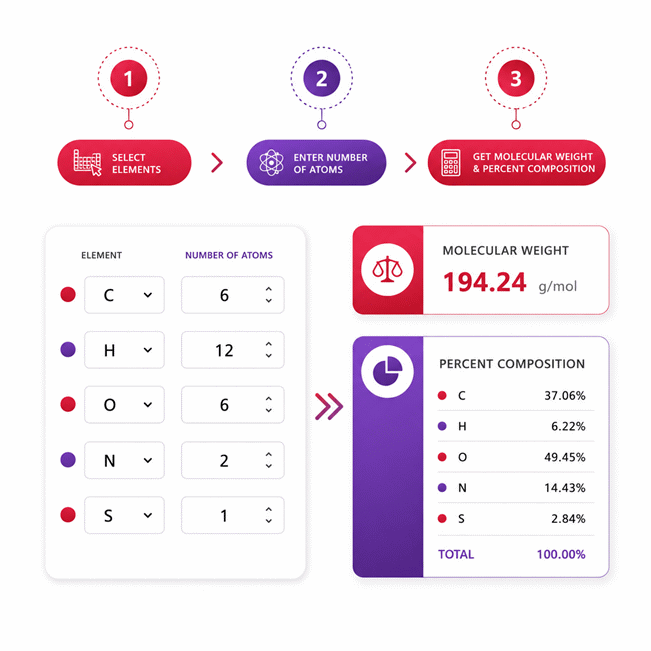
Percent Composition Calculator shows how much each element contributes to the total mass of a chemical compound. It uses the selected elements, their atomic weights, and their atom counts to determine molecular weight and elemental mass percentages. This makes the result easier to verify than estimating composition from a chemical formula alone.
- Each element contributes mass according to its atomic weight and atom count.
- The combined elemental contributions determine the compound’s total molecular weight.
- Each element’s mass share is compared with the total compound mass.
- The final percentages describe composition by mass, not percentage by atom count.
- A heavy element can contribute more mass despite having fewer atoms.
- Reverse solving can recover a missing atom count from suitable known values.
- Unexpected results often reveal an incorrect element, subscript, or chemical formula.
- Percent composition can support formula checks and theoretical elemental analysis.
- Different compounds can sometimes have identical or very similar mass percentages.
- Experimental composition should be distinguished from theoretical formula-based composition.
The Percent Composition Calculator is especially useful when you need a fast elemental mass breakdown, molecular-weight check, or reverse chemistry calculation. Review the chemical formula carefully before using the result, because a correct calculation cannot compensate for an incorrect formula or atom count.
Assumptions used in this calculator
- Atomic weights represent standard reference values for naturally occurring elemental composition.
- Each selected element is treated as chemically valid within the entered formula.
- Atom counts represent stoichiometric quantities for one molecule or formula unit.
- Unused element positions are assumed to have an atom count of zero.
- Percent composition is calculated strictly from elemental mass contribution and molecular weight.
- Isotopic enrichment, depletion, or labeling is not automatically included in calculations.
- Hydrates, solvates, and complexes must be represented through their actual elemental counts.
- Charge state does not alter atomic mass unless isotopic data are specified.
- Experimental impurities and non-stoichiometric composition are outside the idealized calculation model.
- All calculations assume consistent atomic-weight data across every selected element.
- Intermediate values retain full precision before final display rounding is applied.
- Industrial users should verify critical results against approved specifications and laboratory data.
- Results are computational estimates and do not replace certified chemical analysis.
Results are rounded for display.
Internal calculations use full precision.
Formulas Used in Percent Composition Calculator :
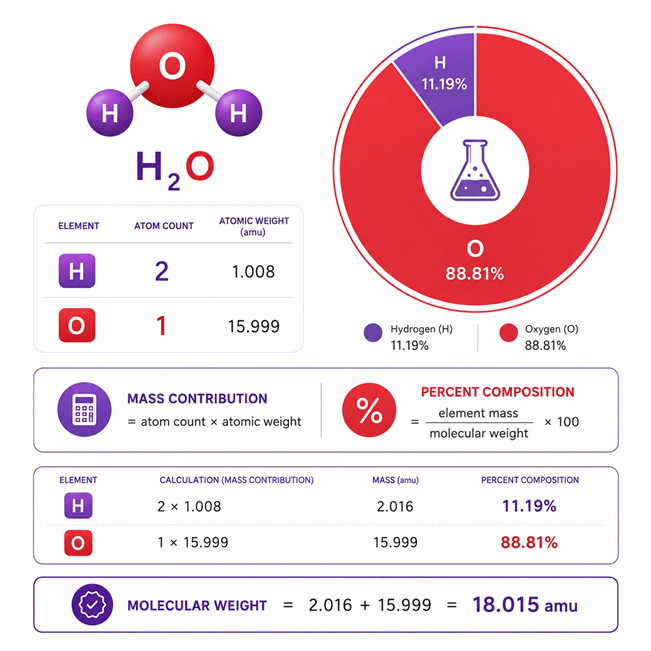
1. Mass Contribution of Each Element
2. Molecular Weight of the Compound
3. Percent Composition of Each Element
4. Reverse Atom Count from Molecular Weight
5. Reverse Atom Count from Percent Composition
Ai = atomic weight of element i, in amu.
ni = number of atoms of element i in the compound.
mi = mass contribution of element i, in amu.
M = total molecular weight of the compound, in amu.
Pi = percent composition by mass of element i.
N = number of active elements included in the calculation.
k = element whose atom count is unknown during reverse solving.
Variables & Definitions
View a complete list of all variables used in this calculator, including definitions and units
Percent Composition Calculator Variables and Symbols
| Variable | Meaning | Unit | Valid or Expected Range | Calculation Role |
|---|---|---|---|---|
| Ai | Atomic weight of element i. | amu | Positive value defined by the selected element. | Used with the atom count to calculate the element mass contribution. |
| ni | Number of atoms of element i in the molecule or formula unit. | Dimensionless | Non-negative whole number; 0 represents an unused element position. | Multiplied by atomic weight to determine the mass contribution of an element. |
| mi | Mass contribution of element i to the total molecular weight. | amu | 0 or greater. | Calculated from ni × Ai and used in the molecular weight and percent composition calculations. |
| M | Total molecular weight of the compound. | amu | Greater than 0 for a valid compound containing at least one atom. | Calculated from the sum of all element mass contributions. |
| Pi | Percent composition by mass of element i. | % | 0% to 100%. | Represents the percentage of the total molecular weight contributed by element i. |
| pi | Decimal mass fraction of element i. | Dimensionless | 0 to 1. | Used in reverse calculations and equals Pi divided by 100. |
| N | Number of element positions included in the calculation. | Dimensionless | 1 to 5 active element positions. | Defines the set of element mass contributions included in the total molecular weight. |
| k | Index of the element with an unknown atom count during reverse calculation. | Dimensionless | One valid active element position. | Identifies the atom count solved from molecular weight or percent composition data. |
| j | Index of a known element used in a reverse percent-composition calculation. | Dimensionless | One valid element position with known composition data. | Identifies the known element whose mass fraction can be used to recover molecular weight. |
Unit Conversion Table
Molecular Weight and Molar Mass Unit Conversion
| Unit Group | Unit Name | Symbol | Equivalent in amu | Used For |
|---|---|---|---|---|
| Atomic and Molecular Mass | Atomic Mass Unit | amu | 1 amu | Atomic weights, elemental mass contributions, and molecular weight. |
| Atomic and Molecular Mass | Unified Atomic Mass Unit | u | 1 u = 1 amu | Scientific notation for atomic and molecular masses. |
| Atomic and Molecular Mass | Dalton | Da | 1 Da = 1 amu | Alternative scientific unit for molecular and atomic-scale masses. |
| Molar Mass | Gram per Mole | g/mol | Same numerical value as molecular weight in amu | Molar mass of one mole of the compound. |
Percent Composition Unit Conversion
| Unit Group | Unit Name | Symbol | Equivalent in Decimal Fraction | Used For |
|---|---|---|---|---|
| Mass Composition | Percent | % | 1% = 0.01 | Displaying each element's share of the compound's total mass. |
| Mass Composition | Decimal Mass Fraction | p | 1 = 100% | Internal percentage calculations and reverse composition calculations. |
Atom Count Unit Reference
| Unit Group | Unit Name | Symbol | Equivalent in Atom Count | Used For |
|---|---|---|---|---|
| Stoichiometric Count | Number of Atoms | n | 1 = one atom per molecule or formula unit | Defining how many atoms of each selected element are present. |
| Stoichiometric Count | Unused Element Position | 0 | 0 = no atoms contributed | Keeping an unused element position inactive without stopping the calculation. |
Example Calculation
Consider a compound with the molecular formula C8H10N4O2. Use atomic weights C = 12.011 amu, H = 1.008 amu, N = 14.007 amu, and O = 15.999 amu.
- Carbon mass contribution = 8 × 12.011 = 96.088 amu
- Hydrogen mass contribution = 10 × 1.008 = 10.080 amu
- Nitrogen mass contribution = 4 × 14.007 = 56.028 amu
- Oxygen mass contribution = 2 × 15.999 = 31.998 amu
- Molecular weight = 96.088 + 10.080 + 56.028 + 31.998 = 194.194 amu
| Element | Atom Count | Atomic Weight | Mass Contribution | Percent Composition |
|---|---|---|---|---|
| C | 8 | 12.011 amu | 96.088 amu | 49.4804% |
| H | 10 | 1.008 amu | 10.080 amu | 5.1907% |
| N | 4 | 14.007 amu | 56.028 amu | 28.8516% |
| O | 2 | 15.999 amu | 31.998 amu | 16.4773% |
| Total | 24 | — | 194.194 amu | 100.0000% |
Each element first contributes mass according to its atom count multiplied by its atomic weight. The molecular weight is the sum of all elemental mass contributions.
Each percent composition value is then obtained by dividing that element's mass contribution by the total molecular weight and multiplying by 100.
The individual percentages add to 100%, apart from possible minor differences caused by displayed rounding.
Full internal precision should be retained until the final displayed values are rounded.
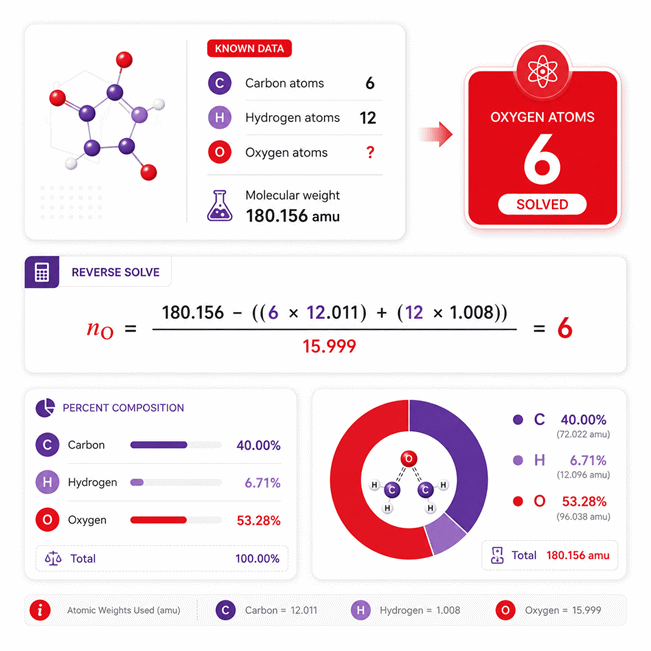
A compound contains 6 carbon atoms and 12 hydrogen atoms, while the number of oxygen atoms is unknown. Its molecular weight is known to be 180.156 amu.
Use C = 12.011 amu, H = 1.008 amu, and O = 15.999 amu to recover the missing oxygen atom count.
- Carbon mass contribution = 6 × 12.011 = 72.066 amu
- Hydrogen mass contribution = 12 × 1.008 = 12.096 amu
- Known mass contribution = 72.066 + 12.096 = 84.162 amu
- Unknown oxygen mass contribution = 180.156 − 84.162 = 95.994 amu
- Oxygen atom count = 95.994 ÷ 15.999 = 6
| Element | Atom Count | Atomic Weight | Mass Contribution | Percent Composition |
|---|---|---|---|---|
| C | 6 | 12.011 amu | 72.066 amu | 40.0020% |
| H | 12 | 1.008 amu | 12.096 amu | 6.7142% |
| O | 6 | 15.999 amu | 95.994 amu | 53.2838% |
| Total | 24 | — | 180.156 amu | 100.0000% |
Reverse solving isolates the missing atom count instead of requiring it as an original input. The known elemental mass contributions are first subtracted from the specified molecular weight.
The remaining mass is divided by the atomic weight of the unknown element, producing the missing atom count.
The recovered value is then used in the normal forward calculation to verify molecular weight and percent composition.
Full numerical precision is retained during calculation, with rounding applied only to displayed results.
Results are rounded for display.
Internal calculations use full precision.
Calculations Disclaimer
Percent Composition Calculator: What the Result Really Tells You
A chemical formula can look correct while hiding an important mass imbalance. The Percent Composition Calculator exposes that balance within seconds. A Percent Composition Calculator shows how much each element contributes to total compound mass. This matters because atom count alone can mislead you. One heavy atom may outweigh several lighter atoms.
Percent composition answers a simple but powerful question. Which elements carry most of the compound’s mass? The result helps students, chemists, analysts, and industrial users read formulas faster. It also helps detect input mistakes before those mistakes spread further.
Consider a compound containing carbon, hydrogen, nitrogen, and oxygen. Hydrogen may have the highest atom count. Yet oxygen may contribute far more mass. Atomic weight changes the balance. This is why visual inspection of a formula is not enough.
The calculator builds the result from each selected element and its atom count. It first evaluates the mass contribution of every element. It then combines those contributions into the compound’s total molecular weight. Finally, it shows the share contributed by each element.
Why Element Mass Contribution Matters More Than Atom Count Alone
A common problem starts when users compare only the subscripts. A larger subscript does not always mean a larger mass percentage. Each atom also carries its own atomic weight.
This creates a useful mental shortcut. Atom count tells you quantity. Atomic weight tells you mass influence. The final composition depends on both at the same time.
Imagine six hydrogen atoms beside one sulfur atom. Hydrogen dominates the atom count. Sulfur can still dominate much of the mass. The reason becomes clear once each contribution is separated.
This breakdown is useful during formula checks. It gives you more than one final percentage. You can see which element drives the total mass. That extra visibility makes mistakes easier to catch.
Why Percent Composition Cannot Identify Every Compound by Itself
Here is the surprising part. Two compounds can share the same elemental mass ratios. Percent composition describes mass distribution, not full molecular structure.
Compounds with proportional formulas can produce identical percentages. Structural isomers can also share the same composition. Their atoms connect differently, but their elemental totals stay equal.
This means percent composition is strong evidence, not complete identification. It becomes more useful when combined with molecular weight or other chemical data.
Quick insight: the largest atom count is not always the largest mass percentage.
How the Calculator Moves From a Chemical Formula to a Clear Result
The real problem is rarely the arithmetic itself. The difficult part is keeping every element connected correctly. One missed subscript can change every result.
The calculation begins with the compound’s elemental makeup. Each active element has an atom count. That count represents its quantity within one molecule or formula unit.
The calculator evaluates each element separately. It combines atom count with the selected element’s atomic weight. That gives the element’s contribution to total molecular mass.
All contributions then join into one total. That total represents the compound’s molecular weight. Each elemental contribution is then compared with that total.
The process creates a complete mass map. You can see the total and each element’s share together. This is more useful than showing one isolated percentage.
Formula structure → Element counts → Element mass contributions → Total molecular weight → Element mass shares
Why a Multi-Element Breakdown Makes Verification Easier
A single answer can look believable even when an input is wrong. A complete breakdown exposes much more context.
Suppose oxygen unexpectedly contributes almost nothing. That result should trigger a quick review. The oxygen count may be missing. The wrong element may also be selected.
Now suppose one element appears twice in separate active positions. The compound may then be counted incorrectly. A structured breakdown helps reveal that problem early.
This matters in classroom work and professional workflows. Transparent intermediate results make review faster. They also make results easier to explain to another person.
Reverse Solving Turns a Missing Input Into a Solvable Chemistry Problem
Sometimes the known value appears at the end of the usual process. A molecular weight may be known, while one atom count is missing.
That situation should not force repeated guessing. Reverse solving works backward from the known information. It isolates the missing contribution and recovers the unknown count.
The same idea can work from a known elemental composition. Known elements define part of the compound’s mass structure. The missing value must satisfy that existing structure.
This feature changes the calculator from a one-way tool into a solver. That matters during homework, formula checks, and analytical reasoning.
When a Reverse Result Signals an Impossible Input Combination
Reverse solving can expose contradictions that forward calculation may hide. A known molecular weight might be too small. Existing elements may already exceed that mass.
A requested composition can also conflict with the remaining elements. The resulting missing count may become physically meaningless. That is not a calculator failure.
It is useful diagnostic information. The supplied values cannot describe the requested chemical composition together.
Fast check: an impossible reverse result often reveals a wrong known value.
Common Percent Composition Mistakes That Change the Entire Answer
Most wrong answers begin before any arithmetic happens. The chemical formula is often entered incorrectly. One missing atom can shift every percentage.
The safest approach starts with element counting. Read the full formula before using the calculator. Confirm every element and every subscript first.
Missing Subscripts, Parentheses, and Hydrate Water
Parentheses create one of the most common traps. An outside subscript applies to every element inside that group. Missing this multiplication changes several atom counts at once.
Hydrates create another hidden trap. Water attached to a hydrate is part of the formula composition. Its hydrogen and oxygen must be counted.
Nested chemical groups require the same care. Resolve each multiplier before combining identical elements. Only then should total atom counts enter the calculator.
A complex-looking formula becomes easier when broken into small groups. Count each group separately. Then combine repeated elements into final totals.
Read groups → Apply subscripts → Count repeated elements → Combine totals → Verify formula → Calculate composition
Using the Wrong Chemical Formula Can Produce a Perfectly Calculated Wrong Answer
This is one of chemistry’s most dangerous calculation traps. Mathematics cannot repair a wrong formula. It can only process the supplied formula accurately.
Consider two compounds containing the same elements. Their atom ratios may differ. Their percent compositions will then differ as well.
Always confirm the chemical identity before calculating. Check oxidation state when relevant. Check hydrate status. Check whether the material is molecular or ionic.
For industrial work, verify the material specification first. Product names can hide different grades or compositions. The formula should match the actual material under review.
Mass Percent and Atom Percent Answer Different Questions
Users sometimes expect atom percentage and mass percentage to match. They usually do not. These measurements describe different properties.
Atom percentage compares numbers of atoms. Mass percentage compares how much those atoms weigh. Heavy elements therefore gain more influence in mass-based composition.
This difference becomes large when light and heavy elements share one compound. A small number of heavy atoms may dominate total mass.
Use percent composition when your question concerns mass distribution. Do not interpret it as a direct atom-frequency measurement.
Watch this trap: correct atom ratios can still produce very different mass percentages.
Where Percent Composition Becomes Useful Outside a Classroom
A calculation becomes valuable when it supports a real decision. Percent composition can do that across several chemical workflows.
Laboratory teams can compare theoretical composition with measured elemental data. Materials teams can estimate elemental mass shares before testing. Students can verify formulas before moving into deeper stoichiometry.
Formula Verification and Elemental Analysis
A proposed formula should produce a predictable elemental composition. That makes percent composition useful as a screening tool.
Suppose measured carbon content differs sharply from the theoretical value. That difference deserves investigation. The sample may contain impurities. The proposed formula may also be wrong.
Experimental data can differ slightly from theoretical values. Real measurements include uncertainty and sample effects. Large differences need more attention than small ones.
This approach is useful because it creates a simple comparison. Expected composition appears on one side. Measured composition appears on the other.
The gap between both values becomes informative. It can guide further testing. It should not be treated as proof by itself.
Industrial Materials, Fertilizers, Minerals, and Process Chemistry
Industrial users often need a fast mass breakdown before deeper analysis. Percent composition can provide that first view.
Fertilizer calculations may focus on nutrient-bearing elements. Mineral work may compare elemental shares within known compounds. Process chemistry may require quick material balance checks.
The calculator can also support preliminary documentation reviews. Engineers can compare a stated formula with expected elemental mass shares. That helps catch obvious inconsistencies early.
However, theoretical composition does not prove actual product purity. Real materials may contain moisture, additives, contaminants, or mixed phases.
For that reason, professional decisions should separate theoretical formula analysis from laboratory measurement. Both answer useful questions. They do not answer the same question.
Why Reliable Data Entry Matters More in Industrial Work
An incorrect formula can affect more than a homework answer. It can influence purchasing, batch planning, or technical communication.
Industrial users should verify material identity before relying on calculated composition. Grade names should not replace chemical formulas. Trade names may describe mixtures instead of pure compounds.
A theoretical calculator is most useful when the material definition is clear. Clean inputs produce results that are easier to audit and explain.
AxiCalculator keeps the calculation workflow visible and repeatable. Users can review selected elements and atom counts before using the result elsewhere.
How to Use Reverse Solving Without Turning Chemistry Into Guesswork
A missing value often creates unnecessary trial and error. Reverse solving removes much of that friction.
Start with what is already known. Keep confirmed element counts unchanged. Leave only the intended unknown unresolved. Then use the known result to recover that missing quantity.
Recovering a Missing Atom Count From Known Molecular Weight
A known molecular weight gives the compound a fixed total mass target. Known elements already contribute part of that target.
The missing element must account for the remaining mass. Its atomic weight then determines how many atoms fit that remainder.
This process works best when only one atom count is unknown. Multiple unknown counts can create several valid possibilities. Additional chemical information may then be required.
A useful review step follows the reverse solution. Run the recovered count through the normal forward calculation. The total should return to the original known result.
This forward check creates a closed loop. It reduces the chance of accepting a misleading reverse answer.
Recovering an Unknown Count From a Known Elemental Composition
A known mass percentage can also constrain the missing structure. The known elements define one part of the compound’s mass.
The unknown count must produce the requested mass relationship. Reverse solving finds the value that satisfies that relationship.
This is especially useful when a composition target is known. It can help explore whether a proposed formula is internally consistent.
Again, the result should make chemical sense. Atom counts within a molecular formula normally represent discrete stoichiometric relationships.
When Reverse Solving Needs More Information
One result cannot always reveal several missing inputs. Chemistry can contain multiple solutions with the same limited evidence.
If two atom counts are unknown, one known molecular weight may be insufficient. A second independent condition may be needed.
The same issue appears with percent composition. One percentage may restrict the possibilities without creating a unique formula.
The best workflow avoids forced certainty. Use reverse solving when the available information defines one clear unknown.
Percent Composition Versus Related Chemistry Concepts
Users often reach the wrong calculator because several chemistry terms sound similar. Knowing the difference saves time.
Percent Composition and Molecular Weight Serve Different Purposes
Molecular weight describes the total relative mass of the compound. Percent composition divides that total among the elements.
One value answers, “How heavy is this formula?” The other answers, “Who contributes that mass?”
They work naturally together. Molecular weight creates the total. Elemental composition explains how that total is distributed.
Percent Composition and Empirical Formula Work in Opposite Directions
Percent composition starts with composition data or a known formula. Empirical formula work often uses composition data to infer ratios.
This creates a useful connection. Percent composition can help generate evidence for empirical formula analysis.
The two tasks should still remain separate. A percentage table does not automatically provide a unique molecular formula.
Molar information may be needed before moving from empirical ratios to a molecular formula.
Why Similar Percentages Do Not Guarantee the Same Material
A close numerical match can feel convincing. It should not become false certainty.
Different compounds can produce similar elemental percentages. Measurement uncertainty can make those values look even closer.
Use composition as one evidence layer. Combine it with appropriate chemical and analytical information when identity matters.
A Practical Workflow for Faster and Safer Composition Checks
The most useful workflow starts before entering any number. Confirm the chemical formula first.
Read every symbol carefully. Count grouped atoms. Include attached hydrate water when applicable. Combine repeated elements before entering their totals.
Then review the displayed mass distribution. Look for surprising results. A surprising value can reveal a mistake faster than repeated arithmetic.
Use reverse solving only when the unknown is clearly defined. Keep other known values fixed. After solving backward, verify the result forward.
For laboratory or industrial work, compare theoretical outputs with actual analytical data separately. Do not confuse calculated purity with measured purity.
Keep a record when the calculation supports an important decision. The export and sharing features can make review easier across teams.
AxiCalculator is designed to reduce repeated manual work. It also keeps the chemistry logic visible. That combination supports faster checks without hiding the underlying reasoning.
Because this is an online software tool, physical-product warranty terms do not apply. Technical issues can be reported through the site’s support channels.
A Fast Decision Path for the Right Chemistry Task
If you know the formula, calculate the elemental mass distribution directly. If one count is missing, use reverse solving.
If you only know experimental percentages, you may need empirical formula analysis. If you need total compound mass, use molecular weight tools.
If the material is a mixture, percent composition of one pure formula may be insufficient. Use composition data that matches the real sample.
The Final Check Before You Trust the Result
Ask three questions before using the output. Is the chemical formula correct? Are all elements counted correctly? Does the result make chemical sense?
These checks take seconds. They prevent many avoidable errors.
Use the calculator when you need a fast elemental mass breakdown. Use reverse solving when one value is missing. Then verify the result before applying it elsewhere.
A clear calculation should answer your question without creating another mystery. That is the standard this tool is built to support.
Frequently Asked Questions
Can I calculate percent composition when the same element appears in multiple parts of a chemical formula?
Does the ionic charge of a compound change its percent composition?
What should I do if I know the compound name but not its chemical formula?
Can this calculator determine percent composition for mixtures or solutions?
Why does laboratory elemental analysis sometimes disagree with theoretical percent composition?
What does it mean when reverse solving produces a non-integer atom count?
Can molecular weight and one known elemental percentage solve two missing atom counts?
Our engineers are here to help you get it right.