Landscape Rock Calculator
- Last formula update:
Decimal & Rounding Policy
- Calculations use full-precision values for length, width, radius, depth, area, waste factor, and landscape rock volume.
- Intermediate values are not rounded, helping prevent cumulative errors in rectangular and circular bed calculations.
- Final displayed results are rounded only for readability, with additional decimal places retained when needed for small or converted values.
- Unit conversions are applied before the final value is displayed, so changing units does not change the underlying physical quantity.
- For material ordering, round the final landscape rock quantity up when supplier increments, settling, or uneven ground require additional coverage.
Valid range
- Length, width, and radius: values must be greater than 0 and within the calculator’s supported measurement range.
- Depth: must be greater than 0; 2-3 in is common for landscape rock beds, while larger rock may require 4 in or more.
- Total area: must be greater than 0 and must represent a physically valid rectangular or circular bed area.
- Rock volume: both base volume and total landscaping rock needed must be greater than 0.
- Waste factor: must be 0% or greater; 10% is the default allowance for settling and uneven ground.
- All dimensions must use compatible units before area and volume relationships are evaluated.

Reviewers:
Elvarine Jexmont
Fenrick Zorquell
Check our editorial policy
August 14, 2026
1.0.0
Initial calculator and formula release.
Our engineers are here to help you get it right.
How Much Rock Do I Need With the Landscape Rock Calculator?
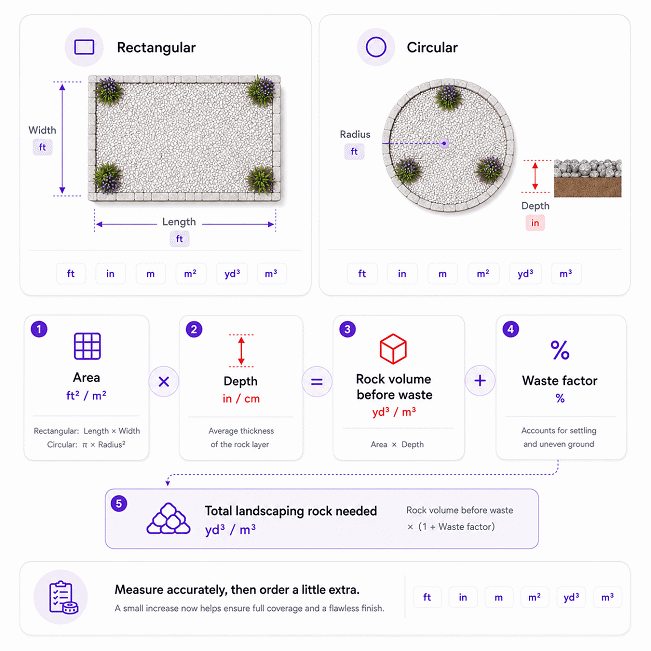
Landscape Rock Calculator turns your bed measurements into a practical rock-volume estimate for rectangular or circular landscaping areas. Enter the available dimensions, choose the planned rock depth, and apply a waste factor to estimate the total landscaping rock needed before ordering.
- Rectangular beds use length and width to determine total surface area.
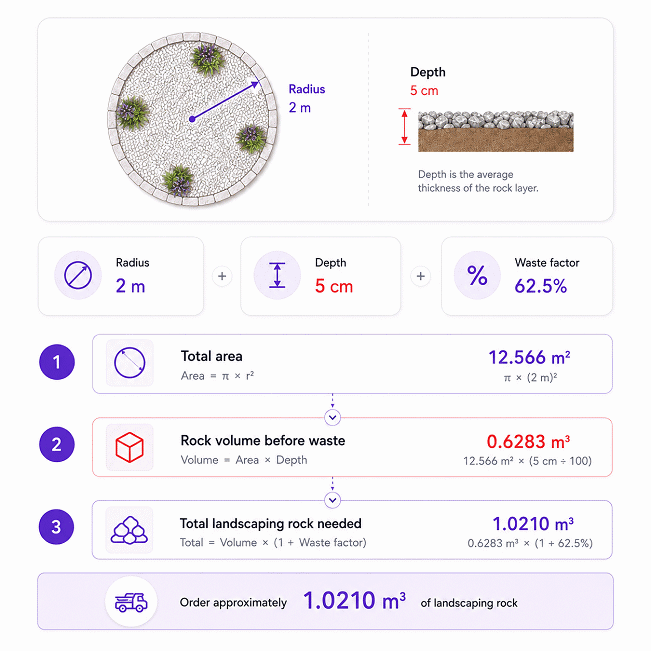
- Circular beds use radius to calculate the area of the rock bed.
- Rock volume before waste equals total area multiplied by installation depth.
- The waste factor adds material for settling, uneven ground, and installation variation.
- Reverse solving can determine a missing length, width, radius, depth, area, or compatible volume.
- Mixed measurement units are converted internally before calculations are completed.
- Changing a unit changes the displayed number, not the physical quantity.
- Irregular areas are best divided into simpler measurable sections before combining results.
The Landscape Rock Calculator is designed for planning material volume rather than exact material weight. Rock type, bulk density, site preparation, supplier selling increments, and field conditions can affect the final purchase quantity. Measure carefully, review the planned depth, check the calculated volume, and confirm the final order with your material supplier before installation.
Assumptions used in this calculator
- Calculations assume the selected bed shape is rectangular or circular.
- Rectangular beds assume length and width are measured perpendicular to each other.
- Circular beds assume the entered radius represents a true circular boundary.
- Rock depth is assumed uniform across the entire calculated landscaping area.
- All dimensions are assumed to represent finished coverage dimensions before waste.
- Unit conversions assume standard conversion factors without intermediate rounding.
- Material volume is calculated geometrically before applying the selected waste factor.
- The waste factor is assumed to cover settling and uneven ground.
- Waste allowance does not replace project-specific compaction or installation requirements.
- Rock density is not assumed because material types vary significantly.
- Volume results do not represent exact material weight or delivery mass.
- Irregular areas should be divided into suitable rectangular or circular sections.
- Final quantities should be verified against supplier packaging and site conditions.
Results are rounded for display.
Internal calculations use full precision.
Formulas Used in Landscape Rock Calculator :
1. Unit Normalization
Each entered measurement is converted to its compatible base SI unit before geometry and volume calculations are performed.
2. Rectangular Bed Area
For a rectangular landscape bed, total area is the product of its length and width.
3. Circular Bed Area
For a circular landscape bed, total area is calculated from the radius using the standard circle-area relationship.
4. Landscape Rock Volume Before Waste
The required geometric rock volume is the bed area multiplied by the selected installation depth.
5. Total Landscape Rock With Waste Factor
The final material quantity increases the geometric volume by the selected waste allowance for settling and uneven ground.
Variables
- xselected = measurement expressed in the unit selected by the user.
- xbase = the same physical measurement expressed in the calculator's base SI unit.
- C = conversion factor from the selected unit to the compatible base SI unit.
- A = total bed area in square meters after unit normalization.
- L = rectangular bed length in meters.
- W = rectangular bed width in meters.
- r = circular bed radius in meters.
- D = landscape rock depth in meters.
- Vbase = geometric rock volume before waste in cubic meters.
- Vtotal = total landscaping rock required after applying the waste factor.
- p = waste factor expressed as a percentage.
Reverse Calculation Rule
Because the calculator uses the same equations in both directions, any editable calculated quantity can be treated as a known value while one compatible unknown is solved algebraically from the same relationships. No separate duplicate equation is required for length, width, radius, depth, area, base volume, total volume, or waste-factor reverse solving.
Precision and Display Rule
Unit conversion and all intermediate calculations use unrounded numeric values. Rounding is applied only when a value is displayed, so reverse calculations and unit changes continue to use the full internal precision and do not accumulate display-rounding errors.
Variables & Definitions
View a complete list of all variables used in this calculator, including definitions and units
Landscape Rock Calculator Variables, Symbols, and Units
| Variable | Definition | Base Unit | Calculation Role |
|---|---|---|---|
| xselected | Measurement expressed in the unit selected by the user | Selected unit | Entered or displayed measurement before unit normalization |
| xbase | The same physical measurement expressed in its base SI unit | m, m², or m³ | Normalized value used internally for calculations |
| C | Conversion factor from the selected unit to the compatible base SI unit | Dimension-dependent | Converts selected measurements before geometry and volume calculations |
| L | Length of a rectangular landscape bed | m | Used with width to determine rectangular bed area |
| W | Width of a rectangular landscape bed | m | Used with length to determine rectangular bed area |
| r | Radius of a circular landscape bed | m | Used to determine circular bed area |
| A | Total surface area of the landscape bed | m² | Calculated from bed dimensions or used as an editable reverse-calculation value |
| D | Installation depth of the landscape rock layer | m | Multiplied by area to determine geometric rock volume |
| Vbase | Landscape rock volume before applying the waste allowance | m³ | Geometric volume calculated from area and depth |
| p | Waste allowance applied for settling and uneven ground | % | Increases the geometric volume by the selected percentage |
| Vtotal | Total landscaping rock quantity after applying the waste factor | m³ | Final material volume produced by the calculator |
Unit Conversion Table
Landscape Rock Length Unit Conversion Table
| Unit Group | Unit Name | Symbol | Equivalent in Meter | Used For |
|---|---|---|---|---|
| Popular Units | Meter | m | 1 m | Length, width, radius, depth |
| Popular Units | Foot | ft | 0.3048 m | Length, width, radius, depth |
| Popular Units | Centimeter | cm | 0.01 m | Length, width, radius, depth |
| Popular Units | Inch | in | 0.0254 m | Length, width, radius, depth |
| SI Units | Millimeter | mm | 0.001 m | Length, width, radius, depth |
| SI Units | Decimeter | dm | 0.1 m | Length, width, radius, depth |
| SI Units | Kilometer | km | 1000 m | Length, width, radius, depth |
| Imperial / US Units | Yard | yd | 0.9144 m | Length, width, radius, depth |
| Scientific Units | Micrometer | µm | 0.000001 m | Length, width, radius, depth |
| Oil & Industrial Units | Survey Chain | ch | 20.1168 m | Length, width, radius, depth |
Landscape Rock Area Unit Conversion Table
| Unit Group | Unit Name | Symbol | Equivalent in Square Meter | Used For |
|---|---|---|---|---|
| Popular Units | Square Meter | m² | 1 m² | Total area |
| Popular Units | Square Foot | ft² | 0.09290304 m² | Total area |
| SI Units | Square Centimeter | cm² | 0.0001 m² | Total area |
| SI Units | Square Millimeter | mm² | 0.000001 m² | Total area |
| SI Units | Hectare | ha | 10000 m² | Total area |
| Imperial / US Units | Square Yard | yd² | 0.83612736 m² | Total area |
| Imperial / US Units | Acre | acre | 4046.8564224 m² | Total area |
| Scientific Units | Square Kilometer | km² | 1000000 m² | Total area |
| Oil & Industrial Units | Square Chain | ch² | 404.68564224 m² | Total area |
Landscape Rock Volume Unit Conversion Table
| Unit Group | Unit Name | Symbol | Equivalent in Cubic Meter | Used For |
|---|---|---|---|---|
| Popular Units | Cubic Meter | m³ | 1 m³ | Base rock volume, total rock volume |
| Popular Units | Cubic Foot | ft³ | 0.028316846592 m³ | Base rock volume, total rock volume |
| Popular Units | Cubic Yard | yd³ | 0.764554857984 m³ | Base rock volume, total rock volume |
| SI Units | Liter | L | 0.001 m³ | Base rock volume, total rock volume |
| SI Units | Cubic Centimeter | cm³ | 0.000001 m³ | Base rock volume, total rock volume |
| Imperial / US Units | US Gallon | US gal | 0.003785411784 m³ | Base rock volume, total rock volume |
| Imperial / US Units | Imperial Gallon | imp gal | 0.00454609 m³ | Base rock volume, total rock volume |
| Scientific Units | Cubic Millimeter | mm³ | 0.000000001 m³ | Base rock volume, total rock volume |
| Oil & Industrial Units | Oil Barrel | bbl | 0.158987294928 m³ | Base rock volume, total rock volume |
| Oil & Industrial Units | Acre-Foot | acre-ft | 1233.48183754752 m³ | Base rock volume, total rock volume |
Example Calculation
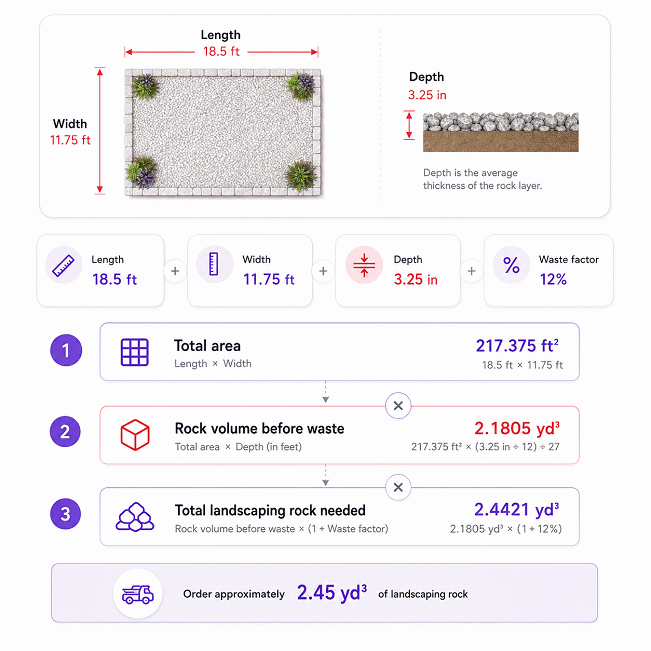
Rectangular bed: Length = 18.5 ft, Width = 11.75 ft, Depth = 3.25 in, Waste factor = 12%.
The bed dimensions first determine the surface area, while the rock depth converts that area into volume. Because the depth is entered in inches, it is converted to feet before multiplying by the area. Cubic feet are then converted to cubic yards using 27 cubic feet per cubic yard. Finally, the 12% waste factor increases the material quantity to allow for settling and uneven ground.
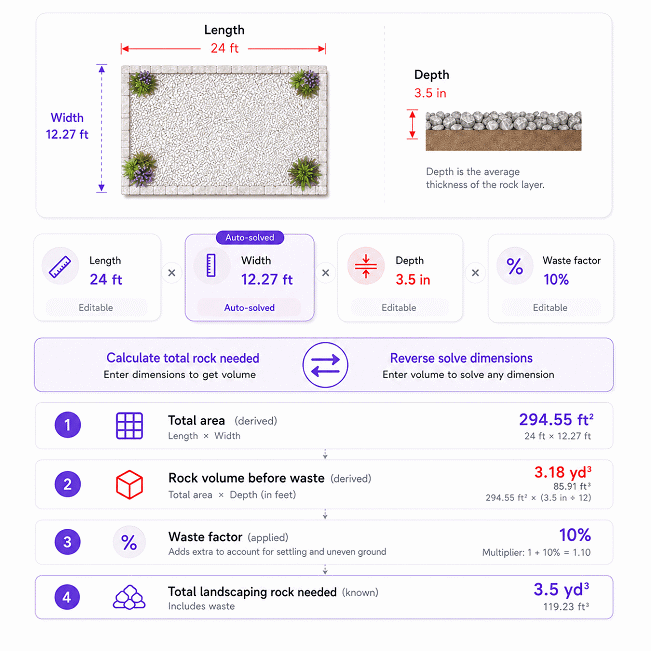
Rectangular bed: Length = 24 ft, Depth = 3.5 in, Waste factor = 10%, Total landscaping rock needed = 3.5 yd3. Width is unknown.
This reverse calculation begins with the required final rock quantity instead of starting with every bed dimension. The waste allowance is removed first to recover the geometric rock volume, and the known depth is then used to determine the required surface area. Because the bed length is already known, the missing width can be solved directly from the rectangular area relationship. Full internal precision is retained until the displayed results are rounded.
Results are rounded for display.
Internal calculations use full precision.
Calculations Disclaimer
How Much Landscape Rock Do You Really Need for Your Project?
A landscape project can look simple until the material arrives. Too little rock stops the work. Too much rock leaves an expensive pile behind. The Landscape Rock Calculator helps remove that uncertainty before ordering. It connects the size of the bed with the planned rock depth. It then gives a material volume that can guide purchasing.
The first step is not choosing a rock color. It is measuring the usable surface correctly. Edges, curves, planting zones, and excluded areas can change the final quantity. Measure the area that will actually receive rock. Do not include patios, tree trunks, drains, or permanent structures unless rock will cover them.
Measure the bed → Check the shape → Set the rock depth → Review the material quantity → Add a practical allowance → Compare supplier options
Why Accurate Measurements Matter More Than Most Buyers Expect
A small measurement error can grow across a large landscape bed. Depth errors are especially easy to miss. A bed may look shallow when viewed from above. Yet adding more depth across the entire surface increases material demand everywhere.
Measure each important dimension at more than one point when the site is uneven. Use the dimensions that best represent the actual coverage zone. For a clean rectangular bed, length and width are usually enough. For a circular bed, the radius defines the usable surface. Complex projects should be divided into simpler sections.
Rectangular and Circular Beds Need Different Measurements
A rectangular bed needs reliable length and width measurements. A circular bed needs a reliable radius. Do not force an irregular garden into the wrong shape. That shortcut can make the final material estimate less useful.
For a curved border, split the project into practical sections. Calculate each section independently. Then combine the material requirements. This takes a little longer, but it gives a much better planning result.
Quick check: if one measurement feels uncertain, measure it again before ordering. Ten extra seconds with a tape measure can prevent a much larger purchasing mistake.
Why Area and Depth Can Change Your Rock Order Faster Than Expected
A common problem appears when a buyer knows the surface size but ignores depth. Surface area only describes coverage. It does not tell you how much three-dimensional material fills that space. Rock depth turns a flat measurement into a material requirement.
This is why two beds with the same surface area can require very different quantities. One project may use a thin decorative layer. Another may need a deeper layer for appearance, drainage, or site conditions. The second project needs more material across every part of the bed.
Rock Depth Is the Measurement That Buyers Often Underestimate
Depth should describe the finished rock layer. Do not confuse excavation depth with rock depth. A project may include soil removal, edging, fabric, base material, and decorative stone. Only the intended landscape rock layer belongs in the rock quantity estimate.
Rock size also affects practical depth decisions. Large stones cannot create the same visual layer as very small material at every depth. The calculator can estimate geometric volume, but the installer still chooses a suitable depth for the selected material and site.
Why a Visually Small Depth Change Can Matter
Imagine increasing the planned layer across an entire side yard. The difference may look minor on a ruler. Across hundreds of square feet, that increase affects the whole surface. The total material requirement can rise noticeably.
One extra inch is not one extra inch in one place. It is one extra inch across the whole bed.
This is one reason professional planning starts with measurements rather than visual guesses. Enter the depth you truly intend to install. Then review the result before calling a supplier.
A good workflow separates design choices from quantity decisions. First decide how the finished bed should perform and look. Then calculate the material needed to build that design.
How Does Reverse Solving Help When You Already Know the Rock Quantity?
Many real projects begin with the wrong information for a normal calculator. You may already own several cubic yards of rock. A supplier may offer one remaining load. A contractor may have leftover material from another job. In these situations, the question changes.
You are no longer asking, “How much rock do I need?” You are asking, “How much area can this rock cover?” That is where reverse solving becomes useful.
Turn a Known Material Quantity Into a Planning Tool
The Landscape Rock Calculator can work backward when enough related information is known. A known material volume can help determine a missing project dimension. This creates a more flexible planning process than a one-way estimator.
Suppose the available quantity is fixed. You also know the planned depth and one side of a rectangular bed. The unknown dimension can become the result. This is useful when deciding how far to extend a border, path edge, planting strip, or decorative zone.
The same idea works with other compatible unknowns. If the surface area and material quantity are known, depth can become the unknown. If a circular area is known, radius can become the missing measurement.
Why Reverse Solving Cannot Determine Two Independent Unknowns
A calculator still needs enough known information. If both length and width are missing, a single area does not identify one unique rectangle. Many different rectangles can have the same area.
This is not a limitation caused by the interface. It is a limitation of the available information. Give the calculator one additional constraint, and the problem becomes solvable.
Known rock quantity → Known depth → Known shape information → Solve the missing dimension → Check the new coverage → Adjust the project
This workflow can be valuable during project changes. Instead of discarding a plan when the available material changes, you can adjust the dimensions around the quantity you actually have.
How Should You Plan for Settling, Uneven Ground, and Real Installation Conditions?
A perfect calculation assumes a perfect physical space. Real landscaping rarely behaves that way. Soil has low spots. Edges are rarely exact. Material shifts during spreading. Some rock stays in the truck, wheelbarrow, or staging area. Finished depth may also vary slightly.
These differences explain why calculated volume and practical order quantity should not always be treated as identical decisions.
Why the Exact Geometric Quantity May Not Be the Best Purchase Quantity
A calculated quantity tells you what the measured space requires under the chosen conditions. Purchasing adds another layer of judgment. The supplier may sell only certain increments. The project may contain rough edges. Access conditions may increase handling loss.
An additional allowance can help absorb these differences. However, there is no universal percentage that fits every project. A small, clean rectangle may need little extra material. A large irregular site may justify more caution.
Waste Allowance Is Not the Same as Compaction
These ideas should not be mixed. An allowance is extra material added for practical uncertainty. Compaction describes a physical change in material volume after consolidation. Decorative landscape rock is also not handled exactly like a compacted structural aggregate base.
The safest order is not automatically the largest order. It is the order that reflects the actual site.
Look at the ground before increasing the quantity. Check slopes, depressions, edge conditions, obstacles, and installation access. A site with a stable prepared surface may behave differently from a rough yard with changing elevations.
Do not use an extra allowance to hide poor measurements. Measure first. Adjust second. That order keeps the estimate useful.
What Can Cause the Delivered Quantity to Feel Different From the Calculation?
Loose rock is difficult to judge by appearance. A pile may look smaller or larger depending on its shape. Material can also settle during handling. Delivery methods differ between suppliers.
For that reason, use the calculator as a planning tool. Then compare its volume with the supplier’s stated selling method. Confirm how the material will be measured, loaded, and delivered before payment.
How Accurate Is a Landscape Rock Calculator in a Real Yard?
The biggest accuracy problems often come from the measurements, not the arithmetic. A calculator can process the values correctly and still produce an unhelpful result if the site data is poor.
The most common mistakes are easy to recognize. Users measure the outer property instead of the rock bed. They ignore excluded planting areas. They guess the depth. They treat an irregular area as a perfect rectangle. They also confuse material volume with material weight.
Common Landscape Rock Planning Mistakes That Can Cost Money
One common error is estimating depth by eye. Measure the intended finished layer instead. Another mistake is using the largest dimensions of an irregular bed without subtracting major empty spaces. That can overstate the covered area.
Another problem appears when buyers compare volume and weight as if they were the same quantity. They are not. Two materials can occupy similar space while having different weights. Rock type, particle size, moisture, and void space can affect practical mass.
A calculation should therefore answer the question it is designed to answer. This tool estimates landscape rock volume. A supplier may later use material-specific information when converting that volume into a sale by weight.
How to Handle Irregular Landscape Areas Without Guessing
Break an irregular bed into shapes you can measure. Use rectangles for straight sections. Use circular sections where that shape represents the site well. Calculate each zone, then combine the quantities.
Do not chase perfect geometry when the site itself is imperfect. The goal is a measurement model that represents the real bed closely enough for purchasing.
If the shape is complicated, simplify the shape before simplifying the measurement.
Why Large Projects Deserve a Second Measurement
The financial effect of an error increases with project size. A small mistake across a small flower bed may have little impact. The same mistake across a large commercial landscape can affect several loads of material.
For large sites, record measurements before entering them. Recheck unusual dimensions. Review the planned depth with the installer. Then compare the calculated quantity with project drawings or field measurements.
This simple review creates a stronger chain of decisions. Measurement supports calculation. Calculation supports purchasing. Purchasing supports installation.
How Do You Turn a Landscape Rock Estimate Into a Smarter Purchase?
The calculator result is only useful if it helps you make a better buying decision. Before ordering, convert the estimate into a supplier-ready question. Ask for the price of the required quantity. Confirm the available selling increment. Check delivery charges. Ask whether the quoted amount refers to volume or weight.
This prevents a common buying problem. Two quotes can appear different because they use different quantities or selling methods. Compare like with like before choosing the lower price.
What Should You Confirm Before Buying Landscape Rock?
Start with the exact material name and size. Decorative rock can vary in grading, shape, color, source, and finish. Ask whether the displayed sample represents the current stock. Natural stone can vary between loads.
Next, confirm how much material is included in the quote. Review delivery conditions and access requirements. Ask whether unloading needs a clear driveway or staging zone. Heavy bulk deliveries may require suitable access.
Then review the commercial terms. Check cancellation rules, return restrictions, damaged-delivery procedures, and any written material guarantee. Do not assume a calculator result creates a supplier warranty. Product support, replacement terms, and guarantees come from the seller.
Bulk Rock or Bagged Rock: Which Purchase Method Makes More Sense?
Small projects may benefit from bags because handling is simple. Large projects often make bulk ordering more practical. The correct choice depends on total quantity, transport, labor, storage space, and local pricing.
Compare the total project cost rather than the package price. Include delivery, handling, unused material, and extra trips. A cheap unit price can become expensive if the order method creates more work.
How Can AxiCalculator Help Before You Request a Supplier Quote?
AxiCalculator gives you a clear starting quantity before the sales conversation begins. That changes the discussion. Instead of asking a supplier to guess your needs, you can present measured project information and compare options around the same requirement.
This also makes quote comparison easier. Save the project dimensions. Review the final material quantity. Share the calculation with another person when needed. Then ask suppliers to price the same project basis.
You remain in control of the buying decision. The supplier provides material-specific details. The calculator provides the planning framework.
Use the Landscape Rock Calculator before changing the bed size, choosing the final depth, or placing an order. A quick recalculation can show how each design decision changes material demand before money is committed.
What Is the Best Workflow for a Landscape Rock Project From Measurement to Delivery?
A landscape rock project becomes easier when each decision happens in the right order. Problems often start when buyers choose a quantity before the site is fully measured. That reverses the process and forces later decisions around an early guess.
Begin with the coverage boundary. Walk the site and identify every area that will receive rock. Separate planting zones, hardscape, drains, structures, and open soil. Decide which sections can be treated as simple shapes.
Measure First, Design Second, Order Last
Record the important dimensions before opening the purchasing page. Then decide the finished rock depth. Check whether the selected rock size suits that depth and intended use. Only after those decisions should you review the required material quantity.
Next, inspect the site for practical differences. Look for uneven grade, loose soil, slopes, narrow access, or complex edges. Decide whether the project needs a reasonable extra allowance.
Then move to supplier comparison. Use the same calculated requirement for each quote. Ask how the supplier sells the material. Confirm whether the order will be measured by volume or weight. If weight is used, ask for the material-specific basis behind the conversion.
A Faster Decision Path for Homeowners, Contractors, and Landscape Crews
The same workflow works at different project sizes. A homeowner can use it for a garden border. A contractor can use it while planning several beds. A landscape crew can use it to check whether remaining material can cover another section.
The key advantage is consistency. Every decision starts from measured site information rather than memory or visual judgment.
Measure what exists. Decide what you want. Calculate what it takes. Then buy.
If the project changes, recalculate before ordering more material. If the available material changes, use reverse solving to explore the coverage that remains possible. That flexibility can reduce waste, prevent rushed purchases, and make field changes easier to manage.
A good landscape rock estimate does not promise that every stone will land exactly where expected. It gives you a disciplined way to connect the real site with the material order. That is the decision AxiCalculator is built to support.
Frequently Asked Questions
Can I use the calculator for a landscape bed with two different rock depths?
Should edging thickness be included when I measure the landscape rock area?
Can I use the calculator to estimate how much rock is needed to refresh an existing bed?
How should I measure a sloped landscape bed for rock coverage?
How can an engineer document a Landscape Rock Calculator result for an estimate or tender?
How can I verify that a reverse-solved result is mathematically consistent?
When should a project use separate calculator runs instead of one combined estimate?
Our engineers are here to help you get it right.