Grams to Tablespoons Formula
- Last formula update:

Decimal & Rounding Policy
- Calculations use full internal precision without rounding intermediate values.
- Displayed results are rounded to a practical maximum of six decimal places.
- Trailing zeros are removed to keep each result clear and readable.
- Very small or large results may be displayed in scientific notation.
- Ingredient density variations can affect more digits than rounding itself.
Valid range
- Mass, volume, tablespoon quantity, and custom density must be finite values greater than zero and within the calculator’s supported range of 0.000000000001 to 1000000000000.

Nolissa Vantford
Reviewers:
Solavyn Marbourne
Orvick Bexquell
Check our editorial policy
September 8, 2026
1.0.0
Initial calculator and formula release.
Our engineers are here to help you get it right.
How Does a Grams to Tablespoons Converter Produce an Accurate Result?
Grams to Tablespoons Converter results depend on ingredient density because grams measure mass while tablespoons measure volume. Select the exact ingredient, enter the known amount, and confirm whether the recipe uses a 15 mL metric tablespoon, a 14.7868 mL US tablespoon, or another supported standard. AxiCalculator then converts in either direction, making it useful when a recipe provides grams but no scale is available or when tablespoon notes must be rebuilt as repeatable gram measurements.
- Ingredient choice has more impact than extra decimal places.
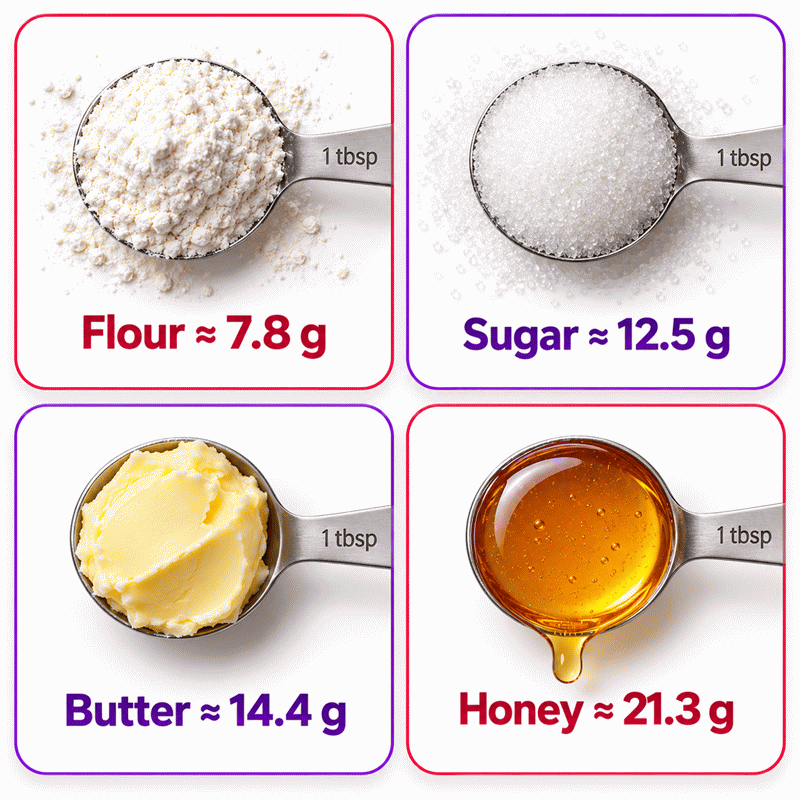
- Flour, sugar, butter, honey, and oil require different conversion factors.
- Level spoons provide more consistent estimates than heaped spoons.
- Custom density supports ingredients that are not included in the preset list.
- Reverse calculation converts tablespoons back to grams using the same assumptions.
The Grams to Tablespoons Converter is designed for practical cooking and recipe planning. Density can still vary with brand, moisture, temperature, particle size, and packing. Use a calibrated scale for commercial production, nutrition labeling, controlled testing, or recipes where small ingredient changes affect the final structure.
Assumptions used in this calculator
- Ingredient density is treated as uniform throughout the measured portion.
- Preset densities represent typical values rather than guaranteed product specifications.
- A standard metric tablespoon contains exactly 15 milliliters.
- A US tablespoon contains approximately 14.7868 milliliters.
- An imperial tablespoon contains approximately 17.7582 milliliters.
- Spoons are assumed level unless the user applies another method.
- Ingredient temperature remains within normal kitchen measurement conditions.
- Moisture changes during measurement are considered negligible.
- Powders are not compressed beyond normal spoon filling.
- No material is lost during transfer between containers.
- Custom density units are converted before calculations are performed.
- Intermediate calculations retain full available floating-point precision.
- Displayed results remain estimates for practical cooking applications.
Results are rounded for display.
Internal calculations use full precision.
Formulas Used in Grams to Tablespoons Formula :
Unit Normalization
Forward Conversion from Mass to Tablespoons
Reverse Conversion from Tablespoons to Mass
Custom Ingredient Density
Variables
- x is an entered measurement in its selected unit.
- f is the selected unit conversion factor.
- xbase is the normalized value in a base unit.
- mg is ingredient mass in grams.
- n is the number of tablespoons.
- ρ is ingredient density in grams per milliliter.
- vtbsp is the selected tablespoon volume in milliliters.
- mknown is a known sample mass.
- Vknown is the corresponding known sample volume.
Variables & Definitions
View a complete list of all variables used in this calculator, including definitions and units
Grams to Tablespoons Formula Variables
| Variable | Meaning | Base Unit | Input or Calculated |
|---|---|---|---|
| x | Entered measurement before unit normalization | Selected unit | Input |
| f | Conversion factor from the selected unit to its base unit | Dimension-specific factor | Selected automatically |
| xbase | Measurement normalized to the required base unit | g or mL | Calculated |
| mg | Ingredient mass | g | Input or calculated |
| n | Number of tablespoons | tbsp | Input or calculated |
| ρ | Ingredient mass density | g/mL | Selected or entered |
| vtbsp | Volume represented by one selected tablespoon | mL/tbsp | Selected automatically |
| mknown | Known mass used to determine custom density | g | Input |
| Vknown | Known volume corresponding to the custom sample mass | mL | Input |
Unit Conversion Table
Mass Unit Conversion Table
| Unit Group | Unit Name | Symbol | Equivalent in Grams | Used For |
|---|---|---|---|---|
| Popular Units | Gram | g | 1 g | Standard recipe mass |
| Popular Units | Ounce | oz | 28.349523125 g | US and imperial recipes |
| Popular Units | Pound | lb | 453.59237 g | Large ingredient quantities |
| Scientific Units | Milligram | mg | 0.001 g | Very small ingredient masses |
| Scientific Units | Kilogram | kg | 1000 g | Bulk ingredient measurements |
Tablespoon and Volume Unit Conversion Table
| Unit Group | Unit Name | Symbol | Equivalent in Milliliters | Used For |
|---|---|---|---|---|
| Popular Units | Metric Tablespoon | tbsp | 15 mL | Metric cooking conversions |
| Popular Units | US Tablespoon | US tbsp | 14.78676478125 mL | US recipes |
| Popular Units | Imperial Tablespoon | Imp tbsp | 17.7581640625 mL | Traditional imperial recipes |
| Scientific Units | Milliliter | mL | 1 mL | Small metric volumes |
| Scientific Units | Liter | L | 1000 mL | Bulk liquid volumes |
Density Unit Conversion Table
| Unit Group | Unit Name | Symbol | Equivalent in Grams per Milliliter | Used For |
|---|---|---|---|---|
| Popular Units | Gram per Milliliter | g/mL | 1 g/mL | Ingredient density |
| Popular Units | Gram per Liter | g/L | 0.001 g/mL | Low-density mixtures |
| Popular Units | Ounce per US Fluid Ounce | oz/US fl oz | 0.958611419 g/mL | US customary measurements |
| Scientific Units | Milligram per Milliliter | mg/mL | 0.001 g/mL | Small mass concentrations |
| Scientific Units | Kilogram per Cubic Meter | kg/m3 | 0.001 g/mL | Scientific and industrial density |
| Scientific Units | Gram per Cubic Centimeter | g/cm3 | 1 g/mL | Laboratory density measurements |
Example Calculation
The mass is first divided by honey density to determine its volume.
The resulting volume is then divided by 15 milliliters per tablespoon.
Intermediate values remain unrounded until the final result is displayed.
Actual spoon measurements may vary with temperature and product composition.
Each metric tablespoon is treated as a volume of 15 milliliters.
The tablespoon quantity is converted to total volume before applying density.
The final mass is calculated without rounding intermediate multiplication results.
Butter composition and temperature can cause small practical differences.
Results are rounded for display.
Internal calculations use full precision.
Calculations Disclaimer
Why Can the Same Gram Value Produce Different Tablespoon Results?
A recipe asks for 50 grams, but the only tool nearby is a tablespoon. The tempting shortcut is to treat every tablespoon as 15 grams. That shortcut works reasonably well for water under ordinary kitchen conditions, but it fails for flour, sugar, honey, butter, and most other ingredients. Grams describe mass. Tablespoons describe volume. The missing link is ingredient density.
A Grams to Tablespoons Converter should therefore do more than divide by a universal number. It must identify the ingredient and apply a representative mass per unit volume. Fifty grams of honey occupies much less space than 50 grams of loosely filled flour. Both samples have the same mass, yet they require a different number of tablespoons.
This distinction matters when a recipe is scaled, adapted, or prepared without a kitchen scale. A small difference may be harmless in a soup. The same error can change the texture of a cake, bread, sauce, or confection. The most useful result is not a false promise of laboratory certainty. It is a transparent estimate based on the ingredient, spoon standard, and a consistent measuring method.
AxiCalculator keeps that decision visible. Select the ingredient, confirm its subtype when available, and enter either grams or tablespoons. The other measurement updates immediately. That two-way workflow supports both recipe conversion and reverse reconstruction when only a spoon quantity is known.
Grams Measure Mass While Tablespoons Measure Volume
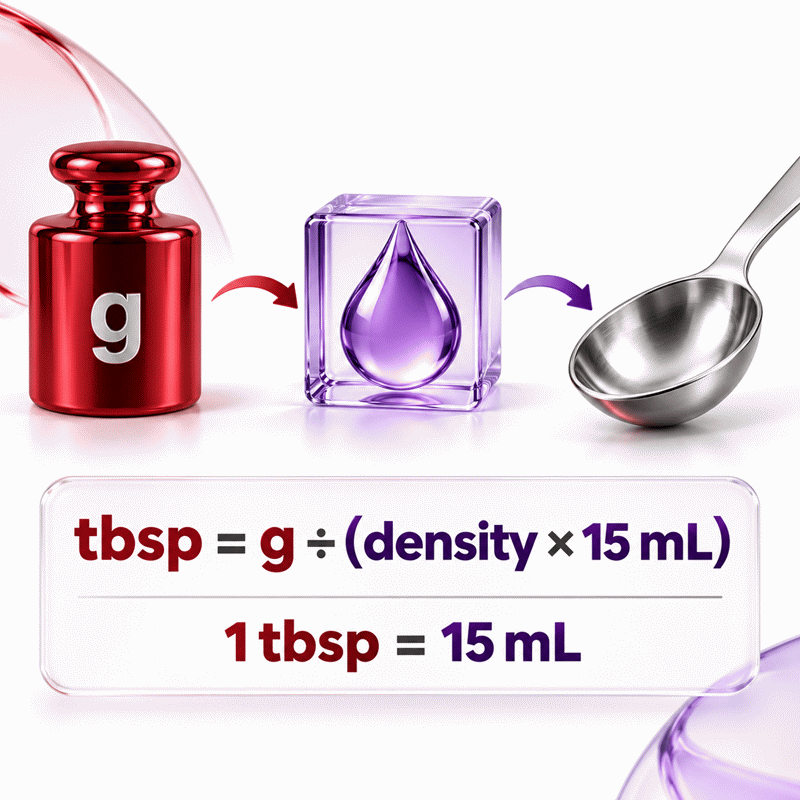
A cook may describe grams as weight in everyday speech. Technically, the calculator uses grams as a mass unit. A tablespoon is a volume unit. Direct conversion between different dimensions is impossible until the material property connecting them is known. For food ingredients, that property is density.
The practical relationship is simple. Mass equals volume multiplied by density. If mass is known, volume is found by dividing mass by density. The resulting milliliters are then divided by the selected tablespoon capacity. If tablespoons are known, the process runs backward: tablespoon count is multiplied by spoon capacity and ingredient density.
This approach also explains why conversion charts disagree. One chart may use a US tablespoon, another may use 15 mL, and another may use a household spoon. The density values may come from different products or filling methods. Differences do not always mean the arithmetic is wrong. They often reveal different assumptions.
Ingredient Density Connects the Two Measurements
Density answers a practical question: how much mass fits into a known volume? Water is close to 1 gram per milliliter in normal kitchen use. Honey is denser. Flour has a much lower bulk density because air remains between particles. Powdered sugar, granulated sugar, and packed brown sugar also behave differently.
Preset values are useful for quick cooking estimates, but they are not certificates for every brand. Moisture, fat content, crystal size, milling, settling, and temperature can shift the real value. A custom density option is valuable when a product specification or measured sample is available. It lets the calculation reflect the ingredient actually being used.
How Does the Grams to Tablespoons Converter Work?
The fastest workflow has three choices. First, choose the ingredient. Second, enter the known measurement. Third, select the spoon or unit standard. The converter handles normalization and updates the unknown field. There is no need to press a calculate button.
If grams are edited last, the tool treats mass as known and calculates volume. If tablespoons are edited last, it treats volume as known and calculates mass. This matters because a real two-way calculator should not duplicate the result in a separate locked box. The result itself should remain editable and become the next known value.
Selecting the Correct Ingredient and Type
The ingredient choice has more influence than the number of displayed decimal places. Choosing water for a flour conversion creates a systematic error that rounding cannot repair. Use the closest available ingredient and subtype. Sugar, oil, and nuts may expose additional choices because their densities differ enough to affect everyday spoon measurements.
For an unlisted food, use a reliable custom density. Confirm both parts of its unit. A value in kilograms per cubic meter cannot be treated numerically as grams per milliliter without conversion. The calculator should normalize those units before applying the relationship.
Entering Grams or Solving Backward from Tablespoons
Forward conversion helps when a recipe lists grams but no scale is available. Reverse conversion helps when notes list tablespoons and a new version requires grams. Both directions use the same physical relationship, so switching direction should not change the ingredient amount.
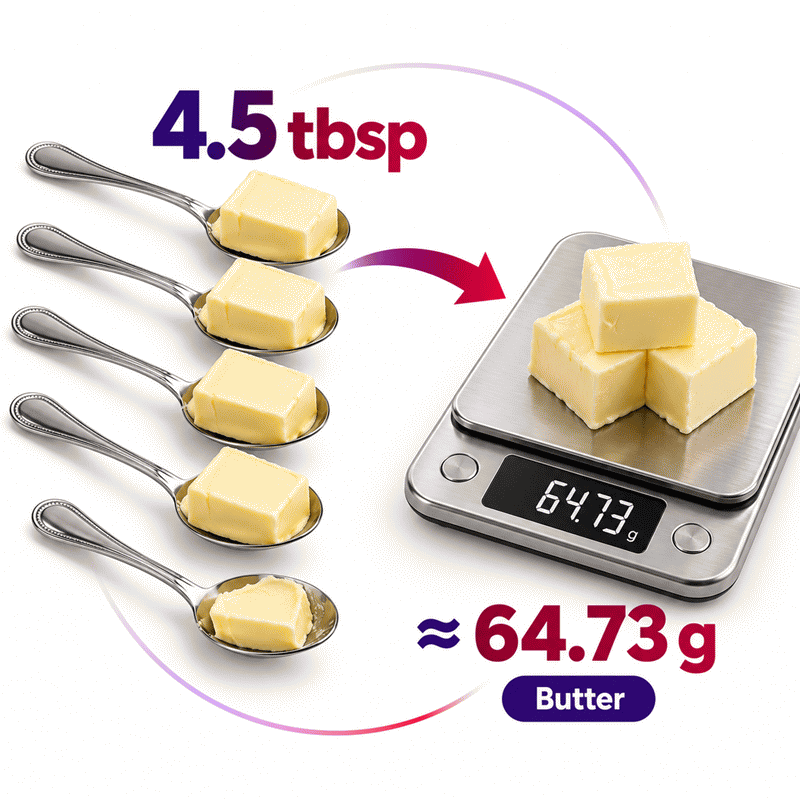
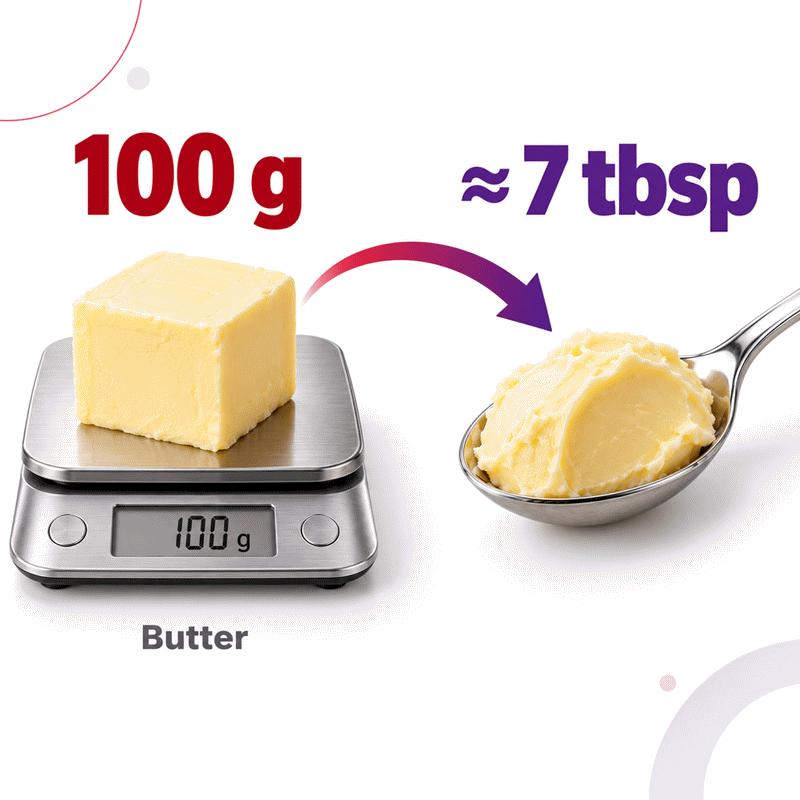
For example, three metric tablespoons of butter represent 45 mL. With a representative density near 0.959 g/mL, the estimated mass is about 43.2 grams. Entering that mass again should return approximately three tablespoons. Small display differences can appear because the interface rounds the visible result.
Choosing the Correct Tablespoon Standard
A recipe may say tablespoon without naming its standard. A metric tablespoon is commonly treated as 15 mL. A US tablespoon is about 14.7868 mL. An imperial tablespoon is larger, and an Australian tablespoon is commonly 20 mL. The difference is modest for one spoon but grows across a large batch.
Choose the standard associated with the recipe rather than the cook’s location alone. An Australian cook following a US recipe should use the US definition for conversion. Consistency between the recipe source and calculator setting is the goal.
Which Ingredients Change the Conversion Most?
A common failure occurs when a saved water conversion is reused for every pantry item. Low-density powders and dense syrups sit far apart. Their tablespoon counts for the same gram value can differ dramatically. Recognizing these groups helps users notice an implausible result before it reaches the mixing bowl.
Flour, Cocoa, Oats, and Other Aerated Powders
Powders contain spaces between particles. Scooping can compress them, while spooning them gently into a measure preserves more air. A cup or tablespoon filled by dipping may hold more mass than one filled lightly. Flour type, milling, and humidity add more variation.
Use a level spoon and repeat the same filling method. Do not tap the spoon unless the reference value assumes tapping. For dough hydration, delicate cakes, and commercial batches, measure by mass whenever possible.
Sugar Types and the Effect of Packing
Granulated sugar flows differently from powdered sugar. Brown sugar is often packed by recipe convention, which removes air and raises mass per spoon. A selector that says only sugar may be too vague for close work. Pick the specific form shown in the recipe.
If the recipe explicitly says packed brown sugar, reproduce that method. If it says sifted powdered sugar, sift before measuring. The conversion estimates quantity, but the written preparation instruction still controls technique.
Butter, Honey, Oils, and Other Dense Ingredients
Fats and syrups usually fill a volume more consistently than loose powders, yet temperature matters. Warm butter can settle without gaps. Cold butter may be pressed into a spoon unevenly. Honey viscosity changes with temperature, which affects handling even when mass is conserved.
Use the converter for a quick estimate, then inspect the recipe’s tolerance. A salad dressing can accept more variation than a confection. Match the measurement method to the consequence of error.
How Accurate Is a Grams to Tablespoons Conversion?
The calculation can be mathematically precise while the input density remains approximate. This is the central accuracy limit. More decimal places do not remove uncertainty in ingredient composition or spoon filling. A useful tool keeps full precision internally but displays a practical result.
For routine cooking, a density-aware estimate is usually more informative than a universal conversion. For nutritional declarations, allergen-controlled work, laboratory procedures, or commercial quality control, use documented material data and calibrated equipment.
Level Spoons, Heaped Spoons, and Real Kitchen Variation
A level tablespoon has a defined boundary. A heaped tablespoon does not. The heap depends on surface tension, particle shape, spoon geometry, and the person measuring. Two careful users can create different heaps.
Level the ingredient with a straight edge when repeatability matters. If a traditional recipe intentionally calls for a heaped spoon, treat the result as a culinary instruction rather than a standardized volume.
Temperature, Moisture, Brand, and Particle Size
Moist ingredients may hold extra mass. Oils expand slightly as temperature changes. Different brands alter formulations, fat percentages, and particle distributions. These effects explain why a calculated result and a package chart may differ.
When a manufacturer provides a weight for a defined serving volume, that product-specific value is often the better choice. Convert it to grams per milliliter or grams per tablespoon and use the custom option.
When Should You Use Grams Instead of Tablespoons?
A busy cook may need a fast substitute for a missing scale. Tablespoons are convenient and understandable. Yet convenience should not be confused with equal precision. Choose grams when repeatability affects safety, texture, cost, or production consistency.
Precision Needs in Baking and Recipe Development
Baking ratios respond to changes in flour, liquid, sugar, fat, and leavening. A spoon estimate can be adequate for a small flavoring addition but risky for the main flour quantity. Recipe developers should record final formulas by mass after testing.
Mass also scales cleanly. Multiplying a gram value by 2.5 is more reliable than multiplying an already rounded spoon fraction. Keep the master recipe in grams and use tablespoon results as a convenience view.
Fast Portioning for Everyday Cooking
Everyday sauces, marinades, fillings, and toppings often tolerate small differences. In those cases, the converter saves time. Select the ingredient, use a level spoon, and avoid rounding until the final practical measure.
A result such as 3.99 tablespoons can reasonably become four level tablespoons. A result such as 3.34 tablespoons may be measured as three tablespoons plus one teaspoon because three teaspoons equal one tablespoon within the same system.
How Can You Avoid Common Conversion Mistakes?
The most expensive mistake is silent inconsistency. A user selects one ingredient, changes the spoon unit, then measures a packed scoop. Each choice may look small, but the effects accumulate. A short check prevents most failures.
Never Apply the Water Ratio to Every Ingredient
Fifteen grams per tablespoon is a water-based shortcut for a 15 mL spoon. It is not a universal food constant. Honey is heavier per spoon, while flour is lighter. Always select the ingredient before trusting the result.
Do Not Mix Metric, US, Imperial, and Australian Spoons
Read the recipe origin and choose its likely standard. If the source specifies milliliters, use that definition directly. Do not switch standards midway through a batch.
Keep the Same Handling Method Across the Recipe
Level, scoop, sift, and pack are measurement instructions. Follow them consistently. A conversion cannot compensate for changing technique between batches.
How Does Reverse Tablespoon-to-Gram Conversion Help?
Old family notes, restaurant prep sheets, and quick mobile recipes often record spoon quantities. Reverse conversion turns those volumes into masses that can be weighed and scaled. It also helps check whether a forward result is internally consistent.
Scaling Recipes and Reconstructing Missing Weights
Suppose a sauce uses 6 US tablespoons of honey. Multiply 6 by 14.7868 mL and by the chosen honey density. The result is an estimated gram value for a repeatable production sheet. Store the ingredient identity and spoon standard with the converted mass.
For another check, consider 54 grams of flour at about 0.6 g/mL. The flour occupies about 90 mL. With a 15 mL tablespoon, that is approximately 6 tablespoons. The result assumes level, normally filled flour and will change if it is compacted.
Make Your Next Recipe Conversion Faster with AxiCalculator
AxiCalculator gives cooks, students, recipe developers, and food teams a direct two-way workflow. Choose the ingredient, confirm the measurement standard, and edit the value you already know. The result appears without a separate calculation step.
Use the answer as a practical estimate and keep the visible assumptions with it. When higher accuracy matters, weigh the ingredient. When speed matters, use the density-aware conversion rather than guessing from water. That balance makes the tool useful without overstating what a tablespoon can measure.
Frequently Asked Questions
Why does my family recipe produce a different result from the calculator?
Can I use this tool when doubling or halving a recipe?
Why is powdered sugar not converted like granulated sugar?
Can I trust the result for sauces, dressings, and liquids?
How should a food laboratory validate a custom ingredient density?
How can a production kitchen control conversion uncertainty between operators?
What should I do when the package serving size conflicts with a preset density?
Engineering Resources
Our engineers are here to help you get it right.