Glass Weight Calculator
- Last formula update:

Decimal & Rounding Policy
- Calculations use full internal precision for glass density, area, volume, thickness, quantity, and total weight.
- Intermediate values are not rounded; rounding is applied only to displayed results.
- Glass density should retain up to four decimal places when the selected material requires that precision.
- Final glass weight should use practical precision, normally showing up to two decimal places while removing unnecessary trailing zeros.
- Unit conversions must use the unrounded internal value so changing units does not introduce cumulative rounding errors.
Valid range
- Glass density: Use a positive value; common glass densities are approximately 2,200 to 3,700 kg/m³.
- Glass dimensions: Height, width, length, diameter, and other required dimensions must be greater than zero.
- Glass area: Area must be greater than zero and must match the selected glass shape and dimensions.
- Glass thickness: Thickness must be greater than zero and is used with area to determine glass volume.
- Glass volume: Volume must be greater than zero and follows the locked relation: volume = area × thickness.
- Quantity: Enter a positive whole number of glass pieces, starting from 1.
- Total weight: Weight must remain positive and follows the locked relation: total weight = density × volume × quantity.

Reviewers:
Elvarine Jexmont
Fenrick Zorquell
Check our editorial policy
August 18, 2026
1.0.0
Initial calculator and formula release.
Our engineers are here to help you get it right.
How Does a Glass Weight Calculator Help You Plan Glass Weight Accurately?
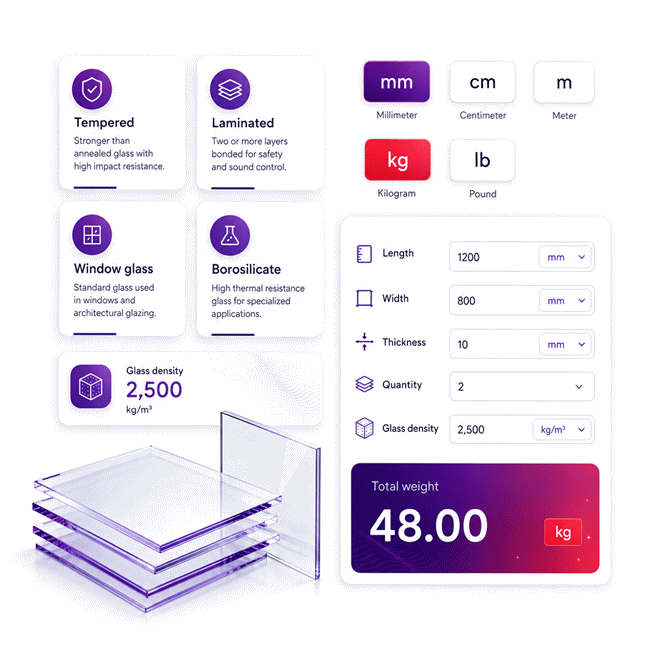
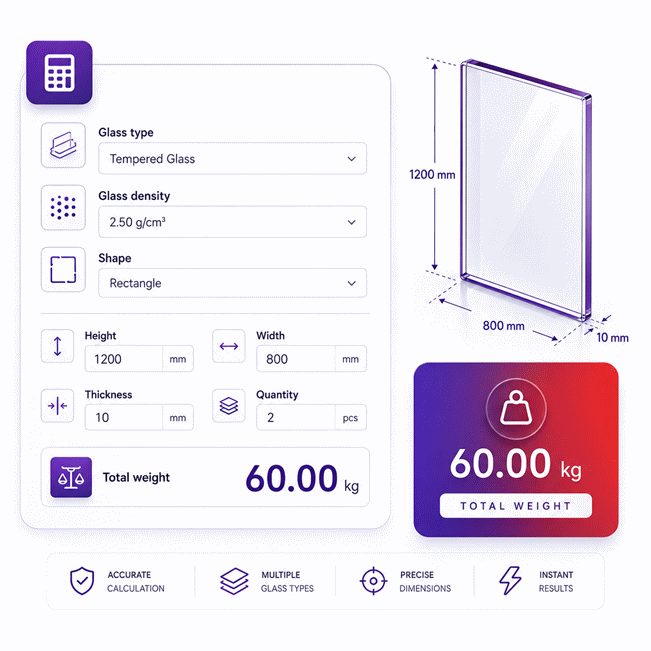
Glass Weight Calculator turns panel dimensions, shape, thickness, glass type, density, and quantity into a practical weight estimate. It helps you check heavy glazing before ordering, transporting, lifting, storing, or installing it. For sheet glass, volume depends on surface area and thickness, while weight depends on material density and volume. :contentReference[oaicite:0]{index=0}
- Choose the correct glass shape before entering its required dimensions.
- Use the appropriate glass type because density varies between glass compositions. :contentReference[oaicite:1]{index=1}
- Check thickness carefully because added thickness increases material across the whole panel.
- Use quantity to estimate the combined load of multiple identical glass pieces.
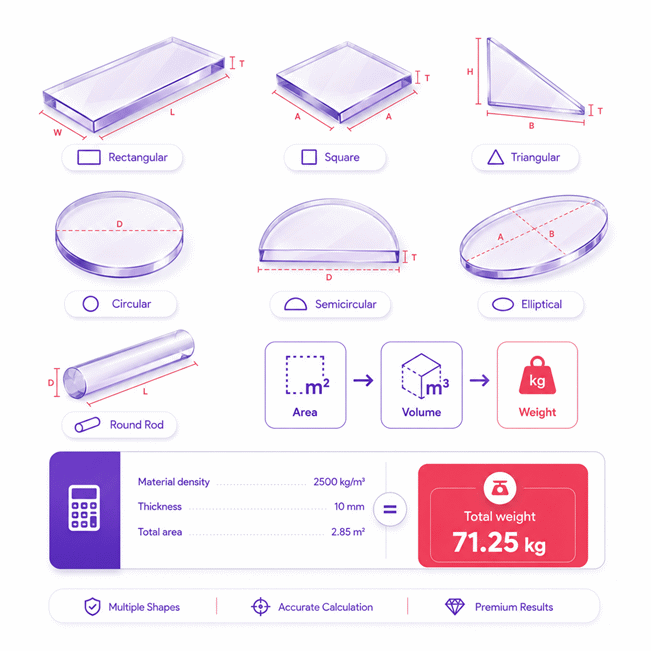
- Rectangular, square, triangular, circular, semi-circular, elliptical, rod, and custom shapes need suitable geometry.
- Reverse solving can help recover unknown dimensions, thickness, volume, density, or quantity when enough values are known.
- Large cutouts, complex shapes, laminated assemblies, frames, and hardware can change finished assembly weight.
- Use verified product specifications when weight affects lifting equipment, hardware, transport limits, or final engineering decisions.
The Glass Weight Calculator is most useful as both an estimating tool and a specification check before costly glass work begins.
Assumptions used in this calculator
- Glass density is assumed uniform throughout each individual glass piece.
- Entered dimensions represent finished glass dimensions before weight calculation.
- Glass thickness is assumed constant across the entire calculated surface.
- Selected glass density represents the actual material being evaluated.
- Standard geometric formulas are assumed valid for the selected glass shape.
- Custom shapes require an accurate surface area entered by the user.
- Round rods are assumed to have a uniform circular cross-section.
- Quantity represents identical glass pieces with matching dimensions and material.
- Manufacturing tolerances are not automatically added to entered dimensions.
- Edge treatments, holes, cutouts, and fittings are excluded unless reflected.
- Unit conversions preserve the underlying physical value before final rounding.
- Calculated weight is an estimate and may differ from measured product weight.
- Engineering, lifting, transport, and safety decisions require independently verified specifications.
Results are rounded for display.
Internal calculations use full precision.
Formulas Used in Glass Weight Calculator :
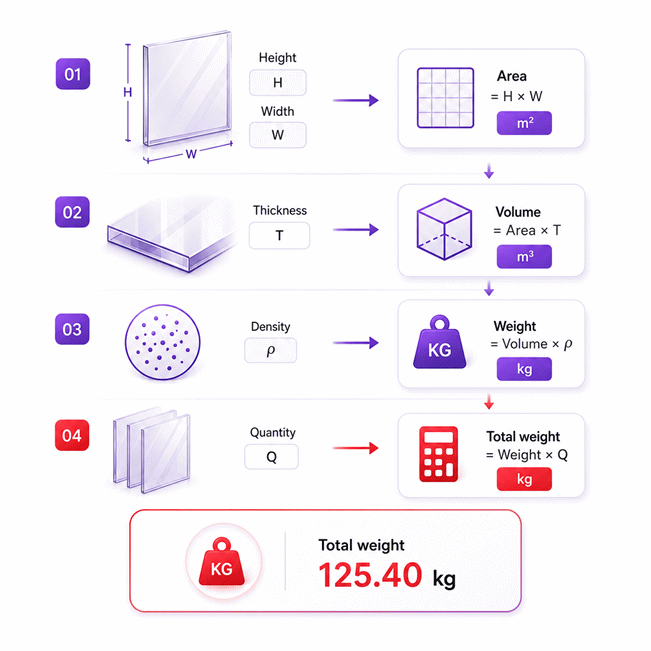
The calculation follows a fixed sequence: convert values to compatible base units, determine the glass area from the selected shape, calculate volume, calculate the weight of one piece, and then apply quantity to obtain the total glass weight. Reverse calculations use algebraic rearrangement of these same equations rather than separate formulas.
Variables
- x = entered measurement or calculated value
- C = conversion factor to the required base unit
- A = glass area or cross-sectional area in m2
- L = length in m
- W = width in m
- s = square side length in m
- b = triangle base in m
- h = triangle or rectangular height in m
- d = diameter in m
- a = ellipse major axis in m
- c = ellipse minor axis in m
- k = circular-shape factor, equal to 1 for a full circle or round rod and 0.5 for a semicircle
- t = glass thickness in m
- V = glass volume in m3
- ρ = glass density in kg/m3
- m = weight of one glass piece in kg
- q = quantity of glass pieces
- mtotal = total glass weight in kg
1. Unit Normalization
Each entered measurement is converted to a dimensionally compatible base unit before geometry or weight calculations are performed.
2. Rectangular Area
3. Square Area
4. Triangular Area
5. Circular, Semi-Circular, and Round Rod Area
6. Elliptical Area
7. Glass Sheet Volume
This relation applies to flat glass shapes, including custom shapes when their area is entered directly.
8. Round Rod Volume
9. Weight of One Glass Piece
10. Total Glass Weight
All intermediate calculations retain full precision. Rounding is applied only when a result is displayed to the user.
Variables & Definitions
View a complete list of all variables used in this calculator, including definitions and units
Glass Weight Calculator Variables and Units
| Symbol | Variable | Definition | Base Unit | Calculation Role |
|---|---|---|---|---|
| x | Measurement value | An entered or calculated physical measurement before or after unit normalization. | Depends on quantity | Unit normalization |
| C | Conversion factor | Factor used to convert an entered value into its required base unit. | Dimensionless | Unit conversion |
| A | Glass area | Surface area of a flat glass piece or cross-sectional area of a round rod. | m2 | Geometry and volume |
| L | Length | Longitudinal dimension used for a round glass rod. | m | Round rod volume |
| W | Width | Horizontal dimension used to calculate rectangular glass area. | m | Rectangular area |
| s | Side | Side length of a square glass piece. | m | Square area |
| b | Base | Base dimension of a triangular glass piece. | m | Triangular area |
| h | Height | Height used for rectangular or triangular glass geometry. | m | Area calculation |
| d | Diameter | Diameter used for circular, semi-circular, and round rod geometry. | m | Circular area |
| a | Major axis | Full major-axis length of an elliptical glass piece. | m | Elliptical area |
| c | Minor axis | Full minor-axis length of an elliptical glass piece. | m | Elliptical area |
| k | Circular-shape factor | Geometry factor equal to 1 for a full circle or round rod and 0.5 for a semicircle. | Dimensionless | Circular shape adjustment |
| t | Glass thickness | Thickness of a flat glass piece used with area to determine volume. | m | Glass volume |
| V | Glass volume | Three-dimensional volume of one glass piece. | m3 | Weight calculation |
| ρ | Glass density | Mass per unit volume for the selected or manually entered glass material. | kg/m3 | Weight calculation |
| m | Weight per piece | Calculated weight of one glass piece before quantity is applied. | kg | Single-piece weight |
| q | Quantity | Number of identical glass pieces included in the total weight calculation. | Count | Total weight multiplier |
| mtotal | Total glass weight | Combined weight of all glass pieces after quantity is applied. | kg | Final result |
Unit Conversion Table
Glass Length Unit Conversion Table
| Unit Group | Unit Name | Symbol | Equivalent in Meters | Used For |
|---|---|---|---|---|
| Popular Units | Millimeter | mm | 0.001 m | Dimensions and glass thickness |
| Popular Units | Centimeter | cm | 0.01 m | Dimensions and glass thickness |
| Popular Units | Meter | m | 1 m | Base length calculations |
| Popular Units | Inch | in | 0.0254 m | Dimensions and glass thickness |
| Popular Units | Foot | ft | 0.3048 m | Large glass dimensions |
| Scientific Units | Micrometer | µm | 0.000001 m | Very small thickness measurements |
Glass Area Unit Conversion Table
| Unit Group | Unit Name | Symbol | Equivalent in Square Meters | Used For |
|---|---|---|---|---|
| Popular Units | Square Millimeter | mm² | 0.000001 m² | Small glass areas |
| Popular Units | Square Centimeter | cm² | 0.0001 m² | Glass sheet area |
| Popular Units | Square Meter | m² | 1 m² | Base area calculations |
| Popular Units | Square Inch | in² | 0.00064516 m² | Imperial glass area |
| Popular Units | Square Foot | ft² | 0.09290304 m² | Large panels and glazing |
| Scientific Units | Square Micrometer | µm² | 0.000000000001 m² | Microscopic area values |
Glass Volume Unit Conversion Table
| Unit Group | Unit Name | Symbol | Equivalent in Cubic Meters | Used For |
|---|---|---|---|---|
| Popular Units | Cubic Centimeter | cm³ | 0.000001 m³ | Glass sheet volume |
| Popular Units | Cubic Meter | m³ | 1 m³ | Base volume calculations |
| Popular Units | Cubic Inch | in³ | 0.000016387064 m³ | Imperial glass volume |
| Popular Units | Cubic Foot | ft³ | 0.028316846592 m³ | Large-volume glass calculations |
| Popular Units | Liter | L | 0.001 m³ | Alternative volume display |
| Scientific Units | Milliliter | mL | 0.000001 m³ | Small volume values |
| Scientific Units | Cubic Millimeter | mm³ | 0.000000001 m³ | Very small glass volumes |
Glass Density Unit Conversion Table
| Unit Group | Unit Name | Symbol | Equivalent in kg/m³ | Used For |
|---|---|---|---|---|
| Popular Units | Gram per Cubic Centimeter | g/cm³ | 1000 kg/m³ | Common glass density |
| Popular Units | Kilogram per Cubic Meter | kg/m³ | 1 kg/m³ | Base density calculations |
| Popular Units | Pound per Cubic Foot | lb/ft³ | 16.018463374 kg/m³ | Imperial glass density |
| Popular Units | Pound per Cubic Inch | lb/in³ | 27679.904710191 kg/m³ | Compact imperial density |
| Scientific Units | Kilogram per Liter | kg/L | 1000 kg/m³ | Alternative density input |
| Scientific Units | Gram per Liter | g/L | 1 kg/m³ | Scientific density conversion |
Glass Weight Unit Conversion Table
| Unit Group | Unit Name | Symbol | Equivalent in Kilograms | Used For |
|---|---|---|---|---|
| Popular Units | Kilogram | kg | 1 kg | Base glass weight result |
| Popular Units | Gram | g | 0.001 kg | Light glass pieces |
| Popular Units | Pound | lb | 0.45359237 kg | Imperial glass weight |
| Popular Units | Ounce | oz | 0.028349523125 kg | Small imperial glass weights |
| Popular Units | Metric Tonne | t | 1000 kg | Heavy glazing assemblies |
| Scientific Units | Milligram | mg | 0.000001 kg | Very small mass values |
Example Calculation
Formula
Solution
Results
The panel area is calculated first from its height and width.
Thickness is converted to a compatible unit before multiplying area by thickness.
Glass density is then multiplied by volume to determine the weight of one panel.
Finally, the single-panel weight is multiplied by quantity to obtain total weight.
Calculation Formulas
Formula
Solution
Results
The total glass weight is treated as a known value while thickness remains unknown.
The rectangular area is calculated first, then the standard weight relationship is rearranged.
The solver isolates thickness without changing the underlying density, volume, or weight method.
A forward calculation verifies that the solved 5 mm thickness reproduces the entered total weight.
Reverse Solving Relations
Results are rounded for display.
Internal calculations use full precision.
Calculations Disclaimer
How Is Glass Weight Calculated?
A glass panel can look easy to move until its size and thickness increase. That is where planning errors begin. Glass weight depends on three physical facts: the amount of material, its thickness, and its density. A larger panel contains more glass. A thicker panel also contains more glass. A denser glass composition adds more mass within the same volume.
The safest workflow starts with the real shape of the glass. Rectangular panes need height and width. Circular pieces need a diameter. Triangular and elliptical pieces need their own geometric measurements. Round rods need both cross-sectional size and length. Once the geometry is known, the calculator can determine how much physical glass exists in one piece.
This matters because two panels with similar visible dimensions may have very different weights. A small increase in thickness affects the entire surface. A change from one glass type to another may also alter the estimated mass. Quantity then multiplies that effect across the whole order.
For buyers, this is more than a number on a screen. Weight can affect transport planning, manual handling, storage, installation access, support hardware, and lifting equipment. It can also help detect an obvious specification mistake before material is ordered.
A good glass weight calculator should therefore do more than return one answer. It should let the user understand how shape, dimensions, material, and quantity influence the result. AxiCalculator is designed around that practical workflow. The goal is simple: turn measurements into a useful planning value without forcing the user through unnecessary technical steps.
Core Glass Weight Relationship
The physical principle is simple. More glass volume means more mass when material density stays unchanged. Higher density also means more mass when volume stays unchanged. This relationship works for ordinary flat panels, circular pieces, custom shapes, and glass rods when the correct geometry is used.
Thickness often creates the biggest surprise. A panel may look almost identical after a small thickness increase, yet its weight rises across the full surface. This is why guessing by appearance can be misleading. Large architectural panels make this effect even more noticeable.
Material selection also matters. Different glass compositions do not all share one density. Common architectural glass types may be close enough for rough planning, but specialty glass can differ. When product-level accuracy is important, the material specification should guide the density selection.
For purchasing teams, the practical lesson is clear. Do not estimate a shipment from panel dimensions alone. Check thickness, glass type, quantity, and any multi-layer construction before making transport or installation decisions.
Calculation Sequence From Dimensions to Total Weight
A reliable calculation follows a clear chain. First, identify the shape. Next, use the relevant dimensions to establish the amount of surface or cross-section involved. Then include thickness or rod length to determine the physical amount of glass. Material density converts that physical volume into mass. Quantity finally turns the single-piece result into the project total.
Keeping these stages separate helps users spot mistakes. If the panel dimensions are wrong, the area will be wrong. If thickness is wrong, volume changes. If the wrong glass type is chosen, the density assumption changes. Each stage has a visible effect on the result.
This sequence also makes troubleshooting easier. When a result looks unexpectedly high, check the largest dimensions first. Then check thickness. After that, verify the selected glass material and quantity. Most dramatic errors come from one of those values rather than from the calculation itself.
Glass Weight Calculator Measurements and Practical Inputs
A common problem appears when drawings, supplier documents, and site measurements use different descriptions. One document may list width and height. Another may specify diameter. A fabrication drawing may provide only the net area. A rod specification may give diameter and length. The calculator must match the geometry rather than force every object into a rectangular model.
Rectangular glass is common in windows, doors, partitions, balustrades, shopfronts, and façade systems. Square panels use one repeated side dimension. Triangular glass appears in architectural details and custom glazing. Circular and semi-circular pieces are common in tables, decorative glazing, windows, and specialist fabrication. Elliptical glass requires two principal dimensions. Round rods require a different geometric approach because their length forms part of the volume.
Custom shapes deserve extra attention. A bounding rectangle can overstate weight when large corners or sections are removed. When accurate net area is available from CAD, fabrication software, or a verified drawing, that area gives a better basis for estimating the actual glass content.
Measurements should represent the finished piece whenever possible. Decorative cutouts, substantial holes, complex edge removal, deep bevels, and shaped sections can reduce the actual material volume. For routine estimates, the effect may be small. For large, expensive, or difficult-to-handle glass, finished geometry becomes more important.
Geometry Measurements for Different Glass Shapes
The correct measurement set changes with shape. Rectangular panes depend on two perpendicular dimensions. Square panes need one side. Triangles depend on base and perpendicular height. Circular pieces depend on diameter or an equivalent radius measurement. Semi-circular pieces use the geometry of half a circle. Elliptical pieces need both principal axes.
Round rods behave differently from sheet glass. Their diameter defines the cross-sectional size, while their length determines how far that section extends. Treating a rod like a thin sheet would produce the wrong physical volume.
Irregular shapes can still be handled when their net area is known. This is useful for CNC-cut panels, shaped mirrors, decorative pieces, and architectural components. It avoids forcing a complex outline into a simplified shape that includes material which does not exist.
Material Selection, Thickness, Quantity, and Total Load
Thickness is one of the fastest ways to change glass weight. If panel area stays fixed, additional thickness adds material across every part of the panel. This makes thickness especially important for doors, large partitions, balustrades, shower panels, façades, and heavy custom glazing.
Quantity should be treated as a project multiplier. It does not make each individual pane heavier. It increases the combined load of all identical pieces. This distinction matters when planning a crate, vehicle, rack, storage area, or installation sequence.
Material selection affects density. Tempered, laminated, window, borosilicate, and specialty glasses may not share identical material properties. Laminated construction can also include interlayers and multiple glass plies. For detailed procurement work, the full assembly specification should be checked instead of assuming that every layered product behaves like one solid pane.
Glass Density by Type: Why Material Choice Changes the Result
A panel can have perfect dimensions and still produce a poor estimate when the wrong material is selected. Density describes how much mass exists within a given volume. It is therefore the material property connecting geometry to weight.
Common flat architectural glass often sits within a relatively narrow density range. That makes standard approximations useful for early planning. However, specialty compositions can move outside that range. Glass containing different oxides, additives, or manufacturing formulations may be lighter or heavier than ordinary window glass.
This is where a material selector becomes useful. A user can choose a known glass family instead of manually searching for a density value. For unusual products, a custom density allows the calculation to follow the actual specification.
The important buying lesson is simple. Use a generic material value for early estimation. Use the supplier or manufacturer specification when the result affects a final purchase, lifting plan, structural check, or transport limit. A few percent may not matter for one small pane. The same percentage across dozens of large panels can become significant.
Common Architectural Glass Density in Practical Planning
Standard glazing often uses soda-lime based glass. Its density is close enough across many ordinary products that quick estimating rules can be useful. These rules help users sense-check results before moving deeper into procurement.
A useful mental check is that thicker flat glass becomes heavier in direct proportion to thickness when area and material stay unchanged. If a panel changes from one thickness to twice that thickness, its glass mass also approximately doubles. This quick relationship can expose an input error within seconds.
However, a mental check is not a replacement for product data. Laminated panels may contain several glass layers. Insulated glazing units may contain multiple panes separated by cavities. Coatings, films, spacers, frames, sealants, and hardware can contribute additional assembly mass.
Tempered Glass Density and Weight
Tempering changes the stress condition and mechanical behavior of glass through controlled heating and cooling. It does not turn the panel into a completely different geometric object. For weight estimation, the correct material density, finished dimensions, and thickness remain the key inputs.
A common mistake is assuming tempered glass must be dramatically heavier than ordinary glass of the same size and thickness. In practice, weight differences are far less important than the dimensional and thickness differences between products. Buyers should therefore compare the actual product specification rather than relying on the word “tempered” alone.
Laminated Glass Density and Weight
Laminated glass creates a different planning problem because the finished product contains more than one layer. Two or more glass plies may be bonded by an interlayer. The glass layers contribute most of the mass, while the interlayer can add a smaller additional amount.
For rapid site planning, the glass plies often dominate the estimate. For detailed fabrication, shipping, or hardware selection, the complete laminated construction should be considered. The exact layer build-up is more useful than a generic label such as “laminated glass.”
Window, Borosilicate, and Specialty Glass Density
Window glass is commonly used as a baseline because it represents familiar architectural glazing. Borosilicate and other specialty materials may use different compositions for thermal, optical, chemical, or mechanical performance. Their density can therefore differ from common flat glass.
This becomes important when a calculator is used outside ordinary construction. Laboratory panels, industrial viewing windows, furnace observation glass, specialty covers, and technical glass components should use verified material data whenever possible.
Glass Weight by Shape: Why Geometry Changes the Estimate
Two pieces can share the same maximum width and height while containing very different amounts of glass. A rectangle fills its entire bounding box. A circle does not. A triangle may contain only half the area suggested by its base and height rectangle. An ellipse also occupies less space than its surrounding rectangle.
This is why shape selection cannot be treated as decoration. It directly affects the amount of material used. For standard rectangles, the relationship is simple. For circles, semicircles, triangles, and ellipses, the geometric area changes before thickness is considered.
Using the wrong shape can create a large error on oversized pieces. The effect becomes even larger when many identical pieces are ordered. A small percentage error in one panel becomes a repeated error across the whole quantity.
For purchasing and fabrication, the best approach is to match the calculator shape to the drawing. If the shape is too complex, use verified net area instead of a rough bounding shape. This keeps the estimate tied to actual material rather than empty space.
Rectangular, Square, and Triangular Glass
Rectangular glass is the most common case. Doors, windows, partitions, shelving, façades, and table panels frequently use rectangular geometry. The two face dimensions establish the surface before thickness is considered.
Square glass is a special rectangular case with equal sides. Keeping it as a separate option reduces input effort and helps prevent mismatched dimensions.
Triangular glass requires the perpendicular height rather than a sloping edge. Using the wrong dimension can overstate or understate the real surface. Architectural drawings should be checked carefully when the triangle is not right-angled.
Circular, Semi-Circular, and Elliptical Glass
Round glazing appears in tables, decorative windows, observation panels, mirrors, and specialist components. Diameter is usually the easiest measurement because it can be taken directly across the widest part of a circle.
Semi-circular pieces contain half the surface of a full circle with the same diameter. Elliptical pieces require both principal dimensions. Confusing an ellipse with a circle can cause a noticeable error when the two axes differ substantially.
When a circular or elliptical panel includes a large center opening, the removed section should be considered for precision work. Otherwise, the estimate represents a solid piece.
Round Glass Rod and Custom Shape Calculations
Glass rods need their own geometry because they extend along a length. Diameter controls the cross-section, while length controls how much of that cross-section exists. This makes rod calculations useful for laboratory, decorative, industrial, and specialty glass applications.
Custom shapes work best from net area. This is often available from CAD drawings or fabrication systems. Using net area is especially useful for polygons, curved outlines, irregular decorative panels, and pieces with substantial material removed.
Reverse Glass Weight Solving: When the Missing Value Is Not Weight
Real projects do not always start with clean dimensions and an unknown weight. Sometimes the weight is known from a shipping document, scale reading, lifting record, or existing installation. The missing value may instead be thickness, area, volume, quantity, or even material density.
This creates a different user problem. A one-way calculator forces the user to rearrange equations manually. A multi-way solver can use the values already known and solve the missing variable when the relationship contains enough information.
That capability is useful during specification checks. If a supplier lists a total shipment weight and quantity, a buyer can investigate whether the stated panel dimensions and thickness are plausible. If an existing panel has known dimensions and measured weight, the calculation can help check whether the assumed thickness or density makes sense.
Reverse solving should not be confused with material identification. Similar density values can belong to different glass compositions. A calculated density can support investigation, but it cannot prove the exact product type without documentation or material testing.
Solving Glass Thickness, Area, or Dimensions From Known Weight
Thickness is often the most valuable reverse target. A user may know the panel size, material, quantity, and combined weight but lack a reliable thickness record. When enough independent information is available, the unknown thickness can be isolated from the same physical relationship used for forward calculation.
Area can also become the missing value. Once area is known, the geometry may allow another dimension to be recovered. For a rectangle, knowing area and width can reveal height. Knowing area and height can reveal width.
This is useful for checking archived drawings, replacement glazing, incomplete project records, and legacy installations. It can also expose impossible combinations before money is spent.
Solving Density, Volume, or Quantity From Known Values
Density can be estimated when weight and physical volume are already known. This can help compare an unknown item with a documented material specification. It should remain an investigative value rather than an automatic material identification.
Quantity can also be recovered when total load and individual-piece information are available. This is useful when checking pallet records, grouped shipments, or repeated panel schedules.
Volume becomes a useful bridge between geometry and material mass. Reverse solving allows that bridge to work in both directions. This makes the calculator more useful for verification, not just prediction.
Glass Weight by Thickness and Surface Area
The fastest way to understand glass weight is to watch thickness across a fixed area. Every additional layer of thickness adds material over the entire panel surface. That is why a large pane can become surprisingly heavy after only a few millimeters of change.
This relationship matters during early design. A designer may increase thickness for strength, stiffness, safety, or specification reasons. The visual change can appear minor, but the handling load changes immediately. The same effect applies across every panel in the project.
Surface area creates the second major multiplier. Doubling panel area doubles the amount of glass when thickness and material stay constant. Large panels therefore deserve special attention even when they are relatively thin.
For buyers, this provides a useful checking habit. Compare thickness and panel area before comparing prices. A cheaper panel that uses the wrong specification is not a saving. A heavier panel may also create extra transport, lifting, hardware, and installation costs.
Glass Weight per Square Meter and Square Foot by Thickness
Weight per unit area is useful because it separates panel size from material loading. Once the approximate weight for each square meter or square foot is known, larger panels become easier to estimate quickly.
This approach is valuable for façade schedules, partitions, balustrades, doors, shower screens, display glass, and repeated window modules. It also helps teams compare design alternatives before every individual panel dimension has been finalized.
However, area-based shortcuts work best when thickness and material remain consistent. Laminated assemblies, insulated units, mixed-thickness constructions, and specialty glass can require a more detailed build-up.
Common Glass Weight Calculation Errors, Tolerances, Limitations, and Safety Risks
A believable result can still be wrong. The most dangerous errors are often simple. Millimeters may be entered as centimeters. A laminated build-up may be treated as one thin pane. Quantity may be forgotten. A diameter may be confused with a radius. A triangular sloping edge may be entered as perpendicular height.
Another common mistake is treating nominal thickness as a perfect physical measurement. Manufactured products have tolerances. Finished glass may also include coatings, interlayers, edge work, holes, cutouts, fittings, frames, spacers, or sealants. Some of these additions are minor. Others can matter in a complete assembly.
Curved glass deserves extra care. Flat width and height may not represent the developed surface. Complex fabricated shapes can also differ substantially from a simple bounding rectangle.
Safety decisions should never depend on weight alone. A 100 kg compact object and a 100 kg glass sheet do not present the same handling problem. Panel dimensions affect grip, bending, balance, access, wind exposure, and lifting method.
Hardware selection also requires more than total mass. Hinges, channels, clamps, anchors, supports, frames, suction equipment, lifting devices, and transport racks have their own rated limits and installation conditions. The relevant product documentation should guide final selection.
Before ordering glass, verify the drawing revision, finished dimensions, thickness, material, layer build-up, edge treatment, hole pattern, quantity, and installation constraints. For supplied hardware or glazing systems, confirm the actual warranty and technical support terms with the responsible manufacturer or seller. Warranty coverage should never be assumed from a weight calculation alone.
Why Calculated and Measured Glass Weight Can Differ
The calculated value represents a physical model built from the information entered. The measured value represents the finished object. Differences appear when the model and finished object are not identical.
Material density can vary slightly. Finished dimensions can differ from nominal dimensions. Thickness tolerances can affect volume. Laminated interlayers add material. Large cutouts remove material. Hardware and frames add mass when the entire assembly is weighed.
The practical response is not to distrust calculation. It is to understand what the calculation represents. For early planning, a clean glass-only estimate is often enough. For lifting limits, shipping documentation, final hardware selection, or structural design, verified product and assembly data become more important.
How to Reduce Glass Weight Planning Errors Before Purchase
Start with the latest approved drawing rather than an old quotation. Confirm whether dimensions describe the finished panel or an opening. Check the thickness of every glass ply in layered construction. Confirm whether the requested result concerns glass alone or the complete installed assembly.
Then compare the calculated result with a quick sense-check. If a modest window suddenly appears to weigh hundreds of kilograms, inspect the units. If a large thick panel appears unusually light, check thickness and density. These simple checks catch many expensive mistakes.
For commercial orders, keep the calculated output with the purchase record. A shared result helps design, procurement, transport, and installation teams work from the same assumptions. AxiCalculator can support that handoff by giving users a clear result that can be reviewed before material reaches the site.
Frequently Asked Questions
Does changing a glass panel from vertical to horizontal change its weight?
Can I calculate the total weight of a project with different glass panel sizes?
Should I use the window opening size to estimate replacement glass weight?
How can I compare the weight impact of two different glass specifications?
Why does my calculated glass weight differ from the supplier's shipping weight?
How should I estimate an insulated or laminated unit with unequal glass plies?
How can reverse solving help diagnose a mismatch between drawings and measured weight?
Our engineers are here to help you get it right.