French Drain Calculator
- Last formula update:

Decimal & Rounding Policy
- The French Drain Calculator keeps full numerical precision during all intermediate calculations to minimize cumulative rounding errors.
- Calculated measurements are rounded only when displayed, using practical decimal precision based on the result magnitude and selected unit.
- Pipe length, gravel volume, filter fabric area, material weight, and cost calculations use unrounded values internally before the final result is shown.
- The required number of standard drain pipes is always rounded up to the next whole piece to ensure enough pipe is purchased.
- Unit conversions are completed before display rounding, so switching between metric and imperial units preserves the underlying physical value as accurately as possible.
Valid range
- Trench width: Use a positive finite value greater than zero and wide enough to accommodate the selected drain pipe.
- Trench depth: Use a positive finite value greater than zero and deep enough to contain the selected pipe and gravel layer.
- Trench length: Enter a positive finite length greater than zero for the full drainage run.
- Trench volume: The calculated volume must remain positive and consistent with the trench width, depth, and length.
- Pipe outside diameter: Use a positive supported or custom diameter that physically fits within the trench dimensions.
- Pipe slope: Use a non-negative slope that meets or exceeds the recommended minimum for the selected pipe size.
- Pipe length: The required drain pipe length must be positive and is determined from trench length and pipe slope.
- Standard pipe length: Enter a positive available pipe-piece length greater than zero when calculating pipe quantity.
- Pipe quantity: The result must be a positive whole number and is rounded up to provide enough drain pipe.
- Gravel volume: The calculated gravel volume must be zero or greater after subtracting pipe displacement from trench volume.
- Wastage: Enter a non-negative percentage to account for additional gravel required beyond the calculated base volume.
- Gravel density: Use a positive density greater than zero when calculating the required gravel weight.
- Filter fabric overlap: Use a zero or positive overlap length when filter fabric is included in the French drain.
- Material prices: Enter zero or positive finite prices for gravel, pipe, and filter fabric cost calculations.

Reviewers:
Elvarine Jexmont
Fenrick Zorquell
Check our editorial policy
August 17, 2026
1.0.0
Initial calculator and formula release.
Our engineers are here to help you get it right.
What Does a French Drain Calculator Tell You Before You Start Your Project?
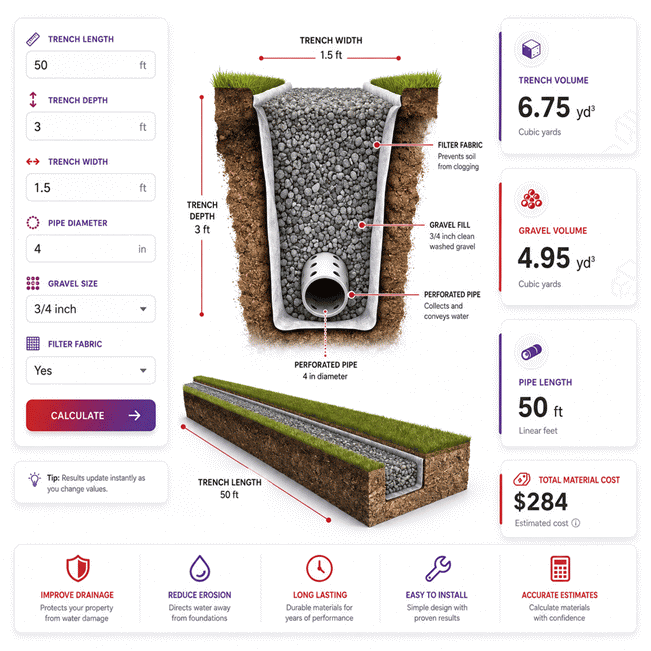
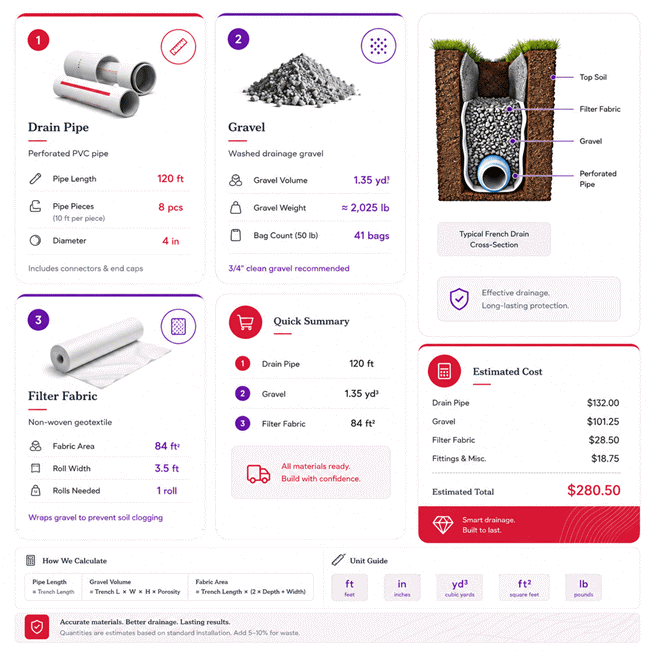
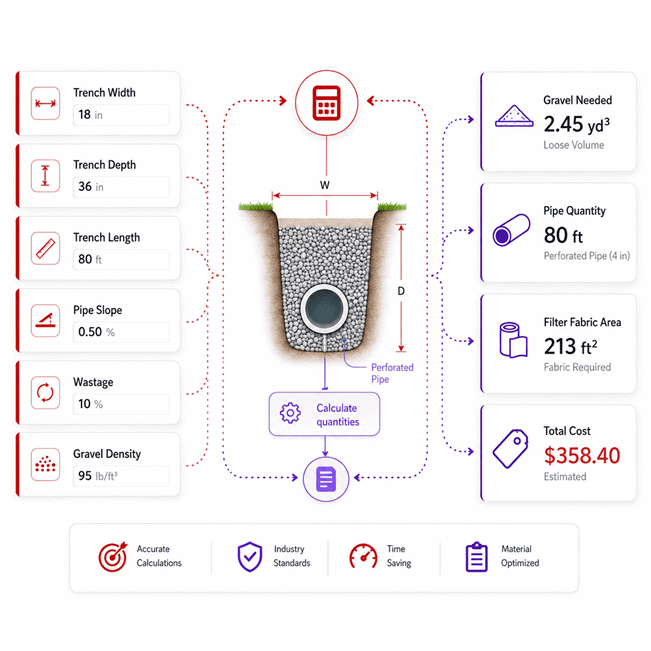
French Drain Calculator results help you estimate the trench, gravel, perforated pipe, filter fabric, and material costs needed for a drainage project. The calculation starts with trench width, depth, and length, then accounts for the space occupied by the drain pipe. It can also include gravel wastage, gravel density, pipe slope, standard pipe lengths, filter fabric overlap, and material prices.
- Estimate trench volume from the actual planned trench dimensions.
- Account for pipe displacement before determining the base gravel requirement.
- Add a practical gravel allowance for site variation and material loss.
- Convert gravel volume into weight when density information is available.
- Estimate pipe slope, vertical drop, installed length, and whole pipe pieces.
- Calculate filter fabric width and area from trench geometry and overlap.
- Compare gravel, pipe, fabric, and combined material costs before purchasing.
- Use reverse solving when a known result must determine a missing dimension.
The French Drain Calculator is most useful before excavation and ordering. Accurate site measurements, a workable drainage route, and a suitable outlet should be confirmed first. Material estimates support planning, while drainage capacity and high-risk structural applications may require site-specific professional design.
Assumptions used in this calculator
- Trench dimensions are assumed uniform throughout the entire drainage run.
- The trench cross-section is treated as rectangular for volume calculations.
- Drain pipe is treated as a straight cylinder using outside diameter.
- Pipe slope is assumed constant along the complete drainage run.
- Gravel is assumed to fill available trench volume surrounding the pipe.
- Pipe displacement is subtracted from trench volume before gravel wastage.
- Wastage is applied as a percentage of calculated base gravel volume.
- Gravel bulk density is assumed uniform for the selected material.
- Filter fabric is assumed to wrap the trench with specified overlap.
- Required filter fabric length is assumed equal to trench length.
- Standard pipe pieces are assumed usable at their full stated lengths.
- Pipe quantities are rounded upward to ensure sufficient purchased material.
- Results exclude labor, excavation, delivery, taxes, and hydraulic capacity verification.
Results are rounded for display.
Internal calculations use full precision.
Formulas Used in French Drain Calculator :
1. Unit Normalization
2. Trench Volume
3. Recommended Minimum Pipe Slope
4. Pipe Drop
5. Sloped Drain Pipe Length
6. Drain Pipe Displacement Volume
7. Base Gravel Volume
8. Total Gravel Volume Including Wastage
9. Gravel Weight
10. Required Number of Standard Drain Pipes
11. Required Filter Fabric Width
12. Total Filter Fabric Area
13. Gravel Cost
14. Drain Pipe Cost
15. Filter Fabric Cost
16. Total Material Cost
- xb = value converted to its internal base unit
- xu = value entered or displayed in the selected unit
- ku = conversion factor from the selected unit to the internal base unit
- w = trench width
- d = trench depth
- Lh = horizontal trench length
- Vt = trench volume
- Dn = nominal drain pipe size
- Smin = recommended minimum pipe slope
- S = selected pipe slope expressed as a dimensionless rise-to-run ratio
- Δh = vertical pipe drop over the drainage run
- Lp = required sloped drain pipe length
- Do = drain pipe outside diameter
- Vp = volume displaced by the outside of the drain pipe
- Vg = gravel volume before wastage
- W = gravel wastage percentage
- Vgt = total gravel volume including wastage
- ρg = gravel bulk density
- Mg = required gravel mass or weight quantity
- Np = number of standard pipe pieces required
- Ls = standard length of one drain pipe piece
- Bf = required filter fabric width
- O = filter fabric overlap allowance
- Af = total required filter fabric area
- Pv = gravel price per unit volume
- Pm = gravel price per unit mass
- Pp = price per standard drain pipe piece
- Pa = filter fabric price per unit area
- Cg = gravel material cost
- Cp = drain pipe material cost
- Cf = filter fabric material cost
- Ctotal = total active material cost
- Ip = pipe inclusion indicator, equal to 1 when pipe is included and 0 otherwise
- If = filter fabric inclusion indicator, equal to 1 when fabric is included and 0 otherwise
Variables & Definitions
View a complete list of all variables used in this calculator, including definitions and units
French Drain Calculator Variables and Formula Parameters
| Symbol | Variable | Description | Unit or Type | Calculation Role |
|---|---|---|---|---|
| xb | Base-unit value | Physical value after conversion to the calculator's internal base unit. | Base unit | Unit normalization |
| xu | Selected-unit value | Numeric value entered or displayed in the unit selected by the user. | Selected unit | Unit normalization |
| ku | Unit conversion factor | Factor used to convert a selected-unit value to its internal base unit. | Conversion factor | Unit normalization |
| w | Trench width | Inside width of the French drain trench used to determine excavation and gravel volume. | Length | Trench and fabric calculations |
| d | Trench depth | Vertical depth of the French drain trench. | Length | Trench and fabric calculations |
| Lh | Horizontal trench length | Horizontal length of the drainage run before pipe slope is applied. | Length | Trench, pipe, and fabric calculations |
| Vt | Trench volume | Total excavation volume determined from trench width, depth, and horizontal length. | Volume | Gravel requirement |
| Dn | Nominal pipe size | Nominal drain pipe size used to select the applicable minimum recommended slope. | Length | Pipe slope selection |
| Smin | Recommended minimum pipe slope | Minimum recommended elevation change per horizontal unit for the selected pipe size. | in/ft | Pipe slope selection |
| S | Selected pipe slope | Pipe elevation change divided by horizontal run, stored as a dimensionless ratio for calculations. | Ratio | Pipe drop and sloped length |
| Δh | Pipe drop | Vertical elevation difference between the beginning and end of the drain pipe run. | Length | Sloped pipe length |
| Lp | Required drain pipe length | Actual sloped pipe length required along the drainage run. | Length | Pipe volume and quantity |
| Do | Pipe outside diameter | External diameter of the perforated drain pipe used to calculate displaced trench volume. | Length | Pipe displacement volume |
| Vp | Pipe displacement volume | Cylindrical volume occupied by the outside of the drain pipe inside the trench. | Volume | Gravel requirement |
| Vg | Base gravel volume | Gravel volume required before adding the selected wastage allowance. | Volume | Gravel quantity |
| W | Gravel wastage | Additional gravel allowance applied to the calculated base gravel volume. | % | Total gravel volume |
| Vgt | Total gravel volume | Final gravel volume after applying the selected wastage percentage. | Volume | Material quantity and cost |
| ρg | Gravel bulk density | Mass of gravel per unit volume used to convert required gravel volume into mass. | Mass/Volume | Gravel weight |
| Mg | Required gravel mass | Calculated gravel quantity by mass using total gravel volume and bulk density. | Mass | Weight-based purchasing and cost |
| Np | Number of pipe pieces | Whole number of standard pipe pieces required, with fractional quantities rounded upward. | Pieces | Pipe quantity and cost |
| Ls | Standard pipe length | Available or custom length of one individual drain pipe piece. | Length | Pipe quantity |
| Bf | Filter fabric width | Required fabric width to cover the trench perimeter and selected overlap. | Length | Filter fabric area |
| O | Filter fabric overlap | Additional fabric width allowed for overlap when lining the French drain trench. | Length | Filter fabric width |
| Af | Total filter fabric area | Total fabric area required from the calculated fabric width and trench length. | Area | Fabric quantity and cost |
| Pv | Gravel price by volume | Unit price of gravel when the material is purchased according to volume. | Currency/Volume | Gravel cost |
| Pm | Gravel price by mass | Unit price of gravel when the material is purchased according to mass. | Currency/Mass | Gravel cost |
| Pp | Pipe price per piece | Purchase price of one standard drain pipe piece. | Currency/Piece | Pipe cost |
| Pa | Filter fabric unit price | Purchase price of filter fabric per unit area. | Currency/Area | Fabric cost |
| Cg | Gravel cost | Calculated gravel material cost based on either total volume or required mass. | Currency | Material cost |
| Cp | Drain pipe cost | Calculated cost of the required whole number of drain pipe pieces. | Currency | Material cost |
| Cf | Filter fabric cost | Calculated cost of the required filter fabric area. | Currency | Material cost |
| Ctotal | Total material cost | Combined cost of the active gravel, pipe, and filter fabric materials. | Currency | Final cost result |
| Ip | Pipe inclusion indicator | Equals 1 when drain pipe is included and 0 when the French drain is pipeless. | 0 or 1 | Total material cost |
| If | Filter fabric inclusion indicator | Equals 1 when filter fabric is included and 0 when filter fabric is excluded. | 0 or 1 | Total material cost |
Unit Conversion Table
French Drain Length Unit Conversion Table
| Unit Group | Unit Name | Symbol | Equivalent in Meters | Used For |
|---|---|---|---|---|
| Length | Millimeter | mm | 0.001 m | Pipe diameter and precise dimensions |
| Length | Centimeter | cm | 0.01 m | Trench and pipe dimensions |
| Length | Meter | m | 1 m | Metric trench, pipe, and fabric dimensions |
| Length | Inch | in | 0.0254 m | Trench dimensions and pipe diameter |
| Length | Foot | ft | 0.3048 m | Trench length, depth, pipe length, and drop |
| Length | Yard | yd | 0.9144 m | Long drainage runs and material dimensions |
French Drain Area Unit Conversion Table
| Unit Group | Unit Name | Symbol | Equivalent in Square Meters | Used For |
|---|---|---|---|---|
| Area | Square Foot | ft² | 0.09290304 m² | Filter fabric area |
| Area | Square Yard | yd² | 0.83612736 m² | Filter fabric purchasing |
| Area | Square Meter | m² | 1 m² | Metric filter fabric area |
French Drain Volume Unit Conversion Table
| Unit Group | Unit Name | Symbol | Equivalent in Cubic Meters | Used For |
|---|---|---|---|---|
| Volume | Cubic Foot | ft³ | 0.028316846592 m³ | Trench, pipe, and gravel volume |
| Volume | Cubic Yard | yd³ | 0.764554857984 m³ | Bulk gravel purchasing |
| Volume | Cubic Meter | m³ | 1 m³ | Metric trench and gravel volume |
French Drain Mass Unit Conversion Table
| Unit Group | Unit Name | Symbol | Equivalent in Kilograms | Used For |
|---|---|---|---|---|
| Mass | Kilogram | kg | 1 kg | Gravel mass |
| Mass | Pound | lb | 0.45359237 kg | Imperial gravel weight |
| Mass | US Short Ton | US ton | 907.18474 kg | Bulk gravel purchasing |
| Mass | Metric Tonne | t | 1000 kg | Metric bulk gravel purchasing |
French Drain Gravel Density Unit Conversion Table
| Unit Group | Unit Name | Symbol | Equivalent in kg/m³ | Used For |
|---|---|---|---|---|
| Density | Kilogram per Cubic Meter | kg/m³ | 1 kg/m³ | Metric gravel bulk density |
| Density | Pound per Cubic Foot | lb/ft³ | 16.01846337 kg/m³ | Imperial gravel bulk density |
| Density | US Short Ton per Cubic Yard | US ton/yd³ | 1186.55284252 kg/m³ | Bulk aggregate density |
French Drain Pipe Slope Unit Conversion Table
| Unit Group | Unit Name | Symbol | Equivalent in m/m | Used For |
|---|---|---|---|---|
| Slope | Inch per Foot | in/ft | 0.0833333333 m/m | Recommended pipe slope and pipe drop |
| Slope | Percent Grade | % | 0.01 m/m | Pipe slope entry and display |
| Slope | Millimeter per Meter | mm/m | 0.001 m/m | Metric pipe slope |
French Drain Wastage Unit Conversion Table
| Unit Group | Unit Name | Symbol | Equivalent in Decimal Ratio | Used For |
|---|---|---|---|---|
| Percentage | Percent | % | 1% = 0.01 | Gravel wastage allowance |
| Percentage | Decimal Ratio | ratio | 1 = 100% | Internal wastage calculation |
French Drain Gravel Price by Volume Unit Conversion Table
| Unit Group | Unit Name | Symbol | Equivalent in $/m³ | Used For |
|---|---|---|---|---|
| Price per Volume | Dollar per Cubic Foot | $/ft³ | 1 $/ft³ = 35.31466672 $/m³ | Gravel cost by volume |
| Price per Volume | Dollar per Cubic Yard | $/yd³ | 1 $/yd³ = 1.30795062 $/m³ | Bulk gravel cost by volume |
| Price per Volume | Dollar per Cubic Meter | $/m³ | 1 $/m³ | Metric gravel cost by volume |
French Drain Gravel Price by Weight Unit Conversion Table
| Unit Group | Unit Name | Symbol | Equivalent in $/kg | Used For |
|---|---|---|---|---|
| Price per Mass | Dollar per Kilogram | $/kg | 1 $/kg | Metric gravel cost by mass |
| Price per Mass | Dollar per Pound | $/lb | 1 $/lb = 2.20462262 $/kg | Imperial gravel cost by weight |
| Price per Mass | Dollar per US Short Ton | $/US ton | 1 $/US ton = 0.00110231 $/kg | Bulk gravel cost by weight |
| Price per Mass | Dollar per Metric Tonne | $/t | 1 $/t = 0.001 $/kg | Metric bulk gravel cost |
French Drain Filter Fabric Price Unit Conversion Table
| Unit Group | Unit Name | Symbol | Equivalent in $/m² | Used For |
|---|---|---|---|---|
| Price per Area | Dollar per Square Foot | $/ft² | 1 $/ft² = 10.76391042 $/m² | Filter fabric cost |
| Price per Area | Dollar per Square Yard | $/yd² | 1 $/yd² = 1.19599005 $/m² | Bulk filter fabric cost |
| Price per Area | Dollar per Square Meter | $/m² | 1 $/m² | Metric filter fabric cost |
French Drain Pipe Price Unit Table
| Unit Group | Unit Name | Symbol | Equivalent in Price per Piece | Used For |
|---|---|---|---|---|
| Price per Piece | Dollar per Pipe Piece | $/pc | 1 $/pc | Drain pipe material cost |
Example Calculation
The trench volume is calculated first, then the volume occupied by the sloped drain pipe is removed to determine the base gravel requirement. A 12% wastage allowance increases the purchasing volume to about 2.448 cubic yards, while gravel density converts that quantity into an estimated weight. Pipe quantity is rounded upward because partial standard pipe pieces cannot satisfy the required run length. The final material cost combines the active gravel, pipe, and filter fabric costs using consistent purchasing units.
Reverse solving starts with the known gravel requirement and treats trench length as the missing variable. The pipe slope and outside diameter remain part of the equation because the pipe occupies measurable trench volume. After solving the trench length, the result is checked by recalculating trench and pipe volumes, which returns exactly 30.000 cubic feet of base gravel. The solved geometry can then be used normally for wastage, weight, pipe quantity, filter fabric, and material cost calculations.
Results are rounded for display.
Internal calculations use full precision.
Calculations Disclaimer
How a French Drain Calculator Turns Trench Data Into Useful Material Decisions
A drainage project often looks simple until material ordering starts. One wrong dimension can change every quantity. A French Drain Calculator removes much of that guesswork. The French Drain Calculator connects trench size, pipe choices, gravel needs, fabric needs, and material costs. It gives each decision a clear place in the same planning process.
The best workflow starts with the trench itself. Width, depth, and length define the available space. Pipe settings then change how much space remains for gravel. Fabric settings affect the amount of geotextile needed. Material prices turn those quantities into a practical budget.
This matters because each part affects another part. A wider trench needs more gravel. A larger pipe occupies more trench space. A longer drain needs more pipe and fabric. A higher waste allowance increases the final gravel order.
Trench dimensions → Pipe setup → Gravel requirement → Fabric requirement → Material cost
The calculator is most useful before ordering materials. It lets homeowners, landscapers, and contractors test several layouts quickly. You can compare choices before excavation begins. That can reduce rushed purchases and unexpected shortages.
AxiCalculator also keeps the planning process in one place. This reduces repeated manual calculations. It also makes project changes easier to review.
French Drain Trench Calculator: Width, Depth, Length, and Excavation Volume
A common mistake starts before the first pipe is selected. The trench dimensions may not match the actual site. This creates wrong material estimates from the beginning.
Measure the planned trench width at the usable interior space. Measure the depth from the finished surface downward. Measure the full horizontal drainage route. Curves and changes in direction should also be considered during site planning.
The trench dimensions control more than excavation volume. They define the space available for gravel and pipe. They also affect the fabric width needed around the drainage zone.
A narrow trench may save excavation work. However, it also leaves less room around the pipe. A deeper trench increases gravel use quickly. A longer trench increases almost every material quantity.
Use measured dimensions instead of rough visual estimates. Even small errors can become large across long drainage runs. A difference of several inches can matter over many feet.
Check this before buying anything: trench geometry drives almost every material quantity.
Site conditions also matter. Existing utilities may limit trench depth. Roots may change the route. Structures may restrict width. The final dimensions should reflect the real installation area.
How Mixed Measurements Affect French Drain Planning
Real projects rarely arrive in one neat measurement system. A pipe may be listed in inches. Trench depth may be measured in feet. Project length may come from a metric site plan.
A useful calculator should handle these values without forcing manual conversions. This prevents simple conversion errors. It also saves time when suppliers use different units.
The physical size should remain unchanged when units change. Only the displayed number should change. This is especially useful during purchasing. A contractor may think in feet while reading metric product data.
Mixed measurements are common on renovation sites. They also appear on imported product sheets. A flexible tool makes these situations easier to manage.
Why Trench Geometry Changes Gravel, Pipe, Fabric, and Cost
A trench is not just an empty channel. It is the container for the entire drainage assembly. Any geometry change moves several results at once.
Increasing width usually raises gravel demand. Increasing depth does the same. Increasing length affects gravel, pipe, fabric, and many costs together.
This creates a useful planning opportunity. You can compare practical trench layouts before digging. A modest change may reduce material use significantly. Another change may improve installation access.
The cheapest geometry is not always the best geometry. The trench still needs to suit the pipe and site. It also needs enough drainage aggregate around the pipe.
The goal is balance. Use dimensions that fit the site and installation plan. Then estimate the material impact before committing to excavation.
French Drain Gravel Calculator: How Much Drainage Gravel Do You Actually Need?
Gravel is often the largest bulk material in a French drain. Ordering too little interrupts the job. Ordering too much creates waste, transport costs, and leftover stone.
The gravel requirement begins with the space inside the trench. If a pipe is included, that pipe occupies part of the available volume. The remaining space is the main gravel zone.
The material should also match the drainage purpose. Clean drainage stone is usually preferred over material containing many fines. Fine particles can fill open spaces between stones. That can slow water movement through the gravel bed.
Supplier descriptions can vary. One yard of loose aggregate may also behave differently after handling. Moisture and material grading can affect delivered weight.
That is why volume and weight should not be treated as identical buying measures. Volume describes space. Weight describes mass. Density links the two.
A useful gravel estimate should help users move from trench geometry to a realistic purchase quantity. It should also allow an extra material allowance where needed.
Why Pipe Displacement Changes the Gravel Requirement
One detail changes everything: the pipe itself occupies real trench space. Ignoring that space can overstate the required gravel.
The effect becomes larger with bigger pipe diameters. It also grows with longer drainage runs. A small residential pipe may have a modest effect. A larger pipe can remove much more usable gravel volume.
This is why outside pipe size matters during material planning. Gravel surrounds the outside surface. It does not fill the internal pipe opening.
A pipeless French drain behaves differently. In that case, the trench can contain gravel without pipe displacement. The required aggregate may therefore increase.
Do not estimate gravel from trench size alone when a large pipe is installed.
This distinction is easy to overlook during manual estimating. A calculator keeps the pipe and gravel relationship visible.
How Extra Material Allowance Changes the Final Gravel Order
A perfect theoretical quantity rarely matches every real construction site. Gravel may be lost during transport or placement. Trench walls may also vary slightly.
An additional allowance helps cover these differences. It should reflect the project conditions. A neat machine-cut trench may need less extra material. An irregular hand-dug trench may need more.
The allowance should not hide poor measurements. Start with good site dimensions first. Then add a practical buffer.
This approach gives buyers a clearer purchasing target. It also reduces emergency supplier trips during installation.
However, excessive extra material can create another problem. Leftover gravel still costs money. It also needs storage or disposal.
How Gravel Density Helps Estimate Pounds, Kilograms, and Tons
Suppliers may sell the same stone by different measures. One supplier may quote cubic yards. Another may quote tons. This can make price comparison confusing.
Gravel density helps connect volume with mass. The value depends on material type and condition. Different stones can have different bulk densities.
This means one cubic yard does not always weigh the same. Moisture can also affect delivered weight. Compaction can change how much space the aggregate occupies.
Use the density that best matches the material being purchased. Supplier data is often the most practical choice. Avoid assuming every drainage stone has identical weight.
Weight output is useful for delivery planning. It can also help compare supplier quotes. Truck capacity may become important on larger projects.
French Drain Pipe Calculator: Diameter, Slope, Drop, Length, and Pipe Quantity
A drainage pipe may look like one simple purchase. In practice, several choices affect the final quantity. Diameter, slope, route length, and available piece lengths all matter.
The pipe should follow the planned drainage path. It also needs a suitable outlet or discharge point. Water collection without a useful outlet can create another wet area.
Perforated pipe is commonly used within the gravel zone. The openings allow surrounding water to enter. The pipe then carries that water toward the discharge point.
The actual installed pipe length can differ slightly from horizontal trench length. Slope creates vertical change along the route. This difference becomes more noticeable across long runs.
Pipe selection should also consider project demand. A small landscape drain has different needs from a major foundation drainage system.
The calculator helps with material planning. The final pipe selection should still fit the actual drainage design.
What Minimum Pipe Slope Should You Use for Different Drain Pipe Sizes?
A common drainage problem appears when water has no clear path downhill. Standing water can remain inside poorly graded pipe.
The required slope depends on the pipe system and project design. Pipe size can also affect recommended installation practice. Larger pipes may use different slope guidance from smaller pipes.
A consistent fall is usually more important than isolated steep sections. Local dips can trap sediment and water. High spots can also interrupt flow.
Measure the route before excavation. Confirm that the outlet elevation is lower than the collection area. This simple check can prevent a major installation mistake.
If site levels are uncertain, use proper leveling equipment. Long drainage runs can be difficult to judge visually.
How Pipe Slope and Vertical Drop Change Actual Pipe Length
A trench may measure one distance on the ground. The sloped pipe travels along a slightly different path. This creates a longer installed length.
For short runs, the difference may be very small. Longer runs can make it more important. The difference also increases when the slope becomes steeper.
This matters when pipe is sold in fixed pieces. A project that appears exact may need another full section.
Vertical drop also helps confirm whether gravity drainage is practical. A long drain needs enough available elevation. A site with almost no fall may need another solution.
Always confirm the final outlet location before buying large amounts of material. The route should work physically, not only on paper.
Why Outside Pipe Diameter Matters More Than Nominal Size for Gravel Planning
Nominal pipe size is useful for product identification. It does not always describe the exact exterior dimension.
The outside diameter is what occupies space inside the gravel bed. That makes it more useful for material displacement.
Two pipe products with similar names can have different outside dimensions. Wall construction and pipe standard can cause these differences.
Use the actual product dimension whenever possible. This improves gravel estimates and trench fit checks.
This detail becomes more important in narrow trenches. A larger outside diameter leaves less gravel around the pipe.
How Many Standard Pipe Pieces Should You Buy Without Under-Ordering?
A common purchasing mistake occurs when required length is divided exactly on paper. Real pipe comes in whole sections.
If the drain needs slightly more than three pieces, three pieces are not enough. The project needs a fourth piece.
Standard lengths also differ between suppliers and pipe types. Confirm available stock before final ordering.
Fittings may also add material needs. Couplers, adapters, cleanouts, outlets, and end components can affect the final order.
Do not assume every offcut will be reusable. Some cuts may be too short for another section.
Plan the pipe layout before purchasing. This gives a cleaner estimate and reduces extra store visits.
French Drain Filter Fabric Calculator: Width, Overlap, Area, and Material Needs
Many drains lose performance because surrounding soil slowly enters the gravel. Filter fabric can help separate those materials.
The fabric should suit drainage use. Water needs to pass through it. Soil particles should remain separated from the aggregate.
The required amount depends on trench geometry. Deeper trenches need more fabric along the sides. Wider trenches need more across the base and closure area.
Overlap also affects the final width. Too little overlap can leave exposed gravel. Excessive overlap increases material use.
Fabric rolls are usually sold in fixed widths and lengths. This creates another practical buying decision. A calculated area may not match the exact roll area purchased.
Plan fabric cuts before ordering. Long continuous sections may reduce seams. They can also simplify installation.
How Trench Width and Depth Determine the Required Geotextile Width
A common mistake is buying fabric based only on trench width. The material also travels down both trench walls.
A deeper trench therefore needs a wider sheet. The closing overlap also adds more width.
Visualize the fabric before digging. Imagine lining the base and both walls. Then include enough material to close the gravel zone.
This simple planning step prevents narrow rolls from becoming useless on site.
Roll orientation also matters. Sometimes a wider roll reduces cutting. In other cases, a narrower roll may reduce waste.
The best purchase depends on both required area and available roll dimensions.
French Drain Cost Calculator: Gravel, Pipe, Fabric, and Total Material Price
Material quantity is only half the purchasing decision. Two designs can use similar space but have different costs.
Gravel often drives bulk delivery cost. Pipe cost depends on diameter, type, and piece count. Fabric cost depends on area and roll format.
Delivery can also change the real project budget. Heavy aggregate may have significant transport charges. Small orders can sometimes carry minimum delivery fees.
Compare supplier pricing using the same quantity basis. A price per ton should not be compared directly with a price per cubic yard.
Pipe prices should also be compared using equivalent product specifications. A lower price may reflect a different pipe class or construction.
The calculator can organize core material costs. Buyers can then add local charges separately.
AxiCalculator is especially useful during supplier comparison. Change the price inputs while keeping the project geometry unchanged.
Should French Drain Gravel Be Priced by Volume or by Weight?
This question often appears when two suppliers quote differently. Neither pricing method is automatically better.
Volume pricing is simple when aggregate is sold by cubic yard. Weight pricing is common at quarries and bulk suppliers.
The important step is comparing equal material quantities. Density provides the bridge between those systems.
Delivery method can also change the better choice. A small landscape supplier may sell by volume. A quarry may sell by weight.
Ask whether quoted weight includes moisture effects. Also confirm the exact aggregate product.
A low price is not useful if the stone is unsuitable for drainage.
Reverse Solving a French Drain Calculator: Find Missing Dimensions From Known Results
Sometimes the project starts with a result instead of a dimension. You may know the available gravel quantity. Trench length may still be unknown.
Reverse solving makes this situation easier. A known result can help determine a missing project value.
This is useful during redesign. A contractor may have fixed material stock. The trench geometry may need adjustment around that stock.
It also helps during verification. If a known trench volume is available, one missing dimension can be checked against it.
Reverse solving works best when the remaining values are reliable. Wrong known values still produce a wrong result.
The feature should therefore support planning, not replace site measurement.
If one value is unknown, do not restart the estimate. Solve around what you know.
How Reverse Calculation Helps With Width, Depth, Length, and Material Quantities
A common redesign problem appears when one project limit changes. The available trench width may shrink. The target material quantity may remain fixed.
Reverse calculation helps explore that change. Known values remain in place. The missing value becomes the target.
This can support trench geometry checks, material quantity checks, and purchasing decisions.
The same idea is useful for cost planning. A known material cost and known quantity can reveal an implied unit price.
Reverse tools are also helpful when reviewing another estimate. Enter the known numbers and compare the missing value.
This makes the calculator more useful than a simple one-direction form.
Buying French Drain Materials Without Overbuying or Stopping the Job Early
Buying too early creates expensive mistakes. Buying too late can stop excavation halfway through the project.
Start with the trench route. Then confirm pipe type and outside diameter. Next, determine the aggregate requirement. Fabric comes after the trench geometry is clear.
Check supplier packaging before final ordering. Gravel may be sold loose or bagged. Fabric may come in large rolls. Pipe may come in fixed lengths.
Compare the calculated need with the actual package sizes. Purchase quantities may need practical adjustment.
Product quality also matters. Check pipe condition before installation. Inspect fabric for damage. Confirm the aggregate is the ordered grade.
Keep receipts and product documents where useful. Warranty terms should come from the actual seller or manufacturer.
AxiCalculator can help prepare the quantity plan before supplier contact. This makes quote requests clearer and easier to compare.
How to Choose Pipe, Gravel, and Fabric as One Drainage System
A French drain works as a system. Choosing each material separately can create compatibility problems.
The pipe needs enough surrounding aggregate. The aggregate must allow water movement. The fabric should separate soil without blocking drainage.
Consider the outlet at the same time. A perfect trench cannot perform well without a suitable discharge path.
Material durability matters in buried installations. Replacing a cheap failed component can require complete excavation.
Choose materials for the site conditions, not only the lowest price.
For foundation or structural drainage, project consequences are higher. Professional design may be worth the added cost.
Common French Drain Planning and Installation Errors That Increase Cost
Many drainage failures begin with simple planning mistakes. The first is choosing a route without checking elevation.
Another mistake is using dirty aggregate with too many fines. Fine material can reduce open drainage space.
Poor fabric placement can also cause trouble. Exposed soil may migrate into the gravel over time.
Pipe layout is another risk. Low spots can hold water and sediment. Poor outlet planning can make the whole system ineffective.
Trench measurements are often underestimated. Irregular walls can require more gravel than expected.
Another problem is ordering pipe by trench length alone. Sloped routing and whole piece lengths can change the purchase quantity.
Do not ignore access. Large gravel deliveries need a practical unloading location. Excavated soil also needs somewhere to go.
Finally, never dig before utility locations are known. A drainage improvement is not worth damaging buried services.
French Drain Material Planning for Homeowners, Landscapers, and Contractors
Different users need different levels of detail. Homeowners often want a reliable shopping quantity. Contractors also need speed and repeatability.
A clear planning process serves both groups. Start with measured site geometry. Add the selected pipe configuration. Review gravel and fabric needs. Then compare material costs.
Measure → Configure → Estimate → Compare → Purchase → Install → Review drainage performance
Homeowners should focus on clear measurements and safe excavation. Landscapers may also compare several routes. Contractors may use the same process across many estimates.
The calculator can also support quote preparation. A material list gives suppliers clearer information. It can reduce vague pricing conversations.
For larger projects, save the final results before ordering. This gives the team one agreed planning reference.
Material planning does not need to feel complicated. Break the project into connected decisions. Review each decision before moving forward.
When a French Drain Material Calculator Is Not Enough for Site Design
Some drainage problems are bigger than material quantities. A wet foundation can involve groundwater pressure. Large runoff areas can create heavy flow.
A material calculator can estimate gravel, pipe, fabric, and cost. It cannot prove that every drainage system has enough hydraulic capacity.
Site soil matters. Clay behaves differently from free-draining soil. Groundwater conditions can also change seasonally.
Outlet conditions are equally important. Water must leave the system safely. Discharging water toward another structure can create a new problem.
Retaining walls and foundations need extra care. Drainage failure near structural elements can become expensive.
Professional review becomes more important when failure has serious consequences. It is also useful when the site lacks obvious fall.
The calculator remains valuable during these projects. It can support material planning after the drainage design is established.
Use AxiCalculator to Plan the Next French Drain Purchase With More Confidence
The most expensive mistake is often not the material price. It is ordering from a weak plan.
AxiCalculator helps turn site measurements into a clearer material decision. You can review trench dimensions, pipe needs, gravel needs, fabric needs, and estimated costs together.
You can also test changes before buying. Increase trench depth and watch the material plan change. Change pipe size and review the gravel effect. Adjust supplier prices and compare the budget.
This makes the tool useful before requesting quotes. It is also useful before scheduling deliveries.
Take accurate site measurements first. Confirm the planned drainage route and outlet. Then enter the project values into the French Drain Calculator.
Review the final quantities before ordering. Compare supplier package sizes and product specifications. Keep the plan available during installation.
A few minutes of careful planning can prevent hours of rework. Use AxiCalculator before excavation, purchasing, and final material scheduling.
Frequently Asked Questions
Can I use a French Drain Calculator before I know the exact pipe brand?
What should I measure on site before using the calculator?
Can I estimate materials if my French drain has several different trench sizes?
Should I use supplier package sizes or exact calculator results when ordering materials?
How should I handle a project where the pipe slope changes along the drainage run?
What should I do if the calculated pipe displacement is too large for the planned trench?
How can I verify a French drain material estimate before issuing it for construction?
Our engineers are here to help you get it right.