Flight Carbon Footprint Calculator
- Last formula update:

Decimal & Rounding Policy
- All calculations use full floating-point precision without rounding intermediate values.
- Flight duration is calculated internally in hours and CO2 emissions in kilograms.
- Seat occupancy is converted from a percentage to a decimal fraction before calculation.
- Final displayed values use up to 6 decimal places and unnecessary trailing zeros are removed.
- Unit conversions are performed from canonical values to prevent cumulative rounding errors.
- Reverse calculations retain full precision before the solved value is formatted for display.
- Yearly allowance percentages are calculated from unrounded CO2 emissions for consistent results.
Valid range
- Flight duration must be greater than 0 and no more than 1,000,000 hours.
- Seat occupancy must be greater than 0% and no more than 100%.
- CO2 emissions must be greater than 0 and no more than 1,000,000,000,000 kg.
- Yearly allowance must be greater than 0% and may exceed 100%.
- One-way and return are the only valid flight-direction selections.
- Duration units are limited to seconds, minutes, and hours.
- CO2 mass units are limited to grams, kilograms, tonnes, and pounds.
- Zero occupancy is invalid because it would cause division by zero.
- Negative, nonnumeric, infinite, and unsupported values are rejected.

Tivessa Zorquell
Reviewers:
Veralisse Noxmere
Sarven Kestthorne
Check our editorial policy
September 13, 2026
1.0.0
Initial calculator and formula release.
Our engineers are here to help you get it right.
How Does the Flight Carbon Footprint Calculator Estimate Your Air Travel Impact?
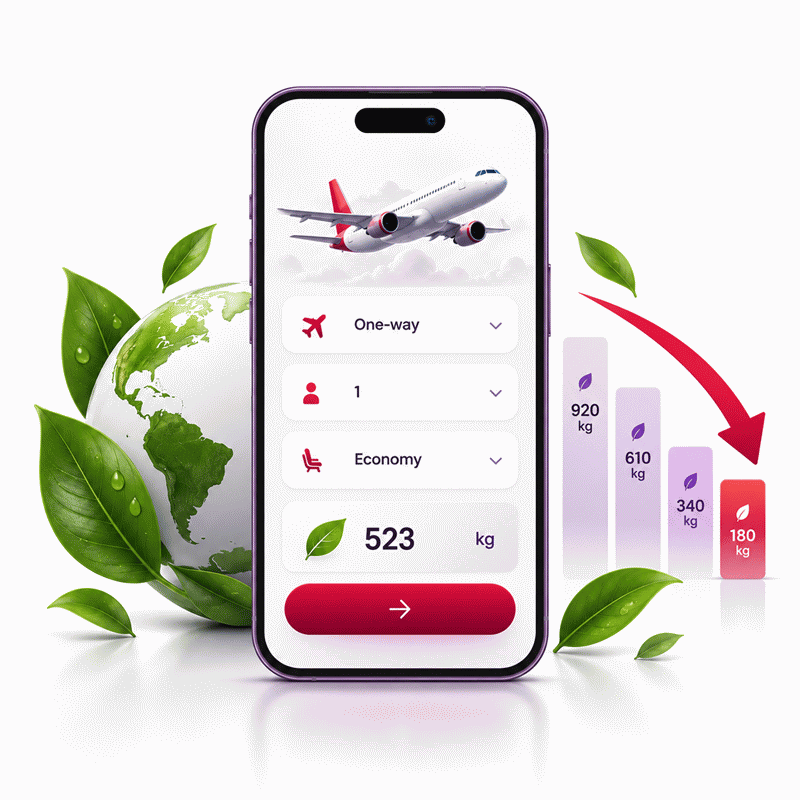
Flight Carbon Footprint Calculator results give you a fast estimate of passenger flight emissions using flight duration, trip direction, and seat occupancy. Enter the duration of one flight leg, choose One-way or Return, and review the occupancy value. The calculator updates immediately, so you can compare different travel scenarios without manual arithmetic. A return selection represents two flight legs, while lower seat occupancy increases the modeled emissions allocated to each passenger.
- Use one-leg flight duration for a normal one-way or return calculation.
- Check the selected time unit before entering your duration.
- Use a realistic seat occupancy value for meaningful comparisons.
- Read CO2 emissions as an estimate for the modeled passenger share.
- Use the yearly allowance result to put the flight into broader context.
- Compare scenarios with the same assumptions for consistent results.
- Use reverse solving when emissions are known but duration is missing.
- Verify professional or regulated results with the required reporting method.
The Flight Carbon Footprint Calculator is especially useful for rapid planning, travel comparisons, educational work, and early sustainability screening when detailed route or aircraft data is unavailable.
Assumptions used in this calculator
- Flight emissions are estimated from duration rather than traveled route distance.
- Base emissions are assumed at 90 kg CO2 per passenger-hour.
- A radiative forcing factor of 2 is applied to flight emissions.
- Seat occupancy directly affects each passenger’s estimated share of emissions.
- The default seat occupancy is assumed to be 80%.
- One-way travel uses a trip multiplier of 1.
- Return travel assumes two flights of equal duration and operating conditions.
- Return travel therefore uses a trip multiplier of 2.
- The annual reference allowance is fixed at 2,500 kg CO2.
- Aircraft type and engine efficiency are not individually modeled.
- Weather, routing, payload, and operational variations are not individually modeled.
- Intermediate calculations retain full precision before final display formatting.
- Results are estimates and are not certified emissions inventory measurements.
Results are rounded for display.
Internal calculations use full precision.
Formulas Used in Flight Carbon Footprint Calculator :
Seat Occupancy Conversion
Flight CO2 Emissions
Yearly Allowance Percentage
Reverse Flight Duration
Reverse Seat Occupancy
Reverse CO2 Emissions from Yearly Allowance
- t = one-way flight duration in hours.
- p = seat occupancy in percent.
- o = seat occupancy as a decimal fraction.
- m = trip multiplier, 1 for one-way and 2 for return.
- E = estimated CO2 emissions in kilograms.
- A = yearly allowance used by the flight in percent.
- 90 = assumed CO2 emission rate in kg per passenger-hour.
- 2 = radiative forcing factor.
- 2500 = reference annual CO2 allowance in kilograms per person.
Variables & Definitions
View a complete list of all variables used in this calculator, including definitions and units
Flight Carbon Footprint Calculator Variables
| Variable | Name | Unit | Role | Valid Value |
|---|---|---|---|---|
t |
Flight duration | h | One-way duration used in the emissions equation | Greater than 0 |
p |
Seat occupancy | % | User-facing occupancy percentage | Greater than 0 and no more than 100 |
o |
Occupancy fraction | Decimal | Internal seat occupancy used in the denominator | Greater than 0 and no more than 1 |
m |
Trip multiplier | Dimensionless | Adjusts emissions for one-way or return travel | 1 for one-way or 2 for return |
E |
CO2 emissions | kg | Estimated flight carbon dioxide emissions | Greater than 0 |
A |
Yearly allowance | % | Share of the reference annual CO2 allowance | Greater than 0 and may exceed 100 |
90 |
Emission rate | kg CO2 per passenger-hour | Base passenger flight emission assumption | Fixed constant |
2 |
Radiative forcing factor | Dimensionless | Accounts for the enhanced climatic effect of high-altitude emissions | Fixed constant |
2500 |
Annual CO2 allowance | kg CO2 per person | Reference value used to calculate yearly allowance percentage | Fixed constant |
Unit Conversion Table
Flight Duration Unit Conversion Table
| Unit Group | Unit Name | Symbol | Equivalent in Hours | Used For |
|---|---|---|---|---|
| Popular Units | Minute | min | 1 min = 1/60 h | Flight duration |
| Popular Units | Hour | h | 1 h = 1 h | Flight duration and canonical calculation |
| Scientific Units | Second | s | 1 s = 1/3600 h | Precise flight duration conversion |
CO2 Emissions Mass Unit Conversion Table
| Unit Group | Unit Name | Symbol | Equivalent in Kilograms | Used For |
|---|---|---|---|---|
| Popular Units | Kilogram | kg | 1 kg = 1 kg | Canonical CO2 emissions calculation |
| Popular Units | Metric tonne | t | 1 t = 1000 kg | Large CO2 emission totals |
| Popular Units | Pound | lb | 1 lb = 0.45359237 kg | Imperial CO2 mass display |
| Scientific Units | Gram | g | 1 g = 0.001 kg | Small CO2 mass values |
Percentage Unit Conversion Table
| Unit Group | Unit Name | Symbol | Equivalent in Decimal Fraction | Used For |
|---|---|---|---|---|
| Popular Units | Percent | % | 1% = 0.01 | Seat occupancy input |
| Popular Units | Percent | % | 100% = 1.00 | Yearly allowance comparison |
Example Calculation
A 3.6-hour one-way flight with 81% seat occupancy produces an estimated 800 kg of CO2 per passenger under the calculator model. The occupancy percentage is first converted to a decimal fraction. The calculated emissions are then compared with the 2,500 kg annual reference allowance. In this case, the flight represents 32% of that annual amount.
When CO2 emissions, seat occupancy, and flight type are known, the flight duration can be solved directly. A return journey uses a multiplier of 2 while the 75% occupancy becomes 0.75 internally. Solving the same emissions relationship gives a one-way duration of 2.8125 hours for each leg. The specified emissions correspond to 54% of the annual reference allowance.
Results are rounded for display.
Internal calculations use full precision.
Calculations Disclaimer
How Can You Estimate the Carbon Footprint of a Flight?
You may know your flight time but not its environmental impact. A Flight Carbon Footprint Calculator turns that time into a practical estimate. Start with the duration of one flight leg. Then choose whether the journey is one-way or return. Check the expected seat occupancy. The result updates as soon as usable values are available.
This approach is useful when route-level aircraft data is unavailable. Travelers often know flight duration before they know the exact aircraft. Sustainability teams also receive travel records with time information. A simple duration-based estimate can therefore fill an important planning gap.
What Information Do You Need Before You Start?
You only need a few pieces of information. First, confirm the scheduled or expected duration. Second, decide whether the trip is one-way or return. Third, review the seat occupancy value. These inputs determine the estimate shown for one passenger.
Do not rush the trip selection. It can create a large difference. A return journey represents two flight legs. The calculator accounts for that choice automatically. This prevents users from manually doubling numbers and making avoidable mistakes.
How Quickly Can You Get a Useful Flight Emissions Estimate?
The result should appear while you type. There is no need for a separate Calculate button. This makes quick comparisons easier. You can change one value and immediately see the effect.
That speed is useful during travel planning. Try different expected durations. Compare one-way and return options. Review how a different occupancy estimate changes the output. The goal is not extra clicking. The goal is faster understanding.
When Is Flight Duration the Most Practical Starting Point?
Flight duration is useful when airport or aircraft details are incomplete. It is also helpful for rough scenario planning. A project team may know travel hours before routes are finalized. A traveler may only have a booking estimate. In those situations, duration provides an accessible starting point.
What Does Your Flight Carbon Footprint Result Actually Mean?
A carbon number without context is easy to misread. The result represents an estimated passenger allocation for the selected flight conditions. It is not the measured exhaust from one seat. The aircraft operates as a complete system. The model assigns a share of its environmental impact to a passenger.
How Should You Read CO2 Emissions per Passenger?
Read the result as a planning estimate. A larger number means the modeled journey carries a larger carbon burden. The result can help compare scenarios on a consistent basis. It can also make an invisible environmental cost easier to understand.
Do not confuse precision on screen with perfect real-world certainty. Aviation operations change. Aircraft models differ. Routes change because of weather and traffic. Payload also varies. A calculator can be mathematically consistent while the real flight still behaves differently.
Why Can One Flight Represent a Large Environmental Impact?
Aircraft travel quickly over long distances. This requires substantial energy. A passenger may spend only a few hours onboard. Yet those hours can represent a meaningful environmental load. The effect becomes more noticeable on longer journeys or repeated business travel.
For companies, this matters during travel planning. A few frequent travelers can create substantial annual aviation emissions. Seeing each journey separately makes that pattern easier to identify. It also supports more informed discussions about meeting locations and remote alternatives.
When Does a Result Need More Context Before Decision-Making?
Context becomes important when the result affects formal reporting. A planning estimate may be enough for personal awareness. It may also support early project comparisons. Regulatory inventories can require specific approved methods, source data, or reporting boundaries. Professional users should match the calculation method to the intended decision.
Why Does Flight Duration Change Your Estimated Emissions?
A common mistake is treating all flights as similar. Flight time changes the amount of operation represented by the estimate. Longer duration increases the modeled impact. Shorter duration reduces it, assuming the other conditions stay unchanged.
What Happens When Flight Time Increases?
The relationship is direct in this calculator. If the duration increases while other settings remain fixed, the emissions estimate increases. This makes sensitivity testing simple. Change the duration and observe the result immediately.
This feature is useful before travel is booked. Suppose two journey options reach the same region. One requires a much longer air segment. The calculator can show how that added duration affects the estimate. The comparison does not require a spreadsheet.
Why Can Delays and Longer Travel Times Matter in Real Operations?
Real aviation is more complex than scheduled time. Taxiing, holding patterns, wind, routing, and congestion can affect operations. A time-based estimate cannot distinguish every cause. It simply reflects the duration entered.
That makes data quality important. Use the same type of duration when comparing journeys. Do not compare scheduled gate time for one trip with airborne time for another. Consistency improves the usefulness of the comparison.
How Does Seat Occupancy Affect Passenger Flight Emissions?
Two identical aircraft can carry different numbers of passengers. That creates an allocation problem. The flight still operates, but the impact is shared among a different number of occupied seats. Seat occupancy helps represent this effect.
Why Can a Fuller Aircraft Reduce the Allocated Impact per Passenger?
A fuller aircraft spreads the modeled flight burden across more occupied seats. The allocated amount per passenger therefore falls. This does not mean the aircraft produces no emissions. It changes how the total modeled burden is distributed.
This distinction matters. The calculator is showing a passenger-level estimate. It is not claiming that adding one passenger suddenly reduces total aircraft fuel burn. The result describes allocation within the chosen model.
What Happens When Seat Occupancy Falls?
Lower occupancy increases the allocated result per passenger. Fewer travelers share the modeled impact. This is why occupancy should not be treated as decorative input. It can materially affect the answer.
Business users should avoid selecting an occupancy value only because it produces a preferred result. Use a defensible figure. When actual occupancy is unavailable, document the planning assumption internally. Consistent assumptions make comparisons more credible.
Why Should Industrial Users Treat Occupancy as a Meaningful Assumption?
Industrial travel records can cover many journeys. Small assumption changes may accumulate across the dataset. A sustainability team should therefore use the same basis across comparable records. That improves repeatability and helps reviewers understand why results differ.
What Changes Between One-Way and Return Flights?
Trip direction is simple, but mistakes are common. Users sometimes enter the full return duration and also select Return. That can unintentionally count the journey twice. The safest workflow is to treat the duration as one flight leg.
When Should You Select One-Way Travel?
Select One-way when the entered duration represents a single flight leg. This is appropriate for a single outbound journey. It is also useful when return travel will be calculated separately.
Separate calculations can help when outbound and return durations differ significantly. Wind and routing can change travel time. Two independent records may therefore provide better planning detail than one combined estimate.
How Should You Enter Flight Time for a Return Journey?
Enter the duration for one leg, then select Return. The calculator represents both directions. This workflow is faster and reduces manual arithmetic.
Check the itinerary before finalizing your result. Some return trips include different connections. In that case, one simple duration may not describe both directions well. Separate estimates can be clearer.
Why Can Aviation Have Climate Effects Beyond Ground-Level CO2?
Aircraft operate in atmospheric conditions unlike cars or household equipment. Their exhaust is released at altitude. Aviation can therefore influence climate through more than carbon dioxide alone. This is one reason aviation impact is discussed differently from many ground activities.
What Makes High-Altitude Emissions Different?
The surrounding atmosphere changes with altitude. Temperature and humidity also change. Aircraft exhaust can interact with those conditions. The resulting effects are not identical on every flight.
This creates uncertainty. A simple consumer calculator cannot simulate the atmosphere along every route. Instead, simplified models use broad factors to provide a practical estimate. Users should understand that distinction before comparing results from different methodologies.
Why Are Contrails and Other Aviation Effects Discussed Separately?
Visible contrails are one example of aviation interacting with the atmosphere. Some disappear quickly. Others persist under suitable conditions. Their climate effect depends on atmospheric conditions and timing.
This complexity explains why different aviation tools may show different values. One tool may focus on direct carbon dioxide. Another may represent broader warming effects. Always compare what each result represents before comparing the numbers themselves.
How Can You Use Flight Carbon Results for Better Decisions?
A result becomes useful when it changes a decision. Travelers can compare journey options. Project managers can review travel intensity. Sustainability teams can identify high-impact patterns. The number should support action rather than sit alone on a screen.
How Can Travelers Compare Different Travel Choices?
Keep the comparison consistent. Use the same calculation approach for each option. Enter realistic duration values. Keep occupancy assumptions consistent unless better information is available. Then compare the resulting passenger estimates.
The comparison may reveal a meaningful difference. A shorter itinerary can produce a lower estimate. Avoiding an unnecessary return journey can also change the result sharply. For some meetings, remote participation may remove the flight entirely.
How Can Sustainability Teams Use Fast Planning Estimates?
Early project planning rarely has perfect data. Teams may only know expected travel hours and trip frequency. A fast estimator can still reveal which plans deserve closer review.
For example, a team can compare one annual conference with several smaller trips. It can also identify travelers with repeated long journeys. These insights can guide later data collection. Detailed analysis can then focus on the largest contributors.
When Should a Formal Carbon Inventory Use a More Detailed Method?
Formal reporting can demand route data, aircraft information, passenger allocation rules, or prescribed conversion factors. A planning calculator should not silently replace those requirements. Use the simple estimate for screening and awareness. Use the required reporting method when compliance or audited disclosure is involved.
What Common Input Mistakes Can Distort a Flight Carbon Estimate?
Most calculation problems begin before the calculation itself. Wrong units, duplicated return travel, and unrealistic occupancy can all distort the result. A mathematically correct tool cannot repair incorrect source data.
Why Should You Check Flight Direction and Duration Together?
These two settings work together. If the duration already includes both directions, selecting Return can overstate the trip. If the duration represents one leg, One-way can understate a return journey.
Read the itinerary first. Decide what the time value represents. Then choose the trip direction. This ten-second check prevents one of the largest avoidable mistakes.
How Can Unit Mistakes Change the Number You Think You Entered?
Two hours and 120 minutes describe the same duration. The displayed number changes, but the physical time does not. Always check the unit selector beside the field.
The same principle applies to carbon mass. Kilograms and tonnes use different numerical scales. A unit-aware calculator should preserve the physical quantity during conversion. Users should still confirm the displayed unit before copying a result elsewhere.
What Should You Verify Before Using a Result Professionally?
Verify the original travel data first. Confirm duration, trip direction, and occupancy basis. Then confirm what the result represents. Keep a record of the calculation date when the number enters a project document.
Finally, match the tool to the decision. A quick estimate is excellent for screening. High-stakes reporting may need a prescribed methodology. Knowing that boundary makes the calculator more useful, not less useful.
Frequently Asked Questions
Can I use a flight carbon estimate before I know the exact aircraft?
Why can two flights with similar travel times still have different real emissions?
Should I calculate connecting flights as one trip or separate legs?
Can I compare flights from different years with this calculator?
How should a sustainability team document results produced by the calculator?
What should an engineer do when known emissions imply an impossible occupancy value?
Can this calculator be integrated into an internal carbon-reporting workflow?
Our engineers are here to help you get it right.