Effective Nuclear Charge Calculator
- Last formula update:

Decimal & Rounding Policy
- All Effective Nuclear Charge Calculator calculations use full internal precision, with no rounding during intermediate steps.
- Slater shielding factors such as 0.30, 0.35, 0.85, and 1.00 are applied exactly before calculating total shielding.
- Shielding constant and effective nuclear charge results are displayed with up to two decimal places when needed; exact integers remain unpadded.
- For scientific unit conversions, sufficient significant digits are retained to prevent meaningful loss of precision.
- Only the final displayed value is rounded, while the underlying calculation remains based on the unrounded result.
Valid range
- Element: Select a chemical element with atomic number Z from 1 to 118.
- Nuclear charge (Z): Enter an integer from 1 to 118, corresponding to the selected element’s atomic number.
- Principal quantum number (n): Use a positive integer from 1 to 7 that corresponds to an occupied electron shell of the selected element.
- Azimuthal quantum number (l): Use an occupied subshell value from 0 to n – 1; supported ground-state subshells are s = 0, p = 1, d = 2, and f = 3.
- Shielding constant (S): Use a finite value from 0 up to, but not including, Z as determined by the selected electron and Slater’s rules.
- Effective nuclear charge (Zeff): The valid result is greater than 0 and no greater than Z, following Zeff = Z – S.

Xylena Morforde
Reviewers:
Cirelle Vossford
Zorven Lumquell
Check our editorial policy
August 31, 2026
1.0.0
Initial calculator and formula release.
Our engineers are here to help you get it right.
How Does the Effective Nuclear Charge Calculator Show What an Electron Really Feels?
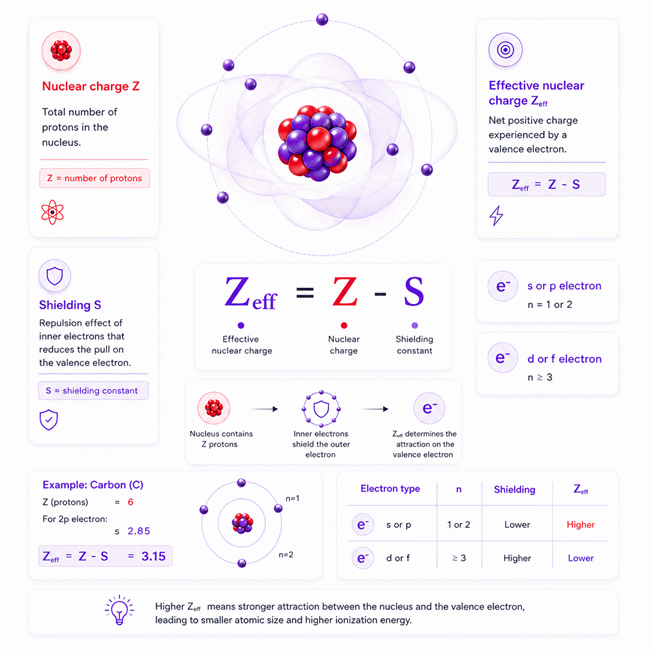
Effective Nuclear Charge Calculator results show how strongly a selected electron feels the nucleus after electron shielding is considered. Instead of treating atomic number as the attraction experienced by every electron, the calculator uses the selected element, electron configuration, shell, subshell, and Slater’s rules to determine the relevant shielding pattern. The Effective Nuclear Charge Calculator is especially useful because different electrons within the same atom can experience different effective nuclear charges.
- Nuclear charge is determined by the atomic number of the selected element.
- The target electron must belong to an occupied shell and subshell.
- Electron configuration determines which electrons contribute to shielding.
- s and p electrons follow a different shielding pattern from d and f electrons.
- The selected electron is never counted as shielding itself.
- Inner electron groups generally provide stronger shielding than same-group electrons.
- Higher Zeff means stronger net nuclear attraction for the selected electron.
- Different orbitals within one atom can produce different Zeff values.
- Reverse solving can recover a missing related charge value from known values.
- Transition metals require careful orbital selection because d and s electrons behave differently.
- Zeff helps explain atomic structure and supports interpretation of periodic behavior.
The most reliable workflow is simple: select the correct element, identify the occupied target orbital, verify the electron configuration, apply the correct shielding pattern, and then interpret the resulting Zeff in the context of that specific electron.
Assumptions used in this calculator
- The calculator applies Slater’s rules as an approximate electron-shielding model.
- The selected element is assumed to use its neutral ground-state configuration.
- Nuclear charge equals the element’s atomic number in proton-charge units.
- The selected electron must belong to an occupied orbital.
- Same-group electrons exclude the selected electron from shielding counts.
- Electrons to the right contribute no shielding in Slater grouping.
- For 1s electrons, same-group shielding uses the 0.30 factor.
- For higher s and p electrons, same-group shielding uses 0.35.
- For s and p electrons, n-1 electrons use 0.85.
- Electrons two or more shells lower contribute full shielding.
- For d and f electrons, left-side groups contribute full shielding.
- Results are estimates and may differ from advanced quantum calculations.
- Industrial or research decisions should use independently verified scientific data.
Results are rounded for display.
Internal calculations use full precision.
Formulas Used in Effective Nuclear Charge Calculator :
Nuclear Charge from the Selected Element
Shielding Constant for an s or p Electron
The selected electron is excluded from the same-group electron count, and electrons in groups to the right contribute zero shielding.
Shielding Constant for a d or f Electron
For a d or f target electron, all electrons in Slater groups to the left contribute fully, while groups to the right contribute zero.
Effective Nuclear Charge
Charge-Unit Display Conversion
Variables
- Z
- Nuclear charge, numerically equal to the atomic number.
- Np
- Number of protons in the selected element.
- σ
- Total electron shielding constant for the selected electron.
- Esame
- Number of other electrons in the selected electron's applicable Slater group.
- En−1
- Number of electrons in the shell one principal level below the selected s or p electron.
- E≤n−2
- Number of electrons two or more principal levels below the selected s or p electron.
- Eleft
- Number of electrons in Slater groups to the left of the selected d or f group.
- n
- Principal quantum number of the selected electron.
- Zeff
- Effective nuclear charge experienced by the selected electron.
- qe
- Displayed charge-scaled value expressed in elementary-charge units.
- qC
- Equivalent displayed value expressed in coulombs.
- e0
- Exact elementary charge used for charge-unit conversion.
Variables & Definitions
View a complete list of all variables used in this calculator, including definitions and units
Effective Nuclear Charge Calculator Variables and Calculation Parameters
| Variable | Definition | Calculation Role | Valid Value or Unit |
|---|---|---|---|
| Z | Nuclear charge of the selected atom. | Provides the positive nuclear charge used in the effective nuclear charge calculation. | Atomic number from 1 to 118; commonly expressed in e. |
| Np | Number of protons in the nucleus. | Determines the nuclear charge because Z = Np for an atom. | Positive integer from 1 to 118. |
| σ | Total shielding constant for the selected electron. | Represents the reduction in nuclear attraction caused by other electrons according to Slater's rules. | Finite value greater than or equal to 0 and less than Z. |
| Esame | Number of other electrons in the applicable Slater group containing the selected electron. | Contributes a shielding factor of 0.30 for 1s or 0.35 for the applicable higher group. | Non-negative integer electron count. |
| En-1 | Number of electrons one principal shell below a selected s or p electron. | Each included electron contributes 0.85 to the shielding constant for an s or p target electron. | Non-negative integer electron count. |
| E≤n-2 | Number of electrons two or more principal shells below a selected s or p electron. | Each included electron contributes 1.00 to the shielding constant. | Non-negative integer electron count. |
| Eleft | Number of electrons in Slater groups located to the left of the selected d or f group. | Each included electron contributes 1.00 to shielding for a d or f target electron. | Non-negative integer electron count. |
| n | Principal quantum number of the selected electron. | Identifies the occupied electron shell and determines which shielding rule applies. | Occupied shell value from 1 to 7. |
| Zeff | Effective nuclear charge experienced by the selected electron. | Calculated after electron shielding is subtracted from the nuclear charge. | Greater than 0 and no greater than Z; commonly expressed in e. |
| qe | Charge-scaled value expressed in elementary-charge units. | Acts as the base value when displaying a calculated charge quantity in elementary-charge units. | e |
| qC | Equivalent charge-scaled value expressed in coulombs. | Provides the coulomb representation of a value converted from elementary-charge units. | C |
| e0 | Exact elementary charge used for unit conversion. | Converts elementary-charge units to coulombs using 1.602176634 × 10⁻¹⁹ C. | 1.602176634 × 10⁻¹⁹ C |
Unit Conversion Table
Elementary Charge Unit Conversion
| Unit Group | Unit Name | Symbol | Equivalent in Coulombs | Used For |
|---|---|---|---|---|
| Popular Units | Elementary charge | e | 1 e = 1.602176634 × 10⁻¹⁹ C | Nuclear charge, shielding constant, and effective nuclear charge display. |
Coulomb Unit Conversion
| Unit Group | Unit Name | Symbol | Equivalent in Elementary Charges | Used For |
|---|---|---|---|---|
| Scientific Units | Coulomb | C | 1 C ≈ 6.241509074 × 10¹⁸ e | Scientific charge representation converted from elementary-charge values. |
Example Calculation
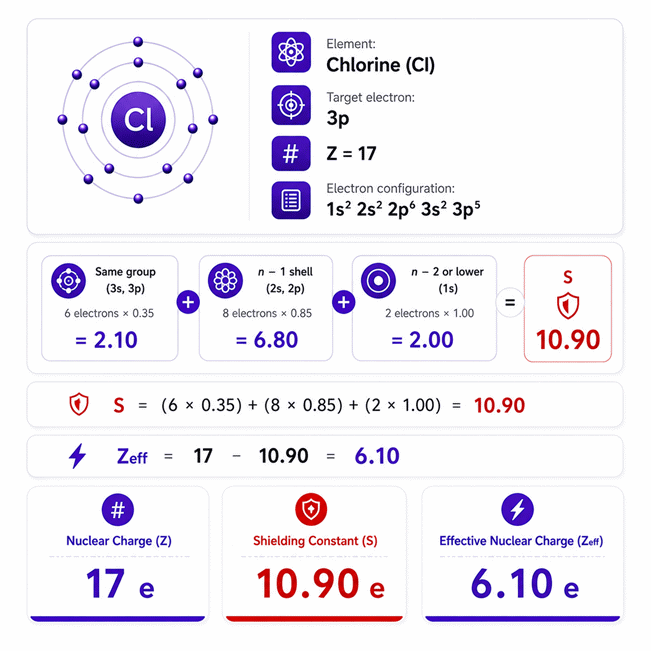
Element: Chlorine, Cl
Atomic number and nuclear charge: Z = 17
Selected electron: 3p
Electron configuration: 1s2 2s2 2p6 3s2 3p5
The selected 3p electron has 6 other electrons in the n = 3 Slater group.
The n = 2 shell contains 8 electrons, while the n = 1 shell contains 2 electrons.
A 3p electron in chlorine does not experience the full nuclear charge of 17 because the other electrons partially shield the nucleus.
The electrons in the same Slater group contribute 0.35 each, electrons one shell lower contribute 0.85 each, and deeper electrons contribute 1.00 each.
The total shielding constant is 10.90, leaving an effective nuclear charge of 6.10 for the selected electron.
This result is an approximate atomic-model value based on electron configuration and Slater shielding rules.
Element: Iron, Fe
Atomic number and nuclear charge: Z = 26
Selected electron: 3d
Electron configuration: 1s2 2s2 2p6 3s2 3p6 3d6 4s2
Known effective nuclear charge: Zeff = 6.25
Unknown value: shielding constant, σ
The other five electrons in the 3d group each contribute 0.35.
The eighteen electrons in groups to the left each contribute 1.00.
The 4s electrons lie to the right of the selected 3d group and contribute zero.
Reverse solving uses the same effective nuclear charge relationship as the forward calculation.
When Z and Zeff are known, the calculator isolates the shielding constant without changing the underlying physical model.
For this iron 3d electron, the reverse result σ = 19.75 agrees with the independent Slater-rule shielding calculation.
This consistency check confirms that the entered values satisfy Zeff = Z - σ.
Results are rounded for display.
Internal calculations use full precision.
Calculations Disclaimer
What an Effective Nuclear Charge Calculator Reveals About Electron Attraction
A common problem starts with one simple question: what charge does an electron actually feel? The Effective Nuclear Charge Calculator answers that question without hiding the shielding process. The Effective Nuclear Charge Calculator starts with the selected element and target electron. It then tracks how surrounding electrons reduce nuclear attraction. This matters because atomic number alone does not describe electron experience. Inner electrons can block part of the nucleus’s pull. Different orbitals can therefore feel very different attraction inside one atom. A useful result must show more than one final number. It should connect electron position, shielding, and atomic structure. That connection makes Zeff useful for chemistry students and technical users. It also helps explain periodic behavior without relying on memorized trends.
Look closer: two electrons in the same atom may experience very different nuclear attraction.
Why Nuclear Charge Alone Can Give the Wrong Mental Picture
The first problem appears when atomic number is treated as electron attraction. Atomic number tells you how many protons are present. It does not show how strongly one electron feels them. Electrons between the nucleus and target electron reduce that attraction. This screening effect becomes important in atoms with several occupied shells. A valence electron may sit far from the nucleus. It may also be screened by many inner electrons. A core electron faces a very different environment. This explains why identical nuclear charge does not create identical electron behavior. Zeff gives a more useful view of that local environment. It turns a simple proton count into an electron-specific picture. This distinction is essential when comparing orbitals, periods, and chemical behavior.
Why Electron Shielding Changes the Result
The next problem is easy to miss: not every electron shields equally. Position matters. Electron grouping matters too. Electrons close to the nucleus often shield outer electrons strongly. Electrons in the same group usually provide weaker shielding. Some electrons contribute nothing for a selected target electron. This is why a simple electron count is not enough. The calculator must follow the correct shielding pattern. Slater’s rules provide a practical way to organize that pattern. They use fixed contributions for specific electron groups. The process is simple enough for fast calculation. It is also structured enough to expose mistakes. A transparent calculator should make this logic visible. You should understand why the result changed, not only see that it changed.
Text infographic: nucleus → electron groups → shielding pattern → target electron → net attraction → Zeff interpretation.
Start with the Correct Element Before Reading Any Zeff Result
A wrong element creates a wrong result before shielding even begins. The selected element sets the nuclear charge and electron configuration. Those two pieces control every later step. Changing from chlorine to argon changes more than one label. It changes proton count and occupied electron groups. That changes the shielding environment around the target electron. A reliable workflow therefore begins with element selection. Do not choose an orbital first and guess the element later. The calculator links the element to its atomic structure. This reduces manual setup and prevents common configuration errors. It also makes repeated comparisons much faster. When several elements are being studied, this first decision becomes critical. One incorrect selection can distort every later comparison.
Electron Configuration Is the Map Behind the Calculation
A frequent problem comes from using the correct element with the wrong configuration. Electron configuration tells the calculator where electrons are located. It also shows which subshells are occupied. The shielding process depends on that arrangement. An electron in a 3p subshell is not treated like one in 3d. The same atom can therefore produce different Zeff values. A good calculator builds the configuration before applying shielding rules. This avoids blind arithmetic and keeps the result tied to atomic structure. Configuration exceptions also matter for some elements. A simple filling pattern does not describe every ground-state atom correctly. Transition metals deserve special care here. When the configuration is correct, the remaining shielding steps become much easier to trust.
Selecting the Target Electron Is More Important Than It Looks
The calculation can fail even when the element is correct. The usual cause is the wrong target electron. Zeff belongs to a selected electron environment. It is not one universal number for the whole atom. A 2p electron and 3p electron experience different shielding. A 3d electron follows another shielding pattern again. This makes target selection a scientific decision, not a cosmetic setting. The calculator uses the chosen shell and subshell to identify that electron. Only occupied choices should be used. Selecting an empty orbital creates no meaningful target electron. This simple rule prevents many false results. Before interpreting Zeff, always ask one question: which electron does this value describe?
Principal and Azimuthal Quantum Numbers Identify the Correct Orbital
A common user mistake is selecting an orbital by name alone. The safer method uses shell and subshell information together. The principal quantum number identifies the main electron shell. The azimuthal quantum number identifies the subshell type. These values connect directly to s, p, d, and f orbitals. Their combination tells the calculator which shielding rules apply. This matters most when several subshells share nearby energies. Transition metals are a clear case. A 3d electron and 4s electron belong to different shielding environments. The calculator should restrict choices to occupied combinations. That makes the interface simpler and prevents impossible selections. Correct orbital identification is the bridge between electron configuration and meaningful Zeff.
Check this first: the correct element with the wrong orbital still gives the wrong result.
How Slater’s Rules Organize Electron Shielding Without Guesswork
The main calculation problem is deciding which electrons actually shield the target. Counting every electron equally gives poor results. Slater’s rules solve this by organizing electrons into groups. Each group contributes according to its position relative to the target electron. Some groups provide partial shielding. Deeper groups usually provide stronger shielding. Groups located beyond the target can contribute nothing. This structure turns a complex many-electron problem into a practical estimate. The method is especially useful for learning atomic behavior. It also makes calculation steps easy to inspect. A user can see where each shielding contribution comes from. That visibility is valuable because most errors begin during grouping. Correct grouping matters more than fast arithmetic.
Shielding for s and p Electrons Follows a Layered Pattern
A common problem with s and p electrons is mixing all inner electrons together. Their shielding is not handled identically. Electrons sharing the target group contribute only part of their screening effect. Electrons in the shell directly below contribute more. Electrons two or more shells lower provide full screening in this model. The 1s case also receives special treatment. These layers create a clear hierarchy of shielding strength. The structure is simple once the groups are identified. Most mistakes happen when users count the target electron itself. Others place lower-shell electrons in the wrong category. The calculator avoids that confusion by deriving the required groups automatically. This keeps the workflow fast while preserving the scientific logic.
Shielding for d and f Electrons Uses a Different Grouping Logic
A major problem appears when s and p rules are copied onto d electrons. That produces the wrong shielding pattern. For a selected d or f electron, earlier electron groups are treated differently. Electrons in the same d or f group provide partial shielding. Groups positioned to the left contribute fully in the Slater model. Groups to the right do not shield that selected electron. This difference matters greatly for transition metals. It also explains why d-electron results can surprise new users. The structure may look similar, but the grouping logic is different. A reliable calculator must switch rules automatically after orbital selection. That prevents users from applying an s-electron rule to a d-electron problem.
Why the Target Electron Must Be Excluded from Its Own Shielding
A subtle error can lower Zeff without producing an obvious warning. It happens when the target electron shields itself. That electron must not be counted among surrounding shielding electrons. Self-shielding is not part of the Slater calculation. Only the other electrons contribute. This rule matters most within the same electron group. Forgetting it adds an extra shielding contribution. The final Zeff then becomes too small. The arithmetic may still look clean, so the mistake is easy to miss. Automated counting removes this risk. The calculator identifies the target electron first. It then counts the remaining electrons around it. This small detail has a large effect on trust. Transparent electron counting is therefore more useful than a hidden final result.
Reading Zeff Correctly Prevents the Most Common Interpretation Error
The biggest interpretation problem is treating Zeff like a property of the whole atom. It is better understood as electron-specific nuclear attraction. A higher value means the selected electron feels a stronger net nuclear pull. A lower value means shielding has reduced more of that attraction. This does not describe every part of atomic behavior. It describes one important part. Zeff becomes especially useful when comparing similar electrons across related atoms. It can also clarify why outer electrons behave differently from core electrons. The calculator should therefore be used as an interpretation tool, not just arithmetic. The result becomes more valuable when connected to orbital position and shielding. That context turns one number into a useful atomic picture.
What a Higher Zeff Means for the Selected Electron
A common question appears after a high result: is higher always better? That is the wrong way to read Zeff. Higher means stronger net attraction from the nucleus. The selected electron is pulled inward more strongly. In comparable atomic environments, this can support tighter electron binding. It can also help explain changes in atomic size and electron removal. Yet Zeff is not a universal score for chemical strength. Orbital shape and electron distribution still matter. The safest interpretation stays close to the target electron. Ask how strongly that electron feels the nucleus after shielding. This keeps the result scientifically useful. It also avoids broad claims that one value alone cannot support.
Comparing Orbitals Inside One Atom Can Reveal Hidden Differences
A surprising problem appears when users expect one atom to have one Zeff. Different orbitals can experience different shielding. Core electrons usually sit closer to the nucleus. Valence electrons often face stronger screening from inner shells. The situation becomes more interesting in transition metals. A 3d electron and 4s electron may follow different shielding rules. Their calculated Zeff values can therefore differ sharply. This comparison can explain why orbital behavior is not controlled by atomic number alone. The calculator makes such comparisons easier because the element stays fixed. Only the target orbital changes. That isolates the effect of electron environment. It is one of the most useful ways to learn shielding without memorizing isolated facts.
Periodic Trends Become Easier When Zeff Is Used with Context
Students often memorize periodic trends without understanding their cause. Zeff gives a clearer starting point. Across many periods, nuclear charge rises as protons are added. Shielding also changes, but not always enough to cancel that increase. The result is often stronger net attraction for valence electrons. This helps explain several familiar trends. Atomic size often becomes smaller across a period. Electron removal can also become more difficult. Electronegativity often rises in the same broad direction. These are trends, not absolute rules. Shell structure and orbital effects still matter. Zeff is therefore most useful as part of a connected explanation. It turns a memorized arrow on the periodic table into a physical story.
Text infographic: stronger net attraction → tighter electron pull → smaller size tendency → harder electron removal → stronger periodic effects.
Reverse Solving Turns the Calculator into More Than a One-Way Tool
A common workflow problem appears when the known value is usually called an output. Traditional calculators force users to restart the problem. Reverse solving removes that barrier. The AxiCalculator workflow allows related charge values to be edited directly. When enough information is known, the missing quantity can be recovered. This is useful in homework checking, laboratory notes, and technical review. It also helps when a published result must be verified. The user does not need a second calculator. The same relationship is used in both directions. This keeps the process consistent and reduces transcription errors. Reverse solving is most useful when the known data already describe the same selected electron environment.
Reverse Solving Is Useful for Checking Existing Chemistry Work
A frequent problem is receiving a Zeff result without the original shielding work. Reverse solving provides a fast consistency check. Known values can be entered to recover the missing quantity. The result can then be compared with the expected shielding pattern. This helps detect copied numbers and arithmetic mistakes. It also supports classroom review because students can check intermediate work. Technical users can use the same process when reviewing stored calculations. The important point is consistency. Reverse solving does not create new atomic information. It only rearranges information already present in the calculation. That makes it useful for verification without changing the scientific model. The result should still match the selected element and electron environment.
Why Reverse Solving Cannot Always Identify the Original Orbital
A dangerous assumption is that one Zeff value identifies one orbital. It usually does not. Different electron environments can sometimes produce similar numerical results. A reverse calculation may recover a missing charge quantity. It cannot always reconstruct the unique electron configuration behind it. Orbital selection still requires atomic information. This is why the calculator keeps the element and orbital workflow visible. Numeric consistency alone is not enough. The result must also make sense for an occupied electron. This distinction prevents a misleading form of reverse engineering. The tool can solve a missing related value. It should not invent a unique orbital without evidence. Good scientific software knows where calculation ends and interpretation begins.
A result can be mathematically consistent and still describe the wrong electron.
Common Zeff Calculation Errors Usually Start Before the Arithmetic
The most frustrating problem is getting a clean number from a bad setup. Zeff calculations are especially vulnerable to this. Wrong configurations, wrong orbitals, and wrong electron groups can all look reasonable. The final arithmetic may contain no obvious error. That is why setup checks matter. Begin with the correct element. Confirm the selected orbital is occupied. Then verify the shielding pattern matches that orbital type. Do not count the target electron as its own shield. Do not copy s and p rules into d and f calculations. These checks take seconds. They prevent most major errors. A reliable calculator should reduce those risks automatically. Good interface design can protect scientific accuracy before calculation even starts.
Using the Wrong Electron Configuration Changes Every Later Step
A common mistake starts with a familiar filling pattern used too mechanically. Most atoms follow expected orbital filling closely. Some important elements do not match the simplest prediction. Chromium and copper are well-known cases. Other transition and heavy elements also need care. An incorrect configuration changes occupancy. That can change available target orbitals and shielding groups. The error then spreads into every later stage. This is why configuration data should not be treated as decoration. It is part of the calculation structure. The calculator should use established ground-state configurations for supported elements. Users should also pay close attention when comparing transition metals. A small configuration difference can create a meaningful change in Zeff.
Choosing an Empty or Incorrect Orbital Produces a Meaningless Target
A user may know an orbital label but forget to check occupancy. That creates a basic scientific problem. Zeff is calculated for an electron, not an empty location. If the selected subshell has no electron, there is no target. The calculator should therefore expose only meaningful occupied choices. This improves accuracy and simplifies the interface. It also prevents a common classroom mistake. Another risk is choosing the right shell with the wrong subshell. A 3p and 3d selection can lead to very different shielding behavior. Always confirm both parts of the orbital identity. When the target electron is correct, the shielding logic becomes much easier to follow and verify.
Transition Metals Need Extra Care Because Their Orbital Structure Is Less Obvious
Transition-metal problems often look simple until 3d and 4s enter the calculation. Their electron arrangement creates several common mistakes. Filling order can mislead users about shielding order. Ionization behavior can add more confusion in other contexts. The safest approach is to focus on the actual selected electron. Then apply the shielding rules for that orbital class. Do not assume nearby orbitals behave the same way. A 3d electron follows different grouping logic from a 4s electron. This difference can produce noticeably different Zeff values. The calculator is especially useful here because it removes manual group switching. The user chooses the occupied orbital, and the calculation follows the correct path.
Technical Use of Zeff Works Best When the Result Answers a Clear Question
A technical problem often begins with too much data and no clear purpose. Zeff should answer a specific question about electron attraction. It can support comparisons between related atoms and orbitals. It can help explain changes in periodic behavior. It can also support teaching, calculation review, and atomic-structure analysis. The result should not be treated as a complete quantum description. It is a practical screening estimate. That makes it fast and easy to interpret. For deeper computational work, more advanced methods may be required. The value of this calculator lies in transparency. Users can connect the selected element, target electron, shielding pattern, and final result. That makes the calculation easier to inspect and discuss.
Students and Researchers Can Use Zeff to Test Atomic-Structure Reasoning
A common study problem is memorizing trends without understanding their cause. Zeff offers a better learning path. Students can change the element while keeping a similar target orbital. They can then observe how shielding and nuclear attraction change. Researchers and technical readers can use the same workflow for quick checks. It is also useful when reviewing notes or teaching material. The tool provides a fast first-pass estimate before deeper analysis. This does not replace advanced atomic calculations. It provides a clear bridge between electron configuration and observable chemical trends. The best learning happens when the number is questioned. Ask what changed in the electron environment, and why the result moved.
A Clear Zeff Workflow Saves Time During Repeated Comparisons
Repeated calculations become slow when every electron group is counted manually. The risk of small mistakes also grows. A structured calculator solves both problems. Element selection creates the required atomic setup. Orbital selection identifies the target electron. The shielding logic then follows the correct branch. Results update immediately when the selection changes. This makes side-by-side reasoning much faster. It is useful for periodic comparisons and orbital studies. The workflow also supports reverse checks when existing values are available. Users spend less time rebuilding the same calculation. They can spend more time interpreting the result. That shift is important. A good scientific calculator should reduce repetitive work without hiding the reasoning behind it.
Choosing a Reliable Online Zeff Tool Requires More Than a Clean Interface
A polished calculator can still produce weak results if its logic is hidden. Trust begins with transparent behavior. The tool should link the selected element to a real electron configuration. It should restrict target choices to occupied orbitals. It should change shielding logic between s, p, d, and f electrons. Reverse solving should preserve the same scientific relationship. Errors should appear near the field causing the problem. Results should update without forcing repeated button clicks. A useful tool also needs a clear mobile layout. These details affect both usability and confidence. AxiCalculator is built around this transparent workflow. The aim is simple: make the result easy to obtain, inspect, and understand.
What to Check Before Trusting a Zeff Result
The final problem is knowing whether a believable number is actually correct. Start by checking the selected element. Then confirm the electron configuration matches that element. Verify that the chosen orbital contains an electron. Next, ask whether the shielding pattern fits the orbital type. For d and f electrons, pay special attention to left-side groups. For s and p electrons, check the shell structure carefully. Finally, compare the result with the expected atomic trend. A strange value deserves another look. This review takes little time. It can catch a setup error before that error enters homework, reports, or technical notes. Confidence should come from traceable logic, not from a polished number.
Why AxiCalculator Focuses on Transparent Scientific Interaction
A user should never need to trust a hidden calculation blindly. AxiCalculator keeps the important choices visible throughout the workflow. Element, shell, subshell, shielding, and effective charge stay connected. Real-time updates make exploration faster. Reverse solving supports verification when different values are already known. Searchable selectors reduce friction when working through repeated calculations. Mobile-friendly controls keep the same workflow usable on smaller screens. Shareable results also make collaboration easier. The goal is not to overwhelm users with atomic theory. The goal is to make the science inspectable. When users can see what changed, they can learn faster. They can also spot unusual results before relying on them.
Use the Result as a Starting Point for Better Chemical Reasoning
A final Zeff number can look complete, but the useful work starts afterward. Ask why the shielding changed. Ask which electrons created that change. Compare another occupied orbital in the same atom. Then compare a related element. These small tests reveal how atomic structure controls electron experience. They also make periodic trends easier to remember. The calculator works best as an interactive reasoning tool. It gives fast answers without forcing users to skip the underlying chemistry. That balance matters for both beginners and experienced users. Open the calculator, choose the target electron, and inspect the result. One careful comparison often teaches more than several memorized trend rules.
Frequently Asked Questions
Why can my calculated Zeff differ from a textbook answer even when my arithmetic is correct?
Can I compare Zeff values from different elements directly?
What information should I record when using a Zeff result in coursework or a report?
How should I handle an ion or excited atom instead of a neutral ground-state atom?
How can I validate a transition-metal Zeff result before using it in technical work?
How should I compare a Slater-based Zeff result with quantum-chemistry software output?
What should I do if reverse solving gives a mathematically valid but chemically unrealistic result?
Engineering Resources
Our engineers are here to help you get it right.