Dice Probability Calculator
- Last formula update:

Decimal & Rounding Policy
- Internal calculations keep full precision and never round intermediate probability values.
- Probability can be displayed as a decimal or percentage without changing its value.
- Displayed results use concise significant digits while preserving very small probabilities accurately.
- Scientific notation may be used when a probability is extremely small.
- Reverse solving compares unrounded probabilities and accepts only a unique valid solution.
- Display rounding never changes validation, outcome counts, or later calculations.
Valid range
- Number of faces: 2 to 100 faces for a custom fair die.
- Total number of dice: 1 to 50 dice.
- Target face value: any integer from 1 through the selected number of faces.
- Target value count: 1 to the smaller of 10 or the number of faces.
- Selected target values: unique integers from 1 through the number of faces.
- Target number of matching dice: 0 through the total number of dice.
- Exact target sum: from the number of dice through dice multiplied by faces.
- Decimal probability: 0 through 1, inclusive.
- Percentage probability: 0% through 100%, inclusive.
- Reverse solving requires exactly one supported numeric input to be unknown.

Wylena Brantford
Reviewers:
Valdren Clyforde
Zenara Dentwick
Check our editorial policy
September 16, 2026
1.0.0
Initial calculator and formula release.
Our engineers are here to help you get it right.
How Does a Dice Probability Calculator Find the Correct Roll Probability?
Dice Probability Calculator results become reliable when the event is defined before the numbers are entered. A fair single die has equally likely faces, but sums from several dice are not equally likely because different totals can be formed by different numbers of ordered outcomes. The Dice Probability Calculator separates these event types so you can evaluate the condition that actually matters.
- Use an exact condition when only one target result qualifies.
- Use at least when the target and all larger valid results qualify.
- Use at most when the target and all smaller valid results qualify.
- Use matching-dice conditions when success depends on how many dice hit accepted faces.
- Remember that all dice matching is different from all dice showing one chosen face.
- Multiple accepted faces increase the success chance for each die.
- Reverse solving is valid only when one missing input has one valid solution.
- Two different targets can sometimes produce the same probability.
- Outcome counts help explain why some totals are more common than others.
- Physical rolls may differ from theoretical probability because of random variation.
Use the calculator to compare exact, cumulative, matching, threshold, and reverse-solving questions without relying on intuition alone.
Assumptions used in this calculator
- All dice are assumed fair, independent, and identically distributed.
- Each face is assumed equally likely on every roll.
- Dice rolls are assumed unaffected by previous outcomes.
- All selected dice use the same number of faces.
- Target face values must be valid faces on the selected die.
- Selected target values are unique within multi-value probability conditions.
- Target counts cannot exceed the total number of dice.
- Target sums remain within the mathematically possible dice-sum range.
- Probability calculations use exact formulas, not random simulation.
- Intermediate calculations retain full floating-point precision.
- Displayed values may be rounded without changing internal calculations.
- Reverse solving requires exactly one mathematically identifiable missing numeric input.
- Real-world dice imperfections may cause observed frequencies to differ.
Results are rounded for display.
Internal calculations use full precision.
Formulas Used in Dice Probability Calculator :
s = number of faces on each die.
n = total number of identical dice.
p = probability of one specified face on one die.
P = probability of the selected event.
y = selected target face value.
m = number of accepted target face values.
q = probability that one die lands on any accepted target value.
k = required number of matching dice.
r = selected target sum.
Di(r) = probability that i dice produce sum r.
Ω = total number of equally likely outcomes.
F = number of favorable outcomes.
Ptarget = probability entered for reverse solving.
x = the single unknown integer input during reverse solving.
ε = numerical comparison tolerance.
Single-Face Probability
Outcome Counts
All Dice Equal One Specified Face
All Dice Show the Same Face
All Dice Equal or Exceed the Target
All Dice Equal or Stay Below the Target
Accepted Target-Set Probability
Exactly k Matching Dice
At Least k Matching Dice
Exact Dice-Sum Distribution
Cumulative Dice-Sum Probability
Probability Display Conversion
Reverse-Solving Condition
Variables & Definitions
View a complete list of all variables used in this calculator, including definitions and units
Dice Probability Calculator Variables and Definitions
| Variable | Meaning | Valid Range or Constraint | Type | Used For |
|---|---|---|---|---|
| s | Number of faces on each die | 2 to 100 for custom dice | Positive integer | Single-roll probability and outcome space |
| n | Total number of dice | 1 to 50 | Positive integer | Every multi-die probability calculation |
| p | Probability of one specified face | 1 / s | Probability | Specified-face calculations |
| P | Probability of the selected event | 0 to 1 | Probability | Primary calculator result |
| y | Selected target face value | 1 to s | Integer | Specified-face and threshold conditions |
| m | Number of accepted target face values | 1 to min(10, s) | Positive integer | Multi-value success conditions |
| q | Probability that one die matches the accepted target set | m / s | Probability | Binomial probability calculations |
| k | Required number of matching dice | 0 to n | Integer | Exactly-k and at-least-k conditions |
| r | Selected target sum | n to n × s | Integer | Exact and cumulative sum conditions |
| D_i(r) | Probability that i dice produce sum r | 0 to 1 | Probability distribution value | Dice-sum recurrence |
| Omega | Total number of equally likely roll outcomes | s raised to n | Positive count | Total possible outcomes |
| F | Number of favorable outcomes | 0 to Omega | Outcome count | Result reporting |
| P_target | Probability entered by the user during reverse solving | 0 to 1 | Probability | Inverse calculation |
| x | The single unknown input during reverse solving | Depends on the selected parameter | Integer | Inverse solution search |
| epsilon | Numerical tolerance for probability matching | Small positive tolerance | Dimensionless | Safe floating-point comparison |
Unit Conversion Table
Probability Unit Conversion Table
| Unit Group | Unit Name | Symbol | Equivalent in Decimal Probability | Used For |
|---|---|---|---|---|
| Popular Units | Percentage | % | 1% = 0.01 | Readable probability display and user input |
| Scientific Units | Decimal Probability | 1 | 1.0 = 1.0 | Dimensionless probability calculations and scientific analysis |
Example Calculation
Each d8 has three successful faces: 6, 7, and 8.
The probability of success on one die is therefore 3 divided by 8.
All four independent dice must satisfy the condition, so probabilities multiply.
Among 4,096 equally likely outcomes, exactly 81 satisfy this condition.
The entered percentage is first converted to decimal probability.
The fourth root recovers the required single-die success probability.
Three of eight faces must satisfy the threshold condition.
The only valid target producing those faces is 6.
Results are rounded for display.
Internal calculations use full precision.
Calculations Disclaimer
Why Can a Simple Dice Roll Produce the Wrong Decision?
A Dice Probability Calculator becomes useful when intuition stops being reliable. The Dice Probability Calculator can separate a result that merely feels common from one that is mathematically common. That difference matters whenever several dice, target values, or success conditions appear together.
A common problem starts with one innocent assumption. A user sees several possible totals and treats them as equally likely. That works for the individual faces of one fair die. It fails as soon as several dice are added together. Different totals can be produced by different numbers of combinations.
One Die and Multiple Dice Do Not Behave the Same Way
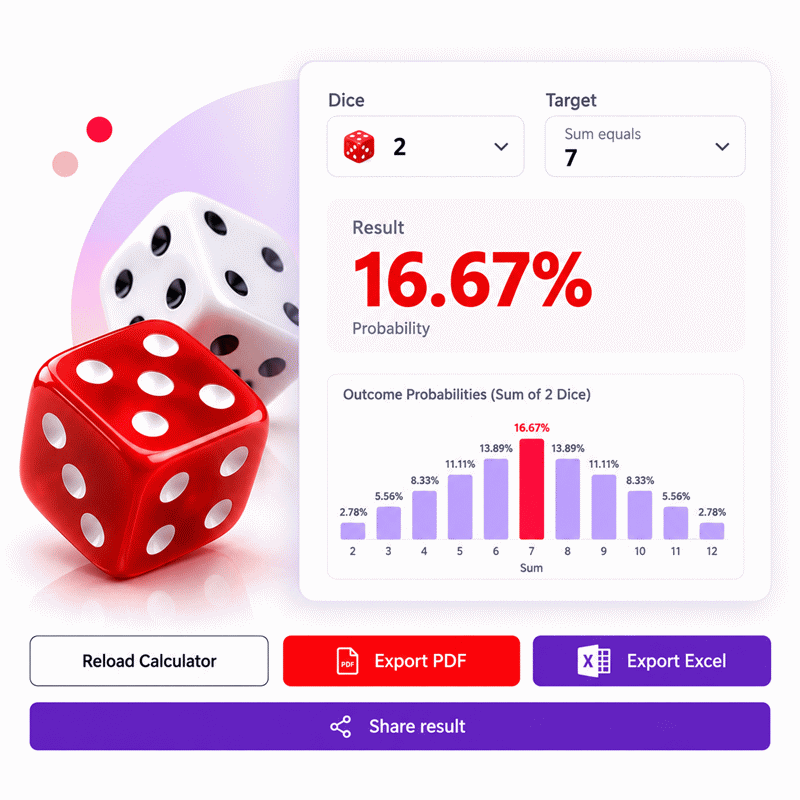
A single fair d6 has six equally likely faces. Each individual face therefore has the same chance. Add another d6 and the situation changes. The possible totals now range from 2 through 12, yet those eleven totals are not equally likely.
A total of 2 requires only one ordered outcome: 1 and 1. A total of 7 can be produced in six ordered ways. That difference is the reason 7 appears much more often over many trials.
How the Sample Space Expands With Every Additional Die
Every added die multiplies the number of possible ordered outcomes. This growth is fast. Two d6 dice have 36 ordered outcomes. Three d6 dice have 216. Four d6 dice have 1,296.
That expanding sample space creates the familiar concentration near middle sums. Extreme totals require unusually specific combinations. Middle totals can often be built in many different ways.
ONE DIE → individual faces are uniform
MULTIPLE DICE → ordered outcomes multiply
SUMS → combination counts become unequal
RESULT → middle totals usually become more likely
Specific Faces, Thresholds, and Combined Events
Another real problem appears when the wording changes slightly. “Roll a 6” is not the same event as “roll 4 or higher.” The first condition accepts one face. The second accepts three faces on a d6.
When every die must satisfy the same threshold, the event becomes stricter with each added die. Even a generous single-die success chance can shrink quickly when every die must succeed.
Why All Dice Showing One Chosen Face Differs From All Dice Matching
Suppose three dice must all show 4. Only one common face is acceptable. Now suppose the requirement is simply that all three dice match. Every common face becomes acceptable.
That small wording change can multiply the number of favorable outcomes. This is why the event must be defined before values are entered.
Quick check → identify exactly which outcomes count as success before trusting any percentage.
How Does Dice Sum Probability Really Behave?
A frequent mistake begins when a player sees eleven possible totals on 2d6 and assumes each deserves one-eleventh of the probability. The totals are eleven labels, but the underlying ordered outcomes are 36 combinations. Those two counts are not interchangeable.
Why Seven Dominates the 2d6 Distribution
The total 7 sits at the center of the classic 2d6 distribution. It can be produced by 1+6, 2+5, 3+4, 4+3, 5+2, and 6+1. No other total has more combinations.
Move away from 7 and the number of possible combinations falls. The distribution therefore rises toward the center and falls toward both edges.
Ordered Outcomes Explain the Shape of the Distribution
Order matters when constructing the sample space. A first die showing 2 and a second showing 5 is a different ordered outcome from 5 followed by 2. Both contribute to a total of 7.
This also explains why simply counting distinct sums gives the wrong result. Probability depends on underlying outcomes, not the number of labels used to describe them.
Exact, At Least, and At Most Answer Different Questions
Imagine a rule that succeeds on a total of exactly 9. Only outcomes summing to 9 count. Change the rule to at least 9 and totals 9, 10, 11, and 12 all count on 2d6.
Change it again to at most 9 and every possible total from 2 through 9 counts. The target number stayed the same. The event changed completely.
How Cumulative Tails Change a Target Decision
Cumulative probability is especially important in games and threshold-based systems. A target often represents the boundary between failure and success rather than one isolated total.
That means an exact calculation may answer the wrong question. Before entering a target, ask whether values beyond that target should also qualify.
EXACT → only the selected result counts.
AT LEAST → the target and every higher valid result count.
AT MOST → the target and every lower valid result count.
How Do Matching-Dice Probabilities Work?
A different problem appears when the total is irrelevant. You may care about how many dice land on selected faces. For example, a rule may require exactly two dice to show one of several successful values.
This is not a sum-distribution problem. It is a success-count problem. Each die either belongs to the accepted set or it does not.
Exactly k Matching Dice Requires a Different Model
Suppose seven d12 dice are rolled and one selected face counts as success. Requiring exactly two successes means two dice must hit the accepted face while the other five must miss it.
There are also many different positions where those two successful dice can appear. The calculation must account for those arrangements as well as the success and failure chances.
Multiple Accepted Face Values Change the Single-Die Success Chance
The logic becomes more flexible when several faces are accepted. If 4, 5, and 6 are all successful on a d6, then half of the die’s faces count as success.
The calculator does not need to treat those three values as separate events when only the number of matching dice matters. They form one accepted set.
At Least k Matches Includes Every Larger Success Count
“Exactly two” and “at least two” are easy to confuse. Exactly two excludes three, four, or any larger number. At least two includes all of them.
This difference can become substantial. When the single-die success chance is large, outcomes with more than the minimum number of matches can represent a meaningful share of the final probability.
Decision shortcut → if extra successes still count, use an at-least condition rather than an exact condition.
Can Dice Probability Be Solved Backward?
A practical problem sometimes arrives in reverse. You already know the probability, but one input is missing. Perhaps the target threshold was removed from a worksheet. Perhaps the number of dice is unknown.
Reverse solving can recover the missing input when the remaining information identifies one valid solution.
Reverse Solving Works Only When the Missing Value Is Identifiable
Consider several d6 dice that must all meet the same minimum face. If the number of dice and final probability are known, a missing threshold may be recoverable.
The solver can test valid integer thresholds and compare the probability produced by each candidate. A unique match gives a defensible answer.
Why One Probability Can Match More Than One Valid Input
Not every inverse problem has one answer. Dice-sum distributions are often symmetric. Two different sums can therefore have exactly the same probability.
For example, opposite sides of a symmetric distribution may share identical outcome counts. If a reverse solver receives only that probability, choosing one target would be guesswork.
A trustworthy result should say that several inputs match. It should not silently choose whichever candidate appears first.
How to Validate a Back-Solved Dice Value
Back-substitution is the fastest validation method. Place the recovered value into the forward calculation and confirm that it recreates the entered probability.
Then check the logical range. A target face must exist on the die. A target sum must be possible. A required match count cannot exceed the number of dice.
KNOWN PROBABILITY
↓
ONE MISSING INPUT
↓
TEST VALID INTEGER CANDIDATES
↓
ONE MATCH → SOLVE
MULTIPLE MATCHES → REPORT AMBIGUITY
NO MATCH → REJECT
How Should You Read a Dice Probability Result?
A percentage alone can hide useful information. A result of 2% may sound small, but understanding the event and sample space reveals what that number actually represents.
Percentage, Decimal Probability, and Outcome Counts Tell Different Stories
Percentage is usually the easiest form to scan. Decimal probability fits mathematical work more naturally. Favorable and total outcome counts explain where the probability came from.
Seeing all three forms can expose mistakes quickly. If an exact event is said to have more favorable outcomes than total outcomes, something is clearly wrong.
Theoretical Probability and Experimental Frequency Should Not Be Confused
Theoretical probability describes the model. Experimental frequency describes what happened in a finite set of actual rolls.
A fair d6 does not promise that each face appears exactly ten times in sixty rolls. Random variation remains present. Over larger samples, observed frequencies often move closer to the theoretical proportions, but no small sample is required to match them perfectly.
This distinction matters whenever physical dice are used. The calculator answers a mathematical question about fair independent dice. A biased die, unusual rolling process, or special game rule may require a different model.
Which Dice Probability Mistakes Cause the Largest Errors?
The most damaging error usually happens before any arithmetic begins. The wrong event is selected, so every later step can be perfectly calculated and still answer the wrong question.
Choose the Event Before You Enter the Target
Write the event in ordinary language first. Ask whether the result must equal a target, exceed it, stay below it, match a face, or contain a certain number of successful dice.
Then decide whether one face or several faces qualify. Only after those decisions should you enter the numeric target.
Another common mistake is confusing a single face with a dice sum. Rolling a 6 on one d6 and rolling a total of 6 on two d6 dice are different events with different sample spaces.
Verify the Result With Independent Reasoning Before You Trust It
Small cases are powerful checks. For 2d6, you can manually list all 36 ordered outcomes. A total of 7 must appear six times. Extreme totals 2 and 12 must appear once each.
You can also inspect boundaries. An impossible total must return zero probability. A certain event must return 100%. Increasing an “at least” target should never increase its probability.
These simple consistency tests catch many implementation errors without requiring another calculator.
AxiCalculator is designed to make that verification process easier. Choose the condition that matches your problem, enter the known values, and inspect the resulting probability together with its outcome context. When the problem is reversible, leave exactly one supported value unknown and let the solver determine whether a unique answer actually exists.
Frequently Asked Questions
Can I use the calculator when my dice have different numbers of sides?
Why can a probability look small even when the event happens often in long sessions?
Does rolling several dice make the result more random?
Can I use a dice probability result to predict the next physical roll?
Why can reverse solving fail even when the entered probability is mathematically valid?
How should I validate a dice calculator before using its results in a model?
What changes if the physical die is biased or the rolls are not independent?
Our engineers are here to help you get it right.