Cooking Measurement Converter
- Last formula update:

Decimal & Rounding Policy
- Calculations use full-precision values without rounding intermediate results.
- Displayed results use up to ten significant digits for practical readability.
- Trailing zeros are removed unless they clarify a measurement.
- Very small or large results may appear in scientific notation.
- Ingredient-density conversions are approximate because food density naturally varies.
Valid range
- Ingredient, density, weight, and volume values must use compatible measurement units.
- Custom density must be a finite number greater than zero.
- Weight and volume entries must be greater than zero and no more than 1,000,000,000,000.
- Empty, negative, zero, nonnumeric, infinite, and dimensionally incompatible values are invalid.

Nolissa Vantford
Reviewers:
Solavyn Marbourne
Orvick Bexquell
Check our editorial policy
September 9, 2026
1.0.0
Initial calculator and formula release.
Our engineers are here to help you get it right.
How does a Cooking Measurement Converter produce ingredient-specific results?
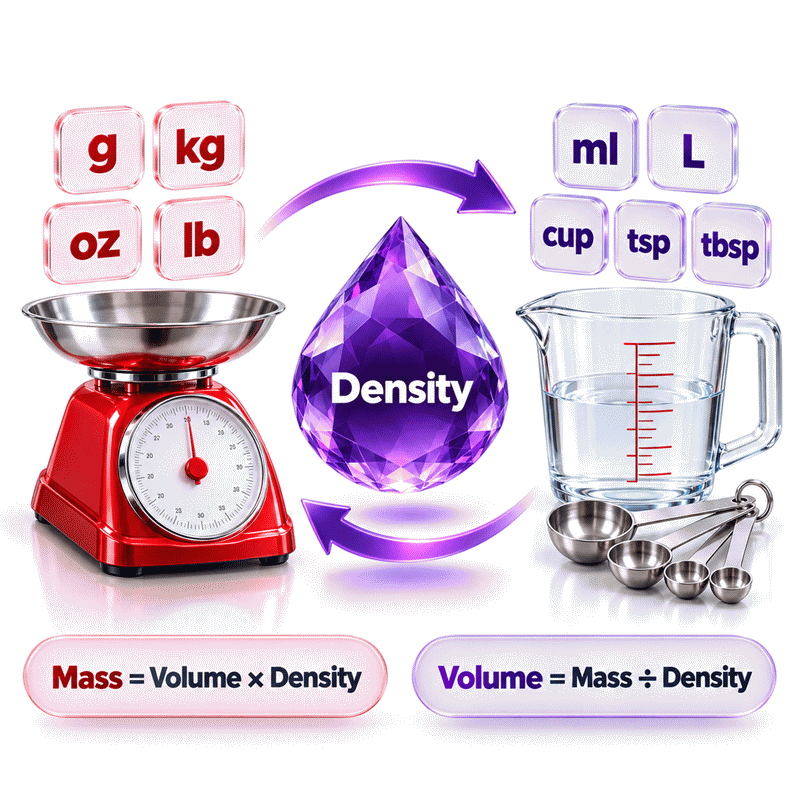
A Cooking Measurement Converter translates recipe values across grams, kilograms, ounces, pounds, milliliters, cups, teaspoons, tablespoons, fluid ounces, pints, and liters. Weight-to-weight and volume-to-volume conversions use defined unit factors. Weight-to-volume results also use the selected ingredient density, because equal cup volumes of flour, honey, oil, and sugar do not contain equal mass.
- Select the ingredient and its closest available subtype.
- Enter any known weight or volume in its correct regional unit.
- Read synchronized results without pressing a calculation button.
- Edit a result field to perform reverse conversion.
- Use Custom mode only with a reliable positive density.
- Check whether cups, spoons, fluid ounces, and pints are US, UK, or metric.
- Treat density-based results as practical estimates.
The AxiCalculator Cooking Measurement Converter keeps unrounded internal values while presenting readable outputs. Ingredient condition, moisture, temperature, particle size, and packing can change real measurements. Use a calibrated kitchen scale when the original recipe provides mass or when precise baking, nutrition, safety, or commercial production decisions depend on the result.
Assumptions used in this calculator
- Ingredient density represents a typical average value.
- Ingredients are measured at ordinary kitchen temperatures.
- Containers match the selected measurement standard.
- Dry ingredients are level unless otherwise specified.
- Ingredients are not intentionally compressed inside measuring containers.
- Moisture content remains consistent with typical retail ingredients.
- Selected units belong to the correct physical dimension.
- Mass units represent net ingredient mass only.
- Volume units represent actual occupied measurement volume.
- Custom density values are supplied by the user.
- Intermediate calculations retain full numerical precision.
- Displayed rounding does not modify the internal result.
- Precision-critical work requires calibrated measuring equipment.
Results are rounded for display.
Internal calculations use full precision.
Formulas Used in Cooking Measurement Converter :
Convert a displayed measurement to its base unit
Convert mass to volume
Convert volume to mass
Convert a base result to the selected unit
- Qb is the quantity expressed in grams or milliliters.
- Qu is the quantity expressed in the selected unit.
- Fu is the selected unit conversion factor.
- mg is ingredient mass in grams.
- Vml is ingredient volume in milliliters.
- ρkg/m³ is ingredient density in kilograms per cubic meter.
Variables & Definitions
View a complete list of all variables used in this calculator, including definitions and units
Cooking Measurement Converter Variables and Units
| Variable | Meaning | Base Unit | Accepted Quantity | Role |
|---|---|---|---|---|
Qb |
Quantity converted to a calculation base unit | g or ml | Positive finite number | Internal calculation value |
Qu |
Quantity displayed in the user-selected unit | Selected unit | Positive finite number | Editable input or result |
Fu |
Factor connecting a selected unit to its base unit | g/unit or ml/unit | Positive fixed factor | Unit conversion |
mg |
Ingredient mass | g | Greater than zero | Weight conversion base |
Vml |
Ingredient volume | ml | Greater than zero | Volume conversion base |
ρkg/m³ |
Representative density of the selected ingredient | kg/m³ | Greater than zero | Weight-volume conversion |
Unit Conversion Table
Weight Unit Conversion Reference
| Unit Group | Unit Name | Symbol | Equivalent in Grams | Used For |
|---|---|---|---|---|
| Popular Units | Gram | g | 1 g | Small and medium recipe quantities |
| Popular Units | Kilogram | kg | 1,000 g | Bulk ingredients and large recipes |
| Popular Units | Ounce | oz | 28.349523125 g | US and imperial recipe weights |
| Popular Units | Pound | lb | 453.59237 g | Large US ingredient quantities |
| Scientific Units | Decagram | dag | 10 g | European recipe measurements |
| Scientific Units | Milligram | mg | 0.001 g | Very small measured quantities |
| Scientific Units | Microgram | µg | 0.000001 g | Trace laboratory-scale quantities |
Volume Unit Conversion Reference
| Unit Group | Unit Name | Symbol | Equivalent in Milliliters | Used For |
|---|---|---|---|---|
| Popular Units | Milliliter | ml | 1 ml | Metric liquid and ingredient volumes |
| Popular Units | Liter | L | 1,000 ml | Large metric volumes |
| Popular Units | US Cup | US cup | 236.5882365 ml | US recipes |
| Popular Units | Metric Cup | cup | 250 ml | Metric recipes |
| Popular Units | Metric Teaspoon | tsp | 5 ml | Small metric quantities |
| Popular Units | US Teaspoon | US tsp | 4.92892159375 ml | Small US quantities |
| Popular Units | Metric Tablespoon | tbsp | 15 ml | Metric cooking measurements |
| Popular Units | US Tablespoon | US tbsp | 14.78676478125 ml | US cooking measurements |
| Popular Units | US Fluid Ounce | US fl oz | 29.5735295625 ml | US liquid measurements |
| Popular Units | UK Fluid Ounce | UK fl oz | 28.4130625 ml | Imperial liquid measurements |
| Popular Units | US Pint | US pt | 473.176473 ml | US liquid quantities |
| Popular Units | UK Pint | UK pt | 568.26125 ml | Imperial liquid quantities |
| Popular Units | Kitchen Glass | glass | 200 ml | Approximate household measurement |
| Scientific Units | Cubic Centimeter | cm³ | 1 ml | Scientific and technical volumes |
| Scientific Units | Cubic Meter | m³ | 1,000,000 ml | Industrial bulk volumes |
Density Unit Conversion Reference
| Unit Group | Unit Name | Symbol | Equivalent in kg/m³ | Used For |
|---|---|---|---|---|
| Popular Units | Kilogram per Cubic Meter | kg/m³ | 1 kg/m³ | Base density calculations |
| Popular Units | Gram per Milliliter | g/ml | 1,000 kg/m³ | Food and liquid density |
| Popular Units | Gram per Liter | g/L | 1 kg/m³ | Dilute ingredients and liquids |
| Popular Units | Kilogram per Liter | kg/L | 1,000 kg/m³ | Dense ingredients and liquids |
| Scientific Units | Gram per Cubic Centimeter | g/cm³ | 1,000 kg/m³ | Scientific material density |
| Scientific Units | Kilogram per Cubic Decimeter | kg/dm³ | 1,000 kg/m³ | Technical density specifications |
| Scientific Units | Tonne per Cubic Meter | t/m³ | 1,000 kg/m³ | Industrial bulk density |
| Scientific Units | Milligram per Liter | mg/L | 0.001 kg/m³ | Very dilute concentrations |
| Scientific Units | Pound per Cubic Foot | lb/ft³ | 16.018463374 kg/m³ | US engineering density |
| Scientific Units | Pound per US Gallon | lb/US gal | 119.826427316 kg/m³ | US liquid density |
Example Calculation
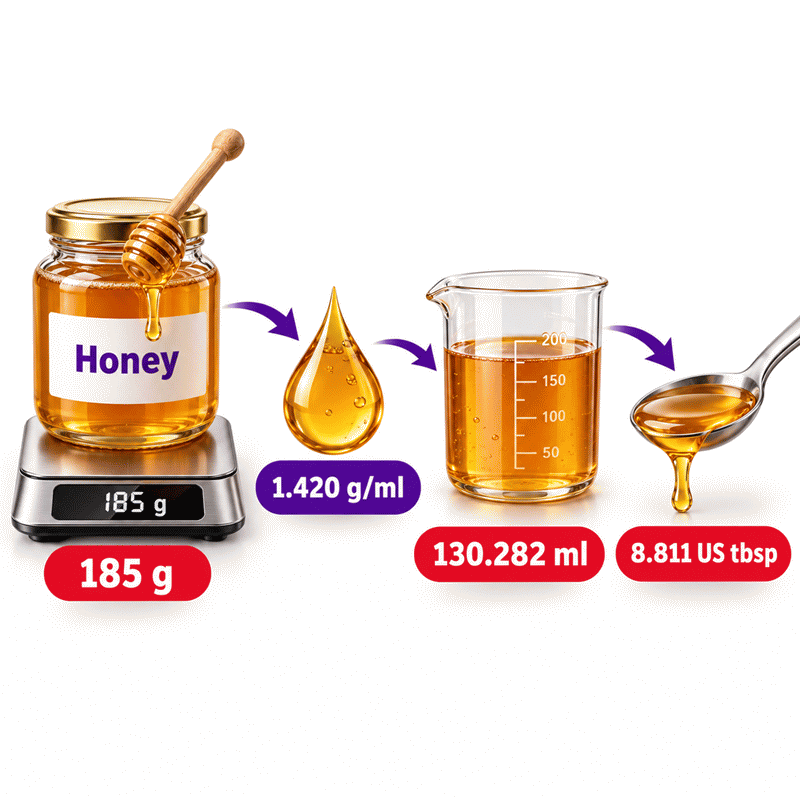
Entered mass: 185 g
Representative density: 1,420 kg/m³
Destination unit: US tablespoons
185 g of honey is approximately 130.282 ml or 8.811 US tablespoons.
The calculation first converts honey mass into milliliters using its representative density. The milliliter result is then divided by the exact US tablespoon factor. Intermediate values remain unrounded, while the final values are shortened for readable kitchen use. Actual spoon measurements may vary with temperature and handling.
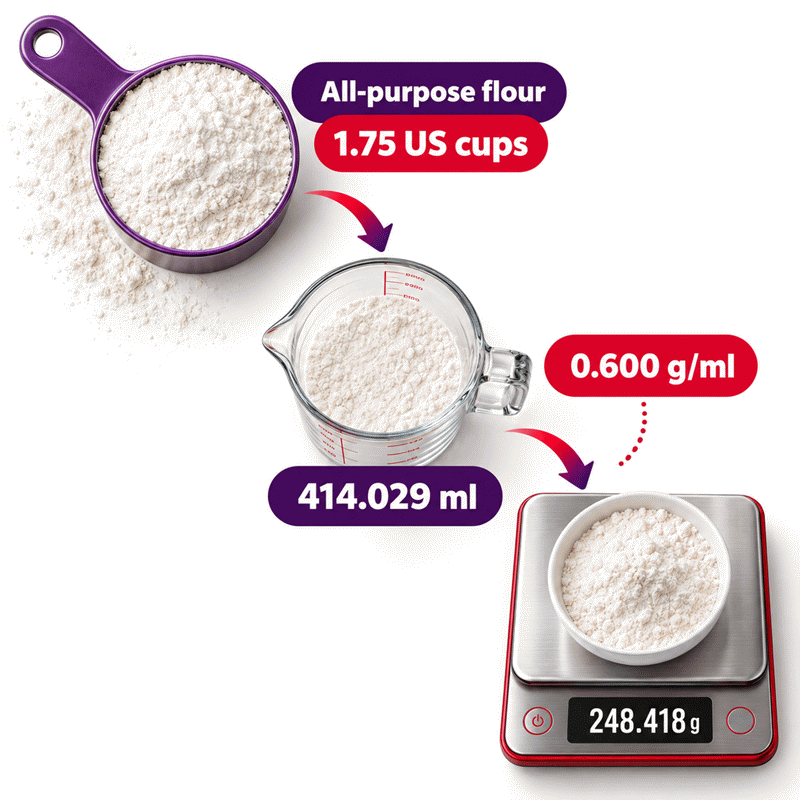
Entered result: 1.75 US cups
Representative density: 600 kg/m³
Unknown value: Ingredient mass
1.75 US cups of all-purpose flour is approximately 248.418 g or 8.763 oz.
The editable cup result acts as the starting value in this reverse calculation. It is first converted to milliliters and then multiplied by the ingredient density. The calculated mass automatically populates all compatible weight fields. Packing flour more tightly or loosely can produce a different real-world mass.
Results are rounded for display.
Internal calculations use full precision.
Calculations Disclaimer
What can you convert with a cooking measurement converter?
A recipe fails fast when its units do not match your tools. A cooking measurement converter solves that problem by linking common weight and volume units in one workspace. The cooking measurement converter on AxiCalculator lets you begin with any known value. You can enter grams, kilograms, ounces, pounds, milliliters, cups, teaspoons, tablespoons, fluid ounces, pints, or liters. The other compatible fields update immediately. This avoids repeated searches and reduces copying errors.
The tool handles two different jobs. The first is conversion within one measurement type. Grams can become ounces or pounds. Milliliters can become cups or tablespoons. These conversions depend on defined unit factors. The second job is more demanding. It connects weight with volume. That step requires the selected ingredient density.
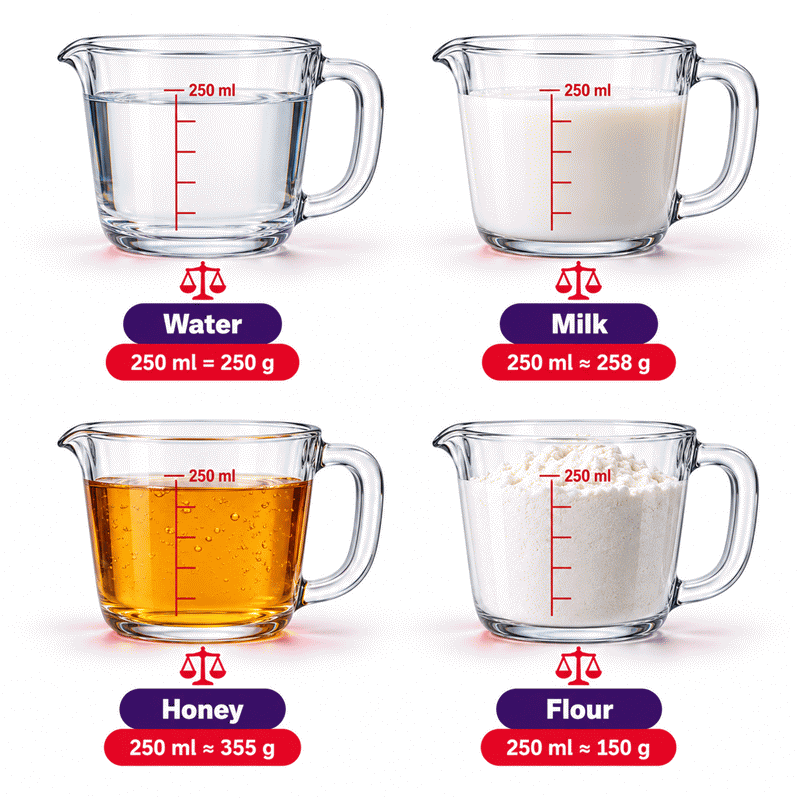
This distinction matters in real kitchens. A cup measures space. A gram measures mass. A cup of honey weighs far more than a cup of oats. The cup size may stay unchanged, yet the material inside it changes the result. Selecting the correct ingredient is therefore part of the calculation, not a decorative option.
The converter also supports reverse work. You may edit a result instead of restarting the form. If a recipe gives cups and your scale uses grams, enter the cup amount. The weight fields then become calculated results. If your recipe gives pounds but your measuring tools use spoons, enter pounds and read the synchronized volume estimates.
Why does ingredient density change every weight-to-volume result?
The most common kitchen conversion mistake is assuming one cup always has one fixed weight. It does not. Density describes how much mass occupies a known volume. Dense liquids place more mass inside the same container. Light powders place less mass inside it.
Water is a useful reference, but it is not a universal ingredient rule. Milk contains dissolved and suspended material. Oil is less dense than water. Honey is much denser. Flour contains air spaces between particles. Sugar crystal size and packing also affect the amount held by a cup.
The converter uses representative ingredient densities. It applies the selected density to connect mass and volume. If the ingredient is not listed, Custom mode accepts a positive density supplied by the user. That value should describe the ingredient in the condition being measured. A bulk-density value for loose flour should not be used for compressed flour.
Density-based results are practical estimates. They are most useful when a recipe does not provide both units. They should not be treated as laboratory certificates or nutrition-label measurements. For repeatable baking, a scale remains the better choice when the original recipe gives weight.
How flour type and packing change a cup measurement
Flour creates uncertainty because small particles trap air. Scooping directly with a cup can compress the flour. Spoon-filling and leveling usually produces a lighter cup. Sifting creates even more air and can reduce the mass held by the same cup.
Flour type also matters. Wheat, rye, corn, soy, buckwheat, and starch products have different particle structures and typical bulk densities. Choose the closest listed type before converting. Keep the method consistent across the whole recipe. If the author says “sifted flour,” sift before measuring. If the recipe supplies grams, use those grams whenever possible.
Why sugar, honey, oil, and butter need separate values
Granulated sugar, powdered sugar, and brown sugar do not fill a cup in the same way. Powdered sugar contains fine particles and more trapped air. Brown sugar is often packed by instruction. Honey flows but has a high density. Oils are lighter and can vary slightly by composition and temperature. Butter may be measured by mass, volume, or standardized sticks.
Choose the ingredient variant that matches the recipe. Do not use a sugar conversion for honey simply because both taste sweet. Do not treat fluid ounces as weight ounces. The visible unit symbol should match the physical quantity.
How do you convert cooking measurements without guesswork?
A rushed conversion often begins with the wrong unit. Pause and identify three facts: the ingredient, the known value, and the measurement system. Then select the ingredient and its subtype. Enter the known number in any compatible field. The calculator normalizes that entry into a base quantity and updates the remaining fields.
For a weight-only conversion, density does not change the answer. One pound always equals 453.59237 grams. For a volume-only conversion, the selected regional definition matters. One US cup equals 236.5882365 milliliters. A metric cup equals 250 milliliters.
For weight-to-volume or volume-to-weight conversion, confirm the ingredient first. Review whether it is loose, packed, melted, ground, or whole. The calculator can perform the arithmetic, but it cannot inspect the ingredient on your counter. Good input selection remains essential.
Finally, check whether the result is sensible. A small spoon amount should not become several kilograms. A cup result should change when the ingredient changes. This quick reasonableness check catches unit mistakes before they reach the mixing bowl.
Choose the correct ingredient and physical condition
Start with the exact ingredient category. Use the subtype selector when it appears. Match flour type, sugar form, oil type, or nut preparation. Ground nuts do not occupy space like whole nuts. Melted butter does not behave like cold chunks.
Custom density is useful for commercial mixes and uncommon ingredients. Obtain the density from a reliable specification or a controlled measurement. Record the temperature and preparation state when consistency matters.
Enter any known weight or volume
The form is bidirectional. You do not need to decide which field is an input forever. Enter a known mass to calculate volume, or enter a known volume to calculate mass. Editing another result makes that field the new source.
Use English digits and a positive finite value. Keep the unit selector beside the number aligned with the source recipe. If the recipe says UK fluid ounces, do not leave the selector on US fluid ounces.
Read and verify the synchronized results
All compatible results should describe the same physical quantity. Grams, ounces, and pounds are different displays of one mass. Cups, spoons, milliliters, and liters are different displays of one volume.
The final digits may exceed useful kitchen precision. Match your practical measurement tool. A scale reading to one gram does not justify reporting a fraction of a microgram. Preserve the calculated result for reference, then measure to the resolution your equipment supports.
Which cooking units does the converter support?
International recipes mix several unit families. Weight units include grams, decagrams, kilograms, ounces, and pounds. Smaller scientific units may help with trace ingredients, though ordinary kitchen equipment may not resolve them.
Volume units include milliliters, liters, US cups, metric cups, teaspoons, tablespoons, US and UK fluid ounces, and US and UK pints. Regional labels are explicit because identical unit names can hide different volumes.
A unit conversion should never cross physical dimensions by factor alone. Ounces of mass and fluid ounces are not interchangeable. Grams and milliliters become connected only after density is known. The converter keeps these paths separate internally and uses ingredient density only when crossing between mass and volume.
Grams, kilograms, ounces, pounds, and decagrams
The gram is the base display for many kitchen weights. A kilogram contains 1,000 grams. A decagram contains 10 grams. One avoirdupois ounce equals 28.349523125 grams. One international avoirdupois pound equals 453.59237 grams and contains 16 ounces.
These factors do not depend on the ingredient. One ounce of flour and one ounce of honey have the same mass. Their volumes differ because their densities differ.
Milliliters, liters, cups, spoons, fluid ounces, and pints
One liter equals 1,000 milliliters. A US cup equals 236.5882365 milliliters. A metric cup equals 250 milliliters. A metric teaspoon is 5 milliliters, while a US customary teaspoon is about 4.92892159375 milliliters.
A metric tablespoon is 15 milliliters. A US tablespoon is about 14.78676478125 milliliters. Small differences can grow when a recipe uses many repeated cups or spoons.
US customary volume definitions
US customary cooking units form a consistent chain. Three US teaspoons make one US tablespoon. Sixteen US tablespoons make one US cup. Two US cups make one US pint. A US fluid ounce equals two US tablespoons. Select the explicitly labeled US option when a recipe comes from the United States.
Metric kitchen volume definitions
Metric kitchen spoons use convenient decimal volumes. A metric teaspoon is 5 milliliters. A metric tablespoon is 15 milliliters. A metric cup commonly means 250 milliliters, although nutrition-label contexts may define a cup differently. Follow the stated recipe convention.
UK imperial volume definitions
Imperial fluid ounces and pints differ from their US namesakes. One UK fluid ounce is about 28.4130625 milliliters. One UK pint is 568.26125 milliliters. Never switch a UK pint to a US pint without conversion.
Why are US, UK, and metric cooking units different?
A recipe can look familiar and still hide a regional mismatch. Cups, pints, fluid ounces, teaspoons, and tablespoons developed under different systems. Some modern recipe publishers use rounded metric equivalents. Others retain exact customary or imperial definitions.
The safest approach is to preserve the recipe’s original system during entry. Select US, UK, or metric explicitly. Then convert into the system used by your tools. This is especially important for large batches, concentrated flavors, salt, leavening, and recipes with narrow texture tolerances.
Do not infer the system from language alone. Check the publisher location, nearby unit symbols, serving conventions, and any measurement notes. A recipe that uses Celsius may still define cups in its own editorial style.
How accurate is an ingredient-based kitchen conversion?
Defined unit conversions can be mathematically exact. Ingredient conversions are different. A representative density cannot capture every brand, harvest, grind, moisture level, or packing method. The arithmetic can be correct while the physical ingredient differs from the assumed state.
Accuracy improves when the selected ingredient closely matches the real material. Use a subtype where available. Measure liquids near normal kitchen temperature. Avoid compressing powders unless the recipe says “packed.” Level cups and spoons consistently.
The result should guide cooking, not replace controlled quality procedures. Commercial production may require approved formulations, calibrated equipment, batch records, allergen controls, and validated process limits. A consumer converter is not a substitute for those systems.
Moisture, temperature, particle size, and settling
Moisture adds mass and can change flow. Temperature changes liquid volume. Grinding changes particle size and the spaces between particles. Vibration and storage allow powders to settle. Each effect can shift bulk density.
For everyday cooking, these shifts may be acceptable. For delicate baking or scaled production, weigh ingredients and document the measurement method.
When a kitchen scale produces a better result
Use a scale when the recipe supplies grams, when flour structure is important, or when a small error changes the outcome. Scales also reduce cleaning because ingredients can be added directly to one bowl.
Volume tools remain useful for liquids and fast household preparation. The converter helps when the available tool does not match the recipe, but it should not encourage replacing a precise original mass with a rough volume.
How does reverse cooking measurement conversion work?
A reverse calculator removes the artificial boundary between input and output. Suppose the form shows a calculated cup value. You can edit that cup value directly. The calculator converts it to milliliters, applies the ingredient density, and repopulates the weight fields.
This is helpful when adapting a recipe around the equipment you own. A user with only measuring spoons can enter the desired spoon quantity and discover the corresponding grams. A user with a scale can enter grams and ignore volume tools.
Only the latest valid edited field should control the result. This avoids circular calculations. Changing a unit should preserve the physical amount and only change its displayed number. Changing the ingredient should recalculate the cross-dimension values because the density has changed.
What common conversion mistakes can ruin a recipe?
The first mistake is converting grams directly to cups without an ingredient. The second is assuming all cups are identical. The third is confusing ounces of mass with fluid ounces. Another common error is selecting the right ingredient but the wrong condition. Whole nuts, ground nuts, and nut flour do not share one bulk density.
Premature rounding can also accumulate error. Convert from the unrounded base quantity and round only for display or practical measurement. Large recipe scaling makes this more important.
Finally, avoid false precision. A calculated value such as 7.438 tablespoons does not mean an ordinary spoon can measure every decimal accurately. Choose a realistic measurement method. For critical ingredients, convert the result to grams and use a scale.
Confusing weight ounces with fluid ounces
An ounce measures mass. A fluid ounce measures volume. Their similar names do not make them interchangeable. When a recipe says “8 oz flour,” context may mean mass. When it says “8 fl oz milk,” it means volume. Confirm the symbol before entry.
Treating every cup as the same volume
A US cup, metric cup, and some editorial “legal cup” conventions differ. The difference may seem small for one cup, but it grows across a large batch. Select the correct cup definition instead of relying on a generic label.
Rounding before the final calculation
Rounding each intermediate step can move the final answer. Keep the exact conversion factor during calculation. Round only the displayed result to a level that matches the kitchen tool. This preserves consistency across synchronized fields.
How can AxiCalculator improve international recipe preparation?
AxiCalculator brings mass, volume, ingredient density, regional units, and reverse calculation into one compact workflow. The goal is not to promise identical results for every bag of flour or bottle of syrup. The goal is to make assumptions visible and arithmetic dependable.
Use the converter before shopping, during recipe preparation, or while scaling a batch. Select the ingredient carefully. Match the unit system. Enter the value you actually know. Then verify the result against your available equipment.
This process reduces uncertainty without hiding real-world variation. It also helps readers learn why conversions change. When the result affects texture, safety, or commercial consistency, choose direct weighing and an approved process. For ordinary international recipe adaptation, the converter provides a fast, clear, and reusable starting point.
Frequently Asked Questions
Why can the same number of cups produce different gram results?
Can I use the converter when my ingredient is not listed?
What is the difference between a US cup and a metric cup?
Should I measure baking ingredients by weight or volume?
How should a production kitchen validate a converted ingredient amount?
Why can two technically correct conversion tables disagree?
How can I test whether reverse calculation is working correctly?
Our engineers are here to help you get it right.