How the Chemical Name Calculator Turns Ions Into Correct Compound Names
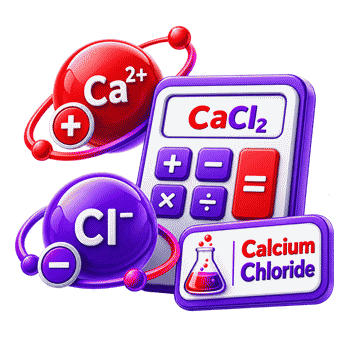
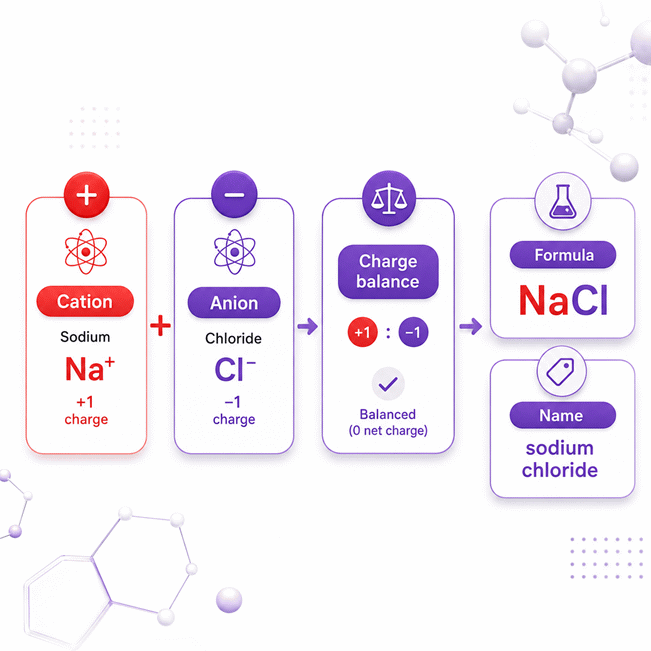
A wrong ion choice can change an entire chemical formula. The Chemical Name Calculator removes that first point of confusion. It links a positive ion with a negative ion. It then checks how their charges can form a neutral compound. The Chemical Name Calculator also helps users move in the opposite direction. A known formula can reveal the ions and the correct ionic name.
The process starts with ion identity, not with guesswork. Every supported cation has a defined symbol, name, and charge state. Every supported anion has the same core data. This matters most for metals with several possible charges. The word “iron” alone is not always enough. The selected charge changes both the formula and the final name.
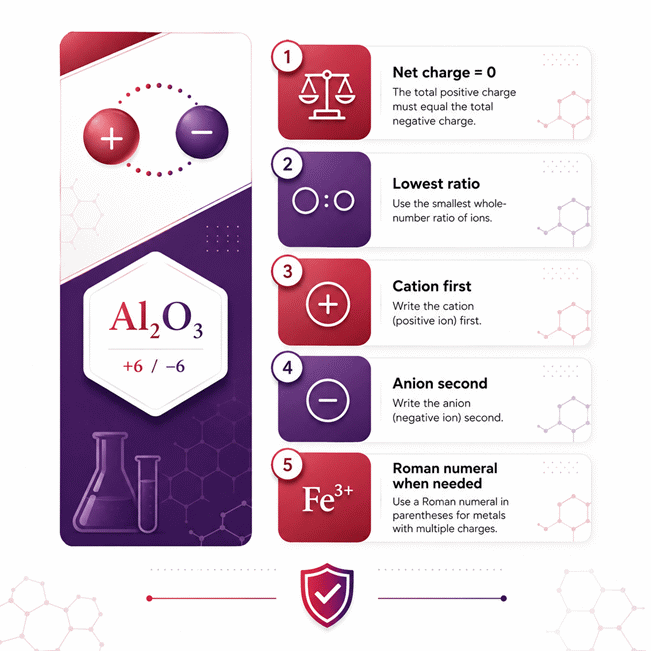
The tool treats an ionic compound as a charge-balanced combination. Positive and negative charge must cancel. It also keeps the smallest valid ion ratio. This prevents formulas that are neutral but not written correctly. That second check is easy to miss by hand.
A good result should answer more than one question. It should tell you which ions were used. It should show their correct relationship. It should also produce a name that matches those ions. This creates a clear path from input to result.
Positive ion → Negative ion → Charge match → Neutral ratio → Compound identity
How Cations and Anions Determine the Final Chemical Name
The cation is the positive part of an ionic compound. Its name appears first. The anion is the negative part. Its name appears second. That order is simple, but ion type changes the naming rule.
A single-atom anion normally changes its ending. Chlorine becomes chloride. Oxygen becomes oxide. Sulfur becomes sulfide. A polyatomic anion behaves differently. Its established ion name normally stays unchanged.
The calculator keeps each selected ion as a complete chemical unit. This is especially useful with polyatomic ions. Breaking one apart would create a different chemical meaning.
How Ion Charges Determine the Lowest Whole-Number Formula Ratio
The name alone does not decide the ion count. Charge does. A compound needs enough positive and negative charge to reach zero overall charge. The smallest ion counts that achieve this become the formula ratio.
This is where many manual answers fail. A charge-balanced ratio may still be reducible. The calculator checks for the smallest whole-number relationship. That keeps the formula in standard ionic form.
Quick check: if every subscript can be divided by the same integer, stop. The formula probably needs reduction.
How to Name Ionic Compounds Without Guessing
A student often sees a formula and knows both element symbols. The uncertainty starts with the name. Which ion comes first? Does the second name change? Is a Roman numeral needed? These small choices create many wrong answers.
The safest workflow starts by identifying the positive ion. Next, identify the negative ion as one complete ion. Then decide whether the positive ion has one common charge or several possible charges. Only after that should the final name be formed.
This order saves time because each step answers one question. It also prevents a common mistake. Users often choose a Roman numeral before checking the formula. That reverses the logic. The formula should support the charge choice.
Naming Fixed-Charge Cations and Monatomic Anions
Some common cations have a predictable charge in basic ionic naming. Their compound names usually do not need Roman numerals. The cation keeps its element name. The monatomic anion then receives its ionic ending.
This pattern is useful because the formula can often be read quickly. Yet the charge still matters. A familiar name should never replace the charge check. The final formula must still represent electrical neutrality.
For monatomic anions, the ending often changes to “-ide.” This gives names such as chloride, bromide, oxide, sulfide, and nitride. The rule is short, but it applies only to the correct ion type.
Naming Variable-Charge Metals With Roman Numerals
Variable-charge metals create a more interesting problem. One metal can form more than one positive ion. The same metal name can therefore appear in several compounds. A Roman numeral tells the reader which positive charge is present.
The numeral does not show how many metal atoms appear. It shows the charge state of the metal ion. Confusing those two ideas can break both the name and formula.
When the charge is not stated directly, the negative ion can reveal it. Its known charge and its subscript show how much negative charge exists. The positive side must match that total.
How to Determine the Correct Roman Numeral From an Ionic Formula
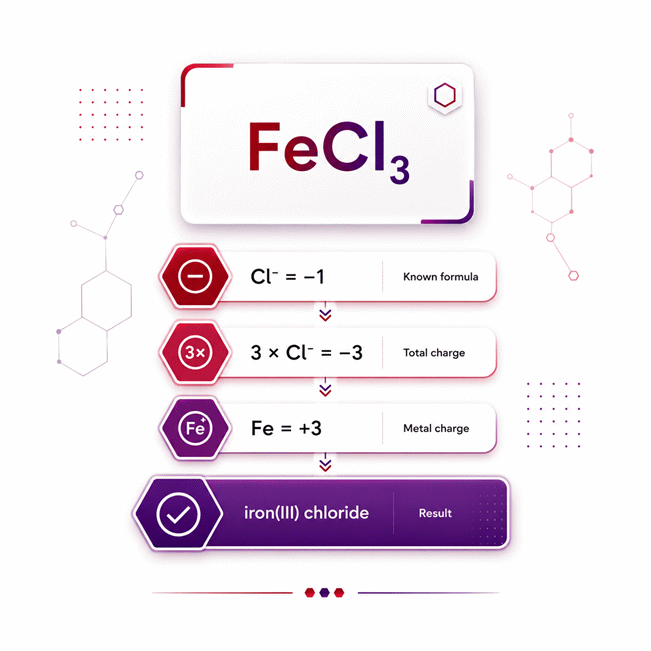
Start with the known anion charge. Count how many anions appear in the formula. That gives the total negative charge. Next, count the metal ions. The metal charge must make the positive total equal the negative total.
Use that calculated metal charge as the Roman numeral. Do not use the metal subscript as the numeral. Do not copy the anion subscript either. The numeral represents charge, not quantity.
One small numeral can completely change a compound name. That is why reverse charge checking is valuable.
How to Write an Ionic Formula From a Chemical Name
A correct name can still lead to a wrong formula. The usual problem is not spelling. It is charge. Users may identify both ions correctly but choose the wrong counts.
Begin by separating the compound name into cation and anion parts. Determine the charge of each selected ion. Then find the smallest number of each ion that creates zero total charge. Write the cation first. Write the anion second.
The result should describe a neutral ionic ratio. It should not contain unnecessary factors. A formula that doubles every ion count may still balance, but it is not the preferred simplest formula unit.
Name → Ion identities → Ion charges → Neutral ratio → Chemical formula
Balancing Positive and Negative Charges to Reach Electrical Neutrality
Electrical neutrality is the central test. The positive contribution must equal the negative contribution in magnitude. Neither side may dominate the final formula.
This does not mean the number of cations and anions must match. Their charges may differ. One highly charged ion can balance several lower-charge ions. That is why counting symbols alone can be misleading.
The fastest mental check is simple. Calculate the total positive charge. Then calculate the total negative charge. Their sum should be zero. If it is not, the ion ratio is wrong.
Reducing Ionic Subscripts to the Lowest Whole-Number Ratio
Charge balance is necessary, but it is not the final check. Ionic formulas use the lowest whole-number ratio. If all ion counts share a common factor, reduce them.
This rule protects the meaning of a formula unit. The written formula should show the simplest repeating proportion. Extra common factors add no useful chemical information.
A subscript of one is also not written. The absence of a visible subscript already means one unit. Adding a written one would be unnecessary.
Why Charge Reduction Matters Before You Trust a Formula
A neutral formula can look convincing and still be poorly written. That makes reduction a valuable second test. First confirm neutrality. Then check whether every ion count shares a common divisor.
This two-step habit catches errors that a single charge check misses. It also makes reverse solving more reliable. A reduced ratio gives a cleaner link between charge and composition.
Eye check: neutral does not always mean finished.
Polyatomic Ions: Charges, Parentheses, and Formula Construction
Polyatomic ions often cause mistakes because they contain several atoms. Yet they act as one charged unit during ionic formula building. Treating their internal atoms separately can change the entire compound.
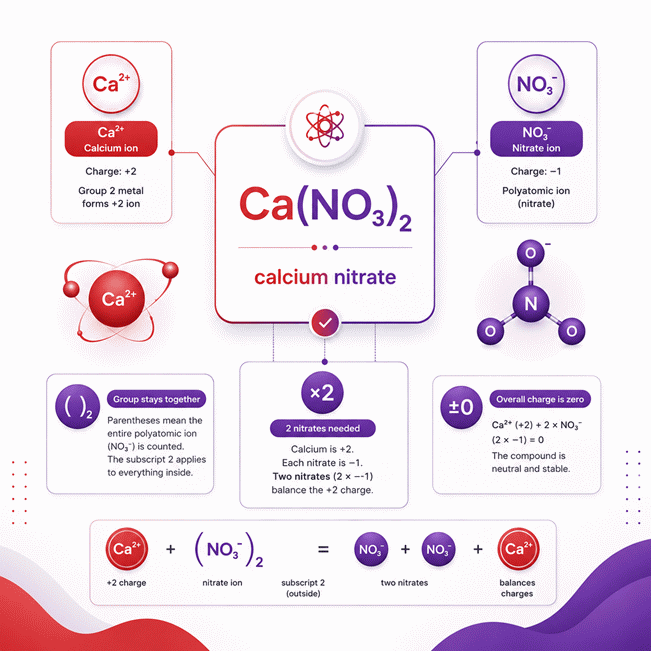
The key is to preserve the ion formula. Its charge belongs to the complete group. When one copy is needed, the group is usually written normally. When several copies are needed, parentheses protect the group before the outside subscript is added.
This small formatting rule carries real meaning. The outside subscript applies to every atom inside the parentheses. Without the correct grouping, the written composition may describe something else.
When Parentheses Are Required Around a Polyatomic Ion
Parentheses become necessary when more than one copy of a polyatomic ion is required. The full ion goes inside the parentheses. The number of copies goes outside.
Do not place parentheses around each element separately. Do not change the internal subscripts of the known ion. Those internal numbers belong to the ion itself.
This distinction matters during reverse solving too. A parser must recognize the group as one ion. Otherwise, it may interpret the formula as unrelated individual atoms.
When One Polyatomic Ion Needs No Parentheses
If only one copy of a polyatomic ion appears, parentheses are normally unnecessary. Adding them does not improve the formula. It can also make a simple formula harder to read.
The useful question is not whether an ion contains several atoms. The useful question is how many copies of that complete ion are needed.
One group usually needs no parentheses. Multiple groups usually do.
How Common Polyatomic Ions Behave During Ionic Naming
Common polyatomic ions keep their established names when they enter ionic compounds. Their names are not changed into “-ide” forms. This separates them from many monatomic anions.
Ammonium is also important because it is a common positive polyatomic ion. It shows why “cation” does not always mean “metal.” The naming process still works because charge and ion identity remain clear.
The calculator should therefore recognize both monatomic and supported polyatomic ions. It should preserve each group during forward and reverse solving.
Reverse Solving: Find Ions and Charges From a Chemical Formula
Sometimes the formula is known, but the ion details are not. This is where reverse solving becomes useful. Instead of building a formula from selected ions, the tool works backward from the written composition.
The first task is structural. The formula must be split into valid ion candidates. Parentheses, subscripts, capitalization, and known ion groups all matter. A careless split can create a false interpretation.
After the ions are identified, charge balance can test the result. The total positive and negative contributions must cancel. For variable-charge metals, this step can reveal the required charge state.
Reverse solving should not guess when several interpretations remain possible. A clear ambiguity message is safer than a confident wrong result.
How to Determine an Unknown Cation Charge From Formula Subscripts
A known anion can act like a clue. Its charge is fixed for that ion. Its subscript shows how many copies appear. Together, those facts reveal the total negative contribution.
The cation side must supply the same positive magnitude. Divide that required positive total across the number of cations present. The result gives the needed cation charge.
This method is especially useful with metals that support several charge states. It links the written formula directly to the correct ionic name.
How to Identify the Compound Name From a Known Ionic Formula
Once the ions and charges are resolved, naming becomes much easier. Name the cation first. Add a Roman numeral when its variable charge requires one. Then add the correct anion name.
For a monatomic anion, use its ionic ending. For a known polyatomic ion, keep its established ion name. Do not rename each atom inside the group.
A good reverse result should match the original formula when solved forward again. That round-trip check is powerful. It confirms both parsing and charge logic.
Why Different Metal Charges Can Produce Different Names
A transition metal may pair with the same anion in several charge states. The element symbols can look nearly identical across those formulas. Yet the compound names differ because the metal charge differs.
This is why a formula should be analyzed before a Roman numeral is chosen. The numeral is evidence from charge balance, not decoration.
If the charge cannot be proven from the supported formula, the result should remain unresolved.
Chemical Name and Formula Validation: How to Check Whether a Result Is Correct
A result can look neat and still be wrong. Validation should therefore test more than spelling. It should test ion identity, charge balance, ratio reduction, group handling, and naming consistency.
Start with the selected ions. Confirm that each symbol or ion formula matches the intended name. Then check the charge state. Next, confirm that the final ion counts create zero net charge.
After that, inspect the written formula itself. Check capitalization. Check parentheses. Check the smallest ratio. Finally, confirm that the displayed name matches the resolved charge state.
This layered approach catches several error types at once. It also explains why a calculator should show more than one output.
The Zero-Charge Test for Verifying Ionic Compound Formulas
The zero-charge test is the fastest general check for an ionic formula. Multiply each ion charge by its ion count. Add the positive and negative totals.
The combined result should be zero for a neutral ionic compound. A nonzero total means the selected ratio cannot represent the intended neutral compound.
Zero charge is necessary, but keep going. A reducible ratio, wrong ion identity, or damaged polyatomic group can still create a bad formula.
Why a Charge-Balanced Formula Can Still Be Written Incorrectly
Charge balance checks electrical consistency. It does not check every writing rule. A formula may use an unreduced ratio. It may contain incorrect capitalization. It may also place a polyatomic group incorrectly.
This is why reliable validation uses several checks in sequence. Each check protects against a different mistake.
Eye check: balance proves neutrality, not perfect notation.
Common Chemical Naming and Formula Errors You Should Avoid
Most mistakes begin with a small assumption. A user sees a subscript and treats it as charge. Another user changes the inside of a polyatomic ion. Someone else adds a Roman numeral to every metal.
These errors feel reasonable because each uses a real chemical feature incorrectly. The best defense is to separate the concepts. Charge belongs to an ion. A subscript counts units. A Roman numeral states a variable metal charge. Parentheses preserve repeated groups.
Capitalization matters too. Element symbols follow exact letter case. A changed capital letter can change the chemical meaning.
Another common error is forcing an answer from incomplete data. Some formulas or names need more context. A careful tool should identify that limit instead of inventing certainty.
Confusing Charges, Subscripts, Capitalization, and Polyatomic Ion Boundaries
A superscript charge and a formula subscript answer different questions. Charge tells you the electrical state. A subscript tells you how many units appear.
Capital letters begin element symbols. A second letter, when present, is lowercase. That simple convention helps distinguish one element from another.
Polyatomic boundaries matter because the group behaves as one ion. If a known ion is split during interpretation, charge balancing may still produce a misleading result.
When an Ionic Formula Is Ambiguous and Should Not Be Guessed
Some inputs do not contain enough information for one safe answer. A variable-charge element may support several states. A formula may also match more than one unsupported interpretation.
In that case, uncertainty should be visible. The user should select the intended ion or charge state. That is better than receiving an answer that only looks precise.
Trust grows when the tool knows when to stop.
Scientific Scope of Ionic Compound Naming
A naming tool becomes less useful when it claims to solve every form of chemistry. Ionic naming is one defined task. Organic compounds, coordination compounds, molecular compounds, acids, and other classes can follow different rules.
The most reliable workflow begins by identifying the compound type. If the substance is built from supported cations and anions, ionic charge balancing is appropriate. If it follows another naming system, a different method is needed.
This scope also matters for real chemical behavior. A balanced formula describes a valid stoichiometric relationship. It does not, by itself, prove that a substance is stable under every condition. It also does not predict solubility, reaction speed, phase behavior, or manufacturing conditions.
That distinction is valuable for students, laboratory users, and technical readers. A formula can answer a composition question without answering every chemistry question.
Why Clear Chemical Scope Produces More Reliable Results
Clear scope prevents a simple tool from becoming a guessing engine. The calculator can focus on what its data supports. It can identify ions, balance their charges, create the smallest neutral ratio, and build the matching ionic name.
That focused path also makes errors easier to audit. Each output can be traced back to ion identity and charge. Users can inspect the result instead of accepting a hidden answer.
For quick checks, study work, and supported ionic naming tasks, this makes AxiCalculator useful as a clear second-check tool. Enter the known information, review the resolved ions, and confirm the final name before moving on.