Astronomical Unit Calculator
- Last formula update:
Decimal & Rounding Policy
- Calculations use full available precision internally to reduce rounding errors.
- Results are rounded only for display, while the underlying conversion value remains unrounded.
- Exact conversion constants, including 1 au = 149,597,870,700 m, are preserved without approximation.
- Very large or very small astronomical distances may be displayed in scientific notation for readability.
- Displayed decimal places may vary by unit so that meaningful significant digits are retained.
Valid range
- Distance: Enter any finite positive value whose converted base distance is from 1e-250 m to 1e250 m.
- Astronomical unit: Conversions use the exact relationship 1 au = 149,597,870,700 m.
- Metric units: Meter, kilometer, and other supported metric length values must represent a positive physical distance.
- Astronomical units: Light-year, parsec, solar radius, and other supported astronomical length units follow the same valid distance range.
- Imperial and US units: Mile, foot, yard, inch, and supported length units are converted through their defined length factors.
- Invalid values: Zero, negative, non-numeric, non-finite, incompatible, or out-of-range values are not accepted.

Felovyn Quarnwick
Reviewers:
Meravie Quellmont
Herixon Vosswick
Check our editorial policy
September 6, 2026
1.0.0
Initial calculator and formula release.
Our engineers are here to help you get it right.
How Does the Astronomical Unit Calculator Make Space Distance Conversion Easier?
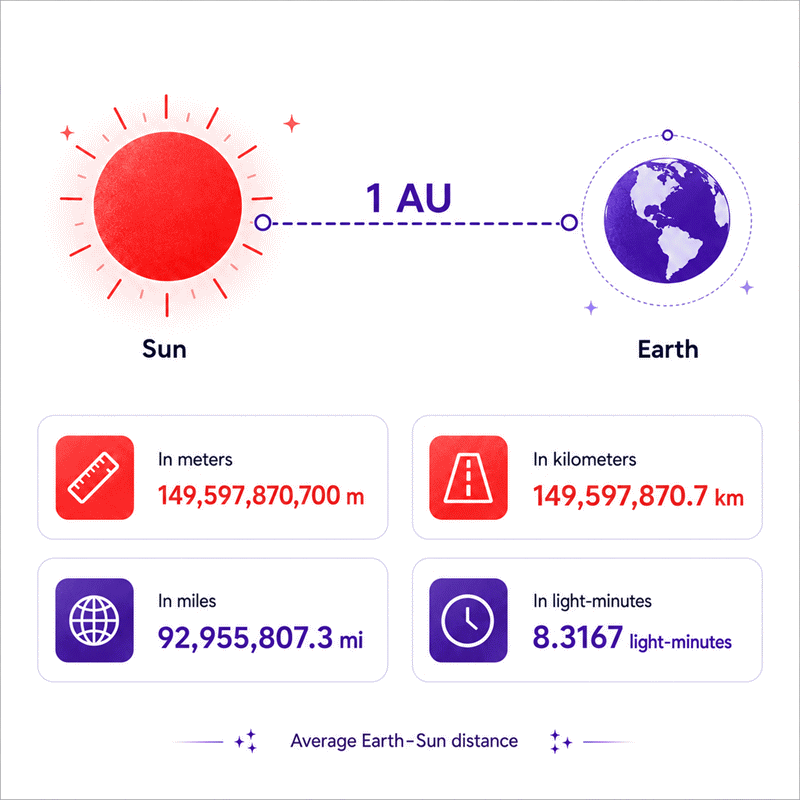
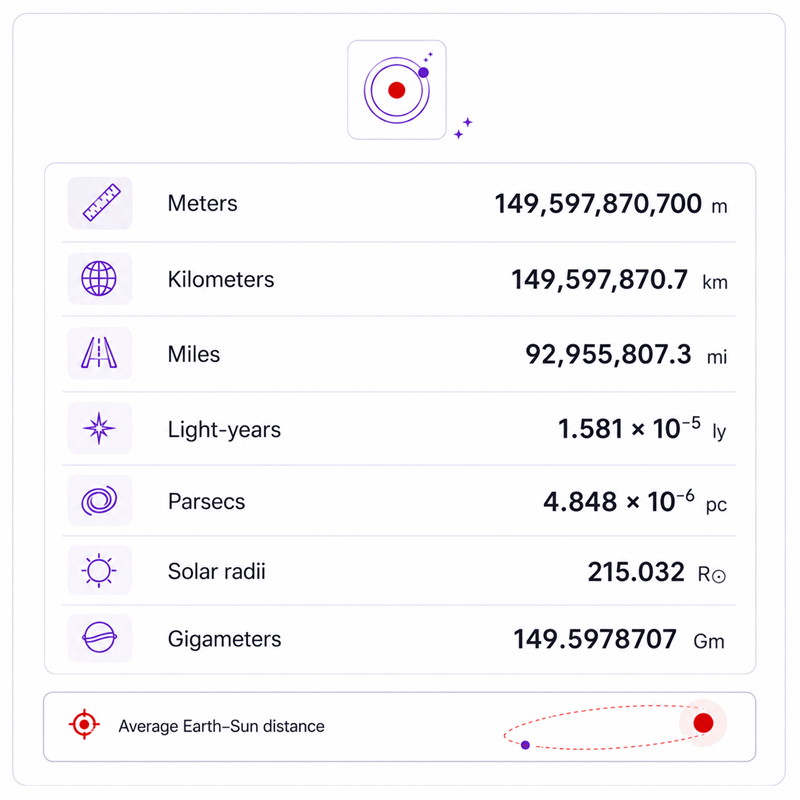
Astronomical Unit Calculator converts Solar System and astronomical distances into clear, comparable units. One astronomical unit, written as au, equals exactly 149,597,870,700 meters. This fixed definition provides a stable reference for converting distances without depending on Earth’s changing position around the Sun.
- Use au for clear comparisons of planetary and Solar System distances.
- Enter any supported distance field to make it the active calculation value.
- Convert between au, meters, kilometers, miles, light-years, parsecs, and related units.
- Use reverse conversion when the known value is not already expressed in au.
- Remember that Earth’s actual distance from the Sun changes during its orbit.
- Choose light-years or parsecs when stellar distances become difficult to read in au.
- Use scientific notation to keep extremely large or small values easier to interpret.
- Avoid confusing distance units such as light-year with measurements of time.
The Astronomical Unit Calculator keeps one physical distance consistent while its displayed unit changes. This makes it useful for planetary comparisons, spacecraft distances, astronomy education, research checks, and everyday space-distance conversions. The result is a faster way to understand scale without manually rebuilding each conversion.
Assumptions used in this calculator
- All calculations assume distance values represent positive, finite physical lengths.
- One astronomical unit equals exactly 149,597,870,700 meters.
- Unit conversions preserve the same physical distance across all supported units.
- Intermediate calculations retain full precision before display rounding is applied.
- Displayed results may use scientific notation for extremely large values.
- Light-year conversion assumes the defined speed of light in vacuum.
- One Julian year is treated as exactly 31,557,600 seconds.
- Parsec conversion follows the standard astronomical-unit angular relationship.
- Solar radius conversion uses the nominal solar radius value.
- Reverse calculations treat the edited field as the new source.
- Unsupported, non-finite, zero, and negative distances are rejected.
- Changing units preserves the underlying physical distance whenever values remain valid.
- Results should be independently verified for safety-critical industrial or scientific decisions.
Results are rounded for display.
Internal calculations use full precision.
Formulas Used in Astronomical Unit Calculator :
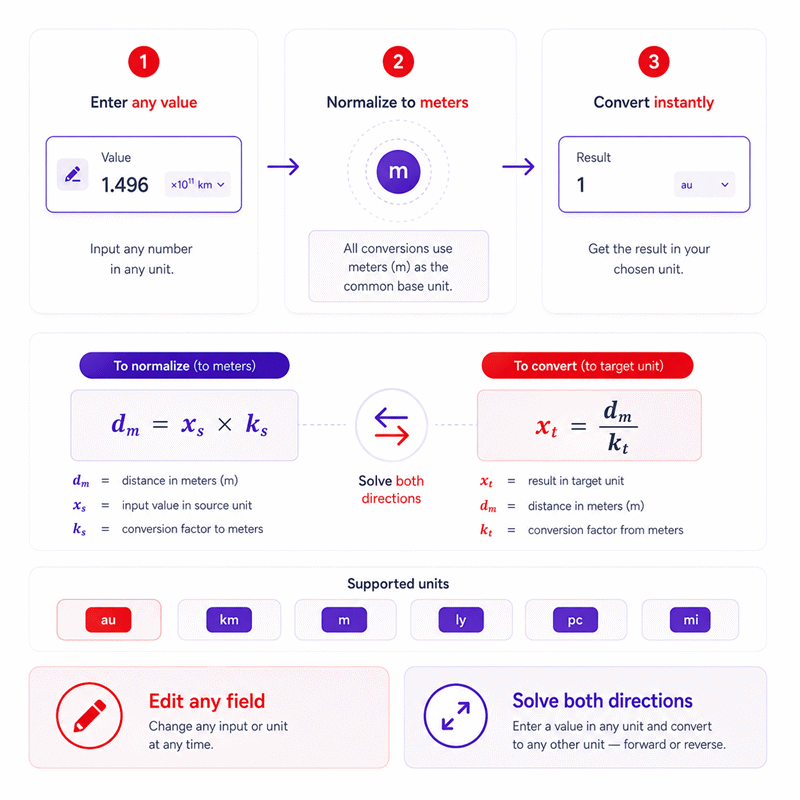
The calculator treats every supported measurement as the same physical distance expressed in a different unit. Each entered value is first normalized to meters and then converted to the selected target unit without intermediate rounding.
1. Astronomical Unit Definition
This exact length is the base conversion constant used for astronomical units.
2. Normalize the Entered Distance to Meters
The entered value is multiplied by the meters-per-unit factor of its selected source unit.
3. Convert the Meter Distance to the Target Unit
The normalized meter distance is divided by the meters-per-unit factor of the selected target unit. Reverse calculations use the same process by treating the edited field as the new source.
4. Light-Year Conversion Factor
Using c = 299,792,458 m/s and a Julian year of 31,557,600 seconds gives 1 ly = 9,460,730,472,580,800 m.
5. Parsec Conversion Factor
This relation gives approximately 206,264.806 astronomical units per parsec.
Variables
- xs = numeric value entered in the source field.
- ks = source-unit conversion factor in meters per source unit.
- dm = physical distance normalized to meters.
- xt = calculated value in the target unit.
- kt = target-unit conversion factor in meters per target unit.
- kau = meters in one astronomical unit.
- kly = meters in one light-year.
- kpc = meters in one parsec.
- c = speed of light in vacuum, 299,792,458 m/s.
- tJy = duration of one Julian year, 31,557,600 s.
Conversion Factors Used by the Calculator
| Unit | Symbol | Meters per Unit |
|---|---|---|
| Astronomical unit | au | 149,597,870,700 |
| Meter | m | 1 |
| Kilometer | km | 1,000 |
| Mile | mi | 1,609.344 |
| Foot | ft | 0.3048 |
| Yard | yd | 0.9144 |
| Inch | in | 0.0254 |
| Nautical mile | nmi | 1,852 |
| Light-year | ly | 9,460,730,472,580,800 |
| Parsec | pc | Approximately 30,856,775,814,913,673 |
| Solar radius | Rsun | 695,700,000 |
| Light-minute | lmin | 17,987,547,480 |
| Light-second | ls | 299,792,458 |
| Gigameter | Gm | 1,000,000,000 |
| Megameter | Mm | 1,000,000 |
| Centimeter | cm | 0.01 |
| Millimeter | mm | 0.001 |
All supported fields use the same normalization and target-conversion equations. No separate forward or reverse formula is required, and values are not rounded during intermediate calculations; rounding is applied only when a result is formatted for display.
Variables & Definitions
View a complete list of all variables used in this calculator, including definitions and units
Astronomical Unit Calculator Variables and Conversion Parameters
| Symbol | Parameter | Definition | Unit | Role in Calculation |
|---|---|---|---|---|
| xs | Source Value | The numeric distance entered or edited by the user in the selected source unit. | Selected length unit | Provides the starting value for the conversion. |
| ks | Source Conversion Factor | The number of meters represented by one unit of the selected source measurement. | m per source unit | Converts the source value to the common meter base. |
| dm | Normalized Distance | The physical distance after the source measurement has been converted to meters. | m | Acts as the common internal distance used for all supported conversions. |
| xt | Target Value | The converted distance expressed in the selected target unit. | Selected length unit | Provides the calculated value displayed in the target field. |
| kt | Target Conversion Factor | The number of meters represented by one unit of the selected target measurement. | m per target unit | Converts the normalized meter distance to the requested target unit. |
| kau | Astronomical Unit Factor | The exact defined length of one astronomical unit: 149,597,870,700 meters. | m/au | Provides the fixed conversion factor between astronomical units and meters. |
| kly | Light-Year Factor | The distance light travels in vacuum during one Julian year. | m/ly | Provides the meter conversion factor for light-years. |
| kpc | Parsec Factor | The meter-equivalent distance of one parsec derived from its astronomical-unit relationship. | m/pc | Provides the meter conversion factor for parsecs. |
| c | Speed of Light | The exact speed of light in vacuum, equal to 299,792,458 meters per second. | m/s | Used with the Julian year duration to determine the light-year conversion factor. |
| tJy | Julian Year Duration | The duration of one Julian year, equal to 31,557,600 seconds. | s | Used with the speed of light to calculate the length of one light-year. |
Unit Conversion Table
Astronomical Unit Conversion Reference Table
| Unit Group | Unit Name | Symbol | Equivalent in Astronomical Units | Used For |
|---|---|---|---|---|
| Astronomical Distance | Astronomical Unit | au | 1 au | Planetary and Solar System distances |
| Metric Distance | Kilometer | km | 1 km = 6.684587122268445e-9 au | Scientific and engineering distance measurements |
| Metric Distance | Meter | m | 1 m = 6.684587122268445e-12 au | Precise scientific calculations |
| Imperial Distance | Mile | mi | 1 mi = 1.0737415732424243e-8 au | Distance values expressed in miles |
| Light Distance | Light-Year | ly | 1 ly = 63241.07708426628 au | Interstellar and stellar distances |
| Light Distance | Light-Day | ld | 1 ld = 173.144632674240 au | Short astronomical light-travel distances |
| Light Distance | Light-Hour | lh | 1 lh = 7.214359694760 au | Planetary and spacecraft communication distances |
| Light Distance | Light-Minute | lm | 1 lm = 0.120239328246 au | Solar System light-travel distances |
| Parsec Distance | Parsec | pc | 1 pc = 206264.80624709636 au | Stellar and galactic astronomy |
Example Calculation
Given distance
2.375 au
Formula
Substitution and solution
A distance of 2.375 astronomical units is first converted to meters using the exact astronomical-unit definition. The resulting meter value becomes the common physical distance used for every other supported unit. Each target result is obtained by dividing that distance by the target unit's meters-per-unit factor. Intermediate values remain unrounded, while displayed results may be shortened for readability.
General conversion formulas
Here, xs is the source value, ks is the source meters-per-unit factor, dm is the normalized distance in meters, xt is the target value, and kt is the target meters-per-unit factor.
Known editable value
742,500,000 km
Reverse formula
Substitution
Solution
In this reverse calculation, the kilometer field is edited directly and becomes the source of the calculation. The calculator first converts 742,500,000 kilometers into 742,500,000,000 meters, preserving the physical distance. It then divides that normalized distance by the astronomical-unit factor to recover approximately 4.96330593828432 au. All other editable fields are recalculated from the same unrounded meter value.
General reverse-solving formulas
Here, xt is the edited known value, kt is its meters-per-unit factor, dm is the normalized distance in meters, xs is the unknown value being solved, and ks is the meters-per-unit factor of that unknown unit.
Results are rounded for display.
Internal calculations use full precision.
Calculations Disclaimer
What Is an Astronomical Unit and Why Is It Used for Solar System Distances?
Space distances become difficult to read when every value uses kilometers. A single planetary distance can contain hundreds of millions of digits. Astronomers therefore use larger units when the scale demands them. The astronomical unit solves this problem inside the Solar System. It gives large distances a shorter and clearer form.
An astronomical unit represents a fixed length. Its official symbol is au. One au equals exactly 149,597,870,700 meters. This definition gives scientists a stable reference. The value does not change with Earth’s position. It also does not change with seasons or orbital motion.
The astronomical unit works especially well for planetary distances. Earth’s orbit provides an intuitive scale for readers. Jupiter lies several au from the Sun. Neptune lies much farther away. These values remain easier to compare than huge kilometer figures.
AU is also useful for spacecraft, asteroids, comets, and orbital studies. It helps people compare distances without losing the physical meaning. A value of 5 au immediately feels larger than 1 au. A kilometer value can hide that relationship inside many digits.
Quick insight: AU makes Solar System distances readable without changing their physical meaning.
The Astronomical Unit Calculator turns this idea into a practical tool. You can enter a supported distance value directly. The other distance fields update from the same physical distance. This removes repeated manual conversions. It also reduces the chance of copying the wrong conversion factor.
The main benefit is not merely shorter numbers. AU also creates useful scale awareness. It lets readers compare planetary distances at a glance. That makes the unit valuable for students, researchers, educators, and space enthusiasts.
Exact Astronomical Unit Definition: Why 1 au Equals 149,597,870,700 Meters
A common mistake starts with treating one au as an approximate number. The modern astronomical unit has an exact defined value. One au is exactly 149,597,870,700 meters. The word exactly matters here. It separates the definition from measured orbital distances.
This fixed value creates a stable conversion reference. A calculator can use the same value every time. Scientists can also compare results across different systems. There is no need to estimate the au from today’s Earth-Sun distance.
The modern definition also prevents another source of confusion. Earth’s real distance from the Sun changes. That does not redefine the au. The unit stays fixed while the physical orbit continues moving.
AU or au: Which Astronomical Unit Symbol Is Scientifically Correct?
Users often see both AU and au across websites and older documents. The recommended scientific symbol is lowercase au. This form keeps notation consistent across modern astronomical work. Capitalized AU remains common in informal writing. However, lowercase au is the preferred technical form.
A clear calculator should show the unit consistently. That prevents users from wondering whether AU and au differ. They describe the same distance concept. The difference is notation, not physical length.
How Does the Astronomical Unit Calculator Work?
Many distance converters force users into one fixed direction. That creates friction during real work. You may know kilometers but need au. Later, you may know parsecs instead. A rigid input-output layout makes those tasks slower.
This calculator uses a more flexible workflow. Any supported distance field can become the active value. When you edit one field, it becomes the new reference. The other fields then update automatically.
This design is useful because distance conversion is reversible. The physical distance does not depend on which field you edit. Only the displayed unit changes. The calculator therefore treats all editable distance fields as views of one quantity.
ENTER A DISTANCE → SELECT ITS UNIT → UPDATE THE PHYSICAL DISTANCE → SHOW ALL RELATED DISTANCES
This approach also makes comparison faster. Suppose you are reading a planetary report. One source may use kilometers. Another may use astronomical units. A third may use light-travel distance. You can compare them without rebuilding the calculation manually.
The interface is designed for immediate feedback. There is no separate calculate button. A valid change produces updated values at once. This keeps the interaction simple. It also reduces unnecessary clicks during repeated conversions.
The unit selector adds another practical advantage. You can work with familiar everyday units. You can also use larger scientific units. This gives one interface enough range for different learning and research tasks.
Need the answer backward? Edit the result field instead of restarting the calculation.
How the Calculator Normalizes Every Distance to Meters
Different distance units cannot be compared safely without a common reference. The calculator solves this by using meters internally. This does not force the user to work in meters. It simply creates one shared internal scale.
This method has an important practical benefit. Every supported unit follows one consistent path. The calculator does not need unrelated conversion logic for every possible pair. That keeps the behavior predictable across the interface.
When a user changes units, the underlying distance stays the same. Only the displayed number changes. This is essential for a trustworthy multi-unit converter. A unit change should never silently change the physical distance.
Reverse Astronomical Unit Conversion: Edit Any Unit and Solve Backward
Reverse solving matters when the known value is not in au. You may start with kilometers, miles, or another supported unit. The calculator should not force you to move that value elsewhere. Instead, the edited field becomes the source.
The other fields then respond to that distance. This creates a true bidirectional experience. It is especially helpful when comparing data from different astronomy sources.
Reverse solving also reduces mental load. You do not need separate tools for each direction. One calculator can handle the whole conversion path. That makes repeated work faster and easier to check.
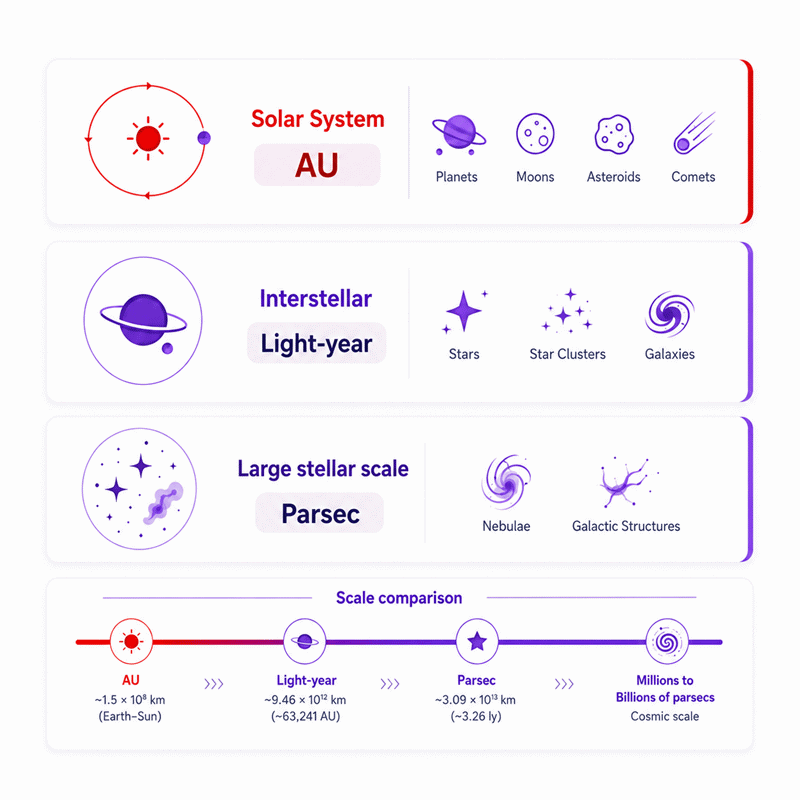
AU vs Light-Year vs Parsec: Which Astronomical Distance Unit Should You Use?
Choosing the wrong distance unit can make a correct answer hard to understand. AU, light-year, and parsec all describe length. However, they are useful at very different scales.
Astronomical units work best inside planetary systems. They are compact enough for orbital distances. They also remain easy to compare with Earth’s Solar System scale. This makes au useful for planets, comets, and spacecraft.
Light-years become more natural when distances extend between stars. A stellar distance written in au can become extremely large. A light-year compresses that value into a more readable scale.
Parsecs are also common in professional astronomy. They are especially useful in stellar and galactic contexts. The unit connects naturally with angular parallax. This makes it valuable in observational astronomy.
SOLAR SYSTEM → au | STELLAR DISTANCES → light-year or parsec | GALACTIC SCALE → parsec-based units
There is no universal “best” astronomical distance unit. The best unit depends on scale. It also depends on the audience. A technically correct value can still be difficult to interpret.
For a Solar System calculator, au usually provides the clearest reference. It lets users see orbital scale quickly. The same tool can still show larger units when needed.
When Is an Astronomical Unit the Best Choice for Measuring Distance?
Use au when the distance belongs to a planetary system. It works well for distances from a star. It also works for orbital positions and spacecraft travel.
AU can make comparisons easier between planets. A reader can quickly compare one orbit with another. That helps education, visualization, and technical communication.
It is less useful for small laboratory measurements. It is also awkward for most terrestrial distances. The unit becomes valuable when kilometer values become visually large.
When Should You Use Light-Years or Parsecs Instead of AU?
Use larger astronomical units when au values become unwieldy. Distances between nearby stars are a good example. Light-years often communicate those distances well to general readers.
Parsecs are common in astronomy research and catalogs. They can be more convenient for stellar distance work. The choice depends on the intended context.
Earth-Sun Distance in AU: Is Earth Always Exactly One Astronomical Unit Away?
This question causes more confusion than almost any AU conversion. The answer is no. Earth is not always exactly one au from the Sun.
Earth follows an orbit that is not a perfect circle. Its distance from the Sun changes throughout the year. The astronomical unit does not follow those changes. It remains a fixed length.
This distinction is crucial. One au is a defined unit. Earth’s current solar distance is a measured physical quantity. They are related, but they are not identical concepts.
People often describe one au as the average Earth-Sun distance. That description is useful for intuition. However, modern scientific use is more precise. The unit itself has a fixed meter value.
This also explains an apparent puzzle. Earth’s distance may appear below one au at one time. It may appear above one au later. Nothing happened to the unit. Only Earth’s position changed.
The surprising part: Earth moves, but the astronomical unit does not.
This distinction becomes useful when reading mission data. A spacecraft can be described as several au from the Sun. That value uses the fixed unit. It does not depend on Earth’s current orbital position.
Why the Real Earth-Sun Distance Changes While the Definition of 1 au Does Not
Earth’s orbit is slightly elliptical. Gravity from other Solar System bodies also affects motion. These effects change the instantaneous Earth-Sun distance.
A measurement unit should not drift with that motion. The fixed au avoids that problem. It gives astronomers a stable yardstick for Solar System distances.
That stability improves communication. A value measured today remains comparable with one published later. The unit keeps the same meaning.
Why Astronomers Use AU Instead of Huge Kilometer Values
Large kilometer numbers create a hidden usability problem. They are harder to scan. They are also easier to copy incorrectly.
AU reduces this visual burden. It turns huge numbers into compact values. That helps readers see relationships between distances more quickly.
Imagine comparing several planetary orbits in kilometers. Every number may contain many digits. The same comparison in au becomes much easier to read. The data did not change. Only its representation improved.
This matters in education and professional communication. A good unit should support understanding. It should not merely provide mathematical correctness.
AU also improves visual charts. Axis labels become shorter. Tables become easier to scan. Orbital comparisons become more intuitive.
The unit is especially effective for Solar System scale. It is large enough to simplify planetary distances. It is not so large that nearby planets become tiny decimals.
How AU Creates Better Scale Awareness
Human attention responds better to manageable numbers. A value near five is easier to compare than ten-digit kilometer values. AU therefore supports faster visual reasoning.
This benefit becomes clear when several bodies are compared together. The reader sees relative scale before reading every digit.
That is one reason the Astronomical Unit Calculator displays several related distances. The goal is not only conversion. It also helps users understand scale.
How Astronomical Units Help With Planetary and Space-Mission Distance Reading
Space-mission data can mix several units. This creates friction for non-specialists. AU provides a useful bridge between raw distance and Solar System scale.
A spacecraft moving beyond the outer planets can cover enormous kilometer distances. AU makes that journey easier to describe. The number remains connected to a familiar orbital scale.
The same benefit applies to comets and asteroids. Their positions may change greatly during an orbit. AU can keep those values readable across large ranges.
Space-mission context: AU is practical when distances span large parts of the Solar System.
This does not mean every mission should use only au. Engineers may need kilometers for local operations. Scientists may need other units for specific models. AU remains useful for broad position and scale communication.
A flexible converter supports those different needs. Users can move between units without changing the underlying distance. This makes the calculator useful beyond classroom exercises.
Reading Planetary Distances Without Losing Context
Raw numbers can hide meaning. A planetary distance should communicate both size and context. AU helps restore that context.
A distance of several au immediately suggests Solar System scale. The same distance in meters may not create that insight. The conversion therefore supports understanding, not just arithmetic.
Using AU for Comets, Asteroids, and Spacecraft
Small Solar System bodies often travel through very different orbital regions. Their distances can change greatly. AU keeps those values manageable.
Spacecraft can also travel across wide Solar System ranges. AU helps summarize their location at a glance. Detailed engineering systems may still use smaller units.
Common Astronomical Unit Conversion Errors and How to Avoid Them
The most common error is using an outdated astronomical unit value. Small differences can appear harmless. They can still affect high-precision work.
Another mistake is confusing au with Earth’s current solar distance. The two are not interchangeable. The au is fixed. Earth’s actual distance changes.
Users also confuse light-year with time. A light-year measures distance, not duration. The word “year” causes the misunderstanding.
Parsec creates a different problem. Some readers treat it as another name for light-year. It is a distinct length unit. Its historical meaning comes from parallax geometry.
Another error comes from changing the unit without preserving the distance. A correct converter must keep the physical quantity unchanged. Only the number and unit label should change.
Typing mistakes also matter. Large astronomical values may contain many zeros. Scientific notation can reduce this risk. However, the exponent must be entered correctly.
Copying displayed values into another calculation can create small differences. A displayed value may be shortened for readability. Users should avoid repeated manual reconversion when possible.
Unit labels deserve attention too. `m` means meter. `mi` means mile. `Mm` means megameter. Small notation differences can represent very different distances.
The safest workflow is simple. Enter one known physical distance. Confirm its unit. Then read the converted field you need. Avoid rebuilding the conversion manually.
Why Correct Numbers Can Still Produce the Wrong Interpretation
A mathematically correct value can still mislead a reader. The wrong scale may hide useful context.
For Solar System work, au often communicates distance better. For nearby terrestrial work, kilometers are clearer. For stellar work, larger astronomical units usually help.
The best result is therefore not always the longest number. It is the clearest valid representation.
Choosing the Right Astronomical Distance Unit for Your Work
Users often ask for the most accurate unit. That question misses the main point. Units do not create accuracy by themselves. They change how a distance is expressed.
Choose the unit that fits your scale. Choose another unit when communication requires it. A good converter should make that switch effortless.
For Solar System studies, au is usually the natural first choice. For maps and local engineering, kilometers may be better. For stellar distances, light-years or parsecs often improve readability.
Your audience also matters. General readers understand kilometers and light-years more easily. Astronomy students may prefer au and parsecs. Technical teams may use several units together.
The Astronomical Unit Calculator supports this decision process. It lets users view the same distance through different scales. That makes the tool useful for learning and practical work.
You do not need to memorize every relationship. You also do not need separate calculators for each direction. Enter the distance you already know. Then choose the representation that communicates it best.
Scientific workflow insight: good unit choice reduces reading errors before deeper analysis begins.
For Students and General Users
Start with the unit used in your source material. Convert only when another unit improves understanding. AU is especially helpful for planetary distance lessons.
Use the different outputs to build scale awareness. Compare them rather than memorizing isolated values.
For Technical and Scientific Users
Use the unit that matches your data workflow. Keep the original measurement context clear. Avoid unnecessary chains of manual conversions.
When several systems use different units, convert from one shared physical distance. This helps keep comparisons consistent.
For Solar System Scale Work
AU gives compact numbers for planets, asteroids, comets, and spacecraft. It is often easier to interpret than very large kilometer values.
For Stellar Scale Work
Light-years and parsecs usually communicate stellar distances more clearly. AU remains valid but can produce very large numbers.
Why AxiCalculator Makes Astronomical Distance Conversion Easier
A conversion tool should remove work, not create another workflow. That principle guides this Astronomical Unit Calculator. You can start with the value you already have.
There is no need to choose a fixed calculation direction first. An editable field can become the active distance. Related values then update around it.
This makes repeated comparison faster. It also helps when a document uses mixed distance units. You can move between scales without leaving the page.
The interface keeps the focus on the calculation itself. Unit selection remains close to each value. Results appear without a separate calculation step.
The design also supports quick checking. You can compare several unit representations at once. That reduces the need for multiple browser tabs.
Most importantly, the tool keeps one physical distance at the center. Every displayed unit represents that same distance. This creates a clear mental model for the user.
If you arrived with kilometers, start with kilometers. If you arrived with au, start with au. If another supported unit is known, use that instead.
The next useful answer should never require a new calculator. Change the field or unit you need. The Astronomical Unit Calculator handles the rest.
Frequently Asked Questions
Can I enter astronomical distances written in scientific notation?
Why can the same distance look extremely large in one unit and tiny in another?
What should I check if an astronomical conversion result looks unrealistic?
Can I use these converted values in homework, reports, or presentations?
How should I handle a dataset that mixes kilometers, astronomical units, and other distance units?
How can I prevent precision loss when a converted distance enters another calculation?
What should an engineer verify before using a converted astronomical distance in software or mission analysis?
Our engineers are here to help you get it right.