Monty Hall Probability Variables and Calculation
- Last formula update:
Test your intuition with the AxiCalculator Monty Hall Problem Calculator and compare staying against switching in real time. Play one round or run repeated simulations to see why an informed host turns an apparent 50/50 choice into a 1/3 versus 2/3 probability decision.

Decimal & Rounding Policy
- Exact fractions are preserved internally, including 1/3 and 2/3.
- Intermediate probability calculations are never rounded before the final result.
- Theoretical probabilities display to three decimal places as percentages.
- Stay probability displays as 33.333%, while switch probability displays as 66.667%.
- Simulation win rates display to three decimal places based on completed trials.
- Win, loss, and trial counts always display as whole numbers.
- Absolute simulation deviation displays to three decimal percentage points.
- Displayed rounding never changes the exact probability used in calculations.
Valid range
- Door selection accepts only Door 1, Door 2, or Door 3.
- The game always contains exactly one car and two goat doors.
- The host may reveal only an unchosen door containing a goat.
- Strategy accepts only Always stay or Always switch.
- Simulation iterations must be a whole number from 1 to 1,000,000.
- Simulation wins must remain between 0 and the total trial count.
- Simulation losses must remain between 0 and the total trial count.
- Wins plus losses must equal the total number of completed trials.
- Empirical win probability must remain between 0% and 100%.
- The theoretical stay probability is fixed at 33.333%.
- The theoretical switch probability is fixed at 66.667%.

Wylena Brantford
Reviewers:
Valdren Clyforde
Zenara Dentwick
Check our editorial policy
September 19, 2026
1.0.0
Initial calculator and formula release.
Our engineers are here to help you get it right.
What Does a Monty Hall Problem Calculator Reveal About Switching?
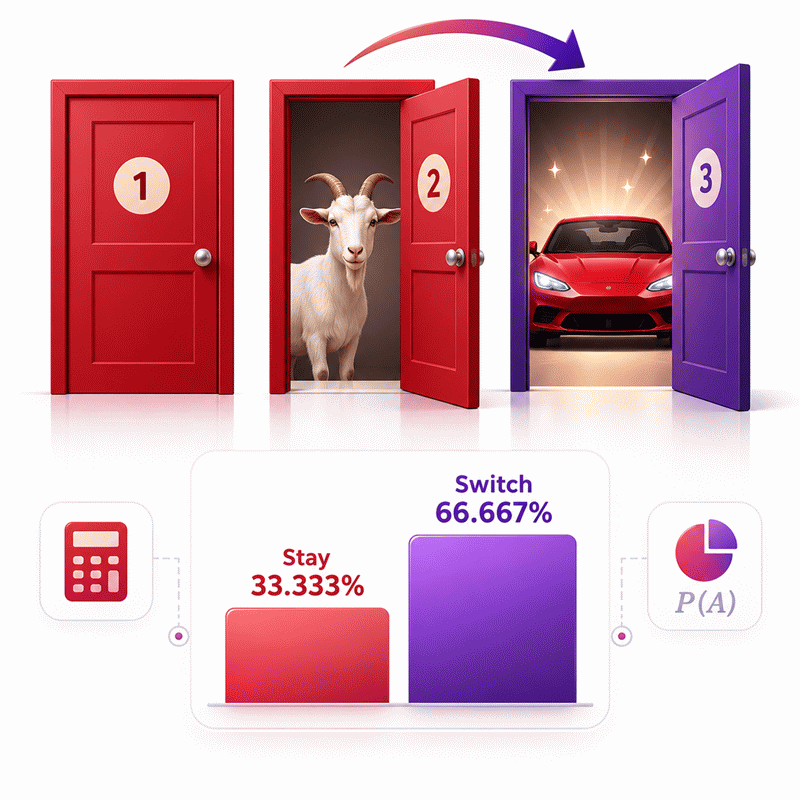
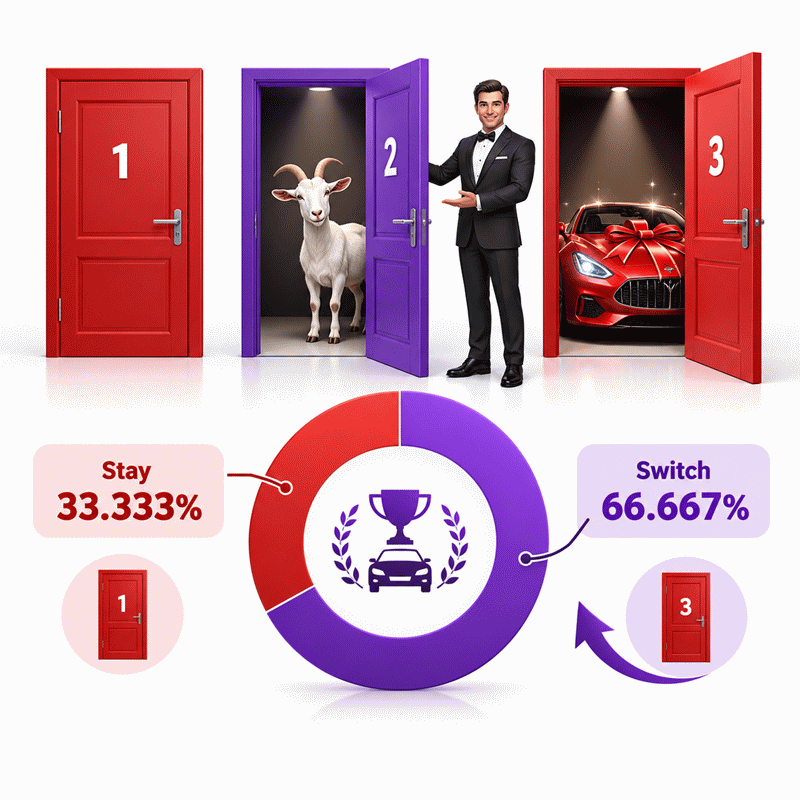
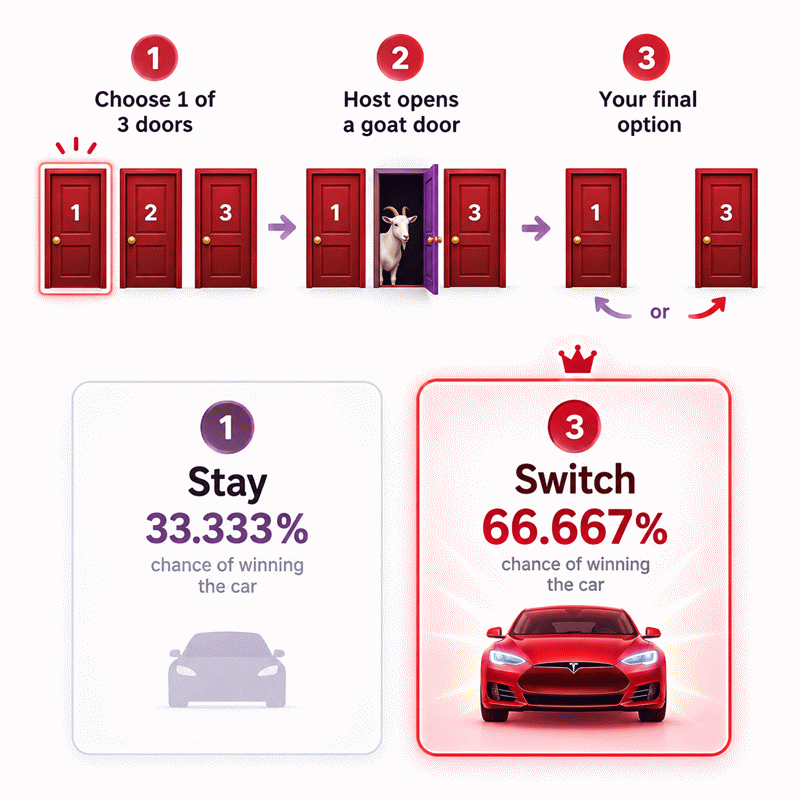
Monty Hall Problem Calculator results show that switching is the stronger strategy under the classic three-door rules. Your first door has a 1-in-3 chance of hiding the prize, while the other two doors collectively hold a 2-in-3 chance. The informed host then reveals an unchosen goat door without exposing the prize.
- Staying wins about 33.333% of valid classic rounds.
- Switching wins about 66.667% of valid classic rounds.
- The two remaining doors are not automatically a 50/50 pair.
- The host knows where the prize is and avoids revealing it.
- Switching wins whenever the initial choice was wrong.
- Finite simulations can differ from the exact theoretical percentages.
- More trials usually make empirical rates more stable.
- Changing the host rules can change the probability model.
The Monty Hall Problem Calculator lets you compare exact probability with repeated simulation. The key insight is simple: the host removes a losing option using hidden information, so the remaining doors reached the final decision through different paths.
Assumptions used in this calculator
- The game always contains exactly three closed doors.
- Exactly one door hides a car.
- The remaining two doors each hide a goat.
- The car location is equally likely among all three doors.
- The player chooses one door before the host acts.
- The host knows which door hides the car.
- The host never opens the player’s selected door.
- The host always opens an unchosen goat door.
- The host always offers the player a switching opportunity.
- Two eligible goat doors are treated as equally likely reveals.
- Simulation trials are independent of previous trials.
- Staying preserves the player’s original selected door.
- Finite simulations may differ from exact theoretical probabilities.
Results are rounded for display.
Internal calculations use full precision.
Formulas Used in Monty Hall Probability Variables and Calculation :
Initial Door Probability
- Ci is the event that the car is behind door i.
Joint Car and Host Probability
- Hj is the event that the host opens door j.
- P(Hj | Ci) is the host likelihood for that car location.
Total Host Reveal Probability
Stay Win Probability After the Host Reveal
- Pstay is the probability of winning by keeping the initial door.
Switch Win Probability
- Pswitch is the probability of winning after switching doors.
Theoretical Probability by Strategy
- ptheory is the expected win probability for the selected strategy.
Empirical Simulation Win Rate
- W is the number of wins.
- N is the total number of completed simulation trials.
- r is the observed empirical win rate.
Simulation Loss Count
- L is the number of losses.
Absolute Simulation Deviation
- d is the absolute difference between observed and theoretical win rates.
Variables & Definitions
View a complete list of all variables used in this calculator, including definitions and units
Monty Hall Probability Variables and Calculation Parameters
| Variable | Name | Definition | Valid Value or Range |
|---|---|---|---|
| Ci | Car location event | Event that the car is behind door i. | i = 1, 2, or 3 |
| Hj | Host reveal event | Event that the host opens goat door j. | j = 1, 2, or 3 |
| P(Ci) | Initial car probability | Probability that the initially considered door hides the car. | 1/3 |
| P(Hj|Ci) | Host likelihood | Probability that the host opens door j given car location i. | 0, 1/2, or 1 |
| P(Ci ∩ Hj) | Joint probability | Probability of a car location and host reveal occurring together. | 0 to 1 |
| P(Hj) | Host reveal probability | Total probability that the host opens a particular valid goat door. | 0 to 1 |
| Pstay | Stay win probability | Probability of winning by keeping the initially selected door. | 1/3 |
| Pswitch | Switch win probability | Probability of winning by changing to the remaining closed door. | 2/3 |
| N | Number of trials | Total number of completed simulation rounds. | 1 to 1,000,000 |
| W | Wins | Number of simulated trials that end with the car. | 0 to N |
| L | Losses | Number of simulated trials that end with a goat. | 0 to N |
| r | Empirical win rate | Observed winning proportion from the completed simulation. | 0 to 1 |
| ptheory | Theoretical win rate | Expected probability for the selected stay or switch strategy. | 1/3 or 2/3 |
| d | Absolute deviation | Absolute difference between empirical and theoretical win rates. | 0 to 1 |
Unit Conversion Table
Dimensionless Probability Representation Conversion Table
| Unit Group | Unit Name | Symbol | Equivalent in Decimal Probability | Used For |
|---|---|---|---|---|
| Dimensionless Probability | Decimal probability | P | 1 P = 1.000 | Internal probability calculations |
| Dimensionless Probability | Percent probability | % | 1% = 0.01 | Displayed theoretical and empirical results |
| Dimensionless Probability | Fractional probability | a/b | a/b = a ÷ b | Exact theoretical probability representation |
| Dimensionless Probability | Stay probability | 1/3 | 0.333333... | Exact probability of winning by staying |
| Dimensionless Probability | Switch probability | 2/3 | 0.666666... | Exact probability of winning by switching |
| Dimensionless Probability | Stay percentage | 33.333% | Approximately 0.33333 | Rounded user-facing stay result |
| Dimensionless Probability | Switch percentage | 66.667% | Approximately 0.66667 | Rounded user-facing switch result |
Example Calculation
Stay: 1/3 = 33.333%
Switch: 2/3 = 66.667%
Door 1 keeps its original one-third probability after the host reveal.
The opened goat door cannot contain the car under the standard rules.
The remaining closed Door 3 therefore carries the other two-thirds probability.
Switching doubles the theoretical chance of winning compared with staying.
Recovered trial count: N = 1,200
Wins: W = 804
Losses: L = 396
Empirical win rate: r = 67.000%
The known win count and empirical rate uniquely recover the aggregate trial count.
The loss count then follows directly from total trials minus wins.
This reverse calculation applies to simulation summary values, not hidden door locations.
A random game's car location cannot be reconstructed uniquely from its final probability.
Results are rounded for display.
Internal calculations use full precision.
Calculations Disclaimer
Why Does Switching Win More Often in the Monty Hall Problem?
A choice can look perfectly balanced while carrying very different odds. The Monty Hall Problem Calculator makes that hidden imbalance visible. The Monty Hall Problem Calculator compares staying with your first door against switching after the host reveals a losing door. The classic result is simple. Staying wins about one third of all valid rounds. Switching wins about two thirds. Yet the result feels wrong because two closed doors remain. That feeling comes from treating the host’s action as random. It is not random under the classic rules. The host knows where the prize is. The host must avoid it. The host also avoids your chosen door. That restriction changes how the revealed information should be read.The One Decision That Changes Your Winning Probability
The real decision arrives after the host acts. You can keep the door selected before any information appeared. Or you can move to the only other closed door. Staying succeeds only when your first guess was correct. That is the smaller branch. Switching succeeds when your first guess was wrong. That is the larger branch. This is why switching is not a trick. It simply converts most incorrect first choices into wins. A useful mental shortcut is this:WRONG FIRST PICK → Stay loses → Switch wins
Why Two Closed Doors Do Not Mean a 50/50 Chance
A common problem appears after one goat is revealed. The screen now shows two closed doors. They look symmetrical. The mind quickly assigns half the probability to each. Their histories are not symmetrical. One door was selected before the host gave any information. The other survived a deliberate elimination process. The host knew which doors were safe to open. That difference matters. A genuine 50/50 situation would require two equivalent remaining choices. Here, one choice is your original one-third guess. The other represents the probability that your original guess was wrong. The visual simplicity of two doors hides the information path that produced them.What the Host Knows Before Opening a Door
The host’s knowledge is the engine of the puzzle. Suppose your first pick hides a goat. The host cannot open your door. The host also cannot open the prize door. Only one legal door remains for the host to reveal. In that situation, the host’s action is forced. If your first pick hides the prize, both unchosen doors contain goats. The host may reveal either one without exposing the prize. This rule is why the host’s behavior cannot be replaced by a random door opening. Change the host rule and you change the probability problem.How the Monty Hall Problem Calculator Tests Your Strategy
Reading an answer may not overcome strong intuition. Interaction often does. A useful calculator therefore needs two experiences. One lets you make a single decision. The other repeats the same rules many times. A single game creates tension. You select a door. A goat appears elsewhere. You decide whether to stay or switch. A simulation removes personal luck from the discussion. It repeats the same probability structure again and again. AxiCalculator separates these ideas so one lucky round never gets confused with long-run probability.Play One Round Before Trusting Your Intuition
One round feels personal. That is exactly why it is useful. Choose a door before you know anything. Watch the host reveal a goat. Then make a final decision. Winning after staying does not prove staying is better. Losing after switching does not prove switching is worse. Each individual result is only one possible outcome. The strategy becomes meaningful when you ask a different question: which decision wins across many correctly generated rounds? That shift from anecdote to repeated evidence is one of the most useful lessons in probability.Run Repeated Trials to Compare Stay and Switch
Repeated trials strip away the drama of one game. The simulator creates a prize location, an initial choice, and a valid host reveal for every round. It then applies the selected strategy. Wins and losses accumulate. The empirical win rate is simply what happened in that batch. It is not a replacement for the exact theoretical probability.Why Short Simulations Can Look Misleading
Small samples can look strange. Ten switching trials could produce four wins, seven wins, or even more extreme results. None of those outcomes changes the underlying strategy. Random variation is strongest when the sample is small. As the number of valid trials increases, the observed percentage usually becomes more stable. It tends to move around the long-run probability instead of matching it perfectly. That is why the calculator should show theoretical and empirical results separately. A difference between them is useful information. It shows sampling variation rather than a mathematical contradiction.What Makes the Classic Monty Hall Result Valid?
A probability answer is only as good as its assumptions. The classic result depends on a specific host. The host cannot behave like an uninformed spectator. The prize must already be placed. The player chooses before seeing it. The host knows the prize location. A losing unchosen door is then revealed. The player is offered the final choice. Break those rules and the familiar result may no longer describe the game. This matters when using any Monty Hall simulator. A polished animation can still model the wrong experiment.The Host Must Know Where the Prize Is
An uninformed host creates a different situation. A random person could accidentally open the prize door. That possibility changes the information contained in seeing a goat. The classic host never makes that mistake. Knowing the hidden state lets the host filter what the player sees. The reveal therefore depends on information unavailable to the contestant. That is the deeper lesson behind the puzzle. Observed information can be biased by the process that selected it.The Host Must Always Reveal a Losing Door
The host does not merely happen to find a goat. A goat reveal is guaranteed under the standard model. This guarantee is what keeps every valid round alive until the stay-or-switch decision. There are no discarded rounds where the host exposes the prize. A simulator that sometimes reveals the prize and then ignores those rounds changes the sample. That programming error can create convincing but incorrect percentages. The host-selection logic must therefore be tested as carefully as the final probability display.The Switch Must Always Be Offered
The offer itself must not depend on whether your first choice was right. Imagine a host who offers switching only in selected situations. Receiving the offer could then reveal extra information. The standard puzzle removes this complication. Every valid round reaches the same decision point. This keeps the strategy comparison clean. Stay means keep the first door. Switch means take the only other closed door. No hidden host preference should alter that choice.Why Your First Door Keeps Its Original Chance
The first door often feels more promising after another door disappears. Nothing has happened to improve the quality of the original guess. It was selected from three possible prize locations. The host’s later action was designed around the other doors. The original door was protected from being opened whether it contained a goat or the prize. That is why the host reveal does not suddenly upgrade your original guess. The safer way to reason is to group outcomes from the beginning. Your door is one group. The other two doors form the second group. The first group begins smaller.How the Unchosen Doors Carry the Remaining Probability
Before the host acts, the two doors you rejected collectively represent the chance that your initial choice is wrong. That group is larger than your single chosen door. The host then removes a door from that group, but only after checking that it is safe to remove. The prize is not eliminated. The host reduces the number of available alternatives without randomly destroying the group’s chance of containing the prize. In the classic three-door setup, only one switch door remains. That is why the switching strategy captures the larger initial branch.What Changes When One Losing Door Is Removed
The number of visible options falls from three to two. The probability model does not restart. This point resolves much of the paradox. If the game restarted after the reveal and randomly placed the prize behind one of the two closed doors, 50/50 would make sense. That does not happen. The prize remains where it was placed before your first choice. The host simply exposes information while respecting strict rules. History therefore matters. The final two doors cannot be judged only by their appearance.How Simulation Turns a Counterintuitive Result Into Visible Evidence
Some ideas are easier to trust after watching them happen. Simulation provides that bridge. A good run does not manipulate outcomes toward the expected result. It performs independent valid trials and reports what occurred. Early percentages move sharply. Later percentages usually move less. This creates a visual lesson about randomness itself.100 ROUNDS → pattern becomes visible
1,000+ ROUNDS → empirical rate usually stabilizes closer to theory
Why Empirical Win Rates Move Around at First
Every new result has a large influence when only a few rounds exist. One additional win after two games can move the displayed rate dramatically. The same win after ten thousand games barely moves it. This explains why early simulator results can jump. Nothing is wrong with the calculator simply because a short run looks unusual. Users should compare the direction of convergence rather than demand exact agreement after a tiny sample. This is a practical lesson that extends far beyond the Monty Hall problem.How More Trials Reveal the Long-Run Pattern
Larger runs reduce the influence of each individual round. The stay result tends to settle around the smaller probability. The switch result tends to settle around the larger one. The two lines do not need to touch their theoretical targets. The important signal is persistent separation. Switching should outperform staying across sufficiently large correctly generated batches. If it does not, the simulation logic deserves inspection. This makes simulation useful for both learning and software QA.How to Spot a Broken Monty Hall Simulation
A simulator can fail while still looking realistic. Check the host first. The revealed door must never equal the player’s first door. It must never contain the prize. Then check switching. After one valid reveal, switching must lead to the only closed door that was not initially selected. Finally, count every valid round. Do not quietly remove inconvenient outcomes. A suspicious long-run result near 50% often points to incorrect host logic, incorrect switching logic, or invalid trial filtering.Where the 50/50 Intuition Goes Wrong
The mistake is not foolish. It comes from a useful shortcut applied in the wrong place. Two apparently equivalent options often suggest equal chances. Here, the options were produced by different mechanisms. One survived because you chose it. The other survived because an informed host was constrained to protect the prize. Those are not equivalent selection processes. Probability depends on how information was generated, not only on what remains visible. That single idea makes the puzzle much less mysterious.The Difference Between Random Information and Informed Information
Random elimination and informed elimination can produce the same picture but different knowledge. Imagine seeing one losing door open. If nobody knew where the prize was, that observation came through chance. If an informed host deliberately selected a safe door, that observation came through a filter. The visible result looks identical. The information process is different. That distinction appears in statistics, testing, sampling, recommendation systems, and everyday decisions. Learning to ask “How was this evidence selected?” is often more valuable than memorizing the Monty Hall answer.Why the Host’s Choice Cannot Be Ignored
Ignoring the host creates the illusion that one door simply vanished. The host did much more. The host looked at hidden information and removed an option under strict constraints. That action connects the reveal to the prize location. Once this is recognized, the puzzle stops being a strange game-show trick. It becomes a clean lesson in conditional reasoning. The result is not that switching has magical power. Switching works because it targets the larger branch: the cases where the first guess was wrong.How to Use Monty Hall Thinking Beyond a Game Show Puzzle
The useful skill is not remembering which door to choose. The useful skill is recognizing selection effects. When someone presents new evidence, ask how that evidence became visible. Was it random? Was it filtered? Did the person revealing it know something you did not? Were some outcomes impossible to show? Those questions change how evidence should be interpreted. AxiCalculator makes this reasoning tangible. Play a round. Run a simulation. Compare the observed rate with the stable theoretical pattern. The goal is not merely to get the correct answer. It is to understand why the answer survives repeated testing.What the Puzzle Teaches About Decisions Under Uncertainty
Good decisions require more than counting visible options. They require attention to prior information, hidden constraints, and the mechanism that produced new evidence. That is why the Monty Hall problem remains useful. It exposes a common mental shortcut in an unusually simple setting. Three doors are enough to show that information can be unevenly distributed. The practical takeaway is compact:Frequently Asked Questions
Why can I lose after switching if switching is the better strategy?
Why can two simulations with the same number of trials show different percentages?
Does opening a goat door physically transfer probability to another door?
Can I use the Monty Hall puzzle to learn real statistics?
How should I validate a Monty Hall simulation implementation?
Why can an incorrect host algorithm produce a result near 50%?
When does the standard 2/3 switching result stop being valid?
Our engineers are here to help you get it right.