Lottery Calculator
- Last formula update:

Decimal & Rounding Policy
- All intermediate combination, probability, and odds calculations retain full precision.
- Intermediate values are never rounded before the final result is calculated.
- Whole-number odds are displayed as integers whenever mathematically appropriate.
- Non-integer displayed odds use up to six decimal places with trailing zeros removed.
- Calculated editable odds retain higher precision to support accurate reverse solving.
- Very large odds and extremely small probabilities may use scientific notation.
- Percentage probabilities are calculated from unrounded odds before display formatting.
- Display rounding never changes the underlying probability or reverse-calculation result.
Valid range
- Main pool size n must be a whole number from 1 to 10000 and cannot be smaller than r.
- Main draw size r must be a whole number from 1 to 10000 and cannot exceed n.
- Main matches m must be a whole number from max(0, 2r – n) through r.
- Remaining-pool matches q must be a whole number from max(0, 2r – n) through r – 1.
- A remaining-pool bonus calculation requires n to be greater than r so at least one ball remains.
- Bonus pool size n_b must be a whole number from 1 to 10000 and cannot be smaller than r_b.
- Bonus draw size r_b must be a whole number from 1 to 10000 and cannot exceed n_b.
- Bonus matches m_b must be a whole number from max(0, 2r_b – n_b) through r_b.
- Winning odds x must be a finite numeric value greater than or equal to 1.
- Reverse solving requires the entered odds to correspond to one unique supported integer solution.

Wylena Brantford
Reviewers:
Valdren Clyforde
Zenara Dentwick
Check our editorial policy
September 17, 2026
1.0.0
Initial calculator and formula release.
Our engineers are here to help you get it right.
How Does a Lottery Calculator Reveal the Real Odds Behind a Draw?
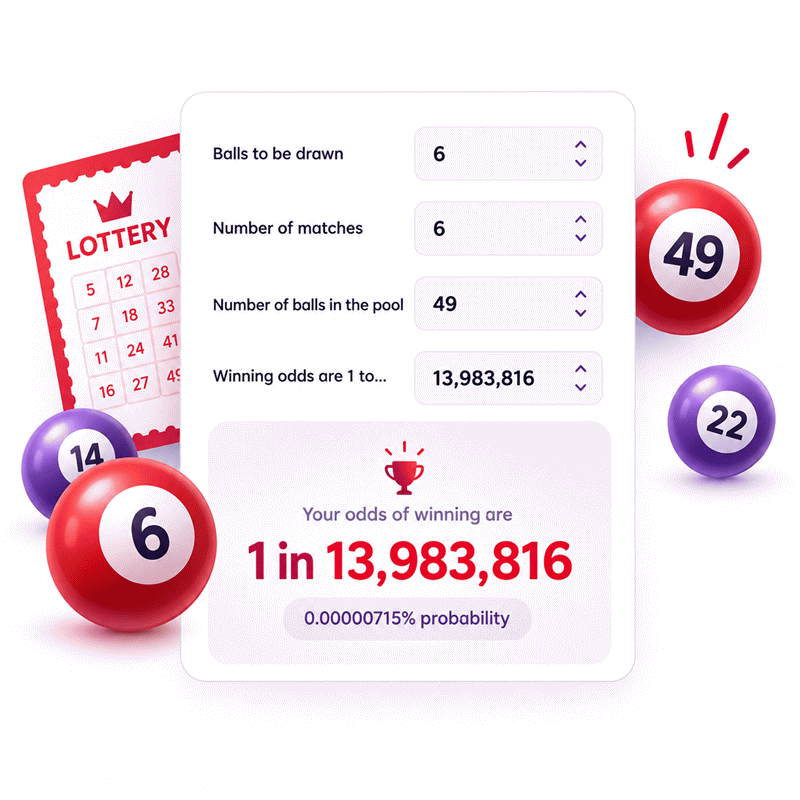
Lottery Calculator results turn a lottery’s draw structure into a clear measure of probability. The calculator considers the size of the main pool, how many balls are drawn, how many matches are required, and whether a bonus ball comes from remaining balls or a separate pool.
- Every valid unordered ticket has the same probability in a fair draw.
- Larger pools can increase the number of possible combinations rapidly.
- Partial-match odds differ from jackpot odds because many outcomes may qualify.
- A remaining-pool bonus depends on what happened during the main draw.
- A separate bonus pool can act as an independent second probability event.
- Reverse solving can recover one missing integer parameter from known odds.
- One-in-X odds describe rarity and never guarantee success after X attempts.
- Past draws do not make a valid number combination more likely next time.
The AxiCalculator Lottery Calculator is designed for checking, learning, and comparing lottery structures. It measures mathematical likelihood rather than predicting future winning numbers.
Assumptions used in this calculator
- Main draw balls are unique and sampled without replacement.
- Each valid ball has equal probability of being drawn.
- Ticket selections contain no duplicate numbers within the same pool.
- Main ticket size equals the number of main balls drawn.
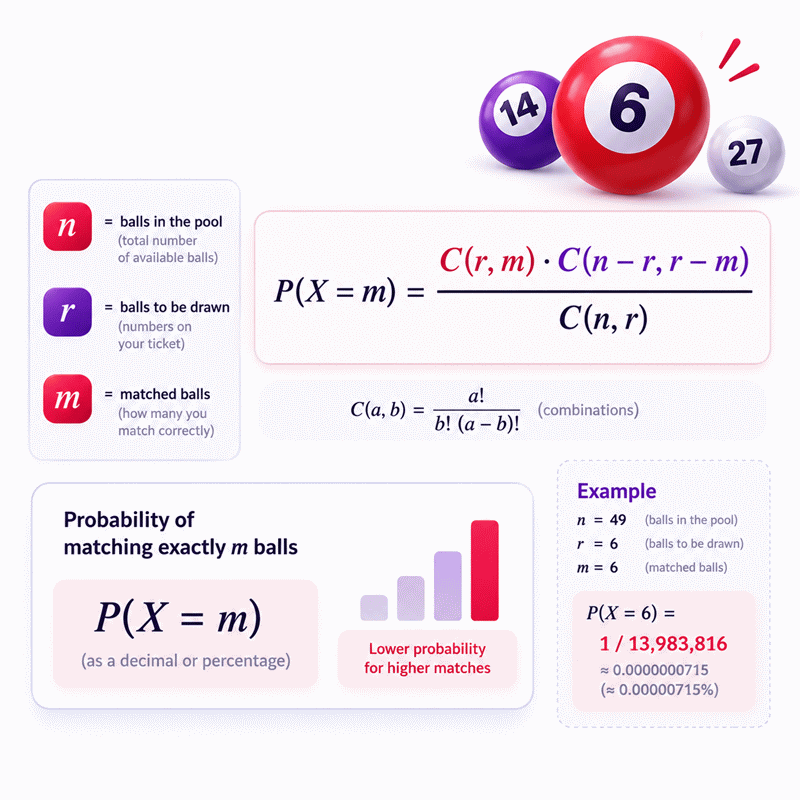
- Exact-match odds use the hypergeometric distribution.
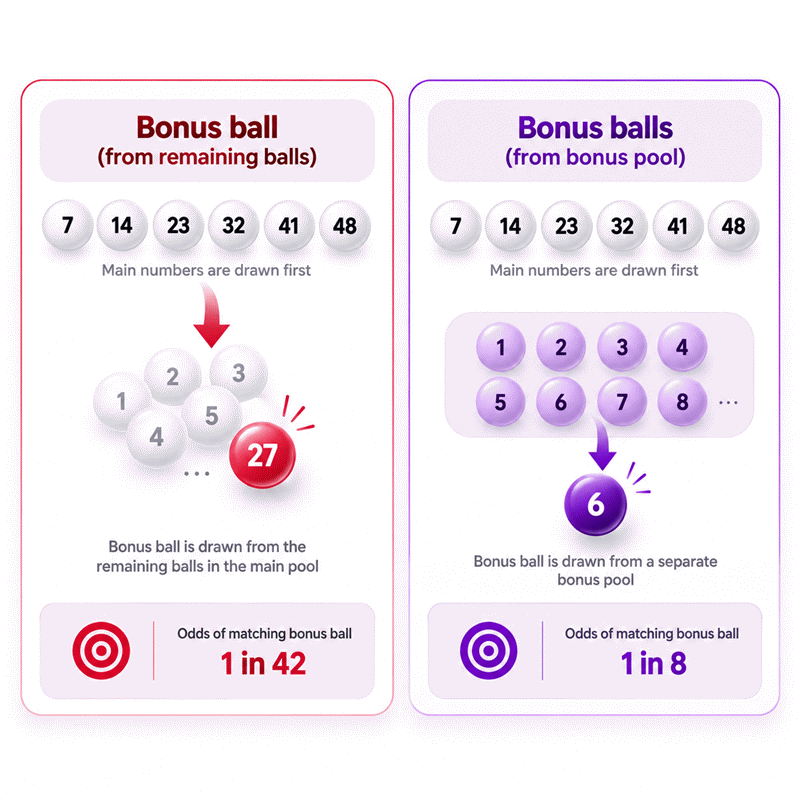
- A remaining-pool bonus ball is drawn after the main draw.
- The remaining bonus ball is sampled from undrawn main-pool balls.
- Separate bonus-pool draws are independent of the main draw.
- Bonus ticket size equals the number of bonus balls drawn.
- Separate bonus-pool odds also use exact hypergeometric matching.
- All counts are whole numbers within supported calculator limits.
- Intermediate calculations retain full precision before display formatting.
- Published lottery rules override generic assumptions when game structures differ.
Results are rounded for display.
Internal calculations use full precision.
Formulas Used in Lottery Calculator :
Combination Count
Main Draw Odds
Remaining-Pool Bonus Odds
Separate Bonus-Pool Combined Odds
Probability from Odds
Reverse Integer Solution
a = total objects in a generic combination.b = selected objects in a generic combination.n = number of balls in the main pool.r = number of balls drawn from the main pool.m = exact required main-draw matches.q = exact main matches before one remaining bonus match.n_b = number of balls in the separate bonus pool.r_b = balls drawn from the separate bonus pool.m_b = exact matches required in the separate bonus pool.x_main = main-draw odds denominator.x_rem = remaining-pool bonus odds denominator.x_combined = combined main and separate bonus odds denominator.x = generic odds denominator.P = probability corresponding to x.x_target = target odds entered for reverse solving.v = unknown integer parameter being solved.D_v = valid integer domain for v.epsilon = accepted reverse-solving tolerance in log-odds space.Variables & Definitions
View a complete list of all variables used in this calculator, including definitions and units
Lottery Calculator Variables and Symbols
| Variable | Meaning | Type | Valid Domain | Used In |
|---|---|---|---|---|
a |
Total objects available in the generic combination function | Integer count | a >= 0 | Combination definition |
b |
Objects selected in the generic combination function | Integer count | 0 <= b <= a | Combination definition |
n |
Number of balls in the main pool | Integer count | 1 to 10000, n >= r | Main draw and remaining bonus |
r |
Number of balls drawn from the main pool | Integer count | 1 to n | Main draw and remaining bonus |
m |
Exact number of required main-draw matches | Integer count | max(0, 2r - n) to r | Main draw odds |
q |
Exact main matches before requiring one remaining-pool bonus match | Integer count | max(0, 2r - n) to r - 1 | Remaining-pool bonus odds |
n_b |
Number of balls in the separate bonus pool | Integer count | 1 to 10000, n_b >= r_b | Separate bonus pool |
r_b |
Number of balls drawn from the separate bonus pool | Integer count | 1 to n_b | Separate bonus pool |
m_b |
Exact number of required matches in the separate bonus pool | Integer count | max(0, 2r_b - n_b) to r_b | Separate bonus pool |
C(a,b) |
Number of unordered combinations of b objects selected from a | Combination count | Defined when 0 <= b <= a | All exact-match calculations |
x_main |
Main-draw odds denominator in a 1-to-x representation | Dimensionless ratio | x_main >= 1 | Main result |
x_rem |
Odds denominator for q main matches plus one remaining bonus match | Dimensionless ratio | x_rem >= 1 | Remaining-pool bonus result |
x_combined |
Combined main-draw and separate bonus-pool odds denominator | Dimensionless ratio | x_combined >= 1 | Separate bonus result |
x |
Generic odds denominator used to derive probability | Dimensionless ratio | x >= 1 | Probability conversion |
P |
Probability corresponding to an odds denominator | Probability | 0 < P <= 1 | Probability display |
x_target |
User-entered odds denominator used during reverse solving | Dimensionless ratio | x_target >= 1 | Reverse calculation |
v |
One unknown integer parameter solved from target odds | Integer count | Its applicable valid domain | Reverse calculation |
D_v |
Set of valid integer candidates for the unknown parameter v | Integer domain | Calculator-supported valid values | Reverse calculation |
epsilon |
Maximum accepted log-odds difference during reverse matching | Numeric tolerance | Positive small tolerance | Reverse calculation validation |
Unit Conversion Table
Lottery Count, Odds, and Probability Conversion Table
| Unit Group | Unit Name | Symbol | Equivalent in Base Representation | Used For |
|---|---|---|---|---|
| Dimensionless Count | Ball Count | count | 1 count = 1 | Main pool size, main draw size, bonus pool size, and bonus draw size |
| Dimensionless Count | Match Count | match | 1 match = 1 | Main matches, remaining-pool matches, and separate bonus-pool matches |
| Dimensionless Ratio | One-to-x Odds | 1:x | P = 1 / x | Main draw odds, remaining-pool bonus odds, and combined bonus-pool odds |
| Dimensionless Probability | Decimal Probability | P | P = 1 / x | Internal probability calculation and numerical probability representation |
| Probability Display | Percentage Probability | % | 1% = 0.01 probability | Human-readable probability display for calculated lottery odds |
Example Calculation
Probability: 0.00904207837%
There are 2,598,960 possible five-number winning sets from a pool of 52.
Exactly four matches can occur in 235 favorable combinations for one ticket.
Dividing all possible sets by favorable sets gives the one-to-x odds.
The probability is calculated from the unrounded odds before display formatting.
x = 21,411.3714286
x = 24,286.0462963
x = 27,461.5045045
The target odds are treated as known while the pool size remains unknown.
The calculator searches only valid whole-number pool sizes for the missing value.
Each candidate is evaluated with the same exact-match lottery formula.
The unique supported match is n = 42, so the reverse result is 42 balls.
Results are rounded for display.
Internal calculations use full precision.
Calculations Disclaimer
Why Lottery Odds Feel Simple Until the Draw Rules Change
A lottery ticket can look simple while hiding a huge outcome space. The difficulty begins with the draw rules. Pool size matters. Draw size matters too. Required matches change the result again. Bonus balls can change the structure completely.
A Lottery Calculator helps separate those effects. It converts the game structure into a clear rarity measure. The same Lottery Calculator can also expose why two similar-looking games behave differently.
The First Trap: Confusing a Random Draw With a Prediction
A common problem starts before any number is entered. Users often expect probability to reveal the next winning line. It cannot do that.
A fair random draw does not reveal its next outcome in advance. Probability measures how many outcomes are possible. It also measures how many of those outcomes satisfy a condition.
This distinction matters because prediction and measurement are different tasks. A calculator can describe rarity with high mathematical confidence. It cannot identify the next random result.
That limit makes the tool more useful, not less useful. It keeps the result tied to measurable information. Users can compare game structures without relying on patterns or intuition.
Why Every Valid Ticket Starts on Equal Mathematical Footing
Another problem appears when one ticket looks more random than another. A scattered sequence often feels safer. A neat pattern can look suspicious.
Appearance does not change the chance of a valid ticket. Every permitted combination occupies one position in the same outcome space. A visually unusual line is still only one line.
This is why “lucky” arrangements need careful interpretation. They may feel meaningful to a player. That feeling does not alter the draw mechanism.
Patterns Look Meaningful Even When Probability Stays Unchanged
The human mind searches for order quickly. Repeated digits, consecutive values, and symmetrical patterns attract attention. Random processes can still produce those shapes.
A useful calculator should therefore reduce pattern bias. It should show the probability created by the game rules. It should not score numbers by appearance.
This creates a clear boundary. Use the result to understand likelihood. Do not use it as evidence that a pattern predicts the future.
How a Lottery Calculator Turns Draw Rules Into Comparable Odds
Users often compare games by headline prizes. That can hide the main mathematical difference. The draw structure controls the chance of matching a target.
The calculator starts with the number pool. It then considers how many balls leave that pool. Finally, it considers how many matches the user requires.
Each change reshapes the number of possible outcomes. This is why two games can share similar names but have very different difficulty.
Why Pool Size Can Change Difficulty Faster Than You Expect
A larger pool gives the draw more possible choices. That increase can grow rapidly. Adding only a few available balls can create many new possible tickets.
This effect is easy to underestimate. Users often think the change should be linear. Combination counts do not behave that way.
The result becomes especially important near jackpot-level matching. The target remains narrow while the possible outcome space grows.
A clear comparison should therefore hold other settings constant. Change one structural input at a time. The effect then becomes easier to understand.
Why Draw Size and Required Matches Affect Results Differently
Draw size controls how many numbers are selected. Match count controls the condition being tested. Those ideas sound similar, but they are not interchangeable.
Increasing the draw size changes the underlying outcome structure. Lowering the required match count creates more favorable outcomes inside that structure.
This difference explains many surprising results. A lower prize tier may have far more winning arrangements. That does not mean every lower tier changes by the same factor.
The One-in-X Number Is a Scale of Rarity, Not a Promise
“One in X” is easy to read. It can also be misunderstood.
The number describes the reciprocal of a probability. It does not create a countdown. Reaching X attempts does not force one success.
Each eligible draw still follows its own random process. The odds describe long-run likelihood under the defined structure.
Use one-in-X values to compare rarity. Do not treat them as a guaranteed waiting time.
What Exact Match Results Reveal About Partial Lottery Wins
Jackpot odds receive most attention. Partial matches reveal more about the full probability structure.
A user may want exactly four matches, not every drawn number. That condition creates multiple ways to succeed. The remaining selected numbers must also be wrong in the correct way.
This is why partial-match analysis needs more care than jackpot intuition suggests.
Why Matching One Fewer Number Is Not Simply One Step Easier
Suppose the target drops by one match. It is tempting to expect one simple multiplier. That shortcut fails.
The number of ways to choose correct numbers changes. The number of ways to choose incorrect numbers changes too. Both effects act together.
As the match target moves, the pool of favorable outcomes can expand sharply. It can also behave differently near the edges of the draw.
This is why exact-match results should be calculated directly. A simple “one fewer means X times easier” rule is unreliable.
How Favorable Outcomes Expand Across Lower Match Levels
A jackpot condition may correspond to a very narrow outcome set. Lower match levels can contain many acceptable draw arrangements.
Each acceptable arrangement contributes to the total chance. More favorable arrangements usually mean a larger probability.
Yet the growth is not uniform. The interaction between correct and incorrect selections changes at every level.
Reading the complete structure gives more insight than viewing one headline value. It shows where probability becomes concentrated.
When the Pool Itself Makes a Requested Match Count Impossible
Some input combinations cannot exist. A small pool can force overlap between a ticket and a draw.
A calculator should detect that situation before showing a result. Returning a polished number for an impossible state would be misleading.
This matters in custom games. Users can enter structures that no commercial lottery would normally use.
Good validation protects the mathematical meaning of the result. It also teaches users where the boundaries come from.
Why Bonus Balls Need Two Different Probability Models
The phrase “bonus ball” creates one of the biggest sources of confusion. It can describe two very different draw systems.
One system takes a bonus from balls left after the main draw. Another uses an entirely separate pool. Those systems cannot be treated as identical.
What Changes When the Bonus Ball Comes From Remaining Main Balls
The first problem is dependence. The main draw changes what remains available.
After the main balls are removed, the bonus candidate must come from the reduced pool. The earlier draw therefore affects the later event.
The ticket also needs a particular main-match pattern before the bonus can help. A full main match leaves no unmatched selected number for that condition.
This structure explains why remaining-ball bonus logic must follow the main draw closely.
What Changes When Bonus Balls Come From a Separate Pool
A second pool creates a different situation. Main numbers come from one source. Bonus numbers come from another.
When the two pools operate independently, their difficulty can be combined cleanly. The main event must succeed, and the bonus event must also succeed.
This makes multi-pool games easier to model conceptually. It does not make the final odds easier to beat.
The bonus pool adds another requirement. That usually makes the complete target rarer.
Dependence and Independence Can Completely Change the Final Odds
Two games may both advertise a bonus ball. Their mathematics can still differ greatly.
The key question is simple. Did the bonus come from the remaining main balls? Or did it come from another pool?
Entering the wrong structure can produce a believable but incorrect result. Always identify the draw process before comparing odds.
AxiCalculator separates these structures so the model follows the actual event.
How Reverse Solving Exposes Hidden Lottery Parameters
Sometimes the known information arrives in reverse. You know the winning odds. You may know two draw settings. One structural value is missing.
A normal forward calculator stops there. Reverse solving asks which valid integer value can reproduce the known result.
This feature is useful for checking published game structures. It can also help students understand how strongly one parameter changes probability.
Finding a Missing Pool Size From Known Winning Odds
A missing pool size cannot be recovered by visual guessing. The calculator must test valid candidates against the known odds.
Each candidate creates its own combination structure. The system compares that result with the target.
A valid solution must also respect the draw size. The pool cannot contain fewer balls than the draw requires.
The best result is not simply the nearest-looking number. It must reproduce the target within the accepted numerical tolerance.
Finding a Missing Match Count Without Guessing
Match count is also discrete. A player cannot match a fraction of one ball.
The calculator therefore checks valid whole-number match levels. Each level creates a different exact-match probability.
This approach prevents a common reverse-calculation problem. A purely algebraic numerical solver might return a meaningless decimal count.
Discrete search keeps the solution tied to a real lottery structure.
Why a Reverse Result Must Be a Unique Valid Integer
A reverse answer should not create false certainty. Sometimes two candidates can appear nearly identical after display formatting.
The internal comparison needs enough precision to distinguish them. If multiple valid candidates remain, the calculator should not guess.
Uniqueness is part of the answer. A result is useful only when the available information identifies one valid structure.
This is one reason editable odds can be powerful. They turn the calculator into a verification tool.
Common Lottery Odds Mistakes and Better Ways to Read the Result
The most dangerous mistakes often look reasonable. A wrong method can still produce a clean number.
That makes interpretation as important as calculation. Three mistakes deserve special attention.
Why Treating Combinations Like Permutations Produces Wrong Answers
Lottery tickets normally ignore the order of the selected numbers. A ticket containing the same set remains the same ticket.
Permutation thinking counts different orders separately. That inflates the number of supposed outcomes.
The error can become enormous as the draw grows. A result may still look mathematically sophisticated.
The correct question is whether order matters under the actual rules. For ordinary unordered number draws, it does not.
Compare Lottery Structures Before Comparing Headline Jackpots
A larger prize does not automatically mean harder odds. Prize size and draw structure describe different things.
Compare pool size, draw size, target matches, and bonus rules first. Those values define the probability challenge.
This approach also prevents misleading game comparisons. Two jackpots can differ greatly while their draw structures remain similar.
Likewise, two similar prize values can sit behind very different odds.
Use AxiCalculator as a Verification Tool, Not a Prediction Engine
The best use of a Lottery Calculator is clarity. Enter the real draw structure. Check the resulting rarity. Compare alternative structures carefully.
Use reverse solving when part of the structure is unknown. Check bonus-ball rules before selecting a model.
Most importantly, separate mathematics from prediction. The tool can measure the chance attached to a rule set. It cannot identify the next winner.
That distinction protects users from false confidence. It also makes AxiCalculator more useful for learning, checking, and comparing probability.
A clean result should leave you with fewer assumptions. You should know what makes the odds large. You should know which rule changed them.
That is the real value of the calculator. It turns a vague idea of “luck” into a transparent statistical structure.
Frequently Asked Questions
Why can two Lottery Calculators show slightly different odds for the same inputs?
Does changing my chosen lottery numbers change the mathematical odds?
Why can the same lottery have several different winning odds?
Does playing for a long time make a jackpot eventually certain?
How should I validate a custom lottery model before using its result?
Why does reverse solving need discrete integer search instead of a normal continuous solver?
How should I interpret a reverse result when several candidates are close?
Engineering Resources
Our engineers are here to help you get it right.