Probability of Three Independent Events
- Last formula update:

Decimal & Rounding Policy
- Probability values may be entered from 0% to 100% or from 0 to 1 in decimal form.
- All calculations use full internal decimal precision without intermediate rounding.
- Rounding is applied only when a calculated value is displayed to the user.
- Displayed results may retain up to 12 significant digits when additional precision is required.
- Changing between percent and decimal preserves the underlying probability value.
Valid range
- P(A): Accepts values from 0 to 1 inclusive, equivalent to 0% through 100%.
- P(B): Accepts values from 0 to 1 inclusive, equivalent to 0% through 100%.
- P(C): Accepts values from 0 to 1 inclusive, equivalent to 0% through 100%.
- All three occurring: The calculated probability must remain between 0 and 1 inclusive.
- At least one occurring: The calculated probability must remain between 0 and 1 inclusive.
- Exactly one occurring: The calculated probability must remain between 0 and 1 inclusive.
- None of them occurring: The calculated probability must remain between 0 and 1 inclusive.
- Reverse solving is valid only when the supplied probabilities produce a unique result within the same range.

Wylena Brantford
Reviewers:
Valdren Clyforde
Zenara Dentwick
Check our editorial policy
September 14, 2026
1.0.0
Initial calculator and formula release.
Our engineers are here to help you get it right.
Probability of 3 Events Calculator: what should you know first?
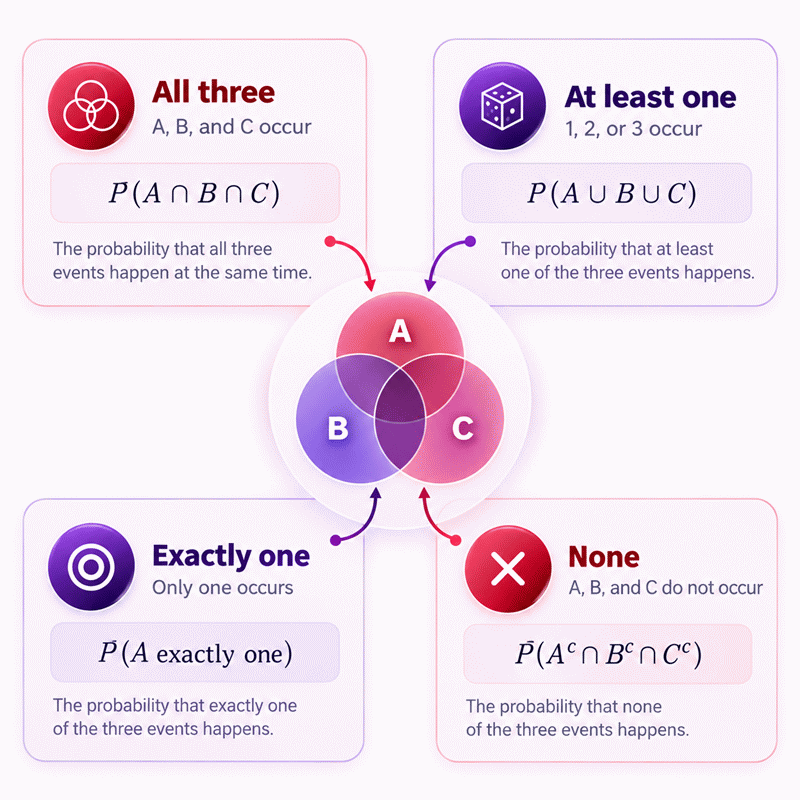
Probability of 3 Events Calculator results become useful when three mutually independent events must be evaluated together. The tool lets you enter three event probabilities and quickly compare four different outcomes: all three occurring, at least one occurring, exactly one occurring, and none occurring. These outcomes answer different questions, so the result label matters as much as the number.
- Use “all three” when every event must occur.
- Use “at least one” when any occurrence satisfies your condition.
- Use “exactly one” when multiple occurrences must be excluded.
- Use “none” when complete non-occurrence is the required outcome.
- Check that the three events are mutually independent before relying on results.
- Do not confuse independent events with mutually exclusive events.
- Compare several outputs before using one probability for a decision.
- Use reverse solving when two event probabilities and one compatible target are known.
The Probability of 3 Events Calculator can also help expose surprising differences between broad and strict outcomes. Use AxiCalculator to test the situation quickly, then interpret every result within the real context of your events.
Assumptions used in this calculator
- The three events are treated as mutually independent.
- Each probability must lie between zero and one, inclusive.
- Percent inputs represent the same values as decimal probabilities.
- Event probabilities are assumed to describe the same defined experiment.
- Input probabilities are assumed accurate enough for the intended analysis.
- No hidden dependence or conditional relationship is modeled between events.
- All calculations use exact entered values before display rounding.
- Intermediate calculation steps are not intentionally rounded.
- Reverse solving assumes exactly one event probability is unknown.
- Reverse solving requires enough valid information for a unique solution.
- Impossible or non-unique reverse solutions are rejected rather than guessed.
- Results are mathematical probabilities, not guarantees of real-world outcomes.
- Users should verify assumptions before applying results to high-impact decisions.
Results are rounded for display.
Internal calculations use full precision.
Formulas Used in Probability of Three Independent Events :
p% = probability entered as a percentage.
p = normalized decimal probability.
a = P(A), the probability of event A.
b = P(B), the probability of event B.
c = P(C), the probability of event C.
T = probability that all three events occur.
N = probability that none of the events occur.
U = probability that at least one event occurs.
E = probability that exactly one event occurs.
Percentage normalization
Decimal probability inputs are already normalized and require no conversion.
Probability that all three events occur
Probability that none of the events occur
Probability that at least one event occurs
Probability that exactly one event occurs
Reverse solving from all three occurring
A unique solution requires a × b ≠ 0.
Reverse solving from none or at least one occurring
When U is supplied, calculate N = 1 − U first. A unique solution requires (1 − a)(1 − b) ≠ 0.
Reverse solving from exactly one occurring
A unique solution requires 1 − 2a − 2b + 3ab ≠ 0. The same structure applies when A or B is the unknown event.
Variables & Definitions
View a complete list of all variables used in this calculator, including definitions and units
Probability of Three Independent Events: Variables and Symbols
| Variable | Meaning | Valid Range | Representation | Role |
|---|---|---|---|---|
| p% | Generic probability entered as a percentage | 0% to 100% | Percent | Unit conversion input |
| p | Generic normalized probability | 0 to 1 | Decimal | Internal calculation value |
| a = P(A) | Probability of event A | 0 to 1 | Decimal internally; decimal or percent for display | Primary input or reverse-solved value |
| b = P(B) | Probability of event B | 0 to 1 | Decimal internally; decimal or percent for display | Primary input or reverse-solved value |
| c = P(C) | Probability of event C | 0 to 1 | Decimal internally; decimal or percent for display | Primary input or reverse-solved value |
| T | Probability that all three events occur | 0 to 1 | Decimal or percent | Forward output or reverse constraint |
| N | Probability that none of the events occur | 0 to 1 | Decimal or percent | Forward output or reverse constraint |
| U | Probability that at least one event occurs | 0 to 1 | Decimal or percent | Forward output or reverse constraint |
| E | Probability that exactly one event occurs | 0 to 1 | Decimal or percent | Forward output or reverse constraint |
Unit Conversion Table
Percentage Probability Unit Conversion
| Unit Group | Unit Name | Symbol | Equivalent in Decimal | Used For |
|---|---|---|---|---|
| Popular Units | Percentage | % | 1% = 0.01 | User-friendly probability input and result display |
Decimal Probability Unit Conversion
| Unit Group | Unit Name | Symbol | Equivalent in Percent | Used For |
|---|---|---|---|---|
| Scientific Units | Decimal Probability | — | 0.01 = 1% | Direct probability formulas and scientific calculations |
Example Calculation
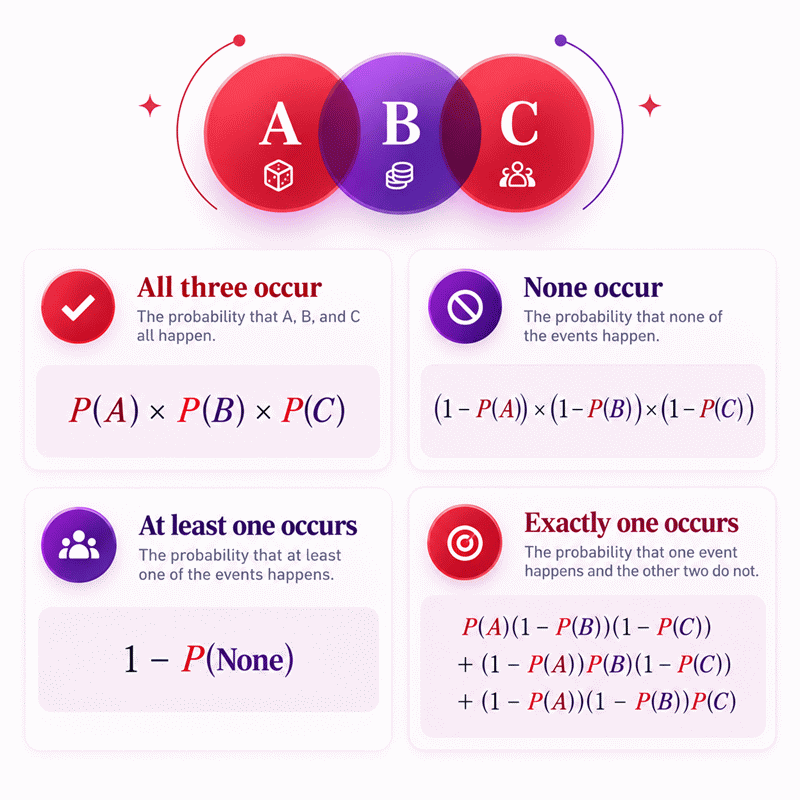
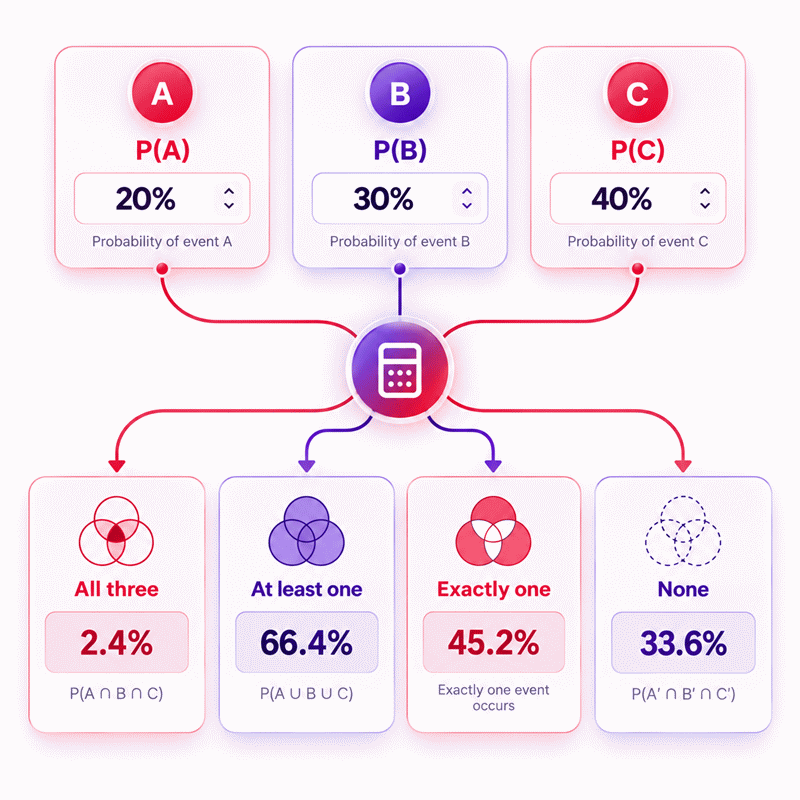
These calculations treat A, B, and C as mutually independent events. The all-three probability is found by multiplying the three event probabilities. The none probability multiplies their complements, while at least one is the complement of none. Exactly one combines the three exclusive cases in which only one event occurs.
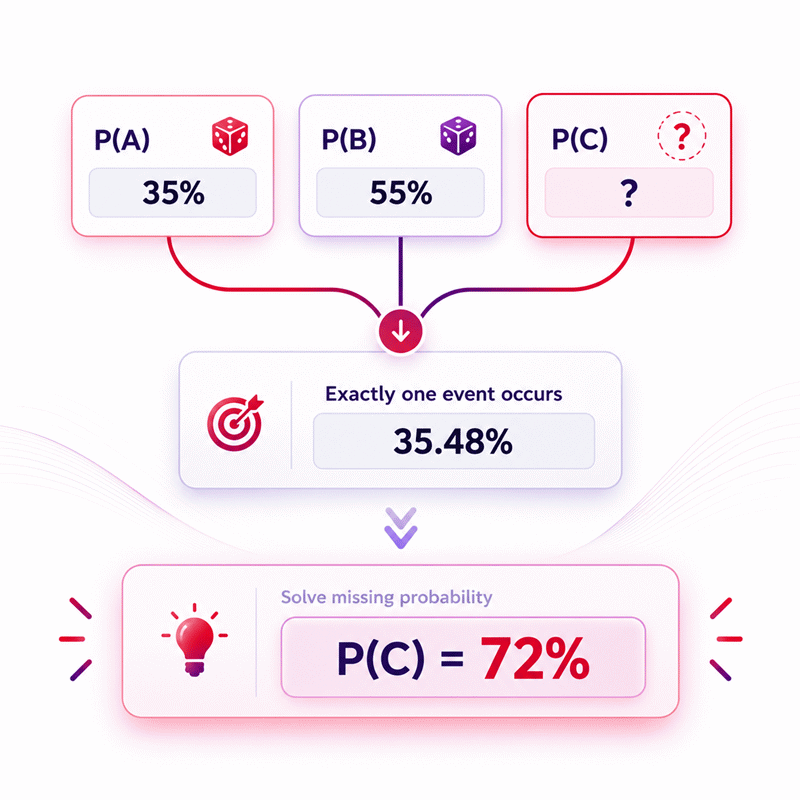
This reverse calculation uses two known event probabilities and the probability that exactly one event occurs. Solving the equation gives P(C) = 0.72, or 72%. Substituting the recovered value back into the forward formulas reproduces the supplied 35.48% exactly-one probability. The remaining outputs can then be calculated normally from all three event probabilities.
Results are rounded for display.
Internal calculations use full precision.
Calculations Disclaimer
What Can a Probability of 3 Events Calculator Tell You?
The Probability of 3 Events Calculator turns three separate chances into clearer combined outcomes. A Probability of 3 Events Calculator also helps you compare those outcomes quickly. That matters when three numbers look simple alone but confusing together. You may care about every event happening. You may only need one event to happen. You may instead want exactly one event, or no event at all.
Those questions sound similar, but they describe different outcomes. Choosing the wrong result can change the meaning of your analysis. A high chance of something happening at least once does not imply all three are likely. Likewise, a low all-three result does not mean every individual event is unlikely.
AxiCalculator keeps these outcomes visible together. This reduces the need for repeated manual work. It also makes comparison easier before you act on one number. The aim is not to replace judgment. The aim is to make the probability structure easier to inspect.
Why Three Probabilities Become Harder to Judge Together
A real problem starts when intuition treats three chances like one chance. People often focus on the largest input. Others add the numbers mentally. Both shortcuts can create the wrong picture.
Three events create several meaningful combined outcomes. Every event could happen. Only one could happen. Nothing could happen. One or more could happen. These possibilities overlap in ways that are easy to misread.
The calculator separates those questions before they become decision errors. That separation is especially useful when probabilities differ greatly. One event may be common while another is rare. Their combined behavior can then feel surprising.
Which Result Answers the Question You Actually Have?
The practical problem is often not calculation. It is choosing the right question. “Will anything happen?” differs from “Will everything happen?” Those two questions can produce very different conclusions.
Use the all-three result when every event must occur. Use at least one when any occurrence is enough. Use exactly one when multiple occurrences do not count. Use none when complete non-occurrence is the outcome that matters.
Reading the labels before the numbers prevents many mistakes. The output should match the decision rule. Otherwise, a mathematically correct number can still support a wrong conclusion.
When Should You Use a Three-Event Probability Calculator?
A common problem appears when three separate uncertainties affect one decision. Manual reasoning can become slow, especially when the desired outcome changes. The same three inputs may answer several different questions.
This tool is useful when the events can reasonably be treated as independent. It can support learning, planning, quality analysis, reliability thinking, and statistical checking. It is also useful when you already know two probabilities and need the third.
The key is to define each event before entering anything. A probability without a clear event definition has little practical value. Keep the time period, population, and outcome meaning consistent. This makes the final comparison much easier to understand.
Using Three Independent Outcomes in Planning and Analysis
Teams often face several uncertain conditions at once. The danger is treating a combined result as obvious. It rarely is. A calculator helps expose how the three chances interact under independence.
For planning, the at-least-one result may show overall exposure. For strict success criteria, all three may matter more. For screening problems, exactly one may describe a special case. For avoidance questions, none may be the key result.
The value comes from matching the output to the operational question. This keeps probability connected to a real decision. It also makes discussions easier between technical and nontechnical users.
When This Model Is the Wrong Choice
A serious problem appears when events share a hidden cause. Independence then becomes a weak assumption. A shared environment, process, supplier, network, or condition can connect outcomes.
When one event changes the chance of another, this calculator’s simple independent model is unsuitable. The analysis may require conditional probabilities or measured intersections instead. Using a simpler model would create false confidence.
Ask one practical question first: would learning that A occurred change your expectation of B? Repeat that thought for every relevant relationship. If the answer is yes, investigate dependence before trusting a combined result.
What Does “All Three Events Occur” Really Mean?
The real problem appears when every condition must succeed together. Each event may look reasonably likely on its own. The joint requirement is stricter.
“All three” means A occurs, B occurs, and C occurs in the defined scenario. It does not mean any one event. It does not mean most events. Every specified event must occur.
This output is useful for strict multi-condition goals. It can also describe simultaneous independent failures. Context determines whether a higher value is desirable.
Why a Joint Outcome Can Become Small Very Quickly
People often underestimate how restrictive an all-three requirement can be. Three moderate chances do not preserve the same overall chance. Every required event narrows the acceptable outcome.
This matters during decision reviews. A team may describe each condition as “likely.” The combined requirement can still be much less likely. Looking only at individual probabilities hides that difference.
Compare the joint result with each input. That simple comparison makes the effect visible. It also helps identify whether one weak event dominates the overall requirement.
What Does “At Least One Event Occurs” Include?
A common misunderstanding starts with the words “at least one.” Some readers hear “exactly one.” That is not the same outcome.
At least one includes every situation with one or more occurrences. One event can happen. Two events can happen. All three can also happen. Every such case satisfies the requirement.
This makes the result useful when any occurrence is enough. It can represent exposure, opportunity, detection, or occurrence. The practical meaning depends on how you define A, B, and C.
Why At Least One Is Broader Than Exactly One
The problem becomes obvious when multiple events are allowed. Exactly one rejects those multi-event outcomes. At least one accepts them.
That difference can be large. Three events may produce many paths to an at-least-one outcome. Only three exclusive paths belong to exactly one. This can create very different percentages.
Before choosing either result, define what happens when two events occur. If that still counts, use the broader result. If it fails your rule, exactly one is more appropriate.
What Does “Exactly One Event Occurs” Mean?
A practical problem arises when one occurrence is useful but several are not. A broad union result cannot answer that question. You need a narrower outcome.
Exactly one means one event occurs while the remaining two do not. It includes A alone, B alone, and C alone. It excludes every two-event combination. It also excludes all three and none.
This result is useful when uniqueness matters. It can also help separate isolated outcomes from clustered outcomes. Always define whether multiple occurrences should be accepted before using it.
Why Exactly One Excludes Every Two-Event Outcome
Confusion often begins when “one or more” is mistaken for “one only.” The words define different sets of outcomes. Exactly one has a strict upper limit of one occurrence.
Suppose two events occur together. That outcome cannot belong to exactly one. It belongs to a different category. The same applies when all three occur.
This distinction matters when analyzing exclusivity within independent events. The events themselves can overlap. The selected result category, however, can still require one occurrence only.
What Does “None of the Events Occur” Tell You?
A common planning problem asks whether every unwanted event can be avoided. Looking at each risk separately gives an incomplete answer. The combined non-occurrence is the relevant outcome.
“None” means A does not occur, B does not occur, and C does not occur. It represents complete avoidance across all three defined events.
Depending on context, a large value may be reassuring or undesirable. If the events represent failures, none can mean success. If they represent opportunities, none can mean complete failure. Labels must therefore stay connected to context.
How the None Result Helps With Avoidance and Reliability Questions
Risk discussions often focus on what can happen. Sometimes the more useful question is what happens when nothing occurs. This provides a clean view of total avoidance.
In reliability thinking, the result can describe a scenario where no independent failure occurs. In opportunity analysis, it can describe zero successes. The mathematics is the same, but the interpretation changes.
Do not attach a positive or negative meaning automatically. First define what each event represents. Then interpret the result in that operational context.
How Does Reverse Probability Solving Help?
A different problem appears when the desired combined result is already known. You may know two event probabilities but not the third. Forward-only tools force extra algebra.
Reverse solving turns the unknown input into the output. A compatible combined target can constrain the missing event probability. This is useful for target setting and sensitivity work.
AxiCalculator is designed so a result can participate in that workflow. This makes the calculator more useful than a one-way form. It also lets you test how demanding a target may be.
Finding a Missing Event Probability From a Known Target
Teams often know the performance they want before knowing every input. Reverse solving helps connect that target with the missing probability.
Start with two known event probabilities. Leave one event unknown. Then provide one compatible combined result. The tool can solve the missing value when the relationship has one valid answer.
This approach is useful for planning. It can show what third-event probability is required. You can then judge whether that requirement looks realistic or needs further investigation.
Why Some Reverse Problems Have No Unique Answer
A reverse problem can look complete while still lacking enough information. Certain input combinations make the selected result insensitive to the unknown value. More than one answer may then satisfy the same condition.
Other combinations can demand an impossible probability. A valid probability cannot move outside its mathematical range. The correct behavior is to reject that combination rather than invent a result.
This distinction protects the user from false precision. “No unique answer” is meaningful information. It tells you the available data cannot identify one missing probability.
Are Your Three Events Really Independent?
The biggest real-world risk is often not arithmetic. It is a wrong independence assumption. Clean numbers cannot repair a poor model.
Independent events do not influence each other within the model. Learning that one occurred should not change the relevant probability of another. That requirement deserves attention before calculation.
Do not assume independence simply because events have different names. They may share causes, environments, timing, or resources. Those shared factors can create dependence.
Pairwise Independence Versus Mutual Independence
A subtle problem appears with three events. Each pair can appear independent while the whole set is not fully independent. That surprises many users.
For a three-event calculator, the important assumption is mutual independence. This is stronger than checking pairs alone. The three-way relationship must also behave consistently.
This matters because the combined outputs rely on the complete three-event structure. A pairwise check alone can miss information that becomes visible only when all three events are considered.
Hidden Common Causes That Can Break the Model
Imagine three outcomes sharing one upstream condition. The events may look separate at first. The shared condition can move them together.
Common power, weather, suppliers, data sources, environments, or operating conditions can create such links. The exact cause depends on the application.
Ask what could affect several events simultaneously. That question often reveals hidden dependence. If you find a plausible common cause, investigate it before using an independent-event model.
How Should You Interpret Three-Event Probability Results?
A number becomes dangerous when it is treated as a conclusion. Probability describes uncertainty inside a model. It does not decide what action is best.
Interpret every result alongside the question that produced it. Consider whether the event definitions are consistent. Check whether the independence assumption is defensible. Then compare the outputs rather than isolating one attractive percentage.
A good probability workflow ends with interpretation, not arithmetic. Ask what the result changes. Ask what information remains uncertain. Ask whether a small input change would alter the decision.
Compare the Results Before Making a Decision
One output can create tunnel vision. The four results together provide a broader view. They describe different slices of the same three-event situation.
Compare all three, at least one, exactly one, and none. A high at-least-one result may coexist with a low all-three result. That difference can be operationally important.
The comparison also helps catch interpretation errors. If the chosen result does not match your real question, another output may reveal the mismatch immediately.
Use Sensitivity Thinking Instead of Trusting One Number Blindly
Inputs are rarely known with perfect certainty. Treating an estimate as exact can hide decision risk. Sensitivity thinking provides a better habit.
Change one probability slightly and observe what happens. Then test another. The goal is not to manipulate the result. It is to understand which assumption matters most.
If the decision changes after a tiny input adjustment, the decision is fragile. That deserves more attention than a beautifully formatted percentage.
What Common Mistakes Distort Three-Event Probability?
Most errors begin before the calculator runs. Users select the wrong relationship, confuse result labels, or treat dependent events as independent.
Another mistake is choosing an output because its number feels useful. The correct output is determined by the question, not by preference. Define the outcome first.
Finally, avoid interpreting model results as guarantees. Probability describes uncertainty. Real systems can contain missing variables, changing conditions, and measurement errors.
Confusing Independent Events With Mutually Exclusive Events
This mistake changes the structure of the problem. Independent events can occur together. Mutually exclusive events cannot occur together.
Do not use those terms as synonyms. Ask whether one event prevents another. Then separately ask whether learning one outcome changes another probability.
Those are different questions. Keeping them separate protects the calculation from a basic modeling error.
Assuming a High At-Least-One Chance Means All Three Are Likely
A high broad probability can create false confidence. “At least one” has many successful paths. “All three” has a much stricter requirement.
Always read the output label before reacting to its size. A large percentage may answer a broader question than you intended.
This simple habit prevents one of the most common interpretation errors. It also keeps discussions focused on the actual decision rule.
How Can AxiCalculator Make Three-Event Decisions Faster?
Manual probability work becomes frustrating when you repeatedly change the question. AxiCalculator keeps the main three-event outcomes together and makes them easier to compare.
Enter the event probabilities that you know. Review the combined outcomes immediately. When appropriate, work backward from a known target to one missing event probability.
The useful part is not simply getting another number. It is seeing how the result changes your understanding. Use the calculator to explore, compare, and verify your reasoning.
Clear probability analysis starts with a clear question. Define the events carefully. Confirm that independence is reasonable. Then use the result that matches your real objective.
Frequently Asked Questions
Can three independent events happen at the same time
Why can “at least one” be high while “all three” is low
Should I enter probabilities as percentages or decimals
What should I do before trusting a three-event result
How can I detect hidden dependence in a reliability problem?
Why can pairwise independence be insufficient for three-event analysis
When is reverse solving mathematically underdetermined
Our engineers are here to help you get it right.