Pounds to Cups Converter
- Last formula update:
Decimal & Rounding Policy
- Calculations retain full precision throughout all intermediate steps.
- Only displayed results are rounded, normally to four significant digits.
- Additional digits are shown automatically for very small quantities.
- Ingredient density and unit factors are never rounded during calculation.
- Displayed values are practical estimates because ingredient density can vary.
Valid range
- Weight must be greater than 0 and no more than 1,000,000,000 selected weight units.
- Volume must be greater than 0 and no more than 1,000,000,000 selected volume units.
- Custom density must be greater than 0 and no more than 1,000,000 kg/L.
- An ingredient and any required ingredient type must be selected before calculation.
- Empty, negative, zero, nonnumeric, infinite, and unsupported values are rejected.

Nolissa Vantford
Reviewers:
Solavyn Marbourne
Orvick Bexquell
Check our editorial policy
September 8, 2026
1.0.0
Initial calculator and formula release.
Our engineers are here to help you get it right.
How Does a Pounds to Cups Converter Give the Right Ingredient Result?
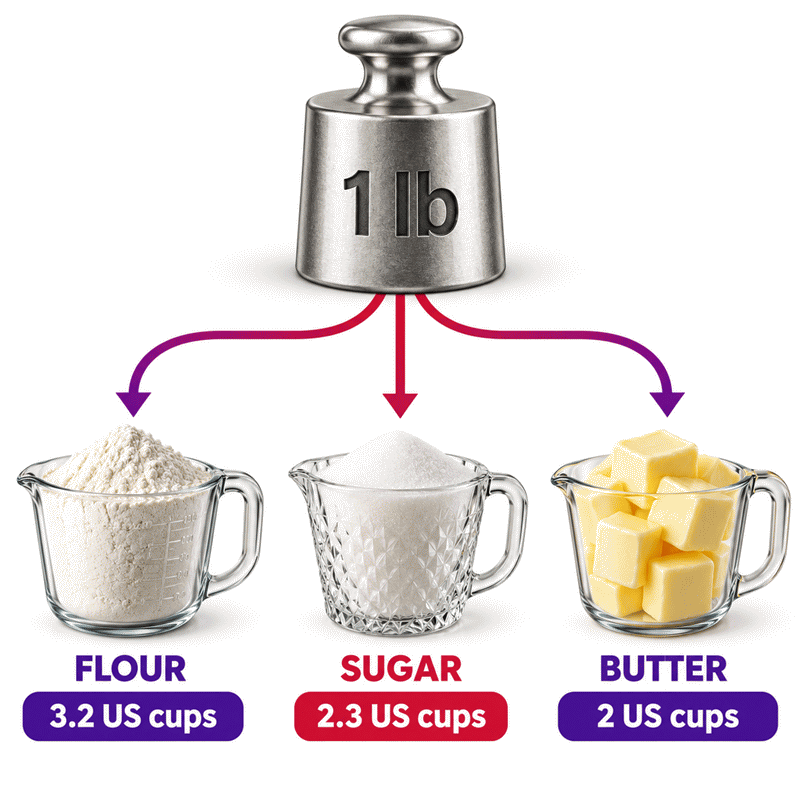
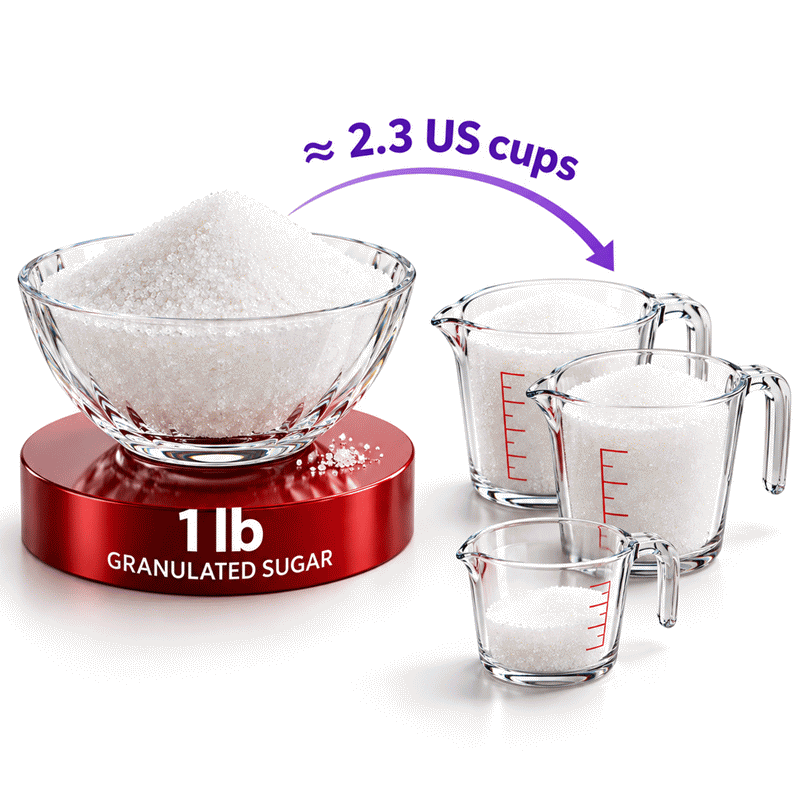
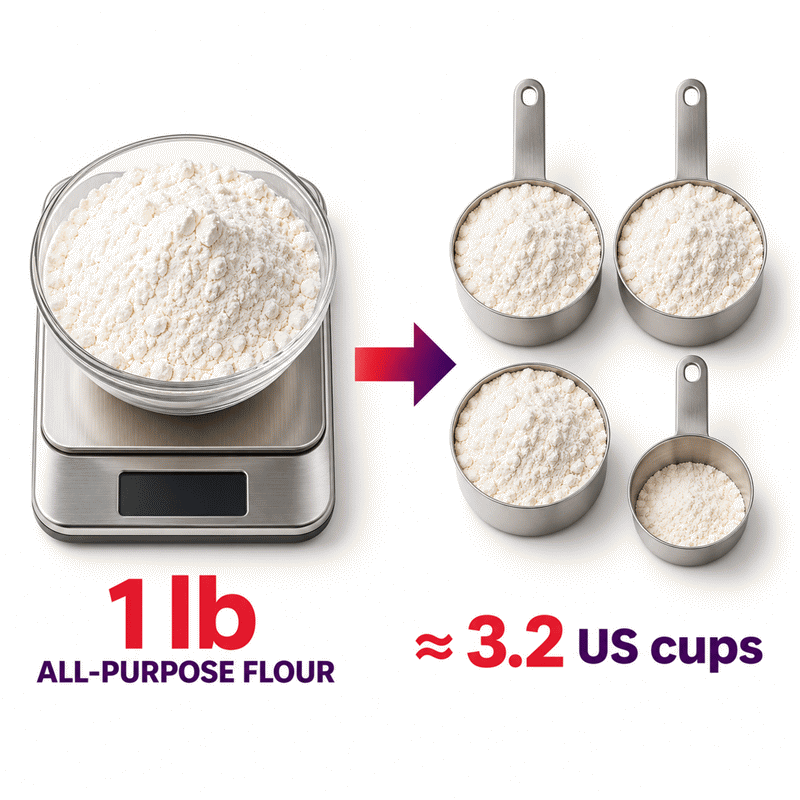
Pounds to Cups Converter results depend on the selected ingredient because pounds measure mass while cups measure volume. A pound of butter, flour, honey, oats, and sugar will not fill the same number of cups. The converter uses the ingredient’s average density and the selected cup standard to connect these measurements.
- Select the exact ingredient and subtype before entering an amount.
- Edit either weight or volume to calculate in both directions.
- Choose US cups, metric cups, glasses, milliliters, or liters carefully.
- Use Custom Ingredient when verified product density is available.
- Check whether flour is aerated, sugar is packed, or nuts are ground.
- Reverse-check important conversions before scaling a large recipe.
- Use a calibrated scale when precision and repeatability are critical.
The AxiCalculator Pounds to Cups Converter keeps the represented physical quantity stable when units change. It makes ingredient and cup choices visible, helping users avoid the common mistake of applying one universal cups-per-pound value to every food. Results remain practical estimates because brands, moisture, preparation, and packing can change real cup weight.
Assumptions used in this calculator
- Ingredient density represents an average value under normal kitchen conditions.
- Selected ingredients are measured without unintended compression or excessive aeration.
- Flour is assumed to be aerated and level-measured.
- Brown sugar packing may differ according to individual recipe instructions.
- Liquids are assumed to be homogeneous at typical room temperature.
- US cups contain 236.5882365 milliliters.
- UK metric cups contain 250 milliliters.
- A standard kitchen glass contains 200 milliliters.
- One avoirdupois pound equals exactly 0.45359237 kilograms.
- Butter sticks represent standard half-cup United States sticks.
- Custom density values must describe the ingredient’s applicable bulk density.
- Intermediate calculations retain full precision before display rounding.
- Results are estimates and do not replace calibrated weighing equipment.
Results are rounded for display.
Internal calculations use full precision.
Formulas Used in Pounds to Cups Converter :
Direct Weight-to-Volume Formula
1. Normalize the Selected Weight
2. Calculate Ingredient Volume
3. Convert Volume to the Selected Unit
Direct Volume-to-Weight Formula
4. Normalize Volume for Reverse Solving
5. Calculate Mass from Volume
6. Convert Mass to the Selected Unit
Mi = mass in the selected weight unit
km = kilograms per selected weight unit
M = normalized ingredient mass in kilograms
ρ = ingredient density in kilograms per liter
V = normalized ingredient volume in liters
kv = liters per selected volume unit
C = volume in the selected cup or volume unit
Ingredient density must match the selected ingredient and its measurement condition. Density connects mass and volume, so pounds cannot be converted to cups accurately without identifying the ingredient.
Variables & Definitions
View a complete list of all variables used in this calculator, including definitions and units
Pounds to Cups Converter Variables and Measurement Units
| Variable | Symbol | Meaning | Base Unit |
|---|---|---|---|
| Entered mass | Mi | Weight entered or calculated in the selected weight unit | Selected mass unit |
| Mass conversion factor | km | Kilograms represented by one selected weight unit | kg per unit |
| Normalized mass | M | Ingredient mass normalized for calculation | kg |
| Ingredient density | ρ | Mass per unit volume of the selected ingredient | kg/L |
| Normalized volume | V | Ingredient volume normalized for calculation | L |
| Volume conversion factor | kv | Liters represented by one selected volume unit | L per unit |
| Displayed volume | C | Volume entered or calculated in cups, glasses, or another selected unit | Selected volume unit |
Unit Conversion Table
Mass Units Used by the Pounds to Cups Converter
| Unit Group | Unit Name | Symbol | Equivalent in Kilograms | Used For |
|---|---|---|---|---|
| Popular Units | Pound | lb | 0.45359237 kg | Primary recipe weight |
| Popular Units | Ounce | oz | 0.028349523125 kg | Small recipe weights |
| Popular Units | Kilogram | kg | 1 kg | Metric ingredient weight |
| Popular Units | Gram | g | 0.001 kg | Precise kitchen measurements |
| Popular Units | Butter Stick | stick | 0.1133980925 kg | Butter only |
| Scientific Units | Milligram | mg | 0.000001 kg | Very small quantities |
| Scientific Units | Metric Ton | t | 1000 kg | Large-scale food production |
Volume Units Used by the Pounds to Cups Converter
| Unit Group | Unit Name | Symbol | Equivalent in Liters | Used For |
|---|---|---|---|---|
| Popular Units | US Customary Cup | US cup | 0.2365882365 L | United States recipes |
| Popular Units | Metric Cup | UK cup | 0.25 L | Metric and UK-style recipes |
| Popular Units | Kitchen Glass | glass | 0.2 L | Approximate household measurement |
| Popular Units | Milliliter | mL | 0.001 L | Small liquid volumes |
| Popular Units | Liter | L | 1 L | Metric recipe volume |
| Scientific Units | Cubic Centimeter | cm3 | 0.001 L | Technical volume measurements |
| Scientific Units | Cubic Meter | m3 | 1000 L | Industrial-scale volume |
Density Units Used for Custom Ingredients
| Unit Group | Unit Name | Symbol | Equivalent in kg/L | Used For |
|---|---|---|---|---|
| Popular Units | Kilogram per Liter | kg/L | 1 kg/L | Primary density input |
| Popular Units | Gram per Milliliter | g/mL | 1 kg/L | Food and liquid density |
| Popular Units | Gram per Liter | g/L | 0.001 kg/L | Low-density ingredients |
| Popular Units | Pound per US Gallon | lb/US gal | 0.119826427 kg/L | US liquid density data |
| Popular Units | Pound per Cubic Foot | lb/ft3 | 0.0160184634 kg/L | Bulk ingredient density |
| Scientific Units | Kilogram per Cubic Meter | kg/m3 | 0.001 kg/L | Scientific density data |
| Scientific Units | Gram per Cubic Centimeter | g/cm3 | 1 kg/L | Laboratory density data |
| Scientific Units | Metric Ton per Cubic Meter | t/m3 | 1 kg/L | Industrial bulk density |
Example Calculation
Convert 2.75 lb of wheat all-purpose flour to US customary cups.
Use a flour density of 0.5991 kg/L, 0.45359237 kg per pound, and 0.2365882365 L per US cup.
The result uses the selected ingredient's average bulk density.
The calculator preserves full precision during each intermediate calculation.
Only the displayed result is rounded for practical kitchen use.
Actual measured volume may vary with aeration, moisture, and scooping technique.
Convert 5.5 US customary cups of butter to pounds.
Use a butter density of approximately 0.958611 kg/L and 0.2365882365 L per US cup.
The reverse calculation begins with the editable volume value.
Volume is converted to liters before ingredient density is applied.
The resulting kilogram value is converted to the selected weight unit.
For standard butter, 2.75 lb also corresponds to approximately 11 sticks.
Results are rounded for display.
Internal calculations use full precision.
Calculations Disclaimer
How Many Cups Are in a Pound of Your Ingredient?
A recipe lists pounds, but your kitchen has measuring cups. The tempting shortcut is two cups per pound. That only fits standard butter well. Other foods need different cup amounts.
The Pounds to Cups Converter starts with the ingredient. Choose flour, sugar, butter, liquid, grain, nut, or another food. Select a subtype when the form matters. Then enter the known amount.
You can edit either side. Enter weight to find volume. Enter volume to find weight. This two-way workflow helps with recipes, packages, storage containers, and bulk planning.
Treat the result as a practical kitchen estimate. Foods vary by brand, moisture, and handling. For delicate baking or large batches, check the final amount with a scale.
Why One Pound Does Not Equal the Same Number of Cups
One pound of honey and one pound of oats balance the same scale. Yet they fill very different containers. Honey is compact. Oats hold many air spaces.
That contrast explains the whole conversion. A pound tells you how much material exists. A cup tells you how much space it fills. The food controls the bridge between them.
Preparation changes that space too. Whole nuts, chopped nuts, and ground nuts settle differently. Powdered sugar behaves differently from granulated sugar. Packed brown sugar loses many air gaps.
Always name the material before converting it. Extra decimal places cannot repair a wrong ingredient choice. The right selection matters more than a long result.
The Practical Difference Between Weight and Volume
A scale measures mass. A cup measures occupied space. These tools answer different questions, even when both appear in one recipe.
Weight is usually easier to repeat. Flour still weighs 500 grams after aeration. Its cup volume may change because extra air sits between particles.
Volume remains useful in home kitchens. Many recipes only provide cups. A careful conversion gives a workable bridge without claiming that every cup is identical.
Use clean, dry cups for powders. Level the surface gently. Measure liquids on a flat counter and read the mark at eye level.
How Ingredient Density Changes Every Conversion
A surprising answer often comes from ingredient density. Dense foods place more mass inside each cup. Light, airy foods need more cups for the same pound.
Honey therefore needs fewer cups than oats. Sugar needs fewer cups than many flours. Oil and water also differ, even though both pour easily.
Storage can shift the real result. Flour settles during shipping. Powders absorb moisture. Warm liquids may occupy slightly more space. These changes are real, not calculator defects.
For a named packaged product, inspect its label. A serving statement with both weight and volume can reflect that product better than a broad average.
How to Use the Pounds to Cups Converter
A conversion can fail before any number is entered. Users may choose the wrong food, cup, or ounce type. The tool keeps these choices close together.
First, select the ingredient. Choose its subtype when another selector appears. Next, enter pounds, ounces, kilograms, grams, cups, milliliters, or another supported unit.
The other field updates immediately. There is no separate calculate step. Change a unit and the displayed number adapts while the physical amount remains unchanged.
Use Reload Calculator before starting another recipe. Export a valid result when a record is helpful. Share the result link when another cook needs the same setup.
Select the Ingredient and Its Exact Form
The word flour may look specific, but it covers very different products. Cake flour, rye flour, soy flour, cornstarch, and potato starch fill cups differently.
Sugar also needs a subtype. Granulated sugar, powdered sugar, and brown sugar do not share one cup value. Nut pieces and ground nuts need separate treatment.
Copy the exact ingredient description from the recipe. Match its prepared form before entering the amount. This simple step prevents the largest avoidable errors.
Choose Custom Ingredient for an unlisted product. Use reliable information for that exact material and condition. Do not guess from color, texture, or a similar food.
Enter Pounds or Edit Cups for Reverse Solving
Some recipes give pounds, while storage containers show cups. Other tasks begin with leftover cups and need a weight. A one-way tool slows both jobs.
This converter keeps both number fields editable. The last valid field you change becomes the known amount. The other field becomes the solved amount.
This helps when dividing packages, scaling recipes, estimating storage space, or converting a supplier sheet. It also makes quick checks easier.
Switch direction without opening another page. Keep the same ingredient and units visible. That reduces context loss and prevents accidental factor changes.
Choose the Correct Cup Standard
A recipe says three cups, but its country is unclear. That missing detail can change the result. Cup sizes are not universal.
A US customary cup holds about 236.59 milliliters. A metric cup holds 250 milliliters. A defined kitchen glass may hold 200 milliliters.
The difference grows with recipe size. Ten metric cups contain more volume than ten US cups. Dough hydration and final yield can shift.
Look for milliliter notes, butter sticks, oven units, or publisher guidance. Use one cup standard across the whole recipe whenever possible.
Pounds to Cups Results for Everyday Ingredients
Quick charts are helpful, but they can hide important details. The exact food and prepared form still control the practical answer.
Water and milk sit near each other. Oil is lighter. Honey and syrup are denser. Flour and oats hold more air, so one pound fills more cups.
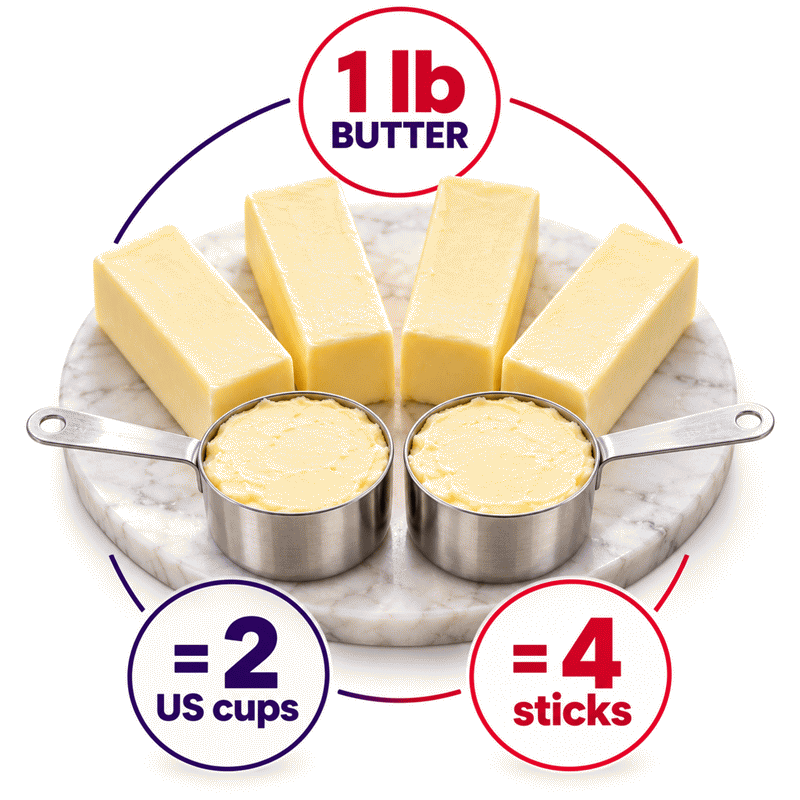
Butter offers a useful US check. One pound commonly matches two cups or four standard sticks. Imported blocks may use different packaging sizes.
Use the interactive result for the selected setup. Use mental comparisons only as a warning system. A dense syrup should not produce more cups than light oats.
Flour, Starch, and Grain Conversions
A bread recipe fails after cake flour replaces bread flour by cup. The issue is not only protein. The cup may also hold a different mass.
Choose the listed flour or starch. Avoid using all-purpose flour as a default for every powder. Cornstarch and potato starch deserve their own selections.
Handle the ingredient consistently. Stir settled flour, spoon it gently, and level the top. Do not shake or press unless the recipe requests it.
Raw and cooked grains are separate materials. Cooking adds water and changes both weight and volume. Never apply a raw rice setting to cooked rice.
Granulated, Powdered, and Brown Sugar Conversions
A frosting becomes too sweet when powdered sugar uses a granulated sugar conversion. Their particle structures differ, so their cup weights differ.
Brown sugar adds another choice. Loose and packed cups contain different amounts. Follow the recipe wording and keep packing pressure consistent.
Powdered sugar may need sifting. Check whether the recipe measures before or after that step. The order can affect the amount placed in the bowl.
Large sugar batches deserve direct weighing. Small cup errors can change spread, browning, moisture, and texture across many servings.
Butter, Oil, Milk, Cream, and Syrup Conversions
Pourable ingredients may look similar, yet one pound does not fill equal cups. Oil is lighter than water. Honey and syrup are heavier.
Cream varies with composition. Milk differs slightly from water. Butter changes shape when softened, but its mass remains stable.
Standard US butter wrappers offer a quick check. Four sticks usually make one pound. Each standard stick represents half a cup.
Measure sticky liquids carefully because some remains in the cup. For repeatable work, weigh them directly into a tared mixing bowl.
Rice, Oats, Nuts, Seeds, and Cocoa Conversions
A bulk bag lists pounds, but the recipe lists cups. Grain size, chopping, and settling now matter. The wrong form creates an immediate mismatch.
Rolled oats differ from oat flour. Whole walnuts differ from ground walnuts. Raw rice differs from cooked rice. Select the form used in the recipe.
Stir heavily settled dry goods before measuring. Fill the cup without deliberate pressing. Level loose ingredients with a straight edge.
For large purchases, calculate a planning amount first. Confirm the final production quantity with a scale before mixing or packaging.
Why Preparation Method Changes the Result
Two cooks use the same cup and still obtain different flour weights. One scoops from the bag. The other spoons flour gently into the cup.
Scooping compresses many powders. Sifting adds air. Packing sugar removes air. Chopping nuts changes the spaces between pieces.
A consistent method limits this variation. Follow the recipe language. Repeat the same filling action for every cup. Avoid tapping unless instructed.
When small differences matter, move from volume to weight. A scale removes most variation caused by cup shape and filling technique.
Aerated, Scooped, Sifted, and Compacted Flour
A cake turns dense despite careful timing. Too much flour may have entered each cup. Direct scooping often compresses flour against the container.
Stir flour before measuring. Spoon it into the cup. Sweep the top level without pressing. This method gives a more repeatable loose cup.
Read wording closely. Sifting before measuring can differ from sifting after measuring. The sequence changes how much flour reaches the recipe.
For scaled baking, stop counting many cups. Use the converted mass and document the flour brand and handling method.
Packed Sugar and Ground Ingredient Differences
Cookies spread differently after someone changes how brown sugar is packed. Air pockets reduce mass. Firm pressure places more sugar inside the same cup.
Pack only when the recipe says so. Keep pressure similar for each measure. Break lumps before measuring powdered products.
Grinding nuts creates a separate material condition. Smaller pieces fill gaps left between whole nuts. The same pound then occupies less volume.
Measure the form named by the recipe. If preparation happens first, select the prepared form. This choice beats false precision.
US Cups, Metric Cups, and Kitchen Glasses Compared
A recipe crosses borders but keeps the word cup. The number survives, while the container standard may change. This quiet error affects every ingredient.
US cups, metric cups, and 200 milliliter glasses hold different volumes. They must not share an unchanged number.
AxiCalculator keeps the selected unit beside the value. Switching units changes the displayed number while keeping the same physical volume.
Use one system throughout the recipe. Record the chosen cup when sharing calculations. This prevents another cook from silently choosing a different standard.
Which Cup Standard Does Your Recipe Use?
An online recipe gives cups without a country note. Look for clues in nearby measurements. Fahrenheit temperatures and butter sticks often suggest US measures.
A statement equating one cup with 250 milliliters points to a metric cup. Explicit volume notes are stronger evidence than a website domain.
If the standard remains uncertain, use the system that matches the remaining recipe. Make a smaller test batch before expensive scaling.
Save or export the selected setup. A visible record keeps the decision clear for future cooks, reviewers, and production staff.
How to Check a Pounds-to-Cups Conversion
A result looks unusually large. Before changing it, check the ingredient, subtype, and cup standard. Most surprising errors begin there.
Confirm direction next. Pounds should solve cups when weight is known. Cups should solve pounds when volume is known.
Then switch direction and recover the starting amount. A close match shows the tool preserved the relationship through both paths.
Finish with a physical sense-check. Honey should fill fewer cups per pound than oats. Butter should match common wrapper markings.
Reverse-Check the Result Before Scaling a Recipe
A bakery plans ten batches. Any small setup error will multiply ten times. A reverse check takes seconds and can protect the whole run.
Complete the first conversion. Keep the ingredient and units unchanged. Enter the displayed result on the opposite side and compare the recovered amount.
This check confirms consistent processing. It cannot prove that a generic food value matches the actual product.
For commercial work, test a representative sample. Record brand, lot, temperature, preparation, and filling method. Repeat when supply conditions change.
Common Measurement Mistakes That Change Recipe Outcomes
The calculator is correct, yet the recipe fails. The cause often sits outside arithmetic. A wrong subtype, cup standard, or ounce type can change everything.
Another mistake is changing a unit label without changing its number. One pound is not one kilogram. One cup is not one liter.
Users also borrow a butter conversion for flour or honey. Ingredient-specific relationships cannot move safely between unrelated foods.
Keep a short record for important work. Note the product, prepared form, cup system, and final measured weight. Reuse verified settings.
Using Fluid Ounces as Weight Ounces
A package shows ounces, but the wrong field receives the number. This happens because mass ounces and fluid ounces share a familiar name.
The symbol oz normally marks mass. The symbol fl oz marks volume. They cannot be exchanged without knowing the ingredient.
Use weight ounces on the mass side. Use fluid measurements on the volume side. Read the full package label before entering a value.
Water can make these units look deceptively close. Other foods expose the mistake quickly. Follow the unit type, not the familiar number.
Ignoring Brand, Moisture, Temperature, and Particle Size
A trusted recipe changes after switching brands. The written quantity stays fixed, but the product’s physical condition may differ.
Milling controls particle size. Shipping controls settling. Humidity changes powders. Temperature affects liquids and fats. Product recipes change spreads and creams.
Average values suit many home tasks. Professional work needs measurements from the actual material and process.
Do not present one average as an exact property of every package. Use a product-specific setting when the outcome carries higher cost.
When a Kitchen Scale Is the Better Choice
A wedding cake or production run leaves little room for drift. This is where direct weighing becomes the safer choice.
Scales reduce differences from packing, cup shape, and surface leveling. They also simplify sticky ingredients when the bowl can be tared.
The converter still helps translate old recipes, estimate storage, check packages, and plan purchases. It explains the relationship before final weighing.
Match the method to the consequence. A forgiving soup tolerates approximation. A delicate cake, nutrition record, or commercial batch deserves calibrated mass.
Frequently Asked Questions
Can I use the same cups-per-pound value for every dry ingredient?
Why does changing from US cups to metric cups reduce the number shown?
What should I choose when my exact ingredient is not listed?
Is a pounds-to-cups result accurate enough for baking?
How can a bakery establish a product-specific conversion factor?
Why can a reverse check pass even when the practical result is wrong?
How should density variability be handled when scaling industrial recipes?
Our engineers are here to help you get it right.