Yards to Acres Calculator
- Last formula update:
Decimal & Rounding Policy
- Calculations use the exact conversion factor: 1 acre = 4,840 square yards.
- Intermediate values are not rounded, helping preserve conversion accuracy.
- Results are displayed with up to 12 significant digits when additional precision is needed.
- Unnecessary trailing zeros are removed to keep results clear and easy to read.
- Exact whole-number results remain whole numbers, such as 4,840 yd² = 1 ac.
- Very small or very large values may use scientific notation for a compact, readable result.
Valid range
- Square yards (yd²): Enter any finite value greater than 0; the calculator converts it using 1 acre = 4,840 square yards.
- Acres (ac): Enter any finite value greater than 0; the equivalent square yards are calculated as acres × 4,840.
- Zero, negative values, non-numeric entries, and non-finite values are not valid area measurements for this calculator.
- Very small decimal values are supported as long as they are greater than 0 and can be represented safely by the calculator.
- Very large values are accepted only within the calculator’s supported numeric range to prevent inaccurate or non-finite results.

Felovyn Quarnwick
Reviewers:
Meravie Quellmont
Herixon Vosswick
Check our editorial policy
September 6, 2026
1.0.0
Initial calculator and formula release.
Our engineers are here to help you get it right.
How Does the Yards to Acres Calculator Help You Understand Land Area?
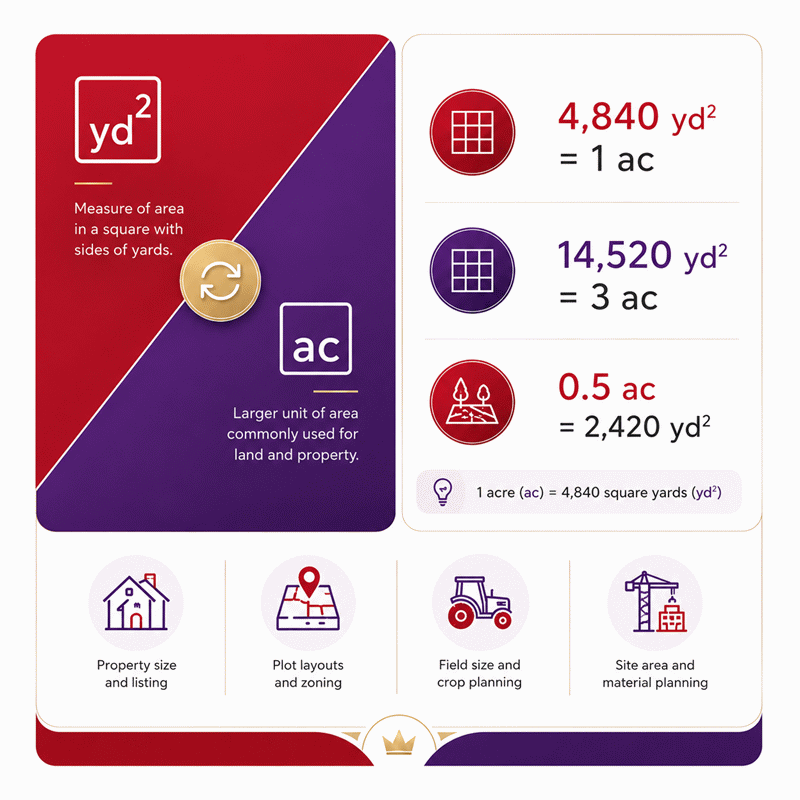
Yards to Acres Calculator converts square-yard measurements into acres and also supports reverse conversion from acres to square yards. The calculation uses the exact relationship that 1 acre equals 4,840 square yards, helping users compare property sizes, land parcels, construction sites, agricultural areas, and landscaping projects in a clearer unit.
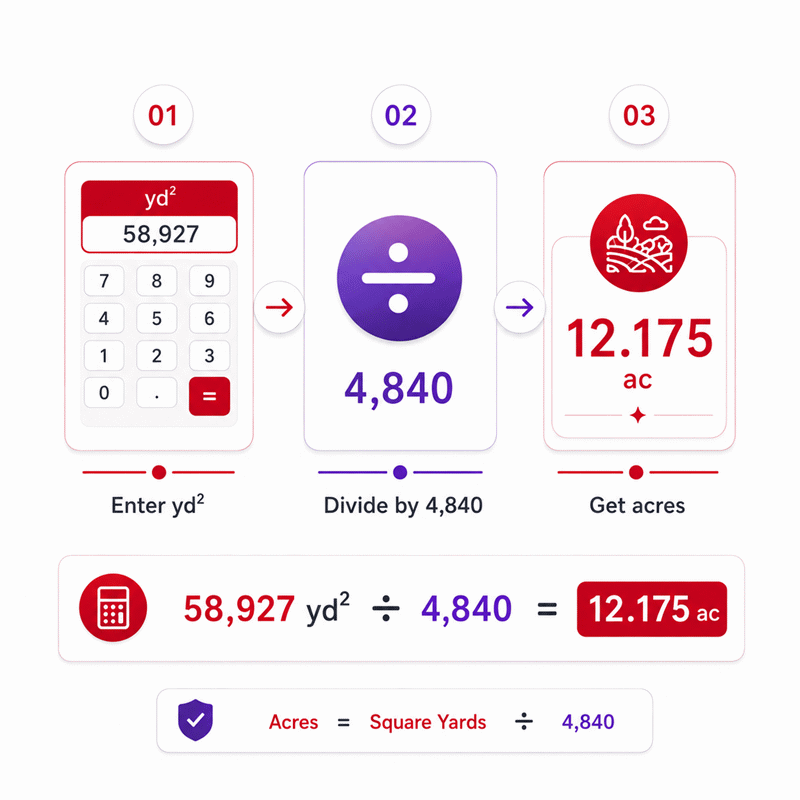
- Convert square yards to acres by dividing the area by 4,840.
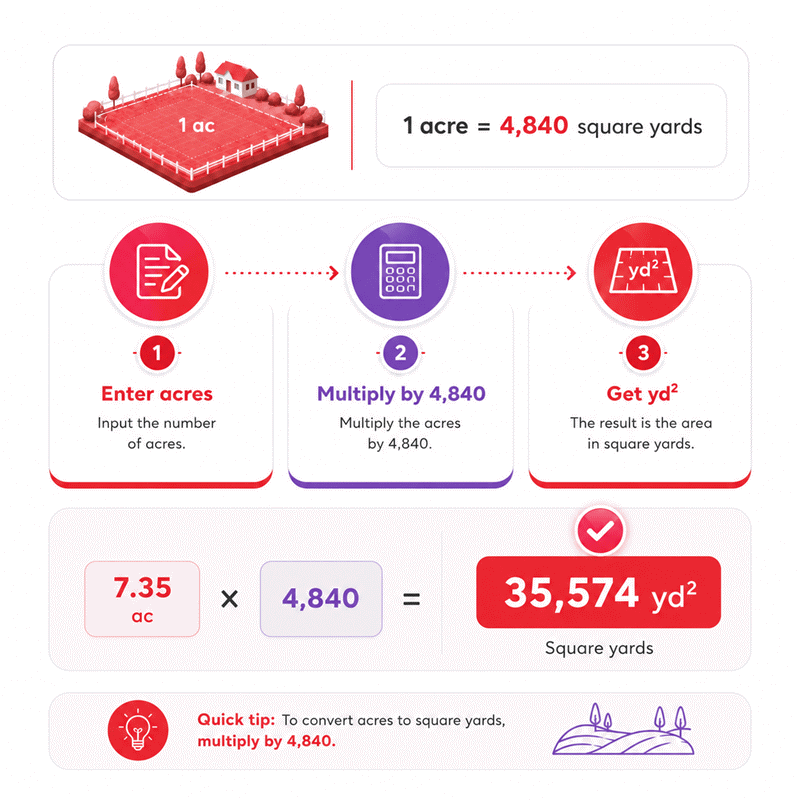
- Convert acres to square yards by multiplying the acreage by 4,840.
- Use square yards when detailed measurements of smaller areas are easier to understand.
- Use acres when comparing larger properties, farms, development sites, or land parcels.
- Confirm that your source measurement represents area, not a linear distance in yards.
- Keep all compared properties in the same unit before evaluating land size or price.
- Remember that converted area does not determine usable or buildable land.
- Check original property records before making important legal, financial, or development decisions.
The Yards to Acres Calculator is especially useful when listings, plans, and property documents use different area units. It provides a fast way to normalize those measurements while keeping the physical land area unchanged.
Assumptions used in this calculator
- Area values are assumed to represent true two-dimensional surface measurements.
- One acre is assumed to equal exactly 4,840 square yards.
- Square yards and acres are treated strictly as compatible area units.
- Entered measurements are assumed accurate before conversion begins.
- All accepted values are assumed finite and greater than zero.
- Intermediate calculations are assumed to retain full available numeric precision.
- Displayed rounding does not alter the underlying converted area value.
- Reverse calculations use the same fixed conversion relationship.
- No correction is applied for surveying, boundary, or measurement errors.
- No adjustment is made for terrain slope or irregular land boundaries.
- Property records are assumed to use standard square-yard and acre definitions.
- Industrial users should verify source measurements before operational or contractual use.
- Legal land dimensions should be confirmed using authorized survey documentation.
Results are rounded for display.
Internal calculations use full precision.
Formulas Used in Yards to Acres Calculator :
Square Yards to Acres Formula
- Ayd² is the area measured in square yards.
- Aac is the equivalent area measured in acres.
- 4,840 is the exact conversion factor because 1 acre equals 4,840 square yards.
The calculator uses this exact relationship for both calculation directions. When acres are edited, the same equation is solved algebraically for square yards, so no separate duplicate formula is required. Intermediate values are calculated without rounding, and rounding is applied only when formatting the displayed result.
Variables & Definitions
View a complete list of all variables used in this calculator, including definitions and units
Yards to Acres Calculator Variables and Units
| Symbol | Parameter | Unit | Quantity Type | Calculation Role | Valid Value | Relationship |
|---|---|---|---|---|---|---|
| Ayd² | Area in Square Yards | yd² | Area | Editable input or calculated result | Finite value greater than 0 | Ayd² = Aac × 4,840 |
| Aac | Area in Acres | ac | Area | Editable input or calculated result | Finite value greater than 0 | Aac = Ayd² ÷ 4,840 |
| 4,840 | Square Yards per Acre | yd²/ac | Conversion Constant | Fixed conversion factor | Constant | 1 ac = 4,840 yd² |
Unit Conversion Table
Unit Conversion Table
| Unit Group | Unit Name | Symbol | Equivalent in Base Unit | Used For |
|---|---|---|---|---|
| Mass | Gram | g | 1 g | Recipe and portion measurements |
| Mass | Kilogram | kg | 1,000 g | Bulk and commercial quantities |
| Mass | Ounce | oz | 28.349523125 g | US customary recipe measurements |
| Mass | Pound | lb | 453.59237 g | Large US customary quantities |
| Mass | Milligram | mg | 0.001 g | Very small measured quantities |
| Volume | US Cup | cup | 236.5882365 mL | Household rice portions |
| Volume | Tablespoon | tbsp | 14.78676478125 mL | Small recipe quantities |
| Volume | Teaspoon | tsp | 4.92892159375 mL | Very small recipe quantities |
| Volume | Milliliter | mL | 1 mL | Metric volume measurements |
| Volume | Liter | L | 1,000 mL | Bulk metric volume measurements |
Example Calculation
The starting area is 58,927 square yards. Because one acre contains exactly 4,840 square yards, the square-yard value is divided by 4,840. The calculation gives exactly 12.175 acres. The same fixed conversion relationship also supports reverse calculations from acres back to square yards.
In reverse solving, the known area is entered in acres while the square-yard value is unknown. Since one acre contains exactly 4,840 square yards, the acre value is multiplied by 4,840. For 7.35 acres, the calculation produces exactly 35,574 square yards. The same fixed relationship keeps forward and reverse conversions mathematically consistent.
Results are rounded for display.
Internal calculations use full precision.
Calculations Disclaimer
How to Convert Square Yards to Acres Without Making a Costly Land-Size Mistake
A land buyer often receives one figure in square yards and another in acres. That creates instant confusion. The Yards to Acres Calculator removes that gap in seconds. The Yards to Acres Calculator also works in reverse. This helps users compare land records without changing tools.
The first step is to confirm that the source number represents area. A yard measures length. A square yard measures area. Mixing these two quantities can ruin the whole calculation. This mistake appears simple, yet its effect can be large.
Once the area is confirmed, the conversion process is direct. Square yards describe smaller land areas in greater detail. Acres make larger parcels easier to understand. The calculator changes the unit while preserving the same physical area.
This matters during property research. Two listings may describe equal land using different units. One seller may publish square yards. Another may publish acres. Comparing those raw numbers can mislead buyers. Converting both values into one unit makes the comparison clear.
It also matters before discussing price. A lower number does not always mean less land. The units may simply be different. Always normalize the area before comparing offers, construction plans, or development options.
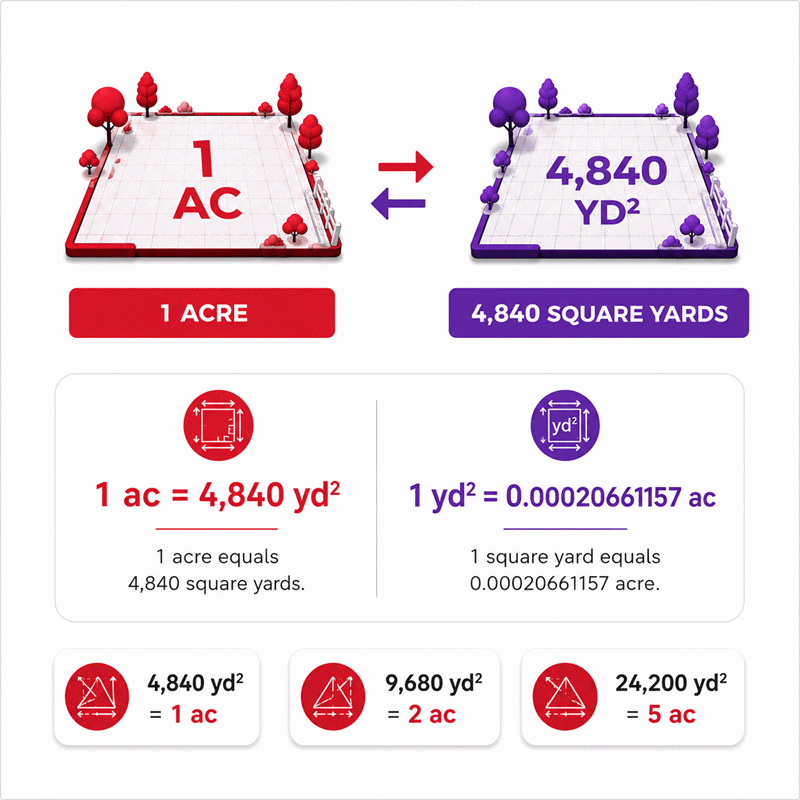
Visual checkpoint: square yards describe the area in smaller pieces. Acres summarize the same land on a larger scale. The land itself never becomes larger or smaller.
Why Square Yards and Acres Are Easy to Confuse
A common problem starts with familiar words. People understand yards from everyday length measurements. They may then read square yards as another length value. It is not. Square yards describe two-dimensional space.
An acre also describes area. However, it is much larger than one square yard. This makes acres useful for farms, estates, development sites, and larger parcels.
The safest mental model is simple. Think of square yards as detailed area blocks. Think of acres as larger area packages. Both describe surface size, not boundary length.
This distinction becomes important when dimensions come from site drawings. A plan may list several boundary lengths. Those lengths cannot be converted directly into acres. The total area must be known first.
Are You Measuring a Boundary or the Actual Land Area?
A property owner may know the fence length but not the parcel area. That boundary figure cannot describe acreage by itself. Different shapes can share the same perimeter. Their enclosed areas can still differ greatly.
Before using any area converter, identify what the number represents. Look for labels such as yd², square yards, acres, or ac. If the document only gives linear yards, more geometry is required first.
This quick check prevents a major category error. It also keeps property comparisons meaningful.
Square Yards vs Acres: Which Unit Makes a Property Easier to Understand?
A property listing can feel larger or smaller because of its chosen unit. That is a presentation effect, not a physical change. Buyers should understand both units before making a decision.
Square yards are useful when detail matters. They work well for residential plots, yards, building sites, and landscaping areas. The smaller unit makes modest differences easier to see.
Acres are easier to scan when parcels become larger. Agricultural land, estates, industrial sites, and development areas often benefit from acreage. The smaller numerical figure is easier to discuss.
Neither unit is inherently better. The best choice depends on the decision being made. Engineers may need detailed area values. Buyers may prefer acres for quick comparison. Contractors may work with whichever unit appears on drawings.
A good calculator should let users move between both views without friction. This is especially useful during meetings. A buyer may think in acres. A contractor may receive square yards. Both people can still discuss the same area.
Eye-catching rule: never compare two land prices until both areas use the same unit.
Square Yards for Residential, Construction, and Landscaping Work
A homeowner may need to compare a garden plan with a property document. Square yards can make that comparison easier. They offer enough detail for smaller spaces.
Construction teams may also receive site areas in square yards. This can happen during early planning. The unit helps describe open areas around buildings and site boundaries.
Landscaping work benefits from detailed area figures. Lawn coverage, paving zones, and outdoor layouts often involve smaller sections. Square yards can keep those sections easy to visualize.
However, area conversion does not estimate material needs by itself. Material depth, waste, coverage, and installation method still matter. Area is only one part of that decision.
Acres for Real Estate, Agriculture, and Large Land Parcels
A land investor may compare several large parcels in one afternoon. Reading every parcel in square yards can slow that process. Acres provide a faster overview.
Agricultural discussions also favor larger area units. Field size, land allocation, and broad site planning become easier to communicate.
Large industrial sites can benefit from the same approach. An acreage figure offers an immediate sense of scale. Detailed plans can still use smaller area units later.
The key is consistency. Choose one unit for comparison. Convert every candidate property to that unit. Then review price, access, zoning, and usable area separately.
How Reverse Solving Changes the Way You Use an Area Converter
A user may know the acreage but need square yards for another document. A one-direction converter creates an unnecessary extra step. Reverse solving removes that problem.
With bidirectional behavior, either side can become the starting point. The user changes the known area. The corresponding value updates in the other unit.
This is especially useful when information comes from several sources. A sales listing may use acres. A contractor may request square yards. A planning document may use another area unit. Switching direction should not require a new page.
Reverse solving also helps with verification. A user can enter a known area in one unit. Then the equivalent value becomes available immediately. This makes cross-checking documents faster.
The most important point is conceptual. Reverse solving does not create a second land area. It only expresses the same area through another unit.
Visual checkpoint: one parcel, two unit labels, one physical area.
Why Bidirectional Conversion Is Better for Real Workflows
A property professional rarely follows one fixed direction all day. One client may provide acres. Another may provide square yards. A rigid converter interrupts that workflow.
Bidirectional conversion keeps both tasks together. This lowers the chance of copying values into the wrong tool. It also saves time during repeated checks.
This matters on mobile devices too. Users often work from property listings, messages, or site documents. Fewer steps mean fewer transcription errors.
A clean workflow should make the known value obvious. It should then update the related area without demanding extra actions.
Why Reverse Conversion Helps When Comparing Multiple Documents
A buyer may receive a brochure, survey summary, and development note. Each document can use different units. That makes quick comparison difficult.
Reverse conversion creates a common language across those documents. The user can convert each reported area into one preferred unit.
This does not verify ownership, boundaries, or legal accuracy. It simply makes the stated areas easier to compare.
Real-World Uses of Square Yards and Acres in Property Decisions
A land decision often starts before professional drawings exist. Buyers may only have listing data and basic parcel information. Area conversion can make that early review much clearer.
For residential property, the buyer may want to understand lot scale. Acres can provide a broad view. Square yards can reveal smaller differences between similar plots.
For development planning, teams may receive data from several consultants. One report may use acres. Another may use square yards. Converting those values creates a common reference.
For agriculture, acreage often communicates total field scale better. Yet smaller sections may still be discussed in detailed area units. Moving between both can support clearer planning.
For industrial sites, total area is only the first filter. Access roads, setbacks, drainage, safety zones, easements, and utilities can reduce usable space. A large gross area does not guarantee an equally large buildable area.
This distinction is critical. A converter tells you how the stated area appears in another unit. It does not decide how much land can be developed.
That knowledge gives buyers a better starting point. It also helps them ask better questions before committing money.
Using Area Conversion Before Comparing Land Prices
A buyer may see one property advertised with a price per acre. Another may use a price per square yard. The cheaper-looking figure may not be the cheaper property.
First place the area and pricing basis on the same scale. Then compare like with like. This simple step can expose pricing differences that were hidden by unit choice.
Do not stop at area price alone. Location, access, services, planning limits, and usable space can matter more. Area conversion supports the decision. It does not replace the decision process.
AxiCalculator is most useful here as a fast normalization tool. It helps users prepare cleaner numbers before discussing a purchase.
Using Area Conversion During Construction and Site Planning
A construction team may receive a land schedule in one unit. The client may discuss the same project in another. That difference can create communication errors.
Converting the area into a shared unit improves meetings and written notes. It can also help teams review site coverage at an early stage.
Still, site area is not the same as building area. Roads, parking, open space, landscape zones, and setbacks may use substantial land.
Good planning separates total parcel area from usable development area. That distinction prevents false expectations.
Common Square Yards to Acres Mistakes That Can Distort a Property Decision
A small unit mistake can become a large financial misunderstanding. The most dangerous errors often look harmless at first.
The first mistake is confusing yards with square yards. Length cannot be treated as area. A linear measurement needs other dimensions before an area can exist.
The second mistake is comparing numbers without comparing units. A smaller figure may represent a much larger unit. Always check the symbol beside the value.
The third mistake is treating converted area as surveyed area. Conversion only changes units. It cannot correct a wrong source measurement.
The fourth mistake is assuming total area equals usable area. Real sites may contain restrictions. Easements, roads, setbacks, waterways, and access zones can change practical use.
The fifth mistake is copying numbers between tools repeatedly. Each manual transfer creates another chance for error. Bidirectional calculation reduces this need.
The sixth mistake is trusting an unlabeled number. Every area figure should remain connected to its unit. A bare number has little practical meaning.
Eye-catching warning: correct arithmetic cannot repair incorrect source data.
Using Length Instead of Area
A user may enter a yard value taken from a boundary line. The result can look professional while being conceptually wrong.
Check the original document first. If it reports only length, calculate or obtain the area before converting.
This distinction becomes even more important with irregular parcels. Several boundary measurements may be needed. Survey methods may also be required.
A unit converter should begin only after the area is known.
Treating Gross Land Area as Buildable Area
A developer may see a large parcel and assume most of it is usable. That assumption can create expensive expectations.
Gross land area includes the whole stated parcel. Buildable area may be much smaller. Planning rules can require setbacks and open space. Site access can consume more land.
Utilities and drainage routes may create further limits. Industrial sites may also require safety separation zones.
Use area conversion to understand scale. Use professional site information to understand practical capacity.
Why Correct Conversion Still Needs Correct Source Data
A perfectly working calculator can only process the value it receives. If the source value is wrong, the converted result remains wrong.
This principle matters for old property documents. It also matters for manually copied listing data. One misplaced digit can change the apparent size greatly.
For important decisions, compare the entered figure with the original record before converting it.
How to Read Land Area Data Like a More Informed Buyer
A buyer may focus on the largest number in a listing. That number can distract from more useful questions. Start with the unit, source, and context instead.
Ask whether the figure describes the whole parcel. Ask whether the measurement comes from a survey, listing, plan, or estimate. Then determine whether you need a detailed unit or a larger summary unit.
Next, normalize competing properties. Put their land areas into the same unit. This makes differences easier to see.
Then separate area from usability. A larger parcel can have less practical space. Shape can matter. Access can matter. Planning limits can matter. Terrain can matter.
Finally, connect the number to your goal. A home buyer may care about outdoor space. A farmer may care about productive land. A developer may care about buildable area. An industrial buyer may care about access and future expansion.
This process changes a conversion from a number exercise into a decision tool.
What Land Buyers Should Check Before Trusting a Listed Area
A listing may show an attractive land size without explaining its source. That should trigger a quick verification step.
Check whether the area matches available property documents. Confirm that the unit is clearly stated. Look for differences between marketing material and formal records.
Also check whether the figure refers to gross or usable land. These terms can affect how buyers interpret the site.
If a major purchase depends on area, use qualified local professionals for boundary and title matters. Conversion can organize the numbers. Professional records establish the property facts.
Why Property Shape Matters Even When Area Stays the Same
Two parcels can contain the same total area but behave very differently. One may be compact. Another may be long and narrow.
The area conversion stays unchanged. Yet development potential can differ. Access, frontage, setbacks, and building layout depend on geometry.
This is why acreage alone cannot describe site quality. It describes size, not configuration.
Buyers should treat area as one layer of the decision. Shape and restrictions form another layer.
Choosing the Right Area Unit for Clearer Communication
A technical meeting can become confusing when every person uses different units. Clear communication starts by agreeing on one reference unit.
For smaller sites, square yards may provide useful detail. For larger sites, acres may improve readability. Both can still appear together when teams need cross-reference.
Real estate teams should use the same unit across comparisons. Construction teams should follow the units used in approved documents. Buyers should choose the unit they understand best, then convert other listings into it.
Consistency reduces mental load. It also reduces the risk of comparing unrelated scales.
The goal is not to force one unit everywhere. The goal is to make every number easy to interpret.
For Buyers: Use One Unit Across Every Property Comparison
A buyer reviewing many listings can lose track of scale quickly. Switching between acres and square yards makes that harder.
Choose one preferred unit before comparing properties. Convert each listed area into that unit. Then place the normalized values beside price and location.
This simple workflow makes shortlisting easier. It can also reveal which properties deserve deeper review.
AxiCalculator can support this stage by removing repeated manual conversion work.
For Technical Users: Keep Converted Values Connected to Their Original Context
An engineer may receive area data from several documents. Converting everything is useful, but context should not disappear.
Keep the original unit visible beside important records. This creates traceability during reviews. It also reduces confusion when returning to source documents.
A converted value should support communication, not replace the original record.
This habit is especially useful when teams work across different measurement systems.
A Practical Decision Workflow for Using Area Conversion With Confidence
A user may want a fast answer, yet important land decisions need structure. A simple workflow can keep the process clear.
First, identify whether the source figure is truly an area. Confirm the written unit. Do not assume that “yards” means “square yards.”
Second, decide which area unit will make the decision easier. Use acres for broad land scale. Use square yards when smaller differences matter.
Third, convert all competing properties into that same unit. This creates a fair comparison.
Fourth, review the original property context. Total land area should not be confused with usable land.
Fifth, compare area with price only after unit normalization. This prevents misleading price comparisons.
Sixth, investigate shape, access, planning limits, and site conditions separately. These factors cannot be understood from area alone.
Seventh, retain the original documented values. Converted figures are useful working values. Original records remain important for professional review.
This workflow gives the user speed without sacrificing clarity. It also keeps the calculator in its proper role.
From Quick Conversion to Better Property Decisions
A calculator becomes more valuable when it supports the next decision. The number itself is only the first step.
After converting the area, ask what the result means for your goal. Does the parcel offer enough space? Can two listings now be compared fairly? Does the price still look attractive?
These questions turn raw area data into useful information.
For high-value decisions, combine the converted area with reliable property records. Then review practical site limits before purchase or development.
When a Fast Calculator Is Enough and When Professional Review Matters
A quick conversion is enough when the goal is simple comparison. It also works well for education and preliminary planning.
Professional review becomes important when boundaries affect money or legal rights. The same applies when construction depends on exact site limits.
Surveyors, planners, engineers, and local authorities can address issues beyond unit conversion.
AxiCalculator helps users understand the numbers first. Better understanding makes later professional discussions faster and more focused.
Frequently Asked Questions
Can I use this calculator when a property listing shows a mixed unit such as acres and square yards?
What should I do if two property documents show slightly different area values after conversion?
Can I use the converted acreage to estimate how much fencing, paving, or landscaping material I need?
Why does the calculator sometimes show a long decimal even when the original land measurement looks simple?
How should an engineer handle legacy survey records that were prepared with older U.S. survey-foot conventions?
How can I validate a square-yard-to-acre result inside a spreadsheet or engineering calculation sheet?
What is the safest workflow when the converted land area will be used in a design or procurement decision?
Engineering Resources
Our engineers are here to help you get it right.