Gallons per Square Foot Calculator
- Last formula update:
Decimal & Rounding Policy
- Input values may include decimals for accurate area, height, volume, and rate calculations.
- Calculations use full internal precision to reduce rounding errors during unit conversions.
- Final results are rounded to practical decimal places while preserving meaningful significant digits.
- Very large or very small results may appear in scientific notation for readability.
- Use unrounded values in further calculations whenever maximum accuracy is required.
Valid range
- Length and width must be greater than zero and are used to calculate area.
- Area must be greater than zero and equals length multiplied by width.
- Height must be greater than zero and represents the liquid depth above the area.
- Volume must be greater than zero and equals area multiplied by height.
- Gallons per square foot must be greater than zero and equals volume divided by area.
- All entered values must be finite numbers within the calculator’s supported unit range.

Reviewers:
Davenya Quillford
Elvaron Kesthall
Check our editorial policy
August 19, 2026
1.0.0
Initial calculator and formula release.
Our engineers are here to help you get it right.
How Does the Gallons per Square Foot Calculator Find Liquid Volume?
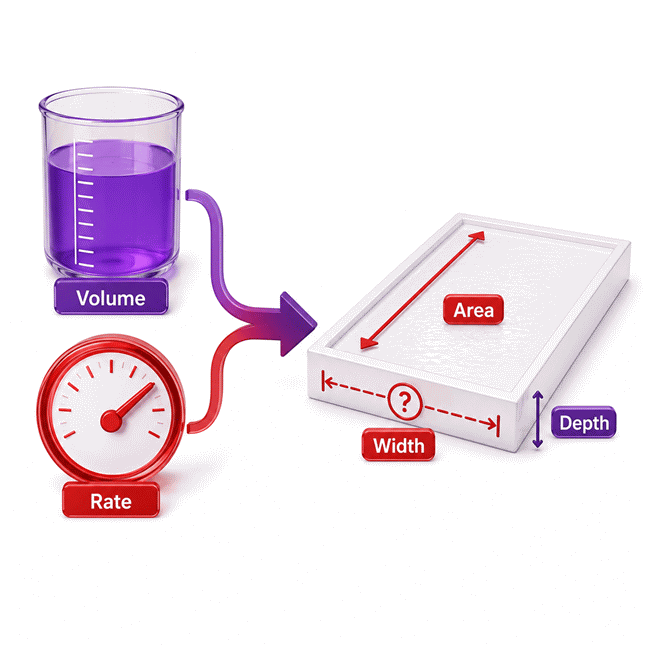
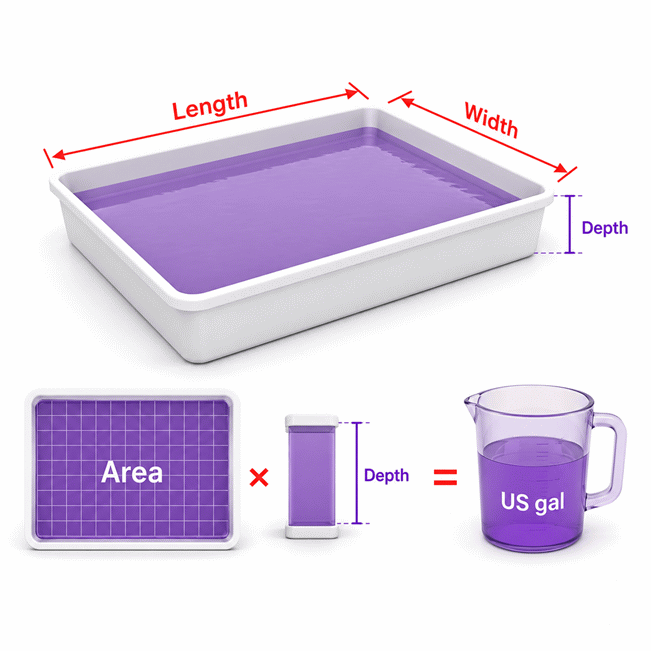
Gallons per Square Foot Calculator connects surface area, liquid depth, and total volume. Square feet measure area, while gallons measure volume. Therefore, a valid conversion always requires a known depth or coverage rate. For a rectangular surface, multiply length by width to find area. Then combine area with uniform liquid depth to determine the occupied volume.
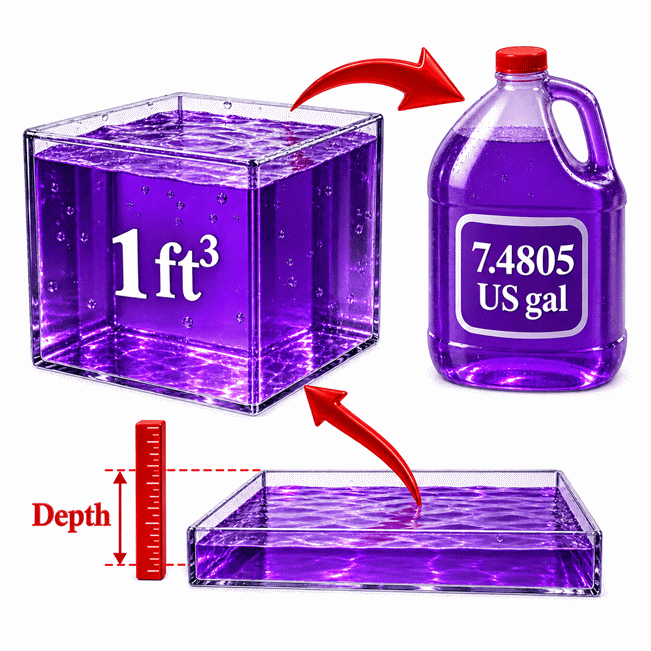
- One cubic foot contains approximately 7.48051948 US liquid gallons.
- One square foot at one-inch depth contains approximately 0.623376623 US gallons.
- Gallons per square foot depends on depth, not total surface area.
- Total gallons increase when either surface area or liquid depth increases.
- Reverse solving can recover area, depth, length, or width.
- Internal dimensions provide better capacity estimates than external dimensions.
- Use average depth for sloped pools, ponds, and uneven containers.
- Exclude freeboard, large obstructions, shelves, and displaced liquid space.
- US and Imperial gallons produce different numerical results.
- Liquid type changes weight but does not change geometric volume.
The Gallons per Square Foot Calculator supports tanks, pools, ponds, irrigation, and rainwater planning. Accurate results depend on reliable measurements, compatible units, and realistic operating depth. Recheck unexpected results before filling, ordering materials, selecting equipment, or making safety-critical decisions.
Assumptions used in this calculator
- The measured surface is rectangular unless area is entered directly.
- Length and width measurements represent usable interior dimensions.
- Liquid depth remains uniform across the entire surface.
- The supporting surface is level and geometrically consistent.
- Entered measurements use compatible units or verified conversion factors.
- One cubic foot equals 7.48051948 US liquid gallons.
- Surface irregularities and obstructions are excluded from calculated volume.
- Liquid temperature and pressure do not materially affect volume.
- Container deformation, leakage, evaporation, and displacement are excluded.
- Measurements are sufficiently accurate for the intended application.
- Calculated results are estimates and require project-specific verification.
- Industrial users must follow applicable safety standards and operating procedures.
- Final capacity must comply with manufacturer specifications and local regulations.
Results are rounded for display.
Internal calculations use full precision.
Formulas Used in Gallons per Square Foot Calculator :
1. Surface Area
2. Volume in Cubic Feet
3. Volume in US Gallons
4. Gallons per Square Foot
Variable Definitions
- L
- Surface length
- W
- Surface width
- A
- Surface area
- h
- Liquid height or depth
- V
- Liquid volume
- R
- Liquid volume in US gallons per square foot
- 7.48051948
- US gallons in one cubic foot
Variables & Definitions
View a complete list of all variables used in this calculator, including definitions and units
Gallons per Square Foot Calculator Variables and Units
| Variable | Parameter | Description | Standard Unit |
|---|---|---|---|
| L | Length | The measured length of the rectangular surface. | ft |
| W | Width | The measured width of the rectangular surface. | ft |
| A | Surface area | The coverage area calculated from length and width. | ft² |
| h | Liquid height | The uniform height or depth of liquid above the surface. | ft |
| V | Liquid volume | The total liquid volume covering the specified area. | ft³ or US gal |
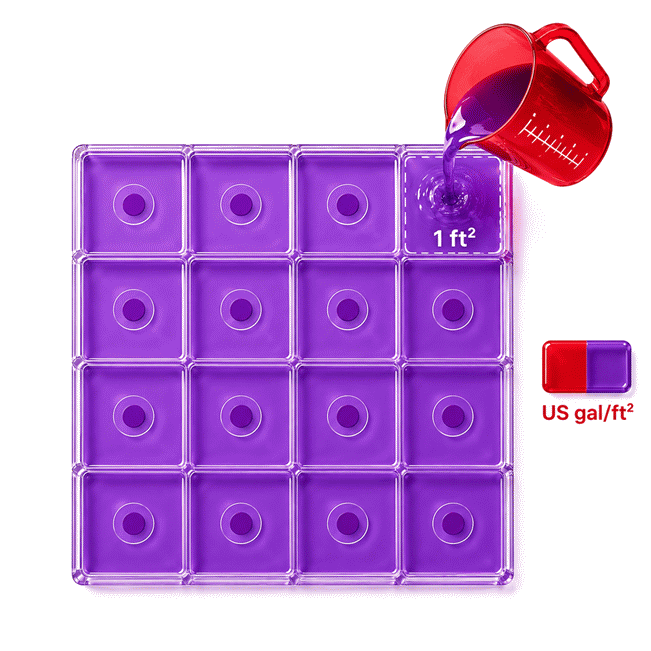
| R | Gallons per square foot | The liquid volume distributed across each square foot. | US gal/ft² |
| 7.48051948 | Volume conversion factor | The number of US gallons contained in one cubic foot. | US gal/ft³ |
Unit Conversion Table
Length and Height Unit Conversion Table
| Unit Group | Unit Name | Symbol | Equivalent in Feet | Used For |
|---|---|---|---|---|
| Metric length | Millimeter | mm | 0.00328084 ft | Small liquid depths |
| Metric length | Centimeter | cm | 0.0328084 ft | Liquid depth and dimensions |
| Metric length | Meter | m | 3.28084 ft | Large dimensions and depth |
| Imperial length | Inch | in | 0.0833333 ft | Shallow liquid depth |
| Imperial length | Foot | ft | 1 ft | Base length and height |
| Imperial length | Yard | yd | 3 ft | Large surface dimensions |
Surface Area Unit Conversion Table
| Unit Group | Unit Name | Symbol | Equivalent in Square Feet | Used For |
|---|---|---|---|---|
| Metric area | Square millimeter | mm² | 0.0000107639 ft² | Very small surfaces |
| Metric area | Square centimeter | cm² | 0.00107639 ft² | Small surfaces |
| Metric area | Square meter | m² | 10.7639 ft² | Metric coverage areas |
| Imperial area | Square inch | in² | 0.00694444 ft² | Small component surfaces |
| Imperial area | Square foot | ft² | 1 ft² | Base surface area |
| Imperial area | Square yard | yd² | 9 ft² | Large coverage areas |
| Land area | Acre | ac | 43,560 ft² | Large outdoor areas |
| Land area | Hectare | ha | 107,639.104 ft² | Industrial and land areas |
Liquid Volume Unit Conversion Table
| Unit Group | Unit Name | Symbol | Equivalent in US Gallons | Used For |
|---|---|---|---|---|
| Metric volume | Milliliter | mL | 0.000264172 US gal | Very small liquid volumes |
| Metric volume | Centiliter | cL | 0.00264172 US gal | Small liquid volumes |
| Metric volume | Liter | L | 0.264172 US gal | Metric liquid volume |
| Metric volume | Cubic meter | m³ | 264.172052 US gal | Large industrial volumes |
| Imperial volume | Cubic inch | in³ | 0.004329 US gal | Small container volumes |
| Imperial volume | Cubic foot | ft³ | 7.48051948 US gal | Volume from area and depth |
| Imperial volume | Cubic yard | yd³ | 201.974026 US gal | Large project volumes |
| US liquid volume | US fluid ounce | US fl oz | 0.0078125 US gal | Small liquid quantities |
| US liquid volume | US gallon | US gal | 1 US gal | Base liquid volume |
| Imperial liquid volume | Imperial gallon | UK gal | 1.20094993 US gal | United Kingdom liquid volumes |
Gallons per Square Foot Rate Conversion Table
| Unit Group | Unit Name | Symbol | Equivalent in US gal/ft² | Used For |
|---|---|---|---|---|
| Metric rate | Milliliters per square foot | mL/ft² | 0.000264172 US gal/ft² | Very thin liquid coverage |
| Metric rate | Liters per square foot | L/ft² | 0.264172 US gal/ft² | Metric liquid coverage |
| US liquid rate | US fluid ounces per square foot | US fl oz/ft² | 0.0078125 US gal/ft² | Small application rates |
| US liquid rate | US gallons per square foot | US gal/ft² | 1 US gal/ft² | Base liquid coverage rate |
| Imperial liquid rate | Imperial gallons per square foot | UK gal/ft² | 1.20094993 US gal/ft² | Imperial liquid coverage |
| Depth equivalent | One inch of liquid depth | 1 in depth | 0.623376623 US gal/ft² | Depth-based volume estimates |
| Depth equivalent | One foot of liquid depth | 1 ft depth | 7.48051948 US gal/ft² | Deep liquid coverage |
Example Calculation
A rectangular containment surface is 18.5 ft long and 12.75 ft wide. The liquid forms a uniform depth of 3.25 in across the entire surface.
The surface covers 235.875 square feet after multiplying its length by width. A depth of 3.25 inches is converted to feet before calculating cubic volume. The resulting 63.882813 cubic feet equals approximately 477.877 US gallons. Distributed uniformly, the liquid volume is about 2.026 gallons per square foot.
A rectangular containment area holds 684.25 US gallons at a uniform coverage rate of 1.75 US gal/ft². Its measured length is 23 ft. Find the surface area, width, and liquid depth.
The known volume is divided by the coverage rate to recover the surface area. Dividing that area by the known length gives the missing width. The coverage rate is then converted into feet of uniform liquid depth. The recovered values reproduce the original 684.25 US-gallon volume after rounding.
Results are rounded for display.
Internal calculations use full precision.
Calculations Disclaimer
Get the Right Liquid Estimate Before a Small Error Becomes Expensive
A shallow depth error can change a large project by hundreds of gallons. The Gallons per Square Foot Calculator turns surface measurements into a clear volume estimate. The Gallons per Square Foot Calculator also works backward from known values. You can recover area, depth, length, or width without rebuilding the whole calculation.
This matters when filling a tank, planning a pond, or checking collected rainwater. It also helps when liquid must cover a flat surface evenly. You enter the measurements you already know. The calculator then connects area, depth, and liquid volume. Results update quickly, so you can compare different project choices.
The central idea is simple. Square feet measure a surface, while gallons measure volume. A surface alone cannot hold a stated gallon amount. It needs a liquid depth. Even a thin layer creates volume across a large surface.
Look first: Area tells you where the liquid spreads. Depth tells you how much volume develops.
This distinction prevents the most common planning error. People often search for gallons inside one square foot. Yet one square foot has no fixed liquid capacity. Its capacity changes whenever the depth changes.
A one-foot-deep layer holds far more than a one-inch-deep layer. The base area may remain identical. This is why the calculator keeps area and depth as separate inputs. It does not hide their different roles.
Use the result as a planning value before filling or ordering. Recheck every field when the project involves valuable materials. A small unit mistake can create a surprisingly large difference.
What the Calculator Can Solve
The calculator supports both direct and reverse problem solving. Direct solving starts with dimensions or surface area. You then add liquid depth and receive the resulting volume.
Reverse solving starts with a known volume and enough supporting measurements. The calculator can then recover a missing surface value. This is useful when a tank label shows capacity. It also helps when field measurements are incomplete.
- Find surface area from known dimensions.
- Estimate liquid volume from area and depth.
- Recover area from volume and depth.
- Recover depth from volume and area.
- Recover length or width from sufficient measurements.
Why Reverse Solving Saves Time
A project rarely begins with every measurement available. You may know a tank capacity but not its working depth. You may know the total area but lack one side length. Reverse solving uses the available information instead of forcing a new survey.
This approach also supports fast checking. Compare the recovered value with a physical measurement. A large difference may reveal a wrong unit or an external dimension. That quick check can prevent wasted liquid and poor equipment choices.
Understand What Gallons per Square Foot Really Tells You
A facility manager may know total gallons but still miss the real coverage level. Total volume shows the full liquid quantity. Gallons per square foot shows how that quantity relates to surface area.
This rate becomes more useful when comparing surfaces of different sizes. Two containers may hold equal gallons but have different base areas. The wider container produces a shallower liquid layer. The narrower container produces a deeper layer.
Gallons per square foot therefore describes volume intensity across the base. It should not be confused with a product coverage claim. Paint and coating labels often describe square feet per gallon. That rate reflects application performance, texture, and product guidance.
A geometric liquid calculation answers a different question. It estimates the space occupied by a liquid layer. It does not predict absorption, evaporation, overspray, or surface loss.
Area → the surface receiving liquid
Depth → the vertical height of the liquid
Volume → the complete space occupied
Gallons per square foot → volume distributed across each square foot
This visual chain helps separate similar terms. It also explains why depth remains essential. Without depth, gallons and square feet describe different kinds of measurement.
Volume Is Independent of Liquid Weight
A user may expect oil and water to produce different gallon results. They do not, when both occupy the same geometric space. One gallon always describes the same volume within its measurement system.
Different liquids can have different weights inside that volume. Density controls weight, not geometric capacity. A gallon of a dense liquid weighs more than a lighter liquid. Both still occupy one gallon.
This calculator focuses on volume. It should not be used to estimate structural loading without density data. Floors, platforms, and containers may require a separate weight assessment.
Why Depth Controls the Rate
Imagine two identical trays on a level floor. One tray contains a thin liquid film. The other contains a much deeper layer. Both trays have the same base area. Their gallons per square foot are not equal.
The deeper tray stores more liquid above every square foot. Increasing the depth increases the rate directly. Reducing the depth reduces it in the same manner.
This relationship makes quick comparisons possible. Change only the depth and observe the new result. You can test several operating levels without changing the physical surface.
Measure the Surface and Liquid Depth Without Guesswork
A tank can look rectangular while its usable interior is smaller. Thick walls, liners, supports, and rounded corners consume internal space. Using external dimensions can overstate capacity.
Measure the actual liquid space whenever practical. Take length and width inside the usable boundary. Exclude wall thickness and blocked sections. Use the liquid operating depth rather than total wall height.
Freeboard is the empty space above the planned liquid level. It supports safer operation and reduces overflow risk. Do not count freeboard as usable liquid depth.
Measure twice: Internal dimensions estimate capacity. External dimensions often estimate only the container size.
For a simple rectangle, measure two perpendicular sides. Keep the tape level and avoid diagonal readings. If the surface is square, both sides should agree closely.
Irregular areas need a different approach. Divide the surface into simple shapes. Measure each part, then combine their areas. Another method uses a verified total area from plans.
Do not force an irregular shape into a rough rectangle. That shortcut may add large unused corner areas. The error grows as depth increases.
Choose a Useful Depth for Sloped Surfaces
A pond or pool may have several depth zones. Using only the deepest point will overstate total volume. Using only the shallowest point will understate it.
Take depth measurements across the surface. Include shallow, central, and deep locations. Use a representative average for early planning.
More depth readings usually improve the estimate. This is especially true for natural ponds. Soft sediment can also hide the true bottom level.
Steps, shelves, rocks, pipes, and equipment displace liquid. Their combined volume can reduce actual capacity. Large displacement should be measured or estimated separately.
How to Handle Changing Water Levels
Some systems operate between minimum and maximum levels. Calculate each level separately. The difference shows the working or drawdown volume.
This comparison helps with pump cycles and storage planning. It also shows how much liquid remains below the operating range. Never assume total capacity equals usable capacity.
Seasonal ponds may change shape as levels fall. Their average area can shrink with depth. A single rectangular estimate becomes less reliable under those conditions.
Use Direct and Reverse Results as a Built-In Quality Check
A maintenance team may receive a capacity label and incomplete field drawings. Direct calculation gives one estimate from measured dimensions. Reverse solving provides a second path from known volume.
When both paths agree closely, confidence improves. When they disagree, inspect the inputs before accepting either result. The conflict may reveal hidden freeboard or rounded corners.
Start with the measurements you trust most. Enter those values first. Avoid filling every field with uncertain estimates. Too many guessed values can create false confidence.
After receiving a result, work backward. Recover one original measurement from the calculated volume. Compare it with the physical measurement. This simple habit catches many entry mistakes.
Forward path: Dimensions → Area → Depth → Volume
Reverse path: Volume + Depth → Area → Missing dimension
Verification path: Recovered value ↔ Measured value
Resolve Conflicting Inputs Carefully
Several entered values may describe the same geometry. Problems appear when those values disagree. A typed area may not match the entered length and width.
Choose one trusted measurement set. Clear values that came from rough estimates. Then calculate again using only verified inputs.
Do not average conflicting values without understanding their sources. One value may describe external size. Another may describe internal usable space.
Record which measurement controlled the final estimate. This creates a clearer project trail. It also helps another person reproduce the result.
When a Result Looks Too Large
An unexpectedly large result often points to a depth-unit error. Inches may have been entered as feet. A decimal point may also be missing.
Check whether the area includes the correct surface. Confirm that length and width use compatible units. Then compare the result with a simple physical reference.
If the result remains surprising, test a smaller section. Estimate one square foot at the same depth. Scale that result across the full area.
Apply the Result to Pools, Ponds, Tanks, and Water Collection
A pool owner may know surface dimensions but underestimate average depth. The deepest wall does not represent the entire pool. Shallow entries and sloped floors reduce total volume.
Use interior surface measurements and a realistic average depth. Exclude steps and large built-in structures when precision matters. The result can support initial filling plans and capacity checks.
A pond requires more caution. Natural sides rarely form clean vertical walls. The waterline area may be much larger than the bottom area. Multiple depth readings give a more useful estimate.
Rectangular storage tanks are simpler. Internal length, width, and working depth usually provide a strong estimate. Baffles and equipment still reduce usable volume.
Plan Irrigation and Rainwater Collection
A gardener may hear that plants need an inch of water. That statement describes depth across an area. The required gallons increase with the watered surface.
The geometric result represents water reaching the target area. Real irrigation systems may deliver more. Wind, runoff, evaporation, and uneven flow create losses.
Rainwater collection begins with rainfall depth and catchment area. The theoretical result assumes every drop is collected. Real systems lose water through first flush and overflow.
Filters, gutters, leaks, and storage limits also reduce captured volume. Use the geometric result as the upper boundary. Apply system performance separately.
Separate Capacity from Equipment Selection
A volume estimate does not select a pump by itself. Pumps also depend on flow, head, pipe resistance, and operating time. Filters may require turnover targets and pressure limits.
Chemical dosing needs more than geometric volume. Product labels, concentration tests, and safety instructions remain essential. Never assume equal volumes need equal treatment.
The calculator provides a strong starting value. The final system decision must consider real operating conditions.
Avoid the Errors That Create the Largest Gallon Differences
A contractor can enter perfect dimensions and still receive a poor estimate. The most damaging errors often involve measurement meaning, not arithmetic.
Mixing internal and external dimensions is a common problem. Another problem is treating maximum depth as average depth. Both errors usually increase the estimate.
Irregular surfaces create hidden uncertainty. Rounded corners, slopes, and shelves change actual volume. A simple rectangular model cannot capture every detail.
- Do not convert area directly into volume without depth.
- Do not use maximum depth for an entire sloped container.
- Do not include freeboard in usable liquid capacity.
- Do not ignore large internal obstructions.
- Do not confuse volume with liquid weight.
- Do not treat theoretical rain capture as collected water.
- Do not use coating coverage as geometric liquid depth.
Final check: Confirm the surface, depth meaning, and gallon system before acting.
Recognize the Limits of a Geometric Estimate
Rigid rectangular spaces produce the most dependable geometric estimates. Flexible containers may expand under pressure. Their final shape can differ from empty measurements.
Temperature can also change liquid volume slightly. This effect is usually small for everyday planning. It may matter in precise industrial storage work.
Natural ponds, damaged tanks, and sloped basins need more field data. A detailed survey may be necessary for critical decisions. Safety-sensitive capacity checks deserve independent verification.
Turn the Result into a Better Project Decision
Save the input values with the final result. Note whether dimensions were internal or external. Record whether depth was uniform, average, minimum, or maximum.
Run a second calculation with slightly different depth. This reveals how sensitive the volume is. Large changes suggest that better depth measurements could add value.
Use AxiCalculator to compare practical scenarios before filling, collecting, or planning. Clear inputs create useful results. Careful verification turns those results into confident decisions.
Frequently Asked Questions
an I use gallons per square foot to plan water for an irregular outdoor area?
Why does the required water volume change when the surface material changes?
How can I estimate the purchase quantity when water is supplied in containers or tanks?
What measurements should I collect before using the calculator on a real project?
How should an engineer account for nonuniform application across a large surface?
Why might field flow-meter totals differ from the calculated gallons?
How can a student validate a reverse calculation when the available area is unknown?
Our engineers are here to help you get it right.