Square Feet to Cubic Yards
- Last formula update:

Square Feet to Cubic Yards Calculator, AxiCalculator.com.
Decimal & Rounding Policy
- Calculations use full-precision values for area, height or depth, and volume.
- Intermediate unit conversions remain unrounded to reduce cumulative calculation errors.
- Displayed results are rounded to a practical maximum of seven significant digits.
- Very small or large results may appear in scientific notation for readability.
- For estimating materials, round the final cubic-yard result up to match purchasing needs.
Valid range
- Area must be a finite value greater than zero in the selected square unit.
- Height or depth must be a finite value greater than zero in the selected length unit.
- Volume must be a finite value greater than zero in the selected cubic unit.
- The calculation is locked to Volume = Area × Height or Depth after unit conversion.
- Any two valid parameters can determine the missing third parameter.
- Zero, negative, non-numeric, and infinite values are outside the valid range.

Reviewers:
Davenya Quillford
Elvaron Kesthall
Check our editorial policy
August 19, 2026
1.0.0
Initial calculator and formula release.
Our engineers are here to help you get it right.
How Does the Square Feet to Cubic Yards Calculator Work?
Square Feet to Cubic Yards conversion requires both surface area and material depth. Square feet measure a flat area, while cubic yards measure three-dimensional volume. Depth supplies the missing dimension and makes an accurate conversion possible. The Square Feet to Cubic Yards Calculator completes this process instantly and also supports reverse coverage calculations.
- Measure the total surface area that will receive the material.
- Exclude drains, planters, steps, borders, and uncovered spaces.
- Measure average depth across high, low, center, and edge points.
- Use cubic yards = square feet × depth in inches ÷ 324.
- Use square feet = cubic yards × 324 ÷ depth in inches for reverse solving.
- One cubic yard equals 27 cubic feet.
- One cubic yard covers 324 square feet at one inch deep.
- Keep geometric volume separate from waste, settlement, and compaction adjustments.
- Check vehicle payload because equal volumes can have different weights.
- Compare total delivered cost, material grade, minimum orders, and delivery increments.
The method supports mulch, soil, gravel, sand, concrete, and similar bulk materials. Recheck every unit before ordering because confusing inches with feet creates major errors. For uneven or structural work, verify site conditions and project requirements before finalizing the purchase.
Assumptions used in this calculator
- Measurements accurately represent the intended surface area and average material depth.
- Area and depth describe the same project region.
- All selected units are correctly identified before calculation.
- Depth remains reasonably uniform across the entire measured surface.
- Surface irregularities are excluded unless reflected in entered measurements.
- Inputs are finite, positive numeric values.
- Unit conversions use standard exact relationships.
- One cubic yard equals 27 cubic feet.
- Calculations use unrounded values until final display.
- Material compaction and settlement are not automatically included.
- Spillage and installation waste require a separate allowance.
- Supplier quantities and packaging increments may require upward rounding.
- Results support estimation and do not replace professional project verification.
Results are rounded for display.
Internal calculations use full precision.
Formulas Used in Square Feet to Cubic Yards :
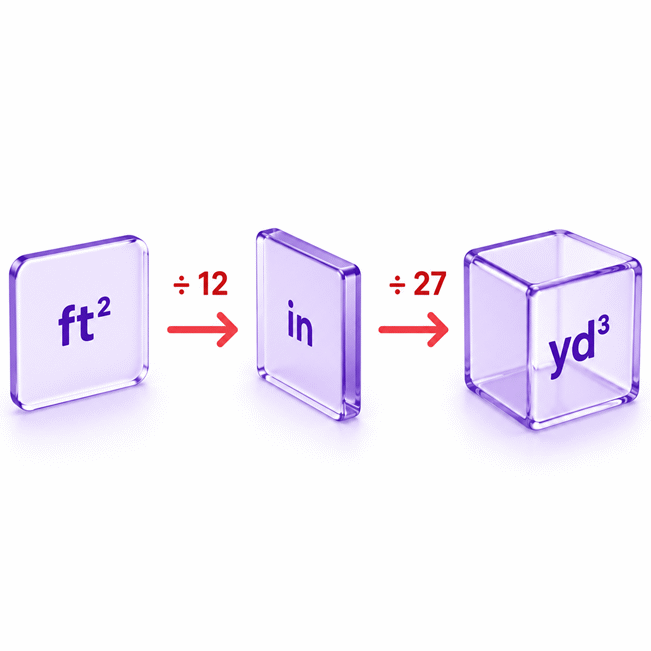
1. Convert Depth from Inches to Feet
2. Calculate Volume in Cubic Feet
3. Convert Cubic Feet to Cubic Yards
- din is the entered height or depth in inches.
- dft is the converted height or depth in feet.
- Aft² is the area in square feet.
- Vft³ is the calculated volume in cubic feet.
- Vyd³ is the final volume in cubic yards.
Variables & Definitions
View a complete list of all variables used in this calculator, including definitions and units
Square Feet to Cubic Yards Formula Variables
| Variable | Definition | Unit | Calculation Stage | Valid Value |
|---|---|---|---|---|
| din | Entered height or depth | inches | Input | Finite and greater than zero |
| dft | Height or depth converted to feet | feet | Depth conversion | Finite and greater than zero |
| Aft² | Measured surface area | square feet | Input | Finite and greater than zero |
| Vft³ | Volume before conversion to cubic yards | cubic feet | Volume calculation | Finite and greater than zero |
| Vyd³ | Final calculated volume | cubic yards | Final conversion | Finite and greater than zero |
Unit Conversion Table
Area Unit Conversion Table
| Unit Group | Unit Name | Symbol | Equivalent in Square Feet | Used For |
|---|---|---|---|---|
| Area | Square foot | ft² | 1 ft² | Primary surface-area input |
| Area | Square inch | in² | 0.00694444 ft² | Small surfaces |
| Area | Square yard | yd² | 9 ft² | Landscaping and flooring |
| Area | Square meter | m² | 10.7639104 ft² | Metric project areas |
| Area | Square kilometer | km² | 10,763,910.4167 ft² | Large geographic areas |
| Area | Square mile | mi² | 27,878,400 ft² | Large land areas |
Height and Depth Unit Conversion Table
| Unit Group | Unit Name | Symbol | Equivalent in Feet | Used For |
|---|---|---|---|---|
| Length | Foot | ft | 1 ft | Primary compatible depth |
| Length | Inch | in | 0.08333333 ft | Shallow material depths |
| Length | Yard | yd | 3 ft | Deep fills and excavations |
| Length | Millimeter | mm | 0.00328084 ft | Precise metric depths |
| Length | Centimeter | cm | 0.0328084 ft | Metric material depths |
| Length | Meter | m | 3.2808399 ft | Large metric depths |
| Compound Length | Feet and inches | ft / in | ft + in ÷ 12 | Mixed imperial measurements |
| Compound Length | Meters and centimeters | m / cm | (m × 3.2808399) + (cm × 0.0328084) | Mixed metric measurements |
Volume Unit Conversion Table
| Unit Group | Unit Name | Symbol | Equivalent in Cubic Yards | Used For |
|---|---|---|---|---|
| Volume | Cubic yard | yd³ | 1 yd³ | Primary material-volume result |
| Volume | Cubic foot | ft³ | 0.03703704 yd³ | Intermediate volume calculation |
| Volume | Cubic inch | in³ | 0.0000214335 yd³ | Small volume measurements |
| Volume | Cubic meter | m³ | 1.30795062 yd³ | Metric material volumes |
Example Calculation
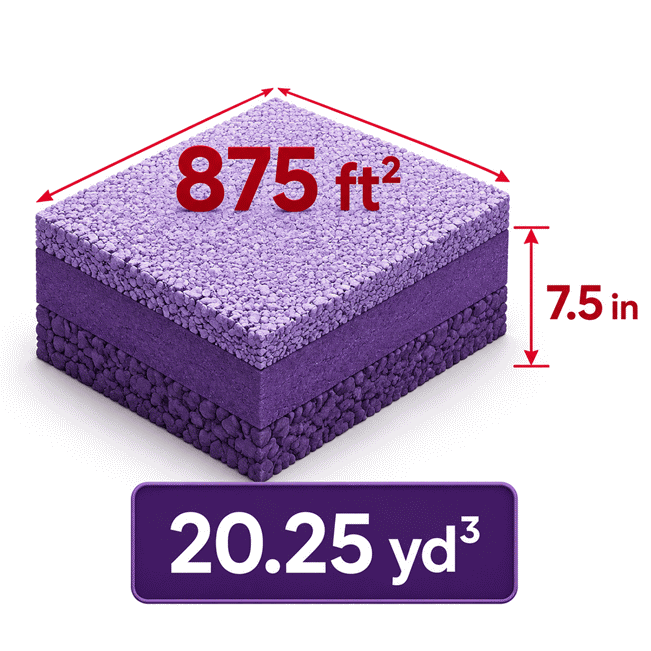
875 ft²
7.5 in
dft = 7.5 in 12 = 0.625 ft
Vft³ = 875 ft² × 0.625 ft = 546.875 ft³
Vyd³ = 546.875 ft³ 27 = 20.2546296 yd³
A surface measuring 875 square feet at an average depth of 7.5 inches contains approximately 20.25 cubic yards. The depth is converted to feet before multiplying it by the area. The resulting cubic feet are divided by 27 to obtain cubic yards. Purchasing requirements may justify rounding upward for waste, settling, or supplier increments.
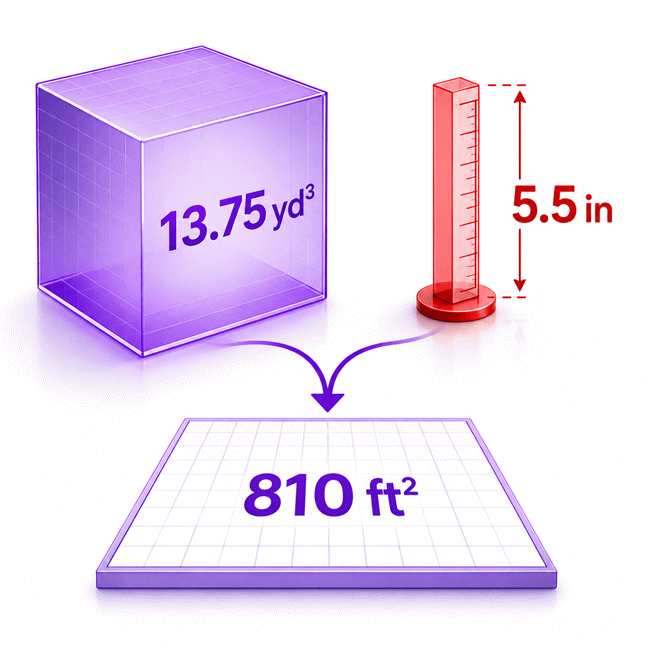
13.75 yd³
5.5 in
Vft³ = 13.75 yd³ × 27 = 371.25 ft³
dft = 5.5 in 12 = 0.458333 ft
Aft² = 371.25 ft³ 0.458333 ft = 810 ft²
A volume of 13.75 cubic yards spread at a uniform depth of 5.5 inches covers 810 square feet. The known volume is converted to cubic feet and the depth is converted to feet. Dividing compatible volume by depth produces the required surface area. Actual coverage may vary because of compaction, settling, waste, and uneven application.
Results are rounded for display.
Internal calculations use full precision.
Calculations Disclaimer
Turn a Flat Area Into a Reliable Material Estimate
A material order can fail before the truck even leaves the supplier. The Square Feet to Cubic Yards Calculator prevents that costly mistake. It connects a measured surface with the depth of material required. The Square Feet to Cubic Yards Calculator then reports the volume needed for planning. This process works for soil, mulch, gravel, sand, concrete, and similar bulk materials. The result gives you a practical starting point before requesting prices or arranging delivery.
Square feet describe a flat surface. Cubic yards describe the space occupied by material. These measurements cannot replace each other without another dimension. That missing dimension is height or depth. A shallow layer covers more ground than a deep layer. This fact explains why one volume can produce several different coverage areas.
Why Depth Controls the Final Material Quantity
Imagine two garden beds with the same surface area. One needs a thin decorative layer. The other needs a deep structural base. Their areas match, but their material requirements differ greatly. Depth creates that difference. Even a small depth change can affect delivery size, project cost, and labor.
Measure depth at several locations when the ground is uneven. Avoid using the deepest point as the average. That choice can inflate the order. Avoid using only the shallowest point too. That choice can create a shortage. A balanced measurement provides a more useful planning value.
Think in Three Dimensions Before Ordering
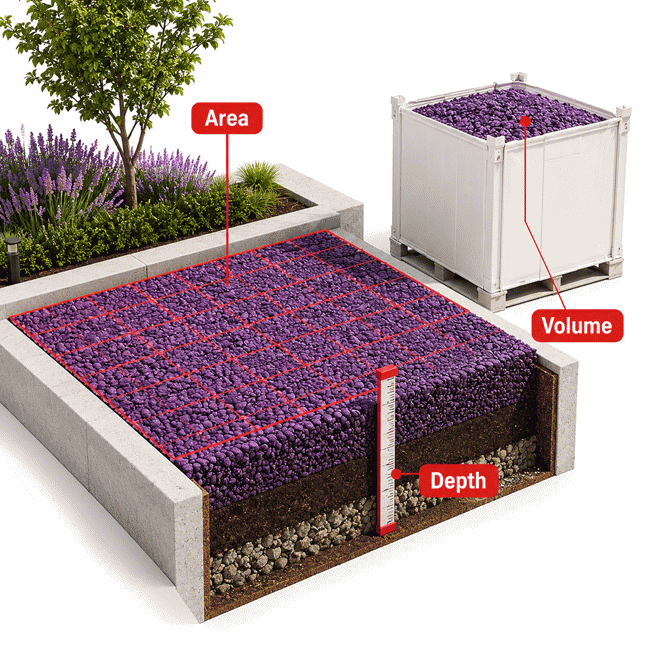
Surface area shows where the material will go.
Depth shows how thick the installed layer will be.
Volume shows how much material fills that space.
This three-part view makes the result easier to understand. It also reveals impossible estimates quickly. A large surface with meaningful depth rarely needs a tiny order. A small bed rarely needs a full truckload. If the result feels wrong, stop and review the measurements.
Use the calculated volume as the base requirement. Keep project adjustments separate from the geometric result. This distinction makes supplier comparisons easier. It also prevents hidden additions from being counted twice.
Measure the Project Before the Project Measures Your Budget
A rushed measurement often creates a second delivery charge. Begin by defining the exact surface receiving material. Include only areas that will actually be covered. Remove patios, drains, planters, steps, utility covers, and permanent obstacles. This simple step can prevent unnecessary purchasing.
Measure Regular Areas With a Clear Boundary
Rectangular spaces are usually the easiest to measure. Record the full length and width at right angles. Do not rely on a fence line appearing straight. Older yards and driveways may narrow across their length. Measure both ends when the shape looks uncertain.
For a square area, confirm that the sides truly match. A space that looks square may be slightly rectangular. Small differences may matter across a large project. Use the measured surface area when it is already available from reliable plans.
Divide Irregular Areas Into Smaller Sections
Curved beds and unusual yards can feel difficult. The fastest solution is controlled simplification. Divide the space into smaller rectangles, triangles, or circular sections. Measure each section separately. Combine their areas before applying the planned depth.
Do not count overlapping sections twice. Mark each zone on a sketch while measuring. Give every zone a simple label. This approach reduces forgotten corners and duplicated areas. It also creates a record for later checking.
Text Infographic: A Clean Measurement Workflow
Define the covered boundary → Divide complex areas → Measure every section
Remove excluded spaces → Combine the usable area → Check average depth
Measure Depth Where the Material Will Finish
Depth should describe the finished layer required by the project. Measure from the prepared base to the planned top surface. Do not measure from loose debris or existing vegetation. Remove temporary material before checking the grade.
For uneven ground, place several measurement points across the area. Include high spots, low spots, edges, and the center. Use a representative average rather than a convenient number. Record the range as well. A wide range signals that grading work may be needed.
Pause here: one wrong depth unit can multiply the order dramatically.
Keep the measurement system clear during the survey. Write each unit beside every recorded value. Never assume you will remember it later. A number without a unit can become an expensive mistake.
Use the Result for Real Material Planning
A correct volume does not automatically create a correct purchase order. Bulk materials behave differently during transport and placement. Some settle. Some compact. Some spill along edges. Others arrive with moisture that changes weight but not measured volume.
Plan Mulch and Decorative Ground Cover
Mulch projects often fail because the installed layer becomes uneven. Thin areas expose soil and weeds. Thick piles near plants may hold too much moisture. Use a consistent target depth across the measured area. Keep material away from trunks and delicate stems.
Loose mulch may settle after rain and foot traffic. The amount of settling depends on particle size and condition. Fine mulch usually behaves differently from large bark pieces. Treat any extra quantity as a project adjustment. Do not hide it inside the measured area.
Plan Gravel, Stone, and Base Materials
Gravel projects need closer attention to the prepared base. A soft subgrade can consume material unexpectedly. Low spots may also increase the installed volume. Correct major grade problems before estimating the final layer.
Compacted bases may require more loose material than the finished space suggests. The difference depends on material grading, moisture, placement, and equipment. Ask the supplier about typical delivered behavior. For load-bearing work, follow the project specification.
Plan Soil, Sand, and Fill
Soil volume can change through handling, moisture, and settlement. Freshly placed soil may look higher than its final level. Sand can move into voids within the base. Fill material may need placement in controlled layers.
Separate geometric volume from expected field behavior. This makes your estimate easier to review. It also helps the supplier understand your needs. Describe the material, finished depth, surface condition, and access limits.
Plan Concrete With Greater Caution
A concrete shortage can interrupt a pour at the worst moment. Forms may vary from their planned dimensions. The subgrade can contain low areas. Spillage and pump conditions may affect the delivered requirement.
Measure the actual forms after installation. Check thickness at several points. Confirm that blockouts and embedded features are handled correctly. Structural work should follow approved drawings and project requirements. A general volume estimate does not replace engineering review.
Text Infographic: From Estimate to Purchase
Measured space → Base volume → Material behavior → Delivery increment
Supplier review → Final quantity → Delivery plan → On-site verification
Look twice before buying: material volume and material weight are different.
A cubic yard describes volume, not weight. Two materials can fill equal spaces while weighing very different amounts. Vehicle payload limits must be checked separately. This is critical when collecting material with a pickup or trailer.
Avoid the Errors That Create Shortages and Waste
Most incorrect estimates come from simple input problems. The mathematics is rarely the hardest part. Measurement quality, unit selection, and project boundaries cause more trouble. A short review can prevent a costly correction.
Do Not Treat Area as Volume
Square feet cannot reveal cubic yards by themselves. Area has no thickness. Any result produced without depth depends on an unstated assumption. That assumption may not match the project. Always provide the required third dimension.
Do Not Confuse Square Yards With Cubic Yards
These terms sound similar but describe different quantities. Square yards measure a flat area. Cubic yards measure three-dimensional volume. Choosing the wrong unit can make an estimate appear reasonable while remaining incorrect.
Do Not Enter Inches as Feet
This mistake can create an extreme overestimate. A depth written as inches must remain identified as inches. Select the matching unit in the calculator. Never change only the number while leaving the wrong unit selected.
Do Not Measure Only the Best-Looking Section
A smooth corner may not represent the whole site. Measure across the complete work area. Include slopes and visible depressions. Check locations near edges, drains, and transitions. These areas often differ from the center.
Do Not Add the Same Allowance Twice
Some users increase the depth and add another percentage later. This can duplicate the same protection. Keep the measured requirement separate. Apply one clear adjustment after reviewing actual project risks.
Do Not Round Too Early
Early rounding can distort several combined sections. Keep accurate measurements during the full process. Make purchasing decisions only after all zones are combined. Then match the final quantity to supplier increments.
Do Not Ignore Access and Delivery Limits
The correct amount may still arrive in the wrong way. Check gate width, overhead clearance, surface strength, and unloading space. Confirm whether the truck can reach the site safely. Restricted access may require smaller deliveries or more labor.
Final check: verify area, depth, selected units, material, and delivery method.
A Five-Point Preorder Check
- Confirm that every measured section is included once.
- Confirm that excluded surfaces have been removed.
- Confirm that depth represents the planned finished layer.
- Confirm that each number uses the correct selected unit.
- Confirm that the supplier can deliver the chosen quantity.
This review takes little time. It protects the budget, schedule, and work crew. It also gives you a clearer conversation with the supplier.
Move From Calculator Result to a Confident Purchase
A calculator result becomes valuable when it improves the buying decision. Do not ask suppliers for price alone. Request the total delivered cost for the same material specification and volume. Otherwise, two quotes may describe different offers.
Compare Supplier Quotes on Equal Terms
Confirm the material name, grade, particle size, and intended use. Ask whether the quoted quantity is measured by volume or weight. Check minimum order rules and delivery charges. Confirm taxes and unloading conditions.
Some suppliers sell partial cubic yards. Others use fixed increments. A cheaper unit price may lose value after delivery costs. A nearby supplier may offer a better total price. Compare the complete transaction, not one number.
Prepare Useful Information Before Calling
Have the measured area and planned depth ready. Share the calculated cubic-yard requirement. Explain the site condition and material use. Mention narrow access, slopes, soft ground, and delivery restrictions.
Ask whether the supplier recommends a project-specific adjustment. Request the reason behind that recommendation. A clear explanation is more useful than a generic percentage. Record the final quantity and delivery terms.
Separate Technical Review From the Buying Decision
The technical review answers one question: how much space must be filled? The buying review answers another: how should that material be supplied? Keeping these decisions separate improves clarity.
The technical layer covers geometry, depth, site variation, and finished conditions. The buying layer covers price, delivery, increments, payload, and scheduling. Combining them too early can hide errors.
Who Benefits Most From This Planning Method?
Homeowners can estimate garden beds, paths, and small landscaping work. Contractors can check takeoffs before requesting supplier quotes. Landscapers can plan material across several zones. Property managers can compare maintenance proposals more clearly.
The method also supports early budgeting. It helps users test how depth changes the required volume. That insight can reveal whether a plan is practical before purchasing begins.
Use AxiCalculator as a Decision Checkpoint
AxiCalculator turns measured area and depth into a clear volume estimate. It also supports reverse solving when the available volume is already known. This helps you test coverage before accepting a delivery quantity.
Use the result to prepare better supplier questions. Save the measurements with the project notes. Recheck the site before placing a large order. Conditions can change after grading, excavation, or form installation.
A good estimate should reduce uncertainty, not hide it. Measure carefully. Keep units clear. Separate field adjustments from geometry. Compare complete delivered costs. Those habits create a smoother project and a more confident purchase.
Frequently Asked Questions
Should I order exactly the cubic-yard volume shown by the calculator?
How should I calculate material for an irregular or sloped area?
Why can mixing feet, inches, and decimal feet produce incorrect results?
Why might the calculated volume differ from a supplier’s estimate?
How should an engineer apply compaction, shrinkage, or swell factors?
How can surveyed elevations be converted into cut-and-fill cubic yards?
What precision and rounding method should support an auditable calculation?
Our engineers are here to help you get it right.