Gravel Calculator
- Last formula update:
Decimal & Rounding Policy
- Keep full calculation precision internally and round only the displayed result.
- Show practical gravel estimates with only the decimal places needed for clear reading.
- Area, volume, weight, and cost results should avoid unnecessary trailing zeros.
- Reverse-calculated dimensions may show additional decimal places when needed for accuracy.
- Do not round intermediate values before calculating volume, weight, density, or total cost.
- Unit conversions should preserve the original physical quantity before display rounding is applied.
- For purchasing decisions, treat rounded gravel quantities as estimates and allow for practical material variation.
Valid range
- Length: Enter any finite value greater than 0 in a supported length unit.
- Width: Enter any finite value greater than 0 in a supported length unit.
- Area: Enter any finite value greater than 0, or calculate it from length multiplied by width.
- Depth: Enter any finite value greater than 0 to represent the gravel layer thickness.
- Volume: Use any finite value greater than 0; volume is calculated as area multiplied by depth.
- Weight: Use any finite value greater than 0; weight is calculated as volume multiplied by gravel density.
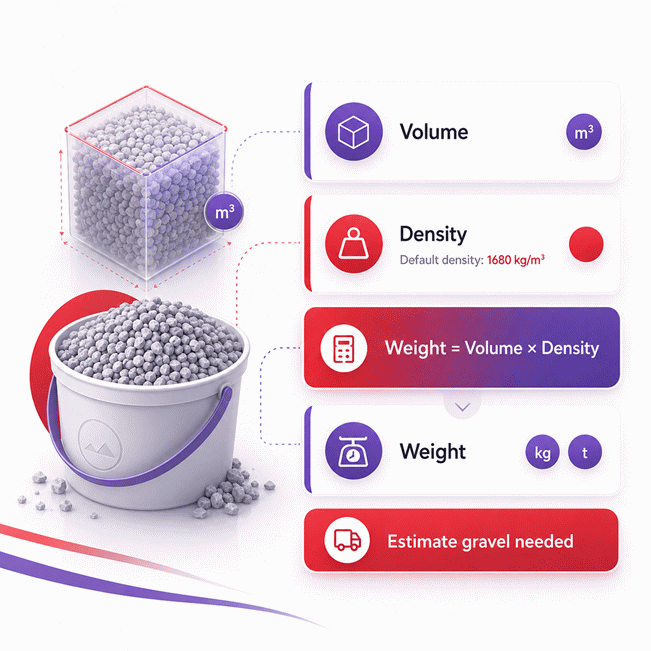
- Density: Use a finite value greater than 0; the standard calculation starts from 1680 kg/m3 unless another gravel density is selected.
- Price per unit of mass: Use any finite value of 0 or greater in the selected mass pricing unit.
- Price per unit of volume: Use any finite value of 0 or greater in the selected volume pricing unit.
- Total cost: Must be a finite value of 0 or greater and is calculated from gravel quantity multiplied by the applicable unit price.

Reviewers:
Elvarine Jexmont
Fenrick Zorquell
Check our editorial policy
August 17, 2026
1.0.0
Initial calculator and formula release.
Our engineers are here to help you get it right.
How Does the Gravel Calculator Help Me Estimate the Right Amount?
Gravel Calculator results help you estimate the area, volume, weight, depth, and material cost needed for a project. Enter the measurements you already know, and the calculator can solve connected values automatically.
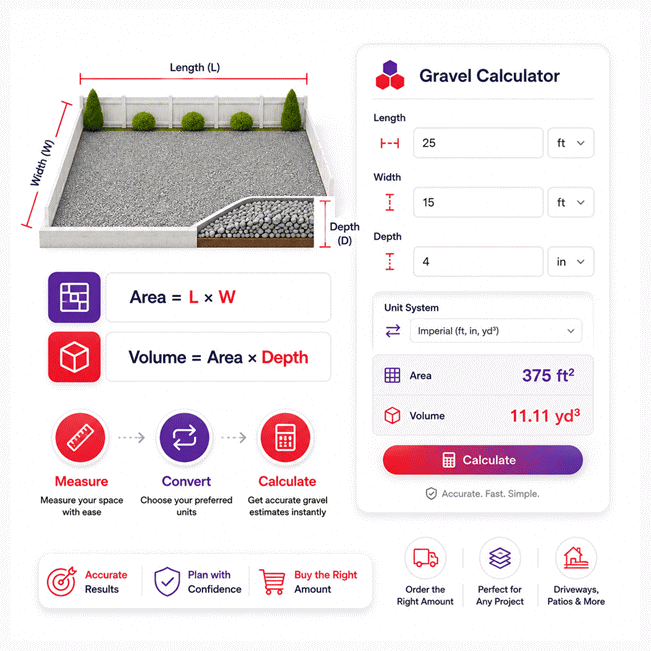
- Measure the actual project area using length and width, or enter area directly.
- Use the planned gravel depth to determine the required material volume.
- Convert volume into weight using the selected gravel bulk density.
- Use material-specific density when reliable supplier data is available.
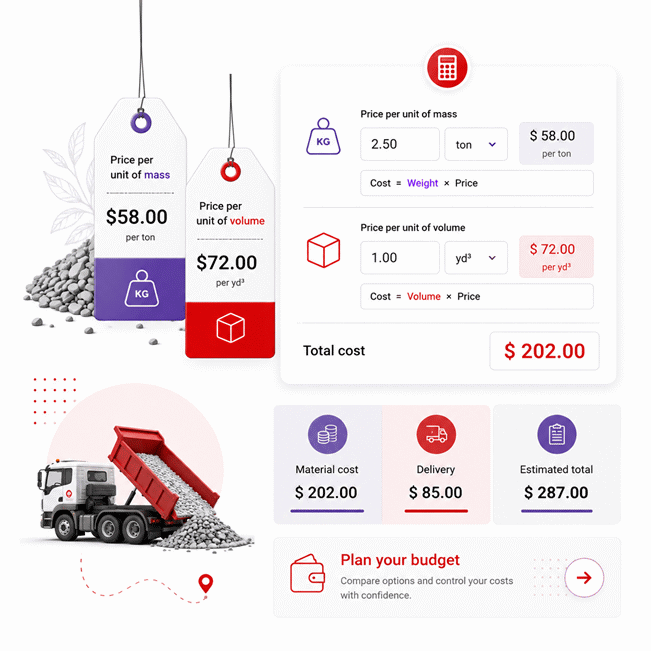
- Compare weight-based and volume-based pricing before placing an order.
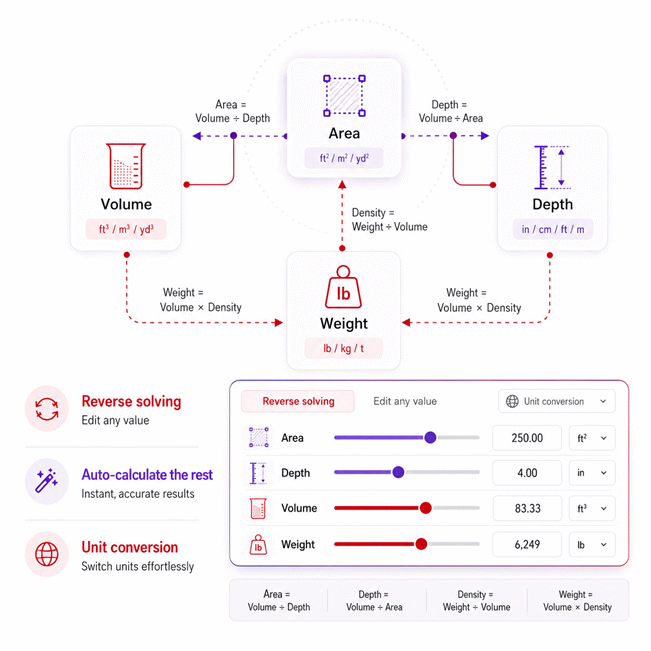
- Use reverse solving when area, volume, weight, depth, or density is already known.
- Divide irregular projects into smaller measurable sections for a better estimate.
- Consider moisture, grading, settlement, compaction, and site conditions before purchasing.
- Check delivery access, selling units, minimum quantities, and supplier terms before ordering.
The Gravel Calculator is especially useful when project conditions change. You can work forward from site dimensions or backward from available gravel. This makes it easier to compare options, control material costs, and prepare a clear quantity estimate before contacting a supplier.
Assumptions used in this calculator
- Measurements are assumed accurate and representative of the actual installation area.
- Rectangular area calculations assume length and width are measured perpendicular to each other.
- Entered area may represent non-rectangular layouts measured independently before calculation.
- Gravel depth is assumed uniform across the entire calculated area.
- Required gravel volume is assumed equal to the filled excavation volume.
- Weight estimates depend on the gravel bulk density selected or entered.
- Default density is 1680 kg/m3 unless another valid density is used.
- Actual density may vary with aggregate type, grading, moisture, and compaction.
- Unit conversions preserve physical quantities before final displayed rounding is applied.
- Intermediate calculations retain full precision to reduce cumulative rounding error.
- Cost estimates assume entered prices match the selected mass or volume units.
- Material loss, settlement, and site irregularities are not automatically added.
- Industrial users should verify specifications, density, quantities, and load limits independently.
Results are rounded for display.
Internal calculations use full precision.
Formulas Used in Gravel Calculator :
1. Excavation Area
2. Gravel Volume
3. Gravel Weight
4. Total Gravel Cost
- l = excavation length
- w = excavation width
- A = excavation area
- d = gravel depth
- V = gravel volume required
- ρ = gravel bulk density
- W = gravel weight required
- pm = price per unit of mass
- pv = price per unit of volume
- C = total gravel cost
Variables & Definitions
View a complete list of all variables used in this calculator, including definitions and units
Gravel Calculator Variables and Measurement Guide
| Symbol | Variable | Description | SI Unit |
|---|---|---|---|
| l | Length | Length of the rectangular area to be filled with gravel. | m |
| w | Width | Width of the rectangular area to be filled with gravel. | m |
| A | Area | Surface area covered by gravel, entered directly or calculated from length and width. | m2 |
| d | Depth | Thickness of the gravel layer placed over the specified area. | m |
| V | Volume | Total volume of gravel required to fill the area to the selected depth. | m3 |
| ρ | Gravel Density | Bulk density used to convert the required gravel volume into gravel weight. | kg/m3 |
| W | Gravel Weight | Estimated weight of gravel required for the calculated volume. | kg |
| pm | Price per Unit of Mass | Gravel purchase price expressed per selected unit of mass. | currency/kg |
| pv | Price per Unit of Volume | Gravel purchase price expressed per selected unit of volume. | currency/m3 |
| C | Total Cost | Estimated gravel cost based on the required quantity and the applicable unit price. | currency |
Unit Conversion Table
Length Unit Conversion Table
| Unit Group | Unit Name | Symbol | Equivalent in Meters | Used For |
|---|---|---|---|---|
| Length | Meter | m | 1 m | Length, width, and depth |
| Length | Centimeter | cm | 0.01 m | Length, width, and depth |
| Length | Millimeter | mm | 0.001 m | Length, width, and depth |
| Length | Foot | ft | 0.3048 m | Length, width, and depth |
| Length | Inch | in | 0.0254 m | Length, width, and depth |
| Length | Yard | yd | 0.9144 m | Length, width, and depth |
Area Unit Conversion Table
| Unit Group | Unit Name | Symbol | Equivalent in Square Meters | Used For |
|---|---|---|---|---|
| Area | Square Meter | m2 | 1 m2 | Gravel coverage area |
| Area | Square Centimeter | cm2 | 0.0001 m2 | Gravel coverage area |
| Area | Square Millimeter | mm2 | 0.000001 m2 | Gravel coverage area |
| Area | Square Foot | ft2 | 0.09290304 m2 | Gravel coverage area |
| Area | Square Yard | yd2 | 0.83612736 m2 | Gravel coverage area |
Volume Unit Conversion Table
| Unit Group | Unit Name | Symbol | Equivalent in Cubic Meters | Used For |
|---|---|---|---|---|
| Volume | Cubic Meter | m3 | 1 m3 | Required gravel volume |
| Volume | Liter | L | 0.001 m3 | Required gravel volume |
| Volume | Cubic Centimeter | cm3 | 0.000001 m3 | Required gravel volume |
| Volume | Cubic Foot | ft3 | 0.028316846592 m3 | Required gravel volume |
| Volume | Cubic Yard | yd3 | 0.764554857984 m3 | Required gravel volume |
Mass Unit Conversion Table
| Unit Group | Unit Name | Symbol | Equivalent in Kilograms | Used For |
|---|---|---|---|---|
| Mass | Kilogram | kg | 1 kg | Required gravel weight |
| Mass | Metric Tonne | t | 1000 kg | Required gravel weight |
| Mass | Gram | g | 0.001 kg | Required gravel weight |
| Mass | Pound | lb | 0.45359237 kg | Required gravel weight |
| Mass | US Short Ton | US ton | 907.18474 kg | Required gravel weight |
| Mass | Long Ton | long ton | 1016.0469088 kg | Required gravel weight |
Gravel Density Unit Conversion Table
| Unit Group | Unit Name | Symbol | Equivalent in kg/m3 | Used For |
|---|---|---|---|---|
| Density | Kilogram per Cubic Meter | kg/m3 | 1 kg/m3 | Gravel bulk density |
| Density | Metric Tonne per Cubic Meter | t/m3 | 1000 kg/m3 | Gravel bulk density |
| Density | Gram per Cubic Centimeter | g/cm3 | 1000 kg/m3 | Gravel bulk density |
| Density | Pound per Cubic Foot | lb/ft3 | 16.018463374 kg/m3 | Gravel bulk density |
| Density | Pound per Cubic Yard | lb/yd3 | 0.5932764213 kg/m3 | Gravel bulk density |
Price per Unit of Mass Conversion Table
| Unit Group | Unit Name | Symbol | Equivalent in USD/kg | Used For |
|---|---|---|---|---|
| Price per Mass | US Dollar per Kilogram | USD/kg | 1 USD/kg | Mass-based gravel pricing |
| Price per Mass | US Dollar per Metric Tonne | USD/t | 0.001 USD/kg | Mass-based gravel pricing |
| Price per Mass | US Dollar per Pound | USD/lb | 2.20462262185 USD/kg | Mass-based gravel pricing |
| Price per Mass | US Dollar per US Short Ton | USD/US ton | 0.001102311311 USD/kg | Mass-based gravel pricing |
| Price per Mass | US Dollar per Gram | USD/g | 1000 USD/kg | Mass-based gravel pricing |
Price per Unit of Volume Conversion Table
| Unit Group | Unit Name | Symbol | Equivalent in USD/m3 | Used For |
|---|---|---|---|---|
| Price per Volume | US Dollar per Cubic Meter | USD/m3 | 1 USD/m3 | Volume-based gravel pricing |
| Price per Volume | US Dollar per Cubic Yard | USD/yd3 | 1.30795061931 USD/m3 | Volume-based gravel pricing |
| Price per Volume | US Dollar per Cubic Foot | USD/ft3 | 35.3146667215 USD/m3 | Volume-based gravel pricing |
| Price per Volume | US Dollar per Liter | USD/L | 1000 USD/m3 | Volume-based gravel pricing |
| Price per Volume | US Dollar per Cubic Centimeter | USD/cm3 | 1000000 USD/m3 | Volume-based gravel pricing |
Example Calculation
The rectangular surface covers 27.36 square meters before gravel depth is applied.
A 12 cm layer requires approximately 3.2832 cubic meters of gravel.
Using a bulk density of 1680 kg/m3 gives an estimated mass of about 5.516 tonnes.
At 42 USD per tonne, the estimated gravel material cost is 231.66 USD.
The available gravel weight is converted back into volume using the selected bulk density.
That volume is then divided by the known area to determine the achievable gravel depth.
This reverse-solving approach is useful when material quantity is fixed before installation begins.
The same logic can also solve pricing values when total cost and gravel quantity are known.
Results are rounded for display.
Internal calculations use full precision.
Calculations Disclaimer
How Much Gravel Do I Need for My Project?
Ordering gravel seems simple until the first delivery arrives short. The Gravel Calculator helps prevent that problem before money changes hands. A Gravel Calculator should answer more than one basic quantity question. It should connect site size, material depth, gravel type, weight, and cost. That gives you a usable purchasing estimate, not just a number.
The first goal is to understand the space you must fill. The second goal is material quantity. The third goal is ordering the correct gravel. These steps sound similar, but they solve different problems. Mixing them can create costly errors.
A driveway may need several layers. A decorative path may need only one layer. Drainage work may require an open aggregate structure. Landscaping may favor appearance over compaction. Your calculation should therefore follow the real project.
AxiCalculator is designed to keep these decisions connected. You can work from known site measurements. You can also work backward from known material quantities. That flexibility is useful when a supplier gives weight first.
Before ordering, ask one question: what quantity is actually fixed in your project?
What Measurements Do You Need Before Calculating Gravel?
A common problem starts with measuring only the longest side. That is not enough for most projects. You need the surface dimensions and intended gravel depth. Irregular spaces need several smaller measurements.
Measure the usable area, not the surrounding property. Borders, walls, drains, and large fixed objects can change the required space. Measure from the actual finished edges whenever possible.
Depth deserves special attention. Small depth changes can create large quantity changes across wide areas. This becomes important on driveways, parking spaces, and long paths.
If your site has several sections, measure them separately. This reduces guesswork. It also makes later changes easier. One section can be adjusted without rebuilding the full estimate.
Write the measurements down before opening a supplier quote. This simple step prevents accidental substitutions. It also helps when comparing different material options.
How Should You Handle Irregular or Divided Areas?
Real projects are rarely perfect rectangles. Garden borders bend. Driveways widen near garages. Paths may turn around buildings. Treating every site as one rectangle can overstate material needs.
The safest method is to divide the site into simple sections. Treat each section as its own measurable area. Then combine the section results into one project quantity.
Curved spaces can also be divided into smaller shapes. The goal is not perfect geometry. The goal is a practical estimate with controlled uncertainty.
Very uneven sites need more care. A sloped surface may have changing depth. A trench may change width along its route. In these cases, use several local sections.
This approach also improves purchasing decisions. You can see which part consumes the most material. That helps identify where design changes can reduce cost.
What Does Your Gravel Result Really Mean?
A calculated quantity can look precise while still being misunderstood. The number represents a model of your project. It does not automatically include every site condition.
Your result should be read in stages. First comes covered space. Next comes material volume. Then bulk density links that volume to weight. Finally, supplier pricing creates the budget estimate.
Each stage answers a different buying question. Volume tells you how much space must be filled. Weight helps when the supplier sells by mass. Cost connects the estimate with your chosen rate.
Site size → Gravel layer → Material volume → Bulk weight → Supplier quantity → Budget
This sequence matters because suppliers do not all sell gravel the same way. Some quotes focus on weight. Others focus on bulk volume. Bagged products use package counts.
A useful calculator should therefore support the decision path. It should not force every user into one fixed workflow.
Why Volume and Weight Must Be Treated as Different Quantities
A frequent mistake is assuming one volume always has one weight. Gravel does not work that way. Different aggregates can pack differently inside the same space.
Particle shape affects packing. Particle size distribution also changes the empty space between stones. Material composition matters too. Moisture can change delivered mass further.
This is why a volume estimate and weight estimate serve different jobs. Volume represents the physical space filled. Weight represents the material mass associated with that volume.
The distinction becomes important during delivery. Truck capacity may be controlled by weight. Your excavation capacity is controlled by volume. Both limits can matter at once.
A buyer who understands this difference can ask better supplier questions. Ask how the material is sold. Ask which bulk density applies. Ask whether the quoted quantity is loose or processed.
How Cost Logic Changes the Buying Decision
The cheapest listed price does not always produce the cheapest project. A low unit price can hide delivery charges. It can also hide a different selling basis.
Compare total delivered cost whenever possible. Include the material quantity required for your actual design. Then include delivery conditions and minimum order rules.
Mass-based pricing works best when your weight estimate is dependable. Volume-based pricing depends more directly on the required filled space. Bag pricing is easier for small jobs.
AxiCalculator can help organize these quantities before you request quotes. That makes supplier comparisons more consistent. It also reduces the chance of comparing unrelated units.
A lower unit price means little when the required delivered quantity changes.
Why Gravel Density Can Change Your Required Weight
Two equal piles can look similar yet weigh differently. Bulk density explains much of that difference. It connects a material’s occupied space with its mass.
Bulk density is not simply the density of solid rock. The pile also contains voids between particles. Those voids affect how much material fits inside a given volume.
Rounded stones may pack differently from angular material. A well-graded mixture may fill spaces more efficiently. A narrowly graded material can leave larger voids.
This matters when converting an estimated volume into a purchasing weight. A poor density assumption can shift the order noticeably. Large projects amplify that error.
The best practical approach uses material-specific information whenever available. Generic values are useful during early planning. Supplier information becomes more valuable near purchase time.
When Should You Use a Custom Gravel Density?
A default material value is useful when the exact product remains unknown. That changes once you select a specific aggregate. At that point, a custom density can improve the estimate.
Use a custom value when the supplier provides dependable bulk information. It is also useful for unusual aggregates. Recycled materials may differ from common natural stone products.
Do not select a custom value simply to match a desired answer. The value should describe the actual material. Otherwise, the calculation becomes less useful.
Industrial users should verify material data before final procurement. Large orders make small density differences financially important. Haul limits can also make weight estimates operationally important.
Keep the selected density with your saved project information. That helps explain later differences between estimates and delivered quantities.
How Moisture, Grading, and Compaction Change Real-World Results
A dry spreadsheet cannot fully describe a wet stockpile. Moisture can increase delivered mass. Fine particles can also retain more water than coarse stone.
Grading describes the mix of particle sizes. A broad grading can fill voids effectively. That changes packing behavior compared with uniform stone sizes.
Compaction creates another difference. Loose material can settle after placement. Mechanical compaction can reduce void space further. The finished layer may therefore differ from loose delivery volume.
Do not treat waste and compaction as identical ideas. Waste includes spills, trimming, and unusable material. Compaction changes the occupied volume after placement.
A reliable purchase plan separates these effects. This makes adjustments easier to explain. It also helps prevent arbitrary percentage additions.
Can You Calculate Gravel Backward from the Material You Already Have?
Sometimes the project does not begin with empty ground. You may already have gravel on site. You may know the truck weight. You may know a fixed budget.
Reverse solving helps in these situations. Instead of asking only how much gravel is needed, you can ask what the known gravel can achieve.
This is useful during site changes. A delivered load may need redistribution. A project area may become larger. Available material can then become the fixed input.
The same idea works with a known volume. You can determine what depth that volume can support across a measured area. A known weight can also guide the material volume.
This workflow makes AxiCalculator useful beyond initial estimating. It can support decisions after purchasing has already started.
Known material → Available volume → Possible coverage → Achievable depth → Revised project plan
How Can Fixed Gravel Quantity Guide the Achievable Depth?
A common site problem happens after delivery. The material quantity is fixed, but the target area changes. You now need to know the depth you can achieve.
Start with the amount of usable material. Next, establish the true coverage area. The relationship between those values determines the achievable layer thickness.
This can reveal an important choice. You may keep the full area and accept less depth. You may reduce the coverage area instead. You may also order additional material.
The right choice depends on project purpose. Decorative cover can tolerate different conditions than a load-bearing driveway. Drainage work may also have its own design requirements.
Reverse solving makes this decision visible early. That is more useful than discovering the shortage during installation.
How Are Volume, Weight, and Density Connected During Reverse Solving?
A supplier may tell you the delivered weight first. Your site plan may need volume. This creates a reverse calculation problem.
The material density provides the connection between those quantities. A more suitable density gives a more useful estimate. A poor density assumption can distort the answer.
This is why material identification matters. Do not assume every gray stone behaves the same. Product grading and composition can change bulk behavior.
Reverse solving also helps investigate unexpected deliveries. If known weight and known volume disagree with expectations, density becomes a useful diagnostic clue.
That does not prove a supplier error. Moisture and measurement conditions can also explain differences. The result should guide investigation, not create unsupported conclusions.
When Can Known Weight and Volume Help Check Material Density?
A project manager may know both delivered weight and occupied volume. Those values can help estimate the material’s effective bulk density.
This can be useful during quality checks. It can also help refine future purchasing estimates. Repeated measurements may reveal more realistic project-specific behavior.
Use consistent conditions when comparing different deliveries. Loose stockpiles should not be compared directly with heavily compacted layers. Moisture conditions should also be considered.
The value should be treated as project information. It should not be presented as a laboratory material property.
When Can Known Volume and Depth Help Recover the Required Area?
Sometimes a fixed stockpile must be spread at a chosen depth. The unanswered question becomes coverage. This occurs often during landscaping changes.
Once the usable volume is known, the planned layer depth defines possible coverage. This helps decide whether the stockpile is sufficient.
The result is especially useful before labor begins. A shortage found early is manageable. A shortage found halfway through installation creates delays.
Use the actual usable material quantity. Exclude obvious contaminated or unsuitable material from the estimate.
How Deep Should Gravel Be for Driveways, Paths, Patios, and Drainage?
Choosing gravel depth by appearance alone can create problems. Different projects place different demands on the material. Load, drainage, base condition, and stone type all matter.
A decorative garden surface does not behave like a driveway. Pedestrian paths see different loads from vehicle areas. Drainage zones have another purpose entirely.
Depth should therefore come from the project design. The calculator should estimate quantity after that decision. It should not replace structural or drainage design.
Existing ground conditions also matter. Soft soil can need different preparation. A stable base can behave differently from recently disturbed ground.
For larger work, confirm the planned section with a qualified contractor. This is especially important for load-bearing areas.
How Does Project Purpose Change the Gravel Quantity?
The same area can require very different quantities. The reason is simple. Each project uses gravel for a different job.
Driveways must handle repeated loads. Paths focus more on walking comfort and surface stability. Decorative beds may prioritize appearance and weed control.
Drainage aggregate must allow water movement. Base materials may need good compaction behavior. Surface stone may need better visual consistency.
These choices affect both depth and material type. They therefore affect the final purchasing quantity.
Decide the function before comparing prices. A cheaper stone may perform poorly in the intended role. Correct material choice can prevent expensive rework.
Why Base Preparation and Drainage Matter Before Ordering
Many gravel failures begin below the gravel itself. Poor base preparation can cause rutting, mixing, and uneven settlement.
Water also changes site behavior. Poor drainage can soften supporting soil. It can wash fine particles into unwanted areas.
Inspect the site before final ordering. Look for soft zones and standing water. Check existing slopes and drainage paths.
A stable project often depends on more than added gravel. Fabric, base layers, drainage work, or excavation may be needed.
These decisions can change the final gravel quantity. Make them before placing a large order.
The biggest gravel mistake may happen before any gravel reaches the site.
Which Gravel Type Fits Your Project Best?
Buyers often choose gravel by color first. That can work for decoration. It is less useful for structural or drainage work.
Start with the job the material must perform. Consider loading, drainage, surface movement, appearance, and maintenance.
Angular materials can interlock differently from rounded stone. Rounded gravel can create a different walking and spreading behavior. Fines can change compaction and drainage.
Ask suppliers for a clear product description. Avoid relying only on informal product names. Similar names can describe different materials between regions.
A better quote includes size range and intended use. Bulk density information is also valuable for large orders.
How Do Pea Gravel, Crushed Stone, and River Rock Differ in Practice?
Pea gravel is commonly chosen for its rounded appearance. It can suit decorative areas and some walking surfaces. Its movement under load deserves consideration.
Crushed stone usually contains more angular particles. Different gradings can serve different construction roles. Some products compact more readily than clean stone.
River rock is often selected for appearance and drainage features. Larger sizes can be harder to walk across. They may also require different installation planning.
No material is automatically best for every project. The correct choice depends on the required function.
Use the selected material when refining your calculator inputs. This keeps the quantity estimate connected to the real purchase.
How Should You Plan Gravel Cost and Ordering?
A correct quantity can still produce a poor purchase. Delivery rules and selling methods can change the final cost significantly.
Start by estimating the required material. Then ask suppliers for delivered pricing. Confirm whether the quote uses weight, volume, bags, or another unit.
Ask about minimum orders before comparing quotes. Delivery charges can dominate small purchases. Large orders may have different logistical limits.
Also confirm how quantity is verified. Some suppliers use certified scale weights. Others sell fixed bulk volumes or packaged quantities.
Keep these details beside your AxiCalculator result. This creates a cleaner purchasing record. It also makes quote comparisons easier.
Should You Buy Bulk Gravel or Bagged Gravel?
Small jobs can become awkward when bulk delivery exceeds the required amount. Large jobs can become expensive when bought entirely in bags.
Bagged gravel offers simple handling and controlled quantities. It can work well for repairs and small decorative areas.
Bulk gravel usually suits larger projects better. It reduces packaging and simplifies high-volume purchasing. Delivery access becomes more important.
Compare the full project cost. Do not compare only the displayed unit price. Include delivery, handling, waste, and storage needs.
Also consider labor. Moving hundreds of small bags can add significant work. A bulk pile creates different handling needs.
Can Delivery Access Change the Best Gravel Order?
A perfect calculation is useless if the delivery truck cannot reach the site. Access should be checked before confirming the order.
Consider road width and gate clearance. Check overhead cables and tree branches. Confirm turning space and unloading location.
Soft ground can also limit truck access. Heavy vehicles may damage lawns or weak surfaces. A safer unloading point may increase handling distance.
Ask the supplier about truck size before delivery day. Do not assume every supplier uses the same vehicle.
Good access planning reduces delays. It also lowers the risk of emergency material handling.
What Should You Check About Product Documentation, Support, and Order Terms?
A gravel order needs different checks from a packaged machine. Traditional warranty language may not always apply. Material acceptance terms matter more.
Ask what happens when the wrong material arrives. Confirm contamination policies and delivery quantity procedures. Ask how damaged access or failed delivery is handled.
For specified aggregates, request relevant product documentation. Large commercial projects may require grading or compliance information.
Keep the quote and delivery ticket. Save any material description provided with the order. These records can help resolve later questions.
Supplier support should be evaluated before purchase. Clear communication is valuable when quantities or specifications change.
Which Gravel Calculation Mistakes Cause the Most Expensive Problems?
The most damaging errors often look harmless at first. A small measurement mistake can spread across the entire project.
One common mistake is measuring the property instead of the filled area. Another is using the wrong planned depth. Irregular areas are also easy to overestimate.
Material selection creates another risk. Using a generic density after choosing a specific product can reduce estimate quality.
Compaction and waste are often mixed into one unexplained allowance. This makes later adjustments difficult. Treat them as separate project effects.
Buyers may also compare incompatible supplier quotes. A price per weight and price per volume are not directly comparable without context.
Another mistake is buying before checking delivery access. A large truck may be unable to unload where expected.
Do not chase false precision. Site conditions can vary. Use the calculator as a structured planning tool.
When the project is large, verify important inputs independently. Rechecking measurements costs little. Correcting a full truckload costs much more.
How Do You Turn a Gravel Estimate into a Supplier-Ready Plan?
A calculation becomes valuable when it supports a real decision. The final step is turning numbers into clear purchasing information.
Record the project area and intended gravel depth. Record the selected gravel type. Keep the estimated volume and weight together.
Then request supplier-specific information. Confirm the product description and selling basis. Ask about delivered price and minimum order rules.
Review delivery access before booking. Select a safe unloading point. Plan how the gravel will move from that point.
If the supplier provides better material data, update your calculation. A revised density can refine the purchasing weight.
Keep one version of the estimate for each quoted material. This avoids mixing numbers from different products.
AxiCalculator can support this workflow from either direction. Start with the site when measurements are known. Start with material quantity when stock is already available.
The goal is simple: make fewer assumptions before spending money. A clear estimate improves supplier conversations. It also helps teams coordinate installation.
Before placing the order, review the project once more. Confirm measurements, material choice, depth, delivery access, and supplier terms.
Then return to the calculator with the final information. Update the values and save the result. That final check can prevent an avoidable second delivery.
Frequently Asked Questions
What should I do if the excavation size changes after I have already calculated the gravel?
Can I combine different gravel products in one project estimate?
What should I do when my gravel supplier quotes tons but my project is measured in cubic meters?
How should I recalculate gravel when part of the project has already been completed?
Should an engineer use field-measured density or supplier bulk density for procurement calculations?
What should happen when reverse solving produces an overdetermined set of conflicting gravel values?
Why can truck-scale weight disagree with the gravel volume calculated from site measurements?
Engineering Resources
Our engineers are here to help you get it right.