Log Weight Calculator
- Last formula update:
Decimal & Rounding Policy
- Accept decimal inputs for log dimensions, board dimensions, density, volume, and weight to support accurate wood weight calculations.
- Keep full numerical precision throughout diameter averaging, volume, density, and weight calculations, and round only the displayed results.
- Use practical significant-digit rounding so calculated volume and weight remain accurate without showing unnecessary decimal places or trailing zeros.
- Perform unit conversions before the final calculation to prevent conversion rounding from affecting log volume, board volume, or total wood weight.
- For very small or very large results, preserve meaningful significant digits so the displayed value remains clear and mathematically reliable.
Valid range
- Density: Use a positive finite wood density greater than 0 in the selected density unit.
- Smaller-end diameter: Enter a positive finite diameter greater than 0 for the smaller end of the log.
- Larger-end diameter: Enter a positive finite diameter greater than 0 for the larger end of the log.
- Mid-section diameter: Use a positive finite value greater than 0, measured directly or derived from the two end diameters.
- Log length: Enter a positive finite length greater than 0 in any supported length unit.
- Board width: Enter a positive finite width greater than 0 when calculating the weight of a board.
- Board thickness: Enter a positive finite thickness greater than 0 when using Board mode.
- Board length: Enter a positive finite length greater than 0 for the board being calculated.
- Volume: Use a positive finite volume greater than 0 when entered or solved from the wood dimensions.
- Weight per piece: Use a positive finite weight greater than 0 when entered directly or calculated from density and volume.
- Quantity: Use a positive whole number of wood pieces, with a minimum practical value of 1.
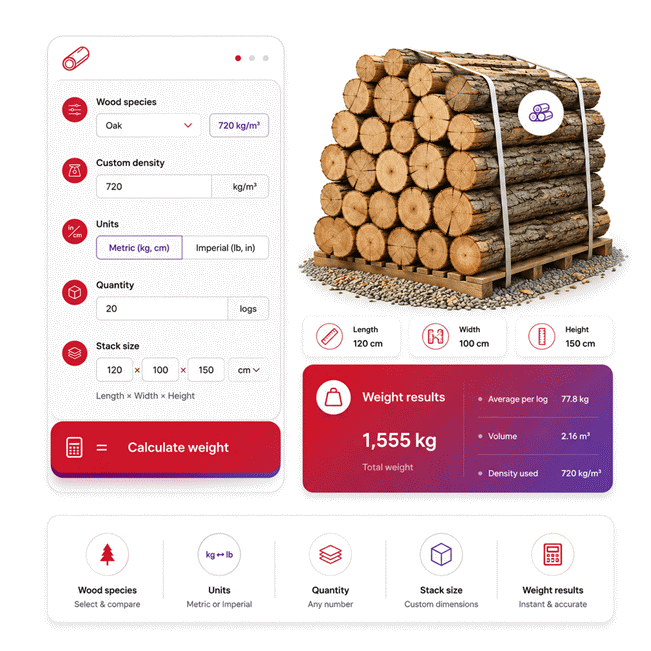
- Stack width: Enter a positive finite width greater than 0 when using Stack dimensions mode.
- Stack height: Enter a positive finite height greater than 0 when using Stack dimensions mode.
- Total weight: Use a positive finite value greater than 0 when entered directly or calculated from piece weight and quantity.

Reviewers:
Elvarine Jexmont
Fenrick Zorquell
Check our editorial policy
August 16, 2026
1.0.0
Initial calculator and formula release.
Our engineers are here to help you get it right.
How Does a Log Weight Calculator Estimate Wood Weight?
Log Weight Calculator results estimate the weight of logs or boards from wood density, dimensions, volume, and quantity. The calculation uses the log’s representative mid-section diameter and length to estimate volume, then combines that volume with green wood density. A Log Weight Calculator can also work backward when enough related values are known, helping solve missing dimensions, volume, density, or piece weight.
- Select the correct wood species or enter a reliable custom density.
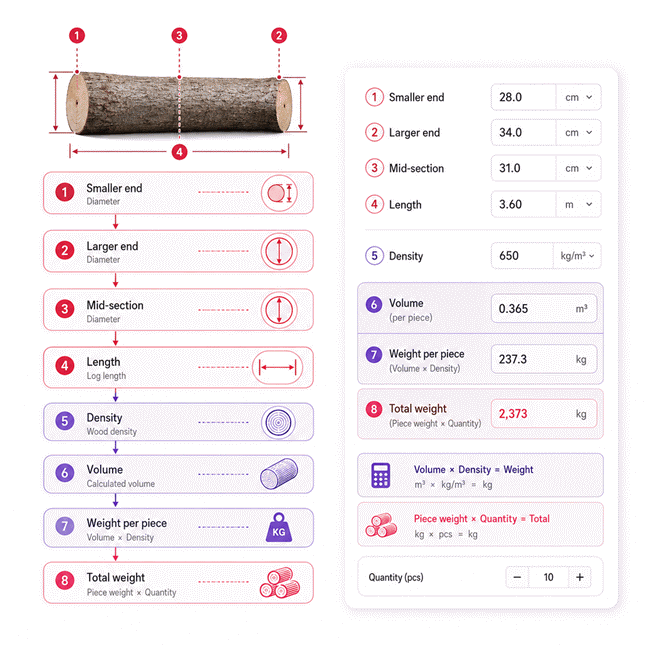
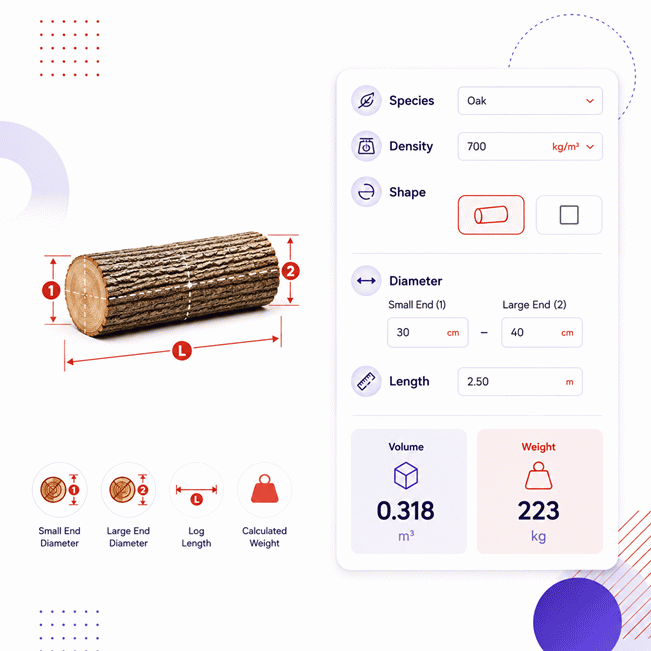
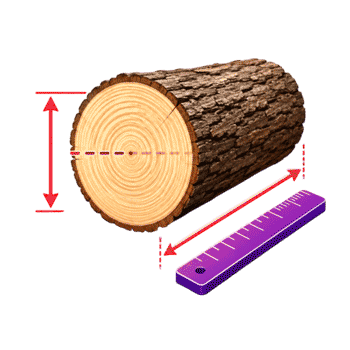
- For logs, measure the smaller end, larger end, and length carefully.
- The mid-section diameter represents the log’s central cross-section.
- Log volume is based on mid-section area multiplied by log length.
- Piece weight comes from calculated volume multiplied by wood density.
- Quantity converts one-piece weight into the estimated total load.
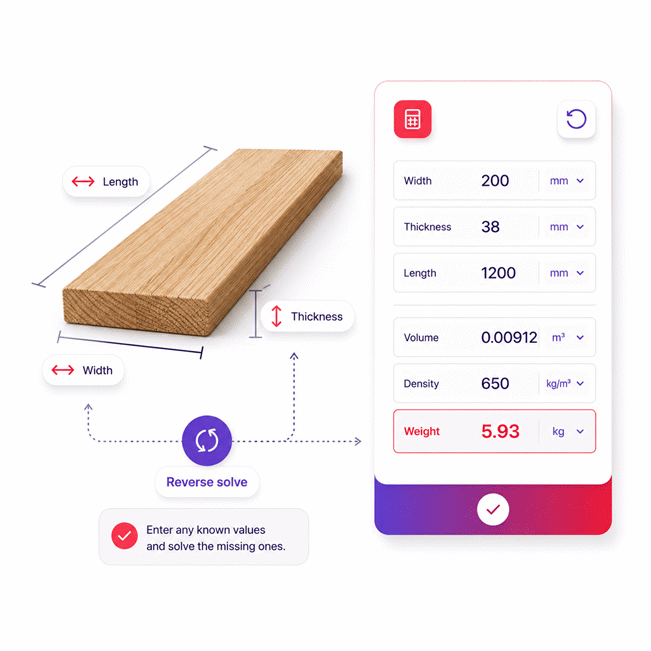
- Board mode uses length, width, and thickness instead of log diameters.
- Reverse solving can recover missing values from valid known measurements.
- Moisture, bark, taper, decay, hollows, and natural density variation affect actual weight.
- Careful diameter measurements are especially important because diameter strongly affects calculated volume.
Use the result as a practical planning estimate for timber handling, hauling, storage, cutting, and load preparation. For safety-critical lifting or transport, compare the estimate with verified equipment limits and direct weight data whenever available.
Assumptions used in this calculator
- Wood density represents typical green-wood density for the selected species.
- Actual density may vary with moisture, age, defects, and growing conditions.
- Logs are treated as circular sections with representative diameters.
- Log volume uses the mid-section diameter and measured length.
- End diameters estimate mid-section diameter using their arithmetic mean.
- Boards are treated as rectangular prisms with uniform dimensions.
- All entered dimensions are assumed accurate and measured consistently.
- Unit conversions preserve physical values before calculations are performed.
- Weight is calculated from volume multiplied by wood density.
- Quantity assumes all pieces share the same dimensions and density.
- Calculated weights exclude hardware, bark variation, coatings, and attached materials.
- Results are estimates and should not replace certified weighing for critical loads.
- Industrial lifting and transport decisions require independent safety verification.
Results are rounded for display.
Internal calculations use full precision.
Formulas Used in Log Weight Calculator :
1. Mid-Section Diameter
2. Log Volume
3. Board Volume
4. Weight per Piece
5. Total Weight
- dm = diameter at the mid-section of the log.
- ds = diameter at the smaller end of the log.
- dl = diameter at the larger end of the log.
- L = log or board length.
- V = volume of one log or board.
- w = board width.
- t = board thickness.
- ρgreen = green wood density for the selected species or custom density.
- Wp = weight of one log or board.
- Q = quantity of equal wood pieces.
- Wtotal = total weight of all wood pieces.
All dimensional values are converted to compatible units before evaluation. Full numerical precision is retained during intermediate calculations, and rounding is applied only to displayed results. Reverse calculations use these same equations algebraically and do not require separate calculation formulas.
Variables & Definitions
View a complete list of all variables used in this calculator, including definitions and units
Log Weight Calculator Variables and Parameters
| Variable | Parameter | Description | Typical Unit | Calculation Role |
|---|---|---|---|---|
| ds | Smaller-End Diameter | Diameter measured at the smaller end of a log. | cm, m, in | Log geometry input |
| dl | Larger-End Diameter | Diameter measured at the larger end of a log. | cm, m, in | Log geometry input |
| dm | Mid-Section Diameter | Diameter at the log midpoint, measured directly or derived from both end diameters. | cm, m, in | Log volume parameter |
| L | Length | Longitudinal length of one log or board. | m, cm, ft, in | Volume input |
| w | Board Width | Width of a rectangular board measured perpendicular to its length. | cm, m, in | Board volume input |
| t | Board Thickness | Thickness of a rectangular board. | cm, m, in | Board volume input |
| V | Volume | Calculated or solved volume of one log or board. | m³, ft³, cm³ | Derived geometry value |
| ρgreen | Green Wood Density | Density of the selected wood species or a user-supplied custom density. | kg/m³, lb/ft³ | Material property |
| Wp | Weight per Piece | Weight of one log or board calculated from density and volume. | kg, lb | Piece weight result |
| Q | Quantity | Number of equal wood pieces included in the total weight calculation. | pieces | Quantity multiplier |
| Wtotal | Total Weight | Combined weight of all equal logs or boards in the calculation. | kg, lb | Final result |
Unit Conversion Table
Length and Diameter Unit Conversion Table
| Unit Group | Unit Name | Symbol | Equivalent in Meters | Used For |
|---|---|---|---|---|
| Length | Millimeter | mm | 0.001 m | Diameters, board dimensions, and stack dimensions |
| Length | Centimeter | cm | 0.01 m | Diameters, board dimensions, and stack dimensions |
| Length | Meter | m | 1 m | Log length, board length, and stack dimensions |
| Length | Inch | in | 0.0254 m | Diameters and board dimensions |
| Length | Foot | ft | 0.3048 m | Log length, board length, and dimensions |
Volume Unit Conversion Table
| Unit Group | Unit Name | Symbol | Equivalent in Cubic Meters | Used For |
|---|---|---|---|---|
| Volume | Cubic Centimeter | cm³ | 0.000001 m³ | Small wood volume measurements |
| Volume | Liter | L | 0.001 m³ | Alternative wood volume measurement |
| Volume | Cubic Meter | m³ | 1 m³ | Log and board volume |
| Volume | Cubic Foot | ft³ | 0.028316846592 m³ | Log and board volume |
| Volume | Cubic Yard | yd³ | 0.764554857984 m³ | Large wood volume measurements |
Wood Density Unit Conversion Table
| Unit Group | Unit Name | Symbol | Equivalent in kg/m³ | Used For |
|---|---|---|---|---|
| Density | Kilogram per Cubic Meter | kg/m³ | 1 kg/m³ | Green wood density |
| Density | Gram per Cubic Centimeter | g/cm³ | 1000 kg/m³ | Wood density and material comparison |
| Density | Pound per Cubic Foot | lb/ft³ | 16.01846337 kg/m³ | Green wood density |
Weight Unit Conversion Table
| Unit Group | Unit Name | Symbol | Equivalent in Kilograms | Used For |
|---|---|---|---|---|
| Weight | Gram | g | 0.001 kg | Small wood piece weight |
| Weight | Kilogram | kg | 1 kg | Weight per piece and total weight |
| Weight | Pound | lb | 0.45359237 kg | Weight per piece and total weight |
| Weight | Metric Tonne | t | 1000 kg | Large total wood loads |
Example Calculation
The two end diameters first determine a representative mid-section diameter of 32 cm. That diameter and the 2.75 m log length produce a volume of approximately 0.221168 m³ per log. Multiplying the volume by the selected wood density gives approximately 191.31 kg per piece. For seven equal logs, the combined estimated weight is approximately 1,339.17 kg.
Reverse solving starts with the known total weight and quantity to recover the weight of one log. The piece weight and green wood density then determine the required log volume. Using that volume with the known log length recovers the mid-section diameter. Finally, the known smaller-end diameter and solved mid-section diameter determine the larger-end diameter.
Results are rounded for display.
Internal calculations use full precision.
Calculations Disclaimer
Log Weight Calculator: Know the Load Before You Move It
A heavy log can look manageable until lifting begins. That is where a Log Weight Calculator becomes useful. It turns a few field measurements into a practical weight estimate. The result helps with hauling, rigging, storage, cutting, and job planning. AxiCalculator keeps the process simple. You choose the wood species, enter the log dimensions, and review the calculated weight. You can also work backward from known values. That makes the tool useful when one measurement is missing.
The Log Weight Calculator is most useful before a physical move. It helps you compare load choices before equipment is committed. It can also reduce rushed decisions around trailers, forklifts, cranes, and manual handling. The estimate becomes more useful when measurements are careful. Species selection also matters. Fresh wood can carry a large amount of water. That extra water changes the final mass.
Why Wood Species Can Change the Load Plan
Two logs can share the same size and still weigh differently. The reason is simple. Different wood species have different densities. Dense hardwoods usually carry more mass within the same volume. Lighter species can produce a much lower load. This difference can become large on long logs. It can become even larger across many pieces.
The calculator links the selected species with a representative green density. This density acts as the material factor in the estimate. A custom density is also useful. It helps when your wood differs from a common preset. Custom data can come from a reliable project record. It can also come from measured material data. Better density data often improves the final estimate.
Green Wood and Seasoned Timber Are Not the Same Load
Freshly cut wood often contains substantial moisture. That moisture adds mass without changing the basic wood species. A seasoned log can therefore weigh less than a fresh log. The difference can matter during transport or lifting. It can also matter when comparing old stock with newly cut timber.
Green density is useful for planning fresh timber loads. It should not be treated as a fixed value forever. Storage time, airflow, weather, and drying conditions can change the material. A log stored outdoors can also gain surface moisture. A log stored under cover may lose water faster. The calculator gives the strongest result when density matches the actual wood condition.
Why Real Timber Never Behaves Like a Perfect Material Sample
A living tree does not grow like a factory-made cylinder. Density can vary within one trunk. Knots, reaction wood, resin, decay, and internal voids can also matter. Bark thickness adds another source of variation. These differences explain why calculated weight and measured weight may not match exactly.
The best approach is practical. Measure the real piece carefully. Choose the closest material density. Then use the result as a planning value. When the operation has little safety margin, verify the load directly. A calculation helps decisions. It should never encourage careless loading.
Measure the Log Once, but Measure the Right Places
A quick diameter measurement can save time. A poor diameter measurement can create a large error. The calculator uses the smaller end, larger end, and mid-section relationship. This captures taper better than one end alone. The log length then completes the main geometry.
Use straight measurement lines across the log. Avoid measuring around a broken corner. Remove loose debris before measuring the cut face. If bark is included, stay consistent. If bark is excluded, use that method everywhere. Mixed measurement methods can distort the result.
Smaller-End, Larger-End, and Mid-Section Diameter
The smaller-end diameter describes the narrow end of the log. The larger-end diameter describes the wider end. Together, they help estimate the middle diameter. A direct mid-section measurement can also be used. That can be helpful when both ends are irregular.
The middle section matters because it represents the log near its center. This gives the calculator a better basis for tapered timber. If the log has extreme swelling, forks, or damage, take extra care. One diameter cannot describe every unusual shape. In those cases, divide the piece into shorter sections when practical.
Why Diameter Errors Can Grow Faster Than Expected
Diameter deserves more attention than many users expect. A small diameter error can change volume noticeably. Cross-sectional area increases quickly as diameter becomes larger. Length errors affect the result in a simpler way. That makes careful diameter measurement especially valuable.
Use a tape, caliper, or reliable diameter tool. Measure across the true section. Avoid estimating by eye. A few extra seconds can improve the estimate greatly. This becomes important when many logs share the same measurement error.
Length, Taper, and Irregular Shape
Length seems simple, but field conditions can make it tricky. Bent logs can confuse a quick tape reading. Broken ends can also create uncertainty. Measure the usable log section from end to end. Keep the measurement aligned with the working length.
Taper is another important detail. A log that narrows sharply contains less wood than a uniform cylinder. Using both end diameters helps represent this change. Very irregular logs need more judgment. If the log changes shape several times, shorter segments can give better control.
How the Calculator Turns Measurements into a Weight Estimate
The calculation path is easy to understand. First, the tool identifies the wood density. Next, it evaluates the log geometry. That produces a volume estimate. The estimated volume is then linked with density. The result is the weight of one piece.
If several matching pieces are present, quantity extends the calculation. This produces the combined load. The same logic works well for planning transport or storage. It also helps compare species before work starts. Users can change one input and watch the result update. That makes the tool useful for quick scenario testing.
Volume Comes Before Weight
Weight cannot be estimated well without understanding volume. A short, thick log can outweigh a longer, narrow log. Volume captures that shape difference. The calculator uses the measured geometry to estimate how much wood is present.
Once volume is available, density gives the mass relationship. This separation is useful. It lets you see whether high weight comes from size or density. That insight can improve planning. It can also reveal an input that looks unrealistic.
Quantity Turns One Piece into a Real Load
One log may be easy to move. Ten similar logs can exceed equipment limits quickly. Quantity helps turn a piece estimate into a load estimate. This is useful for trailers, storage racks, pallets, and lifting plans.
Quantity should describe pieces with similar dimensions and density. If the pile contains mixed sizes, group them first. Calculate each group separately. Then combine the totals. That approach is clearer than using one average piece.
Reverse Solving Changes How You Can Use the Tool
Sometimes the missing value is not weight. You may know the load but not the volume. You may know the volume but not one dimension. Reverse solving makes the calculator more flexible. A known result can become an input. The tool can then solve a related missing value.
This is useful during planning and checking. It can also expose data conflicts. If a known weight produces an impossible size, review the inputs. The problem may be the density. It may also be a measurement mistake. Reverse solving turns the calculator into a checking tool, not only an estimator.
Work Backward from Weight, Volume, or Density
A measured piece weight can help estimate the missing volume. Known volume and measured weight can also reveal an effective density. This is useful for unusual timber. It is also useful when species data differs from actual material.
Reverse solving becomes strongest when related known values are reliable. Poor data cannot create a good result. Use measured values when possible. Keep the physical condition of the timber in mind. Fresh, wet, hollow, or decayed wood may behave differently.
Use Reverse Dimensions to Check Field Measurements
Known volume and length can help solve a missing middle diameter. A known middle diameter can also complete missing end data. This is useful when access is limited. It is also useful when a field note is incomplete.
The result should still pass a visual check. A solved diameter that looks impossible is a warning. Review the units, species, and measurements. Reverse solving is powerful because it shows relationships. It should never hide poor source data.
Board Mode Handles Rectangular Timber Differently
Logs are not the only timber pieces needing weight estimates. Boards and rectangular beams need a different geometry path. Board mode uses length, width, and thickness. Those dimensions describe a rectangular piece directly. The calculator can then estimate its volume and piece weight.
This mode is useful for lumber stacks, beams, slabs, and cut stock. It also supports reverse solving. Known volume can help recover one missing dimension. This makes the same calculator useful across more workshop and site tasks.
When Board Mode Is Better Than Log Mode
Use Board mode after timber has been cut into rectangular stock. Do not force a rectangular board into a round-log model. That can distort the estimated volume. The correct shape model gives a cleaner result.
Board mode also helps purchasing and handling decisions. A stack of dense hardwood boards can become heavy quickly. Knowing piece weight helps with shelf capacity and manual handling. It also helps compare delivery loads before unloading begins.
Common Log Weight Calculation Mistakes
Most bad estimates start with simple input problems. Wrong species selection is common. Mixed measurement systems can create another source of error. Users may also measure only one end of a tapered log. Each mistake can move the result away from reality.
Another common problem is false confidence. A detailed number may look exact. The timber itself may not be exact. Moisture, bark, decay, and internal voids can change real mass. Good measurement matters more than cosmetic numerical detail.
Do Not Treat Every Log as a Perfect Cylinder
A uniform cylinder is easy to imagine. Real logs often taper. Some also swell near the base. Others have knots or damaged ends. A model that ignores taper can misrepresent the amount of wood.
Use the available diameter fields carefully. Measure both ends when possible. Use the middle section when it can be reached safely. For unusual shapes, split the log into practical sections. This gives more control over the estimate.
Do Not Ignore Moisture, Bark, or Internal Damage
Fresh timber can be much heavier than seasoned material. Thick bark can add mass. Hollow centers can reduce mass. Decay can change both density and structure. These details matter when safety margins are small.
Inspect the log before trusting any calculated value. Look for cavities, splits, heavy saturation, and damaged sections. If the load looks unusual, investigate before movement. Direct weighing gives stronger evidence for critical operations.
Real-World Use for Arborists, Sawmills, and Transport Crews
A weight estimate becomes valuable when it supports a real decision. Arborists may need it before rigging a stem section. Sawmills may use it during yard planning. Transport crews may use it before loading a trailer. Workshop teams may use Board mode before moving dense stock.
The same calculator supports each task because the core problem is similar. You need a reasonable mass estimate before movement. AxiCalculator makes that estimate easier to review. The tool also lets users test alternative dimensions and quantities quickly.
Lifting and Rigging Need More Than a Single Number
A log weight estimate can help prepare a lifting plan. It cannot describe the whole lifting system. Rigging hardware, sling geometry, movement, and equipment capacity also matter. The complete load path must make sense before lifting begins.
Use the calculated timber mass as one planning input. Compare it with certified equipment data. Leave room for uncertainty. When conditions change, recalculate before continuing. A few seconds of checking can prevent an expensive decision.
Trailer and Truck Loading Can Change Faster Than Expected
One extra log may seem harmless. Dense green timber can add substantial mass. The risk grows when many pieces are similar. Quantity makes this easier to see. It also helps compare several loading plans.
Group logs by size and species when possible. Calculate each group separately. Keep vehicle limits outside the timber estimate. Include other cargo and equipment in the final transport decision. Never use the wood estimate as the only load-control method.
Choose Better Inputs Before You Trust the Result
The calculator can only work with the data it receives. Better inputs create better estimates. Start with the correct shape. Then select the closest wood species. Use custom density when reliable project data is available. Measure the actual piece, not a nearby example.
Check the result against what you see. A tiny log should not produce a huge load. Massive green hardwood should not appear unusually light. Common sense is part of good calculation practice. When the result feels wrong, investigate before using it.
When Custom Density Can Improve the Estimate
Species presets are convenient. They represent typical material behavior. Real project timber can differ. Custom density can improve the estimate when measured data is available. This is useful for unusual species, stored timber, or known material batches.
Do not guess a custom density just to change the answer. Use a value you can defend. A measured sample can be useful. A project-specific material record can also help. Better density data creates a stronger planning result.
Turn the Estimate into a Better Decision
The best result is not the largest number on the screen. It is the decision that follows. A good Log Weight Calculator helps expose risk before work begins. It gives a fast estimate for one piece or many pieces. It also supports reverse solving when information is incomplete.
Use AxiCalculator when planning timber movement, cutting, hauling, or storage. Enter careful measurements. Choose realistic material data. Review the result before equipment is committed. Then compare that estimate with the real limits of your job.
This workflow saves time because it reduces blind guessing. It also makes planning easier to explain. A crew can review the same dimensions and load estimate. A buyer can compare timber options. A sawmill can plan handling before delivery. The calculator becomes most useful when it supports a clear next action.
Frequently Asked Questions
What should I do if I do not know the exact wood species?
How should I calculate a load containing logs of different sizes and species?
What can I do when one end of a log cannot be measured safely?
How can I tell whether a calculated log weight is reasonable?
How should engineers account for uncertainty in a calculated timber load?
Can circumference measurements be used when direct log diameter is unavailable?
What should I investigate when a scale weight differs from the calculated weight?
Our engineers are here to help you get it right.