Sonotube Calculator
- Last formula update:

Decimal & Rounding Policy
- Keep full decimal precision throughout all intermediate Sonotube volume and concrete calculations.
- Round only the final displayed results to avoid cumulative calculation errors.
- Display concrete volume with up to 4 decimal places when additional precision is useful.
- Use practical decimal precision for weight, density, material volume, and cost results.
- Round required concrete bags up to the next whole bag when a fractional bag is calculated.
- Do not add unnecessary trailing zeros; keep displayed values clear and easy to read.
- Apply the same rounding policy consistently after unit conversions without changing the underlying physical value.
Valid range
- Sonotube Size: Use a supported tube diameter from 6 in to 60 in.
- Height: Enter a value greater than 0 that represents the total concrete column height.
- Quantity: Enter a positive whole number representing the total number of identical columns.
- Volume: Concrete volume must be greater than 0 and remain consistent with diameter, height, and quantity.
- Concrete Density: Enter a positive density value appropriate for the concrete mix being used.
- Weight: Concrete weight must be greater than 0 and remain consistent with concrete volume and density.
- Bag Size: Enter a positive pre-mixed concrete bag weight using a supported mass unit.
- Waste: Use a value from 0% to 100%; a 5% to 10% allowance is commonly practical.
- Bags Needed: The calculated requirement must be at least 1 bag and is rounded to a whole bag for purchasing.
- Concrete Mix Ratio: Select one of the supported cement, sand, and gravel mix ratios available in the calculator.
- Cement Volume: The calculated cement quantity must be greater than 0 and consistent with the selected mix ratio.
- Sand Volume: The calculated sand quantity must be greater than 0 and consistent with the selected mix ratio.
- Gravel Volume: The calculated gravel quantity must be greater than 0 and consistent with the selected mix ratio.
- Material Prices: Enter zero or a positive price for each applicable concrete material or bag.
- Total Cost: The calculated project cost must be zero or greater and consistent with material quantities and unit prices.

Reviewers:
Elvarine Jexmont
Fenrick Zorquell
Check our editorial policy
August 16, 2026
1.0.0
Initial calculator and formula release.
Our engineers are here to help you get it right.
Assumptions used in this calculator
- The Sonotube is assumed to form a straight, circular cylindrical concrete column.
- The selected tube diameter is assumed equal to the finished column diameter.
- Entered height includes every poured section, including any below-ground embedment.
- All columns in one calculation are assumed identical in diameter and height.
- Concrete volume assumes full cylindrical filling without voids, taper, or irregular geometry.
- Concrete density should match the project mix specification or supplier data.
- Pre-mixed bag calculations assume the entered bag mass represents usable concrete.
- Waste percentage is assumed to cover normal mixing, handling, and placement losses.
- Self-mixed material quantities assume the selected cement, sand, and gravel ratio applies.
- Mix ratios should follow approved project specifications rather than calculator selection alone.
- Material costs exclude reinforcement, anchors, hardware, forms, labor, delivery, and taxes.
- Unit conversions preserve physical values and should not change underlying calculation results.
- Final quantities should be verified against drawings, codes, supplier data, and site conditions.
Results are rounded for display.
Internal calculations use full precision.
Formulas Used in Sonotube Calculator :
1. Unit Normalization
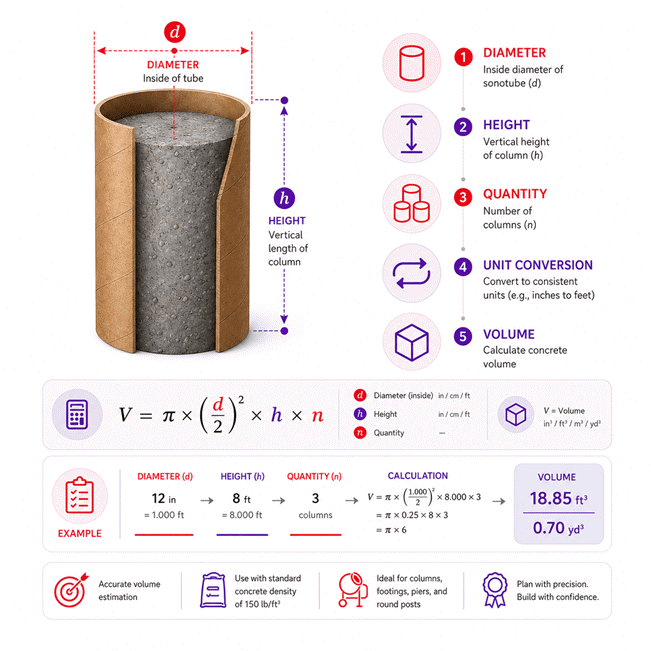
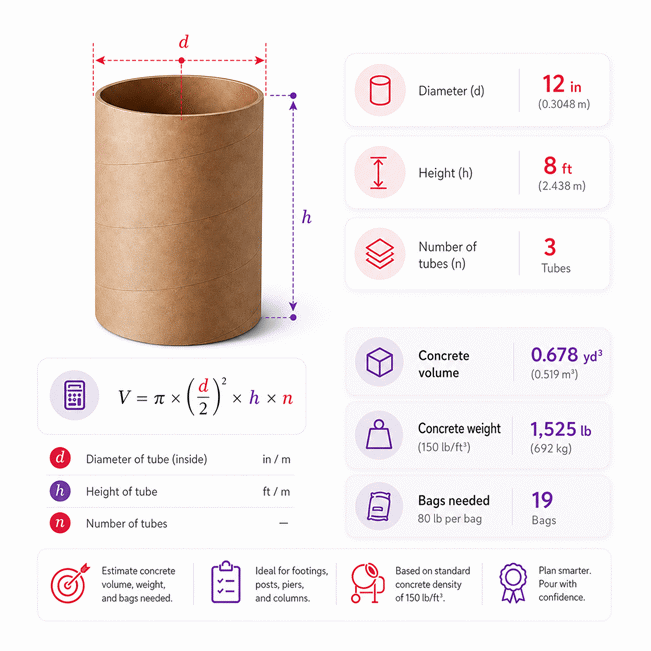
2. Total Sonotube Concrete Volume
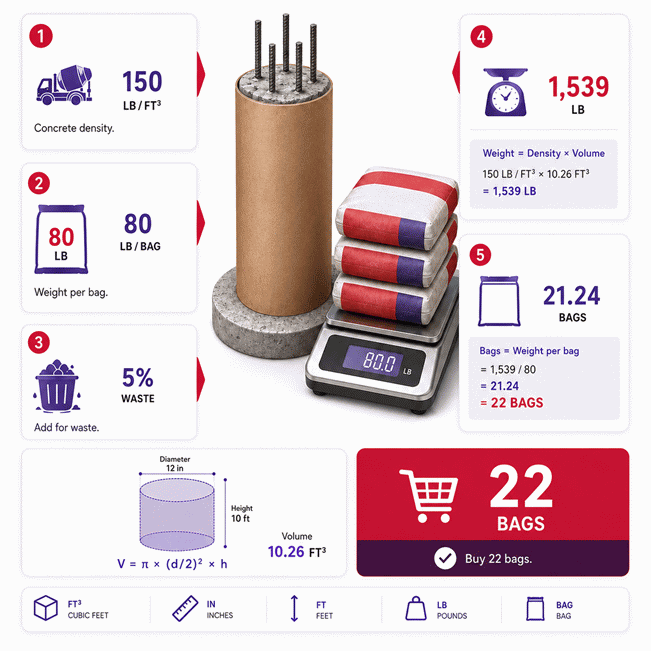
3. Concrete Weight
4. Pre-Mixed Concrete Bags Needed
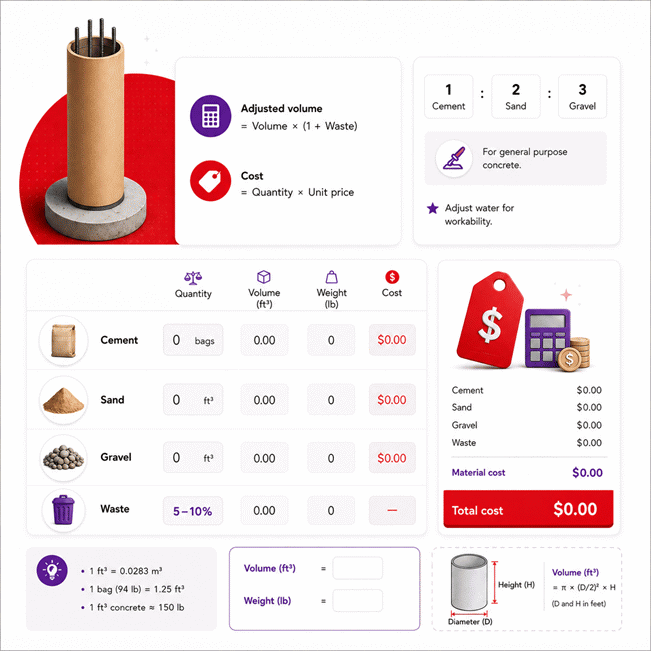
5. Waste-Adjusted Volume for Self-Mixed Concrete
6. Cement, Sand, or Gravel Volume
7. Individual Material Cost
8. Total Material Cost
Variable Definitions
- xu = value entered or displayed in the selected unit.
- xb = corresponding value in the calculator base unit.
- k = conversion factor from the selected unit to the base unit.
- d = internal Sonotube diameter.
- h = Sonotube concrete height.
- n = number of identical Sonotubes.
- V = total required cylindrical concrete volume before waste.
- ρ = concrete density.
- W = concrete weight before the bag waste allowance.
- w = waste allowance expressed as a percentage.
- mb = mass of one pre-mixed concrete bag.
- Nb = whole number of pre-mixed concrete bags required.
- Vw = concrete volume after applying the waste allowance.
- rc = cement ratio part.
- rs = sand ratio part.
- rg = gravel ratio part.
- ri = ratio part of the selected self-mix material.
- Vi = calculated volume of cement, sand, or gravel.
- Qi = purchasable quantity of a cost item, such as bags or material volume.
- Pi = unit price of the corresponding item.
- Ci = cost of one material or purchasing item.
- Ctotal = combined material cost.
- m = number of cost items included in the total.
Variables & Definitions
View a complete list of all variables used in this calculator, including definitions and units
Sonotube Calculator Variables and Calculation Parameters
| Variable | Definition | Unit or Dimension | Calculation Role |
|---|---|---|---|
| xu | Value entered or displayed in the selected unit. | Selected unit | Unit conversion input or displayed value |
| xb | Equivalent value expressed in the calculator base unit. | Base unit | Normalized calculation value |
| k | Conversion factor from the selected unit to the base unit. | Conversion factor | Unit normalization |
| d | Internal diameter of one Sonotube concrete form. | Length | Cylindrical volume calculation |
| h | Concrete fill height of one Sonotube. | Length | Cylindrical volume calculation |
| n | Number of identical Sonotubes included in the project. | Whole number | Total project volume multiplier |
| V | Total concrete volume required before applying waste. | Volume | Primary concrete requirement |
| ρ | Density of the selected concrete mixture. | Mass per volume | Concrete weight calculation |
| W | Total concrete weight before the bag waste allowance. | Mass | Pre-mixed concrete requirement |
| w | Additional material allowance entered as a percentage. | % | Waste adjustment |
| mb | Mass of one pre-mixed concrete bag. | Mass per bag | Bag quantity calculation |
| Nb | Whole number of pre-mixed concrete bags required. | Bags | Rounded purchasing quantity |
| Vw | Concrete volume after applying the waste allowance. | Volume | Self-mix material allocation |
| rc | Cement part of the selected concrete mix ratio. | Ratio part | Cement proportion |
| rs | Sand part of the selected concrete mix ratio. | Ratio part | Sand proportion |
| rg | Gravel part of the selected concrete mix ratio. | Ratio part | Gravel proportion |
| ri | Ratio part assigned to the selected self-mix material. | Ratio part | Generic material proportion |
| Vi | Calculated volume of cement, sand, or gravel. | Volume | Individual self-mix material requirement |
| Qi | Purchasable quantity of a material or concrete bag item. | Item-dependent | Cost calculation quantity |
| Pi | Unit price of the corresponding purchasing item. | Currency per unit | Material cost calculation |
| Ci | Calculated cost of one material or purchasing item. | Currency | Individual material cost |
| Ctotal | Combined cost of all applicable concrete materials or purchasing items. | Currency | Total project material cost |
| m | Number of individual cost items included in the total. | Whole number | Total cost summation |
Unit Conversion Table
Length Unit Conversion Table
| Unit Group | Unit Name | Symbol | Equivalent in Meters | Used For |
|---|---|---|---|---|
| Length | Millimeter | mm | 0.001 m | Sonotube size and height |
| Length | Centimeter | cm | 0.01 m | Sonotube size and height |
| Length | Meter | m | 1 m | Sonotube size and height |
| Length | Inch | in | 0.0254 m | Sonotube size and height |
| Length | Foot | ft | 0.3048 m | Column height |
| Length | Yard | yd | 0.9144 m | Column height |
Volume Unit Conversion Table
| Unit Group | Unit Name | Symbol | Equivalent in Cubic Meters | Used For |
|---|---|---|---|---|
| Volume | Cubic Centimeter | cm³ | 0.000001 m³ | Concrete and material volume |
| Volume | Liter | L | 0.001 m³ | Concrete and material volume |
| Volume | Cubic Meter | m³ | 1 m³ | Concrete and material volume |
| Volume | Cubic Inch | in³ | 0.000016387064 m³ | Concrete volume |
| Volume | Cubic Foot | ft³ | 0.028316846592 m³ | Concrete and material volume |
| Volume | Cubic Yard | yd³ | 0.764554857984 m³ | Total concrete requirement |
Mass Unit Conversion Table
| Unit Group | Unit Name | Symbol | Equivalent in Kilograms | Used For |
|---|---|---|---|---|
| Mass | Gram | g | 0.001 kg | Concrete weight and bag size |
| Mass | Kilogram | kg | 1 kg | Concrete weight and bag size |
| Mass | Metric Ton | t | 1000 kg | Large concrete weight |
| Mass | Ounce | oz | 0.028349523125 kg | Concrete weight and bag size |
| Mass | Pound | lb | 0.45359237 kg | Concrete weight and bag size |
Concrete Density Unit Conversion Table
| Unit Group | Unit Name | Symbol | Equivalent in kg/m³ | Used For |
|---|---|---|---|---|
| Density | Kilogram per Cubic Meter | kg/m³ | 1 kg/m³ | Concrete density and weight calculation |
| Density | Pound per Cubic Foot | lb/ft³ | 16.01846337396 kg/m³ | Concrete density and weight calculation |
| Density | Gram per Cubic Centimeter | g/cm³ | 1000 kg/m³ | Concrete density |
| Density | Kilogram per Liter | kg/L | 1000 kg/m³ | Concrete density |
Example Calculation
Inputs
Unit Conversion
Diameter: 18 in × 0.0254 = 0.4572 m
Height: 8.5 ft × 0.3048 = 2.5908 m
Concrete Volume Formula
Converted volume: 1.70136 m³ = 2.22529 yd³
Concrete Weight
Pre-Mixed Bags
Results
This calculation first converts the tube dimensions into consistent base units before determining cylindrical concrete volume.
Concrete weight is calculated from the required volume and the selected concrete density.
The waste allowance is applied before dividing the required weight by the selected bag size.
A fractional purchasing requirement is rounded upward so sufficient whole bags are available.
Complete Calculation Formulas
Known Values and Unknown
Unit Conversion
Diameter: 18 in × 0.0254 = 0.4572 m
Volume: 2.22529 yd³ × 0.764554857984 = 1.70135628 m³
Governing Formula
Isolate height as the unknown variable:
Solution
Results
Reverse solving uses the same cylindrical volume relationship as the forward calculation.
Known diameter, volume, and quantity allow the calculator to isolate the missing height.
All compatible units are converted before solving so the physical values remain consistent.
Intermediate values retain full precision, while only the displayed result is rounded.
Geometry Reverse-Solving Formulas
Weight and Density Reverse-Solving Formulas
Pre-Mixed Concrete Reverse-Solving Formulas
Self-Mixed Concrete Reverse-Solving Formulas
Cost Reverse-Solving Formulas
Results are rounded for display.
Internal calculations use full precision.
Calculations Disclaimer
How Much Concrete Do You Really Need for a Sonotube?
A rushed concrete order can create an expensive problem within hours. The Sonotube Calculator helps prevent that problem before the pour begins. A Sonotube Calculator turns simple project measurements into a practical material estimate. It also keeps several columns inside one planning workflow.
The main challenge is rarely the arithmetic itself. The challenge is using the right project dimensions. A small measuring error can affect every later decision. That error can change concrete volume, weight, bags, and cost.
Start with the dimensions of the concrete that will actually be placed. Include the full concrete fill height. This includes an embedded section when it forms one continuous column. Then enter the number of matching columns in the project. The calculation can then estimate the total concrete requirement.
This simple order matters. It prevents material planning from becoming disconnected from site conditions. It also makes the result easier to review before purchasing.
Measure the concrete shape → confirm the column count → estimate total material → plan the purchase.
The fastest result is not always the best result. A useful result must match the actual pour.
Sonotube Size, Diameter, Height, and Quantity: What Each Input Changes
A contractor may measure everything correctly but enter the wrong dimension. That mistake can affect every column.
Tube size controls the width of the concrete column. Height controls its vertical concrete length. Quantity controls how many matching columns share the same dimensions.
These three values work together. None should be treated as an isolated field. A wider column needs more concrete across its full height. A taller column needs more concrete through the same cross-section. More columns multiply that demand across the project.
When columns differ, separate them into matching groups. Do not force different columns into one average set. That shortcut hides real material differences.
This is especially useful for decks and pier layouts. Outer piers may differ from interior supports. Sloped sites may also create different column heights.
Treat each matching group as its own material decision. Then combine the totals during purchasing.
Why Inside Diameter Matters More Than Outside Tube Size
A tube can look simple from the outside. Concrete never fills the outside dimension.
The useful diameter is the space inside the form. That space defines the concrete cylinder. Using an outside measurement can quietly increase the estimated volume.
That difference becomes more important on larger columns. It also grows when many forms share the same mistaken measurement.
Check the actual form specification before ordering concrete. Do not rely only on a quick tape measurement. A nominal product size should match the intended concrete diameter.
This single check can prevent a surprisingly large ordering error.
What Changes Concrete Volume Faster Than Most Users Expect?
Many users worry most about column height. Diameter can create the bigger surprise.
A small increase in height adds material in a steady way. A larger diameter expands the whole circular cross-section. That expanded area continues through the full column height.
This is why two columns with similar heights can need very different concrete quantities.
The effect becomes more noticeable on larger columns. It also matters when several large piers are poured together.
Diameter rises → cross-section grows → concrete demand rises quickly → weight and cost follow.
This relationship should guide early project planning. Do not compare tube sizes by appearance alone. Compare the actual material demand behind each size.
A larger form can affect more than concrete volume. It may change handling, reinforcement layout, delivery planning, and site access.
That creates a useful planning rule. Confirm the design size before optimizing the concrete order.
Why Diameter Changes Material Demand More Than Height
A common site question sounds simple: “Can we use the next larger tube?”
That decision may seem minor. It can create a meaningful material increase.
Height changes only one dimension of the cylinder. Diameter changes the circular area across the whole column. That is why diameter deserves extra attention during design review.
The practical lesson is simple. Never substitute a larger tube without checking the material impact.
The same rule works in reverse. Reducing the diameter only to save concrete may create structural problems. The required column size comes from the project design.
Use the calculator to understand material consequences. Do not use material savings to rewrite structural requirements.
Why Quantity Multiplies Small Errors
One wrong column estimate may seem harmless. Twenty identical errors are not harmless.
Quantity multiplies both the correct result and any measurement mistake. That makes repeated column projects sensitive to small input problems.
Check one representative form carefully before copying its dimensions. Confirm the full fill height. Confirm that every grouped column truly matches.
This matters on long deck lines and repeated pier layouts. It matters even more on large multi-column projects.
A short review before ordering can save a second delivery. It can also prevent excess unused material.
Reverse Sonotube Calculator: Solve Missing Project Information
Sometimes the concrete quantity is known before every dimension is known. That situation happens during redesigns, field checks, and quantity reviews.
A reverse-capable calculator can make that information useful. Instead of forcing one fixed input path, it can solve a missing compatible value.
This changes the tool from a simple estimator into a planning aid. Known values can help test an unknown height or quantity. They can also help review whether a selected form size makes sense.
Reverse solving is useful when documents arrive from different sources. One sheet may show concrete volume. Another may show pier count. Field measurements may supply the remaining dimension.
The important point is consistency. Known values must describe the same physical concrete geometry.
A reverse result should also be treated as a planning result. Standard product sizes may limit what can actually be purchased.
How Reverse Solving Helps When One Field Is Missing
A project manager may know the ordered concrete volume. The final pier height may still be uncertain.
Reverse solving can expose that missing relationship quickly. It can also reveal a data conflict.
That is valuable during change orders. It is also useful after a design revision.
The best use is verification. Enter the values you trust most. Then compare the solved value with project documents.
If the result looks unreasonable, investigate the inputs first. Do not force the result to match expectations.
A reverse tool becomes most useful when it reveals inconsistency. That warning can be more valuable than the number itself.
When a Calculated Diameter Does Not Match a Standard Form Size
Mathematics can return almost any positive diameter. Suppliers cannot stock every possible diameter.
This creates an important gap between calculation and procurement.
A solved diameter may fall between available form sizes. In that case, the mathematical answer does not create a new product size.
Return to the design requirement. Check available products. Then confirm the permitted form size before ordering.
Commercial and general construction product lines may also offer different size ranges.
Reverse solving helps diagnose the project. Product availability completes the decision.
How Many Bags of Concrete Do You Need for a Sonotube?
A concrete volume can look manageable until it becomes a stack of bags.
Bag planning adds several practical questions. Concrete density affects total weight. Bag size affects the number of packages. Waste adds another purchasing margin.
A useful bag estimate therefore needs more than column geometry.
The planning path is straightforward. First determine the concrete requirement. Then consider the selected concrete density. Next use the selected bag size. Finally account for expected site loss.
The result should support a purchasing decision. It should not replace the actual product information.
Bag products can differ in yield and formulation. Always check the product specifications before ordering a large quantity.
Concrete Density, Bag Size, and Waste: Three Numbers That Change Bag Count
A user can enter perfect column dimensions and still misjudge the purchase.
Concrete density connects the required volume with material weight. Bag size then divides that need across individual packages. Waste covers expected handling loss.
These values answer different questions.
Density describes the concrete itself. Bag size describes the packaging. Waste describes the jobsite process.
Do not combine them into one guess. Keep each decision clear.
A supplier may offer several bag sizes. A larger bag reduces package count but increases handling weight. A smaller bag may be easier to move but requires more individual units.
That tradeoff is practical, not mathematical. Site access and labor should influence the final choice.
Why Product Yield Still Deserves a Final Bag-Label Check
Two bags with similar weights may not always serve identical project needs.
Product formulation matters. Product instructions matter. Water demand and stated yield also matter.
Use the calculator to create the material plan. Then compare that plan with the selected product information.
This final check is especially important before bulk purchasing. It can prevent a clean calculation from being paired with the wrong product assumption.
The calculator should answer how much material is needed. The package should confirm what that product delivers.
Those two checks belong together.
When Bagged Concrete Becomes Impractical
Bagged concrete works well for many small pours. It can become inefficient as volume rises.
Think beyond the number of bags. Consider unloading, carrying, mixing, water access, labor, and placement time.
A large bag count can create a hidden workflow problem. The concrete may be affordable while the handling becomes difficult.
This is the moment to compare delivery options. Ready-mix may reduce manual batching on larger pours.
Do not choose based on bag price alone. Compare the whole placement process.
Ready-Mix or Self-Mixed Concrete: Which Method Fits the Project?
Two projects can need the same concrete volume yet need different supply methods.
A small isolated pier may suit packaged concrete. A large group of columns may justify ready-mix. Some projects may use a site-produced mix instead.
The calculator can support each planning path. The correct choice depends on project scale and control needs.
For ready-mix, the main focus is total concrete quantity. For bagged concrete, package size becomes important. For self-mixed concrete, material proportions become part of planning.
Few small piers → bagged concrete may be convenient → larger repeated pours → compare ready-mix logistics.
Cost still matters. Speed also matters. So does consistent placement.
Choose the supply method before finalizing the purchase plan.
Planning Cement, Sand, and Gravel for Self-Mixed Concrete
Self-mixing gives more control over individual materials. It also creates more chances for site error.
Cement, sand, and gravel should follow the project mix requirement. Do not choose proportions only because one option appears cheaper.
Material storage also matters. Sand moisture can affect field handling. Aggregate needs clean storage. Cement must remain protected from moisture.
The calculator can organize the quantity decision. Site practice determines whether those materials remain usable.
Keep technical mix requirements separate from purchasing preferences. That separation prevents price decisions from weakening the intended concrete.
How Waste and Handling Loss Affect Material Planning
Concrete rarely moves from purchase to final placement without some loss.
Material may remain in a mixer. Some may spill during handling. Irregular placement can also increase consumption.
A planning allowance helps reduce shortage risk. The allowance should reflect the real site.
A clean, accessible pour needs less contingency than a difficult site. Long carrying distances may increase handling loss.
Do not use a larger allowance to hide poor measurements. Fix the measurement first.
Waste planning should protect a good estimate. It should not rescue a bad one.
Sonotube Concrete Weight and Material Cost Calculator
Volume answers only part of the project question. Weight can change the entire work plan.
Concrete is heavy. A bagged project can quickly become a lifting problem. A self-mixed project can become a storage problem.
Weight planning helps estimate handling effort. It can also support transport decisions.
The calculator connects concrete volume with the selected concrete density. This provides an estimated material weight that can support bag and logistics planning.
Cost comes after quantity. This order matters.
Do not begin with a budget and force the material estimate into it. Determine the need first. Then compare purchasing options.
A clear quantity estimate also makes supplier quotes easier to compare.
How Concrete Density Changes Handling and Logistics
A denser concrete mix creates more weight for the same volume.
That matters when material arrives in bags. It also matters during site storage.
Think about the whole path. Material must be delivered, moved, mixed, and placed.
A calculator can estimate weight. It cannot carry the material.
This is where a technically correct estimate becomes a jobsite decision.
Check transport capacity when moving large quantities. Check access between storage and the pour. Plan labor before the concrete is opened.
The best material estimate should reduce surprises before work begins.
Estimating Bag Price, Material Cost, and Total Project Cost
A cheap unit price can still produce an expensive project.
Total cost depends on required quantity and chosen supply method. Delivery charges can also affect the final purchase.
Keep the technical estimate stable while comparing vendors. This creates a fair comparison.
For bagged material, compare package price and usable project quantity. For self-mixed material, compare each material separately.
AxiCalculator can organize the quantity and cost relationship before ordering. That gives the buyer a clearer starting point for supplier discussions.
Avoid shopping from price alone. The correct product and enough material matter more.
Warranty and Support Checks Before Buying
Warranty language can look reassuring until a problem occurs.
Treat warranty and support as written procurement items. Check what the seller actually covers.
Review storage requirements before accepting delivery. Review return conditions before opening large quantities. Confirm who handles product questions.
Concrete form products can have different handling instructions. Product lines may also differ in moisture resistance and placement limits.
Keep a copy of the product literature. Keep the purchase record as well.
Good support is easier to use when documentation is already organized.
Choosing Sonotube Size for Real Projects
A buyer may see several tube sizes and assume the choice is flexible.
It often is not.
The required column size should come from the project design. The calculator then tells you what that choice means for materials.
This distinction protects both safety and budget.
A smaller tube may reduce concrete demand. That does not make it acceptable. A larger tube may appear safer. It can increase cost and may affect reinforcement details.
Use the specified diameter whenever project drawings provide one.
Concrete form products are used for many round supports and columns. Product families can also target different project types.
The calculator supports the material decision. The project design controls the structural decision.
Common Diameters Are Planning Inputs, Not Design Approvals
Seeing a size in a selector can create false confidence.
Availability does not equal structural approval.
A common tube size only means that size can be part of planning. The required support still depends on the project.
This matters for decks, fences, sheds, columns, and other supports. Loads and site conditions can vary widely.
Use the calculator after the size decision is justified.
If drawings specify the size, follow the drawings. If they do not, obtain the needed design guidance first.
That order keeps the calculator useful and keeps the project decision clear.
What Makes a Sonotube Concrete Estimate Wrong?
Most major estimating errors begin before the calculator receives any input.
The first problem is often an incomplete height. The next is an incorrect diameter. Mixed column groups can create another error.
Site geometry can also exceed the simple tube shape.
The straight form may sit above a wider footing. The excavation may contain extra concrete below the tube. A bell-shaped base may add more volume.
Those shapes do not disappear because a tube sits above them.
Another common problem appears during ordering. Users may treat calculated material as guaranteed jobsite consumption.
Field conditions can change. Placement losses can change. Product yield can change.
The best estimate makes these boundaries visible before concrete arrives.
Common Jobsite Mistakes That Cause Shortages or Overordering
A worker measures only the visible column. The buried section gets missed.
Another worker records the outside tube width. The concrete space is smaller.
A project has several pier heights. Someone enters one average height for all.
These mistakes are easy to make. They are also easy to prevent.
Measure the concrete itself. Group matching columns. Review each unusual footing separately.
Then compare the calculated result with the construction layout.
One minute of checking can prevent hours of material trouble.
Before ordering: verify diameter → verify full fill height → group matching columns → identify extra footing shapes.
This is one of the highest-value checks in the entire workflow.
Footings, Bell Bottoms, Gravel Bases, Rebar, and Other Extra Volumes
A straight concrete form represents a straight cylindrical concrete shape.
Real foundations can include more geometry.
A wider footing below the form needs separate attention. A bell bottom also creates additional concrete volume. Gravel beneath the footing is not concrete.
Reinforcing steel occupies physical space, but basic ordering workflows usually focus on gross concrete geometry. Special precision work may require deeper modeling.
Anchor systems can also affect placement without defining the main concrete shape.
Separate these items mentally before estimating. Ask one simple question:
Will concrete exist outside the straight tube?
If yes, that extra concrete needs its own project review.
The safest purchasing plan sees the whole foundation, not only the visible form.
Frequently Asked Questions
What should I do if a Sonotube becomes oval, bent, or slightly out of plumb?
Can I use different concrete bag sizes or brands for the same Sonotube project?
How should I turn the calculated volume into a ready-mix concrete order?
What should I do if the actual excavation depth changes before the concrete pour?
Why can the theoretical Sonotube volume differ from concrete batch tickets after the pour?
How should groundwater, unstable soil, or temporary casing affect a professional Sonotube estimate?
How should engineers handle construction tolerances when comparing design and as-built Sonotube volumes?
Our engineers are here to help you get it right.