Fire Glass Calculator
- Last formula update:
Decimal & Rounding Policy
- Calculations use full-precision values for area, volume, density, and total weight.
- Displayed results are rounded to a maximum of eight decimal places.
- Shape formulas retain the full value of pi until the final result is displayed.
- Unit conversions occur before rounding to reduce cumulative calculation errors.
- Very large or very small results may appear in scientific notation.
Valid range
- Glass density: Enter a finite value greater than 0 and no more than 1 × 10¹⁵.
- Length, width, side, base, height, diameter, front length, and back length: Each active dimension must be greater than 0 and no more than 1 × 10¹⁵.
- Depth: Enter a positive fire glass layer depth greater than 0 and no more than 1 × 10¹⁵.
- Area: Use a positive value greater than 0 and no more than 1 × 10¹⁵.
- Volume: Use a positive value greater than 0 and no more than 1 × 10¹⁵.
- Total weight: Use a positive value greater than 0 and no more than 1 × 10¹⁵.

Reviewers:
Elvarine Jexmont
Fenrick Zorquell
Check our editorial policy
August 15, 2026
1.0.0
Initial calculator and formula release.
Our engineers are here to help you get it right.
How Does the Fire Glass Calculator Determine How Much Glass You Need?
Fire Glass Calculator quickly estimates the volume and weight needed for a fire pit, fireplace, or decorative gas feature. Select the shape, enter the internal dimensions and fill depth, then choose the matching glass type or custom density.
- Measure only the internal space that will hold fire glass.
- Select round, square, rectangular, triangular, or trapezoidal geometry.
- Volume depends on the calculated fill area and selected layer depth.
- Estimated weight depends on volume and the chosen glass density.
- Bulk density may predict packed coverage better than material density.
- Particle size, shape, settling, and empty spaces can affect coverage.
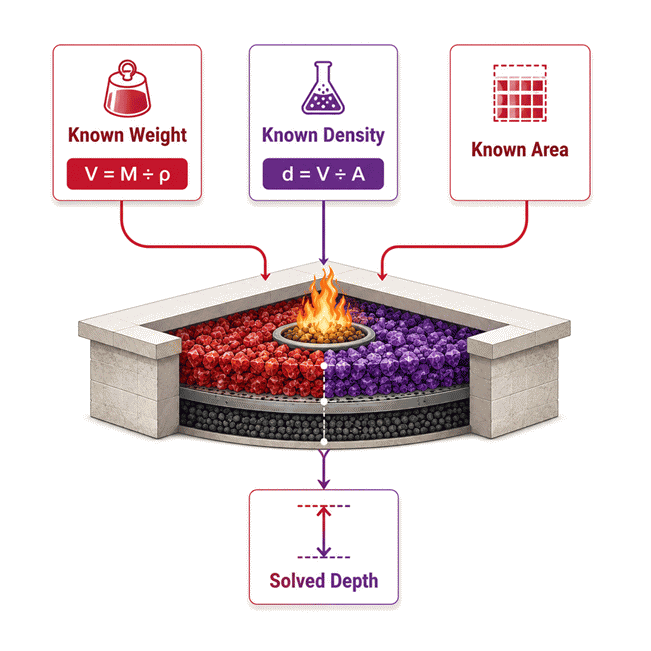
- Reverse mode calculates achievable depth from available glass weight.
- Calculate lava rock and decorative glass layers as separate materials.
- Use internal diameter for round pits and perpendicular height for triangles.
- Compare the result with product packaging before ordering complete bags.
The Fire Glass Calculator supports fast planning without hiding the factors behind the estimate. A deeper layer increases volume, weight, bag quantity, and cost. Confirm burner compatibility, approved media depth, fuel type, airflow, and installation requirements before use. Never install ordinary glass, wet media, or material that blocks burner ports, drainage, ventilation, sensors, or ignition components.
Assumptions used in this calculator
- Measurements represent the fire pit’s internal fire glass fill dimensions.
- The selected shape accurately represents the fire pit’s fill area.
- Fire glass depth remains uniform across the entire calculated area.
- Fire glass density remains consistent throughout the selected material.
- Dimensions are measured using the units selected within the calculator.
- All entered values are positive, finite, and measured accurately.
- Burners, fittings, drains, and internal obstructions are excluded from volume.
- The fire pit base is level and geometrically regular.
- Material settling and compaction are not separately added to results.
- Product density may vary between manufacturers, batches, and glass types.
- Calculated weight represents an estimate rather than a guaranteed purchase quantity.
- Installation depth follows applicable fire pit manufacturer safety requirements.
- Final requirements are verified by a qualified installer before installation.
Results are rounded for display.
Internal calculations use full precision.
Formulas Used in Fire Glass Calculator :
Fire Glass Calculator Formulas
1. Unit Conversion to Base Units
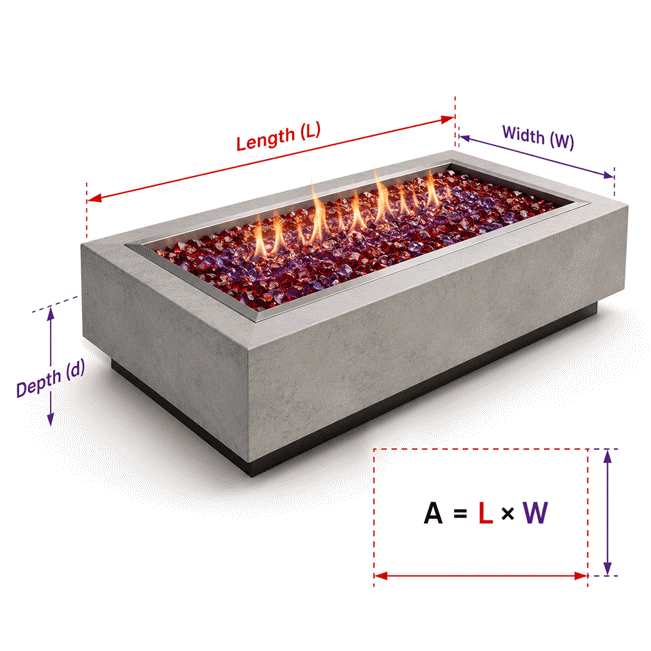
2. Rectangular Fire Pit Area
3. Square Fire Pit Area
4. Triangular Fire Pit Area
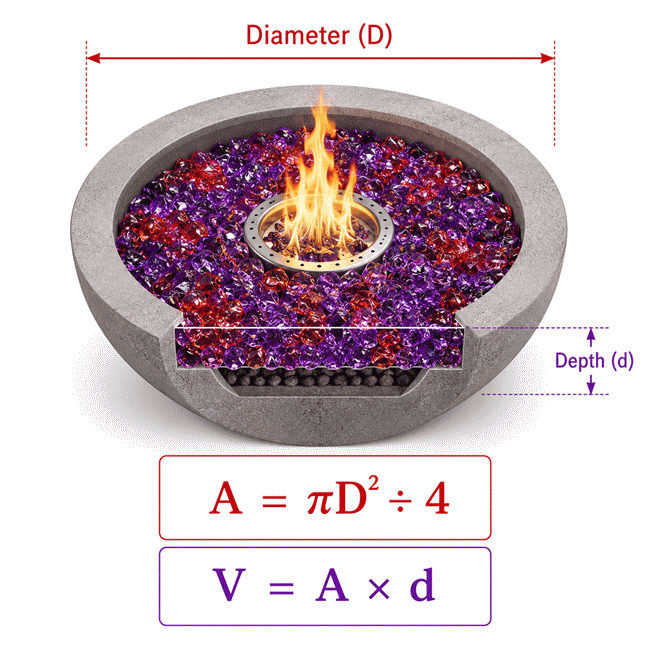
5. Round Fire Pit Area
6. Trapezoidal Fire Pit Area
7. Fire Glass Volume
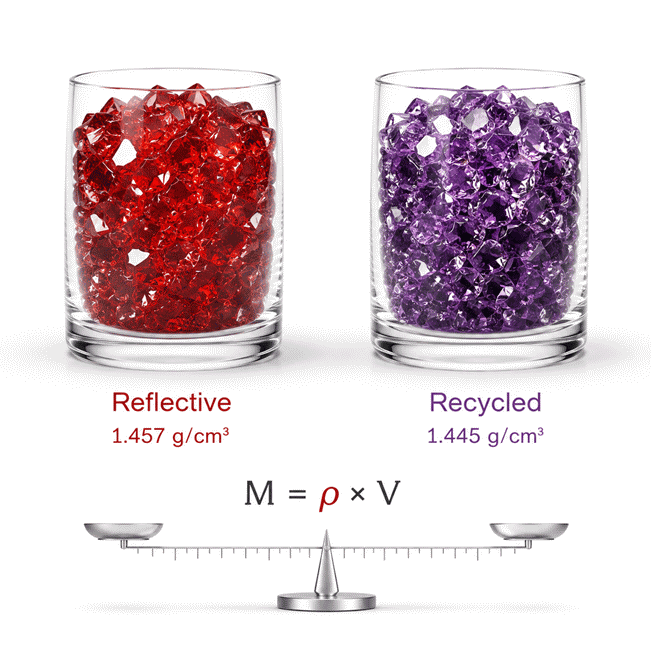
8. Total Fire Glass Weight
Variable Definitions
- xinput = entered measurement in the selected unit
- xbase = measurement converted to its base SI unit
- F = conversion factor for the selected unit
- A = fire pit surface area
- L = rectangular fire pit length
- W = rectangular fire pit width
- s = square fire pit side length
- b = triangular fire pit base
- h = triangular fire pit height
- D = round fire pit diameter
- f = trapezoidal fire pit front length
- r = trapezoidal fire pit back length
- w = trapezoidal fire pit width
- d = fire glass layer depth
- V = required fire glass volume
- ρ = fire glass density
- M = total fire glass weight
- π = the mathematical constant pi
Variables & Definitions
View a complete list of all variables used in this calculator, including definitions and units
Fire Glass Calculator Variables and Measurement Guide
| Variable | Name | Description | Base SI Unit | Calculation Role |
|---|---|---|---|---|
| xinput | Input measurement | The numerical value entered in the selected measurement unit. | Selected unit | Initial input |
| xbase | Base measurement | The entered value converted to its corresponding base SI unit. | SI unit | Standardized value |
| F | Conversion factor | The multiplier used to convert an entered value into its base SI unit. | Varies by unit | Unit conversion |
| A | Fire pit area | The calculated surface area covered by fire glass. | m² | Calculated input for volume |
| L | Rectangle length | The internal length of a rectangular fire pit. | m | Rectangular area input |
| W | Rectangle width | The internal width of a rectangular fire pit. | m | Rectangular area input |
| s | Square side | The internal side length of a square fire pit. | m | Square area input |
| b | Triangle base | The internal base length of a triangular fire pit. | m | Triangular area input |
| h | Triangle height | The perpendicular internal height of a triangular fire pit. | m | Triangular area input |
| D | Round diameter | The internal diameter measured across the center of a round fire pit. | m | Round area input |
| f | Trapezoid front length | The internal length of the front parallel side of a trapezoidal fire pit. | m | Trapezoidal area input |
| r | Trapezoid back length | The internal length of the back parallel side of a trapezoidal fire pit. | m | Trapezoidal area input |
| w | Trapezoid width | The perpendicular distance between the parallel sides of a trapezoidal fire pit. | m | Trapezoidal area input |
| d | Fire glass depth | The intended vertical thickness of the installed fire glass layer. | m | Volume input |
| V | Fire glass volume | The calculated volume required to fill the selected area and depth. | m³ | Calculated input for mass |
| ρ | Fire glass density | The mass of the selected fire glass per unit of volume. | kg/m³ | Mass input |
| M | Total fire glass weight | The estimated mass of fire glass required for the specified installation. | kg | Final result |
| π | Pi | The mathematical constant used to calculate the area of a round fire pit. | Dimensionless | Round area constant |
Unit Conversion Table
Length Unit Conversion Table
| Unit Group | Unit Name | Symbol | Equivalent in Meters | Used For |
|---|---|---|---|---|
| Popular Units | Centimeter | cm | 0.01 m | Dimensions and depth |
| Popular Units | Millimeter | mm | 0.001 m | Dimensions and depth |
| Popular Units | Inch | in | 0.0254 m | Dimensions and depth |
| Popular Units | Foot | ft | 0.3048 m | Dimensions and depth |
| Scientific Units | Meter | m | 1 m | Base length calculations |
Area Unit Conversion Table
| Unit Group | Unit Name | Symbol | Equivalent in Square Meters | Used For |
|---|---|---|---|---|
| Popular Units | Square Centimeter | cm² | 0.0001 m² | Fire pit area |
| Popular Units | Square Inch | in² | 0.00064516 m² | Fire pit area |
| Popular Units | Square Foot | ft² | 0.09290304 m² | Fire pit area |
| Scientific Units | Square Millimeter | mm² | 0.000001 m² | Small fire pit areas |
| Scientific Units | Square Meter | m² | 1 m² | Base area calculations |
Volume Unit Conversion Table
| Unit Group | Unit Name | Symbol | Equivalent in Cubic Meters | Used For |
|---|---|---|---|---|
| Popular Units | Cubic Centimeter | cm³ | 0.000001 m³ | Fire glass volume |
| Popular Units | Liter | L | 0.001 m³ | Fire glass volume |
| Popular Units | Cubic Inch | in³ | 0.000016387064 m³ | Fire glass volume |
| Popular Units | Cubic Foot | ft³ | 0.028316846592 m³ | Fire glass volume |
| Scientific Units | Cubic Millimeter | mm³ | 0.000000001 m³ | Small calculated volumes |
| Scientific Units | Cubic Meter | m³ | 1 m³ | Base volume calculations |
Density Unit Conversion Table
| Unit Group | Unit Name | Symbol | Equivalent in Kilograms per Cubic Meter | Used For |
|---|---|---|---|---|
| Popular Units | Gram per Cubic Centimeter | g/cm³ | 1000 kg/m³ | Fire glass density |
| Popular Units | Pound per Cubic Foot | lb/ft³ | 16.01846337396 kg/m³ | Fire glass density |
| Popular Units | Pound per Cubic Inch | lb/in³ | 27679.9047102 kg/m³ | Fire glass density |
| Scientific Units | Kilogram per Cubic Meter | kg/m³ | 1 kg/m³ | Base density calculations |
Mass Unit Conversion Table
| Unit Group | Unit Name | Symbol | Equivalent in Kilograms | Used For |
|---|---|---|---|---|
| Popular Units | Kilogram | kg | 1 kg | Total fire glass weight |
| Popular Units | Pound | lb | 0.45359237 kg | Total fire glass weight |
| Popular Units | Ounce | oz | 0.028349523125 kg | Total fire glass weight |
| Scientific Units | Gram | g | 0.001 kg | Small fire glass quantities |
Example Calculation
Convert the entered dimensions to centimeters.
Calculate the rectangular fire pit area.
Calculate the required fire glass volume.
Calculate the total fire glass weight.
The internal fire pit dimensions determine the area covered by fire glass.
Multiplying the area by the uniform depth produces the required volume.
The selected density converts that volume into an estimated material weight.
Actual purchasing needs may vary because of obstructions, settling, and installation tolerances.
Convert the dimensions and available weight into compatible units.
Calculate the rectangular fill area.
Reverse the weight formula to determine the available volume.
Reverse the volume formula to solve for the achievable depth.
The known weight and density determine the available fire glass volume.
The selected shape and internal dimensions determine the fill area.
Dividing the available volume by the area returns the achievable layer depth.
Actual installed depth may vary because of obstructions, settling, and measurement tolerances.
Results are rounded for display.
Internal calculations use full precision.
Calculations Disclaimer
How Much Fire Glass Do You Really Need?
A fire pit can look small while holding a surprising amount of glass. Its visible opening does not reveal the full fill volume. Depth can increase the required material faster than many buyers expect.
The Fire Glass Calculator turns your measurements into a clear material estimate. It helps you plan the required volume and weight before placing an order. It also reduces costly shortages, excess bags, and repeated deliveries.
Start by measuring the internal space that will contain the glass. Do not measure the outside walls, frame, ledge, or decorative border. These parts do not consume material.
Select the shape that best matches the fill area. Then enter its internal dimensions and intended glass depth. Choose the correct glass type when product options are available.
The result shows how much material the selected space may require. This estimate supports planning, purchasing, and comparison between different fill depths.
A deeper layer can improve visual fullness and hide the burner assembly. However, unnecessary depth can increase weight and cost. It may also conflict with the appliance maker’s installation guidance.
The safest choice is not always the deepest option. The correct depth must suit the burner, pan, fuel, and approved media arrangement. Check the appliance manual before buying material.
The calculator also supports reverse planning. You can start with available glass weight and find an achievable depth. This feature helps when reusing stored material or working within a fixed budget.
The fastest buying decision follows three checks. Confirm the dimensions, select the correct material, and review the final depth. These checks take seconds but can prevent an expensive ordering error.
Fire Glass Volume, Weight, and Purchase Quantity Explained
Fire glass occupies space but is usually sold by weight. This creates a common buying problem. Homeowners measure dimensions, while suppliers sell pounds, kilograms, jars, or bags.
The calculator connects these two systems. It first determines the occupied space. It then estimates the related material weight using the selected glass properties.
Volume describes the space filled by the decorative media. Weight describes the expected mass of that material. Purchase quantity converts the result into practical packaging.
These values should not be treated as identical ideas. Two products may fill similar spaces but have different weights. Their particle size, shape, finish, and packing behavior may differ.
Reflective pieces can pack differently from larger recycled pieces. Rounded beads can also settle differently from irregular crushed glass. Product-specific information improves purchasing accuracy.
When bags are sold in fixed sizes, the required quantity must cover the result. A partial bag cannot usually be purchased. The practical order may therefore exceed the exact estimated weight.
Do not add a large surplus without a reason. Fire glass is durable and heavy. Unused bags can increase shipping costs and create difficult returns.
A small allowance may help with minor measurement differences and future top-ups. The suitable allowance depends on packaging, installation quality, and supplier return terms.
The Difference Between Calculated Weight and Actual Packed Coverage
A mathematically correct result can still differ from a product coverage chart. The reason often hides between the glass pieces.
Loose fire glass contains small air spaces. Their amount changes with particle size and packing. Irregular pieces may create more open space than compact, uniform beads.
A supplier may base coverage on physical packaging tests. A calculator may use a stated material value. Both approaches can be reasonable, yet their results may differ.
Use the supplier’s tested coverage when it matches your exact product. Use the calculator for planning, comparison, and products with clear material data.
Do not combine coverage information from unrelated products. A value for small beads may not suit large crushed glass. The same warning applies to mixed decorative media.
How the Fire Glass Calculator Works
The most common failure begins before calculation. A user enters the correct number from the wrong location. Outside dimensions then create an estimate for space that will never be filled.
The calculator needs the usable cavity dimensions. This means the open area inside the fire feature. Measure from the inner faces of the surrounding walls.
Choose the matching shape before entering values. A round bowl does not use the same geometric model as a rectangle. A fireplace with unequal front and rear widths needs another shape.
After shape selection, the calculator activates the required fields. This keeps the form simple and reduces irrelevant entries. Each input should represent one physical measurement.
The selected measurement system can match your tools. You may work with common metric or imperial units. The output can then be viewed in a useful purchase unit.
Material selection affects the final weight estimate. Choose recycled or reflective glass when those options match your product. Use the custom option for verified product data.
The result should be reviewed as a connected set. Area explains the footprint. Volume explains the filled space. Weight supports ordering and transport planning.
Reverse mode changes the unknown value. Instead of finding weight, it can find depth or another dimension. This is useful when your available quantity cannot change.
Always recheck surprising results. A single misplaced decimal can change the order dramatically. An incorrect unit can create an even larger error.
Required Measurements for Every Fire Pit Shape
A rectangular pit needs its internal length and width. Measure both across the usable media bed. Do not include coping stones or the outer tabletop.
A square pit needs one internal side when all sides match. Measure a second side if the cavity may not be perfectly square.
A round pit needs its internal diameter. Measure through the center of the cavity. A measurement near the edge may be shorter and produce an incorrect result.
A triangular feature needs its internal base and perpendicular height. The sloping side length cannot replace the perpendicular height.
A fireplace may have different front and rear widths. It also needs the distance between those widths. This layout often resembles a trapezoid when viewed from above.
An irregular feature should be divided into smaller, simple sections. Measure each section carefully and combine their required quantities. This approach is safer than guessing one average dimension.
Curved bowls need special care. Their sides may narrow toward the bottom. A straight-sided estimate can overstate the amount needed for a strongly tapered cavity.
If the manufacturer provides internal capacity, compare it with your measured estimate. A large difference may reveal a measurement or shape-selection problem.
Internal Dimensions, Fill Depth, and Material Density
Internal dimensions define the actual footprint of the glass. Fill depth defines the vertical thickness of the planned layer. Material density connects occupied space with expected weight.
These inputs have different effects. Increasing one rectangular dimension increases the result in direct proportion. Increasing depth has the same direct effect.
Density does not change the physical cavity size. It changes the estimated mass placed inside that cavity.
Measure depth from the planned bottom of the glass layer. Do not automatically measure from the fire pit floor. A base layer may already occupy part of that space.
If lava rock forms the lower layer, calculate only the visible glass layer as glass. Treating the full depth as glass can greatly increase the order.
Fire Glass Density and Why Calculator Results Differ
Two calculators can receive identical dimensions and return different weights. The hidden cause is often density, not geometry.
Fire glass is not one perfectly uniform material. Products vary by manufacturing method, particle size, finish, and shape. These differences affect the weight placed within a fixed space.
A dense product may require more weight for the same fill volume. A loosely packed product may require less. Neither result is automatically wrong.
Problems begin when a density value is treated as universal. One preset cannot perfectly represent every glass product sold worldwide.
Choose a preset only when it reasonably matches the intended material. For a specific commercial product, use verified data from its packaging or technical information.
Do not estimate density from appearance. Reflective coatings and color cannot reveal packed coverage accurately. Product size can also change the spaces between pieces.
The calculator result becomes more useful when its material setting is transparent. Users should know which product type produced the displayed estimate.
If no product-specific value exists, compare the result with the supplier’s coverage information. A wide difference deserves investigation before ordering.
Material settling can also change the visible depth after installation. Vibration, handling, and repeated heating may rearrange loose pieces. A minor top-up may later restore the intended appearance.
Material Density Versus Bulk Density
The word density can describe two related but different values. Confusing them can create a surprisingly large purchase error.
Material density describes the mass of the glass itself. It does not normally include empty spaces between separate pieces.
Bulk density describes the mass inside a larger filled space. That space includes both glass and the small gaps between pieces.
Bulk density is often more practical for buying loose fire glass. It reflects how a packaged or poured product occupies a container.
Material density remains useful for technical comparison. However, it may predict more weight than real loose coverage requires.
The best value comes from testing the exact product under realistic packing conditions. Supplier coverage charts may reflect this kind of practical measurement.
Bulk density can still vary during installation. Pouring, leveling, vibration, and particle distribution affect the final packing condition.
A clear calculator should let users select a suitable material value. It should not hide this important decision behind an unexplained result.
Recycled, Reflective, Crushed, and Custom Fire Glass Density
Recycled glass often contains irregular pieces with varied shapes. Reflective products may have a more controlled size and surface treatment.
Crushed glass can create a natural, angular appearance. Rounded beads offer a smoother look and may settle differently.
Mixed products create another challenge. Different sizes can fill spaces between larger pieces. This may increase packed weight within the same cavity.
A custom material setting offers the most control. Use it when the supplier provides dependable product data.
Do not average unrelated products without considering their proportions. A small amount of accent glass may not justify changing the full density setting.
For a planned blend, estimate each product share separately. This keeps the purchase list clear and protects the intended color ratio.
How Deep Should Fire Glass Be?
A deep glass bed may look luxurious, but more material is not always better. Excess media can increase cost and interfere with the intended flame pattern.
Required depth depends on the fire feature’s approved design. Burner position, pan construction, ignition system, fuel type, and ventilation all matter.
Some installations use glass through the full cavity. Others use a lower filler layer with glass only at the surface.
Do not choose depth only from a generic online recommendation. The appliance instructions should lead the decision.
The media must not block burner ports, drainage, ventilation, sensors, or ignition parts. Loose pieces should not be forced into protected openings.
Propane systems need special care because fuel behavior differs from natural gas. The burner and air-mixing arrangement must suit the selected fuel.
If flames appear below the burner pan, turn the system off. Unexpected flame locations can indicate unsafe gas movement or incorrect media placement.
A shallow decorative layer may be enough when an approved base already exists. A full glass fill can be unnecessary and expensive.
Before ordering, compare several depth options inside the calculator. The change in weight and cost may be larger than expected.
Total Media Depth Versus Glass Depth Above the Burner
Total media depth and glass depth above the burner are not interchangeable. Mixing these terms can double an order.
Total media depth includes every approved layer in the cavity. This may include lava rock, filler media, and decorative glass.
Glass depth describes only the portion made from fire glass. The two values match only when the cavity uses glass alone.
Measure the lower layer separately when using mixed media. Then calculate the decorative layer from its own planned thickness.
The burner may sit within, above, or below part of the media bed. Follow its installation instructions before selecting any layer depth.
A burner should remain able to distribute gas as designed. Decorative appearance cannot justify blocking ports or required airflow.
How Depth Changes Weight, Bag Count, and Project Cost
Depth has a direct effect on the required material. A small increase across a large pit can add several heavy bags.
This effect is easy to underestimate because depth looks small vertically. Yet it applies across the entire internal area.
Compare the shallowest approved depth with the preferred decorative depth. The difference shows the price of added visual fullness.
Package size also changes the final order. A result slightly above one bag boundary requires another complete bag.
Check shipping costs before choosing a deeper fill. Fire glass is heavy, and delivery may affect the total project budget.
Buying extra material can help with future top-ups. However, excess stock should have a clear purpose and safe storage place.
Reverse Fire Glass Calculations
Sometimes the material quantity is fixed before the project begins. You may already own several bags or face a strict spending limit.
Reverse calculation answers a more useful question. It shows what depth the available material can create within the measured area.
This mode prevents blind spreading and repeated adjustment. It also helps compare several possible fire pit layouts.
Enter the known material weight, selected glass type, and internal dimensions. The calculator can estimate the achievable layer depth.
If the result is too shallow, several choices remain. Reduce the filled area, add approved material, or use a suitable lower base.
If the result is deeper than needed, keep the unused material sealed. It may support later maintenance or another compatible feature.
Reverse planning also helps during product substitution. A replacement product with different density may create another finished depth.
Do not assume equal bag weights create equal coverage. Products can occupy space differently despite matching scale readings.
Calculate Achievable Depth From Available Weight
Available weight alone cannot reveal depth. The calculator also needs the fill area and suitable material density.
A wider cavity spreads the same material into a thinner layer. A smaller cavity produces a deeper layer.
Check the calculated depth against the appliance requirements. A mathematically possible result may not be suitable for operation.
Reverse results are especially useful during renovation. Existing glass can be cleaned, weighed, and tested against a new layout.
This approach supports reuse without promising perfect coverage. Lost pieces, contamination, and product mixing may affect the final bed.
Solve for Area, Dimensions, Volume, or Density
A project may have more than one unknown value. Reverse mode can support planning when one dimension must change.
You may test a shorter rectangle, a smaller round opening, or another layer depth. Each adjustment changes the possible layout.
Keep the shape realistic during this process. A calculated width has little value if the burner cannot fit safely.
Use reverse results as design guidance. Confirm final dimensions against the physical appliance before construction or purchase.
Fire Glass Versus Lava Rock
Filling an entire deep cavity with premium glass can become expensive. Lava rock may reduce cost when the appliance permits layered media.
Fire glass offers a bright, reflective appearance. Lava rock creates a darker and more natural surface. Their weights and packing behavior differ.
Neither material is universally better. The right choice depends on appearance, budget, burner design, fuel, and maintenance needs.
Use only media approved for fire applications. Ordinary landscape rock may contain moisture and can fail under intense heat.
Ordinary broken glass is also unsuitable. Sharp edges, unknown treatment, coatings, and hidden defects create avoidable risks.
Light-colored glass may show soot sooner than dark media. Correct combustion and regular maintenance help protect its appearance.
Lava rock can produce dust or small fragments over time. Fire glass may retain its appearance longer when correctly used and cleaned.
Compare the complete project cost, not only price per bag. Include required quantity, delivery, cleaning, and possible filler layers.
Calculate a Lava Rock Base With a Fire Glass Top Layer
A layered installation needs two separate estimates. Combining both materials under one density creates an unreliable order.
Measure the full usable cavity first. Then identify the approved depth of the lower base and upper glass layer.
Calculate each material according to its own occupied space. Keep the resulting purchase quantities separate.
A compatible separator may reduce mixing between layers. It must not obstruct gas movement, drainage, ignition, or ventilation.
Do not bury components that require inspection or service. Future access matters as much as the first installation.
Confirm that the selected arrangement matches the burner instructions. Cost savings should never override safe operation.
How to Measure Irregular Fire Pits and Fire Bowls
Irregular shapes invite guesswork, and guesswork often creates excess material. A better method divides the cavity into simpler sections.
Split a complex layout into rectangles, triangles, circles, or trapezoids. Measure each internal section without counting shared areas twice.
Keep all measurements within the same system while recording them. Mixed units are a common source of severe errors.
For an oval feature, measure both internal axes. Do not use only the longest diameter as a round-pit input.
A tapered bowl becomes narrower toward its base. Using the top opening for every depth can produce an excessive estimate.
Manufacturer capacity data may be more reliable for a strongly curved bowl. Compare that value with the measured estimate.
Built-in burners and solid supports also displace some space. Subtract them only when their occupied volume is meaningful and known.
Photos can support measurement notes, but they cannot replace dimensions. Record every value before leaving the installation area.
Measure twice from different positions. A small check now can prevent an extra shipment later.
Common Fire Glass Calculation and Installation Mistakes
Most ordering failures begin with one small assumption. The calculator cannot detect every incorrect measurement or unsafe installation choice.
Using outside dimensions is the most common mistake. It includes walls and borders that will never contain glass.
Confusing radius with diameter creates another major error. Diameter spans the full circle through its center. Radius covers only half that distance.
Users also confuse total cavity depth with decorative glass depth. This mistake can greatly increase weight and cost.
Selecting the wrong shape changes the estimated area. A tapered fireplace should not be treated as a simple rectangle.
Another mistake is using one density for every product. Glass style and particle size can change packed coverage.
Do not enter package weight as material density. These values describe different properties and are not interchangeable.
Do not round every intermediate value during manual checks. Repeated early rounding can create avoidable differences.
Buying exactly the displayed weight may also fail. Products come in fixed packages, and minor installation differences can occur.
Installing wet glass creates a serious avoidable risk. Every piece must be fully dry before the burner is lit.
Covering ignition parts or burner ports can disturb operation. Keep protected components clear according to the appliance instructions.
Mixing unknown glass with approved fire glass is unsafe. Decorative craft glass and broken household glass are not substitutes.
Finally, do not ignore an unusual flame pattern. Turn the system off and arrange a qualified inspection.
Fire Glass Safety, Limitations, and Result Verification
A precise result can improve purchasing, but safe installation needs more than arithmetic. The appliance remains the controlling system.
Use only approved fire glass in a compatible gas fire feature. Never assume a wood-burning pit accepts decorative fire glass.
Confirm the fuel type before installation. Natural gas and propane systems may require different burner and air-mixing arrangements.
Keep the media dry, clean, and free from combustible debris. Leaves, grease, packaging, and cleaning residue must be removed.
Inspect the burner before adding material. Damaged ports, corrosion, blocked drainage, or loose fittings need attention first.
Do not test for gas leaks with a flame. Follow the appliance instructions and use qualified service when needed.
Allow the entire feature to cool before touching or removing glass. Pieces may remain hot after visible flames disappear.
Wear suitable gloves when handling angular material. Remove cracked or badly damaged pieces during cleaning.
Keep children and pets away from the operating fire feature. Decorative glass can remain dangerously hot after shutdown.
Compare the calculator result with the exact product packaging. Investigate large differences before completing the order.
Check every input one final time. Confirm shape, internal dimensions, layer depth, material type, and desired output unit.
AxiCalculator helps turn measurements into a practical estimate. Clear inputs produce a stronger plan and a calmer purchase decision.
Frequently Asked Questions
Can I combine several fire glass colors without changing the required quantity?
Should I remove old fire glass before adding a new color?
How should unopened fire glass be stored after installation?
Does the selected fire glass color affect flame appearance?
How can an engineer validate the calculator before approving a material schedule?
How should multiple fire-glass zones with different depths be estimated?
What should be done when installed coverage differs from the engineering estimate?
Our engineers are here to help you get it right.