Rip Rap Calculator
- Last formula update:

Decimal & Rounding Policy
- All rip rap calculations use full internal precision to prevent cumulative rounding errors.
- Calculated D50 values are displayed with up to 3 decimal places when additional precision is useful.
- Volume, total volume, weight, and cost results remove unnecessary trailing zeros for easier reading.
- Input values are not rounded before applying the Isbash equation, volume, wastage, density, or cost formulas.
- Unit conversions are completed before display rounding, so changing units preserves the original physical value.
- For practical rip rap selection, use the calculated value as a design reference and select an appropriate available rock size.
Valid range
- Water velocity (V): Use a positive finite value greater than 0 m/s.
- Isbash constant (C): Use 0.86 for highly turbulent flow or 1.20 for low turbulence.
- Gravitational acceleration (g): Use a positive value; the standard default is 9.806 m/s².
- Specific gravity (S): Use 2.50 to 3.00 for typical rip rap rock.
- Average rock diameter (D50): The calculated or entered diameter must be greater than 0.
- Area: Enter a positive surface area greater than 0 in the selected area unit.
- Rip rap depth: Enter a positive depth and use at least twice the D50 value.
- Rip rap volume: Volume must be greater than 0 and is calculated from area multiplied by depth.
- Wastage: Use 0% or a positive project-specific allowance without entering a negative value.
- Rock density: Use approximately 1,600 to 2,800 kg/m³ for typical rip rap materials.
- Weight: Calculated rip rap weight must remain greater than 0 when volume and density are provided.
- Price per weight: Use 0 or a positive value in the selected currency and weight unit.

Reviewers:
Elvarine Jexmont
Fenrick Zorquell
Check our editorial policy
August 14, 2026
1.0.0
Initial calculator and formula release.
Our engineers are here to help you get it right.
What Can a Rip Rap Calculator Tell You Before Your Project Begins?
Rip Rap Calculator results help you estimate suitable rock size, material quantity, weight, and project cost before ordering begins. The calculator connects hydraulic conditions with practical construction inputs, helping contractors, engineers, estimators, and property owners make faster and more informed planning decisions.
- Estimate D50 rock size from water velocity, gravity, turbulence conditions, and rock specific gravity.
- Calculate rip rap volume from the actual coverage area and planned installation depth.
- Add a project-specific wastage allowance before estimating the final material requirement.
- Convert total volume into required weight using the selected rip rap bulk density.
- Estimate material cost from calculated weight and the entered price per weight.
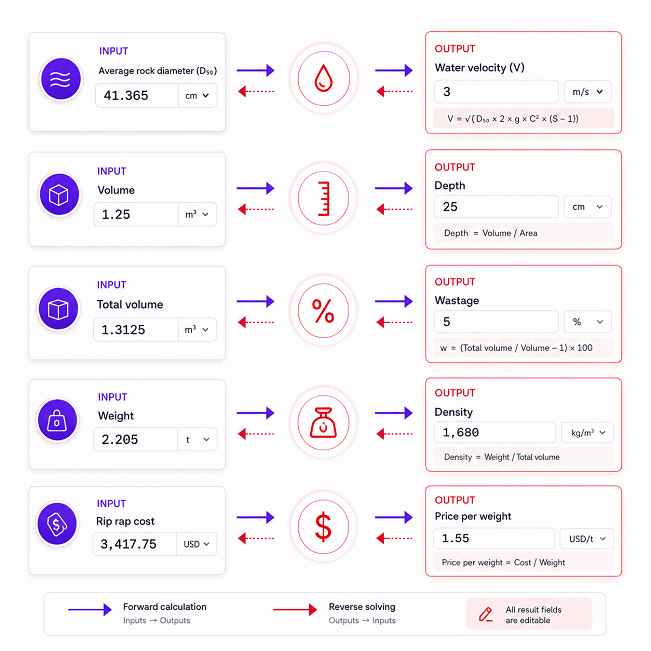
- Use reverse solving when D50, volume, weight, total volume, or cost is already known.
- Check supplier gradation, rock shape, density, delivery terms, and installation requirements before ordering.
- Consider filter layers, subgrade preparation, toe protection, slope conditions, and local hydraulic risks.
The Rip Rap Calculator is most useful as a planning and estimating tool. Reliable projects still depend on accurate site measurements, representative hydraulic conditions, suitable rock gradation, proper placement, and verification of critical site conditions.
Assumptions used in this calculator
- The Isbash relationship assumes representative average water velocity at the protected surface.
- The selected Isbash constant must match the expected water turbulence condition.
- Rock specific gravity represents the actual rip rap material being evaluated.
- Gravity defaults to 9.806 m/s² unless project conditions require another value.
- D50 represents the characteristic median rock diameter used for preliminary sizing.
- Rip rap depth is assumed uniform across the entered coverage area.
- Installed depth should be at least twice the calculated D50.
- Coverage area represents the actual surface requiring rip rap protection.
- Material volume assumes coverage area multiplied by uniform installed depth.
- Wastage increases calculated material volume by the entered project allowance.
- Rock density represents the bulk density of the selected rip rap.
- Results require site-specific verification for scour, gradation, placement, and channel geometry.
- Results are preliminary estimates, not substitutes for professional engineering design.
Results are rounded for display.
Internal calculations use full precision.
Formulas Used in Rip Rap Calculator :
1. Unit Normalization
2. Price per Mass Normalization
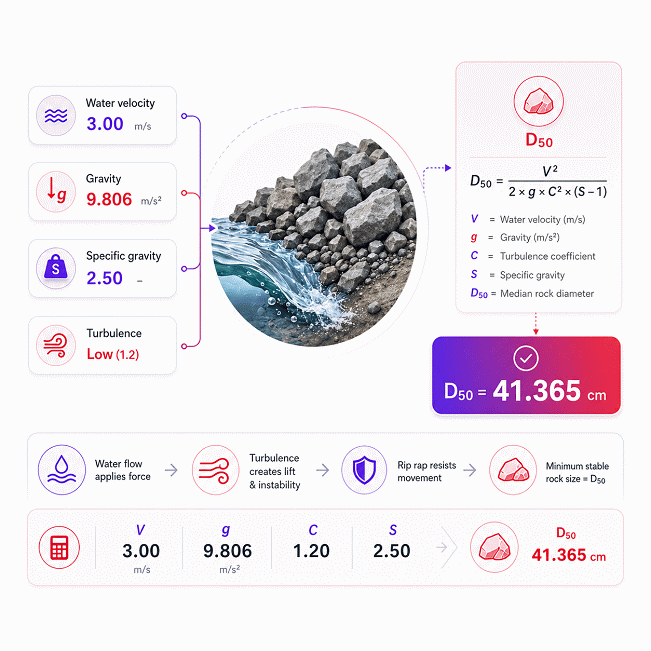
3. Average Rip Rap Rock Diameter
4. Minimum Rip Rap Depth Check
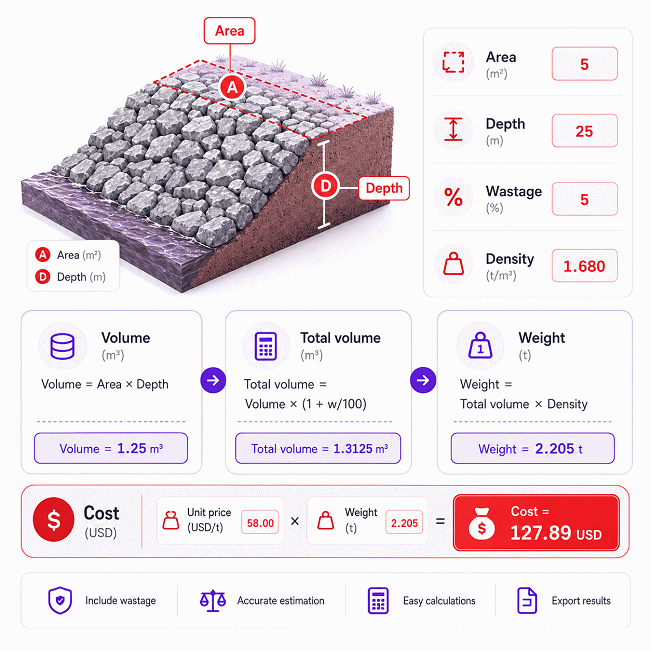
5. Rip Rap Volume
6. Total Volume Including Wastage
7. Rip Rap Weight
8. Estimated Rip Rap Cost
xb = value converted to the calculator base unit.
xu = value entered in the selected unit.
ku = conversion factor from the selected unit to its base unit.
pb = price per kilogram used internally for cost calculation.
pu = price entered per selected mass unit.
km = kilograms represented by one selected pricing mass unit.
D50 = median rip rap rock diameter in meters.
V = average water velocity in meters per second.
g = gravitational acceleration in meters per second squared.
C = Isbash constant, equal to 0.86 for highly turbulent flow or 1.20 for low turbulence.
S = dimensionless rock specific gravity.
d = installed rip rap depth in meters.
A = rip rap coverage area in square meters.
Vr = rip rap volume before wastage in cubic meters.
w = wastage allowance expressed as a percentage.
Vt = total required rip rap volume including wastage in cubic meters.
ρ = bulk density of the rip rap material in kilograms per cubic meter.
M = required rip rap mass in kilograms.
K = estimated rip rap material cost in the selected currency.
Reverse calculations use algebraic rearrangement of these same governing equations, so equivalent reverse forms are intentionally not duplicated. All calculations should retain full internal precision, unit conversion should occur before the governing calculation, and rounding should be applied only to the final displayed value. Displayed results in other units use the inverse of the applicable normalization factor.
Variables & Definitions
View a complete list of all variables used in this calculator, including definitions and units
Rip Rap Calculator Variables and Engineering Parameters
| Symbol | Variable | Base Unit | Definition and Use |
|---|---|---|---|
| xb | Base-unit value | Depends on quantity | The physical value converted to the calculator's internal base unit before calculation. |
| xu | Selected-unit value | User-selected unit | The numerical value entered or displayed in the unit selected by the user. |
| ku | Unit conversion factor | Conversion factor | The multiplier used to convert a selected-unit value to its corresponding internal base unit. |
| pb | Normalized price per mass | Currency/kg | The internally normalized material price per kilogram used to calculate total rip rap cost. |
| pu | Entered price per mass | Currency/selected mass unit | The material price entered by the user for the selected weight unit. |
| km | Pricing mass conversion factor | kg | The number of kilograms represented by one selected pricing mass unit. |
| D50 | Average rock diameter | m | The characteristic rip rap rock diameter calculated by the Isbash sizing relationship. |
| V | Water velocity | m/s | The average water velocity approaching or flowing through the rip rap installation area. |
| g | Gravitational acceleration | m/s² | The acceleration due to gravity used in the rock-sizing equation, with 9.806 m/s² used as the standard default. |
| C | Isbash constant | Dimensionless | The empirical flow-condition coefficient: 0.86 for highly turbulent flow or 1.20 for low turbulence. |
| S | Specific gravity | Dimensionless | The ratio of rock density to water density, typically around 2.50 to 3.00 for rip rap rock. |
| d | Rip rap depth | m | The installed thickness of the rip rap layer used with coverage area to determine material volume. |
| A | Coverage area | m² | The surface area that will be covered by the rip rap installation. |
| Vr | Rip rap volume | m³ | The calculated material volume before applying the project wastage allowance. |
| w | Wastage allowance | % | The percentage added to the calculated volume to account for material loss and installation allowance. |
| Vt | Total rip rap volume | m³ | The required rip rap volume after the selected wastage percentage has been included. |
| ρ | Rock bulk density | kg/m³ | The bulk density used to convert total rip rap volume into required material mass. |
| M | Rip rap mass | kg | The total required material mass calculated from total volume and rock bulk density. |
| K | Estimated material cost | Selected currency | The estimated rip rap material cost calculated from required mass and normalized price per mass. |
Unit Conversion Table
Water Velocity Unit Conversion Table
| Unit Group | Unit Name | Symbol | Equivalent in m/s | Used For |
|---|---|---|---|---|
| Popular Units | Meter per second | m/s | 1 | Water velocity |
| Popular Units | Foot per second | ft/s | 0.3048 | Water velocity |
| SI Units | Kilometer per hour | km/h | 0.2777777778 | Water velocity |
| SI Units | Centimeter per second | cm/s | 0.01 | Water velocity |
| Imperial / US Units | Mile per hour | mph | 0.44704 | Water velocity |
| Imperial / US Units | Knot | kn | 0.5144444444 | Water velocity |
| Oil & Industrial Units | Foot per minute | ft/min | 0.00508 | Water velocity |
Gravitational Acceleration Unit Conversion Table
| Unit Group | Unit Name | Symbol | Equivalent in m/s² | Used For |
|---|---|---|---|---|
| Popular Units | Meter per second squared | m/s² | 1 | Gravitational acceleration |
| Popular Units | Foot per second squared | ft/s² | 0.3048 | Gravitational acceleration |
| SI Units | Centimeter per second squared | cm/s² | 0.01 | Gravitational acceleration |
| Scientific Units | Galileo | Gal | 0.01 | Gravitational acceleration |
| Scientific Units | Standard gravity | g₀ | 9.80665 | Gravitational acceleration |
Rock Diameter and Rip Rap Depth Unit Conversion Table
| Unit Group | Unit Name | Symbol | Equivalent in m | Used For |
|---|---|---|---|---|
| Popular Units | Centimeter | cm | 0.01 | D50 and rip rap depth |
| Popular Units | Meter | m | 1 | D50 and rip rap depth |
| Popular Units | Inch | in | 0.0254 | D50 and rip rap depth |
| Popular Units | Foot | ft | 0.3048 | D50 and rip rap depth |
| SI Units | Millimeter | mm | 0.001 | D50 and rip rap depth |
| Imperial / US Units | Yard | yd | 0.9144 | D50 and rip rap depth |
Rip Rap Area Unit Conversion Table
| Unit Group | Unit Name | Symbol | Equivalent in m² | Used For |
|---|---|---|---|---|
| Popular Units | Square meter | m² | 1 | Coverage area |
| Popular Units | Square foot | ft² | 0.09290304 | Coverage area |
| Popular Units | Square yard | yd² | 0.83612736 | Coverage area |
| SI Units | Square centimeter | cm² | 0.0001 | Coverage area |
| SI Units | Hectare | ha | 10000 | Large coverage area |
| Imperial / US Units | Acre | acre | 4046.8564224 | Large coverage area |
Rip Rap Volume Unit Conversion Table
| Unit Group | Unit Name | Symbol | Equivalent in m³ | Used For |
|---|---|---|---|---|
| Popular Units | Cubic meter | m³ | 1 | Volume and total volume |
| Popular Units | Cubic foot | ft³ | 0.028316846592 | Volume and total volume |
| Popular Units | Cubic yard | yd³ | 0.764554857984 | Volume and total volume |
| SI Units | Liter | L | 0.001 | Volume and total volume |
| Imperial / US Units | US gallon | US gal | 0.003785411784 | Volume and total volume |
Rip Rap Density Unit Conversion Table
| Unit Group | Unit Name | Symbol | Equivalent in kg/m³ | Used For |
|---|---|---|---|---|
| Popular Units | Kilogram per cubic meter | kg/m³ | 1 | Rock bulk density |
| Popular Units | Pound per cubic foot | lb/ft³ | 16.018463374 | Rock bulk density |
| SI Units | Tonne per cubic meter | t/m³ | 1000 | Rock bulk density |
| SI Units | Gram per cubic centimeter | g/cm³ | 1000 | Rock material density |
| Imperial / US Units | Pound per cubic yard | lb/yd³ | 0.5932764213 | Rock bulk density |
| Oil & Industrial Units | Short ton per cubic yard | short ton/yd³ | 1186.5528425 | Bulk aggregate density |
Rip Rap Weight Unit Conversion Table
| Unit Group | Unit Name | Symbol | Equivalent in kg | Used For |
|---|---|---|---|---|
| Popular Units | Kilogram | kg | 1 | Rip rap weight |
| Popular Units | Metric tonne | t | 1000 | Rip rap weight |
| Popular Units | Pound | lb | 0.45359237 | Rip rap weight |
| Popular Units | Short ton | short ton | 907.18474 | Rip rap weight |
| SI Units | Gram | g | 0.001 | Small mass values |
| Imperial / US Units | Long ton | long ton | 1016.0469088 | Rip rap weight |
Price per Weight Unit Conversion Table
| Unit Group | Unit Name | Symbol | Equivalent in Currency/kg | Used For |
|---|---|---|---|---|
| Popular Units | Currency per metric tonne | Currency/t | 0.001 Currency/kg | Rip rap material pricing |
| Popular Units | Currency per short ton | Currency/short ton | 0.0011023113 Currency/kg | Rip rap material pricing |
| SI Units | Currency per kilogram | Currency/kg | 1 Currency/kg | Rip rap material pricing |
| Imperial / US Units | Currency per pound | Currency/lb | 2.2046226218 Currency/kg | Rip rap material pricing |
| Imperial / US Units | Currency per long ton | Currency/long ton | 0.0009842065 Currency/kg | Rip rap material pricing |
Example Calculation
Given Values
Formula
Solution
Results
The hydraulic inputs produce a calculated D50 of approximately 6.953 cm.
The selected 0.30 m layer depth exceeds twice the calculated D50.
A 7% allowance increases the required volume from 21.600 to 23.112 m³.
Using the entered density and price gives approximately 38.828 t and 2,252.03 USD.
Complete Calculation Relationships
Entering D50 instead of water velocity allows the supported velocity to be solved directly.
A known volume and coverage area can be reversed to determine installation depth.
Total volume, weight, and cost can likewise solve wastage, density, and unit price.
Full internal precision is retained before the final displayed values are rounded.
Results are rounded for display.
Internal calculations use full precision.
Calculations Disclaimer
What Does a Rip Rap Calculator Help You Decide Before Work Begins?
A wrong material estimate can delay an entire erosion-control project. A Rip Rap Calculator helps reduce that risk before ordering begins. The Rip Rap Calculator connects hydraulic conditions with material quantity and project cost. It can estimate rock size, required volume, total material weight, and budget needs.
The main value is faster decision-making. You can test project conditions before contacting a supplier. You can also compare several installation depths or material densities. That makes early planning easier and more consistent.
The tool is useful for shorelines, drainage channels, embankments, slopes, and streambanks. It can also support preliminary planning around culverts and outlets. The result gives you a clearer starting point for purchasing and site preparation.
Most users begin with one simple question: how much rock is actually needed? That question quickly becomes more complex. Rock size, layer depth, density, wastage, and site conditions all matter. A useful calculator brings those decisions into one workflow.
For simple projects, this can save several manual calculations. For larger projects, it helps organize data before engineering review. That reduces confusion between contractors, estimators, suppliers, and project owners.
Why Can the Correct Rip Rap Size Change So Quickly?
A small change in water conditions can change the required rock size. This often surprises first-time users. Faster water transfers more energy to exposed stones. Larger stones are usually needed when that hydraulic force increases.
Rock properties also matter. Heavier stone can resist movement differently than lighter material. Flow condition matters as well. Calm movement and highly disturbed flow do not affect a rock layer equally.
This is why visual judgment alone can be risky. A stone may look large beside a person. It may still be unsuitable for the expected hydraulic condition.
The calculator gives a repeatable sizing process. That is useful during early design and purchasing discussions. It also makes alternative project conditions easier to compare.
Fast water → greater hydraulic demand → larger stable rock → stronger erosion protection.
This relationship should guide the first sizing decision. Site geometry must still be reviewed separately. Bends, drops, outlets, steep banks, and concentrated flow can increase local stress.
What Does D50 Tell You About a Rip Rap Layer?
A common mistake is treating D50 as one required stone size. It is better understood as a characteristic size within the rock mixture. A properly graded rip rap layer normally contains different stone sizes.
D50 helps describe the central size of that distribution. It does not mean every installed rock should match one diameter. Larger and smaller stones help create interlock and reduce open movement paths.
This distinction matters when ordering from a quarry. A supplier may sell rock by class or gradation. The available product may not be described only by one D50 value.
Use the calculated D50 as a sizing reference. Then compare it with the supplier’s actual gradation data. This gives a more realistic purchasing decision than selecting single-size stones.
When specifications control the project, those specifications should take priority. The calculator remains valuable for estimating and checking expected scale.
Why Does Water Velocity Matter More Than Rock Appearance?
A large-looking stone can still move when water forces become high. Water velocity is therefore a critical project input. It represents the hydraulic demand acting on the protective rock layer.
The most useful velocity is the one representing the protected location. A general upstream average may hide a stronger local condition. Channel bends can increase attack on one bank. Culvert outlets can create concentrated high-energy flow.
Users should avoid selecting a convenient velocity without site context. That can create false confidence. A conservative design condition may be more appropriate for important projects.
The calculator makes sensitivity testing easy. Enter different expected flow conditions and compare the resulting rock size. This quickly shows how vulnerable the selection is to changing water conditions.
This simple test can reveal an important warning. If small velocity changes create much larger stones, engineering review becomes more valuable.
How Do Rock Properties Change Hydraulic Stability?
Two stones of similar size may behave differently in flowing water. Their material properties can change resistance to movement. Dense rock generally performs differently from lower-density material.
Shape also matters in real installations. Angular stone tends to interlock more effectively. Rounded material can have fewer mechanical locking points. That can reduce stability in demanding flow conditions.
Durability is another concern. Rock that breaks during handling can change the installed gradation. Weathering can also weaken unsuitable material over time.
For purchasing, do not judge quality from color or appearance alone. Ask for the available rock class and material information. Compare that information with the project requirement.
Good rip rap is not simply heavy decorative stone. It is part of an erosion-control system. Its size, shape, grading, durability, and placement all affect performance.
Why Does Turbulence Change the Rock Sizing Decision?
A calm-looking average velocity can hide severe local turbulence. Turbulent water creates unstable force directions around exposed rocks. That can increase the chance of movement.
Locations near outlets deserve special attention. Sudden contractions can also create disturbed flow. Drops, transitions, structures, and rough channel geometry can increase turbulence.
The calculator allows the flow condition to influence the sizing process. The selected condition should reflect the actual project environment. Choosing the less demanding condition only to obtain smaller stones defeats the purpose.
If the site has obvious hydraulic disturbance, treat that as a design signal. The same project may require a different solution near critical zones.
This is where experienced field observation matters. Calculator output becomes more useful when the input reflects real hydraulic behavior.
How Much Rip Rap Do You Actually Need to Order?
Under-ordering creates downtime, extra freight, and inconsistent installation. Over-ordering creates unnecessary cost and leftover material. Quantity planning must therefore start with the actual protected surface.
The calculator connects coverage area with installation depth. This produces the core material volume. A wastage allowance can then account for realistic field conditions.
That volume can be converted into required weight using material density. This is important because suppliers often sell rock by weight. The construction drawing may describe the work by area and thickness instead.
Area → layer depth → material volume → wastage → delivery weight → project cost.
This workflow connects design intent with purchasing language. It also helps estimators check supplier quotations.
Always measure the real protected surface. Sloped banks can contain more area than their horizontal footprint suggests. Ignoring that difference can reduce the ordered quantity significantly.
Why Does Installation Depth Affect More Than Material Cost?
A shallow rock layer may use less material but perform poorly. Layer depth influences how the stones form a stable protective system. It also changes the project volume directly.
Depth should therefore never be selected only to reduce cost. The installed layer must support the chosen rock gradation. Large stones need enough thickness for proper placement and interlock.
Uneven subgrade can also change actual material demand. Depressions may consume more rock than the simple design thickness suggests. Poor preparation can increase this effect.
For estimating, use the planned finished depth across the measured area. Then include realistic field allowance. During installation, verify the finished condition rather than relying only on delivered tonnage.
The cheapest layer on paper can become expensive after repair. Adequate thickness is part of long-term performance.
Why Can Delivered Tonnage Differ from a Volume Estimate?
A contractor may calculate the volume correctly and still receive unexpected tonnage. The reason is often material density. Bulk rock contains both stone and void space.
Different gradations create different void structures. Angularity can also affect packing. Moisture, quarry source, and handling may change measured delivery conditions.
This means one universal tons-per-volume value is risky. The project should use a representative density for the material being ordered.
Supplier data is especially useful near purchasing time. If the quarry provides a reliable bulk conversion, use that information for the final order check.
The calculator makes this easy because density can be changed. You can compare a light and heavy material before choosing a supplier.
That small check can prevent a large purchasing error on high-volume projects.
How Should Wastage Be Treated During Material Planning?
Perfect theoretical coverage rarely happens on a construction site. Irregular surfaces can consume additional material. Handling can also create losses or redistribution.
Wastage should represent real project uncertainty. It should not be used as a random safety number. Steep slopes, irregular banks, difficult access, and rough subgrade can justify more allowance.
A controlled site may need less contingency. A complex shoreline can need more. The best estimate reflects construction conditions rather than habit.
Keep the base quantity visible before adding wastage. This helps reviewers understand where the extra material comes from. It also makes supplier discussions clearer.
When the project is expensive, compare several wastage scenarios. The resulting cost difference can support a better contingency decision.
Can Reverse Solving Save Time During Rip Rap Planning?
Projects do not always begin with the ideal set of inputs. Sometimes the known value is an available rock size. Sometimes the available quantity is fixed. Reverse solving helps work backward from those known conditions.
This feature changes the calculator from a simple estimator into a planning tool. A known rock size can be used to investigate suitable hydraulic conditions. A known material volume can help determine achievable coverage depth.
Known delivery weight can also support density checks. Known project cost can help investigate the implied material price.
The main benefit is faster comparison. Users do not need to rearrange engineering relationships manually. They can test the available project constraint directly.
This is especially useful during procurement. Contractors often know what material is locally available before design choices are finalized.
How Can Known Rock Size Help Evaluate Water Conditions?
A quarry may offer a fixed rip rap class with limited alternatives. The question then changes. Instead of asking which rock size is needed, ask what condition that rock can support.
Reverse solving helps explore that relationship. It can be useful during preliminary supplier selection. It can also show whether an available class appears far below project demand.
This should not be treated as proof of site safety. Real hydraulic systems contain local effects that simple sizing relationships cannot capture.
Still, the comparison has strong planning value. A clearly inadequate available stone can be rejected early. That prevents wasted time requesting detailed quotations for unsuitable material.
When available rock is close to the estimated requirement, deeper engineering review becomes more important.
How Can Known Volume Help Find a Practical Installation Depth?
Sometimes a site already has a fixed quantity of material available. The project team then needs to understand what that stockpile can cover.
If the protected area is known, reverse solving can estimate achievable layer depth. This is useful for budgeting and staging. It can also expose an obvious material shortage before mobilization.
Do not reduce required depth merely to consume existing stock. The reverse result should be compared with the required installation condition.
This distinction protects the project from a common mistake. Available material does not define required engineering performance.
If calculated achievable depth is too low, increase the order. If significant material remains, consider approved additional coverage rather than uncontrolled overplacement.
How Can Weight and Cost Data Reveal Purchasing Errors?
A quotation may look reasonable until weight and price are checked together. Reverse calculations can expose unexpected unit pricing or density assumptions.
For example, a delivered total weight can be compared with estimated volume. This helps identify the implied bulk density. A total quotation can also reveal the effective price per weight.
These checks are valuable when comparing suppliers. One quote may include delivery while another excludes it. Another may use different ton units or material classes.
Keep freight, taxes, placement, fabric, excavation, and rock material separated. This improves purchasing clarity.
A calculator cannot negotiate the contract. It can make hidden assumptions easier to see. That alone can prevent expensive misunderstandings.
What Makes a Rip Rap Purchase Estimate More Reliable?
A low price per ton can become expensive after transportation. Rock is heavy, so hauling distance can dominate project cost. Buyers should therefore compare delivered value, not only quarry price.
First confirm the required rock class. Then confirm estimated tonnage. After that, compare delivery conditions, truck capacity, access, and unloading limits.
Material quality should remain separate from freight cost. The cheapest delivered option is not useful if the stone does not meet project needs.
Ask suppliers for clear material identification. Confirm whether pricing uses metric tonnes, short tons, or another basis. Verify whether the quoted quantity includes expected delivery variation.
For larger projects, stage deliveries around installation progress. This reduces congestion and unnecessary stockpiling.
A good estimate supports a better purchase decision. It should connect technical demand with real procurement conditions.
What Should You Check Before Ordering Rip Rap from a Supplier?
The most expensive mistake often happens before the first truck arrives. Buyers should confirm exactly what material will be delivered.
- Confirm the specified or required rock class.
- Check whether the stone is angular and durable.
- Verify the supplier’s grading information.
- Confirm the pricing weight basis.
- Check delivery charges and minimum order quantity.
- Review truck access and unloading conditions.
- Confirm expected delivery timing for the project.
Photos can help with visual screening. They cannot replace material specifications when those are required.
Large orders deserve tighter verification. A small misunderstanding multiplied across many truckloads becomes costly quickly.
Why Is Rip Rap Gradation More Important Than One Stone Size?
A single calculated diameter does not describe an entire rock layer. Real rip rap normally uses a range of stone sizes. That distribution is called gradation.
Smaller stones help fill spaces between larger pieces. Larger stones provide greater resistance at exposed locations. Together, they can form a better interlocked armor layer.
Poor gradation can create excessive open voids. It can also produce weak contact between stones. This may reduce stability even when some individual rocks are large.
Purchasing decisions should therefore consider the supplied gradation. Do not assume every product labeled rip rap has equivalent performance.
For regulated projects, follow the required specification. For private work, supplier gradation data still improves confidence.
Why Can Good Rock Still Fail After Installation?
Large stone does not guarantee a stable project. Failure can begin underneath the visible rock. Soil migration is one common cause.
Water can move fine soil through large stone voids. This may create hidden loss beneath the armor layer. The surface can then settle or collapse.
A compatible filter layer helps separate the rock from the underlying soil. This may be granular material or suitable geotextile. The correct choice depends on the site.
Toe support also matters. If erosion removes support at the bottom, upper stones can move downward. Steep banks can increase this risk.
Rock size → filter system → toe support → placement quality → long-term stability.
Think of rip rap as a system, not a pile of stones. That mindset prevents many field failures.
Why Does the Surface Beneath Rip Rap Need Preparation?
Dumping rock onto an unstable surface can hide problems temporarily. Poor subgrade preparation may later produce settlement or uneven thickness.
Loose material should be addressed before placement. The intended slope should also be formed correctly. Sharp irregularities can create weak zones in the finished armor.
The filter layer needs proper contact with the prepared surface. Wrinkles, tears, exposed gaps, or displaced fabric can reduce protection.
Placement method also matters. Large rocks can damage sensitive geotextiles when dropped from excessive height.
A well-prepared base makes quantity estimates more accurate too. Severe surface irregularity increases actual rock demand.
Good preparation is rarely visible after completion. Yet it often determines whether the installation remains stable.
What Are the Most Common Rip Rap Calculation Mistakes?
A calculation can look precise while using the wrong project information. That creates false confidence. Several mistakes appear repeatedly in real estimating work.
- Using horizontal area for a steep sloped surface.
- Ignoring local high-velocity zones near structures.
- Using particle density instead of bulk material density.
- Treating D50 as the only required stone size.
- Choosing layer depth only from budget limits.
- Forgetting filter and toe protection requirements.
- Assuming every supplier uses the same ton definition.
- Ignoring delivery access when estimating final project cost.
The fastest way to improve accuracy is simple. Check each input against a real project measurement or supplier document.
Where Does Rip Rap Work Best for Erosion Control?
Erosion problems are rarely identical from one site to another. Rip rap works best where durable rock armor matches the hydraulic problem.
Common applications include streambanks, shorelines, drainage channels, ditches, slopes, culvert zones, and outlet areas. It can also protect embankments exposed to moving water.
The system is especially useful when vegetation alone cannot resist expected flow. It can also provide immediate physical protection after installation.
However, rock is not always the best answer. Some sites may need combined vegetation, structural drainage, retaining systems, or other erosion controls.
The key question is not whether rip rap is popular. The question is whether it addresses the actual failure mechanism at the site.
That decision should come before material ordering.
What Changes When Rip Rap Is Installed on a Shoreline?
Shoreline projects face more than one type of water movement. Waves can repeatedly load and unload the rock face. Changing water levels can expose different parts of the bank.
Boat wakes may also increase local disturbance. Freeze-thaw conditions can affect some sites. A soft shoreline may need careful filter and toe treatment.
Measure the actual sloping surface before estimating quantity. Do not use only the plan-view area. Also identify the upper and lower limits of protection.
Access can become a major cost factor. Large rock often requires heavy equipment near the water edge.
A clear calculator estimate helps plan material. Site-specific shoreline behavior still controls the final installation approach.
What Changes When Rip Rap Protects a Channel or Culvert?
A drainage outlet can look harmless during dry weather. During storms, the hydraulic condition can change within minutes.
Concentrated flow can create strong local attack. Culvert outlets may also create turbulence and downstream scour. Channel bends can redirect forces toward one bank.
Do not assume one uniform condition across the entire protected reach. Critical zones may require special treatment.
Transition areas deserve attention too. Erosion can begin where rock protection ends. Poor termination can simply move the problem downstream.
For quantity planning, divide complex areas into measurable sections. Estimate each section separately. This improves both ordering and installation control.
When Should a Calculator Stop and Engineering Review Begin?
Some projects carry consequences that exceed simple material estimating. Bridge protection is one example. Major channels and high-energy waterways are others.
Complex scour, steep slopes, flood conditions, structures, and public infrastructure need deeper review. Local regulations may also control material size and installation details.
A calculator is strongest when it answers a defined planning question. It becomes weaker when unknown site behavior controls the result.
Watch for warning signs. These include severe turbulence, changing channel geometry, active toe erosion, unstable soil, or repeated past failure.
Also seek review when the project protects buildings, roads, utilities, or public safety.
The smartest decision is sometimes identifying where simple estimating should end.
How Can You Turn the Calculator Result into a Better Project Decision?
A result has little value unless it changes the next project action. Start by checking whether the required stone size is locally available. Then compare the required quantity with realistic supplier delivery options.
Next, review layer depth and the actual protected area. Confirm that filter and subgrade needs are included in planning. Then compare delivered material cost, not only rock price.
Use alternative scenarios when uncertainty exists. Test higher flow demand. Test another material density. Test a greater installation depth. Compare the effect on tonnage and budget.
This process turns one result into a decision range. That is more useful than treating one number as absolute truth.
A well-planned rip rap project connects hydraulic need, material supply, installation quality, and purchasing control. AxiCalculator brings those planning steps into one practical workflow.
Frequently Asked Questions
How many truckloads should I schedule from a calculated rip rap tonnage?
What should I do if a supplier sells rip rap by the truckload instead of by ton?
Can one rip rap estimate cover several separate protection zones on the same site?
How should I update the estimate if field dimensions change after excavation?
How should engineers handle uncertain rock specific gravity when quarry test data are unavailable?
What if short-duration peak flow is much faster than the average design velocity?
How can engineers use the first installed section to improve the remaining rip rap estimate?
Our engineers are here to help you get it right.