Tonnage Calculator
- Last formula update:

Decimal & Rounding Policy
- Calculations retain full internal precision for area, volume, unit weight, tonnage, wastage, and cost.
- Rounding is applied only to displayed values, never during intermediate calculation steps.
- Results use practical decimal precision based on value size while avoiding unnecessary trailing zeros.
- Unit conversions are completed before rounding to reduce cumulative conversion and tonnage estimation errors.
- Cost calculations use the unrounded required weight, including the selected wastage percentage.
- For purchasing or project estimates, use supplier-specific unit weight and appropriate material allowances.
Valid range
- Unit weight: Must be greater than 0 kg/m³ and represent the selected material’s bulk density.
- Length: Must be greater than 0 and within a physically meaningful project dimension.
- Width: Must be greater than 0 and is used with length to calculate rectangular area.
- Area: Must be greater than 0 and may be entered directly or calculated from length × width.
- Depth: Must be greater than 0 and represents the installed thickness of the aggregate layer.
- Volume: Must be greater than 0 and follows Volume = Area × Depth.
- Tonnage: Must be greater than 0 and follows Mass = Volume × Unit Weight.
- Wastage: Must range from 0% to 100% and is applied after the base tonnage calculation.
- Weight needed: Must be greater than 0 and includes the selected wastage allowance.
- Price per unit weight: Must be 0 or greater and use a compatible mass unit.
- Total cost: Must be 0 or greater and is calculated from required weight × unit price.

Reviewers:
Elvarine Jexmont
Fenrick Zorquell
Check our editorial policy
August 14, 2026
1.0.0
Initial calculator and formula release.
Our engineers are here to help you get it right.
How Does a Tonnage Calculator Estimate Material Requirements?
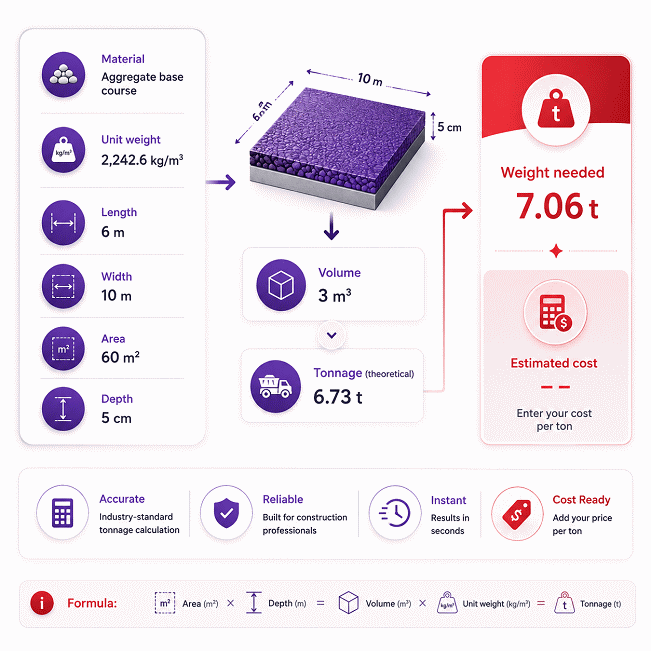
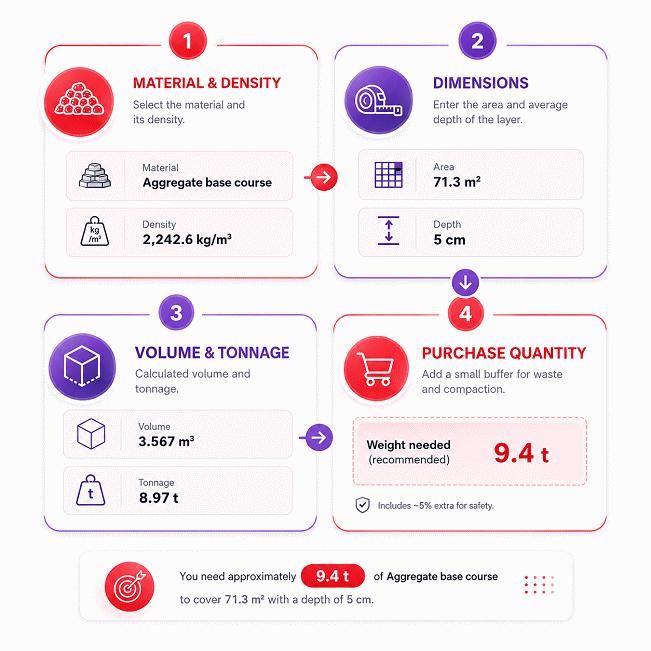
Tonnage Calculator results become reliable when project dimensions, material depth, and bulk density describe the same physical conditions. The calculation begins with project area, converts that area into material volume, and then uses unit weight to estimate material mass.
- Length and width define the project area when area is not entered directly.
- Area and material depth determine the total volume that must be filled.
- Material unit weight converts calculated volume into the estimated base tonnage.
- Bulk density can change with material type, grading, moisture, and compaction condition.
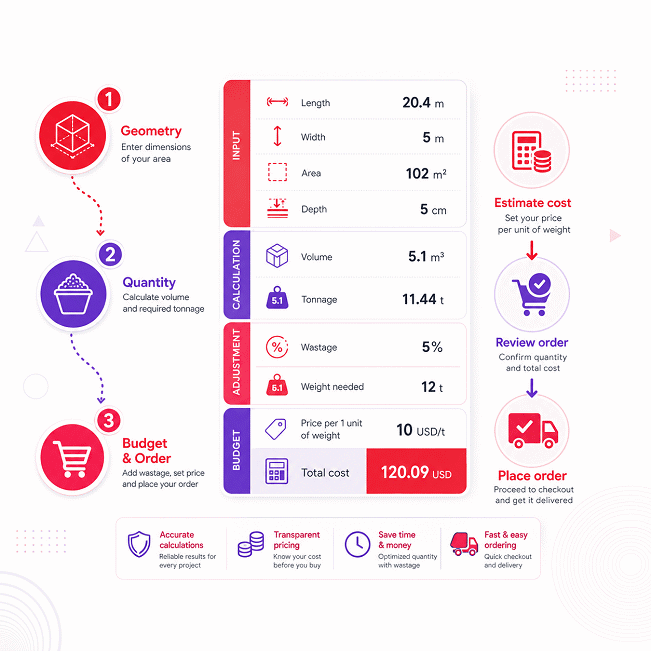
- A wastage allowance increases the theoretical mass to estimate the quantity to purchase.
- Price per weight unit can be applied to estimate the total material cost.
- Metric tonnes and US short tons must remain clearly distinguished during ordering.
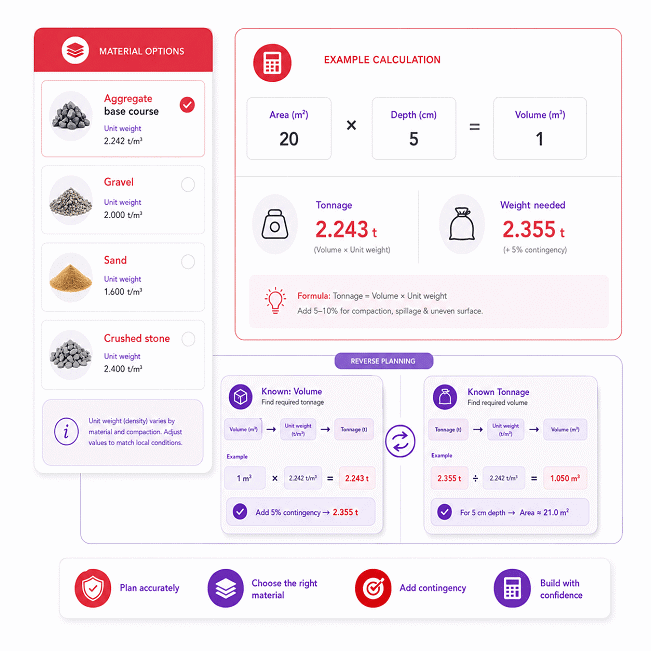
- Reverse solving can estimate depth, volume, area, or dimensions from known material quantities.
- Irregular sites should be divided into simpler areas for more dependable quantity estimates.
The Tonnage Calculator is most useful when supplier-specific density data and accurate site measurements are available. Before ordering material, confirm the selected product, expected compaction condition, delivery unit, project depth, and supplier pricing basis to reduce shortages, excess material, and avoidable project costs.
Assumptions used in this calculator
- Material unit weight represents bulk density under the selected material condition.
- Project dimensions represent uniform rectangular coverage unless values are entered directly.
- Depth is assumed uniform across the entire calculated material area.
- Length, width, area, and depth describe the same project region.
- Material volume excludes settlement changes unless reflected in the entered density.
- Wastage is applied after calculating the theoretical material mass.
- Entered prices apply to the selected mass unit without additional charges.
- Taxes, delivery, labor, and equipment costs are excluded unless included manually.
- Material density may vary with moisture, gradation, compaction, and supplier specifications.
- Unit conversions preserve the physical quantity before display rounding is applied.
- Intermediate calculations retain full precision and are not rounded between steps.
- Reverse calculations assume all known values describe one physically consistent scenario.
- Final estimates should be verified against project specifications and supplier data.
Results are rounded for display.
Internal calculations use full precision.
Formulas Used in Tonnage Calculator :
1. Unit Normalization
2. Surface Area
3. Material Volume
4. Material Mass
5. Required Weight with Wastage
6. Total Material Cost
Variables
- xu
- Measurement expressed in the unit selected by the user.
- ku
- Conversion factor from the selected unit to the calculator's corresponding base SI unit.
- xb
- Measurement converted to its corresponding base SI unit.
- l
- Normalized project length.
- w
- Normalized project width.
- A
- Surface area covered by the material.
- d
- Normalized material depth or layer thickness.
- V
- Material volume.
- γ
- Material unit weight or bulk density.
- M
- Calculated material mass before wastage.
- p
- Wastage allowance expressed as a percentage.
- Mreq
- Total material weight required after applying wastage.
- fp
- Mass in kilograms represented by one selected pricing weight unit.
- P
- Price per one selected unit of weight.
- C
- Total estimated material cost in the selected currency.
Reverse calculations use algebraic inversion of these same equations, so no duplicate reverse formulas are required. All unit conversions are completed before calculation, intermediate values retain full precision, and rounding is applied only to displayed results.
Variables & Definitions
View a complete list of all variables used in this calculator, including definitions and units
Tonnage Calculator Variables and Measurement Parameters
| Variable | Parameter | Description | Base Unit |
|---|---|---|---|
| xu | Selected-unit value | Measurement entered or displayed in the unit selected by the user. | Selected unit |
| ku | Unit conversion factor | Factor used to convert a selected measurement unit into its corresponding base SI unit. | Unit-dependent |
| xb | Base-unit value | Physical measurement after conversion to the calculator's corresponding base SI unit. | Base SI unit |
| l | Length | Normalized project length used with width to determine the covered surface area. | m |
| w | Width | Normalized project width used with length to determine the covered surface area. | m |
| A | Area | Surface area covered by the material, entered directly or calculated from length and width. | m² |
| d | Depth | Normalized material layer thickness used with area to determine material volume. | m |
| V | Volume | Total geometric volume of material required before converting volume into material mass. | m³ |
| γ | Unit weight | Material unit weight or bulk density used to convert material volume into mass. | kg/m³ |
| M | Material mass | Calculated material mass before the wastage allowance is applied. | kg |
| p | Wastage | Percentage allowance added to the calculated material mass for purchasing requirements. | % |
| Mreq | Required weight | Total material weight required after applying the selected wastage percentage. | kg |
| fp | Pricing-unit mass factor | Mass in kilograms represented by one unit of the selected pricing weight unit. | kg per pricing unit |
| P | Unit price | Material price entered for one selected unit of weight. | Currency per weight unit |
| C | Total cost | Estimated material cost based on required weight and the entered price per weight unit. | Selected currency |
Unit Conversion Table
Length, Width, and Depth Unit Conversion Table
| Unit Group | Unit Name | Symbol | Equivalent in m | Used For |
|---|---|---|---|---|
| Popular Units | Meter | m | 1 m | Length, Width, Depth |
| Popular Units | Foot | ft | 0.3048 m | Length, Width, Depth |
| Popular Units | Inch | in | 0.0254 m | Length, Width, Depth |
| SI Units | Millimeter | mm | 0.001 m | Depth, Length, Width |
| SI Units | Centimeter | cm | 0.01 m | Depth, Length, Width |
| SI Units | Kilometer | km | 1000 m | Large Project Dimensions |
| Imperial / US Units | Yard | yd | 0.9144 m | Length, Width, Depth |
| Imperial / US Units | Mile | mi | 1609.344 m | Large Project Dimensions |
Area Unit Conversion Table
| Unit Group | Unit Name | Symbol | Equivalent in m² | Used For |
|---|---|---|---|---|
| Popular Units | Square Meter | m² | 1 m² | Surface Area |
| Popular Units | Square Foot | ft² | 0.09290304 m² | Surface Area |
| Popular Units | Square Yard | yd² | 0.83612736 m² | Surface Area |
| SI Units | Square Centimeter | cm² | 0.0001 m² | Small Surface Areas |
| SI Units | Hectare | ha | 10000 m² | Large Project Areas |
| SI Units | Square Kilometer | km² | 1000000 m² | Very Large Areas |
| Imperial / US Units | Square Inch | in² | 0.00064516 m² | Small Surface Areas |
| Imperial / US Units | Acre | acre | 4046.8564224 m² | Land and Large Project Areas |
Volume Unit Conversion Table
| Unit Group | Unit Name | Symbol | Equivalent in m³ | Used For |
|---|---|---|---|---|
| Popular Units | Cubic Meter | m³ | 1 m³ | Material Volume |
| Popular Units | Cubic Foot | ft³ | 0.028316846592 m³ | Material Volume |
| Popular Units | Cubic Yard | yd³ | 0.764554857984 m³ | Aggregate Volume |
| SI Units | Liter | L | 0.001 m³ | Small Material Volumes |
| SI Units | Cubic Centimeter | cm³ | 0.000001 m³ | Very Small Volumes |
| Imperial / US Units | Cubic Inch | in³ | 0.000016387064 m³ | Small Volumes |
| Imperial / US Units | US Gallon | US gal | 0.003785411784 m³ | US Volume Reference |
| Oil & Industrial Units | Oil Barrel | bbl | 0.158987294928 m³ | Industrial Volume Reference |
| Oil & Industrial Units | Acre-Foot | acre-ft | 1233.48183754752 m³ | Large Earthwork Volumes |
Material Unit Weight Conversion Table
| Unit Group | Unit Name | Symbol | Equivalent in kg/m³ | Used For |
|---|---|---|---|---|
| Popular Units | Kilogram per Cubic Meter | kg/m³ | 1 kg/m³ | Material Unit Weight |
| Popular Units | Metric Tonne per Cubic Meter | t/m³ | 1000 kg/m³ | Bulk Material Density |
| Popular Units | Pound per Cubic Foot | lb/ft³ | 16.01846337396 kg/m³ | US Aggregate Unit Weight |
| SI Units | Gram per Cubic Centimeter | g/cm³ | 1000 kg/m³ | Material Density |
| SI Units | Kilogram per Liter | kg/L | 1000 kg/m³ | Material Density |
| Imperial / US Units | Pound per Cubic Yard | lb/yd³ | 0.593276421258 kg/m³ | Aggregate Bulk Density |
| Oil & Industrial Units | Pound per US Gallon | lb/US gal | 119.826427316897 kg/m³ | Industrial Density Reference |
| Oil & Industrial Units | US Ton per Cubic Yard | US ton/yd³ | 1186.552842515565 kg/m³ | Bulk Aggregate Unit Weight |
Tonnage, Required Weight, and Pricing Weight Unit Conversion Table
| Unit Group | Unit Name | Symbol | Equivalent in kg | Used For |
|---|---|---|---|---|
| Popular Units | Metric Tonne | t | 1000 kg | Tonnage, Required Weight, Unit Price |
| Popular Units | US Short Ton | US ton | 907.18474 kg | Tonnage, Required Weight, Unit Price |
| Popular Units | Kilogram | kg | 1 kg | Tonnage, Required Weight, Unit Price |
| Popular Units | Pound | lb | 0.45359237 kg | Tonnage, Required Weight, Unit Price |
| SI Units | Gram | g | 0.001 kg | Small Material Weights |
| Imperial / US Units | Long Ton | long ton | 1016.0469088 kg | Imperial Material Weight |
| Imperial / US Units | Ounce | oz | 0.028349523125 kg | Small Weight Reference |
| Oil & Industrial Units | US Hundredweight | US cwt | 45.359237 kg | Industrial Material Weight |
| Oil & Industrial Units | UK Hundredweight | UK cwt | 50.80234544 kg | Industrial Material Weight |
| Oil & Industrial Units | Kip | kip | 453.59237 kg | Industrial Weight Reference |
Example Calculation
The 18.6 m by 7.4 m project covers 137.64 m² with a uniform 0.12 m material depth.
At 1,650 kg/m³, the calculated material volume produces a base mass of 27.25272 metric tonnes.
An 8% wastage allowance increases the purchasing requirement to 29.4329376 metric tonnes.
The calculator keeps full internal precision and rounds only the displayed purchasing and cost results.
In this reverse calculation, the required purchasing weight is known while the material depth is unknown.
The wastage allowance is removed first to recover the theoretical base mass before converting mass into volume.
The calculated volume is divided by the known project area to solve the required material depth.
The same physical relationships are preserved in both forward and reverse solving without changing the calculation model.
Results are rounded for display.
Internal calculations use full precision.
Calculations Disclaimer
What Does a Tonnage Calculator Actually Calculate?
A material order can fail when volume and weight are treated as identical. A Tonnage Calculator converts measured project geometry into an estimated material mass. The Tonnage Calculator also helps connect that mass with purchasing needs and cost. This matters because suppliers often sell aggregate by weight. Your site measurements usually describe space instead.
The calculation follows a clear physical chain. Project dimensions define the covered area. Area and layer depth define material volume. Material density then links that volume to mass. A purchasing allowance can increase the final required quantity. Price data can then estimate the material budget.
This process works for gravel, crushed stone, sand, road base, granite, and similar materials. The most important input is not always the largest measurement. Material condition can change the result significantly. Loose material may occupy more space than compacted material. Moisture can also change measured weight.
The useful result is therefore more than one number. It connects geometry, material condition, purchasing quantity, and project cost. That connection helps contractors and homeowners plan before requesting a supplier quote.
How Is Aggregate Tonnage Calculated from Project Dimensions?
A project often begins with only length, width, and intended layer thickness. Those dimensions must describe the same physical area. Otherwise, the final tonnage can look precise while being wrong.
Start by defining the footprint that will receive material. Then determine the finished layer depth. The geometry produces the volume that must be filled. Material unit weight then converts that occupied space into mass.
This sequence is important because tonnage does not come directly from square footage. Two projects can have equal areas but very different material requirements. A deeper layer needs more volume. A denser material also produces more weight inside that volume.
The best workflow keeps each stage visible. This makes unusual results easier to catch. If the calculated mass seems too high, check depth first. Then check the selected material density. If the volume looks wrong, review the project dimensions.
This simple review can prevent expensive ordering errors. It also makes the estimate easier to explain to a supplier or project manager.
How to Calculate Surface Area from Length and Width
A common mistake begins when site dimensions are measured from different boundaries. Length and width must represent the same rectangular working area.
For a rectangular surface, the two dimensions define its footprint. Measure both along the actual material limits. Avoid measuring from landscaping edges that will not receive material.
Large sites should be divided when their shape changes. A driveway may contain a main rectangle and a wider parking section. Treating both as one rough rectangle can create unnecessary over-ordering.
Irregular projects also benefit from smaller zones. Break the site into simple shapes. Determine each area separately. Then combine the areas before estimating material depth.
Direct area entry is useful when the total area is already known. This prevents repeated measurement work. It also supports drawings, survey data, or existing construction plans.
The goal is simple. Make the calculated footprint match the real surface receiving material. Every later result depends on that first geometric decision.
How to Calculate Material Volume from Area and Depth
A thin-looking layer can require surprising material across a large site. Depth controls how much three-dimensional space the aggregate must fill.
Use the intended material thickness across the measured area. A consistent depth produces the cleanest estimate. Real sites rarely remain perfectly uniform, however. Low areas, soft spots, and existing grades can consume extra material.
For uneven ground, one depth reading is risky. Measure several locations across the project. This reveals whether a single depth is representative.
The depth used for planning should match the project goal. A finished compacted layer may need more loose material before compaction. That difference should not be hidden inside random adjustments.
Volume is especially useful when suppliers quote material by cubic measure. It also provides the bridge between geometry and weight. Once volume is known, density determines the expected tonnage.
If volume appears unreasonable, stop before ordering. Recheck the depth unit and project area first. Small depth-unit mistakes can create very large quantity errors.
How to Convert Volume into Tonnage Using Material Unit Weight
Two piles can occupy the same space but weigh very different amounts. Material unit weight explains that difference.
Unit weight describes how much bulk material mass occupies a given volume. It reflects both the solid particles and the spaces between them. That makes it suitable for aggregate quantity planning.
A dense crushed material can produce more tonnage than a lighter aggregate. The project volume may remain unchanged. Only the mass inside that volume changes.
Use a density value that matches the actual material condition. Supplier information is especially valuable here. Local aggregate can differ from a generic material preset.
Moisture also matters. Water adds mass without changing the basic project geometry. Grading can affect packing and void space. Compaction changes how particles settle together.
This is why a density field should remain editable. A fixed value creates false confidence. A project-specific value makes the estimate much more useful.
How to Calculate Required Weight with a Wastage Allowance
A perfectly calculated quantity can still leave a project short. Handling and site conditions rarely behave like an ideal drawing.
A purchasing allowance adds material beyond the theoretical requirement. It can cover minor spillage, trimming, uneven surfaces, and measurement uncertainty. The correct allowance depends on the job.
A clean rectangular site may need little extra material. A complex landscape area may need more. Deep road-base work can also create unexpected consumption.
Do not use one percentage for every project. Consider ground quality, installation method, material type, and delivery method. A deliberate allowance is better than an arbitrary buffer.
Also separate wastage from compaction. They describe different effects. Wastage represents material that does not become useful installed volume. Compaction changes material volume during placement.
This distinction keeps the estimate understandable. It also helps explain why purchased weight can exceed the theoretical material mass.
How to Estimate Total Material Cost from Required Tonnage
A cheap price per ton can become expensive after delivery and quantity changes. Cost planning should therefore begin with required purchasing weight.
Use the supplier price that matches the same mass unit. A price quoted per US ton must not be applied directly to metric tonnes. The units must describe the same quantity first.
The estimated material cost should reflect the final quantity being ordered. That means the purchasing allowance should already be included.
Keep delivery charges separate when they are not part of the material price. Some suppliers charge per load. Others use distance zones or minimum delivery fees.
Minimum order quantities can also change the real invoice. A project needing slightly less than one truckload may still pay for a full delivery threshold.
Use the calculator as a quote-checking tool. Compare quantity, unit basis, and price before comparing suppliers. The lowest headline rate is not always the lowest project cost.
Why Does Bulk Density Change Your Tonnage Result?
A contractor can measure the site perfectly and still receive the wrong tonnage estimate. The cause is often an unsuitable density value.
Bulk density describes material in its real bulk state. It includes spaces between particles. Those spaces make aggregate different from a solid block of stone.
Particle shape affects packing. Rounded gravel can settle differently from angular crushed stone. Fine particles can fill gaps between larger particles. Moisture can increase measured mass.
Density can also change during handling. Material in a stockpile may be loose. Material under a compacting roller becomes denser.
This means density is not simply a material name. It is a material condition. The selected value should reflect the state relevant to the estimate.
For purchasing, supplier information can be more useful than a broad default. For design review, project specifications may provide a required condition. Matching the density to the task greatly improves planning quality.
Typical Unit Weight and Bulk Density of Gravel, Stone, Sand, and Road Base
A material label alone does not guarantee one exact bulk density. Gravel, sand, stone, and road base each cover many gradations and moisture states.
Gravel may contain rounded particles with significant void space. Crushed stone often contains angular particles and mixed sizes. Sand can pack tightly when its grading allows smaller grains to fill spaces.
Road-base products can include fines designed to improve compaction. Their installed condition may differ greatly from loose stockpile material.
This explains why two suppliers can publish different values for similar product names. Neither value must be wrong. The products may have different grading or moisture conditions.
Use preset values for early planning. Replace them when better project data becomes available. A supplier-specific bulk value is especially useful before placing an order.
For critical work, compare the entered value with project specifications. Density should support the project decision, not merely produce a convenient answer.
Loose vs Compacted Aggregate: How Moisture, Grading, and Compaction Affect Weight
A truck can deliver enough material by weight yet still cover less area than expected. The problem may be compaction rather than quantity.
Loose aggregate contains more void space. Mechanical compaction reduces those voids. The same mass can therefore occupy less volume after installation.
Moisture creates another layer of uncertainty. Wet material carries water mass. Very dry material may weigh less for the same bulk volume.
Grading also controls how particles fit together. Well-graded material contains several particle sizes. Smaller particles can fill voids between larger particles.
Do not treat all these effects as one generic correction. Identify what the estimate represents. Is it loose delivery volume, installed compacted depth, or purchased weight?
That question changes the correct input strategy. Clear material conditions produce clearer estimates. They also make supplier discussions faster and more productive.
Metric vs Imperial Tonnage Calculations: Which Units Should You Use?
A project can go wrong even when every measurement looks correct. Mixed unit systems are a common reason.
Use whichever units match the project documents and supplier quote. The important point is physical consistency. Length, area, volume, density, mass, and price must remain compatible.
Construction teams often mix systems in real work. Depth may arrive in inches. Area may be in square feet. Supplier pricing may use tons. This is manageable when conversions happen correctly.
Problems appear when users assume similarly named units are identical. A metric tonne and a US short ton are different masses. Cubic yards and cubic meters also represent different volumes.
A good workflow separates measurement preference from calculation logic. Users can work in familiar units while the system handles conversion.
This reduces mental effort. It also lowers the chance of entering a manual conversion incorrectly during a rushed material order.
Metric Tonne vs US Short Ton: Avoid This Common Ordering Mistake
A supplier quote can look correct while using a different meaning of “ton.” That small wording difference can change the order.
A metric tonne represents 1,000 kilograms. A US short ton represents a smaller mass. They should never be treated as interchangeable.
Confirm the supplier’s unit before comparing prices. This is especially important when checking online quotes across different countries.
The same warning applies to required weight. A result shown in metric tonnes should remain clearly labeled. A purchasing quote in US tons needs compatible conversion before cost comparison.
Do not rely on the word “ton” alone. Read the unit symbol or supplier definition. This simple check can prevent a costly mismatch.
When multiple suppliers use different systems, select one comparison basis. Convert every quote to that basis. Then compare material and delivery costs fairly.
How to Convert Cubic Yards to Tons and Cubic Meters to Tonnes
A volume conversion alone cannot tell you the final material weight. Density must remain part of the process.
Cubic yards and cubic meters describe occupied space. Tons and tonnes describe mass. The material creates the link between them.
This means one cubic yard does not have one universal tonnage. A cubic yard of light material weighs less than denser stone. Moisture can change the result further.
The same principle applies to cubic meters and tonnes. Start with the physical volume. Then apply a suitable material density.
This approach is safer than memorizing a generic “tons per yard” rule. Quick rules may work for one product and fail for another.
When suppliers publish their own volume-to-weight guidance, compare that guidance with the selected density. Differences can reveal a material condition or grading assumption that deserves attention.
How to Use the Tonnage Calculator for Accurate Material Estimates
A rushed estimate often begins by filling every field without deciding what is actually known. A better process starts with the strongest project data.
Enter the material first when its density is known. Then use measured geometry where available. If the project area is already documented, use that instead of rebuilding it unnecessarily.
Add the intended layer depth. Review the resulting volume before focusing on tonnage. A strange volume often signals a geometry problem.
Next, inspect the material mass. Ask whether the density matches the selected product. Then add a purchasing allowance suited to the job.
Finally, add pricing when a supplier rate is available. Match the pricing unit carefully.
AxiCalculator also supports reverse solving. This becomes useful when the available weight or target cost is known first. The tool can then work backward through connected project quantities.
Forward Solving: From Length, Width, and Depth to Required Tonnage
A new driveway usually starts with geometry rather than known material weight. Forward solving is designed for that situation.
Begin with measured project dimensions. Confirm that length and width describe the actual material footprint. Then enter the desired installed depth.
The calculator determines the occupied volume. Material unit weight then converts that volume into the expected base mass.
A purchasing allowance can increase the required weight. Price information can then produce a planning cost.
This direction is useful for new work because measurements come first. It also makes troubleshooting simple. Each stage can be reviewed before moving toward the final order.
If the result feels excessive, inspect depth and density. If the result feels too low, check whether the full project area was captured. Never correct a suspicious result by changing random inputs until the cause is known.
Reverse Tonnage Calculator: Start with the Result and Solve Backward
Sometimes the material arrives before the final design is fixed. You may know available tonnage but not achievable depth.
Reverse solving handles this situation without creating a second calculation model. Known results are used to recover related project values.
This can answer practical questions quickly. How much depth can the available material provide? What volume does a purchased load represent? What project width fits a known area and length?
Reverse solving is also valuable during budget cuts. A fixed material budget can limit the purchasable quantity. That quantity can then reveal the practical volume or depth.
The key is physical consistency. Enough information must remain known to determine the missing value. Reverse solving cannot create information that the project does not provide.
Used correctly, it turns the calculator into a planning tool rather than a simple one-way converter.
How to Solve Required Depth from a Known Material Tonnage
A crew may have a fixed stockpile and need to know achievable layer depth. This is a classic reverse-planning problem.
First, the known material mass must represent the correct material condition. The selected unit weight then reveals the volume represented by that mass.
That volume is spread across the known project area. A larger area produces a thinner layer. A smaller area produces a deeper layer.
This relationship is useful for resurfacing, temporary access roads, and landscaping work. It can also reveal whether existing stock is enough.
Remember that theoretical depth may differ from finished field depth. Compaction and an uneven base can change actual coverage.
Use the solved depth as a planning value. Then compare it with the construction requirement. If the required depth is greater, additional material will be needed.
How to Solve Volume and Project Dimensions from a Known Weight
A delivered ticket may show weight while the project team still needs volume. Reverse solving can connect those quantities.
The material unit weight converts known mass into occupied volume. That volume can then support other planning decisions.
If area is known, the volume can reveal an achievable depth. If depth is known, the same volume can reveal the required area.
Geometry can continue backward when one dimension is missing. A known area and length can determine width. A known area and width can determine length.
This is useful when design constraints change after material procurement. It also helps teams use leftover stock efficiently.
Do not solve several unknown dimensions from insufficient data. At least enough independent project information must remain known. Otherwise, many different project shapes could fit the same material volume.
How Wastage and Price per Ton Change the Final Material Order
A project estimate can be physically correct yet financially incomplete. Purchased quantity and theoretical quantity are not always identical.
Material loss can occur during loading, unloading, spreading, and trimming. Uneven subgrades can also consume more aggregate than expected.
A purchasing allowance accounts for that uncertainty. The chosen amount should reflect the job rather than habit.
Pricing should then use the purchasing quantity. This provides a more realistic material budget than pricing only the theoretical mass.
Delivery costs need separate attention. Some suppliers charge by truckload. Some apply minimum order quantities. Others charge by distance.
Ask for a quote that clearly states material unit, delivery basis, and minimum charges. Then compare the complete delivered cost.
This separates engineering quantity from commercial terms. Keeping those decisions separate makes both easier to review.
How Accurate Is a Tonnage Calculator in Real Construction Projects?
A calculator can process exact numbers while the jobsite remains uncertain. Accuracy therefore depends heavily on input quality.
Project dimensions are usually the first source of uncertainty. Uneven boundaries can make simple rectangular measurements imperfect.
Depth creates another major risk. A site that varies across several centimeters can consume noticeably different material volumes.
Material density adds further variation. Moisture, grading, particle shape, and compaction affect bulk behavior.
The calculator is most useful when these factors are measured deliberately. Use supplier data when available. Check several depth locations. Separate irregular site zones when needed.
Accuracy improves when each input describes the same physical condition. Problems begin when loose density is mixed with compacted depth without thought.
A precise result is valuable only when the underlying measurements deserve that precision.
Common Tonnage Calculation Errors That Can Cost You Material and Money
An ordering mistake often begins with a small input error that looks harmless. The most common problems are easy to prevent.
First, check depth units carefully. Confusing centimeters, millimeters, inches, or feet can change material volume dramatically.
Second, confirm whether the entered density matches the selected material. Similar product names may not share the same bulk properties.
Third, avoid mixing loose and compacted conditions without a clear reason. These states describe different material volumes.
Fourth, verify the meaning of “ton” on every supplier quote. Metric tonnes and US short tons differ.
Fifth, do not hide uncertain geometry inside a larger wastage allowance. Measure irregular areas instead.
Finally, separate material price from delivery charges. A low unit rate can become expensive after transport.
These checks take minutes. Correcting a short delivery or excess stock takes much longer.
Which Material Should You Choose for Driveways, Road Base, Landscaping, and Site Work?
A correct tonnage estimate cannot rescue the wrong material choice. Quantity and suitability are separate decisions.
Driveways usually need materials that support load and resist movement. Angular crushed products often interlock better than rounded decorative stone.
Road-base work usually needs controlled grading and reliable compaction. The selected product should match the project specification.
Landscape areas may prioritize appearance and drainage. River rock, gravel, or decorative stone can suit these applications better.
Sand serves different roles depending on grading. Some sands suit bedding or leveling. Others suit concrete-related applications.
Do not choose material only by density or price. Consider drainage, load, finish, compaction needs, and maintenance.
Once the correct material is selected, use its actual bulk data in the calculator. This connects design choice with quantity planning.
How to Compare Aggregate Supplier Quotes Without Paying More Than Expected
Two supplier quotes can look comparable while using completely different pricing structures. Comparing headline prices alone is risky.
Start with the material specification. Confirm that both suppliers are quoting a genuinely comparable product.
Next, identify the pricing unit. One supplier may quote per tonne. Another may quote per cubic yard. Convert both to a common basis before judging price.
Then review delivery charges. Distance, truck type, minimum load, and unloading conditions can change the final bill.
Ask whether moisture or grading affects the quoted material basis. This can matter when comparing weight-based and volume-based offers.
Also check whether the supplier provides a project-specific density value. That information can improve your tonnage estimate before ordering.
The best quote is the one that delivers the correct material quantity at the lowest complete project cost.
Delivery Loads, Minimum Orders, and Pricing Units That Affect Your Final Cost
A calculated requirement may not match the way a supplier actually sells material. Commercial delivery rules can change the final order.
Truck payload limits can divide the required tonnage into several loads. A small quantity above one load may require another delivery.
Minimum order rules can create the opposite problem. A small project may still need to purchase more material than calculated.
Pricing units also deserve attention. Some suppliers sell by weight. Others quote volume. Bagged products introduce another unit basis.
Delivery access can affect cost as well. Narrow roads, steep entrances, and restricted unloading areas may require smaller vehicles.
Plan these details before confirming the order. The calculator defines the material need. The supplier defines the commercial delivery structure.
Matching both parts prevents a technically correct estimate from becoming a poor purchasing decision.
When Should You Recheck Measurements Before Ordering Aggregate?
A final measurement check is cheaper than a second delivery. Recheck the project whenever one uncertain input could change the order.
Measure again after excavation or grading. The finished base may differ from the original ground level.
Check depth at several points. This is especially important on sloped or repaired surfaces.
Confirm all dimensions after curbs, edging, drainage channels, or foundations are installed. These features can reduce the actual material area.
Review the selected material with the supplier. Confirm the product name, unit weight basis, and pricing unit.
Then compare the calculated purchasing quantity with delivery constraints. Look for minimum loads or payload limits.
This final review creates a simple decision point. You know what area must be filled. You know which material will fill it. You also know how the supplier will deliver it.
That clarity is the real value of careful tonnage planning.
Frequently Asked Questions
Can I use the calculator when I only know the supplier’s quoted density and the site volume?
What should I do if the supplier sells material by truckload instead of by ton?
Can the calculator help me compare two different materials for the same project area?
Why can my final invoice be higher than the calculator’s material cost estimate?
How should I handle a project where field density differs from the supplier’s loose bulk density?
What is the best way to audit a tonnage result when the estimate looks unexpectedly high?
How can I use reverse solving when a design change reduces the available material budget?
Engineering Resources
Our engineers are here to help you get it right.