Decimal & Rounding Policy
- All calculations use full internal precision without intermediate rounding.
- Lengths and lumber volumes display up to three decimal places when needed.
- Trailing zeros are removed from measurement results for cleaner, readable values.
- Prices are displayed to two decimal places for consistent cost calculations.
- Inverse calculations use unrounded values to prevent cumulative rounding errors.
- Unit conversions occur before final display rounding to preserve calculation accuracy.
Valid range
- Length of a single piece: greater than 0 and up to 10,000,000 m.
- Width of a single piece: greater than 0 and up to 10,000,000 m.
- Thickness of a single piece: greater than 0 and up to 10,000,000 m.
- Number of lumber pieces: greater than 0 and up to 1,000,000,000 pieces.
- Total lumber volume: greater than 0 and up to 1,000,000,000,000,000,000,000 m³.
- Total lumber length: greater than 0 and up to 10,000,000,000,000,000 m.
- Price of one piece: greater than 0 and up to 1,000,000,000,000,000 currency units.
- Total lumber price: greater than 0 and up to 1,000,000,000,000,000,000 currency units.
- All dimensions must use positive, finite values with dimensionally compatible units.
- Calculated values must remain consistent with length, width, thickness, quantity, volume, and price relationships.

Reviewers:
Elvarine Jexmont
Fenrick Zorquell
Check our editorial policy
August 13, 2026
1.0.0
Initial calculator and formula release.
Our engineers are here to help you get it right.
How Can a Lumber Calculator Help You Plan and Buy Lumber?
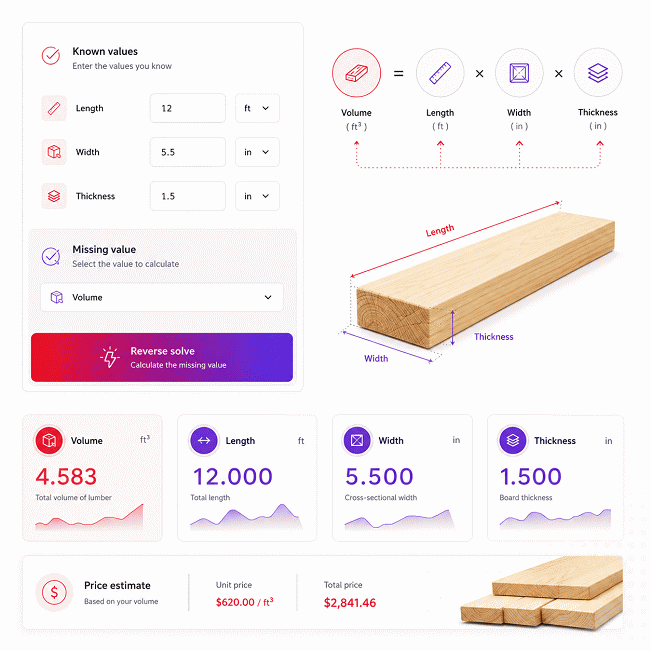
Lumber Calculator helps you estimate material needs before cutting, ordering, or comparing lumber prices. It connects piece dimensions, quantity, total length, volume, and cost in one practical workflow. Reverse solving also helps when a project value is missing but enough related information is already known.
- Use actual measured dimensions when accurate physical material volume matters.
- Keep nominal lumber names separate from the board dimensions you measure.
- Compare required piece quantity with available stock lengths before ordering.
- Use board feet, linear feet, or cubic volume for the correct buying purpose.
- Review cutting waste, saw kerf, defects, and unusable offcuts before purchasing.
- Compare supplier prices only after matching dimensions, quantity, grade, and pricing basis.
The Lumber Calculator can also help check a supplier quote or recover missing quantity, dimensions, or price data. A calculated material requirement may differ from the final purchase quantity because stock comes in physical pieces. For a safer buying decision, verify board size, available lengths, material condition, project needs, and supplier terms before placing the order.
Assumptions used in this calculator
- Each lumber piece is treated as a uniform rectangular solid.
- Length, width, and thickness represent actual measured dimensions, not nominal sizes.
- All entered dimensions are assumed positive, finite, and dimensionally compatible.
- All pieces are assumed to share identical dimensions unless calculated otherwise.
- Total length equals single-piece length multiplied by the entered piece quantity.
- Total volume assumes no voids, overlaps, tapering, curvature, or irregular geometry.
- Price calculations assume one uniform price per piece across the quantity.
- Currency selections label monetary values and do not perform exchange-rate conversion.
- Unit conversions preserve physical quantity before display formatting or rounding.
- Intermediate calculations retain full precision until the final displayed result.
- Material waste, saw kerf, defects, and offcuts are not automatically included.
- Moisture, grading, treatment, and manufacturing tolerances may change real-world requirements.
- Industrial users should verify calculated quantities against project specifications and applicable standards.
Results are rounded for display.
Internal calculations use full precision.
Formulas Used in Lumber Calculator:
1. Unit Conversion to Base Units
2. Total Lumber Length
3. Total Lumber Volume
4. Total Lumber Price
- xb = measurement expressed in the calculator base unit.
- xu = measurement expressed in the selected unit.
- ku = conversion factor from the selected unit to the base unit.
- L = length of one lumber piece.
- W = width of one lumber piece.
- T = thickness of one lumber piece.
- N = number of lumber pieces.
- LT = total length of all lumber pieces.
- V = total lumber volume.
- P1 = price of one lumber piece.
- PT = total lumber price.
All measurements are converted to dimensionally consistent base units before calculation. Reverse calculations use algebraic rearrangements of the same equations, so no additional independent formula is required. Intermediate values retain full numerical precision, and display formatting is applied only after the calculation is complete.
Variables & Definitions
View a complete list of all variables used in this calculator, including definitions and units
Lumber Calculator Variables and Units
| Variable | Definition | Base Unit | Calculator Role |
|---|---|---|---|
| xb | Measurement converted to its calculator base unit | m or m³ | Unit conversion |
| xu | Measurement entered or displayed in the selected unit | Selected unit | Unit conversion |
| ku | Conversion factor from the selected unit to the base unit | Conversion factor | Unit conversion |
| L | Length of one lumber piece | m | Input or reverse-calculated value |
| W | Width of one lumber piece | m | Input or reverse-calculated value |
| T | Thickness of one lumber piece | m | Input or reverse-calculated value |
| N | Number of lumber pieces | pieces | Input or reverse-calculated value |
| LT | Total combined length of all lumber pieces | m | Calculated or editable result |
| V | Total volume of all lumber pieces | m³ | Calculated or editable result |
| P1 | Price of one lumber piece | Selected currency | Editable price value |
| PT | Total price of all lumber pieces | Selected currency | Calculated or editable result |
Unit Conversion Table
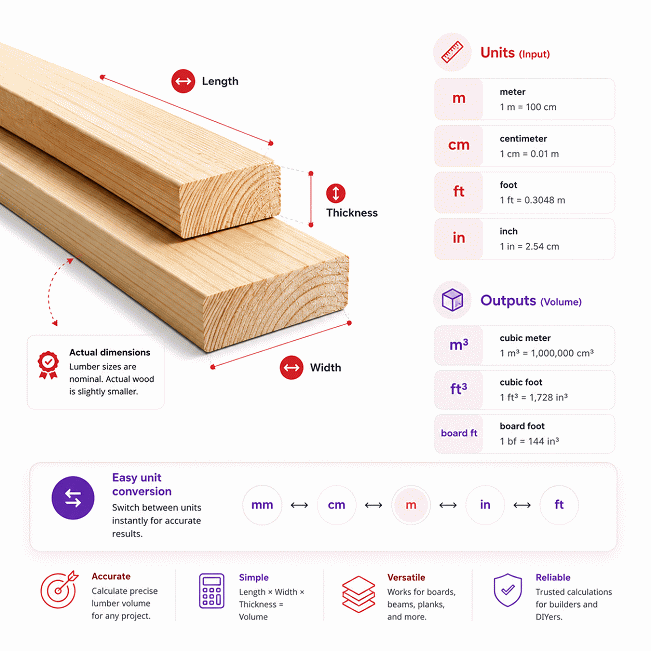
Lumber Length, Width, Thickness & Total Length Unit Conversion Table
| Unit Group | Unit Name | Symbol | Equivalent in Meters | Used For |
|---|---|---|---|---|
| Popular Units | Meter | m | 1 m | Piece length, piece width, piece thickness, total lumber length |
| Popular Units | Centimeter | cm | 0.01 m | Piece length, piece width, piece thickness, total lumber length |
| Popular Units | Millimeter | mm | 0.001 m | Piece length, piece width, piece thickness, total lumber length |
| Popular Units | Foot | ft | 0.3048 m | Piece length, piece width, piece thickness, total lumber length |
| Popular Units | Inch | in | 0.0254 m | Piece length, piece width, piece thickness, total lumber length |
| SI Units | Decimeter | dm | 0.1 m | Piece length, piece width, piece thickness, total lumber length |
| Imperial / US Units | Yard | yd | 0.9144 m | Piece length, piece width, total lumber length |
| Oil & Industrial Units | Mil | mil | 0.0000254 m | Fine piece thickness measurement |
Total Lumber Volume Unit Conversion Table
| Unit Group | Unit Name | Symbol | Equivalent in Cubic Meters | Used For |
|---|---|---|---|---|
| Popular Units | Cubic Meter | m³ | 1 m³ | Total lumber volume |
| Popular Units | Cubic Foot | ft³ | 0.028316846592 m³ | Total lumber volume |
| Popular Units | Board Foot | board ft | 0.002359737216 m³ | Lumber volume |
| SI Units | Cubic Centimeter | cm³ | 0.000001 m³ | Small lumber volumes |
| SI Units | Cubic Decimeter | dm³ | 0.001 m³ | Lumber volume |
| Imperial / US Units | Cubic Inch | in³ | 0.000016387064 m³ | Small lumber volumes |
| Imperial / US Units | Cubic Yard | yd³ | 0.764554857984 m³ | Large lumber volumes |
| Oil & Industrial Units | Thousand Board Feet | MBF | 2.359737216 m³ | Bulk lumber volume |
Example Calculation
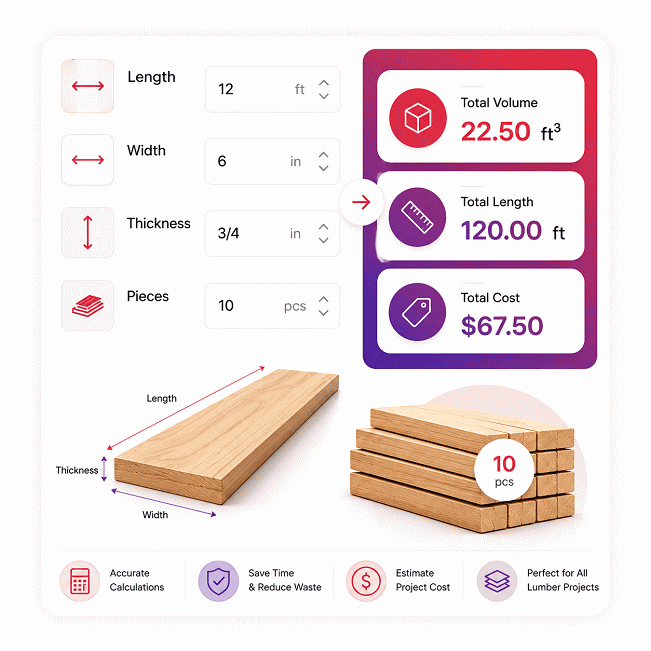
Fourteen identical pieces each measuring 2.4 m by 0.18 m by 0.045 m provide a combined length of 33.6 m. Their total rectangular lumber volume is 0.27216 m³. At 18.75 USD per piece, the complete quantity costs 262.50 USD. Unit conversions should be completed before calculation, while rounding should be applied only to the displayed result.
In this reverse-solving case, total lumber length is entered while the piece quantity is unknown. Dividing the total length by the length of one piece gives 18 pieces. The known width, thickness, and total length then produce a total volume of 0.229824 m³. Entering a total price of 468 USD also allows the calculator to determine a price of 26.00 USD per piece.
Results are rounded for display.
Internal calculations use full precision.
Calculations Disclaimer
How Does a Lumber Calculator Fit a Real Project?
A wrong lumber order can waste money before the first cut begins. A Lumber Calculator reduces that risk by linking size, quantity, volume, and cost. The Lumber Calculator also helps when one project value is missing. That matters during planning, quoting, purchasing, and material checks.
The key is to start with the project, not the calculator. First decide what you need to know. You may need total material length. You may need total volume instead. A buyer may only need the expected cost. Another user may already know the total length. That user may need the required piece count.
This difference changes the workflow. A one-way estimate only answers one fixed question. A reverse-capable tool can work from several known values. That makes it useful during real project changes.
For best results, enter measurements that match the material being purchased. Finished boards need finished dimensions. Rough stock needs the relevant rough dimensions. The same rule applies to project drawings and supplier quotes.
Quick path: Measure -> Calculate -> Check quantity -> Review buying basis -> Order.
What Problem Should You Solve Before Ordering Lumber?
A common mistake starts with entering numbers before defining the real question. This creates a clean result that answers the wrong problem.
A framing contractor may need the number of stock pieces. A cabinetmaker may care more about usable board volume. A purchasing team may need a fast quote check. These are related needs, but they are not identical.
Start by asking what decision follows the calculation. If you must place an order, focus on purchasable pieces. If you compare suppliers, focus on the pricing basis. If you plan storage, total volume becomes more useful.
This approach also prevents false confidence. A precise number is not always a useful number. The value must match the next project action.
Keep technical calculation separate from purchasing judgment. First determine the physical requirement. Then apply stock lengths, grade needs, cutting plans, and commercial terms. This two-stage method keeps the result clear.
Which Measurements Matter Most Before You Start?
Many poor estimates begin with one incorrect board dimension. That error then affects every later result.
Check the piece length first. Then confirm width and thickness. Finally, confirm the planned number of pieces. These values describe the physical stock being measured.
Use measured dimensions when physical volume matters. Do not assume a trade name equals the measured size. This is especially important with common dimensional lumber.
Also confirm what the quantity represents. It may mean stock boards, finished parts, or cut pieces. Those values can differ greatly.
For purchasing work, inspect the supplier description before entering dimensions. Look for surfaced, rough, nominal, or finished sizing. A small difference can become large across many pieces.
The hidden trap: one wrong thickness can distort the entire volume estimate.
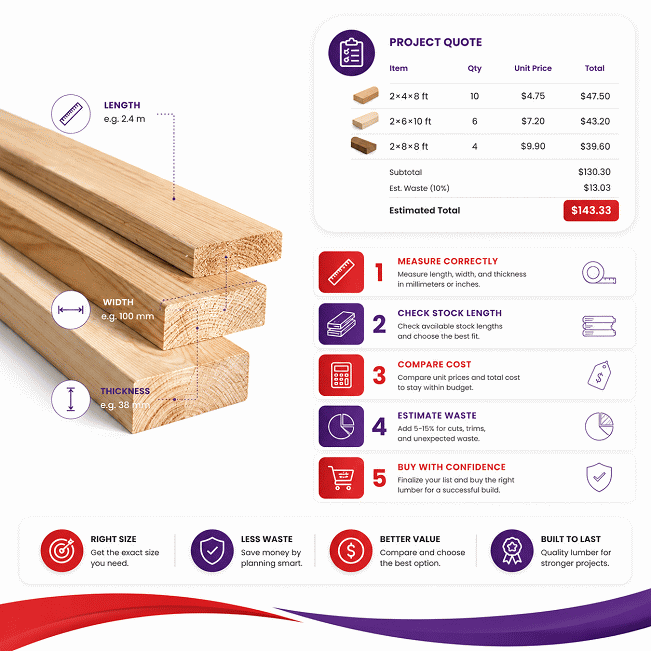
Actual vs Nominal Lumber Dimensions: Which Value Should You Use?
A builder sees “2×4” on a list and enters those numbers directly. The result looks reasonable, but the measured board is smaller.
Nominal dimensions are trade descriptions. Actual dimensions describe the board you can measure. The correct choice depends on the task.
Use actual dimensions for physical volume, storage, weight planning, and precise fabrication. These dimensions reflect the material that exists.
Nominal dimensions may still matter for ordering and specification language. Many plans and supplier catalogs use nominal names. That does not make those numbers physical measurements.
Keep both ideas separate. One identifies the product category. The other describes the real geometry.
This distinction becomes more important on larger jobs. A small difference across one board seems harmless. Across hundreds of boards, it becomes significant.
Why Does a 2×4 Not Measure Exactly 2 by 4 Inches?
A new buyer often checks a board and thinks the supplier sent the wrong size. In most cases, the product name is nominal.
Lumber can lose material during drying and surfacing. The finished cross-section can therefore be smaller. This is normal for many standard products.
The safest approach is simple. Use the product name for ordering. Use the measured size for geometric calculations.
This also improves quote checks. Two suppliers may describe the same nominal product. Their actual finished dimensions should still be reviewed.
Do not treat the nominal name as a universal physical size. Product standards and regional practices can differ.
For precise work, confirm the real board before cutting. This is especially important for joinery, furniture, trim, and fitted assemblies.
When Rough Lumber Changes the Buying Decision
A woodworker may buy rough stock and expect finished dimensions from the order. After surfacing, the usable board becomes smaller.
Rough lumber needs a different buying mindset. The purchased board includes material that may later be removed. Flattening, jointing, planing, and trimming all reduce usable size.
This does not mean the original calculation was wrong. It means purchasing and finished-part planning are different stages.
Buyers should compare the required finished size with available rough stock. Leave enough material for machining and defects. Do not assume every rough board yields the same finished section.
Grain direction also matters. A board with enough volume may still be unsuitable. Cracks, knots, bowing, or twist may reduce usable yield.
How to Estimate Lumber Quantity Without Overbuying
A project can fail in two expensive ways. Too little material causes delays. Too much material locks money into unused stock.
Start with the required usable pieces. Then compare those pieces with available stock lengths. This creates a better purchasing decision.
A raw quantity result is only the mathematical need. A purchase order must also consider cutting layout. The same total length can require different board counts.
For example, several short cuts may fit one long stock board. Different cuts may leave unusable remnants instead. Geometry alone cannot see every cutting pattern.
Use the estimate as the first decision layer. Then review stock size, repeated cuts, defects, and project tolerance.
Stop and check: calculated quantity and purchase quantity are not always identical.
How Total Length Connects to Piece Count
A site supervisor may know the total required length but not the piece quantity. That situation is common during material planning.
The relationship becomes useful when every stock piece has the same length. Longer stock means fewer required pieces. Shorter stock means more pieces.
However, this relationship describes total length only. It does not optimize a cutting plan.
Imagine several parts with different finished lengths. Their total may fit within a certain stock quantity. Poor cut placement can still create extra waste.
For repeated equal pieces, the estimate becomes much simpler. For mixed cut lists, use the result as a baseline.
A good workflow separates length demand from cutting efficiency. First find the theoretical quantity. Then check how parts fit available stock.
Why Purchase Quantity Can Exceed Calculated Quantity
A calculator shows twelve pieces, yet the site team wants fourteen. That does not automatically mean someone made an error.
Real lumber contains uncertainty. Some pieces may be damaged. Others may contain knots in critical areas. Certain cuts can create unusable remnants.
Project design can also increase the required order. Pattern matching may demand more material. Grain selection can reject otherwise usable sections. Structural work may limit where defects are allowed.
Keep this extra material visible as a purchasing choice. Do not hide it inside the core physical estimate.
This makes the project easier to review. The team can see the base requirement. They can also see why extra material was ordered.
How Stock Lengths Change the Final Order
A cut list needs 60 feet of material. Ordering exactly 60 feet may still fail.
The reason is stock format. Lumber arrives in individual lengths, not one continuous strip. Those available lengths shape the final order.
A project may need many short pieces. One long board can supply several cuts. Another cut pattern may leave large unusable sections.
Always compare required part lengths with available stock. This check becomes more important with expensive hardwood.
Long stock may reduce joints and waste. It can also cost more. Short stock may be cheaper but need more connections.
Choose stock length after the physical requirement is known. This keeps technical need separate from purchasing strategy.
Board Feet, Linear Feet, and Cubic Volume: Which One Fits?
A buyer receives three quotes using different measurement terms. Direct price comparison suddenly becomes confusing.
Linear feet describe length. They do not include width or thickness. Board feet describe a lumber volume convention. Cubic volume also describes physical volume.
Each measure answers a different question. Use linear length when cross-section is fixed. Use board feet for common lumber buying workflows. Use cubic volume when comparing full three-dimensional material quantities.
The best unit is not the most familiar unit. It is the one matching the decision.
Text infographic: Length only -> Linear feet. Lumber trade volume -> Board feet. Full physical volume -> Cubic units.
Never compare prices until the measurement basis matches. Different units can make one quote appear cheaper without being cheaper.
When Board Feet Give the Clearest Buying Picture
A hardwood buyer may compare boards with different widths and thicknesses. Price per piece becomes hard to judge.
Board-foot pricing creates a common volume basis. This makes different board sizes easier to compare.
It is especially useful with random-width hardwood. Boards in one stack may not share identical dimensions. A volume-based trade measure helps normalize them.
Still, the buyer should confirm the supplier’s measurement method. Rough dimensions and surfaced dimensions can affect commercial tally practices.
Use board feet when that matches the market and quote. Do not force it into every construction task.
For framing materials sold by piece, direct piece pricing may be clearer.
When Linear Feet Are Enough
A trim installer needs one profile size across an entire room. Width and thickness remain fixed.
In that case, linear length may answer the main buying question. The installer needs enough running length to cover the project.
Linear feet work well when every piece shares the same cross-section. Molding, trim, battens, and certain framing tasks often fit this pattern.
However, linear length does not show material volume. Two products can have equal length and very different cross-sections.
This matters during cost comparisons. A thicker or wider product may cost more despite matching length.
Use linear length when geometry is already fixed. Switch to volume when cross-sections vary.
When Cubic Volume Gives Better Control
A warehouse team needs to compare large material batches. Piece counts alone give little useful information.
Cubic volume provides a direct measure of occupied material space. It can support storage planning and bulk comparisons.
It is also useful when metric purchasing is common. Cubic meters create a clean basis for large quantities.
Volume helps compare different board sizes on the same physical basis. It does not replace grade or species information.
Two lumber batches can have equal volume and very different value. Species, grade, treatment, and finish still matter.
Use volume for material quantity. Use product specifications for quality and suitability.
How Reverse Solving Helps When a Value Is Missing
A project manager receives an incomplete takeoff. Total material is known, but one input is missing.
Reverse solving turns that problem into a useful workflow. Instead of starting from every original input, you start from known results.
This helps during quote checks, design changes, and site revisions. It also reduces repeated manual work.
A reverse-capable tool is most useful when the known values are consistent. Conflicting data can create misleading conclusions.
Only change the value that represents the new project fact. Let linked values update from that change.
This creates a clear chain of responsibility. The user knows which value was entered. The remaining values follow from that decision.
How to Recover Quantity From a Known Total Length
A delivery note shows total length, but the expected piece count is missing. The stock length is already known.
This is a good reverse-solving case. Total length and individual length can reveal the mathematical quantity.
Check the result before turning it into a purchase order. A decimal result may be mathematically valid. Physical stock may still require whole pieces.
This distinction is important. Calculated quantity describes the relationship between known values. Purchase quantity describes what must be ordered.
If the result seems unexpected, inspect the entered stock length first. A unit mistake can produce a dramatic error.
How to Recover a Missing Dimension From Known Volume
A supplier record contains volume and two board dimensions. One physical dimension is missing.
Reverse solving can recover the missing size when enough independent data remains. This can help with records and preliminary checks.
Use care when interpreting the answer. The recovered value represents the mathematical geometry. It does not prove the board was actually manufactured at that size.
Compare the result with standard stock dimensions. If it looks unusual, recheck the source data.
Measurement mistakes often appear as impossible thicknesses or widths. Reverse solving can expose those problems quickly.
It becomes a diagnostic tool, not just an estimator.
How to Recover Price Per Piece From a Known Total Cost
A purchase record shows total cost and quantity but hides the unit price. That can slow a quote review.
Recovering the average price per piece creates a useful comparison point. It can reveal changes between orders.
Do not treat that average as the complete commercial story. Delivery, tax, machining, and treatment may be included elsewhere.
Also check whether every piece had the same price. Mixed sizes or grades can make the average less useful.
Use the recovered unit price as a screening tool. Then inspect the quote structure before making a purchasing decision.
How to Compare Lumber Prices Without Misreading the Quote
Supplier A looks cheaper than Supplier B. The difference may disappear after the quote basis is normalized.
First confirm whether prices use pieces, linear length, board feet, or cubic volume. Then check the dimensions behind each price.
Next review grade, species, treatment, moisture condition, and surfacing. These details can change value substantially.
Delivery terms also matter. A low material price can lose its advantage after transport.
Text infographic: Match unit -> Match dimensions -> Match grade -> Match services -> Compare total cost.
This sequence prevents false savings. It also makes supplier discussions faster and clearer.
What Price Per Piece Can Hide
A low piece price looks attractive. The board may simply be shorter, narrower, or lower grade.
Piece pricing works well when products are truly identical. It becomes weak when dimensions vary.
Check what one piece actually contains. Compare length, cross-section, grade, and finish.
For hardwood, one board can hold far more material than another. A lower piece price may therefore cost more per usable volume.
Also inspect machining. Surfaced material may cost more but save shop time. Rough stock may cost less but require processing.
Before you pay: compare what you receive, not only the number beside “price.”
How Grade, Surfacing, Moisture, and Delivery Change Cost
Two quotes list the same species and size. Their final prices still differ greatly.
Grade can explain part of that gap. Cleaner boards often command a higher price. Surfacing can add processing cost.
Moisture condition can also affect suitability. Material prepared for interior work may have different handling needs.
Delivery can change the total landed cost. Heavy or long material may require special transport.
Check warranty, return, and support terms directly with the seller. These terms vary by supplier and product.
A good buying decision combines technical fit and commercial terms. Price alone cannot confirm value.
Common Lumber Calculation Mistakes That Cost Money
A small input mistake can create a large order error. Most problems come from simple causes.
Users may enter nominal dimensions as measured dimensions. They may mix inches and feet. They may confuse linear length with volume.
Another common problem is treating every calculated piece as directly purchasable. Stock is usually sold in whole physical pieces.
Users also forget to check available stock lengths. A correct total length can still produce a poor order.
Quote comparisons create another risk. Different pricing bases can make totals look comparable when they are not.
Catch these issues before ordering. A ten-second review can prevent an expensive correction.
Why Mixed Measurement Systems Cause Expensive Errors
A board width is entered in inches. The length is accidentally treated as feet. The output can be wildly wrong.
Mixed systems are not the real problem. Unclear units are the problem.
You can work with metric and imperial measurements together. Each value must keep its correct unit identity.
Never convert values mentally during a rushed order. Use explicit unit selections and review them before finalizing results.
This matters most with thickness. A small unit mistake there can multiply through the entire material volume.
Make unit checking part of the buying routine. It takes seconds and protects the full estimate.
Why Decimal Piece Counts Need a Purchasing Decision
A reverse result says 8.4 pieces. A supplier cannot deliver 0.4 of a standard stock board.
The decimal is not automatically an error. It describes the mathematical relationship between total length and piece length.
Purchasing needs another decision. The buyer must select enough whole stock pieces to meet the requirement.
Do not silently round every decimal result. First understand why the decimal appeared.
Sometimes the entered total describes cut material rather than stock material. In that case, cutting layout becomes important.
Separate mathematical quantity from order quantity. This keeps the calculation transparent.
How to Turn a Lumber Estimate Into a Confident Purchase
A correct estimate still needs one final review before money changes hands. This is where technical work becomes a buying decision.
Confirm the project dimensions first. Then verify actual stock dimensions and available lengths. Check whether the result describes finished parts or raw stock.
Next compare the supplier’s pricing method with your calculation basis. Review species, grade, surface condition, and delivery terms.
Use AxiCalculator to keep the technical side organized. Save or share the calculation when another person must review it.
A downloadable record can also help procurement teams. It gives everyone the same numbers before approval.
Final buying path: verify size -> verify quantity -> verify pricing basis -> review stock -> approve order.
That sequence is simple, but it prevents many costly mistakes. The goal is not merely a number. The goal is a purchase you can explain, verify, and trust.
Frequently Asked Questions
Can I calculate a mixed order containing boards of different sizes?
What should I do if the supplier only offers stock lengths different from my plan?
Can I compare per-piece pricing with board-foot pricing for the same order?
Is saving the calculation useful before requesting a lumber quote?
How should an engineer validate a reverse-solved dimension before using it?
How can procurement reconcile a supplier tally with the calculator without changing the source data?
How should mixed-grade or mixed-species lumber be handled in one project estimate?
Our engineers are here to help you get it right.