Vinyl Fence Calculator
- Last formula update:
Calculate vinyl fence panels, posts, spans, layers, and exact layout dimensions. Test different sizes and reverse-solve missing measurements before buying.
Decimal & Rounding Policy
- Keep full decimal precision during unit conversions and intermediate calculations; do not round values before the final step.
- Round calculated fence spans and panel layers up to the next whole number whenever the result is fractional.
- Report columns, panels, and tie beams as whole pieces because partial fence components are not counted as complete required materials.
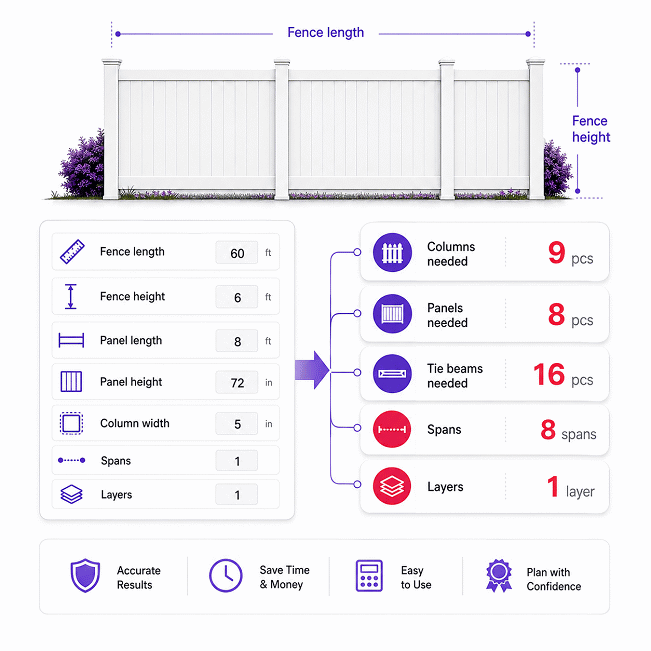
- Calculate columns as spans + 1, panels as spans × layers, and tie beams as equal to the number of spans.
- Display dimensional results with only the necessary decimal places and remove unnecessary trailing zeros for easier reading.
Valid range
- Fence length: Enter a finite value from 0.000001 m to 1,000,000 m; it must be greater than the column width.
- Fence height: Enter a finite value from 0.000001 m to 1,000,000 m.
- Panel length: Enter a finite value from 0.000001 m to 1,000,000 m.
- Panel height: Enter a finite value from 0.000001 m to 1,000,000 m.
- Column width: Enter a finite value from 0.000001 m to 1,000,000 m and keep it smaller than the fence length.
- Spans and panel layers: Values must resolve to positive whole-number quantities after the required geometric calculation and upward rounding.
- Columns, panels, and tie beams: Results must be positive whole-piece quantities consistent with the calculated spans and panel layers.

Reviewers:
Elvarine Jexmont
Fenrick Zorquell
Check our editorial policy
August 12, 2026
1.0.0
Initial calculator and formula release.
Our engineers are here to help you get it right.
What Does the Vinyl Fence Calculator Tell You Before You Plan or Buy Materials?
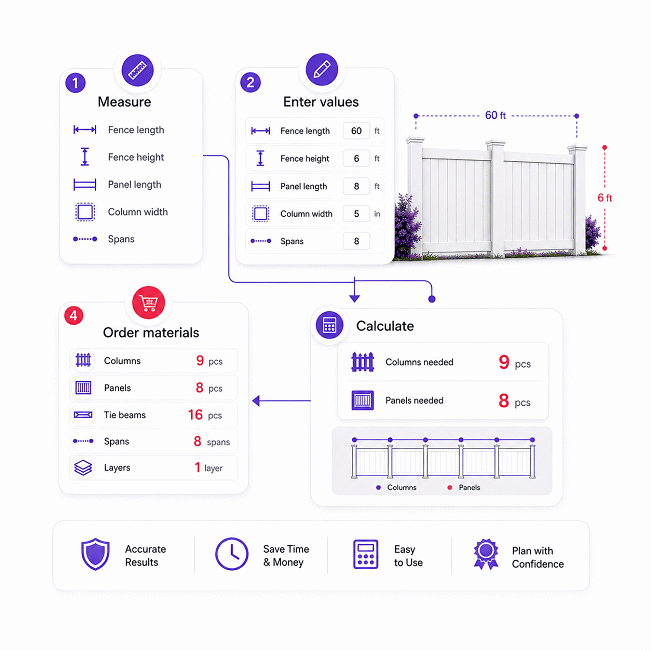
Vinyl Fence Calculator helps you estimate a straight fence layout from fence length, fence height, panel length, panel height, and column width. It connects these dimensions to the required spans, panel layers, columns, panels, and tie beams, while also supporting reverse solving when a key dimension is unknown.
- Use actual installation dimensions rather than relying only on nominal product sizes.
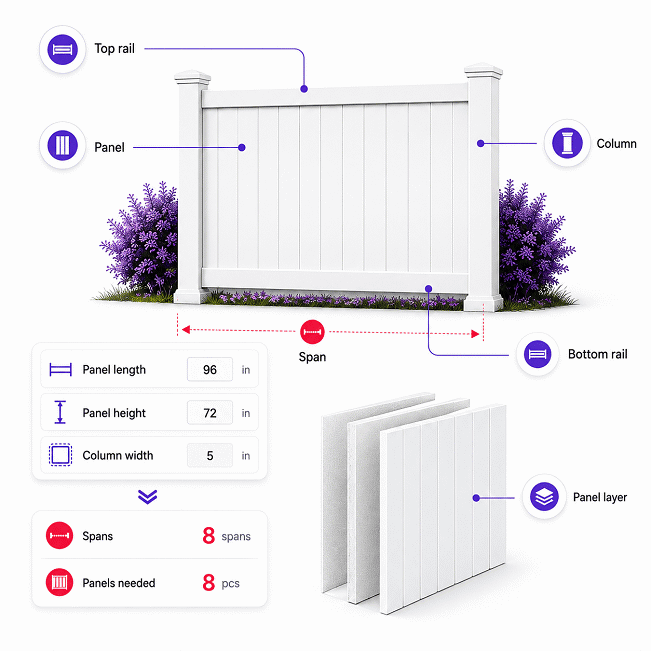
- Each horizontal span combines panel length with column width, with an additional ending column completing the run.
- Vertical panel coverage depends on fence height and the height of each compatible panel layer.
- Columns follow the span layout, while total panels depend on both spans and vertical layers.
- Reverse solving can determine an exact-fit fence length, panel length, column width, fence height, or panel height from known values.
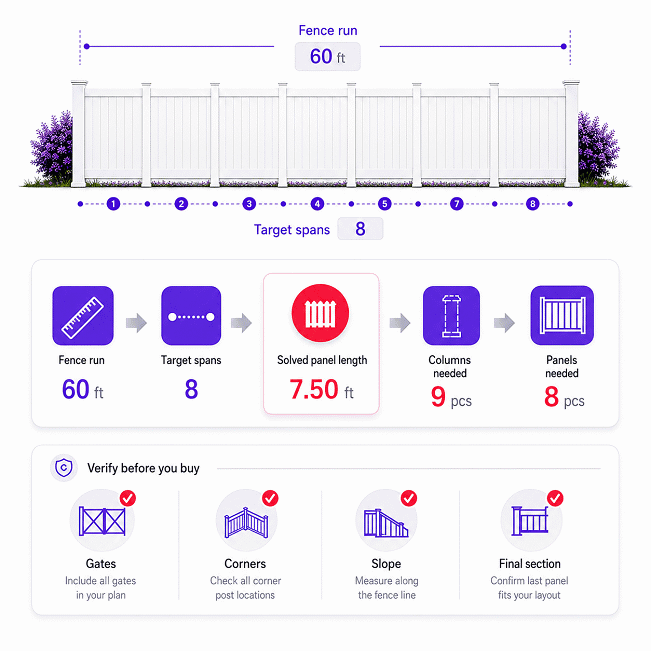
- Gates, corners, short end sections, slopes, grade changes, and special posts should be checked separately before ordering.
- Changing panel or column dimensions can change the complete material plan even when the total fence length stays the same.
The Vinyl Fence Calculator is most useful before purchasing materials or marking post locations. Measure each meaningful fence run carefully, test the planned layout, then compare the calculated quantities with the actual fence system, gate configuration, special post requirements, packaging, and installation details.
Assumptions used in this calculator
- The fence is modeled as connected spans between adjacent column centerlines.
- Each span uses one panel length plus one column width.
- Adjacent fence spans share one common supporting column.
- One tie beam is assigned to each calculated fence span.
- Panel layers use uniform panel heights throughout the modeled fence run.
- All panels within a calculated run use consistent horizontal dimensions.
- Column width remains uniform throughout each calculated fence run.
- Fence dimensions represent finished installation geometry rather than nominal product labels.
- Gates and other openings are excluded unless modeled as separate runs.
- Corners are assumed to occur at planned column locations.
- Mid-span bends require separate adjustments to panels, columns, and beams.
- Structural capacity, wind loading, and foundation design are outside this calculation.
- Final material quantities require verification against actual manufacturer installation requirements.
Results are rounded for display.
Internal calculations use full precision.
Formulas Used in Vinyl Fence Calculator:
Variables and Calculation Conventions
- L = fence length
- H = fence height
- P = panel length
- hp = panel height
- C = column width
- S = number of spans
- R = number of panel layers
- N = number of columns
- Q = number of fence panels
- B = number of tie beams
- xu = value in the selected unit
- xm = equivalent value in meters
- ku = selected-unit-to-meter conversion factor
1. Unit Normalization
Length inputs are normalized to meters before geometric calculations. The supported factors are m = 1, cm = 0.01, mm = 0.001, dm = 0.1, ft = 0.3048, in = 0.0254, and yd = 0.9144.
2. Exact-Fit Horizontal Fence Relationship
This governing relationship is used when reverse calculation solves an unknown fence length, panel length, column width, or span-related value.
3. Required Fence Spans
The calculated span requirement is rounded upward so that a fractional span becomes one complete additional span.
4. Exact-Fit Vertical Fence Relationship
This relationship is used by reverse calculation when fence height, panel height, or the number of panel layers must be solved from the other known values.
5. Required Panel Layers
The layer requirement is rounded upward whenever the fence height is not an exact multiple of the panel height.
6. Columns Needed
A straight fence run requires one more column than the number of spans because adjacent spans share intermediate columns.
7. Fence Panels Needed
The total panel quantity equals the number of horizontal spans multiplied by the number of vertical panel layers.
8. Tie Beams Needed
The material model assigns one tie beam to each calculated fence span.
Reverse calculation uses the same governing relationships above and solves them for the single missing variable. Algebraically equivalent rearrangements are intentionally not repeated, intermediate values remain unrounded, and upward rounding is applied only where complete spans or panel layers are required. This calculator contains no price or cost equation.
Variables & Definitions
View a complete list of all variables used in this calculator, including definitions and units
Vinyl Fence Calculator Variables, Units, and Calculation Parameters
| Symbol | Parameter | Definition | Value Type | Unit |
|---|---|---|---|---|
| L | Fence length | Total linear length of the fence run used in the horizontal component calculation. | Positive length | Length unit |
| H | Fence height | Total required vertical height of the completed fence. | Positive length | Length unit |
| P | Panel length | Horizontal length of one prefabricated fence panel between adjacent columns. | Positive length | Length unit |
| hp | Panel height | Vertical height of one fence panel used to determine the required panel layers. | Positive length | Length unit |
| C | Column width | Horizontal width of each supporting column included in the fence span geometry. | Positive length | Length unit |
| S | Spans | Number of horizontal fence sections required along the total fence length. | Positive whole number | spans |
| R | Layers of fence panels | Number of vertical panel layers required to reach the specified fence height. | Positive whole number | layers |
| N | Columns needed | Total number of supporting columns required for the calculated fence spans. | Positive whole number | pieces |
| Q | Panels needed | Total number of fence panels required across all spans and vertical layers. | Positive whole number | panels |
| B | Tie beams needed | Total number of tie beams required, with one tie beam assigned to each span. | Positive whole number | beams |
| xu | Selected-unit value | Any entered length value expressed in the unit selected by the user. | Positive decimal | Selected length unit |
| xm | Normalized length value | The equivalent physical length after conversion to the calculator's meter-based internal unit. | Positive decimal | m |
| ku | Unit conversion factor | Multiplier used to convert a selected length unit into meters without changing the physical dimension. | Positive conversion factor | Dimensionless |
Unit Conversion Table
Vinyl Fence Calculator Unit Conversion Table
| Unit Group | Unit Name | Symbol | Equivalent in Meters | Used For |
|---|---|---|---|---|
| Popular Units | Meter | m | 1 m | Fence length, fence height, panel length, panel height, column width |
| Popular Units | Centimeter | cm | 0.01 m | Fence length, fence height, panel length, panel height, column width |
| Popular Units | Foot | ft | 0.3048 m | Fence length, fence height, panel length, panel height, column width |
| Popular Units | Inch | in | 0.0254 m | Fence length, fence height, panel length, panel height, column width |
| SI Units | Millimeter | mm | 0.001 m | Fence length, fence height, panel length, panel height, column width |
| SI Units | Decimeter | dm | 0.1 m | Fence length, fence height, panel length, panel height, column width |
| Imperial / US Units | Yard | yd | 0.9144 m | Fence length, fence height, panel length, panel height, column width |
Example Calculation
This fence layout creates eight horizontal spans using panels that are 2.8 m long and columns that are 0.20 m wide. Four vertical panel layers are required to reach the 1.8 m fence height. Adjacent spans share intermediate columns, so nine columns complete the eight-span run. Multiplying eight spans by four layers gives a total requirement of 32 fence panels.
Span length = Panel length + Column width
Fence length = (Spans × Span length) + Column width
Spans = (Fence length - Column width) / (Panel length + Column width)
Layers = Fence height / Panel height
Columns needed = Spans + 1
Panels needed = Spans × Layers
Tie beams needed = Spans
Fence length = Spans × (Panel length + Column width) + Column width
Panel length = [Fence length - (Spans + 1) × Column width] / Spans
Column width = (Fence length - Spans × Panel length) / (Spans + 1)
Fence height = Layers × Panel height
Panel height = Fence height / Layers
Spans = Columns needed - 1
Spans = Tie beams needed
Spans = Panels needed / Layers
Layers = Panels needed / Spans
In this reverse-solving case, the panel length is left unknown while the user specifies a seven-span fence configuration. The horizontal fence relationship is rearranged to solve the missing panel length as exactly 3 m. The vertical dimensions require four panel layers, producing 28 panels in total. Eight columns complete the seven-span run, while seven tie beams are required.
Fence length = Spans × (Panel length + Column width) + Column width
Fence length = Spans × (Panel length + Column width) + Column width
Panel length = [Fence length - (Spans + 1) × Column width] / Spans
Column width = (Fence length - Spans × Panel length) / (Spans + 1)
Spans = (Fence length - Column width) / (Panel length + Column width)
Fence height = Layers × Panel height
Fence height = Layers × Panel height
Panel height = Fence height / Layers
Layers = Fence height / Panel height
Spans = Columns needed - 1
Spans = Tie beams needed
Spans = Panels needed / Layers
Layers = Panels needed / Spans
Columns needed = Spans + 1
Panels needed = Spans × Layers
Tie beams needed = Spans
Results are rounded for display.
Internal calculations use full precision.
Calculations Disclaimer
How Does a Vinyl Fence Calculator Turn Fence Dimensions Into a Material Plan?
A wrong material count can turn a simple fence project into several extra orders. A Vinyl Fence Calculator reduces that risk before materials reach the site. The Vinyl Fence Calculator connects fence dimensions with the parts needed for a straight run. It helps you see how length, height, panel size, and column width interact.
The key is to think about the fence as a connected layout. A panel does not sit alone on the ground. It works between columns and within a repeated fence span. Each change affects another part of the plan. A wider column consumes more horizontal space. A shorter panel can increase the number of sections. A taller fence may require a different vertical arrangement.
This makes the calculator useful before you request a quotation. It can also help before you mark post positions. You can test several layouts without repeatedly doing the same arithmetic.
Why Material Planning Should Start Before You Choose the Final Fence System
Many buying mistakes begin with a panel count taken too early. A buyer measures the perimeter and divides it by a catalog panel size. That shortcut can miss column width, corners, gates, and short end sections.
A better process starts with the site geometry. Measure each meaningful fence run first. Then compare those measurements with the actual system dimensions. This sequence helps prevent a common problem. The selected product may not fit the assumed layout.
AxiCalculator is most useful at this early planning stage. It lets you test dimensions before they become purchasing decisions. You can also change a known result and solve a missing dimension. That feature is valuable when the layout is fixed first.
What the Calculator Result Really Tells You
The result is more than a panel count. It shows the relationship between sections and supporting components. A complete run needs enough spans to cover its planned length. It also needs enough columns to define those spans. The required panel quantity depends on both horizontal and vertical arrangement.
This distinction matters when comparing fence systems. Two products can cover the same boundary with different material counts. Their panel lengths or column dimensions may differ. The cheaper panel price may therefore produce a higher total quantity.
Use the result as a planning map. Then match it against the real product configuration before ordering.
Which Measurements Should You Take Before Calculating a Vinyl Fence?
A calculator cannot repair a bad measurement. One wrong dimension can shift every post along the run. The safest approach is to measure the physical layout before selecting material quantities.
Start with the total usable fence length. Do not automatically use the property perimeter. Gates, buildings, walls, and open driveways can break that perimeter into separate runs. Measure those runs independently when their layouts differ.
Next, define the required fence height. Use the finished height you actually want. Do not confuse that value with the height of one panel component.
Then verify the physical panel length and panel height. Catalog names can be convenient. They are not always the best construction measurement. The installation dimension should guide the calculator.
Finally, confirm the column width used by the chosen layout. That dimension affects the repeated horizontal geometry.
How to Measure Fence Length Without Building an Error Into Every Span
Imagine a backyard with a house on one side. A gate interrupts the rear boundary. The fence then continues around a corner. Treating the whole perimeter as one straight line can hide important transitions.
Break the layout into logical runs. Record each run from its planned start to end point. Mark every gate opening and direction change. Also note places where a fence terminates against another structure.
This simple habit makes later material checks much easier. It also exposes unusual short sections before installation begins.
Why Actual Panel Dimensions and Post Spacing Matter More Than Product Labels
A common surprise appears after posts are already set. The installer discovers that the usable panel dimension differs from the assumed size.
Always base the layout on the manufacturer’s installation dimensions. Check how the rails enter the posts. Check how spacing is defined. Some systems describe spacing from post centers. Others depend on clear space between faces.
Do not mix these measurement methods. A small difference can repeat across many spans. The accumulated shift may become large at the final post.
This is one reason to confirm product dimensions before digging holes. The calculator can process the numbers accurately. The numbers must still describe the real product.
How Are Vinyl Fence Spans Connected to Fence Length and Component Size?
The most common planning error is treating panel length as the entire repeated section. A fence span includes more than the visible panel. The supporting column also occupies horizontal space.
Think of each span as one repeating module. It contains a panel section plus its share of the support layout. The final run also needs an ending column. This explains why the number of columns differs from the number of spans.
This model is especially useful for straight fence runs. It lets the calculator test whether the available distance supports the selected component sizes.
Understanding Exact-Fit Fence Geometry
An exact-fit layout ends at the planned boundary without unused modeled length. This idea becomes important during reverse solving.
Suppose a homeowner wants exactly seven spans. The total fence length is already fixed. The column width is also known. Instead of asking how many spans will fit, the user can solve the required panel length.
That approach turns the planning process around. The desired layout becomes the constraint. The missing component dimension becomes the result.
This can help during product selection. You can compare the solved dimension against available panel systems. If the required panel size is unrealistic, the chosen span count needs review.
Why Short Final Sections Deserve Attention Before Installation
A run rarely ends perfectly by accident. A remaining short section may require panel trimming. Some products allow that modification. Others have limits based on rail construction or routed components.
Do not treat a short final section as an automatic waste panel. First check whether the selected system permits resizing. Then confirm how the cut affects rails, pickets, or internal reinforcement.
A small planning change can sometimes distribute the difference more evenly. That may produce a cleaner visual result. It can also reduce awkward cuts near gates or corners.
How Do Fence Height and Panel Arrangement Affect Material Quantity?
A fence can match its target length and still fail vertically. This happens when panel height is misunderstood. The overall fence height and the height of one panel layer are different concepts.
The calculator treats vertical coverage as another repeated arrangement. The target height determines how much vertical coverage is required. The selected panel height determines how many layers are needed.
This model is useful when a system truly supports multiple vertical panel layers. It should not be treated as permission to stack any fence product.
When Multiple Panel Layers Make Sense
Some modular layouts can use repeated vertical sections. Others use one factory-sized panel for the full finished height. The correct approach depends on the product.
Before using more than one layer, check how the fence is designed. Look at rail locations, post routing, reinforcement, and connection details. The calculated quantity is only useful when the physical system supports it.
This is an important buying check. A mathematically neat layout can still be incompatible with the selected fence design.
Why Taller Fences Need More Than a Quantity Check
A taller fence presents greater structural demands. Material count alone cannot confirm safe performance. Local wind exposure, post embedment, soil conditions, and product design can matter.
Use the calculator to estimate the layout. Use the manufacturer’s installation requirements for construction decisions. Local rules can also limit fence height or placement.
This separation keeps the planning process clear. Quantity estimation answers one question. Structural suitability answers another.
How Do Panels, Columns, and Tie Beams Work Together in the Material Plan?
Buying only the calculated number of panels can leave a project incomplete. A fence system depends on supporting parts that follow the section layout.
For a simple straight run, adjacent spans share intermediate columns. This creates a predictable relationship between spans and supports. The first span needs a starting column and an ending column. Each added span shares the previous ending column.
The same span structure also drives the tie-beam requirement in this calculator model. Panel quantity then combines horizontal span count with vertical panel layers.
Why the Number of Columns Is Different From the Number of Panels
Panels fill openings. Columns define those openings. They are not interchangeable quantities.
Consider a straight sequence of several fence sections. Every new section needs another endpoint. That is why the support count grows differently from the panel count.
This becomes more complex around corners and gates. Those locations can need special post types. A general column quantity should therefore be separated from the final product-specific post list.
How Material Counts Can Change Without Changing the Fence Length
This is one of the most useful planning insights. The total boundary can stay unchanged while quantities change significantly.
Select a shorter panel and more spans may be needed. Increase column width and the repeated layout also changes. Change the vertical panel arrangement and total panel quantity can rise again.
This creates a useful buying strategy. Compare complete layouts instead of comparing individual panel prices.
A system with a higher unit price may need fewer components. Another system may appear cheaper but require more posts or panels. The total project should guide the decision.
How Does Reverse Vinyl Fence Calculation Help When the Layout Is Already Fixed?
Sometimes the missing value is not the material quantity. The project may already have a fixed number of sections. That creates a different planning problem.
A conventional estimator starts with dimensions and produces quantities. Reverse solving can work from a chosen result toward a missing dimension. This makes AxiCalculator useful for design checks as well as material estimates.
You might know the total run and desired span count. Panel length could be unknown. You might know fence height and the selected number of vertical layers. Panel height could then be the missing value.
Reverse Solving Panel Length From a Chosen Fence Layout
This approach is useful when visual symmetry matters. A designer may want equal spans across a specific boundary. The boundary length cannot change. The number of sections is also fixed.
The calculator can solve the panel dimension needed for an exact fit. That result can then be compared with real products.
If no suitable product exists, you have learned something important before installation. Either the section count must change, or some panels need modification.
Reverse Solving Fence Height From a Known Panel Arrangement
The same idea applies vertically. A designer may choose a specific number of compatible panel layers. The resulting overall height can then be checked.
This is useful during early concept planning. It also helps compare modular systems with different panel heights.
However, product approval still matters. A calculated height does not prove structural compatibility.
Why One Rounded Material Count Can Represent Several Valid Dimensions
This detail is easy to miss. Whole components create ranges rather than perfect mathematical uniqueness.
Several slightly different fence lengths can require the same number of spans. The same is true for vertical panel layers. This happens because materials are purchased as complete pieces.
Reverse solving should therefore be interpreted carefully. An exact-fit dimension represents a clean boundary condition. It may not be the only dimension that leads to the same final quantity.
This distinction helps prevent false precision. It also makes reverse planning more useful for real projects.
What Can Make a Vinyl Fence Material Estimate Wrong?
Most serious estimating mistakes come from layout assumptions, not arithmetic. The calculator can be correct while the project input is incomplete.
Three conditions deserve special attention: gates, direction changes, and sloped ground. Each can change the component list.
How Gates and Driveway Openings Change the Fence Plan
A gate is not simply an empty panel location. It creates a separate opening with its own support needs.
Measure the planned gate width before calculating nearby runs. Then treat the fence on each side as its own layout when needed.
Gate posts may also differ from ordinary line posts. Hardware, reinforcement, and clearances can vary by product.
This is why a gate should be planned before material ordering. Adding it later can change several surrounding components.
Why Corners and Multiple Fence Runs Need Separate Checks
A long perimeter can contain several different fence conditions. One side may be straight. Another may turn sharply. A third may end against a building.
Calculate those runs separately when their support conditions differ. Then combine the material totals.
This approach exposes corner and terminal requirements. It also makes mistakes easier to trace.
How Slopes, Steps, and Grade Changes Affect the Layout
Sloped ground creates a different problem. The horizontal plan can look correct while panel placement fails vertically.
Some systems rack along the grade. Others use stepped sections. A sharp grade change may require a special transition.
Decide the installation method before final purchasing. It can change post positions, panel treatment, and visual alignment.
What Should You Verify Before Buying Vinyl Fence Materials?
The most expensive mistake often happens after the calculator is finished. The buyer assumes every result maps directly to a product package.
Before ordering, compare the planned dimensions with the actual product documents. Confirm panel length, panel height, post dimensions, and installation spacing. Check which posts are used at lines, ends, corners, and gates.
Next, review packaging. Panels, caps, rails, brackets, and accessories may be sold differently. The calculated requirement and purchase quantity can therefore differ.
Separate Technical Checks From Buying Checks
Technical checks answer whether the layout works. Buying checks answer whether the order matches that layout.
For the technical review, confirm run dimensions and component compatibility. Confirm the chosen gate and corner arrangement. Check the planned slope method where required.
For the buying review, confirm part numbers and package quantities. Check finish, color, and compatible accessories. Review the manufacturer’s current warranty terms before purchase.
Warranty coverage can vary by product and installation method. Never assume every vinyl fence has identical protection.
Do Not Buy From Panel Count Alone
A panel-only order can miss essential parts. Build a complete material list before checkout.
Review posts, rails, tie components, caps, gates, hardware, and installation materials. Add special components for corners or transitions where required.
This final check takes little time. It can prevent a return trip, delayed installation, or incompatible order.
How Can AxiCalculator Support a Better Vinyl Fence Buying Decision?
A good fence estimate should reduce uncertainty before money is spent. That is the main value of planning first.
AxiCalculator lets you test different fence dimensions without rebuilding the calculation. You can compare several layouts quickly. You can also reverse solve a missing dimension when a result is already fixed.
This is useful when discussing options with a supplier or installer. Instead of asking for a vague estimate, you can bring a defined layout. That creates a more useful conversation about available panel systems and special components.
Use the Calculator as a Decision Tool, Not Just a Number Generator
Try more than one panel size before choosing a fence system. Compare how the span count changes. Look at the resulting support quantity. Review how the layout handles the final section.
Then test the alternative vertically. Different panel heights can change the required arrangement. This comparison can reveal a cleaner or simpler solution.
The goal is not to force one exact product into the site. The goal is to find a layout that works naturally.
Build Confidence Before the First Post Hole Is Dug
The best time to find a layout problem is before installation. A few minutes of checking can expose an impossible panel size. It can reveal a forgotten gate or awkward short section.
Measure the site carefully. Test the layout in AxiCalculator. Compare the result with the selected product system. Then verify the final material list before purchasing.
That sequence keeps planning simple and decisions clear. It also gives installers better information before work begins.
Use AxiCalculator whenever a fence dimension or material count changes. A revised layout can be checked immediately. That makes it easier to compare options without guessing.
Frequently Asked Questions
Can I use the Vinyl Fence Calculator before choosing a specific fence brand or product line?
What should I do if the measured fence length changes after the site is marked?
Can I use the calculator to buy vinyl fence materials in several construction phases?
What if different sections of the project use different vinyl fence panel systems?
How should an engineer reconcile calculator dimensions with survey data and approved shop drawings?
How should dimensional tolerance stack-up be handled across a long vinyl fence run?
How should an exported calculator result be checked before it becomes a project material takeoff?
Engineering Resources
Our engineers are here to help you get it right.